Category: Law, Society & Culture

Research branch

  • 8 Things to Know About the Living Wage

    8 Things to Know About the Living Wage

    by Jim Stanford

    Share

    There has been a lot of discussion about “living wages” in recent years – in Australia, and internationally. And now the idea has become a hot election topic. The ACTU wants the government to boost the federal minimum wage so it’s a true living wage. Opposition leader Bill Shorten has hinted he’s open to the idea. Business leaders predict economic catastrophe if the minimum wage is increased.

    As the debate heats up, here’s a quick guide to 8 things you need to know about the living wage:

    #1. The debate is new. But the idea is old. And it was invented in Australia!

    In 1907 a conciliation and arbitration judge named H.B. Higgins decreed (in the famous “Sunshine Harvester” case) that wages should be sufficient to meet the “normal needs of an average employee, regarded as a human being in a civilized community.”  He actually calculated the wage that would be required for a full-time worker (then assumed male) to adequately support himself, his wife, and three children. At the time, the living wage was 7 shillings (or around 70 cents) per day.

    Of course, our idea of a standard “family” has changed a lot since then. We have fewer kids, and most women now work for pay outside of the home. But the idea of linking the minimum wage, to the actual costs associated with a minimum decent standard of living, is still valid.

    #2. Working for minimum wage is a recipe for poverty.

    From that humble beginning in 1907, Australia’s minimum wage evolved over time. It’s now adjusted annually by the Fair Work Commission. But the link to the concrete costs of running a household has been abandoned. These days the Commission looks at various factors (including profits, inflation, employment trends, and inequality) in setting the minimum. But it does not explicitly consider whether a minimum wage is sufficient to pay for basic living costs. And in reality, it is not.

    A full-time worker on the national minimum wage today ($18.93 per hour) makes $719 per week – and that assumes they work a full 38-hour schedule.  (In reality, most low-wage workers can’t get enough hours of work, on top of their low hourly rate.)  That’s only about 45% of average weekly earnings for all Australian workers.  And it’s certainly not enough to run a household, and pay for a decent standard of living. So Australia’s minimum wage is certainly well below a true “living wage.” Minimum wage workers, especially those with any dependents, are likely to live in poverty.

    #3: How do you measure the living wage?

    A common international threshold for defining low income is at 60% of the median earnings of full-time workers. (The median is the point exactly half-way between the top and the bottom of the income distribution; it differs from the average, which is unduly pulled up by a few very high-earners at the top.) Median earnings for full-time employees in Australia are presently close to $1500 per week. The minimum wage would thus have to increase to $23 per hour or more, to ensure that a full-time worker reached 60% of the median.

    Another method of calculating a living wage is to gather data on the actual costs of operating a basic household for a specific family type (often assumed to be two adults and two children, but other configurations are possible). In addition to the necessities of life (food, clothing, and shelter), a living wage must also allow for other expenses associated with full and healthy participation in society: such as internet, transportation, school supplies, a minimal level of entertainment expenses, insurance, and more. There are no luxuries in this budget – just a basic, decent standard of living consistent with modern social expectations.

    After adjusting for income taxes and transfers (like the family tax benefit and the child care subsidy), we then calculate the pre-tax income required to meet that basic standard of living. That in turn can be converted into an hourly living wage, by assuming a certain amount of paid work by the adults in the household (perhaps one working full-time and one working part-time).

    This “bottom-up” methodology has been utilised by living wage campaigns in several countries – but not yet Australia. The research confirms that current minimum wages are not compatible with healthy families and communities. The estimated living wage benchmark can then be used to lobby for increases in the legal minimum – or even to push individual employers to voluntarily pay a living wage.

    #4. For a generation, Australia’s minimum wage has lagged behind a living wage.

    In 1985 Australia’s minimum wage equaled 65% of median earnings (above that 60% threshold discussed above). It declined steadily relative to overall wages over the next two decades. Successive governments were focused on reducing wages, and fostering more dog-eat-dog competition in labour markets. (Last week Finance Minister Mathias Cormann actually admitted his government was trying to keep wages low as a matter of policy.)

    Over time, the minimum wage declined to a low of 52% of median wages in 2008. It bounced back slightly since then, helped along by a decent minimum wage hike (of 3.5%) last year. But the minimum wage still falls well short of any conception of a true living wage.

    #5. Isn’t Australia’s minimum wage higher than in other countries?

    It’s certainly higher than in America: where the minimum wage has been frozen at $7.25 for the last decade. It’s now equal to just 33% of median wages there – by far the lowest of any industrial country. No wonder many millions of full-time workers there still live in poverty. Not exactly a role model for Australia.

    In dollar terms, Australia’s minimum wage is higher than many countries. Some business lobbyists even complain Australia already has one of the “highest minimum wage in the world.”  But that claim is not true in any meaningful sense. Living costs are also very high in Australia compared to elsewhere. And international wage comparisons must consider deviations in exchange rates and other factors. It’s better to compare minimum wages across countries using the ratio of minimum to median wages discussed above.  By that standard, Australia’s minimum wage ratio is below several other countries, including France (the highest), Israel, Portugal, New Zealand, and even Turkey.

    #6: New Zealand is increasing its minimum wage – and fast.

    In fact, our neighbours across the ditch are quickly putting Australia’s minimum wage to shame. The minimum wage there (presently $16.50 per hour) is already higher as a share of median wages (above 60%) than in Australia. But the new Labour-Greens-NZ First government has been increasing it substantially, as one of its first policies. The minimum wage will grow 25% over the government’s four-year term – by which time it will equal approximately 68% of median wages.

    #7: Economists have changed their mind on minimum wages.

    Business leaders and market-friendly economists used to argue that increasing the minimum wage will inevitably cause unemployment. After all, they believed, if something is more expensive, people will buy less of it (the “buyers,” in this case, being employers). But this simplistic logic has been thoroughly discredited by a whole new generation of economic research on the effects of minimum wages on employment. Starting with a path-breaking study of minimum wages and fast food employment in New Jersey in the 1990s (by economists David Card and Alan Krueger), economists now realise the traditional supply-and-demand story is wrong.

    In fact, they have discovered several reasons why higher minimum wages do not have any significant negative impact on employment – and in some cases can actually lead to higher employment. These reasons include:

    • Improving labour force participation and retention among low-wage workers.
    • Reducing job turnover and the costs of searching for new jobs and new workers.
    • Offsetting the uncompetitive “monopsony” power of very large employers, which otherwise restrict their own hiring in order to help suppress wages.
    • Boosting consumer spending by putting more money in workers’ pockets – an effect which is especially beneficial for small business.

    Hundreds of studies of minimum wages in various countries have found little impact on employment in either direction. Even Australia’s Reserve Bank confirmed that recent increases in the minimum wage had no visible negative effect on employment.

    Further counter-evidence that higher minimum wages do not destroy jobs – and lower minimum wages do not create them – is provided by the experience of Australia’s recent cut in penalty rates for retail and hospitality workers on Sundays and holidays. Employers said this reduction in wages would lead to more jobs and longer hours. However, research by the Centre for Future Work showed those two sectors have been among the worst job-creators in Australia’s economy since penalty rates were cut. In fact, the retail sector eliminated 50,000 full-time jobs in the year under lower penalty rates.

    #8: A living wage would reduce poverty and boost incomes.

    In sum, higher minimum wages have little impact on employment one way or the other. Job-creation depends mostly on macroeconomic conditions and aggregate purchasing power. Higher minimum wages are proven to lift incomes for low-wage workers and reduce inequality. Committing to a true living wage in Australia, would ensure that people who work full-time, year-round are lifted out of poverty, and provide a badly-needed boost to Australia’s stagnant wages. It would be a powerful step in creating a fairer labour market.

    Median wage data from ABS catalogue 6306.0, “Employee Earnings and Hours.” Average wage data from ABS catalogue 6302.0, “Average Weekly Earnings.” Both refer to 2018.


    You might also like

  • Million jobs not what it used to be: new report

    Million jobs not what it used to be: new report

    Share

    Prime Minister Scott Morrison claims that the pace of job creation under the Coalition Government – 1.1 million net new jobs in 5 years – is an achievement, however, the actual amount of new work added in the economy has not even kept up with population growth.

    New analysis of labour market performance released today by The Australia Institute’s Centre for Future Work, shows Australia’s job creation performance over the past five years has been weak relative to population growth and compared to past periods of history.

    “A million jobs in five years sounds like an impressive figure, but there are now over 20 million Australians of working age, and our population is growing very rapidly. A million new jobs every five years, isn’t even enough to keep up,” says Dr. Jim Stanford, Director of the Australia Institute’s Centre for Future Work.

    “A closer look at the evidence shows that both the quantity and the quality of work being created in Australia’s labour market is inadequate to the needs of our growing population, and highlights the role part-time work has played in inflating the apparent total number of jobs created.

    “Part-time employment has accounted for almost half of all new work created since 2013. Without the this rapid expansion of part-time work, which converts a given amount of hours of work into more jobs, the growth in employment would have fallen well below one million.

    “Due to soaring part-time employment, the number of hours worked by each worker has fallen to the lowest on record. Part-time workers also experience lower hourly wages, higher casualisation, and are more dependent on the minimum conditions of modern awards.

    “Along with the declining quality of jobs, our research shows an unprecedented stagnation of wages since 2013. With nominal pay lagging behind inflation, the real purchasing power of Australian works has declined for the first time since the recession-wracked 1990s.

    “This deterioration occurred in a time when the economy was growing steadily.  Instead of constituting some kind of economic triumph, the last five years really represents a lost economic opportunity.”


    Related research

  • Job Creation Record Contradicts Tax-Cut Ideology

    Job Creation Record Contradicts Tax-Cut Ideology

    by Jim Stanford

    The Australian Bureau of Statistics released its detailed biennial survey of employment arrangements this week (Catalogue 6306.0, “Employee Earnings and Hours“). Once every two years, it takes a deeper dive into various aspects of work life.

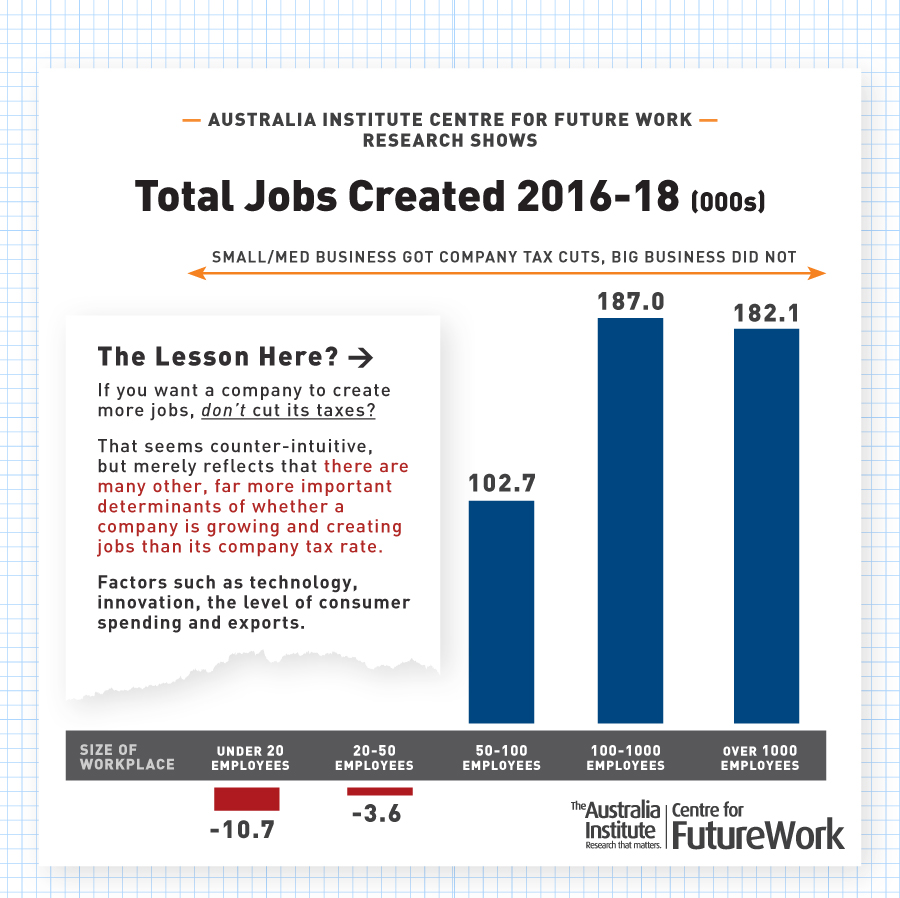
    Buried deep in the dozens of statistical tables was a very surprising breakdown of employment by size of workplace.  It turns out, surprisingly, that Australia’s biggest workplaces (both private firms and public-sector agencies) have been the leaders of job-creation over the last two years.

    This runs against the common refrain that small business is the “engine of growth.”  In fact, workplaces with less than 50 employees actually shed employees (14,000 in total) since 2016.  Curiously, it was only smaller businesses that received the much-vaunted reduction in company tax (from 30 to 27.5 per cent), also beginning in 2016.

    Firm Size and Job Creation

    The tax rate for small and medium-sized businesses began to fall in 2016, first for the smallest firms (with turnover under $2 million), and then for firms with up to $50 million revenue.  The tax is not tied to the number of employees in a business, but the vast majority of firms which have received the tax cut have less than 50 employees.  Yet that is the group that has reduced its workforce since the tax cuts began to be phased in.

    In contrast, very large workplaces (with over 1000 employees) added 182,000 new jobs over the two years.  Workplaces with between 100 and 1000 employees added 187,000.  Very few of those workplaces would have received the reduction in company taxes (since most would exceed the $50 million annual revenue threshold).

    Workplaces between 50 and 100 employees created a net total of 103,000 new jobs between 2016 and 2018.  Some of those firms would have received the tax cut, and some not — depending on the nature of the business and the amount of total turnover generated per employee.

    The data on job-creation by firm size is detailed on Table 13 of Data Cube 1, in the “Downloads” section of the ABS report. The data refers to waged employees, not including owner-managers of businesses.

    The share of small businesses (under 50 employees) in total employment declined by two percentage points — since they were reducing their workforces, while larger companies were growing.  Small businesses (under 50 employees) now account for 34 per cent of all employees, compared to 36 percent in 2016.

    Why would large companies that didn’t get a tax cut create new jobs faster than companies which did benefit from the Coalition tax cuts? (The small business tax cuts are estimated to reduce federal revenues by $29.8 billion over the first decade.) Simple: there are dozens of different factors which determine whether a company is profitable or not, and whether it chooses to grow.  Tax rates are just one of those variables.  Others include:

    • Growth in consumer demand.
    • The company’s investments in product quality, innovation, and design.
    • Production costs.
    • Interest rates and financing costs.
    • Business confidence and expectations.
    • Management capacity.
    • International competition.

    Trends in all these other factors can easily overwhelm the marginal impact of lower tax rates.  Small business sales in particular have been held back by stagnant wages among Australian workers.  Even companies which experience higher profits due to lower tax rates may choose to simply accumulate those profits, or pay them out to shareholders in dividends and share buy-backs (instead of expanding payrolls).  Empirical evidence shows this has been the dominant impact of U.S. business tax cuts implemented by Donald Trump.

    Changes in tax rates can even have offsetting effects which undermine business conditions and hence reduce job-creation: if the revenue lost to tax cuts results in corresponding reductions in government program spending or infrastructure investments (as seems likely), then overall business conditions might be weakened, not strengthened.

    The reduction in employment by the businesses which most benefited from the expensive business tax cuts over the past two years should lead policy-makers of all persuasions to reconsider the argument that this is an effective way to stimulate growth and job-creation. However, in October the government announced it wanted to accelerate the next stages of the small business tax cuts — taking the rate down to 25 per cent five years faster than originally planned.

    So far, the policy is akin to shooting oneself in the foot.  Instead of reloading the gun to do it again even sooner, perhaps this is a good time to reconsider whether the strategy makes any sense at all.


    You might also like

    Commonwealth Budget 2025-2026: Our analysis

    by Fiona Macdonald

    The Centre for Future Work’s research team has analysed the Commonwealth Government’s budget, focusing on key areas for workers, working lives, and labour markets. As expected with a Federal election looming, the budget is not a horror one of austerity. However, the 2025-2026 budget is characterised by the absence of any significant initiatives. There is

    Dutton’s nuclear push will cost renewable jobs

    by Charlie Joyce

    Dutton’s nuclear push will cost renewable jobs As Australia’s federal election campaign has finally begun, opposition leader Peter Dutton’s proposal to spend hundreds of billions in public money to build seven nuclear power plants across the country has been carefully scrutinized. The technological unfeasibility, staggering cost, and scant detail of the Coalition’s nuclear proposal have

  • Rebuilding Vocational Training in Australia

    Rebuilding Vocational Training in Australia

    Share

    Australia’s manufacturing sector has been experiencing an important and welcome rebound during the last two years. The turnaround has been documented and analysed in previous Centre for Future Work research (including studies published in 2017 and 2018 as part of the National Manufacturing Summit, co-sponsored by the Centre).

    Ironically, the manufacturing recovery could be short-circuited by looming shortages of appropriately skilled workers.  This seems unbelievable — given so much downsizing in manufacturing employment that occurred between 2001 and 2015.  But a combination of structural change within the sector, the ageing of the current workforce, and the failure of Australia’s vocational education system (crippled by a bizarre experiment in publicly-subsidized private delivery) means that recovering manufacturers may be unable to find the skilled workers they need.

    A recent feature article in Australian Welding magazine highlighted the Centre for Future Work’s research into the problems of the current VET system, the implications for manufacturing, and 12 key reforms urgently needed to repair the situation.

    The feature article is extracted from a detailed paper (co-authored by Tanya Carney and Jim Stanford) on the evolving skills requirements of the manufacturing sector, and the failure of a privatised, fragmented VET system to meet those needs.  That paper was unveiled at the 2018 National Manufacturing Summit in Canberra.

    “Stable, well-funded, high-quality public institutions must be the anchors of any successful VET system. Public institutions are the only ones with the resources, the connections, and the stability to provide manufacturers with a steady supply of world-class skilled workers.”

    Please see the full 4-page article in Australian Welding magazine with our proposals for rebuilding a high-quality, modern VET system to meet the needs of manufacturing and other Australian industries.

    We are grateful to Australian Welding and Weld Australia for permission to reprint this article!


    Related documents


    Article in Australian Welding magazine

    Related research

    You might also like

    Centre For Future Work to evolve into standalone entity

    The Centre for Future Work was established by the Australia Institute in 2016 to conduct and publish progressive economic research on work, employment, and labour markets. Supported by the Australian Union movement, the centre produced cutting edge research and led the national conversation on economic issues facing working people: including the future of jobs, wages

  • The Year Past, and the Year to Come

    The Year Past, and the Year to Come

    by Jim Stanford in Workforce Magazine
    Originally published in Workforce Magazine on December 14, 2018

    Workforce (a labour relations bulletin published by Thomson-Reuters) recently surveyed major IR figures in Australia on what they saw as the big issues in 2018, and what they expect as the major talking points for 2019. Jim Stanford, economist and Centre for Future Work director, was one of those surveyed, and here are his remarks. 

    What was the most important issue or event in industrial relations this year?

    I would choose the union movement’s “Change the Rules” campaign, which really gathered focus and momentum as the year went on. Of course, unions have been dissatisfied with the state of labour laws, and the erosion of labour rights, for years. But this year, together with other community advocates, they have built a very effective and focused advocacy campaign that I think will have a major impact on labour policy in Australia. Examples of its potential include the big rallies held in Melbourne and other cities in October; the important role that the union movement’s independent door-knocking and phone-banking campaign played in the expanded majority won by the Daniel Andrews govt in Victoria; and the generally high profile of news and debates around the issues of wages and workplace fairness in the media and public commentary.

    The current atmosphere is very reminiscent of the “Your Rights at Work” initiative that the ACTU and its affiliates organised in 2006-07 – and that ended up making a significant difference in the 2007 election (when John Howard lost his seat).

    There is a qualitative difference in this incarnation of the union movement’s organising, however: while union activists obviously are hoping to influence the results of the next election, they are self-consciously and explicitly planning on a longer-run effort to shift public opinion regarding core issues of work and fairness.

    Their agenda of proposed reforms would take several years to implement: including lifting the minimum wage to a “living wage” level, modernising labour laws (so Uber drivers and other gig workers would be protected), changing the structure of enterprise bargaining to allow multi-firm and industry-wide bargaining, and more.

    And they are advancing that agenda as an independent campaign, not as an arm of the Labor party. That positions them well to continue to advance the debate after the election … whoever wins.

    By carefully focusing its energies, building a strong “boots on the ground” infrastructure in communities (including crucial marginal electorates), and building strong public support for the core values underpinning the campaign (tapping into continuing Australian faith in fairness), I think this movement will reshape both public opinion about work and wages, as well as Australia’s labour policy framework.

    What are you most/least looking forward to in 2019?

    There will be a Commonwealth election sometime during the first half of 2019 (perhaps sooner rather than later, if the current disarray in Canberra is any indication).

    I look forward to seeing labour issues – and in particular, the stagnation of wages in Australia, and the growing gap between Australia’s egalitarian tradition and the grim economic reality that most workers presently face – feature as one of the top three issues in the campaign. Most workers have had no increase in real wages over the past five years; millions have fallen behind (especially given escalating prices for housing and other essentials). The present govt knows that this festering economic  frustration issue could be very damaging.

    There’s an opportunity in Australia right now to move the needle: imagine a modernised approach to labour policy: including labour standards that adapt to ongoing change in the economy (like gig jobs), a more ambitious crack-down on wage theft and other  illegal practices, and a revitalisation of Australia’s commitment to a ‘fair go.’

    However, I am not looking forward to the rolling out of some pretty tired warnings and threats about how modernising labour laws and addressing inequality will somehow threaten Australia’s economic viability.

    We can expect many dire threats about how the proposals for reform will drag Australia back to the “bad old 1970s” – a time, interestingly, when GDP growth, job-creation, productivity growth, and real wage growth were all significantly superior to the current era.

    This rhetoric ignores the growing consensus among economists that more equality actually strengthens economic performance – by supporting consumer spending and aggregate demand, avoiding the economic, fiscal and social costs of exclusion and inequality, and boosting govt revenues.

    The doomsday prophecies we can expect to hear from the usual suspects should be understood as the last gasps of a vision of trickle-down economic policy that has lost its credibility, in Australia and around the world.


    Related documents


    Attachment

    You might also like

    Dutton’s nuclear push will cost renewable jobs

    by Charlie Joyce

    Dutton’s nuclear push will cost renewable jobs As Australia’s federal election campaign has finally begun, opposition leader Peter Dutton’s proposal to spend hundreds of billions in public money to build seven nuclear power plants across the country has been carefully scrutinized. The technological unfeasibility, staggering cost, and scant detail of the Coalition’s nuclear proposal have

  • New Book: The Wages Crisis in Australia

    New Book: The Wages Crisis in Australia

    by Jim Stanford, Andrew Stewart and Tess Hardy

    Share

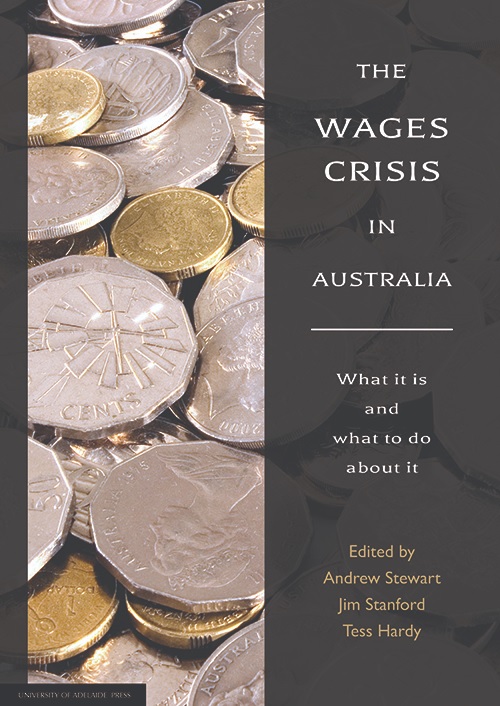
    Australian wage growth has decelerated in recent years to the slowest sustained pace since the 1930s. Nominal wages have grown very slowly since 2012; average real wages (after adjusting for inflation) have not grown at all. The resulting slowdown in personal incomes has contributed to weak consumer spending, more precarious household finances, and even larger government deficits.

    Cover

    The wage slowdown has elicited concern from economists and political leaders across the spectrum. Even Dr. Philip Lowe, Governor of the Reserve Bank of Australia, has called it a “crisis,” and suggested that faster wage growth would be beneficial for the economy.

    This new collection of 20 essays by leading labour market experts and commentators in Australia explores the causes, consequences, and potential solutions to this problem.  The book is published by University of Adelaide Press. The book was launched in Melbourne on 29 November, with remarks from Natalie James, former Commonwealth Fair Work Ombudsman and Chair of the Victorian Inquiry Into the On-Demand Workforce.

    Through the links below you may access excerpts from the book, links to participating authors, and supplementary material (including commentary, other readings, and videos). Our hope is that this collection will spark a needed debate in Australia about how to get wages back on track.

    About the Editors:

    Andrew Stewart is the John Bray Professor of Law at the University of Adelaide and a Legal Consultant to the law firm Piper Alderman.

    Tess Hardy is a Senior Lecturer at Melbourne Law School, and Co-Director of the Centre for Employment and Labour Relations Law.

    Jim Stanford is Economist and Director of the Centre for Future Work at the Australia Institute.


    A digital edition of the book is available for free download from University of Adelaide Press. Paperback copies can be ordered for $60 from Federation Press; please submit inquiries to info@federationpress.com.au.


    Related documents


    Natalie James Launch Speech


    Introduction


    Conclusion

    You might also like

  • Under the Employer’s Eye: Electronic Monitoring & Surveillance in Australian Workplaces

    Under the Employer’s Eye: Electronic Monitoring & Surveillance in Australian Workplaces

    by Troy Henderson, Tom Swann and Jim Stanford

    Each year the Centre for Future Work at the Australia Institute conducts a public survey of Australian working hours, as part of our annual “Go Home on Time Day” (GHOTD) initiative. Findings from the survey regarding hours worked, preferences for more or less hours, and the incidence of unpaid overtime are reported in a companion study.

    This year, our survey also included a special section focusing on the forms, prevalence, impacts and implications of electronic and digital monitoring and surveillance in Australian workplaces. Our goal was to investigate a secondary dimension of the time pressure facing Australian workers. It is not just that work is being extended into greater portions of our days (through unpaid overtime, the use of mobile phones and computers to reach workers at any time, pressure to not fully utilise annual leave, and similar trends). In addition, even within the work day, time pressure is intensified with the expectation that every moment of work time must be used for productive purposes – an expectation that is increasingly reinforced through omnipresent systems of monitoring, performance measurement, and surveillance. The result of these twin forces is an overall inability for people to escape from the demands of work: neither at the workplace (even for short periods), nor away from it.

    Part I of this report begins by describing the main forms of modern electronic monitoring and surveillance (EMS) that have placed more Australian workers “under their employer’s eye.” These methods include the use of location tracking technologies, monitoring of emails and social media content, the “gamification” of work, digital methods of performance monitoring, and even electronic systems for employee discipline and dismissal. Following sections examine the various purposes of modern EMS systems, and the extent of their application. This is followed by a brief description of the legal and regulatory system governing EMS in Australia; current regulations limiting employers’ use of these systems are sparse and inconsistent. The last section of Part I discusses the direct and indirect consequences of these new forms of monitoring and surveillance for workers. It argues that the impact of omnipresent surveillance in workplaces may be contributing to the slower wage growth which has so concerned Australian economists and policy experts in recent years; because it is now easier and cheaper to monitor and “motivate” employees through surveillance and potential discipline, employers feel less pressure to provide positive economic incentives (such as job security, promotion, and higher wages) to elicit loyalty and effort from their workforces.

    Part II of the report then reports the findings of our original survey data regarding the forms, extent and impacts of EMS systems in Australian workplaces, and the attitudes of Australian workers towards these technologies and trends. We surveyed 1,459 people between 26 October and 6 November 2018, using an online survey methodology, conducted by Research Now. The sample was nationally representative with respect to gender, age and state and territory.


    Full report

    Share

  • ‘Go Home On Time Day’ 2018: Australians Owed $106 Billion in Unpaid Overtime, Report Reveals

    ‘Go Home On Time Day’ 2018: Australians Owed $106 Billion in Unpaid Overtime, Report Reveals

    Share

    The 10th annual ‘Go Home On Time Day’ report by The Australia Institute’s Centre for Future Work estimates that Australian employees will work 3.2 billion hours of unpaid overtime for their employers this year, worth an estimated $106 billion in foregone wages.

    A national survey undertaken as part of the report has shown that the average Australian worker now puts in six hours of unpaid overtime per week, which equates to working an extra two months for free every year. That’s an increase from 5.1 hours on average in last year’s survey.

    “Australians are working more unpaid overtime than ever before, and they’re paying a high price for it,” said Troy Henderson, Economist at the Centre for Future Work.

    “Time theft takes many forms, including employees staying late, coming in early, working through their lunch or other breaks, taking work home on evenings and weekends or being contacted to perform work out of hours.

    “Most Australians wouldn’t dream of working for two months without pay. But it’s spread out over the whole year, and has become part of the implicit expectations of too many jobs. ‘Time theft’ has thus become endemic across the whole labour market.

    “Today we ask that all Australians go home on time and try to limit the unpaid overtime they work. And stopping time theft is ultimately the responsibility of employers and government, too, not just individual workers: employers must value and respect the leisure time of workers, and recognise that work cannot take over our entire lives.”

    The survey indicated that even part-time and casual workers – most of whom want more paid hours of work each week – are being asked to work unpaid overtime (averaging over 4 hours per week for part-timers and almost 3 hours per week for casuals). “Given the problem of underemployment and precarious work in today’s labour market, it is especially unfair that part-time and casual workers are being pressured to work for free,” Mr. Henderson added.

    This year’s Go Home on Time Day survey also included a special questionnaire on the use of digital surveillance and monitoring in Australian workplaces. 70% of respondents said their employers use at least one form of digital surveillance or monitoring, including cameras, GPS tracking, monitoring internet or social media activity or counting keystrokes, to monitor employees – and sometimes to discipline or even dismiss them.

    “Technology can have a strong positive effect in the workplace, but our research shows it is also being used in ways that increase pressure on employees and reduce the level of trust in workplaces,” Mr. Henderson said.

    “It’s clear from our research that millions of Australians are losing out to time theft. Both underemployed workers, and those who work too much, are giving up their precious time for free. All Australian workers have the right to go home on time.”


    Related research

  • Go Home on Time Day 2018

    Go Home on Time Day 2018

    Share

    Wednesday 21 November is Australia’s official “Go Home On Time Day,” sponsored by the Centre for Future Work and the Australia Institute. This represents the 10th year of our initiative, to provide light-hearted encouragement to Australian workers to actually leave their jobs when they are supposed to. Instead of working late once again – and allowing your employer to “steal” even more of your time, without even paying for it – why not leave the job promptly. Spend a full evening with your family or friends, visit the gym, see a movie – do anything other than work.

    Please visit our special Go Home On Time Day website for more information, tips on how to get away from work on time, and free posters and shareables. There’s also an online calculator where you can estimate the value of the time theft you experience, through unpaid overtime in all its forms.

    In conjunction with Go Home On Time Day, The Centre for Future Work is releasing two new research reports on the time pressures facing Australian workers:

    Our annual update on attitudes toward working hours, the incidence of unpaid overtime and its aggregate value: Excessive Hours and Unpaid Overtime: 2018 Update, by Troy Henderson and Tom Swann. On the basis of a survey of 880 employed Australians, we estimate that the typical worker puts in 6.0 hours of unpaid overtime per week – ranging from going in early, staying late, working through lunch and tea breaks, taking work home in the evenings and weekends, responding to calls or emails out of hours, and more. That amounts to 3.25 billion hours of unpaid overtime across the whole labour market this year, worth a total of $106 billion.

    This year, our Go Home On Time Day survey also included a special section focusing on the forms, prevalence, impacts and implications of electronic and digital monitoring and surveillance in Australian workplaces. Our goal was to investigate a secondary dimension of the time pressure facing Australian workers. It is not just that work is being extended into greater portions of our days (through unpaid overtime, the use of mobile phones and computers to reach workers at any time, pressure to not fully utilise annual leave, and similar trends). In addition, even within the work day, time pressure is intensified with the expectation that every moment of work time must be used for productive purposes – an expectation that is increasingly reinforced through omnipresent systems of monitoring, performance measurement, and surveillance. The result of these twin forces is an overall inability for people to escape from the demands of work: neither at the workplace (even for short periods), nor away from it.

    Please see our companion report, Under the Employer’s Eye: Electronic Monitoring & Surveillance in Australian Workplaces, by Troy Henderson, Tom Swann and Jim Stanford.


    Related research

    You might also like

  • Secret Weapon Overlooked in Fight Against Financial Misconduct

    Secret Weapon Overlooked in Fight Against Financial Misconduct

    Share

    A potent tool for cleaning up misconduct in the industry is being overlooked by the Royal Commission into financial services.

    The Centre for Future Work has proposed to the Commission that a system of sector-wide collective bargaining in the financial industry could establish clear and ethical benchmarks for compensation, avoiding the problem of ‘conflicted remuneration’, which is behind much of the misconduct the Royal Commission has exposed.

    The Centre for Future Work’s submission to the Royal Commission proposes a uniform compensation system, to apply across the whole industry, consistent with the principles of ethical banking:

    • Uniform compensation can be achieved via a sector-wide collective bargaining system, in which employer and union representatives negotiate standard compensation patterns to apply to all participants across the industry.
    • Compensation in each job to be tied to qualifications and experience; separate pay grids could be specified in various branches of finance (including major banks, insurance, superannuation, and financial advice).
    • Clear and enforceable limits on sales- or revenue-based incentives would be specified – eliminating what the Royal Commission has confirmed is a key motivation for misconduct.
    • Instead of depending solely on government regulators to stop misconduct, enforcement of compensation standards would become part of the regular administration of the collective agreement.

    “At present, flawed pay systems create perverse incentives for banks and brokers to push debt, insurance, and financial services to Australians,” says Dr. Jim Stanford, Director of the Centre for Future Work.

    “Financial professionals can reap tens or hundreds of thousands of dollars in commissions, bonuses and so-called ‘introducing’ fees; top executives pocket millions.

    “It is inevitable that these incentives lead sales staff and executives to sidestep or ignore basic rules and standards such as ‘know your client’ rules, fee transparency and responsible lending.

    “Consumers, many of them vulnerable, end up with expensive commitments they don’t need or – in many cases – even understand.

    “Under a sectoral agreement, hundreds of managers, union officials and delegates throughout the financial industry would be responsible for enforcing the ethical pay practices spelled out in the agreement.

    “Unfortunately, Australia’s current restrictive industrial relations laws generally prohibit collective bargaining on a multi-firm or sector-wide basis.

    “These restrictions are unusual. Most industrial countries permit, and even encourage, multi-firm, pattern, or industry-wide bargaining as an efficient way to determine consistent benchmarks for pay and conditions, and ensure that ongoing economic and productivity growth translates into rising living standards.”

    The Centre’s submission argues these restrictions on sector-wide bargaining should be reconsidered in light of the pervasive pattern of financial misconduct – and the key role of perverse compensation systems in motivating that misconduct.

    “Sectoral collective bargaining could help reform compensation and reduce financial misconduct on a uniform, industry-wide basis,” Stanford said.

    “The Royal Commission should explore standardised sector-wide collective agreements as a promising response to the problems it has documented, and the Commonwealth Government should eliminate its unusual restrictions on collective bargaining to allow this important reform.”


    Related research