Category: Law, Society & Culture

Research branch

  • 93 Economic Experts Back Govt Wages Subsidy in Open Letter

    93 Economic Experts Back Govt Wages Subsidy in Open Letter

    Share

    93 Australian economists and policy experts have signed an open letter, coordinated by the Centre for Future Work at the Australia Institute, supporting a government wage subsidy to prevent mass unemployment during the coming economic downturn resulting from the COVID-19 pandemic.

    Signatories to the open letter include Bernie Fraser, former Secretary to the Treasury and Governor of the Reserve Bank; Professor Roy Green, former Dean of Business at UTS; Professor Andrew Stewart, Professor of Law at the University of Adelaide; RMIT Distinguished Professor Sara Charlesworth; Professor John Howe, Director of the University of Melbourne School of Government; and Rae Cooper, Professor of Gender, Work and Employment Relations at the University of Sydney.

    The open letter states, in part:

    “The coming recession will be unprecedented in Australian history – in both its speed and its depth. Without immediate action, we expect that 1-2 million workers, or even more, could lose their jobs in coming weeks. That would drive unemployment to 15% or higher, overwhelm income support programs, and leave hundreds of thousands of businesses unable to function – even after the immediate health danger passes.

    “We recommend that the Commonwealth government immediately implement a large-scale wage subsidy scheme, similar to those already enacted in several other industrial countries.”

    “The breadth of support we received on this open letter confirms the proposal is supported by a broad cross-section of Australian stakeholders. The Government needs to move quickly now to implement this measure, and ease this pandemic’s devastating economic effects,” said Dr Jim Stanford, Director of the Centre for Future Work at the Australia Institute, and author of the open letter.

    The wage subsidy proposal has also been supported by many Australian unions, business peak bodies, and other stakeholders.

    Bernie Fraser, former Secretary to the Treasury and Reserve Bank Governor said, “Australia’s post-corona economic resurrection requires the on-going preservation both of the skills and self-esteem of our workforces, and of our business and entrepreneurial talents. If Australia is serious about ensuring the readiness of our work-forces to spring into action when the time comes, it should provide appropriate support direct to those workforces, as several other countries appear to be doing.”

    Professor John Howe, Director of the Melbourne School of Government, said, “Wage subsidies are a longstanding and legitimate form of government support for job creation and retention. In the context of the current crisis, an urgently implemented wage subsidy program will help workers retain income and stay in employment, unlike direct welfare payments. And they are more accountable than boosting cash flow to employers, which may or may not be used to save jobs.”

    Professor Roy Green, former Dean of Business at UTS, said, “The duty of the Australian Government in these extraordinary times is to ensure that a short term crisis does not become a long term disaster for the nation. In fact, the Prime Minister has referenced the need to build a ‘bridge’ to a better, stronger economy. For this to happen, the bridge must include substantial wage subsidies to retain workforces for the recovery and provide them with an income as they reskill and reposition our industries for the future.”

    The full open letter and list of signatories can be viewed here.

    A catalogue of international initiatives to support workers, compiled by the Centre for Future Work, is available here.


    Related research

  • Public Sector Pay Freezes Could Push Economy From Recession to Depression

    Public Sector Pay Freezes Could Push Economy From Recession to Depression

    Share

    New research from the Australia Institute’s Centre for Future Work reveals the consequences of freezing public service pay, both for public sector workers and for the broader economy.

    Governments are devoting unprecedented resources to protecting Australians against the health and economic effects of the pandemic, but a contradictory push to adopt fiscal austerity measures is also becoming apparent. Leaders of governments at all levels — federal, state and local council – have already announced plans to freeze wages and cancel previously agreed pay raises for public servants.

    Key findings:

    • At least 35% of the purported ‘savings’ from freezing public service pay is offset by the loss of direct tax revenues that would have been collected as a result of higher income and spending by public servants. And considering other tax revenue losses from the resulting slowdown in broader wage growth, even more of those ‘savings’ are never realised.
    • Pay freezes in the public sector spill over into weaker economy-wide wage growth through three key channels: a composition effect, a demonstration effect, and a macroeconomic effect.
    • Freezing pay for even short periods reduces the lifetime income and superannuation savings of public sector workers by tens of thousands of dollars, because it permanently reduces their lifetime wage trajectory.
      • A 6-month pay freeze for a typical federal APS worker will reduce career earnings by an estimated $23,500, and superannuation accumulations by another $4000 or more. The longer 2-year freeze contemplated for Brisbane local council workers would reduce career earnings by over $100,000, and superannuation accumulations by $17,500.
    • Misguided public sector wage restraint in the aftermath of the GFC short-circuited an initial recovery in private-sector wage trends in 2010-11, and helped lock in a lasting deceleration of national wages after 2013. Since then Australia has experienced the slowest sustained wage growth in the entire post-war era.

    “Pay freezes are being imposed at the very moment when public sector workers such as healthcare workers, first responders, teachers and social service providers are performing vital tasks, at personal risk to themselves, to support Australians through the pandemic. Freezing pay for these essential workers is not just morally questionable — it’s also a major economic mistake,” said Dr. Jim Stanford, Director of the Centre for Future Work.

    “The motivation for public sector wage austerity seems more ideological than fiscal or economic: pay freezes are justified with appeals to ‘shared sacrifice,’ and a symbolic desire to ‘tighten the purse strings’ at a moment when governments are about to incur their largest deficits in history.

    “However, our research shows these arbitrary pay freezes are both unfair and economically counterproductive. Government policy should be driven by economic reality, not political optics.

    “Public sector wage austerity imposed after the Global Financial Crisis helped ‘lock in’ historically slow wage growth in the private sector in the years that followed. Since then, wages in Australia have grown at their slowest sustained rate in the post-war era.

    “Australia cannot tolerate a further deceleration of wage and price inflation. Inflation was already close to zero, chronically falling below the RBA’s inflation target, even before the economy was hit by the double shock of bushfires and COVID-19.

    “Economy-wide deflation is associated with long-term depression. Australia cannot risk letting any COVID-19 recession turn into a depression. At this pivotal moment, governments’ priority should be anchoring price expectations, supporting nominal incomes, and contributing to aggregate demand. Normal wage gains should be implemented in the public sector and encouraged in the private sector.”


    Related research

  • Working From Home: Opportunities and Risks

    Working From Home: Opportunities and Risks

    by Alison Pennington and Jim Stanford

    With many regular workplaces shut down to ‘flatten the curve’ of COVID-19, millions of Australians are now shifting their work to home. Home work has great potential to cushion the economic blow of the pandemic: allowing many to keep working and earning an income, and many firms and industries to continue at least partial production. But there are also many challenges and risks associated with this major shift in work patterns. Much of the increase in home work will likely become permanent, even after the immediate health emergency passes. That makes it crucial to ‘get home work right’: providing home workers with appropriate support and protections, and preventing abuse and exploitation as home work becomes more common.

    This new Briefing Paper from the Centre for Future Work, written by Alison Pennington and Jim Stanford, surveys the scope of home work, considers its impacts on economic and gender inequality, and proposes several policy recommendations to make home work safer and fairer.

    Main findings of the Briefing Paper include:

    • About 30% of Australian jobs could conceivably be performed from home – but it will take time for workplaces to make necessary organisational and technological adjustments to reach that potential.
    • Occupations which can work from home were already paid about 25% more than occupations which cannot be shifted to remote locations. The shift to home work could therefore exacerbate income inequality; this reinforces the need for comprehensive income protections for those who cannot work from home.
    • The expansion of work-from-home arrangements raises several concerns regarding the conditions of home work, and protecting those who perform it. These include fair compensation for extra expenses associated with home work; applying normal rules regarding working hours and pay; ensuring a safe home work environment (including its social and familial context, with challenges like domestic violence); and protecting the privacy of home workers from undue monitoring and surveillance by employers.

    The paper concludes by urging researchers, unions, regulators and policy-makers to pay top-priority attention to ensuring the safety and fairness of home work – because this shift is clearly here to stay.


    Full report

    Share

  • 81% of Australians support JobKeeper for all Casual Workers

    81% of Australians support JobKeeper for all Casual Workers

    Share

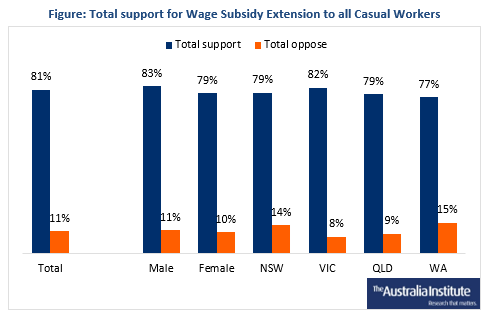
    New polling shows more than eight in ten Australians support extending the wage subsidy, known as the JobKeeper program, to all casual workers, regardless of how long they have worked at their place of employment.

    The Australia Institute surveyed a nationally representative sample of 1,008 people between 3 and 6 April 2020.

    Key Findings:

    • Australians overwhelmingly support (81%) extending the wage subsidy to casual workers, regardless of length of employment, only 11% are opposed to extending the wage subsidy.
    • Strong support for extending the wage subsidy to casual workers regardless of length of employment was seen across voters of all parties. 79% of Coalition voters support (14% oppose), 88% of Labor voters support (6% oppose), 80% of Greens voters support (9% oppose), 78% of One Nation voters support (15% oppose), and 69% Independent/other support (13% oppose).
    • The Government’s ‘JobKeeper’ wage subsidy program currently only applies to casual workers who have been working at their current place of employment for 12 months or longer. This results in over 1 million short-tenure casual workers (under 12 months) being excluded. Apart from hurting those workers, this will also create a serious disadvantage for businesses which rely on short-tenure workers for their staffing needs (including in the retail, hospitality, and agriculture industries).

    “The JobKeeper program is an important and necessary support to help Australian workers through the COVID19 pandemic and accompanying recession,” said Dr. Jim Stanford, director of the Australia Institute’s Centre for Future Work.

    “This research demonstrates that the Australian public recognises the necessity of the JobKeeper program, and wants to see the program enhanced to include the one million casual workers who are currently excluded from the scheme.

    “Short-tenure casual workers are among some of the most vulnerable in our society. Many are living paycheck to paycheck, and already living on the brink – they need more support during this crisis, not less.

    Stanford noted that the JobKeeper scheme will also exclude over one million foreign visa workers. “Driving short-term casuals and foreign visa workers into unemployment is unfair to them, it is unfair to their employers, and it poses significant risks to public health,” Dr. Stanford said.


    Related research

  • Webinar: Protecting Jobs and Incomes During the Pandemic

    Webinar: Protecting Jobs and Incomes During the Pandemic

    by Jim Stanford

    Share

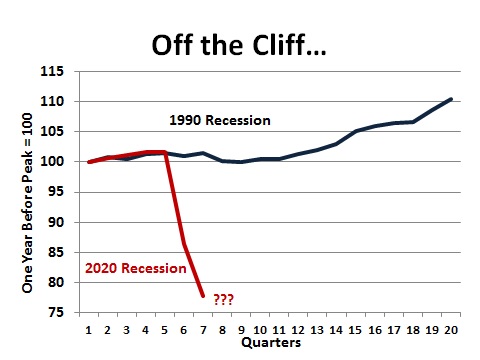
    The COVID-19 pandemic is producing an unprecedented shutdown of large parts of the national and global economies. Our Director Dr. Jim Stanford provided an overview of the coming recession, how it differs from previous downturns, and the best ways for government to respond to protect Australians as much as possible from the economic fall-out.

    Jim titled his presentation “Off the Cliff”, highlighting that the immediate shutdown of so much of Australia’s work and production is producing an economic contraction unlike anything experienced in history.

    Comparing Recessions

    Watch a video recording of the webinar:

    And/or download Jim’s slides below.

    This webinar was part of the Australia Institute’s weekly pandemic webinar series.


    Related documents


    Presentation slides

    You might also like

    Dutton’s nuclear push will cost renewable jobs

    by Charlie Joyce

    Dutton’s nuclear push will cost renewable jobs As Australia’s federal election campaign has finally begun, opposition leader Peter Dutton’s proposal to spend hundreds of billions in public money to build seven nuclear power plants across the country has been carefully scrutinized. The technological unfeasibility, staggering cost, and scant detail of the Coalition’s nuclear proposal have

  • Open Letter From Economists and Policy Experts: Wage Subsidy to Protect Jobs During Pandemic

    Open Letter From Economists and Policy Experts: Wage Subsidy to Protect Jobs During Pandemic

    by Jim Stanford

    Share

    109 Australian economists and policy experts have signed an open letter, initiated by the Centre for Future Work, supporting a government wage subsidy to prevent mass unemployment during the coming economic downturn resulting from the COVID-19 pandemic.

    The letter and the full list of signatories is reprinted below. It has been forwarded to Prime Minister Morrison.

    Public Statement from Economists and Public Policy Experts:

    A Wage Subsidy to Protect Jobs During the Coronavirus Shutdown

    The unprecedented public health measures required to deal with the COVID-19 pandemic are causing a dramatic shutdown of work and production in several key sectors of Australia’s economy. Immediate full or partial closures of activity are occurring in several consumer-facing industries (such as hospitality, retail, airlines, recreation and personal services). But before long, spillover losses will be experienced in other sectors, too: including wholesale trade and logistics, manufacturing, business services, education, and others. Consumer and business confidence has been deeply shocked, and that will magnify the negative economic effects of the pandemic.

    The coming recession will be unprecedented in Australian history – in both its speed and its depth. Without immediate action, we expect that 1-2 million workers, or even more, could lose their jobs in coming weeks. That would drive unemployment to 15% or higher, overwhelm income support programs, and leave hundreds of thousands of businesses unable to function – even after the immediate health danger passes.

    This is a dangerous and dramatic moment in Australia’s economic history. It is imperative that the federal and state governments act immediately and powerfully to protect Australian workers and businesses from the worst of the coming downturn. Important steps have been taken to expand access and benefit levels for income support payments to Australian workers (including casuals, contractors, and gig workers) losing work because of the pandemic. This is a helpful, but on its own inadequate, response. Government must also act forcefully to prevent mass job losses in coming weeks – not just provide support to those who do lose work.

    In this regard, we recommend that the Commonwealth government immediately implement a large-scale wage subsidy scheme, similar to those already enacted in several other industrial countries (including, variously, the UK, Denmark, New Zealand, the Netherlands, South Korea, and Ireland). Under these programs, government directly pays to employers (for a limited period of time) a majority portion of wages (between 70 and 90%) to cover the wages of workers who would otherwise be stood down from their positions. The measure can apply to non-standard workers (including contractors and self-employed). It can also be integrated with measures to support short time working as an alternative to complete redundancy. The wage subsidy is paid to firms experiencing severe losses of revenue and business (beyond a specified threshold). It would cover most of the wage bills for workers who can no longer work for economic reasons, up to a specified ceiling (perhaps the level of full-time median earnings). This program will be expensive – but governments everywhere have recognised that this unprecedented crisis requires them to do everything in their power to protect people, jobs, communities and the economy.

    To date, Australia’s response to the pandemic has been uncertain, inconsistent and inadequate. Immediate, powerful action to keep millions of Australians in their jobs, instead of pushing them into an overloaded and complex Centrelink system, would significantly ease the pandemic’s painful economic effects. It would underpin financial stability for millions of households through the coming terrible weeks or months. And it would preserve the viability of hundreds of thousands of Australian businesses, allowing them to resume work and production as soon as the health restrictions are eased.

    We the undersigned support the proposal for a strong wage subsidy program to keep workers in employment through the coming downturn, and we urge the Commonwealth government to implement such a policy quickly.

    Download full list of signatories below.


    Related documents


    List of signatories

    You might also like

    Dutton’s nuclear push will cost renewable jobs

    by Charlie Joyce

    Dutton’s nuclear push will cost renewable jobs As Australia’s federal election campaign has finally begun, opposition leader Peter Dutton’s proposal to spend hundreds of billions in public money to build seven nuclear power plants across the country has been carefully scrutinized. The technological unfeasibility, staggering cost, and scant detail of the Coalition’s nuclear proposal have

  • The Same Mistake Twice

    The Same Mistake Twice

    The Self-Defeating Consequences of Public Sector Pay Freezes
    by Troy Henderson and Jim Stanford

    New research from the Australia Institute’s Centre for Future Work reveals the consequences of freezing public service pay, both for public sector workers and for the broader economy.

    Governments are devoting unprecedented resources to protecting Australians against the health and economic effects of the pandemic, but a contradictory push to adopt fiscal austerity measures is also becoming apparent. Leaders of governments at all levels — federal, state and local council — have already announced plans to freeze wages and cancel previously agreed pay raises for public servants.


    Full report

    Share

  • Responding to the Economic Emergency

    Originally published in New Matilda on March 21, 2020

    The scale and scope of the economic downturn caused by COVID-19 will be unprecedented in our lifetimes. Mainstream economists have belatedly realised the pandemic will cause an economic downturn, but they are not yet appreciating the size of that downturn, nor the unconventional responses that will be required. Simply calling for government “stimulus” is sadly inadequate, given the complete shut-down of work and production that is occurring in many sectors of the economy. The task is no longer supporting markets with incremental “pump-priming.” What’s needed is a war-like effort, led by government, to mobilise every possible resource to protect Australians’ health and livelihoods. Money is not an object – and this epic effort should not be held back by normal acquiescence to private-sector priorities and decisions.

    That’s the core message of new analysis by Centre for Future Work Director Dr. Jim Stanford, published today by the Australian journal New Matilda.

    Stanford’s article outlines the immediate economic measures needed to both confront the health emergency and prevent households and firms from collapsing:

    • Immediate mobilization of resources to protect health: including more staff at health facilities, quick deployment of off-site and mobile testing capacities, home support for people quarantined or recovering, and quick expansion of equipment and facilities where possible.
    • Income protection for workers: including for casuals, self-employed, gig-workers, and many part-timers who don’t have effective access to sick pay. Incomes must be protected for all workers (regardless of employment status), through mandated special payments (as proposed by the ACTU).
    • Other direct income supplements: similar to the one-time payments distributed in 2009, as well as more targeted aid (like higher Newstart).
    • Debt relief and business assistance: emergency financing will be needed to keep firms viable in many industries (including airlines, other transportation, tourism, and hospitality). Other parts of society also need protection from creditors; foreclosures and evictions should be prohibited, and other personal and credit card debts deferred.

    But Stanford also discusses the longer-run challenge that will face the Australian economy: the pandemic is imposing a shock that is far too powerful and all-encompassing for private market players to autonomously recover from. The economy will need unprecedented and lasting investments by government to repair and expand public infrastructure and services, and directly put Australians back to work:

    “There is enormous need for urgent rebuilding required in our economy and our communities. Repairing and strengthening health care infrastructure comes first, but other priorities, too, are urgent: like sustainable transit, green energy, non-market housing, aged care and early child education. The case for mobilising resources under the leadership of governments and public institutions, and employing millions of Australians to do that work, is compelling. We can repair the damage of this crisis (and better prepare for the next one), deliver valuable services, and create millions of jobs. All we need is the willingness to imagine a different model of organizing and leading economic activity.”

    Please read the full article, We Need Wage Guarantees And Radical Restructure, Not More ‘Stimulus’, published by New Matilda.


    You might also like

    Dutton’s nuclear push will cost renewable jobs

    by Charlie Joyce

    Dutton’s nuclear push will cost renewable jobs As Australia’s federal election campaign has finally begun, opposition leader Peter Dutton’s proposal to spend hundreds of billions in public money to build seven nuclear power plants across the country has been carefully scrutinized. The technological unfeasibility, staggering cost, and scant detail of the Coalition’s nuclear proposal have

    Centre For Future Work to evolve into standalone entity

    The Centre for Future Work was established by the Australia Institute in 2016 to conduct and publish progressive economic research on work, employment, and labour markets. Supported by the Australian Union movement, the centre produced cutting edge research and led the national conversation on economic issues facing working people: including the future of jobs, wages

  • Catalogue of International Initiatives to Support Workers through COVID-19

    Catalogue of International Initiatives to Support Workers through COVID-19

    The Australian government has pushed back against introducing needed measures to support workers in casual, self-employed, or gig positions during the unprecedented labour market turmoil resulting from the COVID-19 pandemic. Other countries, however, are moving quickly with unprecedented measures to support jobs and incomes for all workers – including those in non-standard employment – to ensure they can take necessary time away from work, and do not lose their livelihoods as a result of the virus. We have assembled a catalogue of international initiatives aimed at achieving these dual outcomes.


    Update January 2021: Further JobKeeper and JobSeeker supports have been withdrawn. As of 4 Jan 2021, the JobKeeper subsidy is now at a maximum of $1000 per fortnight until 28 March 2021. The JobSeeker coronavirus supplement has been reduced to $150 per fortnight until 31 March 2021. We are concerned that the government is withdrawing supports too fast and too soon, especially as intermittent outbreaks of the COVID-19 virus, and concomitant lockdowns, continue in various Australian states.

    We have added further information on the US response.

    Update September 2020: The JobKeeper subsidy has been extended from 28 September 2020 to 28 March 2021, at incrementally lower rates as this period continues. In brief, the JobKeeper wage subsidy will continue until March next year, but payments will fall from $1500 to $1200 a fortnight after September (or $750 for those working less than 20 hours per week). The JobSeeker coronavirus supplement will continue until December but fall from $550 to $250 a fortnight, meaning people on the program will receive $815 a fortnight after September.

    The Commonwealth is providing $1500 of paid pandemic leave in Victoria, New South Wales, Western Australia, and Tasmania for workers who need to self-isolate either because they are suffering from the virus or because they are caring from someone who is. At this stage, other states and territories have not signed onto this agreement.

    We have added further information on the UK’s response.

    Update July 2020: Governments around the world continue to take extraordinary measures to contain the economic damage associated with COVID-19. The Australian government has flagged that it will end the JobKeeper wage subsidy and the JobSeeker COVID subsidy (essentially doubling the unemployment benefit) in September, and has already done so for childcare, with negative on-effects for both a particularly feminised workforce and for working women more broadly. Given that economic conditions continue to worsen despite the government’s efforts thus far, it is hard to see how ending JobKeeper across the board would be either politically or economically feasible. In contrast, internationally, governments are expanding economic measures, including those specifically aimed at young workers.

    Update March 2020: The Australian government announced a massive $130 billion wage subsidy program, to catch up with similar schemes that have been implemented in other countries (described in detail below). This is a welcome development, attributable largely to the advocacy of the ACTU and its affiliated unions. However, there are several weaknesses in the design of the scheme – most acutely, the fact that it excludes over 2 million short-tenure casual workers and foreign visa workers. Watch this site for a more detailed analysis of the pro’s and con’s of the government’s package. And we will continue to update the catalogue below with relevant developments from other countries as the world continues to respond to the COVID-19 pandemic.


    Catalogue of International COVID-19 Labour Market Responses

    Australia Hong Kong New Zealand UK
    Canada Ireland Norway USA
    Denmark Italy South Korea  
    France Japan Spain  
    Germany Netherlands Sweden  

    The COVID-19 pandemic poses unprecedented risks to economies and societies around the world: both health risks and economic risks. Because of the urgent medical advice to social distance, and isolate people who may have been infected by or exposed to the virus, normal working patterns are being disrupted for tens of millions of workers. And with so many people unable to work and produce, GDP and incomes are collapsing around us in real time.

    Most governments are recognising the incredible urgency of this situation and moving quickly to provide emergency supports for workers, households, and the economy. A top priority in this regard must be aligning social and labour policy with medical directions to isolate infected and potentially infected workers. In this task, we suddenly confront the painful reality of the modern precarious labour market – which has outdated many of our traditional income support and insurance protections.

    Our research indicates that in Australia today less than half of all employed people hold a ‘standard’ permanent full-time waged job with normal entitlements. All others experience one or more dimensions of precarity: part-time hours, temporary or casual status, or various forms of self-employment (most of which are very insecure). Casual and self-employed workers receive no sick pay; many part-time workers do not have effective protection (since their hours are often irregular); and even permanent full-time workers may have already used some or all of their entitlement. With sick pay thus unavailable for a large and growing share of the workforce, there is great risk that individuals will be forced to choose between earning money to buy food and pay rent, and heeding the public health advice to isolate themselves as needed.

    Apart from increasing Newstart and waiving a waiting period for Newstart sickness benefits, the Australian government has provided no support for the one million casual workers of less than 12 months job tenure who do not qualify for normal paid sick leave or the new JobKeeper allowance. A further one million migrant workers are ineligible for either JobKeeper or social security payments.

    The Attorney-General even suggested that casual workers have somehow already “made provisions” for income disruptions by setting aside funds for an emergency such as this one. And leading business lobbyists have claimed that casual workers already in fact receive sick pay (via their supposedly higher hourly wages). These responses are far-fetched and dangerous. Ignoring the financial stress of casual and migrant workers in this moment enhances the risk that they may continue to perform their jobs when they should be at home, risking further spread of the virus to colleagues and customers.

    In June 2020, the government supplemented its existing JobKeeper and and JobSeeker measures with HomeBuilder, which provides eligible owner-occupiers (including first home buyers) with a grant of $25,000 to build a new home or substantially renovate an existing home. Given the income cap associated with the measure ($125,000pa for an individual applicant or $200,000pa for a couple), in combination with the high threshold for the size of the build or renovation ($150,000), it is not clear that uptake of the program will be high. Even if take-up of the grant is as high as the government estimates, the estimated $680 million budget impact pales into insignificance against the total economic hit Australia has sustained, and the other measures the government has put into place.

    In July 2020, the government announced that it would pay a one-off $750 payment to Australians receiving certain government allowances. Although this is timely and targeted at Australians with the greatest propensity to spend rather than save, it is too small to make an ongoing, systemic difference to the recovery. Economists argue that to restore consumer confidence, Australia needs more certainty about the broader shape of the economic recovery.

    Countries around the world continue to take extraordinary steps to protect workers, support incomes, and ensure that benefits are provided to the large numbers of non-standard workers who now constitute such a large part of the labour market. To inform the continuing policy debate in Australia, we have gathered summary information (and links for further information) on just some of these measures from other countries. So we can keep this catalogue up to date, please forward further suggestions and links to futurework@tai.org.au. Here we focus on measures affecting job and income security for workers and working-class households, rather than other measures (such as loan guarantees and liquidity measures implemented by governments and central banks) also aimed at offsetting the devastating impact of the pandemic on world economies.

    Canada

    The Canadian federal government will pay a 75% direct wage subsidy to businesses and non-profit employers of any size, for workers who will be kept on the payroll (whether actively working or not). The subsidy applies to wages up to $58,700 per year (125% of median wages) is capped, providing a maximum weekly subsidy of $847. The government earlier announced a new income support program for workers affected by the pandemic: the Canadian Emergency Response Benefit (CERB) will pay up to 4 months of benefit at $2000 per month to any workers (permanent, temporary and casual, self-employed, or gig workers) required to self-isolate, care for someone who is ill, care for children while schools are closed, or who lose their jobs for economic reasons during the pandemic but do not qualify for normal Employment Insurance (update: as of June 2020, CERB has been extended for two more months, with the government noting that there are far more unemployed and willing workers than there are job opportunities). The program has replaced traditional Employment Insurance for those who are not currently receiving EI benefits; the EI system became overwhelmed by applications, leading the government to move to this alternative system, delivered through the income tax administration, including on-line processing ability. The government is also boosting payments for GST credits and child benefits, deferring student loan repayments, and deferring income tax filing by four months.

    Denmark

    Denmark’s strong centralised tripartite industrial relations system has allowed that country to quickly implement a novel and powerful response to the labour market effects of the pandemic. The program was reached through agreement between the government, unions, and employer associations… perhaps like a “COVID-19 Accord,” to use an Australian analogy. For up to 3 months, the government will cover up to 75% of the wage costs of salaried workers, and 90% for hourly employees, up to 26,000 kroner ($6500A) per month. It applies to any company that otherwise would make redundant 30% or more of its staff, or at least 50 people. Some casual and contract workers are covered, but not self-employed. Employers cover the other 25% of wages; workers agree to use 5 days of annual leave during the subsidised period. The budget for the plan estimates that 2.5% of private sector workers will be covered by it, but there is no ceiling on the number.

    France

    The government has announced many far-reaching measures, including paying French workers temporarily laid off by their employers due to the coronavirus crisis a “partial unemployment benefit” equal to 84% of their wages, and employers are obliged to keep their jobs open for them.

    Additionally, France has announced a moratorium on household mortgage, utility, rent and credit card payments, and an open-ended pledge that no company will be allowed to go bankrupt during the crisis. Social security contributions by workers and employers are reduced by €35 billion. Unemployment benefits are now available to people whose hours have been cut (but are still working part-time), costing another €8.5 billion. A special “solidarity fund” will pay benefits to self-employed workers and shop-keepers. The government has indicated it is prepared to nationalise major companies facing potential bankruptcy during the downturn, to keep them in business and protect jobs.

    Germany

    Europe’s industrial heartland also pledged unlimited financial support to prevent any company from going bankrupt during the crisis. Employers will pay full salary during the first 6 weeks of absence from work, compensated by government; after that, compensation is paid according to existing sick pay schedules. Government compensation will also be paid directly to self-employed and freelancers based on their declared income in the previous year. Under Germany’s powerful short-time working allowance, hours are reduced, and employers pay for time actually worked at normal rates; the government then tops up the total income to 60% of after-tax levels (67% for workers who are parents). This allows companies to maintain full staff complements, even while reducing hours to offset a downturn in business activity.

    Hong Kong

    A cash subsidy of $10,000HK (about $2200A) is paid to every adult resident. People in public housing (which makes up most of Hong Kong’s residences) receive one month of free rent. One extra month of old age and disability benefits is paid. Home buyers, students, and small businesses also received support, in an overall aid package worth over 4% of GDP.

    Ireland

    The government will directly pay 70% of wages for workers who would otherwise be made redundant, at any business experiencing a revenue decline of 25% or more. The scheme replaces wages up to €410 per week. The government also reformed sick pay, illness benefits, and supplementary unemployment benefits to cover all workers (including self-employed) for the length of the health crisis, so that workers of any status can follow medical advice to self-isolate or care for others. A new Pandemic Unemployment Support Payment is made available to all workers (including self-employed) who lose all work due to the crisis (whether for their own health reasons, or economic impacts). Up to €350 per week will be paid for up to 12 weeks; there is a simple 1-page form to apply, and no waiting period. The former 6-day waiting period for Illness Benefits is waived, and the maximum benefit is raised to €305 per week for 2 weeks. Short-time Work Support can be paid (for up to 234 days) to workers whose hours have been reduced (to 3 days per week or less), paying up to €81.20 per day not worked.

    Italy

    Hard-hit Italy has introduced far-reaching measures based on tripartite agreements between the government, unions, and industrialists, to reduce job loss and support wages. Sick leave is paid to any workers who lose work because of illness, or closure of their workplace due to health concerns (the first 3 days covered by the employer, and then after that by the government). €1000 per month will be provided to any workers who lose their jobs because of the crisis; there is also a €500 per month payment to self-employed workers and freelancers. Mortgage payments have been suspended. The government, unions and employers have also negotiated special safety measures for workers, to maintain production and distribution of essential supplies.

    Japan

    As part of its emergency response to the growing COVID-19 crisis, the Japanese government intends to give most businesses tax breaks, including property tax reductions, tax deferments, and the ability to carry back losses.

    On April 7 Japan declared a state of emergency, announcing a raft of health and safety measures to help slow the spread of COVID-19 in Japan. To help offset the negative effects that those measures will have on economic activity, Abe also announced an economic package worth ¥108 trillion (about $998 billion), equivalent to 20 percent of the country’s GDP. The package would provide ¥2 million to small and medium-size enterprises and “relatively larger corporations,” and ¥1 million to individual business owners.

    Netherlands

    The government will pay wages for workers at businesses which experience falling revenues as a result of the pandemic. The proportion of wages covered varies with the intensity of firms’ revenue losses. Maximum wage payment is 90% of pre-pandemic wage levels. The program replaces the previous short-time work plan, and will last for 3 months (with a 3-month extension if needed). Benefits are retroactive to 1 March. Firms will immediately receive 80% of their estimated compensation upon application; adjustments (as needed) will be made after inspection of submitted documentation. The program also applies to freelance workers.

    New Zealand

    The government support package is worth over $12 billion (NZ), or 4% of New Zealand’s GDP. Close to half the value is for immediate wage subsidies for businesses to prevent redundancies: $585(NZ) per week per full-time worker, for up to 12 weeks. Similar weekly benefits ($585/week for full-time workers, $350 for part-time) will be paid for anyone (including contractors and self-employed) forced into self-isolation or to care for others, for up to 8 weeks. $3 billion is for additional targeted aid for lower-income households, including seniors, and a permanent increase in an energy subsidy. Close to $500 million is allocated to supporting immediate health responses.

    Norway

    The government removed the three-day waiting period for unemployment benefits; it also committed to continue paying salaries of workers who would otherwise face short-term redundancies. Companies can defer forwarding payroll tax to the government, to supplement cash flow during the downturn. The government is also offering 100 billion krone (over 10% of GDP) in loans and guarantees for business lending and bond issues (split half-and-half between smaller and large companies).

    South Korea

    In South Korea, when employers cease operations and make workers redundant, they are legally required to make redundancy payments equal to at least 70% of workers’ previous wages. But with the scale of shutdowns happening now, the government will step in to make those payments instead: covering 70% of wages up to ₩130,000 ($A185) per day. Applications for the subsidy have been being accepted since 17 February. The program can also be utilised to subsidise paid leave for workers in the event of temporary stand-downs: again, the government pays the first ₩130,000 ($A185) per day, and the employer pays the remainder.

    Spain

    As of early April, Spain is moving to establish a permanent universal basic income. No specific date has been announced for its introduction. If passed, this will make Spain the first country in Europe to do introduce the payments truly universal (there have been regional trials in Finland and the Netherlands). While the details remain unclear, the policy framework generally entails regular no-strings-attached cash payments to citizens/residents or households.

    Jobless benefits were increased (including for workers who would not normally qualify), as part of a €200 billion package, equal to 20% of GDP (half of that is loan guarantees for private firms). Workers are granted full pay while self-isolating or caring for family members. The government also announced a one-month moratorium on mortgage payments and utility bill payments (potentially extendable).

    Sweden

    A 300 billion kroner support package (worth about 6% of GDP) contains numerous measures to stabilise employment and incomes.

    A subsidy for work-sharing and covering the costs of short-term layoffs has been significantly increased: the central government will cover 75% of wage costs when hours are reduced, in order to maintain workers’ total income at 90% of initial levels. The government would assume 75% of the cost for the employee’s reduced work hours. The former one-day waiting period before qualifying for sick pay has been eliminated, and the central government will cover the full costs of all sick leave (normally paid by employers) during April and May. Self-employed persons and contractors will also be covered for 14 days of sick pay, also paid by the government.

    Companies can defer payment to government of social security payments, deducted income tax (from workers), and collected GST for up to 3 months, to supplement their cash flow through the crisis. The central bank is directly lending up to another 500 billion kroner (over 10% of GDP) to companies to maintain operations and viability.

    There is also a proposal for temporary reinforcement of the unemployment insurance. More places and more distance learning at higher education institutions have been proposed, as well as more opportunities for vocational education and training throughout the country. It has been proposed that the income ceiling for health and medical students receiving student aid be temporarily removed in order for those students to support the healthcare sector without their student aid being reduced.

    The Government has proposed an extra SEK 1 billion to the cultural sector and sports movement in support due to the economic consequences affecting these sectors as a result of the spread of the COVID-19 virus.

    UK

    Update: In September 2020, the UK Chancellor detailed a different approach to their Wage Subsidy program, which pays 80% of wages and finishes at the end of October. The new Job Support Scheme program will target support to ‘viable’ jobs. It will NOT continue the blanket approach to supporting payroll costs and will exclude workers who are on payroll but not actually working (on layoff or leave or ‘furlough’). The JSS will cover 22% of pay for workers in ‘viable’ jobs for the next 6 months. To qualify, British workers will need to work at least one-third of their normal hours with the employer paying them their normal wages for those hours. Of the remaining two-thirds of the worker’s usual pay, the employer will pay 33 per cent and the government will pay 33 per cent. In total, the government will pay 22 per cent, capped at a maximum £697.72 a month. The employer will pay 55 per cent. 

    In July 2020, the British government put another $30 billion of stimulus into job retention and creation, with the intention of blunting the impact of the expiry of the government’s furlough schemes in October. Seeking to avoid creating a “lost generation” of young workers, the government are offering companies up to £6500 a time for any new jobs they create in coming months aimed at people aged 16 to 24, under a £2 billion “Kickstarter” program. Additionally, businesses would also receive a bonus for any apprenticeship they create, and any apprentice age 25 or over whom they hire.

    In addition to a large program of loan guarantees for businesses (worth some ₤300 billion), the UK government has announced ₤20 billion in direct aid to workers and households affected by workplace disruptions. Specific measures include deferred social security charges, and two months of direct state payments to workers who lose work because of shutdowns. Mandatory sick pay is provided for workers who must self-isolate or care for others, backed by sick pay subsidies to smaller employers. On March 20 the government announced a huge wage support program: it will directly pay the wages (up to ₤2500 per month, just above median income) for workers placed on furlough by employers of any size, in order to keep them on the firms’ payroll. The plan will initially last for 3 months (retroactive to 1 March), and there is no cap on the overall cost of the program. Self-employed workers receive a different stream of benefits: deferral of all tax assessments until January 2021, to be offset by credits equivalent to statutory sick pay received by waged workers.

    USA

    Update: Early in 2021, the US government will send further $600 direct deposits to adults of up to $75,000 annual income, plus another $600 per child. It is expected that there will be a third round of household relief following the commencement of the Biden Administration on 20 January 2021.

    The total package of supports passed 24 March by the US Congress is worth $2 trillion (US), or over 8% of US GDP. That includes $200 billion in secured loans to hard-hit businesses (including airlines). The package direct payments of $1200 to each adult with previous income up to $75,000; and smaller payments for those previously earning between $75,000 and $99,000. Families also receive payments of $500 per child. The federal government will also make special payments to unemployed workers of up to $600 per week – more than doubling the level of unemployment insurance paid by state governments. And a new federal-funded Pandemic Unemployment assistance Program will pay similar benefits to state unemployment benefits for self-employed contractors, gig workers, and others who wouldn’t normally qualify for state UI. Any employer with under 500 employees can receive loans to cover 6 weeks of their payroll costs (up to $1540 per worker), on condition there are no redundancies for at least 8 weeks after receiving the loan. Expanded eligibility to unemployment benefits is provided, backed up by federal aid to the state-run programs. Workers in firms with less than 500 employees are able to take up to 12 weeks of leave for self-isolation or caring for family members, receiving at least two-thirds of their normal pay (up to $200 per day, or $10,000 in total). Income tax filing is deferred by 90 days.


    It is clear that governments around the world are responding to this unprecedented labour market crisis with the urgency and creativity it requires. Policy must be reformed quickly and creatively to address the imperatives of keeping workers healthy, and ensuring that the pandemic does not destroy the livelihoods of millions. Australia’s government must embrace and maintain the same sense of determination.

    Share

  • Gender Inequality in Australia’s Labour Market: A Factbook

    Gender Inequality in Australia’s Labour Market: A Factbook

    by Alison Pennington and Jim Stanford

    While women have made some progress in closing the wage gap and other dimensions of gender inequality in Australia, they still face daunting and persistent barriers to their full participation and compensation in Australia’s economy.

    That’s the conclusion from a new factbook on gender economic inequality in Australia, released by the Centre for Future Work to coincide with International Women’s Day on 8 March.

    The factbook compiles evidence on over 60 different statistical indicators of gender inequality in Australia, organised into 18 different subject groupings. It paints a composite picture of how women are blocked from full participation in work and economic activity, experience greater precarity in employment, are paid less for their efforts, and experience other forms of exploitation (including violence and sexual assault in workplaces).

    Some of its more startling findings include:

    • The true wage gap between women and men is much larger than often reported. The commonly-cited gender wage gap of 14% only applies to women working in full-time positions, and excludes bonuses and overtime payments. However, women have less access to full-time jobs, and receive far less bonus and supplementary income than men. The gender gap in total wage income is 32% – more than twice as wide.
    • Women are much more subject to precarious and insecure work arrangements than men. They are far more likely to be employed in part-time, casual, and temporary positions than men. Only 43% of employed Australian women work in a traditional full-time permanent job with normal entitlements (such as paid sick leave, holidays, and superannuation). The rest all experience one or more dimensions of precarity in their jobs. That compares to 57% of men in permanent full-time jobs with entitlements.
    • Women who undertake self-employment are especially vulnerable. The report shows that 47% of self-employed women are in vulnerable business positions: working part-time, and working either without incorporation or without any other employees (or both). That compares to 19.% of self-employed men.
    • Women are now more likely to be members of a union than men, and make up more than half of union members. Women who are in a union earn 29% more per week than women who are not in a union. For part-time workers, the union advantage is even bigger: women union members earn 44% more than non-members

    “The statistical evidence is overwhelming that women are a long way from achieving equality in Australia’s workplaces,” said Alison Pennington, Senior Economist at the Centre for Future Work and co-author of the factbook.

    “These systemic and structural barriers to full participation and fair compensation are holding Australian women back and our economy is weaker for it.

    “Australian women need to be able to work and earn to their full potential. This requires powerful measures to support women workers in all aspects of their lives; from quality affordable childcare to much stronger protections against violence and sexual harassment.”


    Full report

    Share