Category: Law, Society & Culture

Research branch

  • Financialisation and the Productivity Slowdown

    Financialisation and the Productivity Slowdown

    by Anis Chowdhury

    There has been much discussion in recent months about the apparent slowdown in Australian productivity growth. Rather than dredging up the usual wish-list of the business community (more deregulation, more privatisation, and more deunionisation), it’s time to look at the deeper, structural factors behind stagnant productivity. In this commentary, Dr. Anis Chowdhury, Associate of the Centre for Future Work, looks to the perverse role of our overdeveloped financial sector in slowing down productivity-enhancing investment and innovation.

    Financialisation and the Productivity Conundrum

    by Anis Chowdhury

    There has been much angst at the slower or stagnant productivity growth experienced recently in Australia. Ross Gittins, the Sydney Morning Herald’s much respected Economics Editor, summarised some of the discussions reflecting on the causes and remedies of the productivity problem in his recent piece, ‘Productivity problem? Start at the bottom, not the top’ (SMH, 2 March 2020).

    The phenomenon of slow productivity growth is neither unique to Australia nor recent. It has been observed globally over the past few decades, especially in the developed world, as highlighted in recent reports on global economic health (e.g. United Nations, World Economic Situation and Prospects 2020, and the World Bank’s Global Economic Prospects 2020). The trend accelerated since the global financial crisis (GFC) of 2008-2009, as emphasised by Maurice Obstfeld, IMF’s former Chief Economist, at the joint BIS-IMF-OECD conference on weak productivity (10 January 2018).

    The UN report notes that “as firms around the globe have become more reluctant to invest, productivity growth has continued to decelerate.” It attributes much of the slowdown to significantly lower contributions from capital deepening (investment in machinery, technology, etc.). Subdued productivity growth is also proposed as one of the reasons for slow growth of real wages and falling share of labour income in GDP, contributing to rising inequality – although even more rapid productivity growth is no guarantee, of course, of rising wages or greater equality.

    The World Bank report observes that to rekindle productivity growth, a comprehensive approach is necessary for “facilitating investment in physical, intangible, and human capital; encouraging reallocation of resources towards more productive sectors; fostering firm capabilities to reinvigorate technology adoption and innovation; and promoting a growth-friendly macroeconomic and institutional environment.”

    While similar observations can also be found in the OECD and IMF reports, none offer explanations as to why this is happening, that reach beyond orthodox excuses – like  uncertainty due to Brexit and US-China trade tensions. The Bank of International Settlements (BIS), OECD and IMF also included such factors as unconventional monetary policy (very low or negative real interest rates) and financial frictions (e.g. firm-level financial fragilities and tightening credit conditions) as possible causes of weak investment and the productivity slowdown since the GFC.

    Financialisation

    However, one can trace the deeper cause of the long-term declining trend in productivity growth since the 1970s to financialisation: that is, the dominance of finance over the real economy. This is visible globally in the increasing role of financial motives, financial markets, financial actors and financial institutions in the operation of the domestic and international economies.

    Beginning with the collapse of the Bretton Woods system in August 1971, when President Nixon unilaterally withdrew US commitment to gold convertibility of currencies, the process of financialisation gathered pace in the 1980s. This coincided with the neoliberal counter revolution against Keynesian economics, and the coming to power of Margaret Thatcher in the UK and Ronald Reagan in the US. All this ushered in an era of multinational corporation-led globalisation. In turn, this led to rapid growth of international trade, foreign direct investment and capital flows – all mutually reinforcing – and the consolidation of finance’s domination over the real economy.

    Several features of this era of financialisation have direct implications for productivity. They include:

    • Rapid expansion of financial markets, and the proliferation of financial institutions, instruments and services with the de-regulation and liberalisation of the financial system, blurring the distinction between speculative and patient investors;
    • The banking sector becoming more concentrated, less regionalised and more internationalised with the decline of mutual, co-operative and State ownership of banks and financial institutions;
    • Financial intermediation shifting from banks and other institutions to financial markets, thus the axiomatic ‘invisible hand’ of supposedly anonymous, self-regulating financial markets replacing the ‘visible hand’ of relationship banking;
    • Nonfinancial corporations increasingly deriving profitability from their financial as opposed to their productive activities;
    • Financial institutions increasingly becoming owners of equity, and real decision-making power shifting from corporate boardrooms to global financial markets pursuing shareholder value;
    • Managerial remuneration packages increasingly becoming linked to short-term profitability and share price performance rather than to longer-term growth prospects.

    These features, by and large, have adversely affected levels of real capital investment and innovation, due to the inexorable pressure of financial interests for the pursuit of short-term profits and dividends. Shareholders (most of whom are financial institutions) demand from corporations a bigger, faster distribution of profits. The lower retention of profits ratio, and share buybacks to boost share price together imply reduced internal finance for real investment, R&D, and technology upgrading.

    Corporate managers act in the interests of the financial sector as they too profit personally from increasing stock market valuations – often linked to reduction of employment. This has meant chronic job insecurity and underinvestment in on-the-job training. Increased insecurity also discourages workers to invest in their own skill upgrading.

    Thus, the overall effect of financialisation on investment, technology adoption, skill upgrading has been negative, with adverse consequences for productivity and decent jobs.

    Misallocation

    An overgrown financial system also costs the economy on a daily basis by attracting too many talented workers to ultimately unproductive careers in the financial sector. Talented students are disproportionately attracted to finance courses in preference to liberal arts or social sciences; moreover, bright engineering and science graduates are increasingly engaged in the financial sector, where they can earn many times more. Research at BIS shows that when skilled labour works in finance, the financial sector grows more quickly at the expense of the real economy – disproportionately harming R&D intensive industries.

    In his Fred Hirsch Memorial Lecture (15 May 1984), Nobel Laureate James Tobin doubted the value of “throwing more and more of our resources, including the cream of our youth, into financial activities remote from the production of goods and services, into activities that generate high private rewards disproportionate to the social productivity.”

    Rent seeking

    Luigi Zingales titled his 2015 presidential address to the American Finance Association, ‘Does finance benefit society?’. While acknowledging the need for a sophisticated financial sector, he doubted whether the growth of the financial sector in the last forty years has

    been beneficial to society. He argued on the basis of both theory and empirical evidence that a large component of that growth has been pure rent seeking.

    According to Gerry Epstein and Juan Antonio Montecino, the  US financial sector captured rents “through a variety of mechanisms including anticompetitive practices, the marketing of excessively complex and risky products, government subsidies such as financial bailouts, and even fraudulent activities… By overcharging for products and services, financial firms grab a bigger slice of the economic pie at the expense of their customers and taxpayers.”

    Robert Jenkins listed more ‘misdeeds’ of UK banks. These range from mis-selling (e.g. of payment protection insurance, interest rate swaps), manipulation of markets (e.g. precious metals markets, US Treasury Market auction/client sales, energy markets), aiding and abetting tax evasion and money laundering for violent drug cartels, collusion with Greek authorities to mislead EU policy makers on meeting Euro criteria, and more.

    All this sounds too familiar to us in Australia after the Hayne Royal Commission into misconduct in the financial services industry.

    A drag on the real sector

    The power of finance has become a drag on the development of the real sector in a number of ways.

    First, the manner in which the financial sector has grown has not been conducive for

    real investment and savings. Finance has failed to act as an intermediary between savers and investors, and to allocate and monitor funds for real investment.

    Second, the growth of financial markets and speculation have diverted resources into

    what are essentially zero-sum games.

    Third, the rush to financial liberalisation and the failures of the regulatory systems produced more frequent financial crises, with increasing depth and width. An over-abundance of (cash) finance is used primarily to fund a proliferation of short-term, high-risk investments in newly developed financial instruments, such as derivatives — Warren Buffett’s ‘financial weapons of mass destruction’ that blew up the global financial system in 2007–08.

    Thus, real capital formation which increases overall economic output has slowed down, as profit owners, looking for the highest returns in the shortest possible time, reallocate their investments to more profitable financial markets.

    With financial speculators now panicking in the face of the spread of the COVID-19 virus, in the context of inflated and debt-heavy financial valuations, we could be poised for another chapter in this repeating saga.

    Way out

    No amount of corporate tax cuts or suppression of labour rights in the name of structural reform will solve the productivity conundrum. What is really required is the taming of finance.

    Finance can positively contribute to economic progress, but only when the ‘ephor’ is ‘governed’ and ‘directed’ by State regulation to structure accumulation and distribution into socially useful directions.

    The earlier era of financialisation during the late 19th century and early 20th century ended with the Great Depression. John Maynard Keynes wrote in ‘The Grand Slump of 1930’, “there cannot be a real recovery . . . until the ideas of lenders and the ideas of productive borrowers are brought together again . . . .”. He thought, “seldom in modern history has the gap between the two been so wide and so difficult to bridge.”

    Fortunately, the policymakers listened to Keynes and regulated finance to serve the real economy. This produced nearly three decades of the ‘golden age’ of capitalism, ending in the 1970s.

    But the gap between finance and the real economy is now even wider and more difficult to bridge. It will require a lot of political will and courage to confront the very powerful finance capital which has changed the rules of the game to facilitate rent-seeking practices of a self-serving global elite.

    Dr. Anis Chowdhury is an Adjunct Professor at Western Sydney University (School of Social Sciences) and the University of New South Wales (School of Business, ADFA), and an Associate of the Centre for Future Work.


    You might also like

  • ‘Go Home on Time Day’ 2019: Australian Employers Pocketing $81 Billion Worth of Unpaid Overtime, Report Reveals

    ‘Go Home on Time Day’ 2019: Australian Employers Pocketing $81 Billion Worth of Unpaid Overtime, Report Reveals

    Share

    New research from The Australia Institute’s Centre for Future Work estimates that Australian workers are currently working an average of 4.6 hours of unpaid overtime each week, which translates to 6 weeks of full time work without pay, per employee, per year – with an annual worth of $81.5 billion for Australian employers.

    The Centre’s 11th annual ‘Go Home on Time Day’ report also reveals the growing polarisation of working hours, between Australians who have too much work and others who can’t get enough. While 21 percent of Australians in full-time employment are working more than they want to, 48 percent of part-time workers and 64 percent of casual workers want to work more hours.

    “There is an epidemic of time theft in Australia right now and it is costing workers tens of billions of dollars, each and every year,” said Bill Browne, researcher at The Australia Institute and author of the report.

    Each November, the Centre urges Australians to appreciate the value of their legitimate time off by leaving their jobs at the end of their paid workday.

    “Today is the day we ask all Australian workers to go home on time. We need to put limits on our work – and push back against the increasingly common expectation among employers that we should stay late for free.

    “Our research has shown that employees are regularly staying late, coming in early, working through their lunch or other breaks, taking work home on evenings and weekends or being contacted to perform work out of hours.

    “Most Australians wouldn’t dream of working for 6 weeks without pay, but that is happening every single year in the average Australian job.

    The Centre’s 2019 ‘Go Home on Time Day’ survey indicated that even part-time and casual workers, most of whom want more paid hours of work each week, are still being asked to work unpaid overtime.

    “At the same time as many Australian workers report they would prefer more hours of paid work, unpaid overtime is an all too frequent occurrence,” Browne said.

    “In an era of wage stagnation, underemployment, insecure work and significant cost of living pressures, Australian workers cannot afford to give their time away to employers for free.

    “To end the epidemic of time theft, regulators must enforce existing rules regarding maximum hours of work on a more consistent basis, and provide workers with more choice to refuse overtime and work shorter hours. Workers, either individually or through their unions, must also demand that employers respect their right to leisure time – for their own benefit, and for the good of Australian society.”


    Related research

  • Vital Signs

    Vital Signs

    Indicators of Gender Inequality in Australia

    The Centre for Future Work has partnered with HESTA, the industry super fund for workers in health care and community services, to prepare a comprehensive report on the economic and social status of women in Australia today. The report shows that while progress has been made in some key areas, women continue to confront systematic barriers to their full participation in paid work, fair pay, retirement security, safety, and recognition.

    The report, “Vital Signs,” was published by HESTA as part of the fund’s ongoing efforts to address the all-around economic and social well-being of its members – 80% of whom are women. As HESTA’s CEO, Debby Blakey, put it, the systematic pattern of economic and social inequality follows women right into retirement: “Women, particularly those working in health and community services, often work in part-time or casual roles and are often lower paid. This perpetuates the gender pay gap, ultimately leaving them with less money in super.”

    The Centre for Future Work assisted with the economic and statistical research input to “Vital Signs.” Please see the announcement by HESTA of the report’s release.


    Full report

    Share

  • The Future of Work for Australian Graduates

    The Future of Work for Australian Graduates

    The Changing Landscape of University Employment Transitions in Australia
    by Alison Pennington and Jim Stanford

    The Centre for Future Work has released a major new report documenting the new challenges faced by Australian university graduates in finding jobs that are stable, rewarding, and utilise their newly-developed skills. The report was prepared in conjunction with Graduate Careers Australia.

    The world of work is being transformed by a complex and interdependent set of forces – including technology, changes in workplace organisation and employment relationships, environmental and demographic challenges, and more. No group of workers will confront the reality of constant change more directly than young workers. As new entrants to the labour market, they cannot count on the protection of previous structures or practices to insulate them from coming changes. They immediately face the challenges of an increasingly precarious job market – one in which less than half of all employed Australians now fill a traditional “standard” job (full-time, permanent, paid work offering normal entitlements like paid leave and superannuation).

    Holding a university degree is still a vital and valuable asset for young workers entering this challenging and unstable milieu for the first time. Individuals with university degrees are more likely to be employed, to have more stable jobs, and to be paid more. But despite this relative advantage enjoyed by university graduates, employment conditions have become much more challenging even for graduates. Rates of graduate employment in full-time work are down significantly over the past decade, and there is evidence of a growing mismatch and underutilisation of university graduates in positions that do not fully or even partly utilise their hard-won knowledge and skills. At the same time, employer complaints about supposed skills shortages and the dearth of “job-ready” graduates are as loud as ever; the report documents that those complaints need to be interpreted with considerable scepticism.

    Australia’s higher education system could do a much better job at anticipating the needs for highly-skilled workers in the future, evolving their program offerings in light of those needs, and then assisting students as they traverse their university educations and find meaningful, relevant work.

    This comprehensive new report from the Centre for Future Work, developed in conjunction with Graduate Careers Australia (an association that has worked to gather data and make recommendations regarding university graduate employment issues) provides an overview of the prospects and challenges faced by future university graduates. The report confirms that university education makes a vital, essential, and valuable contribution to Australians’ prosperity: both at an individual level for those who have attained higher education, and at the macroeconomic and social level. But it catalogues gaps and failures in crucial education-to-jobs transitions, considers the most likely factors contributing to those gaps and failures (while dispensing with some commonly-cited but unconvincing myths and stereotypes), and makes several concrete recommendations for policy change and innovation.

    Key findings of the report include:

    • Employment outcomes for university graduates have deteriorated notably since the GFC. Full-time work placements have deteriorated (from 85% in 2008 to 73% in 2018, measured by full-time employment 4 months after graduation). Many graduates report being underemployed: both quantitatively (working fewer hours than they want) and qualitatively (in jobs that do not fully or even partially use their hard-won expensive skills), and insecure work has become a big problem for graduates (like for others in the labour market).
    • Employers continue to complain about pressing “skills shortages” hampering their growth opportunities. But careful empirical data suggests this claim is questionable. Reported skills shortages in most occupations have in fact eased considerably since the GFC.
    • Another stereotype not backed up by hard data is the common assumption that STEM and technical skills are in the most short supply, and that STEM graduates will have the best employment outcomes. For example, math grads have one of the worst full-time employment placement rates of any discipline. Employers report they especially seek applicants with verbal, social, problem-solving, and communication skills.
    • Vocational degrees (tied to specific occupations, often regulated – like health care, engineering or teaching) have the best employment placement rates.
    • Therefore, the solution to graduate employment challenges must include better strategies for directly linking degrees to jobs: for example, through paid placements, occupational licensing, and accreditation.
    • Australia’s system for planning skills / higher education / job placement functions is fragmented, and often contradictory. We could learn a lot from other countries (especially in Europe) which have taken a more hands-on and direct approach to forecasting future skill requirements, planning higher education offerings accordingly, and channeling graduates directly into relevant career opportunities.
    • The report makes 9 specific recommendations to improve university-to-work transitions for future graduates, including establishing a national higher education planning capacity, and creating a timely and high-quality labour force information system.
    • An overarching recommendation in the report is a call for a new social compact for universities as major actors in Australia’s skills system. This includes increased public funding for universities attached to requirements for national policy coordination among universities, expanded employment-to-jobs programming, and stronger mechanisms connecting public research to the development of an innovation-intensive, high-value export-oriented industry policy.

    Download the full report, The Future of Work for Australian Graduates: The Changing Landscape of University-Employment Transitions in Australia, by Alison Pennington and Dr. Jim Stanford. There is also a 12-page summary report available for download. The report was commissioned by Graduate Careers Australia.


    Full report


    Summary report

    Share

  • University-to-Job Pathways Key to Boosting Graduate Employment Outcomes

    University-to-Job Pathways Key to Boosting Graduate Employment Outcomes

    Share

    New research shows active strategies to directly link university degrees to a job are needed, to better support university graduates as they negotiate a rapidly changing labour market.

    The report, by the Australia Institute’s Centre for Future Work, shows that employment outcomes for university graduates have deteriorated significantly since the Global Financial Crisis, with only 73% of recent university graduates finding full-time employment within 4 months of graduating – down from 85% in 2008.

    Key Findings:

    • At the individual level, a university degree is still very valuable: people who hold a university degree are more likely to be employed, more likely to be employed in a stable job, and earn higher average wages and salaries. Half of new jobs created in the coming 5 years will require a degree.
    • However, many recent graduates report being underemployed or in insecure jobs that do not utilise their specific skills—including graduates who studied technical skills or STEM subjects.
    • The report makes 9 recommendations to improve university-to-work transitions for future graduates, including establishing a national higher education planning capacity, and creating a timely and high-quality labour force information system.

    Alison Pennington, Senior Economist, Centre for Future Work:
    “Employment outcomes for university graduates have deteriorated significantly since the GFC,” says Alison Pennington, Senior Economist at the Centre for Future Work and co-author of the report.

    “Finishing tertiary education and finding a job in your field is a difficult and haphazard experience, which is leaving many graduates in jobs that do not fully, or even partially, use their hard-won and expensively acquired skills.

    “Vocational degrees, which are tied to specific occupations like health care, engineering or teaching, have the best employment placement rates. As seen in these professions, directly linking degrees to jobs through paid placements, occupational licensing and accreditation would greatly improve the situation of graduates.

    “A hands-on and direct approach that channels graduates directly into relevant career opportunities is needed. Australia could learn a lot from other countries, especially in Europe, where this is already being achieved through forecasting future skill requirements and planning higher education offerings accordingly.”

    Noel Edge, Executive Director of Graduate Careers Australia:
    “The overwhelming message from this report by the Centre for Future Work is the need for further research in graduate employment,” says Noel Edge, Executive Director of Graduate Careers Australia.

    “Research to explore the emerging work environment for tertiary education students in Australia, beyond basic government labour-market forecasting and graduate outcomes reporting, simply does not exist.”

    The report was commissioned by Graduate Careers Australia.


    Related research

  • Paid Parental Leave for Fathers Advances Parental Equality

    Originally published in Medium on August 26, 2019

    Rising pressure on individuals and families to meet their caring needs is the “human face” of decline in workplace protections and bargaining power that has gathered pace since 2013. Meanwhile, the need for fathers and male spouses to take on more caring and household labour is routinely discussed in the public domain. But how have Australia’s work/care policies worked to support a redistribution of caring and household labour to males and fathers?

    In this commentary, Centre for Future Work Economist Alison Pennington reports on a timely roundtable discussion held with work/care policy experts on Iceland’s “father’s quota” parental leave system, and the future for paid parental leave in Australia – co-hosted with the Nordic Policy Centre.

    Research presented by leading Icelandic academic Dr. Ásdís Aðalbjörg Arnalds on the day shows that paid parental leave for both parents at wage replacement levels is key to building more equal workplaces, families and communities, and a modern dual work/care model.


    You might also like

  • Minimum Wage to Rise 3% for 2019-20

    Minimum Wage to Rise 3% for 2019-20

    by Jim Stanford

    The Fair Work Commission has announced a 3% hike in Australia’s national Minimum Wage, effective July 1, taking it to $19.49 per hour. That increase is lower than the 3.5% increase implemented last year.

    In our judgment, this is inadequate to meet the needs of low-wage workers – and the needs of Australia’s macroeconomy.

    In explaining this year’s smaller boost to wages for the lowest-paid Australians, the FWC argued that recent weak GDP growth (and the risk of Australia’s first recession in 28 years) requires it to be cautious in boosting wages. But that argument is completely backward. The weakest component of GDP growth in the last year has been consumer spending – which actually declined in volume terms in the March quarter. Consumer spending accounts for half of all GDP, and nothing boosts consumer spending more directly than increasing workers’ pay.

    Another argument raised  by the FWC is equally unconvincing: it pointed out that incremental tax cuts promised by the incoming Coalition government will supplement incomes for low- and middle-income workers. But those tax cuts are of no value for the hundreds of thousands of Australian workers who currently pay no income tax (since their wages are too low). And even for middle-income workers, the benefits from those tax cuts are far smaller than the steady improvements in income resulting from healthy ongoing wage increases.

    The Centre for Future Work recently compared the impacts of tax cuts to regular wage gains, and the conclusion is clear: regular annual wage increases are the only way to sustainably improve living standards over time. Please see our research here. Moreover, workers ultimately PAY for those tax cuts in foregone services (which must inevitably be reduced due to fiscal constraints), so the net contribution of tax cuts to living standards is non-existent.

    Many commentators have pointed out that the 3% increase is higher than the current rate of inflation. In fact, inflation is currently running at 0% (in the March quarter), reflecting very weak macroeconomic conditions. Indeed, weak wages are part of the cause for very weak inflation: unit labour costs are the biggest influence on prices. If wage increases are restrained purely because inflation is low, this risks setting off a downward, deflationary cycle in wages and prices. Normal wage increases (in the range of traditional rates of 4% per year or more) are essential to anchor price levels, even in times of macroeconomic weakness.

    So any increase in the minimum wage is higher than current inflation – but that is cold comfort. RBA Governor Dr Philip Lowe has indicated that annual 3.5% wage increases are necessary (when combined with ongoing productivity growth) for the economy to match the RBA’s 2.5% inflation target. In that regard, the FWC should have aimed higher with this year’s increase.

    International and Australian evidence (including from the RBA itself) is clear: minimum wage increases do not “destroy” jobs. Stronger purchasing power is essential to offset other sources of weakness in the macroeconomy, including very poor business investment. In our judgment, the FWC should have increased the minimum wage by twice as much (6%), in order to boost consumer incomes and spending power, and move toward a “Living Wage” for low-income Australians. (See our primer on the Living Wage.)

    Despite those criticisms, this 3% raise for close to 1/4 of Australian employees will provide a crucial boost to wage growth. And it is much better than the under-2% raises for non-Award workers that the private labour market is still delivering. We recently studied the impact of last year’s minimum wage increase on average wage growth. We found it single-handedly explained one-third of all the increase in wages last year.

    The importance of active measures to boost wages has never been clearer. Waiting for “market forces” to reverse recent record weakness in wage growth will not work. Pro-active policies to support wage growth are essential to build more balanced and sustainable economic momentum. And nothing is more important in that policy mix than strong, sustained increases in the minimum wage.


    You might also like

  • Economics 101 for the ABCC

    Economics 101 for the ABCC

    by Jim Stanford

    Share

    The Australian Building and Construction Commission’s decision to press charges against 54 steelworkers for attending a political rally, with potential fines of up to $42,000 per person, is abhorrent on any level. No worker should face this kind of intimidation for participating in peaceful protest.

    But why is the ABCC, established to police construction workers and their unions, now going after steelworkers? It claims that since the factory they work at sells steel to construction sites, it is in effect part of the construction industry. But that claim, if taken seriously, means that the whole economy – and all workers – are subject to the ABCC’s crusade.

    In this commentary, Jim Stanford explains the basic economics of supply chains to the autocrats at the ABCC.

    Economics 101 for the ABCC

    by Jim Stanford

    Democratic-minded people of any political stripe were shocked by the announcement last week that the Australian Building and Construction Commission (ABCC) will take legal action against individual steelworkers who participated in a union protest march last October.  The ABCC was reestablished by the Coalition government in 2016 to supposedly uphold the rule of law in construction. But almost all of its actions are taken against unions, it mostly ignores employers. It was obviously created as part of a broader government effort to vilify, harass, and hamstring trade unions.

    Now the ABCC is pressing charges against 53 workers at Liberty OneSteel (and 1 union organiser) who missed work to attend a union-organised protest march in Melbourne – where they joined 150,000 other demonstrators. The Commission argues the workers’ participation constituted an unauthorised “strike,” and hence they should be punished far more severely than if they had simply missed a day’s work (say, to go fishing). They now face personal fines of up to $42,000 each: if all 54 are convicted and receive the maximum penalty, the fines would total over $2.25 million.

    This intimidation and repression against peaceful political protest is both abhorrent and frightening. In a normal democratic country, this sort of repression would be dismissed in the courts as a blatant violation of democratic rights – and morally rejected by civil society as a step toward totalitarianism. It is only because of Australia’s unusual, even bizarre history of top-down state policing of industrial relations that this police-state activity is somehow “normalised.”

    One of the most shocking aspects of the ABCC’s crusade, however, is that it isn’t even directed at the construction industry: the targeted individuals all work at a steel factory. The Commission argues that since some of the steel produced by OneSteel is used in building construction, the factory is considered part of the construction sector (as per the terms of the Building and Construction Industry Improvement (BCII) Act).

    That argument, if taken seriously, would grant the ABCC power to police workers and their political activity throughout the entire Australian economy. It is a matter of simple economics that any industry in the economy purchases inputs (both goods and services) from dozens of other industries. For the minions at the ABCC who may have never studied economics, this is called a “supply chain.” And thanks to technology, outsourcing, and globalisation, supply chains are longer and more complex than ever.

    In fact, if the entire construction supply chain is considered part of “construction,” then essentially the whole economy is construction. Because virtually every industry in the country sells something to construction companies.

    To see this, check out the Australian Bureau of Statistics’ magnificent annual “input-output table.”  It’s a number-cruncher’s dream: a gigantic matrix that describes the cross-cutting supply chains that feed into every industry. The ABCC might wish to review the latest edition before getting too carried away with its hunt for subversives in every closet.

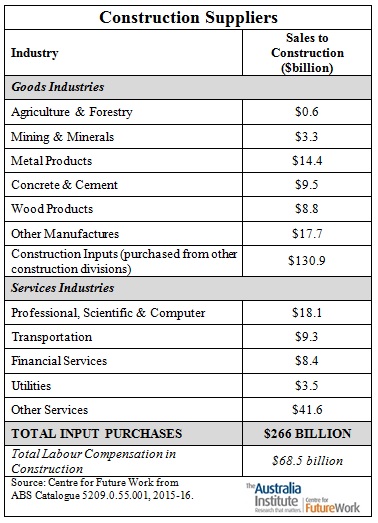
    The ABS table includes 113 different industries. Of those, fully 109 sell something to the construction industry. This includes everything from raw materials to sophisticated manufactures, from scientific laboratories to catering. The table below lists a few of the biggest construction suppliers – both goods and services. But virtually no part of the national economy is not connected somehow to construction.

    Construction Suppliers

    In total, construction firms purchase over one-quarter of a trillion dollars’ worth of supplies and services from those 109 industries (including purchases from other divisions of construction). In fact, the input purchases of the construction industry are four times bigger than the wages and salaries paid to construction workers – revealing again that the ABCC’s obsession with policing construction labour is mightily misplaced.

    Here are some of the more interesting sectors which report sales to the construction industry in the ABS tables:

    • Fishing and hunting ($70 million): Perhaps for trophies of big game to hang over the fireplace mantles of luxury homes?
    • Bakery products ($50 million): Donuts and pies, ‘nuff said.
    • Beer manufacturing ($4 million): This seems at first to be a gross underestimation. However, keep in mind that input-output tables do not include goods and services consumed by construction workers on their own time (in which case, this figure would surely measure in the billions!). Rather, it only includes purchases (tax deductible, of course) made by the companies. You can guess who drank the beer.
    • Veterinary medicines ($7 million): Must be for the nasty pit bulls at construction sites.
    • Gambling ($59 million): Given Australia’s speculative property bubble, it’s not a stretch to consider the whole housing industry to be a form of “gambling”!
    • Public order and safety ($769 million): That’s a biggie: security guards, CCTV cameras, and safety supplies. Conceivably the inflated salaries of the ABCC executives might even show up here: since they act in essence like a state police force.

    Of the 113 industries tracked by the input-output tables, only 4 do not report any sales to the construction sector. But even those sectors probably have some connection to the builders – perhaps once or twice removed:

    • Aquaculture: Construction purchasers buy from the fishing and hunting sector, but not from aquaculture. They must think wild salmon tastes better.
    • Library and other information services: Contrary to classist stereotypes, construction workers do indeed read books.
    • Primary and secondary education: The industry spends a lot on vocational and tertiary education; but school-level training isn’t counted (perhaps because it was completed before construction workers started their jobs).
    • Residential care and social assistance: This is certainly a necessary input for many construction workers – but only after they retire, are injured, or made redundant, and hence have left the industry.

    In short, basic economics confirms that the construction industry’s supply chains stretch into virtually every nook and cranny of the whole economy. If the overzealous autocrats at the ABCC are serious that their dominion extends to anyone who supplies construction, then their dominion extends to all of us.

    And that is an important, if unintended, lesson. If we allow this outrageous attack on the fundamental rights of assembly and expression of construction workers to proceed, then we are all ultimately vulnerable to the same repression. An injury to one really is an injury to all.


    You might also like

    Centre For Future Work to evolve into standalone entity

    The Centre for Future Work was established by the Australia Institute in 2016 to conduct and publish progressive economic research on work, employment, and labour markets. Supported by the Australian Union movement, the centre produced cutting edge research and led the national conversation on economic issues facing working people: including the future of jobs, wages

  • Budget 2019-20: Ooops, They Did It Again!

    Budget 2019-20: Ooops, They Did It Again!

    by Jim Stanford

    Share

    You would think that after 5 consecutive years of wage forecasts that wildly overestimated actual experience, the government might have learned from its past errors – and published a wage forecast more in line with reality. But not this government. They are still trying to convince Australian workers, who haven’t seen real average wages rise in over 5 years, that better times are just around the corner. And rosy wage forecasts are helpful in justifying their equally optimistic revenue forecasts: since if Australians are earning more money, they will be paying more taxes!

    So the 2019-20 Commonwealth budget, tabled Tuesday evening by Treasurer Josh Frydenberg, featured another valiant prediction that fast wage growth is indeed still “just around the corner.” Despite a slowdown in wage growth in the last months of 2018, this budget simply replicates last year’s wage forecast – but delayed by one more year. Crucially, there  is no discussion justifying why Australian workers might have confidence in this year’s forecast, when the last five so widely missed the mark (and always in the same direction).

    Our analysis of the 2019-20 Commonwealth budget focuses on the wages crisis facing Australian workers, and challenges the claim that cutting personal tax cuts can somehow compensate workers for the fact that their wages are not growing.

    Annual wage increases generate compounding benefits for workers and their families: since each year’s raise is applied against a larger and larger base. That cannot happen with tax cuts: to the contrary, their incremental effect can only shrink over time (as tax rates get lower and lower). Moreover, tax cuts always come with a significant cost: the loss of foregone public services, income supports and infrastructure that is the inevitable consequence of government’s shrinking revenue base.

    The tax cuts in this budget increase disposable incomes for workers by less than 1% (and by zero for the lowest-wage workers). In contrast, just one year of a normal wage increases delivers several times more benefits. And annual increases over three years (the term of the next government) delivers benefits dozens of times larger.

    Please read and share our full analysis of the 2019-20 budget below, which explains in detail how tax cuts cannot compensate for stagnant wages. You are also invited to view and share this short video summarising the argument (prepared with the help of our colleagues at the Australia Institute).


    Related documents


    2019-20 Commonwealth budget analysis

    You might also like

    Commonwealth Budget 2025-2026: Our analysis

    by Fiona Macdonald

    The Centre for Future Work’s research team has analysed the Commonwealth Government’s budget, focusing on key areas for workers, working lives, and labour markets. As expected with a Federal election looming, the budget is not a horror one of austerity. However, the 2025-2026 budget is characterised by the absence of any significant initiatives. There is

  • Jobs and a Living Wage

    Originally published in Arena on April 1, 2019

    Australians tend to bring a fair bit of swagger to international comparisons of economic performance. After all, Australia has experienced twenty-eight consecutive years of economic growth without a recession—a record for industrial countries. We are the ‘lucky country’, with one of the highest material living standards in the world, a wealth of natural resources, and a ‘no worries’ ability to withstand global economic shocks.

    The Australian policy journal Arena has published a wide-ranging article by Centre for Future Work Director Jim Stanford on the labour market issues at play in the current federal election.

    Stanford argues that the sense of “superiority” which typically accompanies economic debates during Australian election campaigns is muted in the current contest, because of the poor performance of the labour market in recent years. Unemployment and especially underemployment remain high; the quality of work has deteriorated; and wages have experienced their weakest performance since the end of the Second World War.

    Visit Arena’s website to read the full article.


    You might also like