Category: Law, Society & Culture

Research branch

  • Workers’ slice of Australian economic pie gets smaller

    Workers’ slice of Australian economic pie gets smaller

    Share

    As corporate profits continue to climb, new research from the Centre for Future Work shows the share of Australian GDP paid out to workers is hovering at a post-war low.

    The Australia Institute’s Centre for Future Work has today published a new research symposium documenting how workers’ slice of the national economic pie continues to get smaller.

    Key findings:

    • From peak levels of 58 per cent of GDP in the mid-1970s labour compensation — including wages, salaries, and superannuation contributions — declined to just 47 percent in 2017, their lowest level since 1960.
    • Real wages have consistently lagged behind the ongoing growth in labour productivity, meaning workers are not getting paid enough to buy back the goods and services they produce.
    • The loss of labour’s share of GDP translates into the redirection of over $200 billion in income per year from workers to other groups in society (mostly corporations).

    “In recent years, wages have barely kept up with consumer price inflation – and for many workers, they have fallen behind,” said Dr. Jim Stanford, Director of the Centre for Future Work.

    “The fact that the workers’ slice of the economic pie continues to get smaller speaks volumes about the lopsided power imbalance in today’s labour market.

    “The decline in Australia’s labour share from the 1970s peak to the present, ranks among the worst of all OECD countries, even worse than the United States.

    “Almost the entire decline in the labour share has been reflected in a corresponding increase in the share of GDP going to corporate profits – especially the financial sector.

    “In short, while the workers’ share has continued to get smaller, the share of corporate profits has continued to get larger.

    “By comparison, in some countries the labour share has been stable or rose during the same period, disproving the claim that this trend is somehow ‘universal’ or ‘inevitable’.

    “Without urgent measures to strengthen labour standards and protections, including stronger minimum wages and a restoration of meaningful collective bargaining, this decline will almost certainly continue.

    “The company tax cuts for big business now being proposed by the federal government are just the icing on top of an already-rich cake.”

    This research resulted from a special panel of experts convened by the Centre for Future Work, at the Society for Heterodox Economists conference at UNSW in Sydney last December. The papers from that panel have been peer-reviewed, and are published this week in the Journal of Australian Political Economy.

    Authors contributing to the symposium include Dr.David Peetz (Griffith University), Dr. Shaun Wilson (Macquarie University), Dr. Margaret Mackenzie (Economist, Australian Council of Trade Unions), and Dr. Jim Stanford (Economist and Director of the Centre for Future Work).


    Related research

  • Centre for Future Work at #ACTUCongress18

    Centre for Future Work at #ACTUCongress18

    by Jim Stanford

    Share

    Trade unionists from across Australia are gathering in Brisbane this week for the 2018 Congress of the Australian Council of Trade Unions. And the Centre for Future Work will be there!

    Come and check out our information booth in the exhibitors’ area: meet our staff, learn more about our work, and sign up for updates.

    Our Director Jim Stanford will be presenting as part of a session on The Future of Work (good title!), Tuesday July 17 at 2:15 pm in conference room P1.

    And we will be distributing copies of a brochure with links to some of our most recent research (attached below).

    We are glad that our research can support the campaign to #ChangeTheRules!


    Related documents


    Brochure

    Related research

    You might also like

    Commonwealth Budget 2025-2026: Our analysis

    by Fiona Macdonald

    The Centre for Future Work’s research team has analysed the Commonwealth Government’s budget, focusing on key areas for workers, working lives, and labour markets. As expected with a Federal election looming, the budget is not a horror one of austerity. However, the 2025-2026 budget is characterised by the absence of any significant initiatives. There is

  • Manufacturing Rebound Could Be Cut Short By Skills Shortage

    Manufacturing Rebound Could Be Cut Short By Skills Shortage

    Share

    After years of decline, Australia’s manufacturing industry is finally recovering – adding almost 50,000 jobs in the last year, one of the best job-creation records of any sector in the whole economy. But that recovery could be cut short by growing shortages of skilled workers, according to a new report on vocational training in manufacturing.

    The new report from the Centre for Future Work identifies key factors behind the rapid emergence of skills shortages in manufacturing, including:

    • The sector’s ageing workforce, creating a looming demographic transition for skilled worker
    • The highly specific nature of manufacturing skills (across sectors and occupations), creating difficulty for workers moving from between shrinking sectors to growing sectors
    • The need for new skills and ongoing training as companies adopt advanced manufacturing techniques and new digital technologies.

    “Manufacturing is again making a positive contribution to Australia’s economic progress after over a decade of decline. We don’t want to squander this potential,” said Dr. Jim Stanford, Director of the Centre for Future Work.

    “If Australia doesn’t get its act together on vocational training, this will be a wasted opportunity for manufacturing.

    “Recent experiments with market-based vocational training have been a waste, they have damaged confidence in the skills system among both potential students and employers.

    “Stable, well-funded, high-quality public institutions must be the anchors of any successful VET system.

    “Public institutions are the only ones with the resources, the connections, and the stability to provide manufacturers with a steady supply of world-class skilled workers.

    “No sector feels the pain of the failure of vocational training more than manufacturing, precisely because advanced skills are so essential for the success of advanced manufacturing techniques.

    “Manufacturing stakeholders need to work together to strengthen vocational education and training.”

    Key principles for rebuilding vocational education in manufacturing, discussed in the report, include:

    • A greater reliance on courses and apprenticeships through public-sector TAFE (rather than private providers)
    • Phased-in retirement programs to allow senior workers to pass on their skills to new apprentices
    • Inclusion of provisions guaranteeing access to further training in industry awards and enterprise agreements.

    The report was co-authored by Dr. Jim Stanford and Dr. Tanya Carney and prepared for the Second Annual National Manufacturing Summit at Parliament House on 26 June 2018.

    The National Manufacturing Summit engages leading representatives from all parts of Australian manufacturing: businesses, peak bodies, unions, universities, the financial sector, suppliers and government. The growing problem of skills shortages is a priority focus for this year’s Summit.


    Related research

  • Advanced Skills for Advanced Manufacturing

    Advanced Skills for Advanced Manufacturing

    by Jim Stanford and Tanya Carney

    Australia’s manufacturing industry is at a crossroads.  After years of decline, the sector has finally found a more stable economic footing, and many indicators point to an expansion in domestic  manufacturing in the coming years.  Manufacturing added almost 50,000 new jobs in the last year – making it one of the most important sources of new work in the whole economy.

    However, one key factor that could hold back that continuing recovery is the inability of Australia’s present vocational education and training system, damaged by years of underfunding and failed policy experimentation, to meet the needs of manufacturing for highly-skilled workers.  The skills challenge facing manufacturing is all the more acute because of the transformation of the sector toward more specialised and disaggregated advanced manufacturing  processes.  This naturally implies greater demand for highly-trained workers, in all its occupations: production workers, licensed trades, technology specialists, and managers.

    To sustain the emerging turnaround in manufacturing, the sector has an urgent need for a concerted and cooperative effort to strengthen vocational education and training. This report contributes to that process: by cataloguing the emerging skills challenges facing manufacturing, reviewing the failures of the existing approach to vocational education in this sector (and across Australia’s economy as a whole), and proposing twelve key principles for reform.

    This report, by Dr. Tanya Carney and Dr. Jim Stanford, was prepared by the Centre for Future Work for the Second Annual National Manufacturing Summit.  The Summit, held at Parliament House on 26 June 2018, will gather leading representatives from all major stakeholders in Australia’s manufacturing sector: business, unions, universities, the financial sector, suppliers and government. They will consider the industry’s prospects and identify promising, pragmatic policy measures to support a sustained industrial turnaround.  It is a highly appropriate forum at which to begin a discussion about multi-partite efforts to rebuild vocational education and address the looming skills challenges facing manufacturing.


    Full report

    Share

  • A Comprehensive and Realistic Strategy for More and Better Jobs

    A Comprehensive and Realistic Strategy for More and Better Jobs

    by Jim Stanford

    Share

    The Australian Council of Trade Unions has released a major policy paper outlining an ambitious, multi-faceted program to address the chronic shortage of work, and the steady erosion of job quality, in Australia. The full paper, Jobs You Can Count On, is available on the ACTU’s website.  It contains specific proposals to stimulate much stronger job-creation, reduce unemployment and underemployment, improve job quality (including through repairs to Australia’s industrial relations system), and ensure that all communities (including traditionally marginalised populations like indigenous peoples, women, youth, and people with disability) have full access to the decent work opportunities that the plan would generate.

    Dr. Jim Stanford, Director of the Centre for Future Work, reviewed the ACTU’s paper in detail, and prepared an evaluation of its proposals and likely effects. Stanford endorsed the policy’s complementary set of expansionary macroeconomic measures, which would strengthen every major component of aggregate demand in the national economy: including government programs, capital investment, net exports, and consumer spending. He also emphasised the importance of the paper’s vision for a stronger labour market information and planning system, which will be essential to effectively match workers with jobs as the labour market tightens.

    Stanford estimated that the ACTU’s plan, if implemented consistently over a five-year period, would be capable of achieving the following outcomes:

    • Unemployment rate falling to 4 percent or lower.
    • Share of full-time work rebounding toward 75 percent of employment (since employers will be pressured by falling unemployment to create full-time jobs).
    • Underemployment rate falling to fall to 5 percent or lower.
    • Incidence of casual work declining below 20 percent.
    • Labour force participation rising by at least 2 percentage points, especially among young workers.
    • Nominal wage growth accelerating to traditional rates of 4 percent per year.

    Read the complete ACTU paper, Jobs You Can Count On.


    Related documents


    Report review

    You might also like

  • A Portable Training Entitlement System for the Disability Support Services Sector

    A Portable Training Entitlement System for the Disability Support Services Sector

    by Rose Ryan and Jim Stanford

    A new proposal for a portable training system for disability support workers under the NDIS would help to ensure the program achieves its goal of delivering high-quality, individualised services to people with disabilities. The proposal is developed in a new report from the Centre for Future Work.

    Under the plan, disability support workers would receive credit for one hour of paid training, for every 50 hours worked in NDIS-funded service delivery.  Those credits would be vested with each individual worker, allowing them to accumulate credits even if they work for multiple employers or directly (as sole traders) for NDIS participants.  The training system thus takes account of the very flexible and mobile nature of work in this growing sector. 

    The system would allow a typical disability support worker to access one three-day upgrading course per year. A corresponding system of advanced recognised qualifications (and matching job classifications) would provide specialised pathways allowing disability support workers to develop their careers over time, thus reducing the very high staff turnover that has bedevilled the roll-out of NDIS services.

    The proposal is detailed in a new 70-page report, A Portable Training Entitlement System for the Disability Support Services Sector, co-authored by Dr. Rose Ryan and Dr. Jim Stanford.

    The NDIS has the potential to enrich the lives of people with disabilities through customised individual packages of services. But to achieve that goal, the system must facilitate ongoing investments in specialised skills and qualifications, rather than relying on short-term ‘gigs’ performed by high-turnover, casualised workers.

    Most disability support workers are employed in part-time or casual jobs, and spending on staff training by established service providers has shrunk as the NDIS has been rolled out.  The NDIS is expected to spur massive job-creation in coming years, adding as many as 70,000 full-time-equivalent positions, but evidence is accumulating that the quality of many jobs is very poor, undermining stability of the workforce and the quality of delivered services.

    Cost estimates suggest the overall scheme would require $192 million per year in additional funding, which the authors suggest should be delivered through a separate state-Commonwealth funding stream (to avoid undermining the revenue base for delivered services). Compared to the $22 billion annual pricetag for the NDIS, the authors suggest this cost is modest: less than one cent on the dollar to support the development of a workforce with state-of-the-art knowledge and training.


    Full report

    Share

  • Scare Tactics for Corporate Tax Cuts Do Not Stand Fact Checks

    Scare Tactics for Corporate Tax Cuts Do Not Stand Fact Checks

    by Anis Chowdhury

    Share

    In the wake of the Trump Administration’s success in pushing a major company tax cut through the U.S. Congress, the Australian Treasurer has stepped up his calls for reduced company taxes here. He claims Australia will bypass the growth-inducing benefits of these tax cuts, but Dr. Anis Chowdhury, Associate of the Centre for Future Work, has compiled the economic evidence.  The U.S. experience shows no statistical evidence of any “trickle-down” growth dividend from company tax cuts.

    “Trump tax cuts: Scott Morrison warns business will abandon Australia while we are at the beach” was the Sydney Morning Herald headline, reporting on the Coalition Government’s scare tactics to press through its tax cuts gift for business.  The Treasurer used the opportunity of the Trump tax cuts to issue this “dire” warning. However, his claim does not withstand some basic empirical scrutiny.

    Fact 1: Australia is not a high tax country

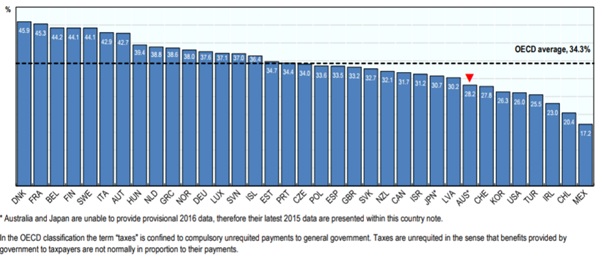
    Our overall tax take is one of the lowest among the 35 OECD countries. If Mr. Morrison was correct, then by now there should have been a tsunami of investment flowing here from 27 OECD countries with higher tax-GDP ratios than that of Australia’s 28.2% in 2016. Australia’s overall tax ratio is well below the OECD average of 34%, and also below neighbouring New Zealand’s tax take of 32.1% of GDP.

    Here are reported tax ratios for 27 OECD countries, 2016.

    OECD Tax Shares
    Source: Revenue Statistics 2017 – Australia; https://www.oecd.org/tax/revenue-statistics-australia.pdf

    Fact 2: Australia’s effective corporate tax is far below its statutory 30% rate

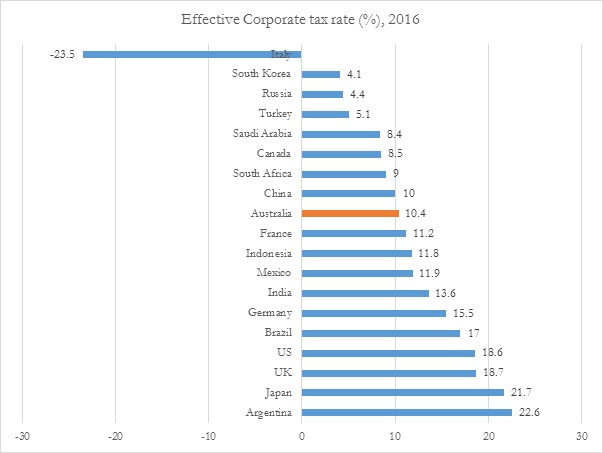
    Australian companies may seem to face a higher statutory corporate tax rate, but once they go through all their deductions and credits they don’t end up paying an unusually high amount compared to companies in other nations. The average effective rate (10.4%) is barely one-third the statutory rate. In fact, more than a third of large companies did not pay any corporate taxes in 2016 according to the recently released ATO data.

    Effective vs Statutory Tax Rates
    Source: National Public Radio, based on US Congressional Budget Office data; https://www.npr.org/2017/08/07/541797699/fact-check-does-the-u-s-have-the-highest-corporate-tax-rate-in-the-world

    Fact 3: Tax is low on companies’ lists of factors influencing investment location decision

    For example, the OECD noted, “it is not always clear that a tax reduction is required (or is able) to attract FDI. Where a higher corporate tax burden is matched by well-developed infrastructure, public services and other host country attributes attractive to business… tax competition from relatively low-tax countries not offering similar advantages may not seriously affect location choice. Indeed, a number of large OECD countries with relatively high effective tax rates are very successful in attracting FDI.”

    This is corroborated by the most recent World Bank survey of enterprises, which found that tax incentives are not high on the list of critical factors affecting inflows of foreign direct investment. The IMF’s recent research also reports that the net impact of corporate tax cuts to incentivise private investment is quite often negative on government revenues.  The pre-tax profitability of Australian businesses has also tended to exceed that in other countries, and this is surely more important in motivating investment flows.

    Fact 4: Rigorous studies of past US tax cuts did not find a positive link between tax cuts and economic or employment growth

    For example, the oft-cited examples of the Reagan or Bush tax cuts do not in fact demonstrate that tax cuts cause growth.  Admitted by President Reagan’s former chief economist, Martin Feldstein, the vast majority of growth during the Reagan era was due to expansionary monetary policy that slashed interest rates massively to help the economy bounce back from a severe recession in 1982.  Increased defence spending and an expanded labour force due to an influx of baby boomers also boosted the economy. In another study with Doug Elmendorf, the former Congressional Budget Office Director, Martin Feldstein found no evidence that the 1981 tax cuts increased employment.

    The 2001 and 2003 Bush tax cuts also failed to spur growth. Between 2001 and 2007 the economy grew at a lacklustre pace—real per-capita income rose by 1.5% annually, compared to 2.3% over the 1950-2001 period. Interestingly, the two sectors that grew most rapidly in this period were housing and finance, which were not affected by the 2001 and 2003 tax cuts.  Moreover, by 2006, prime-age males were working the same hours as in 2000 (before the tax cuts), and women were working less – both facts inconsistent with the view that lower tax rates raise labour supply.

    Fact 5: The most infamous case of tax cuts in the US State of Kansas was a colossal failure

    Governor Sam Brownback promised that a moderate tax cut for individuals and a big tax cut for businesses would be “like a shot of adrenaline into the heart of the Kansas economy.”  Unfortunately, however, despite his 2012 tax cuts, the Kansas economy remained moribund, while neighbouring states surged ahead. In the process, the Kansas state budget was left in tatters. No wonder that the Republican-led state legislature reversed most of Brownback’s tax cuts in the face of poor growth and pressing public spending needs.

    Therefore, if Mr. Morrison is serious about repairing the budget, or stimulating growth and employment, then he should be concentrating on raising more revenues (not less) and investing in the nation – instead of cutting basic services to fund his tax cuts for the rich. He should be looking at the facts, instead of resorting to scare tactics.


    You might also like

    Commonwealth Budget 2025-2026: Our analysis

    by Fiona Macdonald

    The Centre for Future Work’s research team has analysed the Commonwealth Government’s budget, focusing on key areas for workers, working lives, and labour markets. As expected with a Federal election looming, the budget is not a horror one of austerity. However, the 2025-2026 budget is characterised by the absence of any significant initiatives. There is

    Centre For Future Work to evolve into standalone entity

    The Centre for Future Work was established by the Australia Institute in 2016 to conduct and publish progressive economic research on work, employment, and labour markets. Supported by the Australian Union movement, the centre produced cutting edge research and led the national conversation on economic issues facing working people: including the future of jobs, wages

  • Wage Suppression a Time Bomb in Superannuation System

    Wage Suppression a Time Bomb in Superannuation System

    by Jim Stanford

    The record-slow pace of wage growth in Australia’s economy is not just making it difficult for families to balance their budgets, it also threatens severe long-run damage to Australia’s superannuation retirement system.  That’s the finding of new research from the Centre for Future Work at the Australia Institute.

    A key factor behind the wage slowdown in Australia has been the aggressive measures implemented by employers in recent years to suppress wage growth, and even to significantly cut wages.  These actions directly undermine superannuation savings, and hence the future retirement incomes of affected workers.

    This new report from the Centre for Future Work simulates the impacts of eight specific wage suppression strategies on workers’ superannuation balances – ranging from temporary wage freezes, to wage caps, to more dramatic actions (such as widespread wage theft in retail and fast food franchises, reduced penalty rates for Sunday work, and the outright termination of enterprise agreements).  In every case, workers’ superannuation payments are negatively affected by the suppression in wages below normal trajectories.  The damage is then compounded over many years by the subsequent loss of investment income on foregone superannuation contributions.

    The report estimates that for a 40-year-old worker experiencing one of the simulated wage-suppressing measures, superannuation balances would be cut by between $30,000 and $270,000 by the time they retire.  Simulated effects depend on the worker’s starting income, gender, inflation, and other factors.

    The worst impacts are experienced in the case of enterprise agreement termination, an increasingly common strategy invoked by employers to cut wages by 40 percent or more.  If allowed to stay in place, wage cuts on this scale produce losses in workers’ superannuation savings that can exceed one-quarter million dollars per person.

    Aggregated across the millions of Australian workers who have experienced one or more of these wage-suppressing strategies, the overall costs of continuing wage suppression on superannuation savings would ultimately amount to many tens of billions of dollars.  Based on plausible estimates of the number of workers affected by wage suppression, the report predicts a total loss of superannuation savings that could reach $100 billion (in real 2017 dollar terms). In essence, employers’ efforts to suppress wage growth have planted a time bomb in Australia’s retirement system

    Government (and hence all Australians) will also bear a significant share of the resulting costs: tax revenues on superannuation contributions and investment income will be lower, and payouts of Age Pension benefits will be significantly larger (since workers’ own superannuation incomes will be reduced).  The report estimates the damage to government budgets at between $31 and $37 billion (in real 2017 dollar terms) if these wage suppression measures are allowed to stand.

    This report was commissioned by the Transportation Workers Union.


    Full report

    Share

  • Labour Share of Australian GDP Hits All-Time Record Low

    Labour Share of Australian GDP Hits All-Time Record Low

    by Jim Stanford

    Amidst increasing concerns among economists and budget forecasters about the historic stagnation of Australian wages, the latest GDP statistics from the Australian Bureau of Statistics have confirmed that the proportion of national economic output that is paid to workers has reached an all-time low.


    Full report

    Share

  • Budget Wrap-Up

    Budget Wrap-Up

    Share

    Commonwealth Treasurer Scott Morrison tabled his 2017-18 budget in Parliament House on May 9, and the Centre for Future Work’s Director Jim Stanford was there in the lock-up to analyse its likely impacts. Here are some of our main impressions and comments:

    Wage Growth and Deficit Reduction

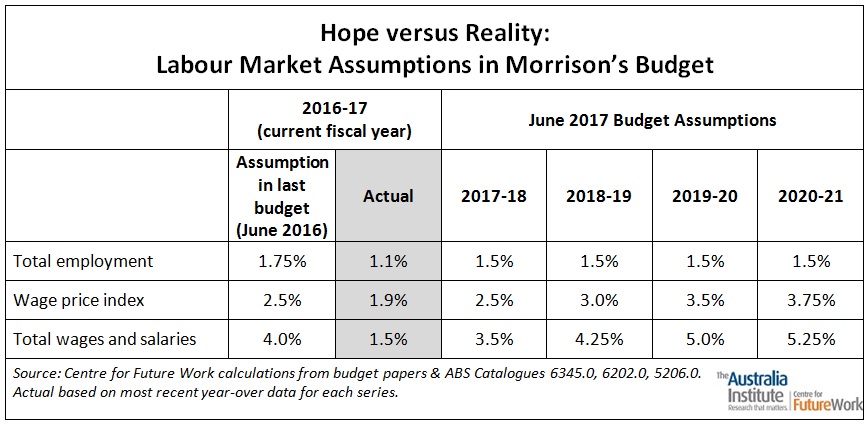
    Several commentators have highlighted the budget’s highly optimistic assumptions regarding future job-creation and wage growth incorporated into the budget forecast. The government is anticipating an immediate and sustained acceleration of all of the factors that contribute to the wage base for tax revenue: faster job-creation, significantly faster growth in hourly pay, and dramatically faster growth in total wages and salaries.

    Back in the real world, the labour market has been underperforming on ALL THREE of those components: slow job-growth, record slow growth in hourly wages, and falling weekly hours of work (due to the dramatic expansion of part-time and irregular work). For all of these reasons, total wages and salaries paid out in the economy (which forms the major basis for personal tax collections, both income and GST) actually declined in the latest quarter of GDP (Dec 2016).
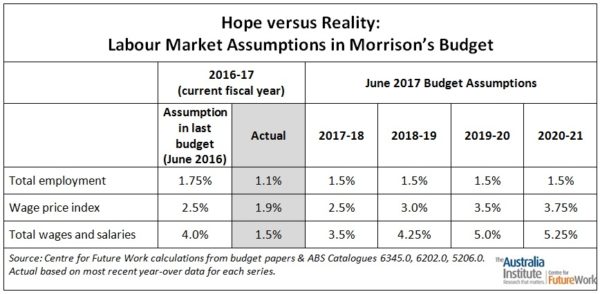
    This table summarises the main wage assumptions in Mr. Morrison’s budget, contrasting them to the latest actual figures on each of the three criteria. The last budget (2016-17) missed the mark badly on all three criteria — but the likely undershooting error will be huge by the end of this budget’s forward estimates, unless there is a dramatic and sustained acceleration of employment and wages growth.

    Director Jim Stanford pointed out in this Huffington Post column that the current weakness in Australian wages is not an accident, nor is it likely to reverse automatically. Chronically weak aggregate labour market conditions, combined with structural attacks on the institutions that support wages (including unions, minimum wages, penalty rates, and others), have caused the unprecedented stagnation of wage incomes in Australia. The macroeconomic consequences of this state of affairs have been widely acknowledged — even by the government itself. (Mr. Morrison himself spoke recently of his concern with the impact of wage stagnation on his own budget targets.)

    As Stanford put it in his Huffington Post commentary, the contradiction between the government’s wage-suppressing economic and regulatory policies, and its hope that wage growth will nevertheless power the way to a balanced budget, is both glaring and unsustainable:

    “[Morrison’s] rose-coloured labour market assumptions will be sabotaged by his own government’s continuing war on workers and wages. And that’s one important reason why his hopeful deficit targets will not be realised.”

    General Optimism Regarding Revenue

    The budget’s optimistic wage growth assumptions are just one factor behind an overall revenue forecast that is downright ebullient. The main force behind the projected return to a balanced budget is an enormous assumed increase in tax revenues — very ironic coming from a government that regularly derides the alleged “tax-and-spend” procilivities of its opponents. Over the four years of the forward projection, annual revenues are expected to expand $120 billion by 2020-21 (or 30 percent). As a share of GDP, revenues are expected to swell by 2.2 percentage points, reaching the highest share (25.4% of GDP) since the peak of the mining boom (in 2005-06).

    There is no clear explanation of where these huge new revenues come from – especially given the revenue-reducing effect of other budget measures, including company tax cuts, the elimination of the deficit repair levy for high-income earners, last year’s bracket adjustments, and others. There are some modest revenue measures in the budget: including the 0.5% Medicare levy increase (after 2019), the levy on bank liabilities, and a new levy on employers who hire migrant labour. But those policy decisions account for just 6.5% of all new revenues assumed to be received over the coming 4 years — and they will be more than offset by the revenue losses from the other measures (especially the company tax cuts).

    If revenues stay constant as a share of GDP (instead of magically growing), the budget will be $45 billion short in 2020-21 – and the forecast small surplus will evaporate into a large continuing deficit. Indeed, as our colleagues at the Australia Institute have pointed out, this budget marks the fourth consecutive four-year LNP timetable for balancing the budget. The government’s tough talk on the dangers of deficit-financing, and stated intention to quickly achieve balance, have proven hollow. Many of its proposed spending cutbacks have been successfully resisted by community campaigning. And its rosy revenue forecasts have been consistently unfounded. There is no reason to believe this year’s four-year deficit elimination timetable is any more realistic than the last three.

    Robbing Peter to Pay Paul

    On the spending side, the government is announcing some modest new spending initiatives, totaling $9 billion over 4 years.

    But at the same time, they are announcing spending cuts to a wide range of programs (including higher education, welfare, and civil servants) – totaling $10 billion over the same period.

    The net impact of new policy decisions on spending is therefore $1 billion in the negative. Despite the promise of “better times” in the future, the government’s discretionary actions will reduce aggregate funding for the programs that Australians depend on.

    A Target Everyone Can Love: The Big Banks

    The government’s new 6 basis point “levy” on bank liabilities (ie. on outstanding loans) is forecast to raise $6.2 billion over 4 years.

    Many analysts believe this tax will be passed on to borrowers (since it is defined as a proportion of lending), and the government has not provided a convincing refutation of this concern. The levy is equivalent to a slight increase in the cost of capital for new lending. (In fact, this new “levy” is smaller than recent increases in interest rates which the banks have already passed on to their borrowers.)

    The government’s claim that the ACCC, with increased funding, will ensure the banks do not pass on the costs of the levy is laughable — as is its claims that competition from smaller banks will keep the big banks in line. Unless there is outright collusion and price-setting between the banks (something that is rare and unnecessary anyway), there is nothing illegal about passing on higher costs to consumers. Indeed, the ability to do this is precisely what explains the banks’ consistent above-normal profits (earning return on equity of 15 percent or more each and every year).

    At any rate, once the banks start to benefit from the full 5% reduction in their own corporate taxes (by 2026-27), they will still be saving billions each year on a net basis.

    The eminent economist Prof. Geoffrey Harcourt, a good friend of our Centre, put it this way in a blog comment:

    “The discussions on the levy/tax on the big four banks in the 2017 budget are often hysterical and beside the point. Because banks play an essential role in the running of the economy, they need protection through a guarantee from the government. Because of their oligopolistic market structure, they are in a privileged position to make large profits, a portion of which reflects their necessary privileged position, rather than any merit of their own. Common sense suggests that it would be both efficient and equitable that the banks be allowed to receive, say, the average rate of profits ruling in the economy as a whole without being taxed differently than any other form of enterprise in Australia. If their overall rates of profit are greater than the average – which they certainly are – the differences between the two sets of rates should be subject to a higher rate of tax so that the community at large receives a return on the privileged position the banks have been necessarily granted. The proposed levy is roughly akin to this proposal, which is tackling an equitable puzzle. It should not, in principle, be related to what is happening to the budget overall and especially to the sizes of any deficits or surpluses. These should reflect the outcome of attempting to meet the real aims of good government starting with achieving and sustaining full employment and sustainable growth.”

    Infrastructure Spending: Show Us the Money

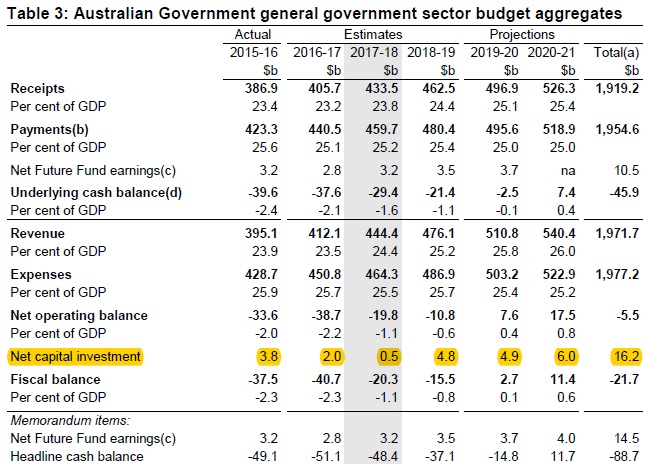
    The government is boasting of $75 billion in infrastructure funding and financing over the next ten years. It is impossible to know how much of this represents new funds, nor when the funds would be delivered. Keep in mind that at present the government already spends over $18 billion per year on capital (or $200 billion over the next decade): both on new projects, and offsetting the wear and tear of existing assets. So the $75 billion “plan” ($7.5 billion per year) may or may not represent a substantial ramp-up in new capital spending by Canberra.

    In fact, the details of the budget do not seem to indicate any enormous expansion in capital spending. Net capital spending (after depreciation) is projected to decline in 2017-18: to just $0.5 billion, the smallest since 2002-03. (See Budget Table 3, reprinted below.) In essence, in the first year of the budget, the government will spend barely enough to offset depreciation of existing assets.
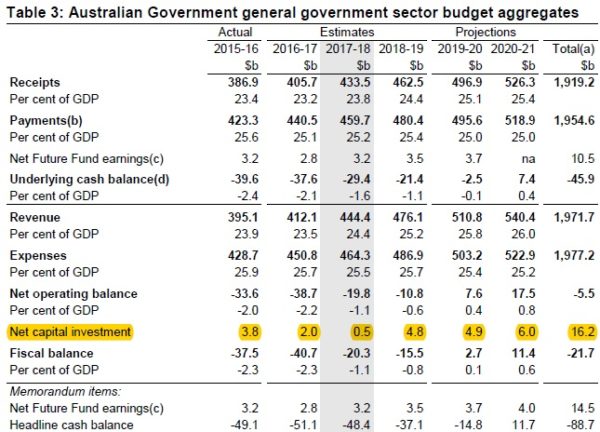
    Net investment grows in later years, but not dramatically. And as a share of GDP, net capital spending by the Commonwealth is projected to average just 0.2% of GDP over the forward projections. Over the last ten years, in contrast, it averaged 0.25% of GDP. In other words, under this budget, net Commonwealth capital spending will actually shrink relative to the economy.

    It is easy to come up with “big numbers” when talking about infrastructure programs (especially by summing totals over many years), and associated ribbon-cutting ceremonies will attract much attention. But there is no concrete evidence that this budget will accomplish the real and sustained increase in Commonwealth government capital spending that is needed. Commonwealth capital spending has declined in recent years compared to earlier decades, and there is no evidence that this budget will change that trend.

    Migrant Labour and Apprentices

    The government is imposing a new “head tax” on employers who hire foreign migrants: $1200 to $1800 per year per head for temporary migrants, and $3000 to $5000 for each permanent migrant (on a one-time basis). The revenues from this levy will be used to fund support for apprenticeships in conjunction with the states, to a total of $1.2 billion over the next 4 years.

    Funding skill programs through a tax on migrant labour is not an effective way to rebuild Australia’s battered vocational education system – nor is it an effective way to regulate employers’ over-reliance on temporary foreign migrants (rather than recruiting and training Australian workers). Indeed, the scale of revenues anticipated by the government suggests that incoming migrant labour will continue to constitute a major force in Australia’s labour market.

    Effectively regulating and reforming Australia’s migrant labour system – limiting its use to classifications where skilled workers are truly unavailable, and ensuring that migrant workers are entitled to the same protections as all other workers – would in fact undermine the head tax revenues that the government is now counting on.

    Check Out The Australia Institute’s Budget Analysis

    Our colleagues at the Australia Institute have also generated some useful and punchy commentary on the budget: see it all (including a hilarious podcast with economists Richard Denniss and Matt Grudnoff) on the Institute’s Budget Wrap page.


    You might also like

    Commonwealth Budget 2025-2026: Our analysis

    by Fiona Macdonald

    The Centre for Future Work’s research team has analysed the Commonwealth Government’s budget, focusing on key areas for workers, working lives, and labour markets. As expected with a Federal election looming, the budget is not a horror one of austerity. However, the 2025-2026 budget is characterised by the absence of any significant initiatives. There is

    Centre For Future Work to evolve into standalone entity

    The Centre for Future Work was established by the Australia Institute in 2016 to conduct and publish progressive economic research on work, employment, and labour markets. Supported by the Australian Union movement, the centre produced cutting edge research and led the national conversation on economic issues facing working people: including the future of jobs, wages