Category: Law, Society & Culture

Research branch

  • Pain of penalty rate cuts can not be avoided through transition measures

    Pain of penalty rate cuts can not be avoided through transition measures

    Share

    Analysis from The Australia Institute’s Centre for Future Work has shown that proposals for phasing in lower penalty rates for work on Sundays and holidays will not “protect” the workers affected by those cuts, and in some cases would make things worse.

    Simulations of various proposals from political and business leaders for deferring lower penalty rates, making offsetting adjustments in base wages, and/or “grandfathering” the wages of people already employed in the sector, suggest that none are capable of truly avoiding the resulting hardship.

    “Taking several years to implement a painful, damaging policy does not erase the impacts of that policy,” said Jim Stanford, Economist and Director of The Centre for Future Work, and the report’s author.

    “There appears to be a lack of understanding by some as to how much Sunday and holiday wages will fall under these proposals.  A wage cut of that scale can’t be disguised simply by introducing it in stages.”

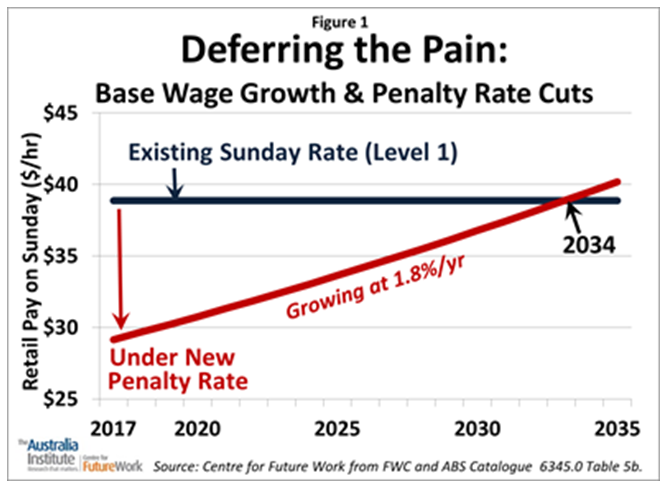
    The Centre’s report investigates the Prime Minister’s suggestion that penalty rate cuts could be “offset” by the impact of normal wage increases over time.  At current rates of wage growth, it would take 17 years until higher base wages for retail workers fully offset the effect of lower penalty rates on nominal incomes.

    CFW Pen rate

    Making matters worse, ongoing inflation during those 17 years would reduce the real purchasing power of wages by 22 percent: almost equal to the reduction in Sunday pay proposed.

    Another transition proposal is to lift the minimum wage for retail and hospitality workers – either gradually or all at once.  The report shows that this would substantially increase weighted average labour costs across retail and hospitality sectors by up to 25 percent (since the higher base wage must be paid to workers on other days of the week, too).  This approach would be fiercely resisted by retail and hospitality employers.

    “Grandfathering” wages of existing retail and hospitality workers is also not feasible, largely because employers can easily reschedule existing workers to other days of the week, or even end their employment altogether.

    “The reduction in penalty rates for retail and hospitality workers will have a significant, negative impact on hundreds of thousands of employees, who are already among Australia’s most low-paid, insecure workers.

    “It is impossible to imagine a phase-in system to protect their compensation, when the whole point of this decision is to reduce it,” Stanford said.

    Stanford noted that lower penalty rates will exacerbate the problem of wage stagnation, which he argues is a more serious threat to growth and job-creation in Australia than penalty rates.


    Related research

  • Women’s Wages and the Penalty Rate Cut

    Women’s Wages and the Penalty Rate Cut

    by Jim Stanford

    Today is International Women’s Day, a time to reflect on the continued inequality faced by women — including in the world of work.  Traditional measures of the “gender pay gap” indicate that women earn around 17 percent less than men, in ordinary pay in equivalent full-time positions.  But the situation is worse than that, because of women’s disproportionate concentration in part-time work.  Including part-time workers, women now earn exactly one-third less than men.

    The Fair Work Commission’s announcement of coming reductions in penalty rates for Sunday and holiday work (of up to 50 percentage points of base wage) in the retail and hospitality sectors will clearly (if implemented) exacerbate the gender inequality in earnings.

    After all, the retail and hospitality sectors are among the biggest employers of part-time workers, very often in casual and irregular positions.  Women make up most of the workforce in both sectors, and they occupy an even larger share of part-time positions: 70 percent of women in food and beverage services, and 60 percent of women in retail, are in part-time jobs.  Most of the workers whose Sunday wages will be cut are women — and they were already among the lowest-earning workers in the entire labour force.

    If this decision was a “gift” to workers from the FWC (as some politicians have described it), wrapped up and delivered just in time for International Women’s Day, women should definitely send it back.


    Full report

    Share

  • Employers’ pyrrhic penalty rates win reflects self-defeating economics

    Originally published in The Sydney Morning Herald on February 24, 2017

    The Fair Work Commission unveiled its long-awaited decision on penalty rates for Sunday and holiday work this week. Penalty rates for most retail and hospitality workers will be cut, by up to 50 percentage points of the base wage. Hardest hit will be retail employees: their wages on Sundays will fall by $10 an hour or more. For regular weekend workers, that could mean $6000 in lost annual income.

    The equity implications of the commission’s decision are odious. Store clerks and baristas are already among the least-paid, least-secure members of Australia’s workforce. The retail and hospitality workforce is disproportionately female, young and immigrant. Most work part time, and casual and labour-hire positions are common. In short, the burden of this decision will be borne by those who can least afford it.

    Penalty rate cut: how did it happen?

    Workplace reporter Nick Toscano contextualises the Fair Work Commission’s announcement on Thursday that Sunday penalty rates paid in retail, fast food, hospitality and pharmacy industries will be reduced from the existing levels.

    Remember, too, that it’s in retail and hospitality that recent scandals regarding underpayment of wages and other violations of labour law have been rife. Weakening labour standards that are already poorly enforced thus constitutes a double jeopardy for service workers.

    It’s notable that the commission only targeted low-paid service workers with this review of penalty rates. There are many other people who need to work Sundays and holidays, including emergency personnel, essential service workers, healthcare workers and others. The commission stressed it wasn’t calling for those workers to lose their penalties, too (although employers everywhere are no doubt preparing to push to extend this precedent to other industries). If it’s all about changing “cultural norms” regarding weekend work, then why have these low-paid service jobs been singled out?

    All of this says much about the political and economic context for the Fair Work Commission’s deliberations. There was no emergency in Australia’s retail and hospitality sector; no crisis that needed immediate attention. It’s not that stores and restaurants couldn’t do business on Sundays under the existing rules; any casual observer can attest to the brisk trade that now takes place right through the weekend. It’s just that those businesses would be considerably more profitable if wages were lower.

    So penalty rates became the target of a sustained pressure campaign by business, backed by conservative political leaders. The commission heard those complaints and acceded to them. Whatever the precise wording of the commission’s legislative mandate, it was never envisioned as a mechanism for rolling back employment standards; it was supposed to protect them. This decision will therefore spark a political debate not only over the merits of this specific decision, but over the commission’s overall mandate and function.

    The politics of that debate will be complicated. Coalition leaders are hiding behind the commission’s supposed neutrality – although they are clearly pleased with the decision (and many explicitly lobbied for it). Labor’s response, meanwhile, is coloured by the fact that it created this commission; Bill Shorten now promises to adjust its mandate. None of this will stop the anger among working-class families who’ll lose income because of this decision. The threat to penalty rates was a potent doorstep issue for union campaigners across Australia before the last election, which the Coalition almost lost. It will be an even hotter button in the next one.

    The economics of the rollback are even more muddled than the politics. Retail lobbyists claim the decision will unleash a surge of new job creation, but those promises are hollow. After all, the market for retail and hospitality services depends primarily on the strength of domestic consumer spending power – more so than any other part of the economy. Australians have a certain amount of disposable income. Will they shop more, and eat out more, just because stores and restaurants stay open longer? Of course not.

    To the contrary, slashing retail and hospitality wages can only undermine demand for the very services that these businesses are selling. It’s incredibly ironic that, even as the commission’s Judge Iain Ross read his judgment on live television, the Australian Bureau of Statistics was releasing yet another dismal report on national wage trends. Average weekly earnings in the period to last November grew at an annualised rate of just 0.4 per cent: slower than any other point in the history of the data, and well behind the rate of inflation. This reflects both the stagnation of hourly wages, and the continuing shift to part-time and casual work (for which retail and hospitality employers are among the worst culprits).

    So this won’t increase the amount of money Australians have to spend in shops and restaurants. Instead, there will be an incremental decline. If stores actually do stay open longer hours, the same spending must now be spread across longer operating hours, driving down productivity. Retail lobbyists should be careful what they ask for.

    Meanwhile, employment in these industries will continue to reflect bigger, structural forces. For example, the whole Australian retail sector has created precisely zero net jobs over the last three years, largely because of the structural shift to big-box retailing (which employs fewer workers per unit of sales). That’s not going to change just because big-box stores can now pay their staff $10 an hour less.

    In short, Australia’s economy isn’t held back because wages are too high. It’s held back because wages are too low. And the stagnation of wages is no accident: it’s the cumulative result of years of deliberate efforts to weaken the power of wage-setting institutions (including unions, minimum wages and awards). The Fair Work Commission chopped away a little more of that edifice this week.

    The greatest irony is that it’s retail and hospitality businesses – which led the push to cut weekend wages – that confront the weakness of household spending power most directly. Each employer may individually celebrate the prospect of paying lower wages. Yet for their industry as a whole, this decision is collectively irrational and ultimately self-defeating.

    Jim Stanford is economist and director of the Centre for Future Work at The Australia Institute.


    You might also like

  • Economic Aspects of Paid Domestic Violence Leave Provisions

    Economic Aspects of Paid Domestic Violence Leave Provisions

    by Jim Stanford

    Economic insecurity is one of the greatest factors inhibiting victims of domestic violence from escaping violent situations at home.  To address that problem unions and employers have developed paid domestic violence leave provisions which allow victims to attend legal proceedings, medical appointments, or other events or activities related to the violence they have experienced, without risk of lost income or employment.  Proposals have now been made to extend that provision to more Australian workers, by including a paid domestic violence leave provision in the Modern Awards (presently being reviewed by the Fair Work Commission), and/or by including it as a universal entitlement under the National Employment Standards.

    This report considers the likely impact of such an extension on the payroll costs of employers, and finds it to be so small it would be difficult to measure: we estimate that incremental payments to workers taking the leave would amount to one-fiftieth of one percent (0.02%) of current payrolls.

    These findings refute recent statements by Commonwealth Finance Minister Mathias Cormann, who recently described domestic violence leave as “another cost on our economy that will have an impact on our international competitiveness.”  His government has opposed extending the provision — at least not until the Fair Work Commission has completed its review.

    The idea that a 0.02 percent increment to payrolls (less than one hundredeth of a percent of last year’s increase in average weekly wages) would even be noticed internationally, let alone undermine our “competitiveness,” is not credible.  Worse yet, this argument misunderstands the nature of competitiveness in a modern, innovation-driven economy.  Cementing a reputation as a safe, high-quality, inclusive place to live is beneficial to national competitiveness, and paid leave for victims of domestic violence would be an important symbol of Australia’s commitment in that regard.


    Full report

    Share

  • ABCC will do nothing for housing prices: Report

    ABCC will do nothing for housing prices: Report

    Share

    As the Senate continues to debate the proposed Australian Building and Construction Commission, new research from the Centre for Future Work challenges the government’s claim that construction labour costs have pushed up Australian housing prices.

    Prime Minister Turnbull blamed construction workers and their union for the high cost of housing, when he re-introduced the ABCC bill in Parliament last month, claiming the bill would help “young Australian couples that can’t afford to buy a house because their costs are being pushed up by union thuggery.”

    But new research from the Centre for Future Work shows there is no statistical correlation between construction unionization or construction wages, and the soaring cost of housing.

    “The government’s claim that construction labour costs explain the rising price of housing has no basis in evidence,” Director of the Centre for Future Work, Jim Stanford said.

    “The suggestion that restricting union activity in construction can somehow deflate the great Australian property bubble reveals a critical misunderstanding of the Australian housing market.”

    The study provides detailed statistics regarding housing prices, union membership, wage growth, total construction costs, and replacement building costs.  The report finds that:

    • Construction wages have grown more slowly than the Australian average over the last five years.
    • Real wage gains in construction have been slower than real productivity growth, and hence real unit labour costs in construction have declined.
    • Construction labour accounts for only 17-22 percent of the total costs of new building.
    • Construction costs, in turn, account for less than half the market value of residential property.
    • Construction labour costs correspond to less than 10 percent of housing prices (and even less than that in Australia’s biggest cities).
    • Construction labour accounts for about the same proportion of a house purchase as real estate commissions and stamp duty.

    “Homes in Australia are fast becoming unaffordable, even for the workers who build them. On average, a construction worker now needs 9.2 years of pre-tax earnings to purchase a median home – up 25 percent from just four years ago.

    “If the government is genuine in its desire to make housing more affordable in Australia, it should turn its attention to the real causes of the problem. Better policy responses would include measures to cool off property speculation, more carefully regulate the banking sector, and reform property-related taxes,” Dr Stanford said.


    Related research

  • Go Home on Time: Wednesday 23 November

    Go Home on Time: Wednesday 23 November

    Share

    The Centre for Future Work is proud to host this year’s Go Home on Time Day. It’s the eighth annual edition of this event, which draws light-hearted attention to a serious issue: the economic, social, and health consequences of excess working hours.

    This year’s Go Home on Time Day is Wednesday, November 23.  Visit our special Go Home on Time Day website for more information, to download posters and other materials, and use our online calculator to estimate the value of YOUR unpaid overtime.

    The focus of this year’s Go Home on Time Day is the threat to the “Great Aussie Holiday.”  Thanks to the rise of precarious work in all its forms, a growing share of Australian workers (about one-third, according to our research) have no access to something we once took for granted: a paid annual holiday.  Moreover, about half of those who ARE entitled to paid annual leave, don’t use all of their weeks – in many cases because of work-related pressures.  And recent decisions by the Fair Work Commission allowing for the “cash out” of annual leave, mean that this great cultural institution – the Aussie holiday – is very much in jeopardy.

    Check out our  special in-depth report, Hard to Get Away: Is the paid holiday under threat in Australia?, prepared by Troy Henderson of the University of Sydney, documenting these multiple threats to the Aussie holiday, and cataloguing the many economic, social, and health consequences that occur when we don’t get a break from work.

    We have also updated our regular calculations of the value of workers’ time that is effectively “stolen” each year by employers through massive amounts of unpaid overtime regularly worked in all industries and occupations: Excessive Hours and Unpaid Overtime: An Update.


    Related documents


    Participating workplace poster


    Missed hours poster


    Negative impacts poster


    Leave pass

    Related research

    You might also like

  • Bracket Creep Is A Phoney Menace

    Originally published in New Matilda on May 11, 2016

    For someone who piously bemoans an “us versus them” mentality in political culture, Treasurer Scott Morrison certainly drove a deep wedge into the social fabric with one of the centrepieces of his budget. There are four thresholds in the personal income tax system; Morrison chose to increase one of them, supposedly to offset the insidious effects of “bracket creep.” The third threshold will be raised from $80,000 to $87,000.

    Other thresholds don’t change. Taxpayers making over $80,000 will thus get a small saving ($6 per week at most). Those who make less, get nothing.

    It’s not the most expensive tax cut in the budget. It will cost an estimated $800 million in the first year – barely half the $1.5 billion lost annually by cancelling the deficit repair levy on incomes over $180,000, and far less than the ultimate cost of Morrison’s company tax cuts. But it is the most transparent and easy to understand of all the budget’s tax measures. And it will spark the most gossip around the water-cooler. Who makes over $80,000 per year, anyway? And who makes less? It’s hard to imagine a more “us versus them” tax policy.

    The Treasurer’s own rhetoric reinforces this schism: he says it will “reward hard working Australians,” encourage them to work overtime, take more shifts, and accept a promotion. The clear implication is that people making less than $80,000 are not interested in working more hours or taking promotions. Indeed, they aren’t even “hard working” in the Treasurer’s terms, and hence don’t merit protection from “creeping” taxes.

    The Treasurer tried, but failed, to define the measure as one that benefits “average” wage-earners. Mean annual earnings for a full-time worker employed year-round are indeed near $80,000. But this does not remotely describe the typical Australian. First off, the mathematical “average” is skewed upward by super-high incomes at the top of the income ladder; the median full-time wage (received by the full-time worker in the exact middle of the distribution) is $10,000 lower than the average, and well below the threshold. Likewise, women (even those employed full-time year-round) earn $10,000 less than the mathematical mean.

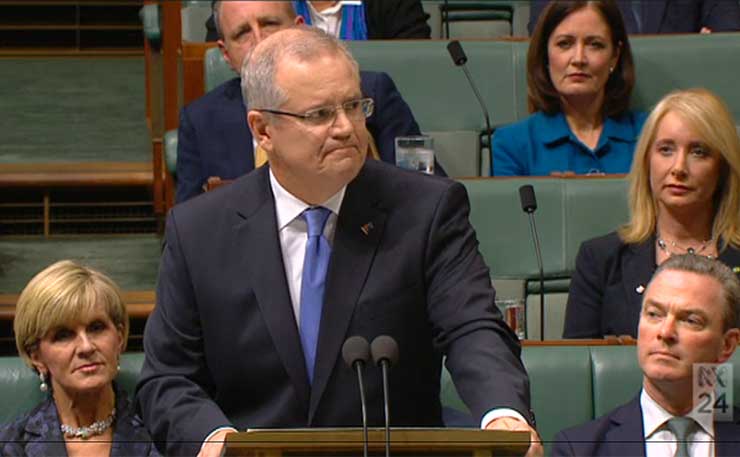
    Federal Treasurer Scott Morrison delivering his first budget, in 2016.
    Federal Treasurer Scott Morrison delivering his first budget, in 2016.

    But the bigger problem is that a shrinking share of Australians have full-time permanent jobs to start with. Part-time work now accounts for almost one in three jobs – the highest on record.  And labour hire, temporary contract, and other forms of precarious work are increasingly the norm. Very few of those workers earn anywhere near $80,000. At most about one in four Australian workers (and perhaps 15 per cent of all tax-filers) will get the full $6 per week saving.

    The whole concept of “bracket creep” is itself as misleading as Morrison’s maths. He says taxpayers are “pushed” into higher tax brackets by rising incomes, constituting a punitive and underhanded tax grab. But this description merits some careful second thought.

    There are two different reasons why a worker’s income might rise. One is pure inflation, experienced across all wages and prices. In that case, nothing “real” changes, and a higher tax rate might seem unfair (although we should remember that the cost of many government programs also grows with inflation, and someone has to pay for that).

    Alternatively, it might be changes in a worker’s real income that qualify them for the next bracket. If they worked more hours or took a promotion (as the Treasurer urges), then their real income rises, and so does their tax. That’s not bracket creep, and there’s nothing “underhanded” about it. In fact, that is the whole point of a personal income tax system in which tax rates depend on income.

    Moral panic over bracket creep is all the more ironic given the unprecedented stagnation in Australian wages, reflecting sustained weakness in the job market. Average weekly earnings in the private sector are growing at their slowest pace in history: under 1 per cent per year (slower than inflation). The budget itself acknowledged this is badly hurting Commonwealth revenues. With wages going nowhere fast, this is hardly the time in history to make a mountain out of a bracket creep molehill.

    If the government truly wanted to prevent inflation from distorting taxes, it could simply index all parameters in the tax code to consumer prices (as other countries, like the U.S. and Canada, have done). Then all thresholds, not just the one cherry-picked by Morrison, would rise 1.3 per cent this year, the same as year-over-year inflation. But that would depoliticise the whole process, hardly acceptable in a year when every single clause of the budget is focused on getting the government re-elected. So Morrison picked one politically-potent threshold, lifted it seven times faster than inflation, and left everyone else to get “creeped.”

    Previous ad-hoc increases to thresholds have lifted them far faster than inflation. In fact, with this latest increase, the third tax threshold will have risen twice as much as inflation since 2003. Combined with rate reductions also targeted at top brackets during that time, government revenues have been undermined badly, and the upward redistribution of after-tax income has been exacerbated.

    In short, the politics of Morrison’s over/under game are hard to understand. He will deliver a tiny benefit to less than one in four employed workers, and barely one in seven tax-filers. Most Australians won’t get a cent. But the economics are even worse. His divisive and false anti-tax narrative undermines the long-run stability of the government’s revenue base, damages public services, and reinforces inequality.


    You might also like

    Commonwealth Budget 2025-2026: Our analysis

    by Fiona Macdonald

    The Centre for Future Work’s research team has analysed the Commonwealth Government’s budget, focusing on key areas for workers, working lives, and labour markets. As expected with a Federal election looming, the budget is not a horror one of austerity. However, the 2025-2026 budget is characterised by the absence of any significant initiatives. There is

    Centre For Future Work to evolve into standalone entity

    The Centre for Future Work was established by the Australia Institute in 2016 to conduct and publish progressive economic research on work, employment, and labour markets. Supported by the Australian Union movement, the centre produced cutting edge research and led the national conversation on economic issues facing working people: including the future of jobs, wages

  • 6 Reasons to Be Skeptical of Debt-Phobia

    6 Reasons to Be Skeptical of Debt-Phobia

    by Jim Stanford

    In the lead-up to tomorrow’s pre-election Commonwealth budget, much has been written about the need to quickly eliminate the government’s deficit, and reduce its accumulated debt.  The standard shibboleths are being liberally invoked: government must face hard truths and learn to live within its means; government must balance its budget (just like households do); debt-raters will punish us for our profligacy; and more.  Pumping up fear of government debt is always an essential step in preparing the public to accept cutbacks in essential public services.   And with Australians heading to the polls, the tough-love imagery serves another function: instilling fear that a change in government, at such a fragile time, would threaten the “stability” of Australia’s economy.

    However, this well-worn line of rhetoric will fit uncomfortably for the Coalition government, given its indecisive and contradictory approach to fiscal policy while in office.  The deficit has gotten bigger, not smaller, on their watch, despite the destructive and unnecessary cutbacks in public services imposed in their first budget.  Their response to Australia’s fiscal and economic problems has consisted mostly of floating one half-formed trial balloon after another (from raising the GST to transferring income tax powers to the states to cutting corporate taxes), with no systematic analysis or framework.  And their ideological desire to invoke a phony debt “crisis” as an excuse for ratcheting down spending will conflict with another, more immediate priority: throwing around new money (or at least announcements of new money), especially in marginal electorates, in hopes of buying their way back into office.

    In short, the politics of debt and deficits will be both intense and complicated in the coming weeks.  To help inoculate Australians against this hysteria, here are six important facts about public debt, what it is – and what it isn’t.

    1. Australia’s public debt is relatively small

    Despite annual deficits incurred since the GFC, Australia’s accumulated government debt is still small by international standards.  Debt can be measured on a gross or net basis; gross debt counts total outstanding borrowing, while net debt deducts the value of financial assets which the government also possesses.  Gross debt for all levels of government equaled 44% of Australian GDP at the end of 2015 (according to the OECD).  That was the 5th lowest indebtedness of any of the 34 OECD countries (see table below), equal to about one-third the average level experienced across the OECD.  Moreover, despite recent deficits, the growth of debt in Australia was considerably slower than in most other OECD countries.  Of course, having low debt in and of itself does not justify increasing it.  But given the universal fiscal challenges that have faced industrial countries since the GFC, Australia’s debt challenge is both unsurprising and relatively mild.

    Australia’s Debt in International Context: General Government (all levels) Gross Financial Liabilities (%GDP) 
    2015 10-yr. Change
    Australia 44.2% +22.4 pts
    U.S. 110.6% +43.7 pts
    Japan 229.2% +59.7 pts
    France 120.1% +38.3 pts
    Germany 78.5% +8.1 pts
    Italy 160.7% +41.8 pts
    U.K. 116.4% +60.3 pts
    Canada 94.8% +19.0 pts
    OECD Average 115.2% +36.3 pts
    Source: Author’s calculations from OECD Economic Outlook #98, Nov.2015.

    2. A government debt is matched by an asset

    Australians aren’t “poorer” because their government accumulates a debt.  Any rise in government debt is mirrored by an increase in some offsetting asset.  This is true in both accounting terms, and in real economic terms.  For example, government typically issues a bond (or some other financial instrument) to finance a deficit.  But that bond also constitutes an asset in the investment portfolio of whoever lent the government money.  Most Australian government debt is owned by Australians.  In fact, investors increasingly appreciate the opportunity to invest in government bonds, because they are safer than other assets at a time of financial uncertainty.  (That investor interest is one reason interest rates on government debt are so low.)  So government debt translates into someone else’s wealth – usually someone in Australia.

    This match between liabilities and assets is also visible in concrete economic terms – especially when new debt is issued to construct a real, long-lasting capital asset (like a road, a transit system, a school, or a hospital).  In this case, the matching asset is owned by government itself, and so its own net worth won’t change much at all: it takes on a new debt, but also has a new asset.  For budgetary purposes, the government must account for the gradual wear-and-tear of that asset (called depreciation), which appears as a cost item on the budget.  But it hasn’t “lost” the money it raised through the new debt: it invested it, and that investment carries both financial and social value.

    3. Other sectors of society borrow much more than government

    Tired rhetoric about how governments need to act “more like households” is especially ironic, given that households are by far the most indebted sector in Australian society.  Household net debts equal close to 125% of GDP – or around 4 times the net debt of government (all levels), according to data from the Bank for International Settlements.  It is factually wrong to claim that “households balance their budgets,” and therefore governments must do the same.  Households borrow regularly – and thanks to overinflated housing prices and stagnant wages, that borrowing is growing rapidly.  The same is true of business: net debts of non-financial corporations are more than twice the net debt of government (see chart).

    In fact, it is quite rational for households and businesses to borrow, when needed to fund purchase of long-run productive assets (like a house or a car for consumers, or a factory or new technology for a business).  Business leaders know that rational, prudent borrowing will enhance the profitability of a corporation.  Indeed, any CEO who said paying off all company debt was the top priority of the firm would be chased from office by directors and shareholders (who would understand the pledge was irrational and superstitious).  Following exactly the same logic, government debt can be rational and productive – especially (but not only) when it is associated with the acquisition of long-run productive assets (like infrastructure).  Close to two-thirds of the Commonwealth government’s 2015/16 deficit (projected to be $36 billion) is associated with capital spending, including $11 billion in capital transfers to lower levels of government and $12 billion in net investment in Commonwealth non-financial assets.  Contrary to the rhetoric, Australians do largely cover the cost of current public services with their current tax payments.  Government borrowing is primarily required to fund capital spending.

    4. Interest rates are low, and falling

    The cost of public borrowing has fallen dramatically as a result of the decline in Australian and global interest rates since the GFC (see chart).  Indeed, the two factors are connected: large government deficits resulted primarily from underlying economic weakness (this is true in Australia, like elsewhere in the industrialized world), which in turn bro8ught about low interest rates (via both central banks and private financial markets).  These very low interest rates mean that the cost-benefit decision associated with any new government borrowing has been fundamentally altered, in favour of borrowing.
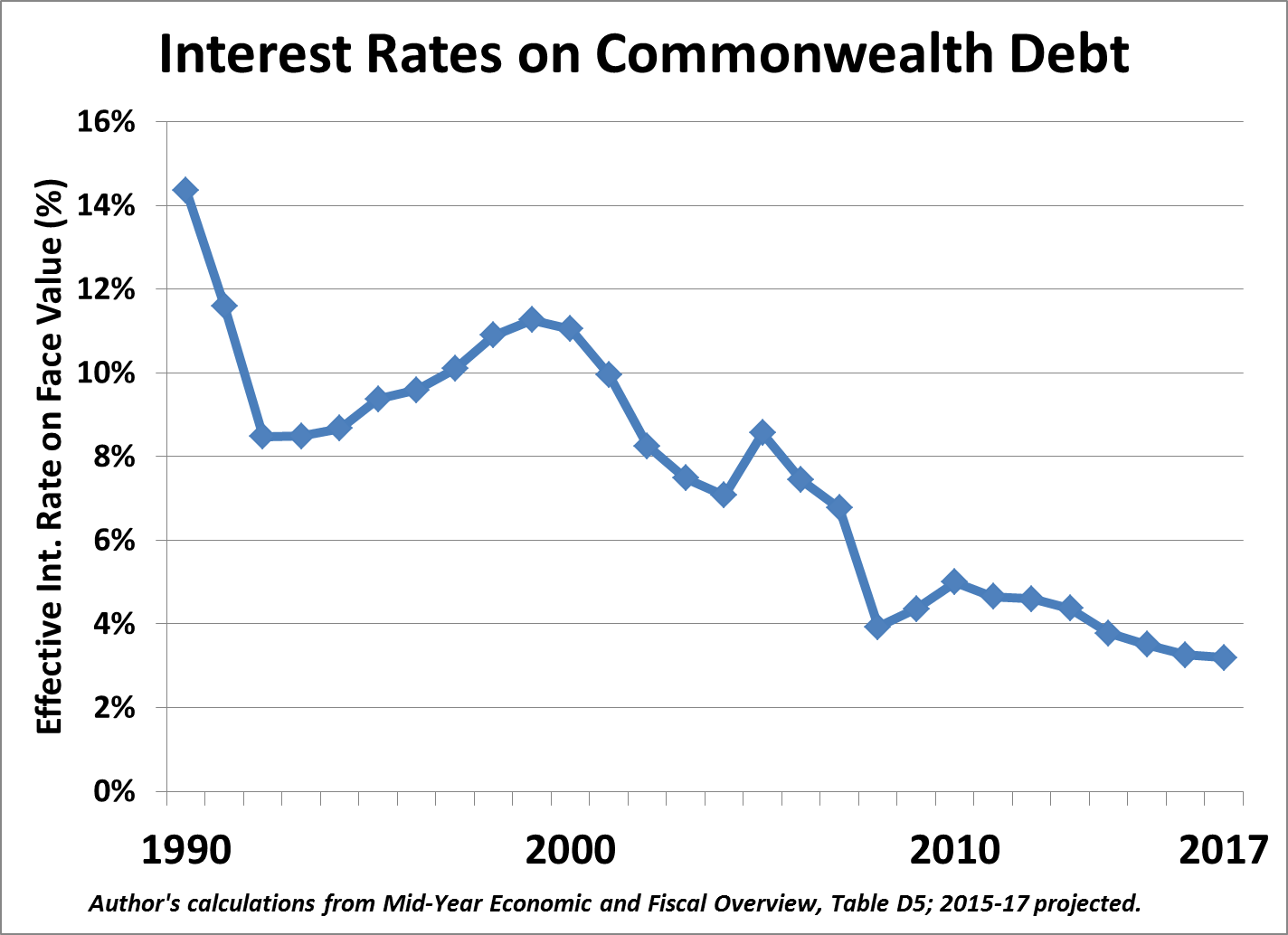
    Current interest rates are likely to stay low for many years to come, given the continuing failure of the global economy to regain consistent momentum, the slowdown in China, and other factors.  (In fact, it is possible that the Reserve Bank of Australia may soon cut its interest rate further, below its current record-low 2% level, due to weak growth and signs of deflation here in Australia.)  Ten-year Commonwealth bonds can presently be floated to private investors for little more than 2% interest (close to zero in real after-inflation terms).  If government can borrow for what is effectively zero interest, and put that money to work in the real economy doing useful things (including both infrastructure and public services), then it is irrational to let old-fashioned balanced-budget mythology stand in the way.

    Even if current interest rates do not fall any further, the average effective interest rate paid on overall public debt will continue to fall for years to come.  The current average effective rate paid on Commonwealth debt (about 3.5% last year) reflects the weighted average paid on all maturities of debt.  As past debts come due, they are refinanced at now-much-lower interest rates (those prevailing on new issues of bonds).  That will pull down the average weighted interest rate for several years into the future – even if the rate on new issues stabilizes or increases somewhat.  Consider that new ten-year bonds can be issued for less than half the interest rate paid a decade ago.  The refinancing of those bonds will generate enormous future interest savings for government (equivalent to home-owners who re-mortgage their homes to benefit from the decline in household lending rates).

    This is why the economic burden of public debt servicing is not growing, even though the debt is.  Government budget projections forecast debt service remaining at between 0.9 and 1.0% of GDP for the next 5 years, with the effect of rising debt offset by falling interest rates.  And those government projections likely overestimate true interest costs (partly for political reasons).  For example, the December 2015 MYEFO update assumes a significant increase in interest rates in the coming year (its near-term interest rate assumption was 0.3 points higher than the assumption used in last year’s budget); ongoing global and domestic economic weakness makes that highly unlikely.

    5. The debt/GDP ratio is a more meaningful fiscal constraint than a balanced budget

    Fear-mongers think that by talking about public debt in “big numbers,” the fright value of their dire forecasts can be magnified accordingly.  But all macroeconomic aggregates are measured in big numbers.  And what’s more important than the absolute size of debt, is the government’s capacity to service that debt.  That, in turn, depends on the flow of government revenues, which in turn is driven primarily by overall economic growth.  That’s why economists prefer to evaluate public debt relative to GDP (called the “debt ratio”).  Even this ratio can overstate the real burden of debt, in times (like now) when interest rates are low and falling.

    Avoiding a lasting, uncontrolled rise in the debt/GDP ratio is a more meaningful fiscal constraint on government, than trying to balance a budget in any particular year.  Economists do not agree on a maximum “acceptable” limit for that ratio.  But most agree it cannot rise forever.  (Some economists argue that there is no limit on a government’s ability to issue sovereign debt denominated in its own currency, and the recent experience of countries like Japan – whose debt ratio is five times Australia’s – is consistent with that view.)

    At any rate, Australia is far away from any feasible “ceiling” on public debt relative to GDP.  And remember, like any ratio, the debt/GDP ratio has both a numerator and denominator: growing the denominator is as effective as shrinking the numerator, if the goal is reducing the value of the combined ratio.  In this regard, the stagnation in Australia’s nominal GDP in recent years has been more damaging to the trajectory of the debt ratio, as has the addition of debt through continued deficits.  The government’s policy focus should be on expanding economic activity (and the jobs and incomes that go with it), rather than suppressing the deficit with austerity measures (which have the unintended consequence of undermining growth and hence the economy’s ability to service a given amount of debt).

    6. The government can incur moderate deficits every year, yet still stabilize its debt burden

    A related and under-appreciated countervailing argument is to note that government can run a medium-sized deficit on an ongoing basis, and yet experience no increase in the debt/GDP ratio at all – so long as the economy is progressing at a normal pace.  A deficit adds to the numerator of the ratio, while economic growth expands the denominator.  So long as both are expanding at roughly the same rate, the ratio will not be changed.  (Our reference to economic expansion envisions more jobs and incomes across the economy, including in the public sector, and with due attention to the need for environmental sustainability.)  This basic arithmetic provides government with an additional degree of maneuverability in financing essential services and investments, without unduly increasing the debt ratio.

    A simple numerical example helps to illustrate the point in Australia’s context.  A healthy economy should be expanding by at least 5-6 percent per year in nominal terms: divided roughly equally between inflation (given the RBA’s 2-3 percent inflation target) and greater output of real goods and services (driven by both population and productivity).  The Commonwealth’s current net debt ratio is slightly below 20 percent of GDP.  With a healthy economic expansion, the government could incur an annual deficit of 1-1.25 percent of GDP (or close to $20 billion per year) but still stabilize the debt ratio below that 20 percent benchmark.  And there is nothing magical about a 20% debt ratio; if Australians were willing to tolerate a larger steady-state debt ratio, then the size of this annual permissible deficit would be correspondingly higher.  All this merely reinforces the need for government to focus on supporting job-creation and incomes, not balancing its budget – and confirms that ample fiscal space is indeed available for the Commonwealth to fund public services and infrastructure spending (with the fringe benefit of reinforcing strong job creation that should be their top priority).

    You might also like

    Commonwealth Budget 2025-2026: Our analysis

    by Fiona Macdonald

    The Centre for Future Work’s research team has analysed the Commonwealth Government’s budget, focusing on key areas for workers, working lives, and labour markets. As expected with a Federal election looming, the budget is not a horror one of austerity. However, the 2025-2026 budget is characterised by the absence of any significant initiatives. There is

    Centre For Future Work to evolve into standalone entity

    The Centre for Future Work was established by the Australia Institute in 2016 to conduct and publish progressive economic research on work, employment, and labour markets. Supported by the Australian Union movement, the centre produced cutting edge research and led the national conversation on economic issues facing working people: including the future of jobs, wages

  • State Income Taxes Would Promote Inequality and Debt

    State Income Taxes Would Promote Inequality and Debt

    by Jim Stanford

    The latest “big idea” on tax policy from the Coalition government is to grant independent income tax powers to the states.  This would be accompanied by a devolution of funding responsibility for big-ticket services like health care, hospitals, and schools.  Prime Minister Turnbull argues that forcing state governments to raise the money they spend will lead to more accountability and efficiency in public service delivery.  And it’s a politically convenient response to the demands from states for more revenues: “If you need it so much, go out and raise it yourself.”

    While this trial balloon serves a short-run political function for a government struggling to define its agenda, it would be a terrible way to organize long-run fiscal affairs in a diverse, federal country.  Canada’s experience with tax devolution is an appropriate cautionary tale.  Like Australia, Canada is a federal country with a complex division of government responsibilities, a vast resource-dependent economy, and big economic and social gaps between regions.

    Canada’s ten provinces have the power to set their own personal income and company taxes.  They also set province-specific GST rates.  The result is enormous variation in tax rates (and rules).  Top marginal provincial income tax rates range from 11.25 percent in Alberta, to over 25 percent in Quebec and New Brunswick.  Provincial GST rates range from zero in Alberta, to almost 10 percent in Quebec.  In each case, provincial taxes are in addition to those levied by the federal government (with its own GST of 5 percent, and a top marginal federal income tax of 33 percent).  Each province also sets its own rules regarding coverage, eligible deductions, and tax brackets, complicating inter-provincial business.

    It’s not just that individuals must pay tax twice, to different levels of government.  (In fact, at tax-filing time, taxpayers must fill out two forms to separately determine what they owe to the federal and provincial governments.)  More damaging are the long-run fiscal and social mechanisms set in motion by interprovincial tax disharmony.

    Provinces enjoying stronger economic conditions can reduce their tax rates, yet still raise adequate revenue.  This sparks a destructive race-to-the-bottom in tax rates that undermines government revenues in all provinces.

    The worst example of this occurred during the resource boom of the 2000s.  Oil-rich Alberta adopted a low flat-tax applying to all taxpayers (no matter how wealthy).  This helped the Conservative government there get reelected.  But it exacerbated demands in other provinces (especially neighboring British Columbia and Saskatchewan) to reduce their own taxes in tandem.  Well-off Canadians (especially those receiving business or investment income) can easily establish multiple “residences,” allowing them to pay tax in the lowest-rate province.

    Smaller, poorer provinces bear the brunt.  Consider New Brunswick, in Canada’s poorer east, with a population of just 750,000.  Its top marginal income tax rate is more than twice as high as Alberta’s (and New Brunswickers also pay an 8-point GST premium).  This makes it all the harder to retain young talent, attract investment, and catch up to the rest of the country.  Underfunding provincial schools won’t help economic recovery, either.

    By undermining fiscal capacity, tax competition has also contributed to the escalation of provincial debt.  Some provinces (like New Brunswick) now owe over 40 percent of their GDP in provincial debt (on top of their share of federal debt, another 33 percent of GDP).  Alberta and other higher-income provinces have virtually no debt.  Yet indebted provinces pay higher interest rates than Ottawa, resulting in many billions of dollars of avoidable debt service charges.  It would be much cheaper for both revenues and debts to be managed centrally, minimizing both tax competition and interest rates.

    The Coalition’s most unbelievable claim is that tax devolution will end fiscal squabbles between the governments.  That was the theory in Canada in 1977, when the federal government transferred 13.5 percentage points of income tax powers to the provinces, to fund provincially-delivered health and education programs.  Forty years later, however, the squabbling is louder than ever.  The provinces cannot single-handedly fund public services from their own revenues (especially given the destructive effects of tax competition).  So Ottawa still transfers $65 billion per year to the provinces (one-quarter of all federal spending).  And debates over those transfers are as intense as ever.  Right now, for example, the provinces are furious over a unilateral reduction in federal health transfers.

    Federalism is a messy business.  And that’s probably how it should be: the whole idea is to ensure a healthy balance between national and regional interests.  But the hope that a one-time tax transfer to lower governments can somehow fix all problems of funding and accountability is pure fantasy.


    You might also like

    6 Reasons to Be Skeptical of Debt-Phobia

    by Jim Stanford

    In the lead-up to tomorrow’s pre-election Commonwealth budget, much has been written about the need to quickly eliminate the government’s deficit, and reduce its accumulated debt.  The standard shibboleths are being liberally invoked: government must face hard truths and learn to live within its means; government must balance its budget (just like households do); debt-raters will punish us for our profligacy; and more.  Pumping up fear of government debt is always an essential step in preparing the public to accept cutbacks in essential public services.   And with Australians heading to the polls, the tough-love imagery serves another function: instilling fear that a change in government, at such a fragile time, would threaten the “stability” of Australia’s economy.

    Commonwealth Budget 2025-2026: Our analysis

    by Fiona Macdonald

    The Centre for Future Work’s research team has analysed the Commonwealth Government’s budget, focusing on key areas for workers, working lives, and labour markets. As expected with a Federal election looming, the budget is not a horror one of austerity. However, the 2025-2026 budget is characterised by the absence of any significant initiatives. There is

  • Company Tax Cuts: A Cautionary Tale from Canada

    Originally published in New Matilda on March 3, 2016

    Was it really the Treasury’s economic modeling that convinced Prime Minister Turnbull to abandon his plan to raise the GST and cut income taxes? Treasury simulations indicated the trade-off would have no significant impact on growth. Or perhaps it was another kind of calculation – electoral – that convinced the Coalition to drop the idea, and the economic numbers just provided political cover.

    Whatever the motive, the constituency most disappointed by this about-face is the corporate sector. Business leaders hoped to ride the coat-tails of a “tax shift” to achieve a significant reduction in company income taxes. And they continue to beat the drum for lower business taxes, financed if necessary from other fiscal savings. By sweetening after-tax returns, they argue, business capital spending will accelerate: driving GDP expansion, more jobs, and fiscal dividends for government. In short, everybody wins.

    But is their promise of a growth dividend realistic?

    Never mind economic models, which depend entirely on whatever assumptions are programmed in by the modelers. Instead, let’s consider some real-world experience to judge whether company tax cuts would indeed generate a significant growth dividend. Canada’s recent experience with deep corporate income tax cuts is especially relevant to Australia, given the structural similarities between the two economies: large geography, dependence on major resource projects, and large inflows of foreign capital.

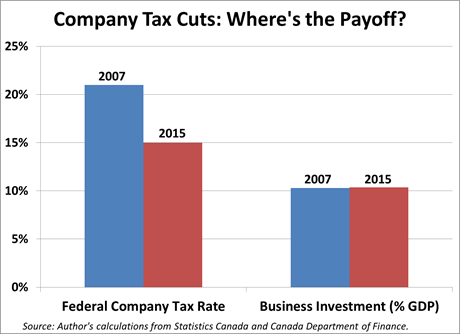
    CanadaBusinessTax

    The Canadian federal government implemented three successive federal corporate tax reductions over the last generation. (Provincial governments also levy their own corporate taxes, averaging around 10 per cent, added to federal levies.) The first stage occurred in the late 1980s: the statutory rate was reduced from 36 per cent to 28 per cent, but various loopholes and deductions were closed in the process. The second reform occurred early this century: the general rate fell to 21 per cent, and preferences for manufacturing and resources were eliminated. The latest cuts were implemented beginning in 2007 by former Conservative Prime Minister Stephen Harper (defeated in last year’s election): he cut the base rate to 15 per cent, and eliminated a 1.1 per cent CIT surtax. Those last reductions alone still cost the federal government over $15 billion (Canadian Dollars) in foregone revenue each year.

    Together, these successive cuts reduced combined Canadian corporate taxes (including provincial rates, which also fell in several provinces) from near 50 per cent of pre-tax income in the early 1980s, to 26 per cent today. In theory, the resulting boost to profits should have stimulated a strong response in business investment. Unfortunately, hopes for this “jobs and growth” dividend have been repeatedly dashed.

    Instead of growing, business spending on fixed capital (machinery, structures, etc.) declined under lower company taxes, by about one full point of GDP since the reforms began. Business innovation spending (one of Mr. Turnbull’s top priorities) fared even worse: business R&D outlays shrank by over one-third as a share of GDP, to a record low of just 0.8 per cent. In fact, over the last decade real business investment performed worse than during any other era in Canada’s postwar history. Several provincial governments have given up waiting for the promised investment boom, and are now increasing company tax rates to help address chronic deficits.

    It is instructive to compare Canada and Australia’s investment performance over this period. Both countries face the same booms and busts in global commodity prices. Yet in the last decade business spending on fixed assets grew more than twice as fast in Australia, according to OECD data: by 3.9 per cent per year in Australia (after inflation), despite higher company taxes, versus an anemic 1.7 percent in Canada. Canada’s GDP outgrew Australia’s in just two of those ten years, and last year the country slipped into outright recession.

    One especially painful side-effect of lower company taxes has been the sustained accumulation of liquid assets by Canada’s non-financial businesses. Corporate cash hoarding accelerated dramatically after the turn of the century. Non-financial firms now hold cash and other liquid assets equal to over 30 per cent of GDP. IMF researchers have shown that corporate cash holdings grew faster in Canada than any other G7 economy (and twice as fast as in Australia).

    With businesses investing less than they receive in after-tax cash flow, lower taxes only add to the stockpile of idle liquid assets, draining spending power from the economy. In this regard, lower corporate taxes may very well have weakened growth and job-creation, not strengthened it. In any event, Canada’s experience is a sobering reminder to Australian policy-makers: anyone expecting a tax shift to generate a big growth dividend is likely to face chronic disappointment.


    You might also like

    Commonwealth Budget 2025-2026: Our analysis

    by Fiona Macdonald

    The Centre for Future Work’s research team has analysed the Commonwealth Government’s budget, focusing on key areas for workers, working lives, and labour markets. As expected with a Federal election looming, the budget is not a horror one of austerity. However, the 2025-2026 budget is characterised by the absence of any significant initiatives. There is