Category: Article

  • Budget’s Illusory Hope for Business-Led Recovery

    Budget’s Illusory Hope for Business-Led Recovery

    by Jim Stanford

    Share

    The Commonwealth government tabled its 2020-21 budget on 6 October, six months later than the usual timing because of the dramatic events associated with the COVID-19 pandemic and resulting recession. There is no doubt it is a budget unlike any other in Australia’s postwar history. While the budget certainly unleashes unprecedented fiscal power, its underlying logic and specific policy design are unsatisfactory in many ways. We present here analysis and commentary on several aspects of the budget, drawing on input from all of the Centre’s research staff: Economist and Director Dr. Jim Stanford, Senior Economist Alison Pennington, and Economist Dan Nahum.

    Key conclusions of our analysis include:

    • This budget says explicitly that Australia’s economic reconstruction after COVID-19 is to be trusted almost entirely to private business – helped along with generous tax cuts and business subsidies.
    • The need to strengthen public services (like health care, child care, and higher and vocational education) is largely ignored, as is the need to preserve and strengthen income security programs (with the phase-out of JobKeeper and cuts to JobSeeker going ahead).
    • Tax cuts, whether targeted at businesses or high-income households, will have little impact on actual spending and job-creation.
    • The government needs a more forceful, hands-on, and sustained reconstruction plan to ensure that the economy does not get ‘stuck’ in its current state of partial recovery. That needs much more public sector leadership, vision, and funding.
    • The government admits that wage growth is going to get weaker before it gets stronger – but is doing nothing about that critical problem (which will undermine consumer spending far more than tax cuts will stimulate it).

    Download our full review of the 2020-21 budget below.


    Related documents


    2020-21 Budget Analysis

    You might also like

    Commonwealth Budget 2025-2026: Our analysis

    by Fiona Macdonald

    The Centre for Future Work’s research team has analysed the Commonwealth Government’s budget, focusing on key areas for workers, working lives, and labour markets. As expected with a Federal election looming, the budget is not a horror one of austerity. However, the 2025-2026 budget is characterised by the absence of any significant initiatives. There is

    Centre For Future Work to evolve into standalone entity

    The Centre for Future Work was established by the Australia Institute in 2016 to conduct and publish progressive economic research on work, employment, and labour markets. Supported by the Australian Union movement, the centre produced cutting edge research and led the national conversation on economic issues facing working people: including the future of jobs, wages

  • Webinar: How TAFE Can Drive Australia’s Skills and Jobs Recovery

    Webinar: How TAFE Can Drive Australia’s Skills and Jobs Recovery

    by Alison Pennington

    Share

    With millions facing unemployment and crisis-accelerated job transitions, public investment in the skills and earning capabilities of Australians will be critical to our post-pandemic recovery.

    To mark National TAFE Day and the release of new research by the Centre for Future Work on the economic and social benefits of the TAFE system, The Australia Institute hosted a timely discussion on how the TAFE system can drive a COVID-era skills and jobs recovery with ACTU President Michele O’Neil, Correna Haythorpe, federal president of the Australian Education Union, and Alison Pennington, Senior Economist at the Centre for Future Work.

    The webinar was presented as part of the Australia Institute’s widely acclaimed Economics of a Pandemic webinar series and explored why the TAFE system has been in turmoil, the historic role it has played generating a more skilled workforce and productive economy, and how we can fix it.


    Related documents


    Presentation slides

    Related research

    You might also like

  • Austerity Threatens Women’s Access to Paid Work

    Originally published in The New Daily on June 25, 2020

    Women have suffered the worst labour market impacts since the shutdowns. Gender-unequal impacts have been due to women’s greater exposure to customer-facing industries shut down first by public health orders, higher employment intensity in insecure and part-time positions, and an increased caring burden unmet by the state. But instead of providing countervailing support, the federal government is accelerating women’s work crisis.

    In this commentary, originally published in the New Daily, Senior Economist at the Centre for Future Work Alison Pennington outlines how government’s austerity agenda has intensified the unequal jobs fallout and threatens to “turn back the clock” for women’s economic security.

    How the government is turning back the clock for women

    The increase in women’s workforce participation is the most significant labour market trend of the past 40 years.

    However, in the COVID-19 health and economic crisis, the gender boundaries of paid work are being redrawn.

    Worse still, the government is the one holding the pen.

    Women have suffered the worst labour market impacts since the shutdowns.

    Total employment fell by 7.3 per cent for women compared with 5.7 per cent for men between February and May.

    About 450,000 women have lost their jobs and 350,000 left the labour market all together.

    Women saw a 12 per cent decline in hours worked, compared to 9 per cent for men.

    This gender inequity stems from three main channels:

    This combination has created a ‘perfect storm’ for women in the workplace.

    However, instead of stepping up to provide countervailing support, the federal government is only exacerbating the crisis.

    This started back when JobKeeper was announced and excluded short-term casuals by design, which affects more women than men.

    And then, most recently the government targeted early JobKeeper cuts to childcare workers in what is a cruel double blow.

    Not only do more women work in child care, but more women benefit from access to affordable child care.

    The cumulative impact of Australia’s effective gender pay gap of 32 per cent (in average weekly earnings for all workers) and inadequate parental leave supports for cash-strapped families makes their work-care decisions clear cut.

    Without affordable child care, mum’s got to stay home.

    There’s more bad news on the industrial relations front.

    Last week the Fair Work Commission decided to freeze minimum wages for up to seven months, in the sectors with the lowest wages and most precarious jobs – which are, surprise, mostly women’s jobs.

    While women have been bearing the brunt of the economic impacts of COVID19, state and federal governments have targeted stimulus spending on the most bloke-heavy industry in the economy – construction.

    For every $1 million invested in construction only 0.2 direct jobs are generated for women.

    Yet $1 million invested in education generates almost 11 jobs for women.

    In fact, education investment creates more jobs for just women than construction creates for anybody: Man or woman.

    Job-generating spending for women is best directed to the public sector.

    Women make up 61 per cent of all public sector workers, with the sector supporting fuller female participation – women hold 54 per cent of full-time roles but only 35 per cent of full-time roles in the private sector.

    Not only would public sector pay cuts risk driving this recession into a depression, they disproportionately hurt women’s incomes.

    Even temporary wage freezes (of one or two years) compound into tens of thousands of dollars in lost wages compounding over her working life.

    And austerity pain radiates far beyond income losses for affected workers, reducing consumer spending (right when the economy needs more), tax revenues and enhancing deflation risk.

    When the largest employer in the economy cuts wages, it has a powerful effect for other employers.

    It’s not just a hunch, this is exactly what happened after the GFC.

    The unnecessary 2011-12 federal public sector wages caps cut the legs out from everyone’s wages.

    But the pain induced from pay cuts doesn’t end there. Because lower-wage environments breed insecure work.

    People accept lower-quality jobs or juggle multiple jobs to earn the same income. Women are much more likely to work these precarious jobs.

    Prime Minister Scott Morrison has acknowledged that COVID-19’s fallout has been harshest on women.

    Yet his government is pushing an agenda that will ensure there will be less jobs for women, and they’ll be worse paid.

    Economic inclusion of women must be targeted in a long-term, sustained public investment plan that mops up the private sector carnage and lets us build back better.


    You might also like

    Commonwealth Budget 2025-2026: Our analysis

    by Fiona Macdonald

    The Centre for Future Work’s research team has analysed the Commonwealth Government’s budget, focusing on key areas for workers, working lives, and labour markets. As expected with a Federal election looming, the budget is not a horror one of austerity. However, the 2025-2026 budget is characterised by the absence of any significant initiatives. There is

  • Repairing Universities & Skills Key to Meeting COVID-Era Challenges

    Repairing Universities & Skills Key to Meeting COVID-Era Challenges

    by Alison Pennington

    Share

    Training must play a vital role in reorienting the economy after the pandemic, supporting workers training for new jobs including millions of young people entering a depressed labour market without concrete pathways to work. But what kind of jobs will we be doing in 2040? And how prepared is Australia’s skills system (and universities specifically) to play this important role now?

    Our Senior Economist Alison Pennington was interviewed by UTS The Social Contract podcast on how COVID-19 is reshaping relations between universities, government and industry. 

    Alison explains how the pandemic economic crisis presents significant challenges to Australia’s fragmented, underfunded and unplanned skills system wounded from decades of failed marketisation policies, and why sustained public investments in skills and jobs pathways will be essential to solving our economic and social challenges. 

    Listen to the episode on Whooshkaa. She is joined by Megan Lilly, head of Workforce Development at the Australian Industry Group.


    You might also like

    Centre For Future Work to evolve into standalone entity

    The Centre for Future Work was established by the Australia Institute in 2016 to conduct and publish progressive economic research on work, employment, and labour markets. Supported by the Australian Union movement, the centre produced cutting edge research and led the national conversation on economic issues facing working people: including the future of jobs, wages
  • Webinar: Protecting Jobs and Incomes During the Pandemic

    Webinar: Protecting Jobs and Incomes During the Pandemic

    by Jim Stanford

    Share

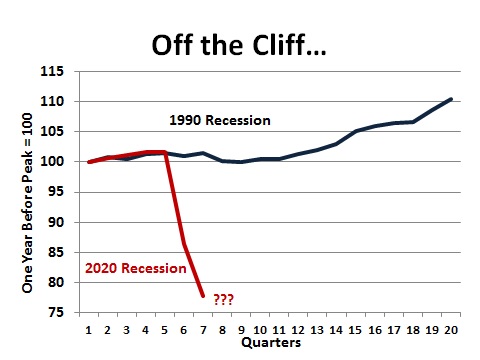
    The COVID-19 pandemic is producing an unprecedented shutdown of large parts of the national and global economies. Our Director Dr. Jim Stanford provided an overview of the coming recession, how it differs from previous downturns, and the best ways for government to respond to protect Australians as much as possible from the economic fall-out.

    Jim titled his presentation “Off the Cliff”, highlighting that the immediate shutdown of so much of Australia’s work and production is producing an economic contraction unlike anything experienced in history.

    Comparing Recessions

    Watch a video recording of the webinar:

    And/or download Jim’s slides below.

    This webinar was part of the Australia Institute’s weekly pandemic webinar series.


    Related documents


    Presentation slides

    You might also like

    Dutton’s nuclear push will cost renewable jobs

    by Charlie Joyce

    Dutton’s nuclear push will cost renewable jobs As Australia’s federal election campaign has finally begun, opposition leader Peter Dutton’s proposal to spend hundreds of billions in public money to build seven nuclear power plants across the country has been carefully scrutinized. The technological unfeasibility, staggering cost, and scant detail of the Coalition’s nuclear proposal have

  • Open Letter From Economists and Policy Experts: Wage Subsidy to Protect Jobs During Pandemic

    Open Letter From Economists and Policy Experts: Wage Subsidy to Protect Jobs During Pandemic

    by Jim Stanford

    Share

    109 Australian economists and policy experts have signed an open letter, initiated by the Centre for Future Work, supporting a government wage subsidy to prevent mass unemployment during the coming economic downturn resulting from the COVID-19 pandemic.

    The letter and the full list of signatories is reprinted below. It has been forwarded to Prime Minister Morrison.

    Public Statement from Economists and Public Policy Experts:

    A Wage Subsidy to Protect Jobs During the Coronavirus Shutdown

    The unprecedented public health measures required to deal with the COVID-19 pandemic are causing a dramatic shutdown of work and production in several key sectors of Australia’s economy. Immediate full or partial closures of activity are occurring in several consumer-facing industries (such as hospitality, retail, airlines, recreation and personal services). But before long, spillover losses will be experienced in other sectors, too: including wholesale trade and logistics, manufacturing, business services, education, and others. Consumer and business confidence has been deeply shocked, and that will magnify the negative economic effects of the pandemic.

    The coming recession will be unprecedented in Australian history – in both its speed and its depth. Without immediate action, we expect that 1-2 million workers, or even more, could lose their jobs in coming weeks. That would drive unemployment to 15% or higher, overwhelm income support programs, and leave hundreds of thousands of businesses unable to function – even after the immediate health danger passes.

    This is a dangerous and dramatic moment in Australia’s economic history. It is imperative that the federal and state governments act immediately and powerfully to protect Australian workers and businesses from the worst of the coming downturn. Important steps have been taken to expand access and benefit levels for income support payments to Australian workers (including casuals, contractors, and gig workers) losing work because of the pandemic. This is a helpful, but on its own inadequate, response. Government must also act forcefully to prevent mass job losses in coming weeks – not just provide support to those who do lose work.

    In this regard, we recommend that the Commonwealth government immediately implement a large-scale wage subsidy scheme, similar to those already enacted in several other industrial countries (including, variously, the UK, Denmark, New Zealand, the Netherlands, South Korea, and Ireland). Under these programs, government directly pays to employers (for a limited period of time) a majority portion of wages (between 70 and 90%) to cover the wages of workers who would otherwise be stood down from their positions. The measure can apply to non-standard workers (including contractors and self-employed). It can also be integrated with measures to support short time working as an alternative to complete redundancy. The wage subsidy is paid to firms experiencing severe losses of revenue and business (beyond a specified threshold). It would cover most of the wage bills for workers who can no longer work for economic reasons, up to a specified ceiling (perhaps the level of full-time median earnings). This program will be expensive – but governments everywhere have recognised that this unprecedented crisis requires them to do everything in their power to protect people, jobs, communities and the economy.

    To date, Australia’s response to the pandemic has been uncertain, inconsistent and inadequate. Immediate, powerful action to keep millions of Australians in their jobs, instead of pushing them into an overloaded and complex Centrelink system, would significantly ease the pandemic’s painful economic effects. It would underpin financial stability for millions of households through the coming terrible weeks or months. And it would preserve the viability of hundreds of thousands of Australian businesses, allowing them to resume work and production as soon as the health restrictions are eased.

    We the undersigned support the proposal for a strong wage subsidy program to keep workers in employment through the coming downturn, and we urge the Commonwealth government to implement such a policy quickly.

    Download full list of signatories below.


    Related documents


    List of signatories

    You might also like

    Dutton’s nuclear push will cost renewable jobs

    by Charlie Joyce

    Dutton’s nuclear push will cost renewable jobs As Australia’s federal election campaign has finally begun, opposition leader Peter Dutton’s proposal to spend hundreds of billions in public money to build seven nuclear power plants across the country has been carefully scrutinized. The technological unfeasibility, staggering cost, and scant detail of the Coalition’s nuclear proposal have

  • Seminar Presentation: Superannuation & Wages in Australia

    Seminar Presentation: Superannuation & Wages in Australia

    by Jim Stanford

    Share

    Centre for Future Work Director Jim Stanford gave a seminar presentation in Sydney on 21 November based on his research paper about the historical and empirical relationship between superannuation contributions and wage growth.

    Watch a summary version of his talk below.

    The full paper is posted at: The Relationship Between Superannuation Contributions and Wages in Australia.


    Related research

    You might also like

    Centre For Future Work to evolve into standalone entity

    The Centre for Future Work was established by the Australia Institute in 2016 to conduct and publish progressive economic research on work, employment, and labour markets. Supported by the Australian Union movement, the centre produced cutting edge research and led the national conversation on economic issues facing working people: including the future of jobs, wages

  • Young Workers are “Shock Troops” of Precarious Labour Market

    Young Workers are “Shock Troops” of Precarious Labour Market

    by Jim Stanford

    Share

    Dr. Jim Stanford, Director of the Centre for Future Work, appeared before the National Youth Commission on 31 October in Sydney to discuss the challenges facing young workers in Australia’s labour market.

    The National Youth Commission into Youth Employment and Transitions has been holding an inquiry in communities across Australia to document the situation of young workers, who are experiencing much lower rates of employment and income than other workers.

    Stanford’s submission argued that young workers are like the “shock troops” of the precarious labour market: the ones sent in first to confront an especially dangerous situation. The rise of precarious work in all its forms – part-time work, casual jobs, labour hire, temporary positions, marginal self-employment, and digitally mediated ‘gigs’ – now dominates youth employment patterns. And that situation will not automatically disappear as young workers get older and gain experience. Rather, evidence suggests that without policy measures to stabilise and improve jobs, this will be a permanent shift that gradually affects most workers. Already, less than half of employed Australians are working in a ‘traditional’ full-time permanent wages jobs with normal entitlements (like paid holidays, sick leave, and superannuation). For young workers, that ratio is less than one in five.

    Stanford argued for targeted measures to stimulate more youth hiring into stable positions, an ambitious effort to rebuild vocational education in Australia and strengthen pipelines to post-education jobs, and a broader commitment to full-employment macroeconomic policy.


    Related documents


    Presentation slides

    You might also like

    Centre For Future Work to evolve into standalone entity

    The Centre for Future Work was established by the Australia Institute in 2016 to conduct and publish progressive economic research on work, employment, and labour markets. Supported by the Australian Union movement, the centre produced cutting edge research and led the national conversation on economic issues facing working people: including the future of jobs, wages

  • Five Contrarian Insights on the Future of Work

    Five Contrarian Insights on the Future of Work

    by Jim Stanford

    Share

    In this comprehensive but readable commentary, our Director Jim Stanford challenges five stereotypical claims that are often advanced in debates over the future of work.

    1. Work is not disappearing; it can’t.
    2. Technology is not accelerating.
    3. “Gigs” aren’t even new.
    4. Technology is often more about relationships than productivity.
    5. Skills are not a magic bullet.

    The commentary was prepared for the My Labour, Our Future conference held last month in Montreal, Canada to mark the 100th Anniversary of the founding of the International Labour Organization. We thank the organizers and the Atkinson Foundation for permission to repost the paper.


    Related documents


    Full paper

    You might also like

    Centre For Future Work to evolve into standalone entity

    The Centre for Future Work was established by the Australia Institute in 2016 to conduct and publish progressive economic research on work, employment, and labour markets. Supported by the Australian Union movement, the centre produced cutting edge research and led the national conversation on economic issues facing working people: including the future of jobs, wages

  • Job Opportunity: Research Economist

    Job Opportunity: Research Economist

    Share

    The Centre for Future Work invites applications for an economist to join our research team in labour market research and policy analysis. The position may be at a junior or senior level, and the successful candidate may work from our offices in either Sydney or Canberra.

    The successful candidate will offer:

    • A graduate degree in economics or a closely related discipline.
    • Knowledge of and experience with a wide range of labour issues, preferably including: labour market statistics and trends; characteristics and determinants of employment; industrial relations and collective bargaining; wage determination and inequality; gender, racial, and demographic aspects of labour markets; the impact of technology on employment; macroeconomic policy and labour markets; and others.
    • Demonstrated ability to write to deadline for professional and popular audiences in a credible, succinct, and accessible manner.
    • Strong quantitative skills, including ability to access statistical data, analyse it (including familiarity with statistical tools), and report it in a variety of textual, tabular and graphical formats.
    • Confident communication skills, including ability to speak to public audiences, classrooms, and the media.
    • Ability to work collegially with other members of a research team.
    • Commitment to a progressive vision of work and fairness, including the goals of equality, participation, collective representation and trade unionism.

    Responsibilities of the position will include:

    • Research and completion of several project-length research papers, briefing notes, and shorter commentary articles per year on a range of topics related to labour markets and labour market policy.
    • Ongoing monitoring and analysis of labour market data and information.
    • Helping to maintain relevant websites and databases.
    • Public speaking, presentations, lectures and courses, media interviews, and related communication and educational activities.
    • Minimal office and administrative functions.

    Ability to undertake occasional out-of-town travel (including overnight travel) is essential, as is ability to successfully work in a self-managed and autonomous manner.

    The position will be offered on a one-year term-limited basis, with possibility for renewal. Salary will be commensurate with qualifications and experience.

    Applications are especially invited from women, indigenous persons, other racial and linguistic communities, people with disabilities, and other marginalised communities.

    Please forward applications (including contact information, qualifications, experience, two samples of written work, and names and contact details for two references) in confidence to cfwjob@tai.org.au. Please cite “Economist Job Application” in the subject field of your message; supporting documents should be attached in pdf format. Receipt of applications will be acknowledged by e-mail. Only candidates selected for an interview will then be contacted; no phone calls please.

    Applications must be received by 5:00 pm AEDT on Wednesday 9 October, and interviews will be conducted in Sydney on Wednesday 23 October 2019.

    The Centre for Future Work is an initiative of the Australia Institute, Australia’s leading progressive research institution. Thank you for your interest in the Centre for Future Work.


    You might also like

    Dutton’s nuclear push will cost renewable jobs

    by Charlie Joyce

    Dutton’s nuclear push will cost renewable jobs As Australia’s federal election campaign has finally begun, opposition leader Peter Dutton’s proposal to spend hundreds of billions in public money to build seven nuclear power plants across the country has been carefully scrutinized. The technological unfeasibility, staggering cost, and scant detail of the Coalition’s nuclear proposal have