Category: Article

  • Go Home on Time Day 2018

    Go Home on Time Day 2018

    Share

    Wednesday 21 November is Australia’s official “Go Home On Time Day,” sponsored by the Centre for Future Work and the Australia Institute. This represents the 10th year of our initiative, to provide light-hearted encouragement to Australian workers to actually leave their jobs when they are supposed to. Instead of working late once again – and allowing your employer to “steal” even more of your time, without even paying for it – why not leave the job promptly. Spend a full evening with your family or friends, visit the gym, see a movie – do anything other than work.

    Please visit our special Go Home On Time Day website for more information, tips on how to get away from work on time, and free posters and shareables. There’s also an online calculator where you can estimate the value of the time theft you experience, through unpaid overtime in all its forms.

    In conjunction with Go Home On Time Day, The Centre for Future Work is releasing two new research reports on the time pressures facing Australian workers:

    Our annual update on attitudes toward working hours, the incidence of unpaid overtime and its aggregate value: Excessive Hours and Unpaid Overtime: 2018 Update, by Troy Henderson and Tom Swann. On the basis of a survey of 880 employed Australians, we estimate that the typical worker puts in 6.0 hours of unpaid overtime per week – ranging from going in early, staying late, working through lunch and tea breaks, taking work home in the evenings and weekends, responding to calls or emails out of hours, and more. That amounts to 3.25 billion hours of unpaid overtime across the whole labour market this year, worth a total of $106 billion.

    This year, our Go Home On Time Day survey also included a special section focusing on the forms, prevalence, impacts and implications of electronic and digital monitoring and surveillance in Australian workplaces. Our goal was to investigate a secondary dimension of the time pressure facing Australian workers. It is not just that work is being extended into greater portions of our days (through unpaid overtime, the use of mobile phones and computers to reach workers at any time, pressure to not fully utilise annual leave, and similar trends). In addition, even within the work day, time pressure is intensified with the expectation that every moment of work time must be used for productive purposes – an expectation that is increasingly reinforced through omnipresent systems of monitoring, performance measurement, and surveillance. The result of these twin forces is an overall inability for people to escape from the demands of work: neither at the workplace (even for short periods), nor away from it.

    Please see our companion report, Under the Employer’s Eye: Electronic Monitoring & Surveillance in Australian Workplaces, by Troy Henderson, Tom Swann and Jim Stanford.


    Related research

    You might also like

  • Infographic: The Shrinking Labour Share of GDP and Average Wages

    Infographic: The Shrinking Labour Share of GDP and Average Wages

    by Jim Stanford

    Share

    The Centre for Future Work recently published a symposium of research investigating the long-term decline in the share of Australian GDP paid to workers (including wages, salaries, and superannuation contributions). The four articles, published in a special issue of the Journal of Australian Political Economy, documented the erosion of workers’ share of national income, its causes, and consequences.

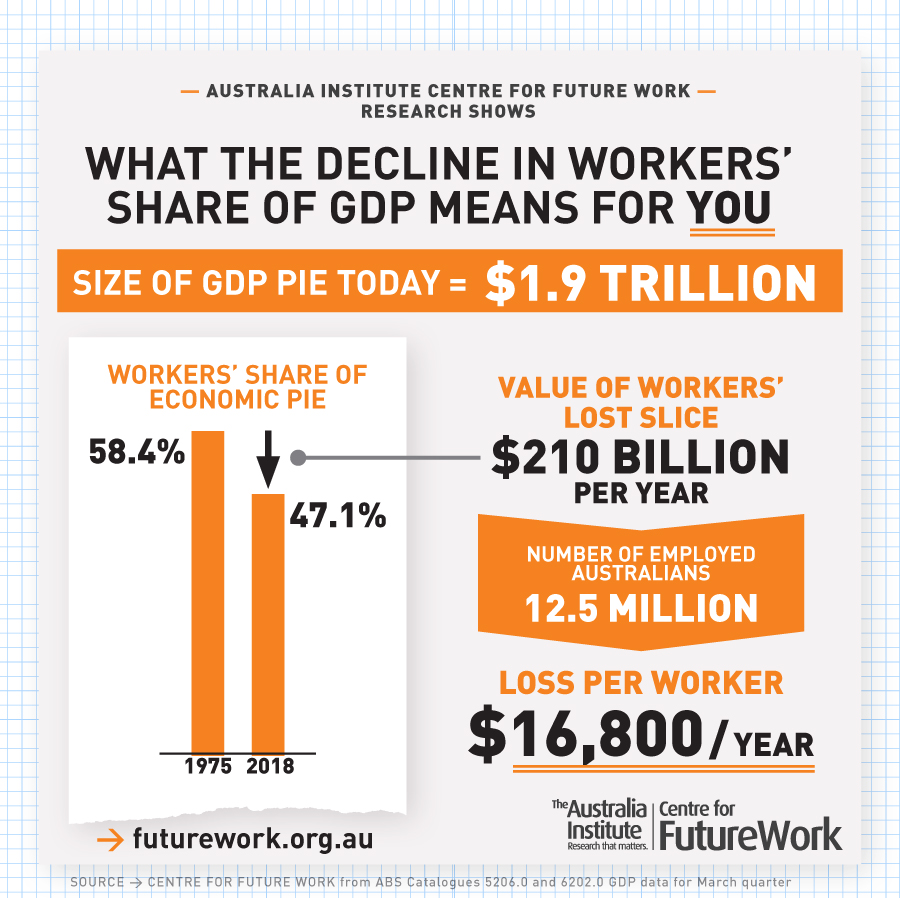
    This infographic summarises the bottom-line impact on average wage incomes for Australian workers.

    Labour Share Infographic

    In the March quarter of 2018, labour income (in wages, salaries, and superannuation contributions) accounted for 47.1% of total GDP. That is down over 11 percentage points from the peak labour share (over 58%) recorded in the same quarter of 1975. The loss of that share of GDP, given total output today, is equivalent to a redirection of some $210 billion in annual income – and the research symposium showed that almost all of that income was captured in the form of higher company profits (especially in the financial sector). If it were divided equally amongst all employed Australians, that lost income share translates into foregone income of close to $17,000 per worker.

    Many thanks to Anna Chang for her creative work on the infographic!

    The research symposium highlighted several factors that have caused the long-run shift in income distribution from workers to the business sector, and resulting growth in personal income inequality in Australia. Key factors included the erosion of union representation and collective bargaining, inadequate minimum wages, and the growing power of the financial sector.  For more details, see the articles by Jim Stanford, David Peetz, Margaret Mackenzie, Shaun Wilson, and Frances Flanagan.


    You might also like

    Denying Wages Crisis Won’t Make It Go Away

    by Jim Stanford

    As the great novelist Isaac Asimov wrote, “The easiest way to solve a problem is to deny it exists.” Business leaders and sympathetic commentators have adopted that advice with gusto, during current public debates over the unprecedented weakness of Australian wages.

  • Possibly Surprising Insights on the Future of Work

    Possibly Surprising Insights on the Future of Work

    by Jim Stanford

    Share

    Trade unionists are gathering this week at the ACTU’s triennial Congress in Brisbane.  Jim Stanford, Director of the Centre for Future Work, participated in a panel on the Future of Work (an apt title!) at the Congress.

    His presentation was “5 Possibly Surprising Insights on the Future of Work”.

    More detail on the issues raised in his presentation is provided in the Centre’s recent submission to the Senate Inquiry on the Future of Work and the Future of Workers.


    Related documents


    Presentation Slides


    Factsheet

    Related research

    You might also like

    Centre For Future Work to evolve into standalone entity

    The Centre for Future Work was established by the Australia Institute in 2016 to conduct and publish progressive economic research on work, employment, and labour markets. Supported by the Australian Union movement, the centre produced cutting edge research and led the national conversation on economic issues facing working people: including the future of jobs, wages

  • Centre for Future Work at #ACTUCongress18

    Centre for Future Work at #ACTUCongress18

    by Jim Stanford

    Share

    Trade unionists from across Australia are gathering in Brisbane this week for the 2018 Congress of the Australian Council of Trade Unions. And the Centre for Future Work will be there!

    Come and check out our information booth in the exhibitors’ area: meet our staff, learn more about our work, and sign up for updates.

    Our Director Jim Stanford will be presenting as part of a session on The Future of Work (good title!), Tuesday July 17 at 2:15 pm in conference room P1.

    And we will be distributing copies of a brochure with links to some of our most recent research (attached below).

    We are glad that our research can support the campaign to #ChangeTheRules!


    Related documents


    Brochure

    Related research

    You might also like

    Commonwealth Budget 2025-2026: Our analysis

    by Fiona Macdonald

    The Centre for Future Work’s research team has analysed the Commonwealth Government’s budget, focusing on key areas for workers, working lives, and labour markets. As expected with a Federal election looming, the budget is not a horror one of austerity. However, the 2025-2026 budget is characterised by the absence of any significant initiatives. There is

  • The Dimensions of Insecure Work in Australia

    The Dimensions of Insecure Work in Australia

    by Jim Stanford

    Share

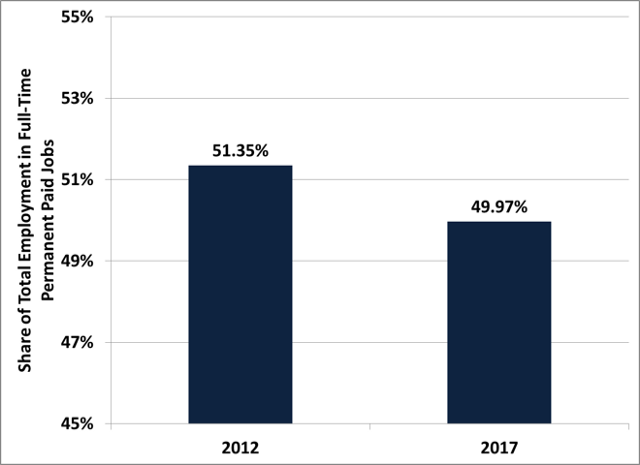
    Less than half of employed Australians now hold a “standard” job: that is, a permanent full-time paid job with leave entitlements. That’s the startling finding of a new report on the growing insecurity of work published by the Centre for Future Work.

    Share of Workers in Full-Time Paid Employment with Leave Entitlements. Source: Centre for Future Work calculations from ABS Catalogues 6291.0.55.003, EQ04 (2017), and 6333.0 Tables 2.3 and 9.1 (2012).

    The report, The Dimensions of Insecure Work: A Factbook, reviews eleven statistical indicators of the growth in employment insecurity over the last five years: including part-time work, short hours, underemployment, casual jobs, marginal self-employment, and jobs paid minimum wages under modern awards.

    All these indicators of job stability have declined since 2012, thanks to a combination of weak labour market conditions, aggressive profit strategies by employers, and passivity by labour regulators. Together, these trends have produced a situation where over 50 per cent of Australian workers now experience one or more of these dimensions of insecurity in their jobs - and less than half have access to “standard,” more secure employment.

    “Australians are rightly worried about the growing insecurity of work, especially for young people,” said Dr. Jim Stanford, one of the co-authors of the report. “Many young people are giving up hope of finding a permanent full-time job, and if these trends continue, many of them never will.”

    The report also documents the low and falling earnings received by workers in insecure jobs. While real wages for those in permanent full-time positions (the best-paid category) have grown, wages for casual workers have declined. And part-time workers in marginal self-employed positions (including so-called “gig” workers) have fared the worst: with real wages falling 26 percent in the last five years.

    “Given current labour market conditions and lax labour standards, employers are able to hire workers on a ‘just-in-time’ basis,” Dr. Stanford said. “They employ workers only when and where they are most needed, and then toss them aside. This precariousness imposes enormous risks and costs on workers, their families, and the whole economy.”

    Dr. Stanford called on policy-makers to address growing precarity with stronger rules to protect workers in insecure jobs (such as provisions for more stable schedules, and options to transition to permanent from casual work). He also stressed the need for economic policies that target the creation of permanent full-time jobs.


    Related research

    You might also like

    Centre For Future Work to evolve into standalone entity

    The Centre for Future Work was established by the Australia Institute in 2016 to conduct and publish progressive economic research on work, employment, and labour markets. Supported by the Australian Union movement, the centre produced cutting edge research and led the national conversation on economic issues facing working people: including the future of jobs, wages

  • A Comprehensive and Realistic Strategy for More and Better Jobs

    A Comprehensive and Realistic Strategy for More and Better Jobs

    by Jim Stanford

    Share

    The Australian Council of Trade Unions has released a major policy paper outlining an ambitious, multi-faceted program to address the chronic shortage of work, and the steady erosion of job quality, in Australia. The full paper, Jobs You Can Count On, is available on the ACTU’s website.  It contains specific proposals to stimulate much stronger job-creation, reduce unemployment and underemployment, improve job quality (including through repairs to Australia’s industrial relations system), and ensure that all communities (including traditionally marginalised populations like indigenous peoples, women, youth, and people with disability) have full access to the decent work opportunities that the plan would generate.

    Dr. Jim Stanford, Director of the Centre for Future Work, reviewed the ACTU’s paper in detail, and prepared an evaluation of its proposals and likely effects. Stanford endorsed the policy’s complementary set of expansionary macroeconomic measures, which would strengthen every major component of aggregate demand in the national economy: including government programs, capital investment, net exports, and consumer spending. He also emphasised the importance of the paper’s vision for a stronger labour market information and planning system, which will be essential to effectively match workers with jobs as the labour market tightens.

    Stanford estimated that the ACTU’s plan, if implemented consistently over a five-year period, would be capable of achieving the following outcomes:

    • Unemployment rate falling to 4 percent or lower.
    • Share of full-time work rebounding toward 75 percent of employment (since employers will be pressured by falling unemployment to create full-time jobs).
    • Underemployment rate falling to fall to 5 percent or lower.
    • Incidence of casual work declining below 20 percent.
    • Labour force participation rising by at least 2 percentage points, especially among young workers.
    • Nominal wage growth accelerating to traditional rates of 4 percent per year.

    Read the complete ACTU paper, Jobs You Can Count On.


    Related documents


    Report review

    You might also like

  • Scare Tactics for Corporate Tax Cuts Do Not Stand Fact Checks

    Scare Tactics for Corporate Tax Cuts Do Not Stand Fact Checks

    by Anis Chowdhury

    Share

    In the wake of the Trump Administration’s success in pushing a major company tax cut through the U.S. Congress, the Australian Treasurer has stepped up his calls for reduced company taxes here. He claims Australia will bypass the growth-inducing benefits of these tax cuts, but Dr. Anis Chowdhury, Associate of the Centre for Future Work, has compiled the economic evidence.  The U.S. experience shows no statistical evidence of any “trickle-down” growth dividend from company tax cuts.

    “Trump tax cuts: Scott Morrison warns business will abandon Australia while we are at the beach” was the Sydney Morning Herald headline, reporting on the Coalition Government’s scare tactics to press through its tax cuts gift for business.  The Treasurer used the opportunity of the Trump tax cuts to issue this “dire” warning. However, his claim does not withstand some basic empirical scrutiny.

    Fact 1: Australia is not a high tax country

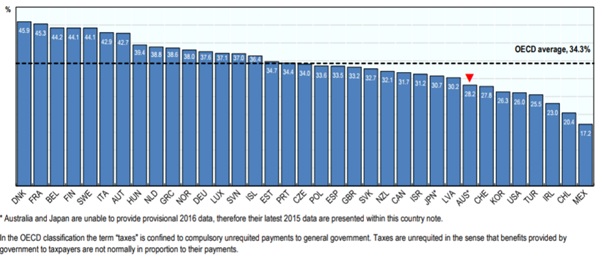
    Our overall tax take is one of the lowest among the 35 OECD countries. If Mr. Morrison was correct, then by now there should have been a tsunami of investment flowing here from 27 OECD countries with higher tax-GDP ratios than that of Australia’s 28.2% in 2016. Australia’s overall tax ratio is well below the OECD average of 34%, and also below neighbouring New Zealand’s tax take of 32.1% of GDP.

    Here are reported tax ratios for 27 OECD countries, 2016.

    OECD Tax Shares
    Source: Revenue Statistics 2017 – Australia; https://www.oecd.org/tax/revenue-statistics-australia.pdf

    Fact 2: Australia’s effective corporate tax is far below its statutory 30% rate

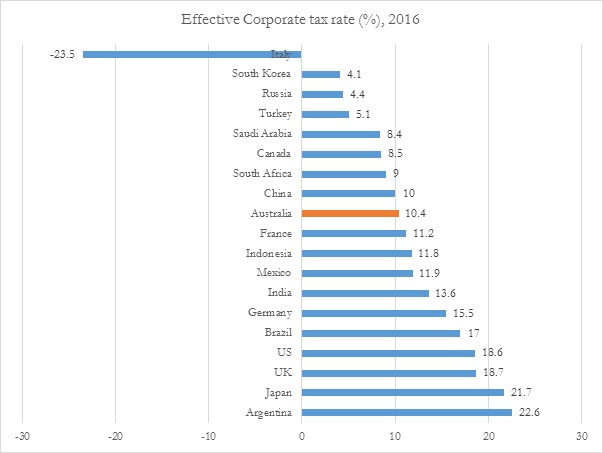
    Australian companies may seem to face a higher statutory corporate tax rate, but once they go through all their deductions and credits they don’t end up paying an unusually high amount compared to companies in other nations. The average effective rate (10.4%) is barely one-third the statutory rate. In fact, more than a third of large companies did not pay any corporate taxes in 2016 according to the recently released ATO data.

    Effective vs Statutory Tax Rates
    Source: National Public Radio, based on US Congressional Budget Office data; https://www.npr.org/2017/08/07/541797699/fact-check-does-the-u-s-have-the-highest-corporate-tax-rate-in-the-world

    Fact 3: Tax is low on companies’ lists of factors influencing investment location decision

    For example, the OECD noted, “it is not always clear that a tax reduction is required (or is able) to attract FDI. Where a higher corporate tax burden is matched by well-developed infrastructure, public services and other host country attributes attractive to business… tax competition from relatively low-tax countries not offering similar advantages may not seriously affect location choice. Indeed, a number of large OECD countries with relatively high effective tax rates are very successful in attracting FDI.”

    This is corroborated by the most recent World Bank survey of enterprises, which found that tax incentives are not high on the list of critical factors affecting inflows of foreign direct investment. The IMF’s recent research also reports that the net impact of corporate tax cuts to incentivise private investment is quite often negative on government revenues.  The pre-tax profitability of Australian businesses has also tended to exceed that in other countries, and this is surely more important in motivating investment flows.

    Fact 4: Rigorous studies of past US tax cuts did not find a positive link between tax cuts and economic or employment growth

    For example, the oft-cited examples of the Reagan or Bush tax cuts do not in fact demonstrate that tax cuts cause growth.  Admitted by President Reagan’s former chief economist, Martin Feldstein, the vast majority of growth during the Reagan era was due to expansionary monetary policy that slashed interest rates massively to help the economy bounce back from a severe recession in 1982.  Increased defence spending and an expanded labour force due to an influx of baby boomers also boosted the economy. In another study with Doug Elmendorf, the former Congressional Budget Office Director, Martin Feldstein found no evidence that the 1981 tax cuts increased employment.

    The 2001 and 2003 Bush tax cuts also failed to spur growth. Between 2001 and 2007 the economy grew at a lacklustre pace—real per-capita income rose by 1.5% annually, compared to 2.3% over the 1950-2001 period. Interestingly, the two sectors that grew most rapidly in this period were housing and finance, which were not affected by the 2001 and 2003 tax cuts.  Moreover, by 2006, prime-age males were working the same hours as in 2000 (before the tax cuts), and women were working less – both facts inconsistent with the view that lower tax rates raise labour supply.

    Fact 5: The most infamous case of tax cuts in the US State of Kansas was a colossal failure

    Governor Sam Brownback promised that a moderate tax cut for individuals and a big tax cut for businesses would be “like a shot of adrenaline into the heart of the Kansas economy.”  Unfortunately, however, despite his 2012 tax cuts, the Kansas economy remained moribund, while neighbouring states surged ahead. In the process, the Kansas state budget was left in tatters. No wonder that the Republican-led state legislature reversed most of Brownback’s tax cuts in the face of poor growth and pressing public spending needs.

    Therefore, if Mr. Morrison is serious about repairing the budget, or stimulating growth and employment, then he should be concentrating on raising more revenues (not less) and investing in the nation – instead of cutting basic services to fund his tax cuts for the rich. He should be looking at the facts, instead of resorting to scare tactics.


    You might also like

    Commonwealth Budget 2025-2026: Our analysis

    by Fiona Macdonald

    The Centre for Future Work’s research team has analysed the Commonwealth Government’s budget, focusing on key areas for workers, working lives, and labour markets. As expected with a Federal election looming, the budget is not a horror one of austerity. However, the 2025-2026 budget is characterised by the absence of any significant initiatives. There is

    Centre For Future Work to evolve into standalone entity

    The Centre for Future Work was established by the Australia Institute in 2016 to conduct and publish progressive economic research on work, employment, and labour markets. Supported by the Australian Union movement, the centre produced cutting edge research and led the national conversation on economic issues facing working people: including the future of jobs, wages

  • Job Opportunity – Research Economist

    Job Opportunity – Research Economist

    Share

    The Centre for Future Work invites applications for an economist to join our research team in labour market research and policy analysis, working from our offices in Sydney or Canberra.

    Deadline for applications is December 21 2017.

    It’s a chance to be part of our growing team, and to make a contribution to strong, progressive policy research on jobs, employment, fairness, and the future of work!

    Please download the full notice below for more details.


    Related documents


    Position description

    You might also like

    Dutton’s nuclear push will cost renewable jobs

    by Charlie Joyce

    Dutton’s nuclear push will cost renewable jobs As Australia’s federal election campaign has finally begun, opposition leader Peter Dutton’s proposal to spend hundreds of billions in public money to build seven nuclear power plants across the country has been carefully scrutinized. The technological unfeasibility, staggering cost, and scant detail of the Coalition’s nuclear proposal have

  • The Future of Work is What We Make It

    The Future of Work is What We Make It

    by Sarah Kaine and Jim Stanford

    Share

    Progressives everywhere are grappling with developing policy proposals to improve the quantity and quality of work in our economy, as part of their broader vision for building more successful and inclusive societies. To this end, the Fabians Society in NSW recently published an interesting booklet of policy proposals, to inject into debate within the Labor Party and other fora. One chapter written by Sarah Kaine (Associate Professor at UTS and a member of the Centre for Future Work’s Advisory Committee) and Jim Stanford (Economist and Director of the Centre) deals head-on with the challenges facing work, and what can be done to make it better; it is reprinted below.

    To receive a copy of the full Fabians Society booklet, please visit their website.

    The Future of Work is What We Make It

    There has been an outbreak of public concern recently about the impacts of technological change on employment. Some research suggests that 40 percent or more of all jobs are highly vulnerable to automation and computerisation in coming decades (Frey and Osborne, 2013). Some observers even suggest that work can no longer be the primary means for people to support themselves – leading to all sorts of radical policy responses ranging from taxing robots (Delaney, 2017) to the provision of universal basic income to all people, working or not (Arthur, 2016).

    Of course, this general fear of technological unemployment isn’t new. Since the industrial revolution, workers have quite understandably worried about what will happen to their jobs when machines can do their work faster, cheaper, or better. Previous periods of accelerating technological change were also associated with other waves of concern; even relatively recently, futurists were predicting that technology would make work largely obsolete (for example, Rifkin, 1995).

    Conventional market-oriented economists downplay these concerns: the magical workings of supply and demand forces should ensure that any labour displaced by technology is automatically redeployed in other, more appropriate endeavours, and people will be better off in the long run. The focus of policy should be to facilitate that transition through retraining and mobility assistance, allowing displaced workers to move more easily into better, alternative occupations.

    There are many reasons to question this optimistic theoretical perspective. But actual historical experience gives more cause to doubt ultra-pessimistic forecasts of technological unemployment. In practice, previous waves of technological change have not been associated with mass unemployment, for a range of reasons. The labour-displacing effects of new technology can be offset, in whole or in part, by other factors: including new work associated with the development, production, and operation of the new technology itself; new tasks that become conceivable only as a result of the new technology; historic reductions in average working hours (a trend which has unfortunately stalled under neoliberalism); and the capacity of active macroeconomic policy to boost aggregate labour demand when needed.

    So even from a critical economic perspective, there is little reason to conclude that “work will disappear”. This does not mean we should be complacent about the problems and risks posed to workers by accelerating technological change. But it does mean our response to those challenges should be grounded in a more balanced and complete assessment of what technology actually does to work – and where technology comes from in the first place.

    Remember, technology is not some exogenous, uncontrollable force. What we call “technology” is actually the composite of human knowledge about how to produce a broader range of goods and services, using better tools and techniques. Humans put their minds to solving certain problems (so-called “mission-based innovation”, as termed by Mazzucato, 2011), based on their particular concerns and interests. And therefore, technology is never neutral: the problems we turn our creative attention to, reflect the interests and influence of the constituencies which get to decide and fund innovation activity.

    For example, one nefarious use of modern technology in workplaces is the ubiquitous and largely uncontrolled application of surveillance and performance-tracking technology by employers, to more immediately and completely monitor the work effort of their employees. Increasingly intrusive systems now give bosses minute-by-minute data on the whereabouts, productivity, and even attitudes of their workers. This has wide-ranging impacts not only on privacy and the quality of work. It even affects compensation: when it is so easy and cheap to monitor employees (and sack them if their performance is unsatisfactory), employers have less reason to offer workers positive incentives (or “carrots”) for performance and retention – and are more likely to use a disciplinary “stick” instead. It is no accident that surveillance and monitoring technology has advanced in leaps and bounds: employers have a strong vested interest in using these techniques to intensify work and enhance profit margins. Yet at the same time, easily-solvable monitoring problems – like ensuring that franchise businesses actually pay their employees minimum wages, for example, or are making their legally mandated superannuation contributions – are not addressed with technological solutions. Why not?

    This non-neutrality of technology reflects the increasingly lopsided power imbalances in the modern labour market: those with power can influence the direction of technology in ways that reinforce their power. Another example is the one-sided application of digital platforms for assigning work and collecting payment used by “gig”-economy businesses like Uber and Deliveroo. Their technology has not (so far) actually changed the core nature of the work involved in these businesses: passengers are still driven about in a car, and take-away food is still delivered on a bicycle. What technology has facilitated, rather, are big changes in how work is hired, supervised, and compensated. By using digital applications (which they developed and own), platform businesses try to distance themselves from traditional employer functions and responsibilities (like paying minimum wages, or offering any stability or continuity of work). Technology thus allows businesses to shift risk to those performing the work, and minimise their labour costs. These changes in the social relations of work are by no means inevitable – as is being proven as workers around the world fight back against the most exploitive practices of these businesses. (Singapore’s approach was fairly effective in this regard: simply banning Uber from operating altogether). Resisting the mis-use of technology to cheapen and degrade work, is very different from a Luddite-like effort to try to stop technology itself.

    Some jobs will certainly disappear as technology replaces some tasks (and employers use it to enhance their ability to control and parcel out work most profitably). Some new jobs will be created: including good ones (like the creative, knowledge-intensive ones developing and managing new technologies), and some less good ones (like the menial digital work associated with many technologies). Many jobs, perhaps counterintuitively, will hardly be affected at all: including a range of caring services, cleaning, hospitality, and other functions which seem to inherently require hands-on human labour.

    To be sure, the quantity of work available is always a concern, all the more so given the stagnation (globally and in Australia) which continues to dominate the global economy since the GFC. Governments should put top priority on stimulating job-creation, wielding the whole array of policy tools (fiscal, monetary, industry, trade, skills, and more) at their disposal. Spurring stronger demand for labour will automatically ease adjustment to new technologies and their labour-displacing effects.

    But the quality of jobs is an equal concern, and it is in this realm that the impacts of new technology may be most severe. The quality of new jobs created as technology advances, and the quality of existing jobs that are largely untouched by technology, must be targeted for forceful, ambitious policy attention, to arrest and reverse the widespread degradation of work which is being permitted by weak labour market conditions, technology, and the enhanced and largely unchallenged power of employers.

    After all, a sustained structural shift in bargaining power in the labour market, in favour of employers, has been a central goal of neoliberal economic and social policy. There has been an expansion of non-standard employment in all its forms: irregular hours, casual work, labour hire positions, precarious forms of contracting and self-employment, and more. This precarity has been facilitated by a combination of persistently weak labour market conditions (compelling desperate workers to take any job no matter how insecure); technologies which make it easier for firms to orient staffing around precarious and on-call work; and regulatory inattention and complacency. On this last point, regulatory levers for protecting workers have not kept up with employers’ efforts to sidestep traditional minimum standards. Even the simplest of standards (like the minimum wage) are widely unenforced.

    In short, to address the impacts of technology – and, more importantly, the one-sided application of technology within workplaces – we must modernise and revitalise the concept of a social contract. We need a social contract for the digital age, that re-establishes mutual responsibilities and expectations, that commits to improving both the quantity and quality of work as a central goal of policy, and that actively supports the countervailing forces (like unions, employment standards, and cultural expectations of fairness) that are essential to achieving more security and fairness in the world of work.

    The values of NSW Labor provide a solid foundation from which to embark on such a revitalisation. The party’s vision emphasises that ‘prosperity starts with good jobs’ and commits that the ‘benefits of rising prosperity are shared fairly’; working towards such collective prosperity is a stated goal (NSW Labor, 2017). Key to this prosperity from a Labor viewpoint is support for more equal opportunities in the labour market and an effective system for regulating work. These values are constant and are not altered by technology or innovation: they apply whether citizens are engaged to work in full-time, “old economy” jobs or precarious “gigging” in the digital economy. A challenge is posed, though, by the rhetoric of innovation that leads the launch of a shiny new app to distract from the business models that underpin it – often based on underpaid, insecure, or invisible labour. What is needed then is clarity and purpose to create a system for regulating work that is modern, but fair.

    Australian governments at all levels have been creative regulators of the labour market since Federation: think of the tax provisions implemented in the early years following federation. The Commonwealth government was constrained by the Labour power [Section 51 (xxxv)] of the Constitution, meaning that it could not intervene directly to set wages and conditions of work. However, it could impose taxes. The Excise Tariff Act 1906 passed by the Deakin government included a provision for manufacturers of agricultural machinery to be exempt from the excise if the workers in that company were paid a ‘fair and reasonable’ wage (Hamilton, 2011). The Harvester judgement that ensued is embedded in industrial relations folklore and has become synonymous with the establishment of minimum wages in Australia. However, what is often overlooked is that the mechanism used to establish this landmark was not a mechanism of traditional labour law – it was, after all, triggered by tax law.

    Labor Governments have not been alone in this regulatory innovation to address labour policy concerns. The Howard Government was just as inventive and driven in its determination to use the Corporations power [Section 51 (xx)] of the Constitution to create a national regulatory framework that downgraded collective bargaining and instituted statutory individual contracts. A further legacy of that re-orientation was the whittling away of State industrial relations jurisdictions. This might lead to the conclusion that a State Labor government has little capacity to influence the wages and conditions of workers beyond the public sector. However, this conclusion is too narrow, and underestimates the extent to which creative, ambitious interventions at the state level could contribute to the restoration of a progressive social contract.

    Consider, for example, the current Victorian government’s attempts to eradicate the exploitation of workers in industries like horticulture, through the introduction of a legislated licensing scheme for labour hire companies. This is illustrative of the potential for action by a State government to curb the exploitation of vulnerable workers. But legislation is not the only choice; there is a vast array of options on the regulatory spectrum.

    Another means of regulating for better outcomes outside the confines of labour law is to support industry-specific multi-stakeholder collaboration. A developing example of this is the Cleaning Accountability Framework. CAF is an independent, multi-stakeholder initiative comprising representatives from across the cleaning supply chain – including institutional property investors, building owners, facility managers, cleaning companies, cleaners (through United Voice) and industry associations. CAF seeks to improve labour standards by encouraging transparency throughout the cleaning supply chain. CAF will recognise stakeholders who adopt better practice in the cleaning industry through a building certification scheme. In doing so, CAF will work to improve the employment conditions of cleaners, support sustainable business models and responsible contracting practices, help building owners and investors manage risk, and assist tenants in ensuring that they are benefiting from quality cleaning services. Multi-stakeholder initiatives have been criticised for lacking enforceability, but CAF overcomes this by using the structure of the supply chain, specifically the power of building owners and managers to drive compliance.

    None of these examples are centred in the “gig economy,” nor do they address sectors immediately threatened by automation. But they nevertheless provide an insight into “‘outside the box” efforts to improve the quality and fairness of jobs. Similar ambition and creativity could provide a better regulatory environment for the conduct of all types of work – not least in the digitally enabled economy. This could begin with a comprehensive mapping of State-based regulation to identify potential opportunities to leverage existing laws, regulations, procurement policies and industry codes.

    This would be an ambitious project, but given the extent of State influence in major areas of the economy (health, education, transport), it would provide a plethora of policy options.

    Alternatively, if changes to work (whether wrought by technology or ‘innovation’ in business models) are left unquestioned, and if we assign the determination of working conditions to algorithms, then the aspirations encapsulated in “Labor values” will remain unrealised and, a chance to re-imagine a social contract based on decent work will be squandered.

    References

    Arthur, Don 2016, “Basic Income: A Radical Idea Enters the Mainstream,” Parliament of Australia, Research Paper Series 2016-17, November 18.

    Delaney, Kevin J 2017, “The robot that takes your job should pay taxes, says Bill Gates,” Quartz, February 17.

    Frey, Carl Benedikt, and Michael A. Osborne 2013, The Future of Employment: How Susceptible are Jobs to Computerisation? (Oxford: Oxford Martin School).

    Hamilton, R. S. 2011, Waltzing Matilda and the Sunshine Harvester Factory: The early history of the Arbitration Court, the Australian minimum wage, working hours and paid leave (Melbourne: Fair Work Australia).

    Mazzucato, Mariana 2011, The Entrepreneurial State: Debunking Public vs. Private Sector Myths (London: Anthem).

    NSW Labor 2017, “Our Values,”.

    Rifkin, Jeremy 1995, The End of Work: The Decline of the Global Labor Force and the Dawn of the Post-Market Era (New York: Putnam & Sons).

    Sarah Kaine is an Associate Professor at the UTS Business School, and a member of the Advisory Committee of the Centre for Future Work. Jim Stanford is Economist and Director of the Centre for Future Work, part of the Australia Institute.

    You might also like

    Centre For Future Work to evolve into standalone entity

    The Centre for Future Work was established by the Australia Institute in 2016 to conduct and publish progressive economic research on work, employment, and labour markets. Supported by the Australian Union movement, the centre produced cutting edge research and led the national conversation on economic issues facing working people: including the future of jobs, wages

  • The Paradox of Rising Underemployment and Growing Hours

    The Paradox of Rising Underemployment and Growing Hours

    by Anis Chowdhury

    Share

    Paradoxically, underemployment and number of hours actually worked are both on the rise in Australia.

    Paradoxically, underemployment and number of hours actually worked are both on the rise in Australia.

    Since 1978 from when the ABS started publishing data on the number of hours worked per month, the hours increased continuously. For example, in July 1978 slightly less than a billion hours was worked; the figure was 1.7 billion in June 2017 – a rise of 781.9 million hours worked a month. Compared with June 2008, 151.3 million more hours were worked in June 2017. The recently released Labour Account Australia, Experimental Estimates, July 2017 (by ABS) shows that between 2010/11 and 2015/16, hours actually worked increased by 5.7% from 19.15 billion hours to 20.23 billion hours.

    The rising number of hours worked should be a good news, provided it meant more income. But for the most part during this period real wages either stagnated or fell. Recent ABS data show that quarterly real wage growth stuck below 0.6% for three years, translating into an annual wage growth of just 1.9%, the lowest figure since the late 1990s, and probably the slowest rate of pay rises since the last recession.

    Hence the majority of workers are forced to work more hours in their struggle to maintain a decent living. Labour Account Australia, Experimental Estimates (July 2017) records that a good number of people work more than one job. Interestingly, increasing by 64,100 (9.2%), the growth in secondary jobs outstripped the growth in main jobs which increased by 791,700 (6.8%) over the six years to June 2016.

    It is also not surprising that people are wanting to work more hours, raising the incidence of involuntary underemployment. The most recent ABS estimate, for May 2017, shows 1.129 million Australians working fewer hours than they would like. This translates into an underemployment rate of 9.3%. When added to the current headline unemployment rate of 5.6%, we have a whopping “underutilisation” rate of around 14.9%!

    Labour exploitation is also on the rise as the unpaid overtime work gets longer. The Australia Institute’s 2016 survey (Excessive Hours and Unpaid Overtime: An Update) found that full-time workers were on average performing more than 5.1 hours a week in unpaid overtime. Part-time and casual employees work an average of 3.74 hours unpaid overtime per week. For full-time workers, average unpaid overtime is worth over $10,000 per year – or 13% of actual earnings. For part-time workers, lost income from unpaid overtime exceeds $7500 per year, and represents an even larger share (nearly 25%) of actual earnings. The lost income due to unpaid overtime represents a significant loss to workers and their families.

    Australians are putting in some of the longest hours (more than 50 hours) in the developed world, coming in 9th in a survey of OECD countries. Full-time employees are on average putting in extra 4.28 hours and part-time staff are working an hour over their contracted hours every week. ABS data show that around 30% of employed men and 11% of employed women report usual working 45 hours or more each week.

    Thus, Australian workers are over-worked and underpaid. They are both time and income poor.

    These paradoxes are not statistical quirks. They are the results of heightened job insecurity; but it is deliberate! It is caused by changes in the labour market institutions governing wage and employment conditions, designed to increase the share of profit and strengthen corporate power.

    Alan Greenspan, the former Chairman of the US Federal Reserve, made this very clear in his testimony to the Congress two decades ago (26 February, 1997). He elevated job insecurity to major status in central bank policy when he said, “Certainly other factors have contributed to ‘the softness in compensation growth” despite a low unemployment rate, but ”I would be surprised if they were nearly as important as job insecurity”.

    Workers have been too worried about keeping their jobs to push for higher wages, and this has been sufficient to hold down inflation without the added restraint of higher interest rates. He also acknowledged, “Owing in part to this subdued behavior of unit [labour] costs, profits and rates of return on capital have risen to high levels”.

    Most interestingly, according to Greenspan, widely regarded as the “guru” of present day monetary policy-makers, workers’ fear of losing jobs is not in itself sufficient; the sense of job insecurity has to be rising or getting worse to prevent any push for significant wage increases. This is because, once it levels off, and workers become accustomed to their new level of uncertainty, their confidence may revive and the upward pressure on wages resume, especially when more people find jobs and the unemployment rate drops.

    Right now, millions of Australians are feeling some level of job insecurity because of increased casualisation of employment and insufficient availability of full-time regular jobs. The increase in casual and non-permanent work is putting pressure on people to work harder for longer, and to work more hours unpaid.

    There are many reasons, from automation to slower growth of the economy, for increased job insecurity. But one factor contributed the most – the deregulation of the labour market in the name of increased flexibility. This not only involved moves from centralised to enterprise bargaining and to individual contracts, but also restrictions on union activities – both intended to weaken worker’s bargaining power and strengthen business’s hiring and firing power.

    One can easily blame successive Liberal-National Coalition Governments, starting from John Howard for this. But the Hawke-Keating Labor Government started the process, arguing that it was necessary to respond to changing global economic conditions and to remain competitive. The Hawke-Keating Government argued that linking wage bargaining to the enterprise performance would provide flexibility and hence boost productivity.

    The succeeding Howard-Costello Government increased so-called flexibility by introducing “work choices” (individual contracts) arguing the same. In 2007, Peter Costello said that the greatest risk to Australia’s prosperity is a return to centralised wage fixing: “Nothing could be a bigger threat to the Australian economy at the moment than moving away from decentralised wage fixation and going back to the past.”

    But alas; there has been no sustained boost in productivity growth. Instead, successive labour market reforms have allowed inefficient enterprises to survive. Employers  felt no pressure to upgrade technology, improve management practices or train workers to boost productivity, as both Labor and Coalition Governments, held hostage by the business group threatening to leave Australia for cheaper destinations, vied with each other to make Australia more hospitable – more “competitive” – for businesses by making labour cheaper and regulations looser.

    During 2016, Australia’s labour productivity growth was nil whereas it grew by 1.9% in OECD. Only 4 other OECD countries experienced lower productivity growth than Australia. Using the internationally comparable US Conference Board data, the Productivity Commission reported that Australia’s multi-factor productivity (MFP) growth in 2014 was negative (-0.9%) – and lower than China, India and Korea. MFP reflects the overall efficiency with which labour and capital inputs are used together in the production process. MFP growth in Australia continued to decline since the mid-1990s reaching a negative figure, i.e., declining during 2005-2010.

    The problem is well exemplified by Australia’s auto industry which survived only due to the life-line of government subsidies and some industry protection – recall the Rudd Labor Government’s $6.2 billion over the next 13 years and Abbott Government’s $900 million budget backdown. Despite all the flexibilities afforded by diluting the employment and pay conditions, one of just 13 countries in the world capable of building a car from the ground up, Australia’s 90-year history of assembling and building automobiles is coming to an end with the pulling off of the plug of government assistance.

    Therefore, the only way Australia can now compete internationally is by racing to the bottom; by lowering labour cost – cutting the penalty rates, lowering the minimum wage and diluting working conditions; in short, by underpaying the workers and forcing them to work longer hours. And this only can succeed by ensuring continued rise in job insecurity though underemployment, more spells of unemployment, more volatility in the hours the workers are expected to work and continued weakening of labour’s bargaining power.


    You might also like

    Centre For Future Work to evolve into standalone entity

    The Centre for Future Work was established by the Australia Institute in 2016 to conduct and publish progressive economic research on work, employment, and labour markets. Supported by the Australian Union movement, the centre produced cutting edge research and led the national conversation on economic issues facing working people: including the future of jobs, wages