Category: Article

  • Australia’s Gas Use On The Slide

    Australia’s Gas Use On The Slide

    by Ketan Joshi

    Share

    The Federal Government has released a new report that includes projections of how much gas Australia is set to use over the coming decades. There is no ambiguity in its message: Australia reached peak gas years ago, and it’s all downhill from here:
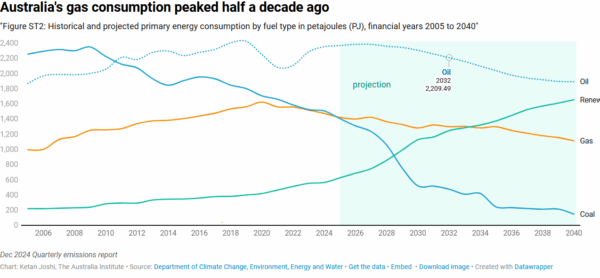
    “Gas consumption is projected to decline to 2040 as electrification increases across the economy and renewables and storage take an increasing share of electricity generation”, wrote the Department of Climate Change, Energy, Environment and Water (DCCEEW).

    This doesn’t sit well with the Prime Minister’s recent claims that more gas is needed for “firming” renewable energy. Figures from the Australian Energy Market Operator (AEMO)’s 2024 Integrated System Plan (ISP) show just how little gas is likely to be required in Australia’s electricity system.

    In AEMO’s ‘step change’ scenario, there isn’t a single year where gas generates more than its historical peak in the National Electricity Market. In this scenario, more gas was burned in the past 16 years than is burned over the next 25 years.

    In short: while gas might serve occasional use during low wind and sun periods, Australia simply will not end up using large amounts of it.

    It is weird, then, that Australia has a massive pipeline of planned fossil gas extraction projects. Many of them are justified on the grounds that they’re required to help Australia decarbonise its power grids, with more than 1,000 new petajoules coming online by 2027, according to the latest government projects report.

    The chart below compares the above projections of Australia’s domestic gas use to projections of the volume of gas exports, prepared by the separate Department of Resources and Energy (DISER). It makes it pretty clear where all the new gas is going – exports.

    Only looking at new gas production capacity, and only looking at the proportion that has a clear operation date, that is still around 11 times the amount of gas projected to be used in the power sector. In fact, the use of LNG for FY23 was greater just for processing LNG than the entire power sector in Australia:

    This analysis by climate expert Tim Baxter lays it out in even more detail.

    “Again, more than 3,000 petajoules of gas were exported from Western Australia in 2022–23. If the entire transition to clean energy were to stand dead still as if renewables weren’t already going gang-busters — in Western Australia renewable energy generation has increased by an average of 20% each year for the past five years — we would need just 2.5% of that gas to keep the lights on for the state”.

    It is pretty simple: Australia does not need to be expanding its fossil gas production, least of all to run fossil gas power stations. It’s a hollow fossil fuel industry talking point, and the Federal Government should know better than to repeat it.


    You might also like

    Centre For Future Work to evolve into standalone entity

    The Centre for Future Work was established by the Australia Institute in 2016 to conduct and publish progressive economic research on work, employment, and labour markets. Supported by the Australian Union movement, the centre produced cutting edge research and led the national conversation on economic issues facing working people: including the future of jobs, wages

  • Commonwealth Budget 2025-2026: Our analysis

    Commonwealth Budget 2025-2026: Our analysis

    by Fiona Macdonald

    Share

    The Centre for Future Work’s research team has analysed the Commonwealth Government’s budget, focusing on key areas for workers, working lives, and labour markets.

    As expected with a Federal election looming, the budget is not a horror one of austerity. However, the 2025-2026 budget is characterised by the absence of any significant initiatives.
    There is very little in this budget that is new, other than some surprise tax cuts, which are welcome given they mostly benefit people on low incomes

    There are continuing investments in some key areas supporting wages growth where it is solely needed and for rebuilding important areas of public good. However, there remains much that needs to be done in the next parliament, whoever is in government.

    “The budget does deliver a welcome tax cut targeted towards those on low incomes” Chief Economist Greg Jericho notes, “but the lack of new spending and initiatives highlights the need for policies from all political parties in the coming election campaign that address inequality and the needs of people who have been most hurt by cost of living rises over the past three years.”

    Read our full budget briefing paper for more information


    Related research

    You might also like

    Dutton’s nuclear push will cost renewable jobs

    by Charlie Joyce

    Dutton’s nuclear push will cost renewable jobs As Australia’s federal election campaign has finally begun, opposition leader Peter Dutton’s proposal to spend hundreds of billions in public money to build seven nuclear power plants across the country has been carefully scrutinized. The technological unfeasibility, staggering cost, and scant detail of the Coalition’s nuclear proposal have

  • Webinar: Stop passing the buck -Workers’ compensation and ‘gig’ workers

    Webinar: Stop passing the buck -Workers’ compensation and ‘gig’ workers

    by Lisa Heap

    Share

    Workers’ compensation and rehabilitation are amongst the most important legal issues facing the ‘gig’ economy. This reflects the potential vulnerability of these workers and their families, co-workers, and community to harsh and long term consequences from injuries. For a while, it looked like federal industrial policy might ‘solve’ the workers compensation problem by redefining ‘gig’/platform workers as employees.

    However, the policy decision to enshrine minimum rights for a separate ‘employee-like’ category of workers leaves gig workers outside the scope of workers compensation protections.

    In this discussion we will hear from those researching and advising on the reforms necessary to better protect injured gig workers, a worker who has been seriously injured, and those who are organising and advocating for policy and law reform.

    Free Event – Register Now

    Speakers:

    • Michael Kaine – National Secretary Transport Workers’ Union
    • Professor Emeritus David Peetz – Carmichael Centre’s Laurie Carmichael Distinguished Research Fellow.

    When:
    Thursday, July 18, 2024 at 12:30 pm AEST

    Where:
    Zoom


    You might also like

    Dutton’s nuclear push will cost renewable jobs

    by Charlie Joyce

    Dutton’s nuclear push will cost renewable jobs As Australia’s federal election campaign has finally begun, opposition leader Peter Dutton’s proposal to spend hundreds of billions in public money to build seven nuclear power plants across the country has been carefully scrutinized. The technological unfeasibility, staggering cost, and scant detail of the Coalition’s nuclear proposal have

  • “I studied economics to better understand the world and equip me with better tools to serve society”

    “I studied economics to better understand the world and equip me with better tools to serve society”

    Share

    Prof Anis Chowdhury, an Associate of the Centre for Future Work, was recently appointed Emeritus Professor at Western Sydney University, in honour of his decades of influential work in progressive macroeconomics and development economics. Prof Chowdhury’s address on occasion of his installment provides an overview of his evolution as a progressive economist and significant impact on global policy:

    Installment Address, Emeritus Professor Anis Chowdhury, Western Sydney University, June 2024

    Chancellor, Deputy Vice-Chancellor, colleagues, guests, ladies and gentlemen – and of course, graduands.

    Thank-you Deputy Vice-Chancellor for your generous introduction. My sincere thanks to the Board of Trustees for approving me for this prestigious title.

    I recognise the Traditional Custodians of the lands where our campuses are located, and pay my respects to all First Nations Elders past and present.

    I join my voice to all calls to honour their right to self-determination and development, as enshrined in the landmark 2007 UN Declaration on the Rights of Indigenous Peoples.

    Incidentally, at the UN, the first report I provided significant input into, was State of the World’s Indigenous Peoples 2009, and drafted, was Report on the World Social Situation 2010.

    My passion for human rights, equity and justice is the product of my time. I was born in 1954, a year before the leaders of newly-decolonised Africa and Asia met in solidarity in Bandung, Indonesia.

    Indonesia’s founding President Soekarno reminded, “our unhappy world [is] torn and tortured, … because the dogs of war are unchained once again”.

    He called for “Moral Violence … in favour of peace”, to “demonstrate to the minority of the world … that we, the majority, are for peace, not for war”.

    At school in the 1960s, we were constantly inspired by calls against all forms of discrimination, violence and exploitation in favour of peace, humanity and social justice.

    Despite the wave of decolonisation, we remembered Soekarno’s warning: colonialism “was not dead”. Instead, it took “its modern dress … It is a skilful and determined enemy, … appears in many guises… [and] does not give up its loot easily”.

    In solidarity with Franz Fanon’s ‘Wretched of the Earth’, I was a student activist, joining protest movements against the Vietnam War, Indonesia’s invasion of East Timor and India’s annexation of Sikkim; condemning the murders of the likes of Che Guevara and Salvador Allende; demanding the end of apartheid in South Africa; and joining Bangladesh’s liberation war.

    Today, my involvement in these movements would be labelled as “radicalism”; back then, it was the norm.

    I studied economics to better understand the world and equip me with better tools to serve society. My father, a doctor, readily agreed, socio-economic ills are the root cause of many diseases.

    In universities in the 1970s, dissent and debate were encouraged as ways to develop humanist and universalist views; to think big; and to become movers and shakers. We were inspired by world leaders like Gough Whitlam, and Tanzania’s freedom leader Julius Nyerere. Of course, Nelson Mandela stood tall.

    The 1970s were significant.

    • Bangladesh became an independent nation in 1971.
    • In 1972, the Club of Rome warned of the unsustainability of current consumption and production.
    • In 1974, the UN called for a “New International Economic Order” to end economic colonialism.
    • And the people of Vietnam defeated the US superpower in 1975.

    Alas, the 1980s slid us backwards, commodifying everything, including education. Universities turned into mass degree factories, and economics moved from the social science faculty, to business schools.

    Unfortunately, it was not just ‘Gordon Gekko’, but a Nobel Laureate economist, Milton Friedman, who promoted the idea that “greed is good”.

    Then came wars instigated by lies, against the urging of the UN Security Council; and the gleeful murder of half a million children as “collateral damage” justified as “a price worth paying”.

    We started this decade with rich nations stockpiling Covid-19 vaccines and blocking poor countries’ access to drugs, testings and vaccines to protect big pharma profits.

    Now, we’ve descended to the lowest point of our post-war history, with the massacre of over 40,000 Palestinians – mostly women and children – and those in high office openly calling for the total annihilation of a colonised people. The ICC and ICJ are threatened by the leaders of the free world acting like a mafioso cartel.

    How much lower can we descend?

    Has civilization progressed at all?

    We cannot resolve our differences with dialogue; and modern killing machines have replaced sticks and stones where might is right.

    Have I lost hope? NO.

    I look at the bright moments like Bob Hawke’s leadership of the anti-apartheid BDS movement that liberated South Africa and Nelson Mandela.

    Student protests and encampments for Gaza all around the world, including at Western Sydney University, maintain my faith in the power of active citizens.

    Under this “moral violence” for peace, universities are reconnecting with their essential humanity and their duty of care.

    As we celebrate our academic achievements today, we must also remember the students and teachers of Gaza’s razed universities.

    We must not lose sight of the real-world impacts of our academic pursuits. My knowledge of economics was enriched by my social and political activism. When I was in Indonesia to advise on the recovery from the Asian financial crisis and to draft National Human Development Report, I lived outside the gated community to understand the daily struggle of those who lost livelihoods.

    In 1970, Friedman wrote, “the social responsibility of business is to increase its profits”.

    Dear new business graduands, as I congratulate you, I also urge you to purge the world of this obnoxious Friedmanite idea that is destroying our planet and tearing our communities apart.

    Look instead to the “Social Business Model” of Bangladesh’s Nobel Laureate Muhammad Yunus.

    Work on the right side of history; stand up for justice and liberation; spread the “moral violence” for peace; and put people and planet before profit.

    Thank-you.


    You might also like

    Centre For Future Work to evolve into standalone entity

    The Centre for Future Work was established by the Australia Institute in 2016 to conduct and publish progressive economic research on work, employment, and labour markets. Supported by the Australian Union movement, the centre produced cutting edge research and led the national conversation on economic issues facing working people: including the future of jobs, wages

    Dutton’s nuclear push will cost renewable jobs

    by Charlie Joyce

    Dutton’s nuclear push will cost renewable jobs As Australia’s federal election campaign has finally begun, opposition leader Peter Dutton’s proposal to spend hundreds of billions in public money to build seven nuclear power plants across the country has been carefully scrutinized. The technological unfeasibility, staggering cost, and scant detail of the Coalition’s nuclear proposal have

  • No need for panic over ‘sticky’ inflation: Jericho

    No need for panic over ‘sticky’ inflation: Jericho

    by Greg Jericho

    Share

    Inflation has stopped falling, but there’s no need for a further rate hike, says Greg Jericho.

    Inflation is stubbornly staying above the Reserve Bank’s target, but it’s not because Australian consumers are flush with cash, according to Australia Institute Chief Economist, Greg Jericho.

    In fact, retail spending figures suggest that people are struggling and further suppressing consumer demand by increasing interest rates could have a detrimental effect on the economy, Jericho said on the latest episode of Dollars & Sense.

    “Pretty much since December, inflation has been stuck at that 3.5, 3.6 per cent area.

    “Whereas, before that, it had been coming down fairly steadily.

    “And so, some economists are getting rather panicky about the fact that inflation is ‘sticky’.”

    But that’s not the full picture, Jericho said.

    “What I care about as an economist is: are consumers out there spending like mad? And, as a result shop owners are going ‘wow, I’ve got lines around the block – I can raise prices’.

    “But what we see in the retail spending figures is that we are not buying much at all.

    “That is a real sign that we are not flush with cash, we are not doing well – households are really struggling.”

    While some are calling for the Reserve Bank to take further action, further suppressing consumer demand to get inflation below three per cent isn’t a silver bullet, Jericho said.

    “The Reserve Bank has a target – and it’s an arbitrary target – of trying to keep inflation between two and three per cent.

    “Other countries have different inflation targets.

    “There’s no natural law of economics that says once inflation goes below three per cent things are hunky dory.”

    Dollars & Sense is available on Apple Podcasts, Spotify or wherever you get your podcasts.


    You might also like

    Centre For Future Work to evolve into standalone entity

    The Centre for Future Work was established by the Australia Institute in 2016 to conduct and publish progressive economic research on work, employment, and labour markets. Supported by the Australian Union movement, the centre produced cutting edge research and led the national conversation on economic issues facing working people: including the future of jobs, wages

  • Calls for massive rate hikes and recession are cavalier: Jericho

    Calls for massive rate hikes and recession are cavalier: Jericho

    by Greg Jericho

    Share

    Inflation will remain higher for longer, but a recession is not the solution, says Greg Jericho.

    The Reserve Bank have revised their inflation projections, suggesting that interest rates are going to remain high for longer than many expected.

    This has sent plenty of people into a spin, with media speculating about interest rate armageddon and some economists calling for a recession.

    But with inflation still heading in the right direction, cooler heads must prevail as policymakers navigate the tricky economic climate, Australia Institute Chief Economist Greg Jericho said on the latest episode of Dollars & Sense.

    “[Inflation] is not dropping as fast as people thought because the previous thinking was probably a bit hopeful.

    “Importantly, the long-term trend – where the Reserve Bank thinks inflation is going to go – really wasn’t changed. They still believe it’s going be below three per cent by the end of next year.

    “That was what they were thinking in February – perhaps it’s just not going to be as sharp a drop.”

    But that’s not necessarily a bad thing, Jericho argued – saying inflation’s fall had been roughly mirroring the pattern leading into the 1990s recession.

    “That’s generally not a good thing to try and copy.

    “Inflation, when it comes down, often can have a tendency to come down really fast – and the problem is it doesn’t actually steady and flatten out at the point you want it to.

    “It just keeps going because the economy kind of tanks.”

    Despite the risks, some economists have called for significant interest rate increases – even a small recession.

    “The reality is that you very rarely get what you desire when you call for a ‘little’ recession.

    “Calling for a ‘short recession’ is like calling for a ‘small war’. They don’t stay small, they don’t stay short.

    “How can you be so cavalier with people’s livelihoods?”

    Dollars & Sense is available on Apple Podcasts, Spotify or wherever you get your podcasts.


    You might also like

    Centre For Future Work to evolve into standalone entity

    The Centre for Future Work was established by the Australia Institute in 2016 to conduct and publish progressive economic research on work, employment, and labour markets. Supported by the Australian Union movement, the centre produced cutting edge research and led the national conversation on economic issues facing working people: including the future of jobs, wages

  • Increasing JobSeeker is possible, it’s just a question of priorities

    Increasing JobSeeker is possible, it’s just a question of priorities

    by Greg Jericho

    Share

    The government has the power to make significant and long-awaited improvements to the JobSeeker scheme in this federal budget, but it has to make it a priority, says Greg Jericho.

    The federal government’s hand-picked Economic Inclusion Advisory Committee has called for a significant increase to the JobSeeker unemployment payment, describing the current rate as “seriously inadequate”.

    While the aged pension has increased over time, JobSeeker has stagnated for decades, dragging people without a job well below the poverty line, Australia Institute Chief Economist Greg Jericho said on the latest episode of Dollars & Sense.

    Currently worth less than 70 per cent of the aged pension, JobSeeker payments should be increased to 90 per cent, according to the Committee.

    The significant disparity between the two payments is the result of a policy decision by the Howard government, Jericho explained.

    “What John Howard did was change how [JobSeeker and the aged pension] were indexed,” Jericho said.

    “He linked the aged pension – but not unemployment benefits – to average, full-time, male earnings.

    “In a sense, what [Howard] was saying was, ‘those people on that government benefit, they’re worthy – these people on unemployment benefits, not worthy.

    “We’ve always had people talking about ‘dole bludgers’…[but Howard] made that view government policy.”

    In considering the Committee’s recommendations, the federal government faces a question around where its priorities lie, Jericho said.

    “It’s going to cost around $4.6 billion a year, but this is where it comes back to choices.

    “Josh Frydenberg was quoted as saying, back when they were talking about AUKUS, that everything is affordable if it’s a priority. Julia Gillard made a speech in 2014 where she said budgets are made of choices.

    “If something is a priority, they find the money.”

    Dollars & Sense is available on Apple Podcasts, Google Podcasts, Spotify or wherever you get your podcasts.


    You might also like

    Centre For Future Work to evolve into standalone entity

    The Centre for Future Work was established by the Australia Institute in 2016 to conduct and publish progressive economic research on work, employment, and labour markets. Supported by the Australian Union movement, the centre produced cutting edge research and led the national conversation on economic issues facing working people: including the future of jobs, wages

  • Who’s hurting most from rising interest rates? It’s probably you.

    Who’s hurting most from rising interest rates? It’s probably you.

    by Greg Jericho

    Share

    Soaring house prices, high household debt and the pervasiveness of variable rate home loans mean that Australians bear the brunt of interest rate rises, says Greg Jericho.

    A new report by International Monetary Fund (IMF) shows rising interest rates bite harder in some countries than others – and it’s grim reading for Australian mortgage holders.

    Globally, repayments have become increasingly difficult to meet on the back of rapid rate increases.

    But the new IMF World Economic Outlook report shows that rate rises hurt Australians the most.

    “It mightn’t come us a surprise too many Australians, but we are right at the top – we’re number one,” Australia Institute Chief Economist Greg Jericho said on the latest episode of Dollars & Sense.

    “What it’s saying is that, if interest rates went up – let’s say by one per cent in every advanced economy in the world – Australians would feel that the most.”

    The prevalence of variable home loans in Australia is one of the reasons rate increases are hitting harder, according to the IMF.

    “In Australia, around 85 per cent of people with a mortgage have a variable rate of some kind. That’s actually really unusual,” Jericho said.

    “In the United States, 95 per cent of people with a home loan have a fixed rate mortgage. In the United Kingdom, it’s 85 per cent.

    “If you’ve got a 30-year fixed rate mortgage, you really don’t care what the Reserve Bank does.”

    Other drivers identified by the IMF include high levels of household debt and looser lending guidelines, but Jericho said that soaring house prices also play a big role.

    Since 2005, median house prices have gone up by 86 per cent globally, but Jericho’s analysis shows that prices have gone up 162 per cent in Australia over the same period.

    “So, just a little bit different.

    “I think you can make a pretty good case…that we have some damned expensive houses.

    “Things have really taken a turn for the worse over the past five, 10, 15 years – nearly 20 years really.”

    As for what the Reserve Bank of Australia might do from here, the market is predicting cuts over the next 12 months, but that might be optimistic, according to Jericho.

    “If Australians are hurt more by interest rate rises than elsewhere, it means they also get the benefit of rate cuts more than elsewhere.

    “So the Reserve Bank might be inclined to go, ‘yeah, let’s just wait and see’.”

    Dollars & Sense is available on Apple Podcasts, Google Podcasts, Spotify or wherever you get your podcasts.


    You might also like

  • Australia’s “stupid” surplus obsession must end

    Australia’s “stupid” surplus obsession must end

    by Greg Jericho

    Share

    A budget surplus doesn’t mean a government is good at running the economy – we should focus on the choices they make instead, says Greg Jericho.

    Australian governments like to brag about their big budget surpluses — one even slapped it on a mug — but they aren’t all they’re cracked up to be, according to Chief Economist at the Australia Institute, Greg Jericho.

    “I think the discussion about budget surpluses and deficits is quite stupid, to be blunt,” he said on the latest episode of Dollars & Sense.

    The accuracy of budget projections is highly dependent on commodity prices, international economic conditions and other factors outside a government’s control, making them notoriously difficult to get right.

    “It’s a fairly complicated thing, the Australian economy. There are lots of moving parts and they never get it right,” Jericho said.

    “Last year, in the May budget, there were essentially two months to go in the 2022-23 financial year, so you’d think they can’t get the figure that wrong. Treasury estimated that the budget was going to be in surplus by $4 billion.

    “When we got complete figures in September…they found out, no — it wasn’t $4 billion, it was $22 billion!

    “If they can be that wrong with two months to go, think how wrong they can be 12 months ahead, four years ahead.”

    Jericho said it’s “absurd” to suggest a surplus or deficit alone reveals if a government is managing the economy effectively.

    “It started with Paul Keating and then Peter Costello really set fire to it because he was Treasurer during a massive mining boom, where there were masses of tax revenue coming in, making it very easy to be in a surplus.

    “He wanted to be able to sell that as being really good and he was this great economic manager.”

    But like household debt, a national deficit can be good if used to invest in the future, Jericho argued.

    “What if that deficit was used to build a hospital?

    “Our children, and our children’s children, are going to be using that hospital — would you prefer they didn’t build it?

    It’s not just about expenditure, he said, because budgets also reflect a government’s priorities in how it raises revenue.

    “Let’s say we raised $5 billion more from the Petroleum Resources Rent Tax — that means we could reduce the tax on individuals by $5 billion with no change in the budget balance.

    “Or we could spend that money on health or education.

    “Budgets are very much about choices.”

    Dollars & Sense is available on Spotify, Apple Podcasts, Google Podcasts or wherever you get your podcasts.


    You might also like

    Commonwealth Budget 2025-2026: Our analysis

    by Fiona Macdonald

    The Centre for Future Work’s research team has analysed the Commonwealth Government’s budget, focusing on key areas for workers, working lives, and labour markets. As expected with a Federal election looming, the budget is not a horror one of austerity. However, the 2025-2026 budget is characterised by the absence of any significant initiatives. There is

    Centre For Future Work to evolve into standalone entity

    The Centre for Future Work was established by the Australia Institute in 2016 to conduct and publish progressive economic research on work, employment, and labour markets. Supported by the Australian Union movement, the centre produced cutting edge research and led the national conversation on economic issues facing working people: including the future of jobs, wages

  • “It’s a scare campaign”: award wage rise won’t trigger inflation spiral

    “It’s a scare campaign”: award wage rise won’t trigger inflation spiral

    by Greg Jericho

    Share

    With unions calling for a five per cent increase to award wages, business groups are crying wolf over the proposal’s impact on inflation and unemployment, says Greg Jericho.

    The call from the Australian Council of Trade Unions (ACTU) comes after the Fair Work Commission announced a 23 per cent pay increase for aged care workers, a decision Jericho – Chief Economist at the Australia Institute and Centre for Future Work –  said will bring the award up to around $63,000 per year.

    “It’s incredibly vital work, it’s a growing sector and there are massive shortages,” he said on the latest episode of the Dollars & Sense podcast.

    “One of the reasons there are these shortages is that [workers] are paid bugger all.”

    “And while I still think they are chronically underpaid, especially for how important the role is…at least there is some good news.”

    Business groups and commentators have argued that the ACTU’s proposal will send inflation and unemployment soaring, but Jericho said those claims don’t stack up.

    “Last year, when we had the award go up by 5.75 per cent and the minimum wage go up by 8.6 per cent – again we’re told this is the end of times.

    “The most recent unemployment figures, as we saw last week? They fell!”

    Far from being a sign of runaway wage growth, Jericho’s analysis shows that a five per cent increase would only get real wages back to where they were in 2020.

    The two per cent increase proposed by the Australian Chamber of Commerce and Industry (ACCI) would not only leave workers on an award well short of that mark, but also falling further behind inflation, which was 3.4 per cent in the 12 months to February.

    “Wages should go up more than inflation. Wages should go up more than prices,” said Jericho.

    “If you can’t buy more with your wage than you did a year ago then your living standards haven’t gone up.”

    While increasing wages can theoretically lead to greater demand and rising inflation, the reality is that, for decades, wage increases in Australia haven’t been anywhere near enough to set off inflation, he said.

    Australia Institute research found that, between 2019 and 2022, corporate profits contributed far more than wage rises to the rapid rise in inflation.

    “I can recall then-Senator Eric Abetz…during the Rudd-Gillard years saying we were about to have a wages breakout and then we went on a decade-long run of ever lower wages.

    “It’s a scare campaign.”

    Dollars & Sense is available on Apple Podcasts, Google Podcasts, Spotify or wherever you get your podcasts.


    You might also like