Category: Article

  • A new tool reveals how badly the Stage 3 cuts mismanage the budget

    Originally published in The Guardian on January 12, 2023

    The Stage 3 tax cuts will cost $300bn in their first 9 years. A new tool shows how we can spend the money better

    Just before Christmas last month the Parliamentary Budget Office released a “Build Your Own Budget” tool that reveals the interactions of taxes, spending and economic conditions that go into determining the budget balance.

    While the tool is an invaluable device for economists, its real value as noted by Labour Market and Fiscal Policy Director Greg Jericho, is how it highlights the massive cost of the Stage 3 tax cuts.

    In his Guardian Australian column, Jericho notes that the Stage 3 tax debate has become about all-or-nothing rather than realising the $300bn cost of the tax cuts over 9 years provides an opportunity for the Albanese government to amend the tax cuts and also increase support for benefits and government services.

    The Stage 3 tax cuts are so expensive that the PBO’s budget tool reveals you could raise Jobseeker from its current rate of $668 a fortnight to $1,925 and the budget deficit in 2032-33 would still be lower than it is currently predicted to be with the Stage 3 tax cuts.

    The Stage 3 tax cuts could be amended to reduce the 32.5% tax rate for earnings between $45,000 to $120,000 to 30% and still raise the top tax threshold from $180,000 to $200,000. These still very large tax cuts would cost $120bn less over the first 9 years than would the Stage 3 cuts. That would enable the government to, for example, increase Jobseeker to $1,025 and still have a better budget position than current predicted with the Stage 3 cuts.

    This highlights just how many options are available to the government.

    Budget are about choices, government is about choices. The Albanese government has a massive choice to make – either continue with the Stage 3 tax cuts that massive hit the budget for little reason other than to hand wealthy people a huge tax cut, or it can take this opportunity to create a fairer economy and society.


    You might also like

    Commonwealth Budget 2025-2026: Our analysis

    by Fiona Macdonald

    The Centre for Future Work’s research team has analysed the Commonwealth Government’s budget, focusing on key areas for workers, working lives, and labour markets. As expected with a Federal election looming, the budget is not a horror one of austerity. However, the 2025-2026 budget is characterised by the absence of any significant initiatives. There is

  • Inequality and poverty is a policy choice – and the Stage 3 tax cuts will make both worse

    Originally published in The Guardian on December 15, 2022

    When you reduce the revenue available to fund government services, you inevitably increase inequality

    Much has been made in the debate around the Stage 3 Tax Cut that the cuts themselves massively favour the wealthy and make our income tax system less progressive. But as Policy Director, Greg Jericho, notes in his Guardian Australia column the latest survey of Household Income Distribution reveals that is only the beginning of the problem.

    Taxation works to redistribute the national income, but taxes alone play only a small part. The real work in lowering inequality and raising people out of poverty comes from government benefits and crucially the provision of government services like public health and education.

    The poorest 20% of households have just 4.1% of all private household income in Australia. After taxes, this rises to 4.7%. Once you include government benefits it rises even more to 8.1%. But when you also include the dollar value of public education, health and other government services it rises to 12.1%.

    Without properly funded broad government services, Australia’s society would be much less equal as low t middle income households would be forced to battle the private sector for access to vital services.

    Given the massive cost of the Stage 3 tax cuts, which in their initial year cost $17.7bn – roughly the same as the cost of the PBS, and $6.2bn more than the federal government will spend that year on public schools – the policy threatens to not just make the tax system less fair, it will also significantly affect the ability of the government to provide the necessary services that create a better and fairer society.


    You might also like

    Commonwealth Budget 2025-2026: Our analysis

    by Fiona Macdonald

    The Centre for Future Work’s research team has analysed the Commonwealth Government’s budget, focusing on key areas for workers, working lives, and labour markets. As expected with a Federal election looming, the budget is not a horror one of austerity. However, the 2025-2026 budget is characterised by the absence of any significant initiatives. There is

    Centre For Future Work to evolve into standalone entity

    The Centre for Future Work was established by the Australia Institute in 2016 to conduct and publish progressive economic research on work, employment, and labour markets. Supported by the Australian Union movement, the centre produced cutting edge research and led the national conversation on economic issues facing working people: including the future of jobs, wages

  • Rough times ahead for Australia’s economy as oil, gas and coal companies celebrate

    Originally published in The Guardian on November 24, 2022

    The latest economic outlook from the OECD highlights the precarious path for Australia over the next few years.

    As Labour market and Fiscal Policy Director, Greg Jericho, notes in in his Guardian Australia column, the OECD predicts in both 2023 and 2024 Australia’s economy will grow by less than 2%. In the past such weak growth has been associated with recessions. And while a recession is not predicted, unlike for the UK and Germany, the OECD also notes the risks that lie ahead.

    One major problem is that most nations around the world are lifting interest rates to attempt to slow their economies and thus reduce inflation. The OECD notes however that when nations act in concert the impact of higher interest rates on slowing the economy is greater, while the impact on slowing inflation is weaker.

    Given Australia has a higher proportion of mortgage holders with variable rates this increases the risk that higher interest rates will slow our economy more than in other nations, and still have less impact on inflation.

    But one sector of the economy are rejoicing at the current conditions that are causing the rising inflation – energy companies.

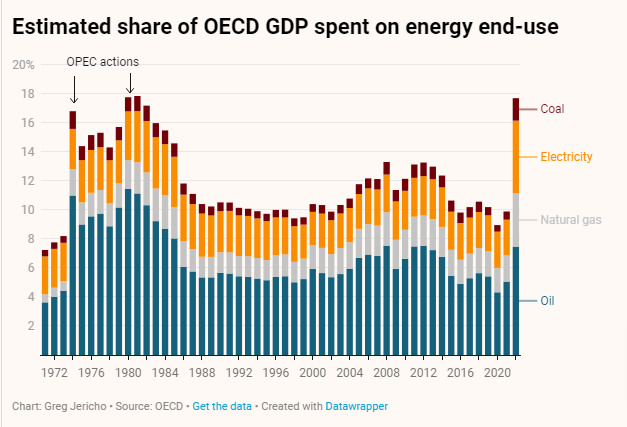
    The OECD notes that the share of GDP being spent on energy by OECD nations is higher now than it was during the OPEC crisis in 1974 and 1980. The evidence again is clear that a windfall profits tax should be levied on coal, oil and gas companies who a reaping massive profits while the cost of living rises sharply for households.


    You might also like

    Australia’s Gas Use On The Slide

    by Ketan Joshi

    The Federal Government has released a new report that includes projections of how much gas Australia is set to use over the coming decades. There is no ambiguity in its message: Australia reached peak gas years ago, and it’s all downhill from here:

    Dutton’s nuclear push will cost renewable jobs

    by Charlie Joyce

    Dutton’s nuclear push will cost renewable jobs As Australia’s federal election campaign has finally begun, opposition leader Peter Dutton’s proposal to spend hundreds of billions in public money to build seven nuclear power plants across the country has been carefully scrutinized. The technological unfeasibility, staggering cost, and scant detail of the Coalition’s nuclear proposal have

  • Gas companies are profiting off of human misery – we need a windfall profits tax

    Originally published in The Guardian on November 14, 2022

    Russia’s illegal invasion of Ukraine caused a massive surge in gas and LNG prices that have enabled gas companies around the world, including Australia to make record-level profits.

    But none of these profits have come from either management decisions or productive investments. The price rise has not come from any economic improvements. No, they have come only from an illegal invasion that is causing great human misery.

    Labour market and fiscal policy director Greg Jericho notes research suggests that the gas sector has accrued around $26bn in profits due to price rises affected by the Russian invasion. He argues that all of these profits should be garnered in taxation – a view that echoes that of former Treasurer Secretary Ken Henry.

    This revenue would be enough to cover the cost of rewiring the nation and greatly assist the tradition to renewables.

    But the problem of revenue are much deeper than the need for a windfall profits tax.

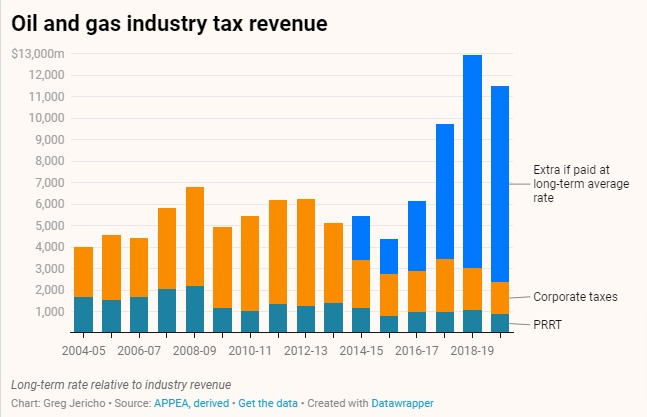
    Jericho’s analysis of industry data reveals that the industry pays much less company tax relative to production than it did in the past.

    Had the industry paid the same level of company tax relative to revenue that is had in the decade prior to the opening of the Gladstone port, in 2019-20 alone, an extra $9.1bn in tax revenue would have been raised.

    Oil and gas are Australia’s resources. Not only are their emissions causing climate change but the profits are largely headed overseas, and more than in the past not flowing through into taxation.

    As Australians demand better and wider government services, and the costs of dealing with climate change grow ever higher, we need to ensure the fossil fuel companies pay their rightful share.


    You might also like

    Australia’s Gas Use On The Slide

    by Ketan Joshi

    The Federal Government has released a new report that includes projections of how much gas Australia is set to use over the coming decades. There is no ambiguity in its message: Australia reached peak gas years ago, and it’s all downhill from here:

  • Job Opening: Carmichael Distinguished Research Fellow

    Job Opening: Carmichael Distinguished Research Fellow

    by Jim Stanford

    Share

    The Carmichael Centre at the Centre for Future Work invites applications for the Laurie Carmichael Distinguished Research Fellow position. It’s a three-year posting, with awesome potential to explore a range of progressive issues related to unions, collective bargaining, industrial policy, and workers’ education.

    Applications are due at 11:59 pm 21 November 2022. The Melbourne-based position will start in January. Please see job description and application details below. Come and join our team!

    *   *   *   *   *

    The Carmichael Centre is a project housed within the Centre for Future Work at the Australia Institute, to acknowledge the legacy of former union leader Laurie Carmichael. Laurie passed away in 2018 after a lifetime of outstanding service and innovative leadership to the trade union and social justice movements in Australia. His legacy touches on numerous themes that remain relevant and pressing today, including:

    • The importance of active industrial policy to develop Australia’s value-added industries.
    • The importance of skills and vocational education to a strong economy and labour market.
    • The importance of strong union education programs to the development of an effective and vibrant cadre of union leaders and activists.
    • The importance of shorter working hours and superannuation to the quality of life of working people.
    • The importance of actively integrating economic, labour market and social policies, in a multi-dimensional plan for achieving full economic and social equality.
    • The importance of peace and resistance to war.

    The Carmichael Centre is established to:

    • Increase public awareness of Laurie Carmichael’s life, achievements, and ideas.
    • Undertake and publish new research into themes relevant to Laurie’s legacy (including trade unionism, vocational education, and labour and social policy).
    • Contribute to modern efforts to educate trade unionists in political-economy and related subjects.
    • Celebrate the achievements of the union movement and inspire emerging leaders.

    To that end, the Carmichael Centre hosts a 3-year research and public education position, the Laurie Carmichael Distinguished Research Fellow, awarded to a mid-career or senior researcher in labour and industrial relations, political-economy, or a related field.

    The Fellow will undertake and publish new research, and undertake other educational and commentary activities, consistent with the themes and progressive vision expressed by Laurie Carmichael, and the goals of the Centre.

    The Fellow will be employed by the Australia Institute, and would work from our office in Melbourne.

    Compensation for the position will be consistent with experience of the successful candidate (and will include superannuation contributions and related employment expenses).

    Prospective candidates for the Fellow must demonstrate the following attributes:

    • Proven record of high-quality research and publication in fields relevant to the Carmichael Centre’s goals.
    • Demonstrated history of commitment to and engagement in the trade union movement.
    • Capacity and willingness to engage in the range of activities (including research, education, public commentary, and public events) that will be required of the role.

    Applicants are invited for the Carmichael Fellow. Applications must include a cover letter describing the applicant’s interest and experience in trade unionism and the themes relevant to the Carmichael Centre; a full resume (listing relevant experience and publications); and 2 letters of reference.

    Applications should be submitted electronically by 11:59 pm AEDT on Monday 21 November, 2022, to:

    recruitment@australiainstitute.org.au

    Only applicants selected for an interview will be contacted. Online interviews will be held in early December. The successful candidate will commence work in January, 2023.

    Thank you for your interest in the Carmichael Centre!


    You might also like

    Dutton’s nuclear push will cost renewable jobs

    by Charlie Joyce

    Dutton’s nuclear push will cost renewable jobs As Australia’s federal election campaign has finally begun, opposition leader Peter Dutton’s proposal to spend hundreds of billions in public money to build seven nuclear power plants across the country has been carefully scrutinized. The technological unfeasibility, staggering cost, and scant detail of the Coalition’s nuclear proposal have

  • Webinar on Wages, Prices, and Power

    Webinar on Wages, Prices, and Power

    Share

    The Australian Council of Trade Unions is sponsoring a series of webinars for union members, delegates, officials, and leaders on the current crisis in the cost of living in Australia. The surge in inflation since economic re-opening after COVID lockdowns has obviously intensified that crisis. But the seeds for it were planted long ago: by a decade of historically weak wage growth, a speculative property price bubble, and a systematic efforts to weaken collective bargaining and unionisation.

    Jim Stanford (Economist and Director) and Greg Jericho (Policy Director, Labour Market and Fiscal) from the Centre for Future Work are providing keynote presentations as part of this series. Below is a recording of the first of these presentations, presented by Jim.

    For other resources on inflation, how it is undermining real living standards for workers, and how to fix it (without throwing the whole economy into recession – an even bigger risk!), please see:

    The Wages Crisis: Revisited (Centre for Future Work overview of falling real wages, by Andrew Stewart, Jim Stanford, and Tess Hardy)

    An Economy That Works for People (ACTU Macroeconomics Discussion Paper)

    The Cure of Inflation Looks Worse than the Disease (latest Guardian Australia column by Greg Jericho)


    Related research

    You might also like

    Dutton’s nuclear push will cost renewable jobs

    by Charlie Joyce

    Dutton’s nuclear push will cost renewable jobs As Australia’s federal election campaign has finally begun, opposition leader Peter Dutton’s proposal to spend hundreds of billions in public money to build seven nuclear power plants across the country has been carefully scrutinized. The technological unfeasibility, staggering cost, and scant detail of the Coalition’s nuclear proposal have

  • Yesterday’s Tomorrow Today – a new podcast from the Carmichael Centre at the Centre for Future Work

    Yesterday’s Tomorrow Today – a new podcast from the Carmichael Centre at the Centre for Future Work

    Share

    The Centre for Future Work and the Carmichael Centre are pleased to announce the launch of a new podcast project titled Yesterday’s Tomorrow Today, presented by the Laurie Carmichael Distinguished Research Fellow at the Carmichael Centre, Dr Mark Dean, and comedian and ecology researcher, Duncan Turner.

    Laurie Carmichael believed that a worker-centred agenda for technological change was important to achieving better outcomes for society, with workers and their unions playing a pivotal role in shaping technology and skills for social progress.

    The films reviewed in Yesterday’s Tomorrow Today often depict the opposite of a worker-led future of technological change. It’s the aim of the podcast to break down what this looks like, and to suggest what an alternative future – one that benefits workers and humanity – might look like.

    Listeners of YTT can expect podcast episodes to feature accessible political-economic analysis laced with good humour, reflections on accurate (and not-so-accurate) predictions of a future shaped by the neoliberal surveillance state, and a rotating list of special guests, including Dr Jim Stanford, Lily Raynes (Anne Kantor Fellow at the Centre for Future Work), Matt Grudnoff (Senior Economist at The Australia Institute) and more to come.

    Don’t forget to like and subscribe to Yesterday’s Tomorrow Today wherever you get your podcasts and be sure to leave a review – this is what helps other listeners to find and subscribe to YTT, making sure we can keep reaching working people far and wide.

    Listen to the first episode – a review of 1987’s RoboCop – and what it warned us about deindustrialisation, gentrification, privatisation and police militarisation (also available on Apple Podcasts, Google Podcasts and Spotify).


    You might also like

  • Work in the Care Economy Vital for Future Well-Being

    Work in the Care Economy Vital for Future Well-Being

    by Fiona Macdonald

    Share

    There is growing understanding that care work — including jobs in aged care, disability services, early child education and care, and others — is of growing importance to future employment and wage trends, as well as to the quality of life of Australians who depend on these social and community services. For too long, jobs in these growing sectors have been devalued. Government underfunding and weak labour and quality standards have reinforced the degradation of work in care sectors. But with intense labour shortages, public concern about inadequate quality, and the need to expand services to meet social needs, there is now more widespread recognition that care jobs must be improved, and quickly: with more funding, better training, limits on private delivery, multi-employer bargaining, and more.

    Our Policy Director for Industrial and Social issues, Dr Fiona Macdonald, recently discussed these issues in a feature conversation with Richard Aedy on the ABC RN program, The Money. They discussed the size of the care workforce, the challenges faced by care providers and participants alike, and the need for government reform.


    You might also like

  • Enterprise Bargaining System no Longer Fit for Purpose

    Enterprise Bargaining System no Longer Fit for Purpose

    by Alison Pennington

    Share

    The collapse in agreement coverage under Australia’s enterprise bargaining system in Australia in recent years, particularly in the private sector, has focused attention on the need for reforms that will give more workers the effective ability to collectively negotiate better wages and conditions. In the private sector, coverage by a current enterprise agreement has fallen by half since 2013: to below 11% of all workers by March 2021. No wonder wages are lagging so far behind inflation.

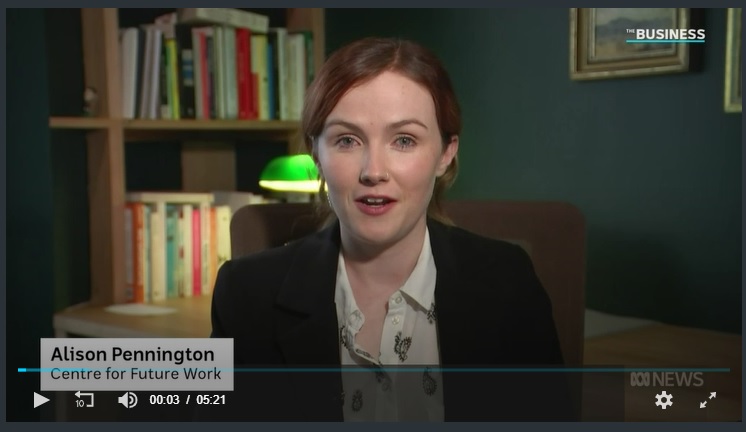
    The new Commonwealth government has pledged to find ways to strengthen collective bargaining. In this feature interview with the ABC’s national economics program The Business, Senior Economist Alison Pennington discusses the reasons why the current system is not working, and some of the reforms that will be required to support bargaining and lift wages.

    Alison Pennington on ABC


    You might also like

    IR Bill Will Cut Wages & Accelerate Precarity

    by Alison Pennington in Jacobin

    The Morrison government has proposed sweeping changes to labour laws that will expand unilateral employer power to cut wages and freely deploy casual labour. Together, the Coalition’s proposed changes will accelerate the incidence of insecure work, undermine genuine collective bargaining, and suppress wages growth. Impacts will be felt across the entire workforce – casual and permanent workers alike.

  • More Resources on Australia’s Wages Crisis

    More Resources on Australia’s Wages Crisis

    Share

    The debate over wages, prices, and living standards heated up even further this week, with the release of new ABS statistics showing continuing weakness in wages despite the acceleration of inflation. The latest data from the ABS Wage Price Index (WPI) shows nominal wages grew just 2.4% over the 12 months ending in March. That is less than half as fast as consumer prices grew (5.1%), producing the biggest decline in real wages this century.

    Our Centre continues to develop resources documenting the dimensions and causes of declining real wages, and countering the claim that trying to protect real living standards (by boosting wages at least as fast as inflation) will somehow cause hyperinflation and economic ruin.

    Our new landmark report, The Wages Crisis: Revisited, provides comprehensive data on the scale of Australia’s wage slowdown – which began in earnest around 2013. Even after the dramatic events of the COVID-19 pandemic, and the surprising decline in the official unemployment rate (now slightly below 4%), wage growth has only regained the same sluggish pace demonstrated for several years before COVID. And with consumer price inflation accelerating, weak nominal wage growth is now corresponding to major erosion in real wages.

    The three authors of that report – Prof Andrew Stewart from the Adelaide Law School, Assoc Prof Tess Hardy from Melbourne Law School, and the Centre for Future Work’s Director Jim Stanford – participated in a webinar hosted by our colleagues at the Australia Institute. They reviewed the main findings of the report, and answered several questions from the audience about the wages crisis and possible solutions. The webinar was hosted by Ebony Bennett, Deputy Director of the Australia Institute.

    Our team has also been working to analyse the implications of the latest wages data for real incomes, macroeconomic performance – and the federal election, in which wages have emerged as a major point of contention. Please see the following analysis from our team:

    Our team will continue to research the dimension, causes, consequences, and potential solutions to the worsening wages crisis in the coming weeks — no matter who wins Saturday’s election!


    You might also like