Category: Article

  • Webinar: Changes to the SCHADS Award and Next Steps to Improve Job Quality in Human Services

    Webinar: Changes to the SCHADS Award and Next Steps to Improve Job Quality in Human Services

    Share

    The Fair Work Commission recently announced important changes to the SCHADS Award (which sets minimum standards for workers in home care, disability services, community agencies, and other vital services) as part of its award review process. This culminates several years of research and advocacy by unions representing workers in these sectors, aimed at improving job quality and stability in these vital but undervalued positions. The Centre for Future Work provided expert testimony to the Commission as part of its review.

    We recently hosted a special webinar to discuss the Commission’s changes, their significance, and what comes next in the struggle to improve and properly value work in human services.

    The webinar featured two representatives from the Australian Services Union, which was centrally involved in the campaign for these changes: Emeline Gaske, Assistant National Secretary for the ASU, and Michael Robson, National Industrial Coordinator. They reviewed the economic and policy context for the review, the specific changes that have been announced, how they will be implemented, and the next steps in lifting the quality of work in these vital sectors. The conversation was chaired by our Policy Director for Industrial and Social issues, Dr. Fiona Macdonald.


    You might also like

  • The election campaign needs to be more than a quiz show

    Originally published in The Guardian on April 14, 2022

    The election campaign thus far has been dominated with gotcha questions that unfortunately have missed the vital need to examine the different policies on offer at a time when Australia’s economy is in a state of extreme flux.

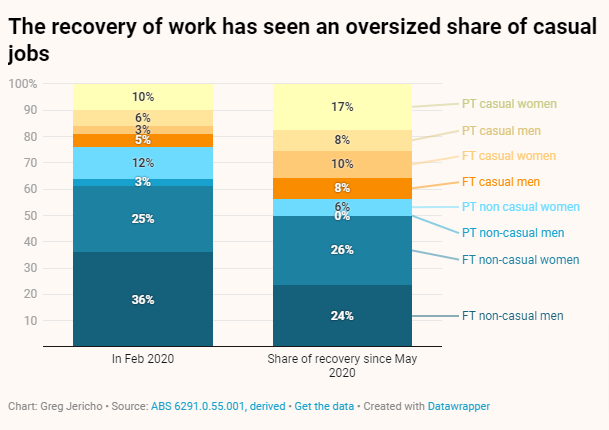
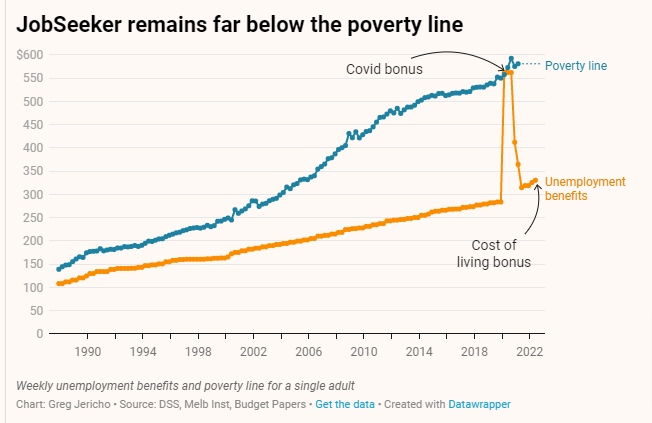
    Labour market and fiscal policy director, Greg Jericho writes in his Guardian Australia column that the recovery from the depths of the pandemic has overwhelmingly been on the backs of casual workers. It also has seen a large increase in the gap between people on JobSeeker and the number of unemployed. The rise of low paying, insecure work that has helped bolster the employment figures has also meant people who are working but still earning less than enough to keep out of poverty is remaining high.


    You might also like

    Dutton’s nuclear push will cost renewable jobs

    by Charlie Joyce

    Dutton’s nuclear push will cost renewable jobs As Australia’s federal election campaign has finally begun, opposition leader Peter Dutton’s proposal to spend hundreds of billions in public money to build seven nuclear power plants across the country has been carefully scrutinized. The technological unfeasibility, staggering cost, and scant detail of the Coalition’s nuclear proposal have

    Commonwealth Budget 2025-2026: Our analysis

    by Fiona Macdonald

    The Centre for Future Work’s research team has analysed the Commonwealth Government’s budget, focusing on key areas for workers, working lives, and labour markets. As expected with a Federal election looming, the budget is not a horror one of austerity. However, the 2025-2026 budget is characterised by the absence of any significant initiatives. There is

  • A slap-dash budget revealing a government with no idea why it is in power

    Originally published in The Guardian on March 31, 2022

    This year’s budget was transparently targeted towards the May election.

    But as Fiscal and Labour Market Policy Director, Greg Jericho notes in his Guardian Australia column, the slap-dash and short-term nature of the measures reveals this government has lost any real reason for governing.

    From the extra bonus of the low-middle income tax offset with no taper, which is now being used by businesses to argue against raising the minimum wage and the relative lack of concern about those in poverty while trying to exist on JobSeeker, this budget has all the hallmarks of an effort made up at the last minute and where poll numbers were more important than any economic figures.


    You might also like

    Commonwealth Budget 2025-2026: Our analysis

    by Fiona Macdonald

    The Centre for Future Work’s research team has analysed the Commonwealth Government’s budget, focusing on key areas for workers, working lives, and labour markets. As expected with a Federal election looming, the budget is not a horror one of austerity. However, the 2025-2026 budget is characterised by the absence of any significant initiatives. There is

    Dutton’s nuclear push will cost renewable jobs

    by Charlie Joyce

    Dutton’s nuclear push will cost renewable jobs As Australia’s federal election campaign has finally begun, opposition leader Peter Dutton’s proposal to spend hundreds of billions in public money to build seven nuclear power plants across the country has been carefully scrutinized. The technological unfeasibility, staggering cost, and scant detail of the Coalition’s nuclear proposal have

  • Alison Pennington: Budget billions wasted as real wages go backwards

    Originally published in The New Daily on March 30, 2022

    The federal government’s budget would have us believe that the cost of living is a sudden problem because of higher oil prices.

    But the real reason people are feeling the pinch is because their real wages are going backwards.

    The budget forecasts wage growth of 2.75 per cent in 2021-22, below inflation which is forecast to grow by 4.25 per cent. That’s a real wage cut of 1.5 per cent.

    The budget will increase the low-and-middle-income tax offset, but then scrap it at the end of this financial year. The fuel excise will be reduced for six months.

    Complex tax-bracket-shifting schemes are a good way to distract from powerful wage suppression policies. While we’re calculating “how much do I get”, these policies entrench insecure work, cap public sector pay, and stop collective bargaining. These measures hit workers every pay packet, not just at tax time.

    The amount workers get from the tax cuts is nothing compared to normal wage increases. For the 15 years to 2012, private-sector wages grew about 3.5 per cent per year. For someone on $70,000, that’s about $2500 more in one year.

    Distracting the income-strapped

    This budget is about trying to distract the income-strapped with temporary solutions that do nothing to help in the long-run. Alongside time-bound tax cuts are $250 one-off payments to income support recipients – thousands of people who permanently languish below the poverty line.

    The government is also hoping people believe in magical free-market fairies – that lower unemployment will finally unlock wages growth. As though holding a job automatically equips workers with bargaining power.

    The “record funding” fairies were out in full force, too. The Treasurer says “record funding” has been allocated in schools, hospitals, mental health, aged care, women’s safety and disability health. But if you reduce spending to rock-bottom, every marginal increase in spending with population growth can be called “record funding”.

    If it’s not enough funding to meet demand, then it can still be “record funding” for some. Shockingly, public school funding will be cut by $560 million over the next three years. Meanwhile, JobKeeper-subsidy-dripping private schools will get $2.6 billion more over the forward estimates. It’s not a budget without blows.

    Cuts to workers’ pay

    Worse, this budget signals more cuts to workers’ pay. The budget has earmarked reducing legislated minimum redundancy payments for part-time workers. This will disproportionately affect women.

    Women’s chronically low wages and poor job quality receive no attention. Hundreds of thousands of women in underfunded healthcare and social services need government to front up and fund their pay increases. This budget is proof the biggest barrier to Australian women’s progress isn’t glass ceilings, but their own government.

    This government will balls up any opportunity to address structural gender inequality. A new paid parental leave (PPL) scheme will combine the paltry two-week Dad and Partner Pay with the existing 18-week program for a combined 20 weeks. Packaged as empowering “family choice”, it will remove any incentive for fathers to take leave.

    PPL payment at minimum wage will continue to push women into primary caring roles. This is because men earn almost one-third more than women on average. That’s not women’s “choice”.

    Governments have wage-booting tools to deal with the higher cost of living. Across the ditch, New Zealand just increased the minimum wage by 6 per cent, recognising its frontline lowest-paid workers have offered the most in the pandemic, and been hit the hardest.

    Genuine cost-of-living help overlooked

    Along with boosting minimum wages, there are other options for helping workers deal with high inflation. The government could lower the cost of living by ending fee-for-service practices in all the areas they fund – child care, aged care, and disability care. Under the current government, out-of-pocket healthcare costs have increased almost three times more than CPI.

    And there’s not much hope for youth in this budget. Presented with a future of declining living standards, political dysfunction and ecological catastrophe, young people are given just $206 million in mental health funding. They can talk to someone on the phone while the world burns.

    The bottom rungs on the economic-opportunity ladder have been eliminated and youth can’t get up. Tens of thousands of educated capable youth languish in dead-end jobs. Sacrificed by a government that would rather turn unemployment into a misery industry than to create secure, career-building jobs.

    Billions of waste

    The government is wasting billions of dollars paying off their friends in business without conditions to invest in higher wages. Before this Budget, $291 billion in public spending was ploughed into a “business-led recovery” from COVID. On businesses responsibility to reinvest post-war record-high profits, there’s an eery silence.

    And in this budget, we have zero assurances new business subsidies will be invested in the real economy – people, capital, research – rather than more profit-padding.

    On budget eve, Morrison attempted to hat-tip a bygone conservative era. He said “families” will be key to winning the upcoming election. But he never invested in them, instead putting them in a pressure cooker of record-low wage growth and high living costs.

    The government was struck by enormous luck this budget. Extra revenue to play with and they’ve thrown it all away. Hundreds of billions in government spending and no era-defining economic reforms.

    Cos-of-living pressures wouldn’t be as acute if people had almost a decade of normal wages growth. But the truth is, the government has pursued wage suppression over the entire nine years it has been in power.


    You might also like

    Commonwealth Budget 2025-2026: Our analysis

    by Fiona Macdonald

    The Centre for Future Work’s research team has analysed the Commonwealth Government’s budget, focusing on key areas for workers, working lives, and labour markets. As expected with a Federal election looming, the budget is not a horror one of austerity. However, the 2025-2026 budget is characterised by the absence of any significant initiatives. There is

  • A short-term budget with no vision or coherency

    Originally published in The Guardian on March 29, 2022

    The 2022-23 budget is one of the most shameless election year budgets in memory.

    With the opportunity to use windfall gains in revenue to begin the fix of structural issues in the economy dealing with the low paid and essential services, the government instead has thrown money at voters in the hopes of re-election.

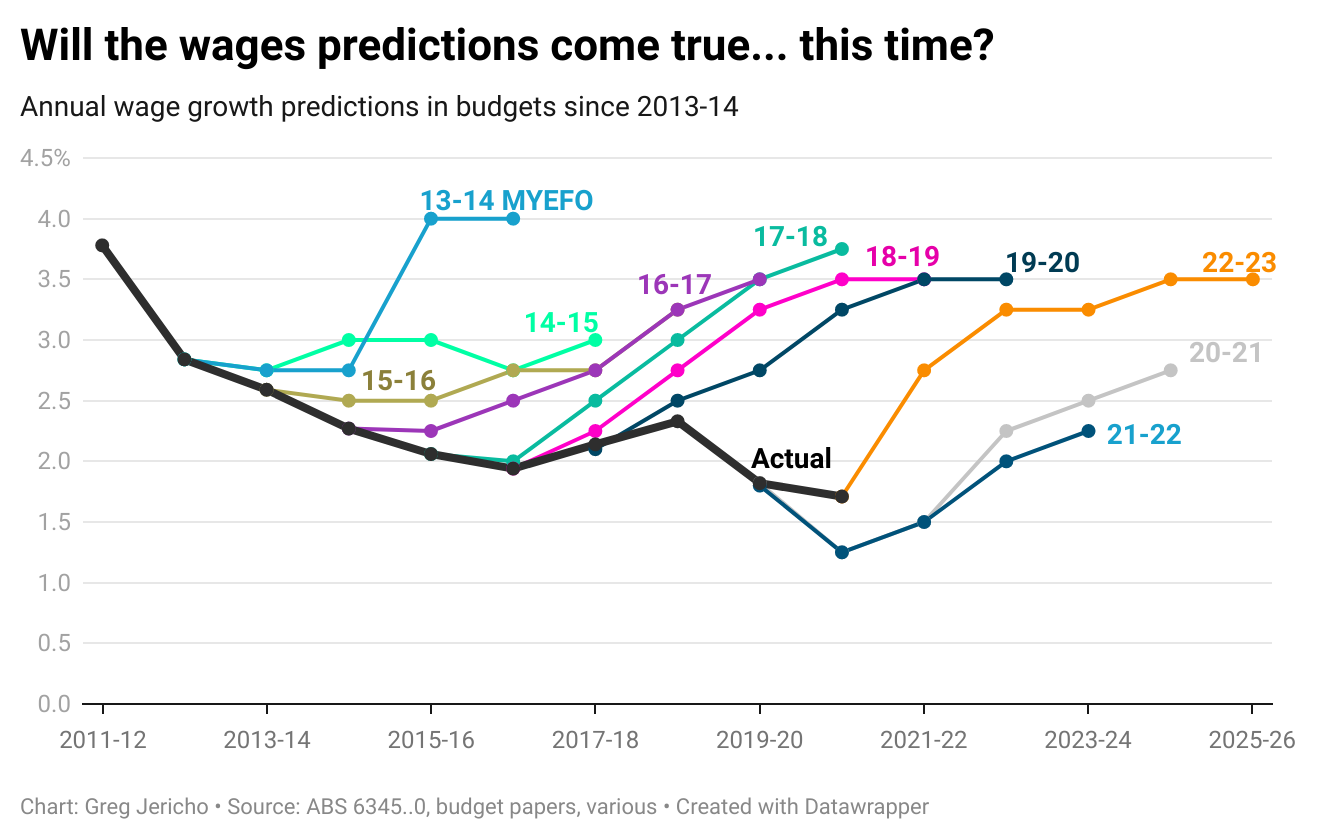
    The Centre’s Fiscal Director, Greg Jericho, goes through the budget numbers and finds that despite predictions of once again strong wage growth, the underlying assumptions are overly optimistic and would even still leave workers worse off than they were in the middle of 2019 until 2025.

    The budget forecasts are for strong growth now, while the money is being pumped out, but once that ends we find yourself back with the same middling growth we had prior to the pandemic.


    You might also like

    Commonwealth Budget 2025-2026: Our analysis

    by Fiona Macdonald

    The Centre for Future Work’s research team has analysed the Commonwealth Government’s budget, focusing on key areas for workers, working lives, and labour markets. As expected with a Federal election looming, the budget is not a horror one of austerity. However, the 2025-2026 budget is characterised by the absence of any significant initiatives. There is

  • In next week’s budget watch out for the tax cut that won’t cut your tax

    Originally published in The Guardian on March 24, 2022

    Next Tuesday, Treasurer Josh Frydenberg will deliver the 2022-23 budget. As it is only 2 months from the next federal election, the budget will be even more politically charged than usual.

    And while there will be the usual attempts to suggest better wages growth is just around the corner and those on low-to-middle income earners are benefitting the most, we should watch out for the almost guaranteed spin around tax cuts. 

    The Centre’s Fiscal Policy director, Greg Jericho, notes in his Guardian Australia column that the low-to-middle income tax offset (LMITO) was meant to be discarded when the Stage 2 tax cuts were introduced. However because doing so would have delivered no net benefit to people earning below $90,000 the government extended the offset in the 2020 budget. 

    It extended the offset again last year claiming it was providing tax relief to “10 million low-and-middle income earners” despite it actually doing nothing other than keeping the tax rate of those workers at the same level.

    We can expect the same to occur next week. 

    Budget spin is always a sight to behold, but we are now at the point where income earners are being told they are getting a tax cut that does not actually see them pay any less tax.

    Meanwhile the Stage 3 tax cut that will deliver a cut of up to 4.5% for those earning $200,000 remains in place.

    Spin and imaginary tax cuts for some; truly excessive tax cuts for others.


    You might also like

    Commonwealth Budget 2025-2026: Our analysis

    by Fiona Macdonald

    The Centre for Future Work’s research team has analysed the Commonwealth Government’s budget, focusing on key areas for workers, working lives, and labour markets. As expected with a Federal election looming, the budget is not a horror one of austerity. However, the 2025-2026 budget is characterised by the absence of any significant initiatives. There is

  • International Collective Bargaining Experts Explore Future System Reform

    International Collective Bargaining Experts Explore Future System Reform

    Share

    Multiple negative economic and social consequences have emerged across Anglophone industrial countries from the retrenchment of collective bargaining systems, including slowing wages growth, rising insecure work, inequality, and declining productivity and growth – bringing urgency to proposals for collective bargaining reform.

    On 10 February, Centre for Future Work hosted an exciting timely panel discussion between international collective bargaining experts titled “Beyond the Enterprise: Building Sectoral Collective Bargaining Systems in the Anglophone World”. The panel, delivered for the Association of Industrial Relations Academics of Australia and New Zealand (AIRAANZ) 2022 Conference, explored proposals across Australia, New Zealand, Britain and the US for widening bargaining scope to the multi-employer, industry-wide, or occupational level. Panelists and their presentation links are below:

    • David Madland, Senior Fellow with Center for American Progress and Senior Adviser for the American Worker Project presented on lessons from the US and Britain on strengthening unions and broad-based bargaining proposals. There is a summary of David’s presentation available here.
    • Craig Renney, Director of Policy and Economist with the New Zealand Council of Trade Unions presented on NZ’s ambitious plan to implement sectoral bargaining through Fair Pay Agreements. Craig explained how FPAs can be initiated, bargained and agreed upon. Slides for Craig’s presentation are attached below.
    • Alison Pennington, Senior Economist with Centre for Future Work presented a new sectoral bargaining system design for Australia. The dual-tiered model proposed combines both a revitalised Awards system and multi-employer bargaining. Alison proposed traditional bargaining be re-integrated into Awards, with coverage, scope and minimum wage rates redrawn and refreshed. Her presentation is attached below.
    • Emma Cannen, Nation Research Coordinator with the United Workers Union presented on the bargaining challenges experienced in Australia’s highly fragmented, insecure, feminised care services, and why sector bargaining with stronger regulation and accountability is needed. Emma’s presentation can be viewed below.

    Jim Stanford, Economist and Director at Centre for Future Work chaired the panel.

    The AIRAANZ panel follows release of the 13-article Special Issue Global Lessons for Stronger Collective Bargaining Systems prepared by academic researchers and trade unionists from five countries for the peer-reviewed journal Labour and Industry. The Issue co-edited by Alison Pennington and Jim Stanford adopts a multi-dimensional approach to collective bargaining revitalisation, investigating the role of bargaining in skills and education, unemployment insurance and other social insurance policies, and industry policy – in addition to specific industrial relations matters.

    The final published versions of all articles in the Special Issue are available through Labour and Industry, or through your local library. All commentaries in the Issue freely accessible until end-March 2022.


    Related documents


    Craig Renney’s presentation


    Alison Pennington’s presentation


    Emma Cannen’s presentation

    Related research

    You might also like

  • Centre for Future Work Announces Two Senior Appointments

    Centre for Future Work Announces Two Senior Appointments

    by Jim Stanford

    Share

    The Centre for Future Work at the Australia Institute is pleased to announce the appointment of two senior staff to its team of labour policy researchers.

    Greg Jericho will join the Centre on 1 February as Policy Director: Labour Market and Fiscal. Greg is an economist and well-known columnist for The Guardian in Australia; he currently teaches at the University of Canberra. He will continue writing his Guardian column, while overseeing new research projects for the Centre on issues of employment, wages, insecure work, and related topics.

    Dr Fiona Macdonald will join the Centre on 1 March as Policy Director: Industrial and Social. Fiona is presently Vice-Chancellor’s Senior Research Fellow at the School of Management, RMIT University, and an internationally recognised expert on caring labour, gender and work, and industrial relations policy. She has published extensively on the Awards system, working conditions and compensation in human and caring services, and violence at workplaces. Fiona will oversee new research at the Centre on industrial relations reform, social policy, and caring labour.

    The two Policy Directors join the Centre’s existing research team, which includes: Economist and Director Jim Stanford; Senior Economist Alison Pennington; Economist Dan Nahum; and Mark Dean, Distinguished Research Fellow at the Carmichael Centre.

    “This is a critical moment in the history of work and industrial relations in Australia,” said Dr Stanford, the Centre’s Director. “The addition of Greg Jericho and Fiona Macdonald to our team will greatly enhance our capacity to investigate the threats facing work and workers, and to develop progressive policy responses that could achieve a better future of work.”

    “I am very excited to join the Centre for Future Work,” said Jericho. “At such a crucial moment, being able to push the policy debate in the interests of fairness for workers is of utmost importance. I look forward to working with the great team at the Centre and the Australia Institute to continue producing quality research that leads the political and policy debates.”

    “As a long-time admirer of the Centre, I am thrilled to be joining its research team,” said Dr. Macdonald. “I look forward to contributing to the Centre’s important work, including in the vital areas of the care economy and gender equality. Work is changing rapidly, and the Centre’s research empowers those working for a fairer, more equal labour market.”

    Greg Jericho will work out of the Australia Institute’s central office in Canberra. Fiona Macdonald will be based in Melbourne.

    Greg Jericho can be followed on Twitter at @GrogsGamut. Fiona Macdonald can be followed at @DrFionaMac.


    You might also like

    Centre For Future Work to evolve into standalone entity

    The Centre for Future Work was established by the Australia Institute in 2016 to conduct and publish progressive economic research on work, employment, and labour markets. Supported by the Australian Union movement, the centre produced cutting edge research and led the national conversation on economic issues facing working people: including the future of jobs, wages

    Carmichael Centre Announces Appointment of Prof. David Peetz as Laurie Carmichael Distinguished Research Fellow

    by Jim Stanford

    The Carmichael Centre at the Australia Institute’s Centre for Future Work is proud to announce the appointment of Prof. David Peetz, one of Australia’s most outstanding labour policy experts, as the new Laurie Carmichael Distinguished Research Fellow. Prof. Emeritus Peetz has recently retired from a long career at Griffith University, where he served as Professor

  • Snatching Defeat from the Jaws of Victory: Labour Market Implications of Australia’s Failed COVID Strategy

    Snatching Defeat from the Jaws of Victory: Labour Market Implications of Australia’s Failed COVID Strategy

    by Jim Stanford

    Share

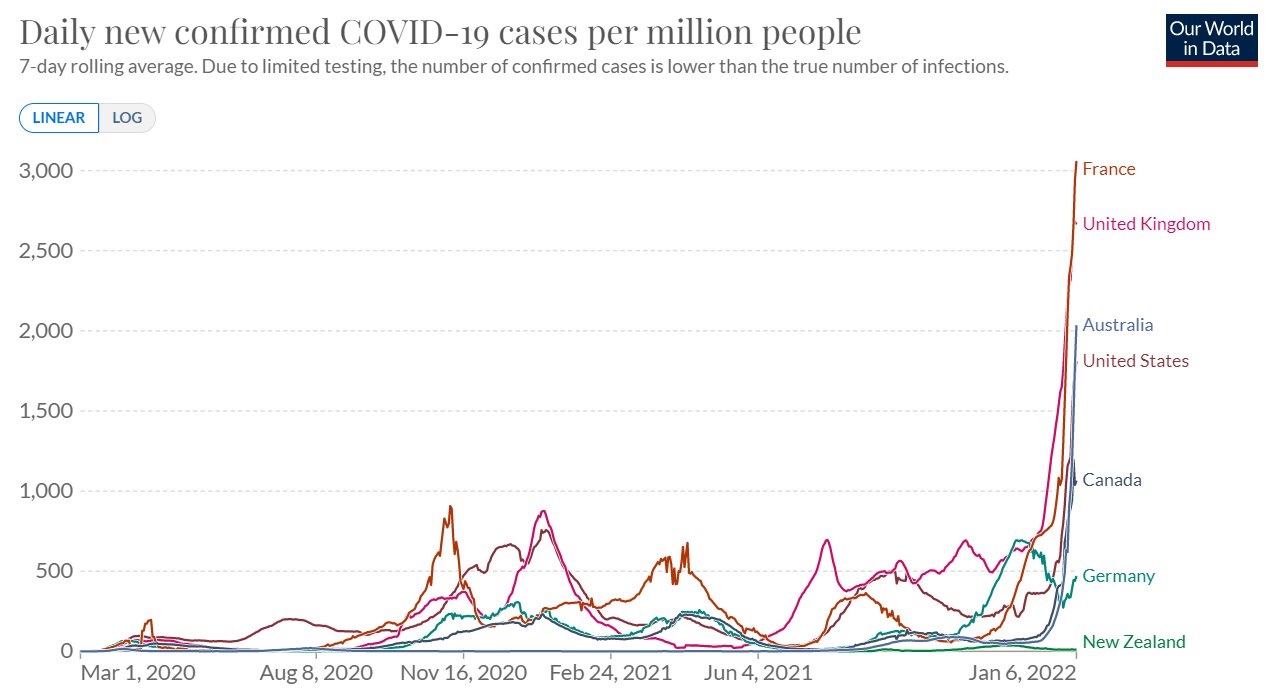
    As COVID and recession gripped the world, through 2020 and most of 2021 Australia recorded one of the best outcomes: lower infection, fewer deaths, and a faster, stronger economic recovery. That seeming victory has been squandered, however by the appalling and infuriating events of recent weeks. Purportedly in the name of ‘protecting the economy’, key political leaders (led by the Commonwealth and NSW governments) threw the doors open to the virus at exactly the wrong time: just as the super-infectious Omicron variant was taking hold.

    The resulting surge in infections has been among the worst in the industrialised world (worse than the U.S. now, as shown in the following graph from Our World in Data). The implications of this massive outbreak for work, workers, production, and the economy have been as predictable as they are devastating. One-third or more of workers in the most-affected regions cannot attend work: because they contracted COVID, were exposed to it, or must care for others (like children barred from child care and soon, possibly, schools).

    Our Centre for Future Work team has been active in highlighting the risks of ‘letting it rip’, analysing the failures of isolation and income support programs, and reminding everyone that keeping workers healthy must be the first priority in keeping the economy healthy. Here is a selection of our recent interventions:

    New COVID Cases per Million (7-day rolling)

    • Our Director Jim Stanford reminded policy-makers in this commentary in The Conversation that human labour is the critical input to production at all stages of value-added and supply chains, and if policy-makers acknowledged the centrality of work to the economy they would not have made such destructive choices. The article was reposted by the ABC, the Sydney Morning Herald, and other platforms, and viewed over a half-million times.
    • Senior Economist Alison Pennington has exposed the flaws in government isolation and testing systems. For example, she highlighted the perverse incentives created by the NSW government’s punitive $1000 fine for failing to register a positive RAT test — never mind the governments’ failures to make tests available, and support workers (with necessary income benefits) to isolate. Her analysis was shared thousands of times, and featured in multiple news coverage (including News.com, The New Daily, and Yahoo Finance) of the flawed NSW policy.
    • Alison further detailed the flaws in changes to the Commonwealth government’s isolating support payments, in this commentary in The New Daily. By punitively excluding hundreds of thousands from isolation benefits, the policy will accelerate contagion and make supply chain problems even worse down the road.
    • Our experts have been featured in numerous other reports on the supply chain problems arising from the Omicron surge, including these reports on Channel 10, Today, The Age, ABC Online, and The Guardian.
    • Our Economist Dan Nahum linked the surge in Omicron contagion to the spread of insecure work arrangements in Australian workplaces. And the Centre’s previous work on how COVID has accentuated the dominance of casual and insecure work in Australia’s labour market shows that without urgent action to improve job quality, the labour market will be even more vulnerable to the inevitable future disruptions from this continuing crisis.

    Our team of experts will continue monitoring the dangerous labour market developments arising from Omicron, and flawed government responses to it. Please watch our site and follow our Twitter feed for regular updates.


    You might also like

    Centre For Future Work to evolve into standalone entity

    The Centre for Future Work was established by the Australia Institute in 2016 to conduct and publish progressive economic research on work, employment, and labour markets. Supported by the Australian Union movement, the centre produced cutting edge research and led the national conversation on economic issues facing working people: including the future of jobs, wages

  • What Next for Casual Work? Professor Andrew Stewart webinar recording

    What Next for Casual Work? Professor Andrew Stewart webinar recording

    Share

    Casual employment has dominated Australia’s labour market recovery from COVID-19. And the right of employers to hire staff on a casual basis in almost any role they choose – including jobs that on their face appear have permanent characteristics – seems to have been cemented by recent amendments to the Fair Work Act, and by the High Court’s recent ruling in the WorkPac v. Rossato case.

    What do these new developments mean for the further spread of casual and precarious work? What are the other implications of the High Court ruling for future employer strategies? And what options remain for limiting the spread of casual and insecure work? To examine these matters and their implications, we were recently joined by renowned labour law expert Professor Andrew Stewart from the University of Adelaide.

    Andrew’s highly informative presentation can be viewed below:


    You might also like

    “Permanent Casuals,” and Other Oxymorons

    by Jim Stanford

    Recent legal decisions are starting to challenge the right of employers to deploy workers in “casual” positions on an essentially permanent basis. For example, the Federal Court recently ruled that a labour-hire mine driver who worked regular shifts for years was still entitled to annual leave, even though he was supposedly hired as a “casual.” This decision has alarmed business lobbyists who reject any limit on their ability to deploy casual labour, while avoiding traditional entitlements (like sick pay, annual leave, severance rights, and more). For them, a “casual worker” is anyone who they deem to be casual; but that open door obviously violates the intent of Australia’s rules regarding casual loading.