Category: Wages & Entitlements

  • The Relationship Between Superannuation Contributions and Wages in Australia

    The Relationship Between Superannuation Contributions and Wages in Australia

    by Jim Stanford

    New research from the Centre for Future Work shows that scheduled increases in employers’ minimum statutory superannuation contributions would have no negative effects on future wage growth, and that Australia’s economy can afford both higher wages and higher employer contributions to superannuation.

    The research refutes claims made by some commentators and lobbyists that higher superannuation contributions would automatically lead to lower wages, and hence would be self-defeating. The new research finds no statistical evidence for that claim in Australian empirical data.

    The paper reviews economic statistics from the introduction of superannuation to the present. On average, wages were more likely to accelerate and grow at a faster rate when the superannuation guarantee (SG) rate was increased, than to decelerate or grow more slowly. This indicates a slight positive correlation between wages growth and changes in employers’ minimum SG rate.

    The paper also reviews theoretical predictions and empirical findings from previously published economic research. Even under very restrictive and unrealistic assumptions about competitive market-clearing behaviour in labour markets, the expectation of a fully offsetting one-for-one trade off between wages and SG contributions only occurs in the special cases of perfectly inelastic labour supply, or perfect substitutability between voluntary and policy-induced personal savings. Neither of those conditions prevail in practice. More realistic economic models (that allow for responsiveness in labour supply, minimum wages, and other real-world features) do not anticipate a full trade-off – and many expect no trade-off at all.

    The paper concludes that current record-low wage growth in Australia cannot be “fixed” by abandoning scheduled increases in the SG rate (which is currently legislated to grow from 9.5% of wages to 12% over a five-year period, beginning 1 July 2021). Abandoning those increases would only further suppress the total compensation received by workers, which has been falling steadily as a share of GDP for decades. Instead, weak wage growth should be tackled with direct wage-boosting policies; the determination of wages and superannuation contributions are largely independent policy decisions.


    Full report

    Share

  • Messing With Success

    Messing With Success

    Victoria’s Puzzling Turn to Austerity
    by Troy Henderson and Jim Stanford

    The Centre for Future Work has released new research estimating the negative impacts on wages and spending power of the Victoria government’s proposed 2% cap on wage increases for the state’s large public sector workforce.

    In recent years, Victoria’s economy has consistently been the strongest in Australia: with the most new jobs, the fastest growth in wages, and the biggest expansion in output. The state government has been both a key cause of that growth, and a major beneficiary of it. New expenditures on expanded public services and infrastructure have been crucial engines of the state’s growth. In turn, that strong growth generated huge fiscal dividends for the state government, through a robust, diversified and growing revenue base.

    Given this positive history, it seems inexplicable that the state government would now mimic tools of fiscal austerity that have been implemented, with negative and unintended consequences, in other Australian jurisdictions. The government has imposed a stringent cap on public sector wage increases: 2% per year over the coming four-year period. That cap falls well below relevant benchmarks: including growth rates for state GDP, state revenues, overall state wage growth, and Reserve Bank targets for both wage and price inflation. It also falls far below what the state’s elected representatives will receive in their own wage increase this year – including, in particular, the Premier and Treasurer, who have been awarded an 11.8% salary increase.

    The wage cap would artificially suppress total state public sector compensation by over $3 billion over the coming four years – compared to normal compensation patterns. It would short-circuit a badly-needed recovery in wage growth that is just taking hold in Victoria’s broader labour market. It would damage consumer spending, exert a chilling impact on private sector wage settlements, and do particular damage to regional communities which depend especially strongly on public sector jobs and incomes. The negative spillover effects of this unnecessary cap would extend throughout Victoria’s economy, totalling far more than the direct $2 billion hit to wages.

    The wage cap would be exacerbated by a secondary, equally puzzling austerity measure announced in the state’s 2019-20 budget: an increase in the so-called “efficiency dividend,” to take effect form 2020-21, that would impose an effective and homogeneous budget cut on departments and programs. This expanded “efficiency dividend” is justified as a tool for eliciting greater efficiency in service delivery; in practice it amounts to a mindless, across-the-board cut in expenditures, service delivery, and potentially employment.

    There is no fiscal problem that justifies either of these austere measures. The state government is not experiencing a deficit; it plans to generate consistent annual operating surpluses over the next four years. Its total revenues will continue to grow strongly. Financial analysts and debt rating agencies are unanimous that the state’s net debt and interest payments are fully manageable, and the government’s net worth remains strongly positive.

    In sum, the Victoria state government enjoys a healthy and enviable fiscal position; there is no fiscal argument at all for the imposition of these unnecessary forms of fiscal austerity. The government’s flirtation with austerity, despite the proven success (both economic and political) of its previous, more expansive approach, is puzzling and concerning. And it will undermine the positive economic success which explains why Victoria currently leads Australia in employment, growth, and incomes.

    The state government in Victoria faces no fiscal challenges that could justify either of these forays into the realm of austerity. The paper concludes with five key recommendations:

    1. The state government should abandon the imposition of a wage cap on state public sector workers.
    2. Instead, the state government should enter into normal negotiation of enterprise agreements in all broader public sector enterprises and agencies. The state’s fiscal outlook is obviously a relevant and important factor in those negotiations, but it does not justify the imposition of direct wage controls.
    3. The state government should abandon the proposed increase in the annual “efficiency dividend,” which has proven to be a blunt and ineffective budgetary strategy.
    4. Instead, the state should undertake an open-ended program review of departments and agencies. The goal of this review should be enhancing genuine efficiency – defined as improving the effectiveness and quality of public service delivery – rather than attempting to attain a target budget cut.
    5. Finally, the state should commit to no forced redundancies during the course of that program review. Any identified redeployments (motivated genuinely by improving service and better allocating existing resources) should be attained through relocation, retraining, and voluntary severance.

    Please read the Centre’s full report, Messing With Success: Victoria’s Puzzling Turn to Austerity, by Troy Henderson and Dr. Jim Stanford. The report was commissioned by CPSU Victoria.


    Full report

    Share

  • Update on Penalty Rates and Job-Creation: Two Years Later

    Update on Penalty Rates and Job-Creation: Two Years Later

    by Jim Stanford

    July 1 marked the implementation of the next stage of reduced penalty rates in the retail and hospitality industries in Australia. It is now two full years since the first reductions were imposed for Sunday and holiday work in several segments of retail and hospitality. Once fully phased in, these reductions will reduce wage payments in the two broad industries by an estimated $1.25 billion per year – at a time when concerns over weak wages and their impacts on the Australian economy are growing.

    Employers argued before the Fair Work Commission that if their Sunday and holiday labour costs were reduced, they would hire more workers, and the Commission cited this logic in accepting employer demands for lower penalties. Now, with two full years of experience since the first reductions, there is growing evidence that the penalty rate reductions have not spurred job creation in retail and hospitality. To the contrary, our new report shows that employment growth in retail and hospitality has been far slower than in other parts of the economy (where penalty rates remained constant) — and job-growth in the two sectors actually slowed by more than half after penalty rates began to fall.

    This briefing paper, authored by Dr Jim Stanford (Director and Economist of the Centre for Future Work) reviews disaggregated employment statistics for 19 Australian industries in the two years after the first penalty rate reductions were imposed on 1 July, 2017.

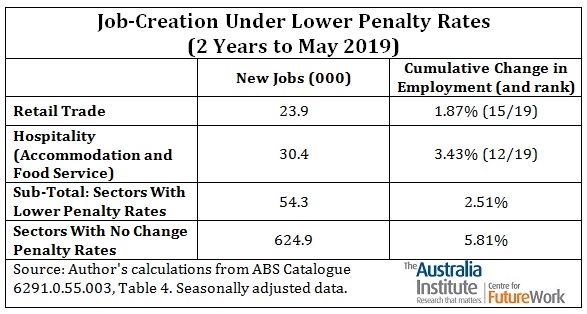
    The retail sector created 24,000 new jobs in the two years since 1 July 2017, and the broad hospitality sector (including accommodation and food & beverage services) created 30,000. In both cases, over 100% of the new jobs were part-time — both sectors actually shed full-time work during this period. The rate of job-creation was less than half as fast during the last two years in both sectors, as it had been in the two years before penalty rate cuts began — even though the pace of job-creation in the broader economy accelerated during the last two years.

    Penalty Rate Chart

    The retail sector ranked 15th out of 19 sectors in job-creation over the past two years; hospitality ranked 12th. Their combined rate of job-creation (up by 2.5% over the two years) was less than half the combined rate of job-creation in the 17 sectors which had no change in penalty rates. 92% of all jobs created in the last two years were created in sectors with constant penalty rates. The two sectors with reduced penalty rates created just 8% of new jobs in this period — even though they accounted for 18% of total employment at the time the penalty rate reductions began.

    It is clear that lower penalty rates have not ignited new hiring in either of these sectors. Instead, job-creation in both sectors has deteriorated well below economy-wide averages in this period. Clearly it takes more than cheapening labour costs to create jobs. Stronger consumer spending (a goal which would be supported by higher wages, not lower wages) is far more important to hiring decisions in these two domestic service industries.


    Full report

    Share

  • Kick-Starting Wage Growth: What the Commonwealth Government Could do NOW

    Kick-Starting Wage Growth: What the Commonwealth Government Could do NOW

    by Jim Stanford

    Australia’s economy continues to endure historically slow growth in wages and salaries, that is undermining household incomes, consumer spending, and economic growth. The Commonwealth government continues to predict an imminent rebound in wages – like in its most recent budget, where it yet again forecast wage growth accelerating quickly to 3.5% per year. But is the government willing to actually do anything to support wages?

    The Centre for Future Work has released new research showing that just 3 specific actions by the Commonwealth government would lead to a significant rise in national wage growth, adding over $10 billion per year to aggregate wage income within three years. That doesn’t single-handedly solve the whole wages crisis, but it would be a big improvement.

    The three measures simulated in the report include:

    1. Reversal of the reductions in penalty rates for Sunday and public holiday work in the retail and hospitality sectors.
    2. Introduction of a “living wage” mandate for Australia’s federal minimum wage, moving it toward a level that would lift full-time full-year workers above standard benchmarks of relative poverty.
    3. Removal of the Commonwealth government’s restrictive cap on wage increases for its own employees, and restoration of normal collective bargaining and traditional rates of wage increase.

    Those three measures alone would boost wages for an estimated 3.3 million Australian workers, by a total of over $10 billion per year once fully implemented.That is equivalent to a 1.25% boost in aggregate national wage income, thus helping to lift overall wage growth in the economy as a whole from current sluggish rates (of 2.3%, according to most recent data) back toward normal historical rates (of 3.5% per year or more).

    The report also considers broader positive benefits from supporting wage growth, including: stronger consumer spending (estimated to rise by $8.5 billion per year), stronger GDP growth (as businesses respond to the increase in purchasing power with expanded output and hiring), stronger government revenues (expected to rise by over $1 billion per year from these measures alone), and a positive spillover onto wage settlements in the rest of the labour market (as employers are pressured keep up with renewed wage growth).


    Full report

    Share

  • Estimating Wage Trends From Personal Income Tax Data

    Estimating Wage Trends From Personal Income Tax Data

    by Jim Stanford

    New analysis of income tax data confirms a dramatic slowdown in Australian wages in recent years – and the slowdown is worse than previous statistics indicated.

    The research is contained in a new report from the Centre for Future Work at the Australia Institute.  It shows that average nominal wages in Australia grew just 1.7% per year between 2012-13 (when the wage slowdown took hold) and 2016-17 (most recent tax data available). That’s below the average national rate of inflation over that period (1.9%), resulting in a decline in the average real wage.

    While the wage slowdown was experienced across the country, some regions were particularly hard-hit. Real wage losses were especially large in Queensland and Western Australia. Moreover, the impact was disproportionate in regional communities in both states — located in some of the most fiercely contested electorates in the current federal election campaign. This suggests that public anger over falling real wages could be politically pivotal to the result on May 18.

    The new research uses a novel source of data on wages: personal tax returns, summarised in Australian Tax Office reports. The data is produced on a financial-year basis (less frequently than other wage statistics, such as those publishedby the Australian Bureau of Statistics). However, the tax data allow a more precise disaggregation of wage trends by state, community, and electorate.

    The 1.7% estimate of annual national wage growth from 2012-13 through 2016-17 based on the ATO data was a full half-point slower than the 2.2% growth reported for the same period in the ABS’s commonly-cited Wage Price Index (issued quarterly by the Bureau). The WPI series makes adjustments for changes in the composition of employment, in order to create a hypothetical fixed “bundle” of jobs. As a result, the impact of changes in job quality (such as the rise of part-time work, casualisation, and ‘gigs’) is not reflected in the WPI results. In the tax data, in contrast, all of these factors affect the evolution of realised average wages and salaries reported per tax-filer. This is thus a more complete and accurate indicator of the evolution of earnings actually received by Australian workers.

    Analysis of tax data also confirms that while wage growth in all parts of the country fell to historic lows, two states were especially hard-hit: Queensland and Western Australia. In those states, wages grew more slowly than elsewhere, and real income losses were larger. Real wages fell by over 3% in Queensland, and over 5% in WA, during that four-year period.

    Those two states are home to some of the most tightly contested electorates in the current federal election. The tax data allow calculation of wage trends by electorate – a level of detail not possible with other data sources.

    The report estimates wage trends for 17 marginal electorates in the two hard-hit states: including all electorates decided by less than a 5% margin in the 2016 election. Real wages fell in every one of the marginal electorates. In 7 seats (6 of which are currently represented by Liberal or LNP members) the cumulative decline in real wages exceeds 5%.

    “Perhaps it is not a coincidence that some of the tightest contests in the current federal election are precisely in those communities where real wages have declined the most,” said Dr. Jim Stanford, Economist and Director of the Centre for Future Work, and author of the report. “Public anger over cost-of-living issues is clearly understandable, given this hard evidence that real wages in these communities have fallen substantially.”

    “It would be a poetic irony for the whole election to be decided by frustrated voters in these hard-hit marginal electorates, which have been seemingly left behind by economic growth in the rest of the country.”


    Full report

    Share

  • The Importance of Minimum Wages to Recent Australian Wage Trends

    The Importance of Minimum Wages to Recent Australian Wage Trends

    by Jim Stanford

    Tomorrow the Australian Bureau of Statistics will release its quarterly Wage Price Index: the most commonly-reported measure of wage growth in Australia’s labour market. Given the importance of public debates about wages and wage policy in the current federal election campaign, this release is timely and politically important.

    This briefing note reviews some methodological issues related to the WPI. It also considers recent data confirming the visible impact on the WPI of last year’s strong increase in the national minimum wage.

    The minimum wage was increased 3.5% effective 1 July 2018 – the biggest increase since 2010. That large minimum wage increase accounts for virtually all of the modest uptick in the WPI experienced in 2018. In other words, it was active policy (namely, the decision by the Fair Work Commission to boost the minimum wage faster than either overall wages or consumer prices), not a reflection of underlying “market forces,” that explains why this indicator of wage growth slightly improved. Without that increase in the minimum wage, overall wage growth would remain below 2%.

    This perspective should be considered when interpreting tomorrow’s release of new WPI data.


    Full report

    Share

  • April Holiday Cluster Highlights Income Losses From Reduced Penalty Rates

    April Holiday Cluster Highlights Income Losses From Reduced Penalty Rates

    by Jim Stanford

    Many Australians are eagerly anticipating a unique concentration of public holidays in coming days. There is a ten-day period (stretching from Good Friday through Sunday, 28 April) during which many employees only have to work three days. Many Australians are now arranging to take those three days off: creating an extended 10-day holiday for the “price” of just three days leave.

    Of course, many other Australians will be required to work during this period, and so for them the appeal of this coming period is diminished. Adding insult to injury, however, is the fact that their compensation for working during this period is being significantly reduced as a result on ongoing reductions in penalty rates for Sunday and public holiday work in the retail, accommodation, and food and beverage industries. A new report from the Centre for Future Work puts a number on the total loss of wages that will be experienced by workers in the broad retail and hospitality sectors through the coming holiday period: $80 million this year, rising to $107 million for a similar period once the rate cuts are fully implemented.

    The reduction in penalties for public holidays (by an amount equal to 25% of base wages for most workers in these sectors) was fully implemented on 1 July, 2017. The reduction in penalty rates for Sunday work is still being phased in: a third reduction in the rate will occur on 1 July this year. And for workers in industries covered by the General Retail and Pharmacy awards, another reduction will occur on 1 July, 2020.

    Over one-half million Australians are at work in these industries on a typical Sunday. The income losses experienced by most of these workers (both directly and indirectly) are substantial: presently amounting to about $16 million in lost wages for each public holiday, and over $8 million (at present) for a Sunday. The unique concentration of public holidays within the 10 days starting on Good Friday (amounting to a total of 6 holidays or Sundays in most states) dramatically highlights the scale of those losses. Over that 10-day period, we estimate that wages will be $80 million lower than if penalty rates had been maintained. And the problem is getting worse, due to the further reductions in Sunday penalties that are coming. After 2020, if the remaining Sunday penalty rate reductions are fully implemented, the loss in wages would equal $107 million for a corresponding 10-day cluster of holidays.

    The coming concentration of public holidays dramatises the magnitude of income losses resulting from the penalty rate cuts, but those income losses are experienced throughout the entire year. In the current financial year (from 1 July 2018 through 30 June 2019), we estimate aggregate income losses at around $630 million. That loss will double once the Sunday penalty cuts are fully in place, to some $1.25 billion per year after 1 July 2020. In sum, this policy imposes a substantial income loss on a group of workers who are already vulnerable to low and uncertain earnings.

    The report also examines the job-creation record of the sectors in which penalty rates were reduced. Employers promised that lower labour costs would result in more hiring, but that promise has been broken. In fact, hiring in sectors where penalty rates were not reduced has been five times faster since July 2017 than in the retail and hospitality sectors (where penalty rates were cut). The idea that cutting penalty rates will spur more hiring has been disproven by real experience.


    Full report

    Share

  • Wages, Taxes and the Budget: How to Genuinely Improve Living Standards

    Wages, Taxes and the Budget: How to Genuinely Improve Living Standards

    by Jim Stanford and Troy Henderson

    This week’s pre-election Commonwealth budget will feature reductions in personal income taxes, as the Coalition government tries to overcome a disadvantage in the polls in the coming federal election. Public debate in recent weeks has been focused on the economic and social hardship caused by the unprecedented slowdown since 2013 in Australian wage growth. It is likely that the government will portray its personal tax cuts as a form of “compensation” for slower wage growth.

    But new analysis from the Centre for Future Work shows it is mathematically impossible for personal income tax cuts to offset the loss in family incomes resulting from years of wage stagnation. The report simulates the effects of ongoing regular wage increases on household incomes, compared to the “savings” of personal income tax cuts. Regular, compounding wage increases provide boosts in disposable income dozens of times larger than tax cuts. Moreover, tax cuts always come with a “cost” for households – in the form of foregone public services and income supports that also contribute to workers’ standard of living.

    Highlights of the new research include:

    • Every one of the government’s budgets since its first (in 2014-15) has wildly overestimated the growth of wages in its official forecasts. Every single year-forecast in every budget (14 year-forecasts in total) has overestimated actual wage growth. If workers’ wages had actually grown as fast as government budgets predicted, the average full-time worker would have $4000 per year in additional income today than they actually do.
    • Wage increases in Australia, already inching along at record-low rates, slowed down further in the December quarter – to an annualised rate of less than 2%. A temporary rebound in wage growth earlier in 2018 was mostly due to a stronger increase in the minimum wage (3.5%), which came into effect on July 1, but has now been absorbed by the labour market.
    • Personal tax cuts likely to be included in the 2019-20 Commonwealth budget will have only a small impact on disposable incomes for workers: worth less than 0.5% for most workers (and worth nothing for many workers). Moreover, the “savings” of tax cuts are offset by the cost of foregone public services, infrastructure and income supports which inevitably accompany shrinkage of the government revenue base.
    • In contrast, annual wage increases at traditional rates (around 3.5% per year, such as prevailed in most years prior to 2013) deliver much greater benefits to workers. Even after deducting taxes on their extra incomes, workers at various income levels receive much larger gains from normal wage increases than tax cuts – especially when those increases are compounded over consecutive years.
    • For example, a worker earning $60,000 per year would see a $210 increase in disposable income from the simulated tax cuts. But they would receive almost $1400 extra disposable income (almost 7 times as much) from a single 3.5% wage increase. And close to $6000 (over 20 times as much) from 3 consecutive years of normal wage increases.

    It is mathematically impossible for tax cuts to deliver ongoing improvements in disposable incomes, let alone of a scale comparable to the benefits of normal wage growth. To genuinely achieve rising living standards for working Australians, the emphasis of economic and budget policies should be shifted to strengthening the institutions (like minimum wages, the awards system, and collective bargaining) that could rekindle normal wage growth.


    Full report

    Share

  • Private Sector Wage Growth Still in Doldrums

    Private Sector Wage Growth Still in Doldrums

    by Jim Stanford

    New data on private-sector business conditions confirm that wage increases paid in the private sector of Australia’s economy continue to plumb record lows.

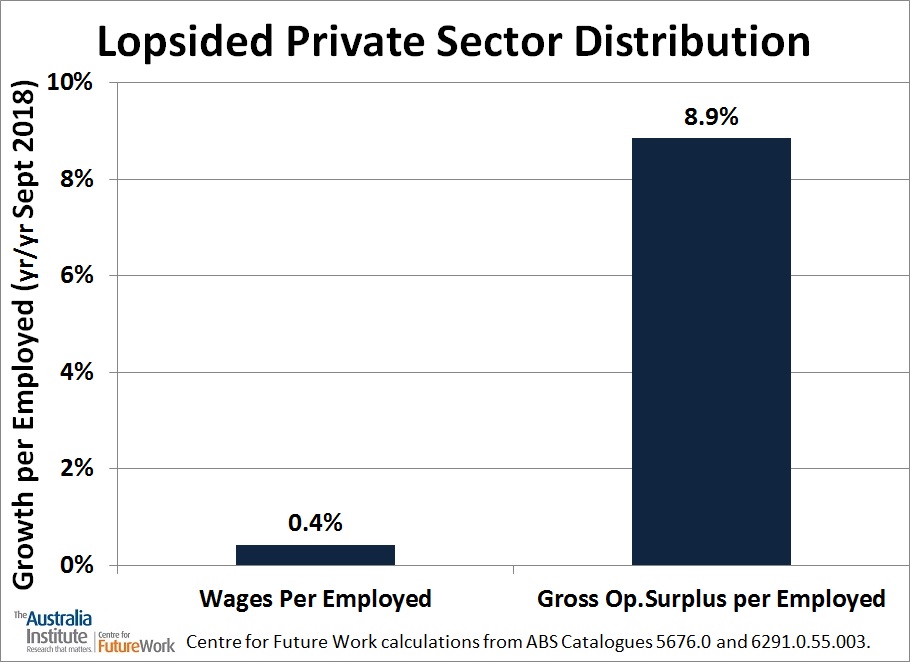
    The ABS’s quarterly Business Indicators report, released yesterday, indicates total wages and salaries paid out by private businesses grew 4.3 percent in the September quarter, compared to year-earlier levels. This only slightly exceeded the increase in total private sector employment during the same period. As a result, wages and salaries paid per employed worker grew very slowly – by just 0.43 percent over the year.

    A new briefing note prepared by Dr. Jim Stanford, Economist and Director of the Centre for Future Work, reviews the data on average wage and salary levels in the private sector.  The 0.43 percent year-over-year increase implies a reduction in real wages for private sector workers (relative to consumer prices, which grew 1.9 percent over the same period) of about 1.5 percent.

    Over the last three years, average annual growth in wages paid per employed private sector worker has fallen below 1 percent per year. Private sector wages are not only lagging behind consumer prices, they have also become de-linked from growth in real labour productivity (which continues to advance at about 1 percent per year).

    The report also finds that business profits are constituting a growing share of total income in the private sector. In the September quarter, 75 cents of profits (gross operating surplus of businesses) were generated for private firms for every $1 paid in wages. That is the second-highest ratio of profits to wages since the ABS began collecting this data. The finding suggests that the labour share of total GDP will likely continue to decline in coming months.

    In the year ending in the September 2018 quarter, business profits per worker grew by almost 9 percent – 20 times faster than wage payments per worker.

    Lopsided Growth


    Full report

    Share

  • Exploring the Decline in the Labour Share of GDP

    Exploring the Decline in the Labour Share of GDP

    The share of total economic output in Australia that is paid to workers (in the form of wages, salaries, and superannuation contributions) has been declining for decades. Workers produce more real output with each hour of labour (thanks to ongoing efficiency improvements and productivity growth), but growth in real wages has been much slower – and recently, real wages haven’t been growing at all. The result is that labour’s slice of the economic pie has been getting smaller. In fact, a recent Centre for Future Work report showed that in early 2017 the labour share of GDP hit its lowest level since the Australian Bureau of Statistics began collecting quarterly GDP data.

    To explore the causes and consequences of this decline in workers’ share of national income, the Centre for Future Work convened a special panel of experts at the Society for Heterodox Economists conference at UNSW in Sydney last December. The papers presented at that panel have been peer-reviewed and just published in the Journal of Australian Political Economy. We are very pleased to co-publish the 4 papers here.

    • In addition to further documenting the long erosion of workers’ share of Australian GDP, the symposium sheds additional light on the trend, including the following aspects:
    • The shifting distribution of income from labour to capital contributes to widening inequality in personal incomes (since financial wealth, and income from that wealth, is so tightly concentrated among the richest Australians).
    • The decline in the labour share in Australia has been among the worst third of all OECD economies; and some countries have experienced stable or even rising labour shares, proving this trend is neither universal nor inevitable.
    • The growing power of finance, and the financialisation of business practices even by non-financial firms, have been key factors in the relative fall of labour compensation.
    • New business models involving the fragmentation of work and the outsourcing of direct employment responsibilities by lead companies (what participating author David Peetz terms “not-there capitalism”) have also contributed to the trend.
    • Australia’s minimum wage once established a strong foundation for a healthy labour share of national income, but its influence has eroded over the last 30 years as minimum wages have failed to keep up with overall wage trends and productivity growth.
    • Despite the erosion of union density and collective bargaining, Australian unions still possess an impressive capacity to mobilise working people to demand a better share of the economic pie (including through the political process).

    The long decline in the labour share is a powerful, telling indicator of the regressive shifts in the power balances of Australian society over the last generation.  These articles help us understand what has happened – and how to achieve a better distribution of income between factors of production in the future.

    Links to the 4 articles, and a rich introduction to the symposium (by Dr. Frances Flanagan of United Voice and Prof. Frank Stilwell of the University of Sydney) are provided below. Please visit the Journal of Australian Political Economy to learn more about the symposium, and to subscribe.

    • Introduction: Frances Flanagan and Frank Stilwell.
    • The Declining Labour Share in Australia: Definition, Measurement, and International Comparisons: Jim Stanford (Director, Centre for Future Work)
    • The Labour Share, Power and Financialisation: David Peetz (Professor of Employment Relations, Griffith University)
    • The Erosion of Minimum Wage Policy in Australia and Labour’s Shrinking Share of Total Income: Margaret McKenzie (Economist, Australian Council of Trade Unions)
    • The Declining Labour Share and the Return of Democratic Class Conflict in Australia: Shaun Wilson (Associate Professor Sociology, Macquarie University)


    Frances Flanagan & Frank Stilwell


    Jim Stanford


    David Peetz


    Margaret McKenzie


    Shaun Wilson

    Share