Category: Wages & Entitlements

  • Are Wages or Profits Driving Australia’s Inflation?

    Are Wages or Profits Driving Australia’s Inflation?

    An analysis of the National Accounts

    Labour costs have played an insignificant role in the recent increase in inflation, accounting for just 15 percent of economy wide price increases while profits have played an overwhelming role, accounting for about 60 percent of recent inflation.


    Full report

    Share

  • Wages, Prices and the Federal Election

    Wages, Prices and the Federal Election

    by Lily Raynes

    The recent federal election featured important debate regarding the rising cost of living in Australia, and whether and how wages should be boosted to keep up with higher prices. One exchange, late in the campaign, occurred when ALP leader Anthony Albanese stated his belief that wages should keep up with prices — but then was strongly criticised for that view by Coalition leaders and some business commentators.

    New exit poll results from the Australia Institute indicate that a very strong majority of voters (83%) in fact support the idea that wages should at least keep up with prices. This opinion was shared broadly across the political spectrum. Even 79% of Coalition voters supported lifting wages to at least keep up with inflation.

    It seems likely, therefore, that this debate over wages and prices worked to the advantage of Mr Albanese. The exit poll indicated that voters identified the ALP, by a large margin, as having enunciated the best position on the problems of wages and the rising cost of living. 39% of voters (including 11% of Coalition voters) indicated the ALP had the strongest position on this issue, compared to 26% who thought the Coalition had the best policy.


    Full report

    Share

  • The Wages Crisis Revisited

    The Wages Crisis Revisited

    by Andrew Stewart, Jim Stanford and Tess Hardy

    A comprehensive review of Australian wage trends indicates that wage growth is likely to remain stuck at historically weak levels despite the dramatic disruptions experienced by the Australian labour market through the COVID-19 pandemic. The report finds that targeted policies to deliberately lift wages are needed to break free of the low-wage trajectory that has become locked in over the past nine years.

    The report, The Wages Crisis: Revisited, authored by three of Australia’s leading labour policy experts: Professor Andrew Stewart from Adelaide Law School, Dr Jim Stanford from the Centre for Future Work, and Associate Professor Tess Hardy from Melbourne Law School, updates analysis and recommendations from their 2018 edited book, The Wages Crisis in Australia.

    The report shows that annual nominal wage growth recovered after initial lockdowns during the pandemic – but rebounded only to the same slow pace (just above 2% per year) recorded for several years prior to COVID. Unprecedented fluctuations in employment and labour supply, including a significant decline in the official unemployment rate, do not seem to have altered wage growth, which is still tracking at the slowest sustained pace in post-war history.

    The research found little correlation between the lasting slowdown in wage growth after 2013, and changes in supply-and-demand balances in the labour market. Traditional market forces did not cause the wages crisis, and market forces are unlikely to be able to fix it – even with a relatively low unemployment rate.

    Instead, the authors identified nine policy and institutional factors which were more important in explaining the deceleration of wages, including: the erosion of collective bargaining coverage; inadequate minimum wages; pay restraint imposed on public sector workers; and widespread wage theft.

    The problem of restrained compensation in public and human services reaches further than just the pay caps imposed directly on public servants. Wages in publicly funded services (like aged care, the NDIS, and early child education) are also held back by inadequate funding and weak labour standards in those programs. The report makes special mention of the need to improve wages in aged care, in the wake of the recent Royal Commission’s finding that wages in the sector must be improved as a top priority in improving care standards and attracting the new workers the sector needs.

    The authors suggest that nominal wages should grow faster than 4% per year in coming years, to restore healthy relationships with productivity growth, inflation, and national income distribution. But a resuscitation of wage growth will not occur without proactive wage-boosting policies.

    The authors list five broad measures to quickly support wage growth. One is a proposal for a new statutory definition of employment. This would prevent businesses from drafting contracts that present workers as being self-employed, even if in reality they have no business of their own. The authors predict that such arrangements will become far more widespread, including in the growing gig economy, in the wake of two recent decisions by the High Court.


    Full report

    Share

  • Putting a Cap on Community

    Putting a Cap on Community

    The Economic and Social Consequences of Victoria’s Local Government Rate Caps Policy
    by Dan Nahum

    The Victorian Government’s policy of capping of local government rates revenue in Victoria is a regressive move on economic, social and democratic grounds. By arbitrarily tying the growth in total rates revenue in each local government area to price indexes, the state government restricts the ability of local governments to respond to the COVID-19 crisis with expanded, secure employment and service offerings.

    Rates on property are the largest single source of revenue to local governments in Victoria. Of total Victorian local government revenue in 2019-20 ($11.7 billion), rates accounted for $5.6 billion or almost half. Since 2016-17, the Victorian state government has capped the amounts local governments can collect from their ratepayers.

    New research by the Centre for Future Work, commissioned by the Australian Services Union, finds that the imposition of rate caps has cost up to 7425 jobs in 2021-22, counting both direct local government employment and indirect private sector jobs. They have also reduced GDP by up to $890 million in 2021-22. The costs of suppressed local government revenues, and corresponding austerity in the delivery of local government services, will continue to grow with each passing year if the policy is maintained.

    The rate cap policy becomes more restrictive as the overall economy slows, since the rate cap is tied to inflation indexes which tend to slow when the economy is weak.

    The local government sector in Victoria employs about 50,000 people in a wide range of services and occupations, including road planning and maintenance, home and aged care, waste disposal, libraries, childcare, school crossing supervision, maternal and child health, the State Emergency Service, and environmental management.

    The rate caps act as a brake on recovery and growth by embedding a dynamic of self-fulfilling fiscal restraint and austerity. Additionally, there has been a shift to other forms of local government revenue-raising that are less progressive and socially equitable, such as fees and fines.

    Rates bills are calculated based on relative property valuations – so even if local governments are collecting less from rates overall than they would in the absence of the cap, growth in a particular ratepayer’s payments may well exceed the overall cap.

    The rate cap policy inhibits a normal trend of expanding and improving local government services in line with population growth, rising living standards, and economic expansion – as well as interfering with the democratically-expressed preferences of local government voters.


    Full report

    Share

  • Log of Extraordinary IR Measures During COVID-19 Shutdowns

    Log of Extraordinary IR Measures During COVID-19 Shutdowns

    by Alison Pennington

    COVID-19 containment measures have suspended large sections of the economy. Governments have committed over $220 billion in income supports to workers and firms. The $130 billion JobKeeper wage subsidy scheme is the most extensive “shock absorber” (with worrying exclusions of many casual and migrant workers). With the scheme now in place, assessment of the government’s COVID-19 measures is now shifting to implementation. This includes effects on the laws and regulations governing wages and how businesses and employees (and their unions) interact to determine the terms and conditions of employment.

    Despite enduring a heightened anti-union agenda, unions (headed up by ACTU) liaised early with government to secure the JobKeeper wage subsidy to prevent mass layoffs. Unions have negotiated with industry to adapt Awards and enterprise agreements (EAs) to new business conditions. The Coalition government has proceeded with significant changes to the Fair Work Act that could hamper efforts to drive an inclusive economic and labour market recovery. What’s more, the Morrison government has indicated it will continue its pre-COVID agenda to further weaken representation rights and minimum labour laws.

    To inform assessment of the impacts of COVID-19 on jobs, wages, and workplace protections, we have summarised major developments within the industrial relations system since March 2020. The log traces revisions to Awards, enterprise agreement-making rules, new instruments formed between unions and industry, major decisions by the Fair Work Commission, and ongoing lobbying efforts by business to weaken minimum labour laws. Links to relevant research from Centre for Future Work released during the crisis, or prior to, are provided. All log entries are reported in the industrial relations publication Workplace Express. Links to other media outlets are provided where relevant.

    If there are any major IR developments that we have not reported here please get in touch at futurework@tai.org.au.

    Thursday 17 September

    • The Fair Work Commission rejects a union application for a $5 per hour “COVID-19 care allowance” for disability workers attending to clients quarantining with COVID-19. While the FWC acknowledged that disability workers were more at risk of having to take paid or unpaid leave to self-isolate, they considered the circumstances in which the allowance would be paid “rare and temporary”, while also presenting an undue cost burden on employers dealing with real or potential COVID outbreaks. The Commission also noted concern that the decision would trigger further litigation, leading to “pressure for a flow-on to other employees and awards” to other sectors with the same circumstances including in hospital care, aged care, home care and crisis accommodation.

    Thursday 3 September

    • New legislation introduced by Morrison government granting more flexibility for parents of young children to vary how they use their 12 months’ unpaid parental leave under the National Employment Standards (NES). The NES entitlement presently requires 12 months unpaid leave to be used in one continuous period (with the employee forfeiting any unused leave if returning to work before 12 months is up). Under the proposed changes, all parents (primary and secondary carers) will be able to access 30 days of flexible unpaid leave of their 12 months’ quota, subject to agreement by their employer about how the leave can be used (e.g. reduced hours, single days, groups of days, or one single block). Primary carers currently eligible under the government’s parental leave scheme will be able to claim the minimum-wage parental leave payment from Services Australia for their 30 days of flexible unpaid parental leave ($753.80 per week). The proposed laws also provide for 12 months of unpaid parental leave for families who have experienced stillbirths, infant deaths and premature births.

    Wednesday 26 July

    • Morrison government introduces JobKeeper V2.0 legislation. The Bill establishes a new two-tiered JobKeeper payment scheme and an additional revenue test that expands access to JobKeeper-enabled exemptions to the Fair Work Act (FW Act) for employers no longer eligible for the wage subsidy. The emergency FW Act measures were introduced in April for businesses receiving JobKeeper, allowing employers to change workers’ hours, duties, days, and location of work, and direct employees to take annual leave. The new Bill allows businesses that fail the existing 30% revenue decline test to apply for FW Act exemptions under a new 10% revenue decline test to determine whether they’re still “distressed”. Employees in businesses that qualify for the revised revenue test for JobKeeper-branded FW Act exemptions can have their hours reduced by up to 40%, with worrying implications for large reductions in employee incomes. The legislation states that employers cannot require staff to work less than two hours a day, and must provide seven days’ written notice before a JobKeeper-enabling direction is given. The Bill adds that employers cannot unreasonably target certain categories of workers for hours reductions, compared with other employees also subject to the directions.
    • The new two-tiered JobKeeper payment replaces the flat $1,500/fortnight rate with $1,200/fortnight for employees who worked full-time prior to the pandemic (in February), and $750/fortnight for employees working less than 20 hours. From January 2021, payments will reduce again to $1,000 and $650, respectively. The scheme will be extended to March 2021.

    Monday 27 July

    • As COVID cases surge in Victoria’s aged care sector, the Fair Work Commission approves an application for two weeks paid pandemic leave for healthcare and social services workers required to self-isolate for coronavirus. The Commission originally adjourned the application on 8 July due to concerns the leave entitlement would cause private aged care providers financial difficulty. The new COVID-era paid leave entitlement expires in three months and applies to full-time and part-time workers, but only casual workers with “regular and systematic shifts”.

    Tuesday 21 July

    • Morrison government reveals JobKeeper wage subsidy payments will be reduced from late-September under a new two-tiered system paying $1,200 for employees who worked full-time prior to the pandemic, and $750 for those working less than 20 hours in February. In January 2021, payments will reduce again to $1,000 and $650, respectively. Employers must continue to meet turnover tests to be eligible for the scheme which will be extended to March 2021.
    • The federal government announces the JobSeeker coronavirus supplement will be reduced from $550 a fortnight to $250 per fortnight, extended only until December 2021. The $300 cut to the supplement coincides with an increase in the income-free threshold for JobSeeker payments from $106 per fortnight to $300 per fortnight. Means-testing and mutual obligations will be reintroduced on 4 August.
    • Cuts to the JobKeeper and JobSeeker programs will reduce government spending by $10 billion per month and reduce the number of employees covered by the wage subsidy by over 2 million by December. Research released by The Australia Institute shows cuts to JobSeeker will plunge 370,000 people into poverty, including 80,000 children.

    Friday 17 July

    • Prime Minister Scott Morrison announces intention to extend JobKeeper exemptions to the Fair Work Act for employers no longer receiving JobKeeper. The COVID-era exemptions were introduced in April for a period of 6 months and allow employers to change workers’ hours, duties, days, and location of work, and direct employees to take annual leave. Extension of JobKeeper FW Act provisions would allow businesses no longer receiving JobKeeper to continue operations with all relevant Awards, enterprise agreements, individual contracts or transitional instruments suspended (though hourly rates of pay under the prevailing pay instruments remain in place).

    Wednesday 8 July

    • In a major decision with concerning public health consequences, the Fair Work Commission adjourns a union application to introduce a paid pandemic leave entitlement for Award-covered healthcare and community services workers required to self-isolate during coronavirus crisis. The Commission contended the COVID-era paid leave provision would undermine financial security of private aged care and NDIS providers.

    Wednesday 1 July

    • Fair Work Commission extends temporary COVID-19 variations made to the fast food, retail, health industry, clerks, hospitality and vehicle maintenance awards in late-March. The flexibility schedules broadly allow employers to deploy workers across classifications, direct employees to take annual leave, and reduce minimum hours requirements. The Clerks Award variation enabling employers to spread out employee working hours without paying penalty rates were opposed by the ASU but the FWC granted the extension until September 27.
    • FWC extends unpaid pandemic leave provisions until further order for health professionals, nurses, aged care, pharmacy and ambulance awards. Other awards granted extensions until defined cut-off dates include fast food, retail, and hair and beauty (July 31), and airline pilots (December).

    Thursday 11 June

    • The Morrison government announces intention to withdraw the regulation introduced in April enabling employers to reduce the period of notice they give employees of proposed changes to EAs from seven days to one. IR Minister Christian Porter stated that the regulation introduced to support employers to rapidly respond to COVID19 disruptions to business was no longer needed.
    • Senate approves Labor proposal to discharge the Ensuring Integrity Bill.

    Tuesday 26 May

    • Morrison announces five working groups of business representatives and unions will be assembled to create a new workplace relations deal by September. The working groups will cover five key areas: award simplification, enterprise agreement making, casual and fixed-term employment, greenfields projects, and compliance and enforcement in areas including wage theft. Morrison also announces withdrawal of the Ensuring Integrity Bill from its second vote in the Senate.

    Wednesday 20 May

    • A full Federal Court rules that a coal miner employed as a casual under six consecutive contracts over almost four years is an employee entitled to leave benefits. The decision exposes employers to annual leave backpay claims for approximately 1.6 million casuals working on a regular, predictable basis.
    • FWC approves AiG application to vary the Fast Food Industry Award covering over 200,000 fast food workers to mitigate impacts of COVID-19 on employees and businesses. The variation approved by the SDA and ACTU (and contested by RAFWUU) allows employers to cut part-time workers’ hours with reduced overtime penalties, amend rosters, and request employees take annual leave which they cannot “unreasonably” refuse.

    Tuesday 19 May

    • Australian Industry Group release post-COVID-19 IR proposals for enterprise agreement-making, limiting Award content, and expanding casual employment. AiG propose to abolish the Better Off Overall Test (that requires employees covered by an EA to not fall below terms and conditions outlined in Awards), replaced by the weaker No Disadvantage Test, and weakening scrutiny of non-union EAs by the FWC, unions and employees. Award content would be drastically reduced under AiG’s proposals to remove annual leave, personal/carer’s leave, redundancy pay and public holiday loadings from Awards. Other Award derogation proposals include the expansion of Individual Flexibility Agreements (a revitalised form of the Australian Workplace Agreement implemented under WorkChoices by John Howard), and annualised salary clauses. Contrary to “fresh” branding, these proposals were developed long-before the pandemic struck. We documented the enterprise bargaining proposals from AiG and other business lobbyists in October 2019.

    Monday 18 May

    • Federal Court rules in favour of Qantas claim that it is not required to pay sick leave, carers’ leave and compassionate leave to the thousands of Qantas workers stood down due to coronavirus. Court considers entitlements forms of income protection that are extinguished when workers are not in receipt of income.

    Thursday 14 May

    • Federal government announces intention to limit the life of enterprise agreements varied using the shortened access period to 12 months. IR Minister Christian Porter said government intends to introduce the regulation through agreement with the Governor-General. On April 16, the government reduced the access period employers are required to consult with employees on changes to EAs from seven days to one.

    Friday 15 May

    • FWC flag that wages paid by distressed companies signed up to Job-Keeper could be frozen as part of the Commission’s Minimum Wage Review decision. The Commission will hand down its decision by June 30.

    Wednesday 13 May

    • The FWC hands down the first published ruling in the JobKeeper dispute jurisdiction, ruling a part-time employee unreasonably refused an employer’s request to use up one day annual leave each week for 16 weeks. The employee argued the wage subsidy was not intended to be used to offset employers’ annual leave obligations, but the case was unsuccessful.

    Friday 1 May

    • Federal government modifies JobKeeper eligibility rules to exclude workers employed by corporations owned by foreign governments. This exclusion applies to all workers including Australian residents.

    Monday 27 April

    • FWC approves joint employer-union application to vary Educational Services (Schools) General Staff Award covering non-teaching staff in non-government schools (bus drivers, maintenance workers, and others). For workers otherwise stood down due to school operations ceasing, the variation allows employers to cut hours by 25%, and redeploy workers across classifications (similar to hospitality and clerks Award variations).

    Friday 24 April

    • Business lobby groups propose changes to the enterprise bargaining system as key economic recovery measure. The proposals to increase employer unilateral power setting terms and conditions of work in EAs were prefaced pre-crisis (documented by Alison Pennington here) and include: removal of Better Off Overall Test, introduction of “whole of life” greenfields agreements, and less scrutiny of non-union EAs.

    Wednesday April 22

    • Government announces intention to reintroduce the Ensuring Integrity (EI) Bill (defeated in the Senate in December 2019). The anti-union Bill would allow the federal court to disqualify union officials, place unions under court administration, and deregister unions altogether. The Bill would also empower the FWC to prohibit union mergers on “public interest” grounds (See Jim Stanford’s submission on EI).

    Monday 20 April

    • Major law firms seek variation to the Legal Services Award mirroring previously agreed changes to the Clerks Award. Changes allow employers to provide workers of 24 hours’ notice of a vote to reduce working hours by 25%, give directives to use annual leave (beyond two weeks), reduce the minimum hours per shift for part-time and casual workers from three hours minimum to two hours, and widen ordinary weekly hours.
    • Australian Tax Office issues updates JobKeeper advice to employers clarifying the “one in, all in” rule. “You cannot choose to nominate only some employees.”

    Sunday 19 April

    • Australian Mines and Metals Association (AMMA) launch second call to abolish all Awards and all enterprise agreements (EAs) for a period of 6 months due to impacts of coronavirus on business activity.

    Thursday 16 April

    • Federal government drastically weaken representation rights under the Fair Work Act, reducing the access period employers are required to consult with employees on changes to EAs from seven days to one. Employer instruments to change hours and pay hitherto were only available to those qualifying for JobKeeper. These FW Act changes are accessible to all employers covered by EAs (including those in no danger of business failure).

    Wednesday 15 April

    • NSW Industrial Relations Commission approves a “splinter Award” covering NSW local government workers (who are ineligible for JobKeeper as state public sector workers) in the first instance of new union-employer Award-making during the pandemic. Covering over 100 councils, the Award requires councils find alternate work for worker redeployment. Those who cannot be redeployed receive a retention allowance of $858.20 per week for a period of 13 weeks. The Award provides a new Special Leave entitlement of four weeks at normal pay to cover any period where no suitable work can be provided (including self-isolation due to contracting COVID-19).

    Tuesday 14 April

    • FWC approves an employer application from Melbourne-based Mason Architectural Joinery to cut redundancy pay – the first redundancy pay entitlement cut by the Commission during the pandemic.
    • The Commission rules against an employer application to reduce the redundancy pay for three manufacturing workers on the same day. Cash flow problems were deemed an insufficient excuse since the company “has both the means to pay the full amount of the redundancy entitlement[s]. . . and the money in the bank to do so”.

    Thursday 9 April

    • Government announces pay freeze for hundreds of thousands of Commonwealth public sector workers. The pay increase deferral is stipulated by determination from April 14 for a period of 12-months. CFW release a report one week later assessing the negative impacts of public sector wage freezes on workers’ incomes and economic recovery post-pandemic.
    • JobKeeper wage subsidy legislation passes Parliament.

    Wednesday 8 April

    • FWC introduce two weeks’ unpaid pandemic leave to Award-covered workers required to self-isolate. The entitlement is available to workers who cannot access other leave entitlements and is inserted into 103 modern Awards, covering around half of all private sector workers (or 4.4 million workers). Awards were selected by the FWC based on a combination of factors including industries most affected by COVID-19, and industries with high proportions of Award-reliant workers and small and medium businesses.
    • In a worrying sign the FWC will permit enterprise bargaining to unravel due to COVID-19, UWU lose their bargaining order application with large food manufacturer Baida after the company refused to continue EA negotiations, proceeding to present the same EA deal to employees previously voted down. The FWC agreed with employer claims that it was too difficult to host negotiations due to virus social distancing requirements.

    Tuesday 7 April

    • Government introduces $130 billion JobKeeper wage subsidy scheme delivering payment of $1,500 per fortnight for a period of 6 months to employees within businesses who have experienced a 30% revenue decline compared to this time last year (less than $1 billion turnover). Registered charities with 15% revenue decline qualify for the scheme. Only Australian citizens (NZ included), employees in full-time or part-time roles, casual roles where an employee has been with the same employer for at least 12 months, and self-employed workers with ABNs are eligible for the subsidy.
    • Morrison government seek substantial changes to standard operation of the Fair Work Act 2009 (FW Act). Government and ACTU reach agreement allowing eligible employers to lawfully change workers’ hours, duties, days and location, and force employees to use annual leave (with two weeks’ “buffer” leave remaining) for period of 6 months. Limited safeguards are introduced with the FWC empowered to adjudicate disputes. No additional funding for the FWC to deal with disputes has been announced. These changes were implemented through entirely new provisions in the FW Act (Parts 6-4C in The Coronavirus Economic Response Package Omnibus (Measures No. 2) Act 2020) that suspend operation of all relevant Awards, enterprise agreements, individual contracts or transitional instruments applicable to employers covered by JobKeeper for a period of six months. The new JobKeeper provisions in the FW Act state:
      • Employers must pay all eligible employees an amount of at least $1,500 per fortnight. Employers are required to pay all wages earned above the JobKeeper threshold to employees who performed work in the period.
      • New employer powers to decrease employee hours, and change duties and location of work. These “JobKeeper enabling directions” allow employers to amend hours of work to “match” the subsidy rate (though hourly rates of pay under the prevailing pay instruments do not change). All directions must be provided in writing, reasonable in the circumstances, delivered with three days’ notice to the employee, and be necessary to the continued employment of the worker.
      • Employers may request that employees agree to alter the days and times that they work, provided the employees’ duties are safe (including with protection from COVID-19), and within the scope of the business’ operations. Employers can also request workers take annual leave, provided they maintain a two-week annual leave balance. Changes to work days and times, and request to use annual leave must be by agreement with employees, but an employee may not “unreasonably refuse”.
    • The Centre for Future Work release early analysis of the pros and cons of JobKeeper, including polling from the Australia Institute showing 81% of respondents support extending the wage subsidy to all casual workers.

    Thursday 2 April

    • The FWC full bench approves the first application by an employer to suspend wage rises payable under the EA due to impacts of COVID-19 on future business revenue. The FWC approve the application from Queensland-based electrical services to withhold a 3% pay rise due to predicted (but not yet realised) revenue decline. The FWC hold powers to change EAs so long as employees remain better off overall than the Award. An additional untested provision allows the FWC to approve EA changes that provide for below-Award conditions in “exceptional circumstances”.
    • Council of Small Business call for suspension of unfair dismissal claims during COVID-19. Joining the Australian Mines and Metals Association, the Council also call on government to suspend all Awards and enterprise agreements for up to six months.

    Tuesday 1 April

    • Restaurant employers apply to vary the restaurants Award with consent of ACTU and UWU. Employers apply for the same hours, leave and location variations made to the Award for clerical and hotels workers on 26 and 24 March.

    Monday 30 March

    • FWC approves UWU ballot for industrial action at RSEA – a manufacturer of personal protective equipment – after the company applied to freeze bargaining for a new agreement till July. The company claimed the industrial action ballot should not be approved due to their “essential business” status and inability to bargain within an unpredictable economic climate.

    Thursday 26 March

    • FWC approves application from Australian Chamber of Commerce and Industry and AiG for a three-month variation to the Clerks Award covering approximately 1.3 million administrative workers. Changes allow employers to reduce minimum hours, allow work across classifications, direct employees to take leave, and provide leave at half pay. The application mirrors amendments made to the hospitality Award on 24 March.
    • NSW parliament passes legislation allowing early access to long service leave entitlements for period of 6 months. Amendments to the Long Services Leave Act 1955 will allows employees to use accrued long-service leave in shorter time periods (such as one day per week), with less notice by agreement with their employer.

    Tuesday 24 March

    • FWC approves joint union–employer application to vary the hospitality Award. The joint Australian Hotels Association and United Workers Union amendment inserts a flexibility schedule expiring in three months. Changes allow employers to deploy workers across classifications, direct employees to take annual leave with 24 hrs notice, and reduce minimum hours requirements – full-time employees entitled to 22.8 to 38 hours per week, part-time employees to 60% of guarantees minimum hours.

    Share

  • Polling – Casual workers and the wage subsidy

    Polling – Casual workers and the wage subsidy

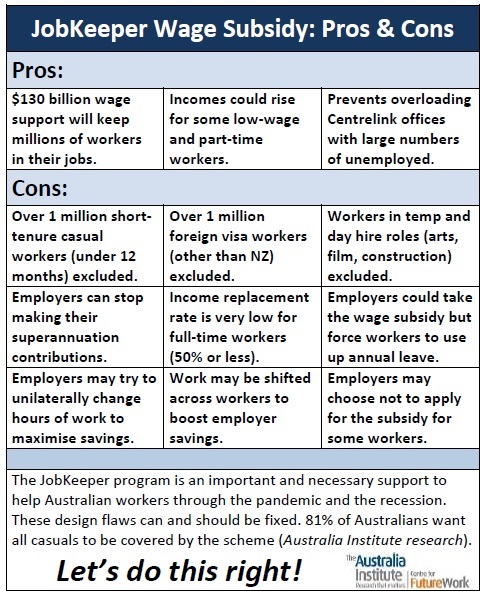
    The Commonwealth government’s proposed JobKeeper wage subsidy scheme represents an important and promising response to the COVID-19 shutdown of several key sectors of Australia’s economy. The scheme would support an estimated $130 billion worth of wage payments over the coming 6 months, keeping millions of Australians in jobs even if their employers experience major revenue losses from the restrictions that have been imposed on activity, mobility, and work during the pandemic.

    However, the program as originally proposed contains several design flaws that will seriously undermine the effectiveness of the program if they are not fixed.

    These include, most prominently, the arbitrary exclusion of over 1 million casual workers (those who have not been continuously employed by their current workplace for at least 12 months), over 1 million foreign visa workers (other than New Zealanders on special 444 visas), and many thousands of temp and day-hire workers in industries such as arts, film, and construction (whose employers technically no longer exist).

    Our partners at the Australia Institute recently conducted polling of Australians regarding these exclusions in the JobKeeper program. An overwhelming majority of respondents, from all political persuasions, support making the program available to all casual workers regardless of their tenure with their existing employer. 81% of respondents support extending the wage subsidy to all casual workers.

    For a full breakdown of the polling results, please see the Australia Institute’s full report below.

    Other concerns with the government’s proposal include the possibility that employers could compel workers to draw down paid annual leave even while their wages are being largely or fully covered by government, and the risk that employers would use the program’s $1500 per fortnight benefit level to push down wages or unilaterally alter hours of work.

    These concerns in the proposed program design can and should be corrected by government, in order to maximise the potential positive effects of the scheme in preserving employment and income levels.

    See our summary table of the ‘pros and cons’ of the JobKeeper program as initially proposed by government:


    Full report

    Share

  • Submission to the 2020 annual wage review

    Submission to the 2020 annual wage review

    by Jim Stanford

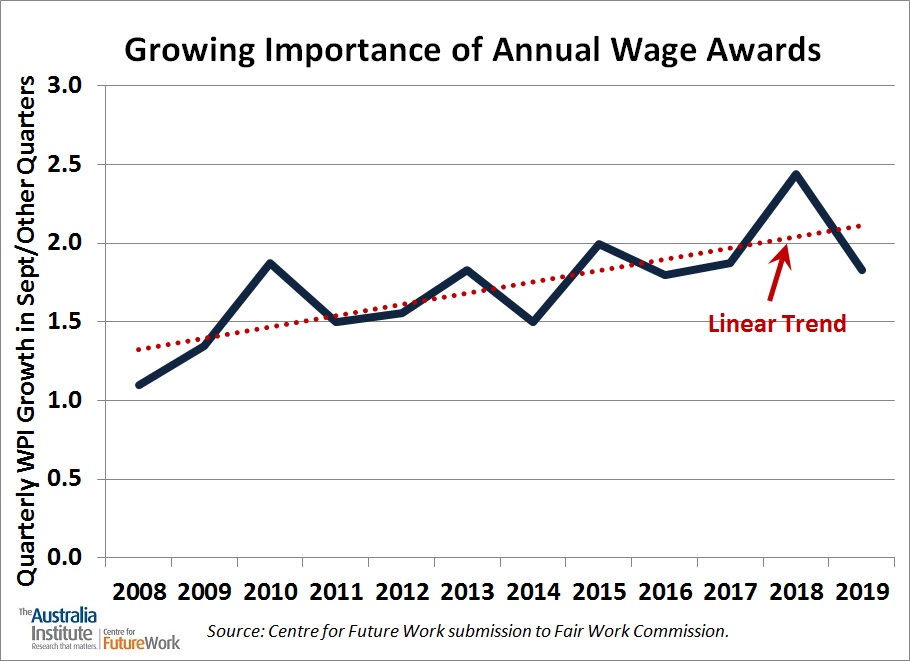
    The Centre for Future Work has made a submission to the 2020 annual wage review conducted by the Fair Work Commission. The submission compiles evidence showing that the annual minimum wage adjustments (which flow through into wages specified in the Modern Awards, as well as some enterprise agreements and individual contracts) have played a more important role in recent years in supporting the overall level of wage growth in Australia’s labour market. Without relatively strong minimum wage increases since 2017 (of 3% or higher for three consecutive years), Australian wage growth would still be languishing at all-time record lows of under 2% per year.

    In this context, the Centre argued it is vital the Commission proceed with a normal, healthy minimum wage increase for 1 July, 2020, with full flow-through into Award wages. Otherwise wage growth will slump significantly (to an estimated 0.7%, or even lower), heightening the risk of economy-wide deflation.

    The submission also provided new analysis on the seasonal pattern of wage growth in Australia’s labour market. In recent years, quarterly wage growth has been twice as strong in the quarter that contains the annual wage award, as in the rest of the year. That attests to the growing structural importance of the annual award in supporting wages, and preventing wage growth from falling even lower.

    September Quarterly Wage Premium

    The Centre’s submission was reported in the Australian Financial Review, and other media.


    Full submission

    Share

  • The Same Mistake Twice

    The Same Mistake Twice

    The Self-Defeating Consequences of Public Sector Pay Freezes
    by Troy Henderson and Jim Stanford

    New research from the Australia Institute’s Centre for Future Work reveals the consequences of freezing public service pay, both for public sector workers and for the broader economy.

    Governments are devoting unprecedented resources to protecting Australians against the health and economic effects of the pandemic, but a contradictory push to adopt fiscal austerity measures is also becoming apparent. Leaders of governments at all levels — federal, state and local council — have already announced plans to freeze wages and cancel previously agreed pay raises for public servants.


    Full report

    Share

  • The Long-Term Consequences of Wage Freezes for Real Wages, Lifetime Earnings, and Superannuation

    The Long-Term Consequences of Wage Freezes for Real Wages, Lifetime Earnings, and Superannuation

    by Jim Stanford

    New research from the Centre for Future Work has dramatised the lasting consequences for workers’ lifetime incomes – even after they retire – of wage freezes.

    A wage freeze is often described as a “temporary sacrifice,” that supposedly ends once normal annual wage increments are restored. However, this report confirms that the legacy of even a temporary pay freeze is a permanent reduction in lifetime incomes and superannuation, which can easily ultimately result in hundreds of thousands of dollars of lost income. These long-term effects are illustrated with reference to a real-world example: an 18-month pay freeze imposed on workers at Jetstar in 2014-2016.

    Many Australian employers have frozen the pay of their workers in recent years, typically justified on grounds of temporary financial duress. However, those pay freezes have a lasting negative impact on the long-run trajectory of wages. As a result, workers lose tens of thousands of dollars of income through the rest of their careers. To cap the losses, employers must implement special one-time catch-up pay increases to restore the pre-freeze trajectory of wages.

    To illustrate the lasting, cumulative impact of pay freezes on workers’ lifetime incomes, a new Briefing Paper from the Centre for Future Work considers the case of an 18-month wage freeze implemented in 2014-16 by Jetstar. The pay freeze was implemented amidst financial losses at the airline. However, since then the airline (and its parent firm, Qantas) have returned to strong profitability, and executive compensation has soared. Normal 3% wage increases were restored beginning March 2016, and a one-time bonus payment was made at that time as “compensation” for the sacrifice of Jetstar workers. But the current incomes of Jetstar workers are still thousands of dollars per year lower than if the pay freeze had not been imposed.

    The report considers three distinct categories of losses resulting from a pay freeze:

    1. Loss of real purchasing power while the freeze is in effect.
    2. Loss of future income resulting from the permanent downward shift in pay trajectory.
    3. Loss of superannuation contributions and investment income resulting from lower pay.

    The report quantifies these cumulating costs for the case of the pay freeze at Jetstar. Jetstar workers could lose $150,000 or more in cumulative earnings by the time they retire, despite the restoration of annual wage increments after 2016 and the one-time bonus. Moreover, workers’ superannuation accounts will also be suppressed accordingly: because of lower employer contributions (resulting from lower earnings) and lost investment income. On the basis of typical investment performance, the report estimates potential superannuation losses of $40,000 or more by the time Jetstar workers retire. Some workers could lose over $200,000 in lifetime incomes and superannuation because of the “temporary” wage freeze.

    The only way to stop these ongoing losses from getting bigger (let alone to compensate workers for losses already incurred) is to implement additional catch-up wage increases that bring wages back to their pre-freeze trajectory. In the case of the Jetstar wage freeze, that would require a one-time increase of 6.1%.

    The Jetstar case is just one of many instances of wage freezes being imposed on Australian workers in recent years, in both the private and public sector. The legacy of those wage freezes contributes to the ongoing stagnation of real wages in the Australian labour market, and to the historic shift in income distribution away from workers and toward businesses and investors. While it may seem as if a wage freeze is a “temporary” sacrifice, without offsetting catch-up adjustments it nevertheless continues to impose ongoing economic harm on affected workers.


    Full report

    Share

  • Needle in a Haystack

    Needle in a Haystack

    Searching for the Impact of Tax Cuts on Consumer Spending and Economic Growth
    by Jim Stanford

    The latest economic statistics have confirmed that Australia’s economy is barely limping along – with quarterly GDP growth of just 0.4%. One of the weakest spots in the report was consumer spending, which recorded its weakest performance since December 2008 (amidst the worst days of the Global Financial Crisis). This was despite the supposed benefit of recent Commonwealth government tax cuts in boosting disposable income and stimulating more spending.

    Analysis from Dr. Jim Stanford shows that the tax cut is in fact completely invisible in the macroeconomic data.

    Among the major findings of the report:

    • Consumer spending stagnated despite expensive tax cuts provided by the newly-reelected Coalition government. Income taxes paid by Australians declined by over $4 billion in the quarter. But fearing future recession, Australians socked away those savings: personal savings grew by $6 billion in the quarter, more than taxes fell.
    • Because of the sharp increase in the saving rate, none of the aggregate tax savings showed up in new consumer spending. The propensity of Australians to consume from their pre-tax income actually declined in the quarter. In other words, the effect of the tax cut had zero measurable impact on aggregate consumer spending.
    • Wage growth slowed further in the September quarter – with the Wage Price Index increasing by just 2.2% over year-ago levels. With slowing wage growth and higher-than-expected unemployment, Australian consumers simply cannot afford to boost their spending, despite the tax cuts.
    • One-tax tax cuts have an insignificant effect on disposable incomes, compared to the benefits of restoring normal wage growth in Australia. In just one year, a restoration of normal wage growth would boost incomes by $12 billion – 3 times the value of the tax cuts. Compounded over just 3 years, normal wage increases would lift incomes by a cumulative total of $75 billion, and consumer spending by $50 billion. Restoring wage growth, not cutting taxes, is the key to turning around Australia’s flagging economy.


    Full report

    Share