Author: Jim Stanford

  • The Importance of Minimum Wages to Recent Australian Wage Trends

    The Importance of Minimum Wages to Recent Australian Wage Trends

    by Jim Stanford

    Tomorrow the Australian Bureau of Statistics will release its quarterly Wage Price Index: the most commonly-reported measure of wage growth in Australia’s labour market. Given the importance of public debates about wages and wage policy in the current federal election campaign, this release is timely and politically important.

    This briefing note reviews some methodological issues related to the WPI. It also considers recent data confirming the visible impact on the WPI of last year’s strong increase in the national minimum wage.

    The minimum wage was increased 3.5% effective 1 July 2018 – the biggest increase since 2010. That large minimum wage increase accounts for virtually all of the modest uptick in the WPI experienced in 2018. In other words, it was active policy (namely, the decision by the Fair Work Commission to boost the minimum wage faster than either overall wages or consumer prices), not a reflection of underlying “market forces,” that explains why this indicator of wage growth slightly improved. Without that increase in the minimum wage, overall wage growth would remain below 2%.

    This perspective should be considered when interpreting tomorrow’s release of new WPI data.


    Full report

    Share

  • April Holiday Cluster Highlights Income Losses From Reduced Penalty Rates

    April Holiday Cluster Highlights Income Losses From Reduced Penalty Rates

    by Jim Stanford

    Many Australians are eagerly anticipating a unique concentration of public holidays in coming days. There is a ten-day period (stretching from Good Friday through Sunday, 28 April) during which many employees only have to work three days. Many Australians are now arranging to take those three days off: creating an extended 10-day holiday for the “price” of just three days leave.

    Of course, many other Australians will be required to work during this period, and so for them the appeal of this coming period is diminished. Adding insult to injury, however, is the fact that their compensation for working during this period is being significantly reduced as a result on ongoing reductions in penalty rates for Sunday and public holiday work in the retail, accommodation, and food and beverage industries. A new report from the Centre for Future Work puts a number on the total loss of wages that will be experienced by workers in the broad retail and hospitality sectors through the coming holiday period: $80 million this year, rising to $107 million for a similar period once the rate cuts are fully implemented.

    The reduction in penalties for public holidays (by an amount equal to 25% of base wages for most workers in these sectors) was fully implemented on 1 July, 2017. The reduction in penalty rates for Sunday work is still being phased in: a third reduction in the rate will occur on 1 July this year. And for workers in industries covered by the General Retail and Pharmacy awards, another reduction will occur on 1 July, 2020.

    Over one-half million Australians are at work in these industries on a typical Sunday. The income losses experienced by most of these workers (both directly and indirectly) are substantial: presently amounting to about $16 million in lost wages for each public holiday, and over $8 million (at present) for a Sunday. The unique concentration of public holidays within the 10 days starting on Good Friday (amounting to a total of 6 holidays or Sundays in most states) dramatically highlights the scale of those losses. Over that 10-day period, we estimate that wages will be $80 million lower than if penalty rates had been maintained. And the problem is getting worse, due to the further reductions in Sunday penalties that are coming. After 2020, if the remaining Sunday penalty rate reductions are fully implemented, the loss in wages would equal $107 million for a corresponding 10-day cluster of holidays.

    The coming concentration of public holidays dramatises the magnitude of income losses resulting from the penalty rate cuts, but those income losses are experienced throughout the entire year. In the current financial year (from 1 July 2018 through 30 June 2019), we estimate aggregate income losses at around $630 million. That loss will double once the Sunday penalty cuts are fully in place, to some $1.25 billion per year after 1 July 2020. In sum, this policy imposes a substantial income loss on a group of workers who are already vulnerable to low and uncertain earnings.

    The report also examines the job-creation record of the sectors in which penalty rates were reduced. Employers promised that lower labour costs would result in more hiring, but that promise has been broken. In fact, hiring in sectors where penalty rates were not reduced has been five times faster since July 2017 than in the retail and hospitality sectors (where penalty rates were cut). The idea that cutting penalty rates will spur more hiring has been disproven by real experience.


    Full report

    Share

  • Australia’s Economy Heads Into Election on a Weak Note

    Australia’s Economy Heads Into Election on a Weak Note

    by Jim Stanford

    The ABS has released what is likely the last quarterly GDP report before a Commonwealth election expected in May. Coalition leaders were hoping a strong report would underline their standard talking points about being the best “economic managers.”  But they were badly disappointed.

    The headline number was bad: Just a 0.18% increase in GDP for the December quarter, barely above zero. But the details, if anything, were worse.

    Some of the major takeaways from the ABS report include:

    • Real GDP per capita in Australia has now declined for two consecutive quarters: creating a so-called “per capita recession.” This is because the economy is growing more slowly than the population.
    • Consumer spending was the weakest in five years, suppressed by weak wage growth, falling property prices, andhuge consumer debts.
    • Net exports and housing investment both declined.
    • Business capital spending was very weak, despite growing profits. This may be the most damning refutation of the logic of “trickle down” economics: despite strong profits and a favourable policy regime, business is failing to invest more in real projects.
    • Workers’ share of the total GDP pie fell again in the December quarter – and for the 2018 calendar year, shrank to the lowest of any year since the ABS began reporting this data in 1959.
    • A broad measure of wages (total labour compensation per worker) grew just 0.3% in the December quarter, and just 1.9% over the year as a whole. This indicates wage growth is slowing down, not picking up.

    Australia’s economic growth in recent years has been fueled by three unsustainable factors: a property boom, rapid growth in consumer debt, and a spurt in resource exports (especially LNG) that has now leveled off. Those drivers are all shifting into reverse. More sustainable drivers of progress (including public and private investment, rising wages, and domestic demand) have been absent. These weak economic numbers should foster an important debate in the lead-up to the election: let’s get beyond slogans about who are the best “managers,” and start to think big about building an economy that is sustainable and socially beneficial.


    Full report

    Share

  • Private Sector Wage Growth Still in Doldrums

    Private Sector Wage Growth Still in Doldrums

    by Jim Stanford

    New data on private-sector business conditions confirm that wage increases paid in the private sector of Australia’s economy continue to plumb record lows.

    The ABS’s quarterly Business Indicators report, released yesterday, indicates total wages and salaries paid out by private businesses grew 4.3 percent in the September quarter, compared to year-earlier levels. This only slightly exceeded the increase in total private sector employment during the same period. As a result, wages and salaries paid per employed worker grew very slowly – by just 0.43 percent over the year.

    A new briefing note prepared by Dr. Jim Stanford, Economist and Director of the Centre for Future Work, reviews the data on average wage and salary levels in the private sector.  The 0.43 percent year-over-year increase implies a reduction in real wages for private sector workers (relative to consumer prices, which grew 1.9 percent over the same period) of about 1.5 percent.

    Over the last three years, average annual growth in wages paid per employed private sector worker has fallen below 1 percent per year. Private sector wages are not only lagging behind consumer prices, they have also become de-linked from growth in real labour productivity (which continues to advance at about 1 percent per year).

    The report also finds that business profits are constituting a growing share of total income in the private sector. In the September quarter, 75 cents of profits (gross operating surplus of businesses) were generated for private firms for every $1 paid in wages. That is the second-highest ratio of profits to wages since the ABS began collecting this data. The finding suggests that the labour share of total GDP will likely continue to decline in coming months.

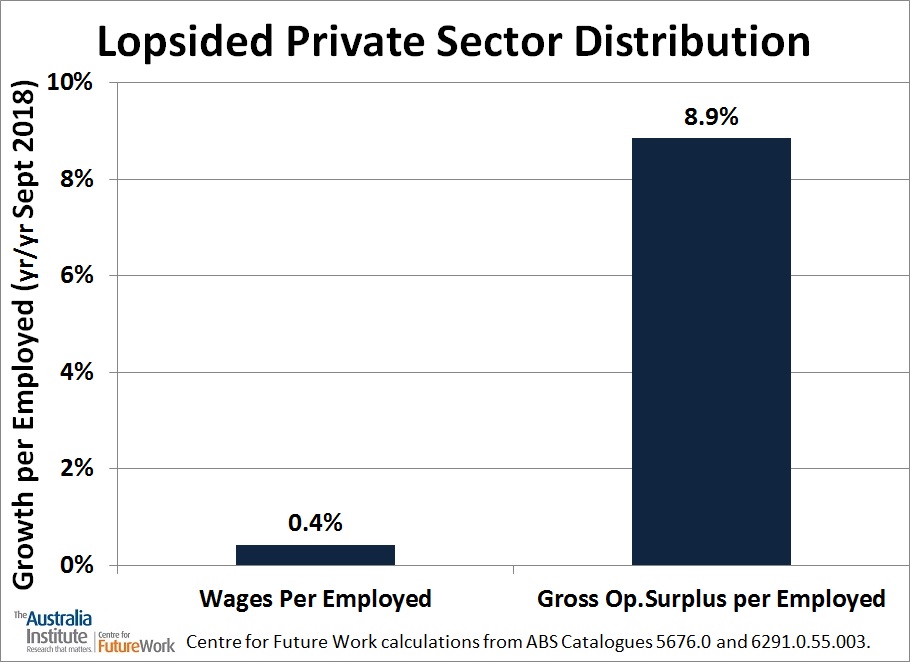
    In the year ending in the September 2018 quarter, business profits per worker grew by almost 9 percent – 20 times faster than wage payments per worker.

    Lopsided Growth


    Full report

    Share

  • A Secret Weapon in the Fight Against Financial Misconduct

    A Secret Weapon in the Fight Against Financial Misconduct

    Sectoral Collective Bargaining
    by Jim Stanford

    The Royal Commission into the financial services industry has heard tens of thousands of incidents of financial misconduct. The problem is clearly not just a “few bad apples”; the problem is clearly rooted in the core structure and practice of this industry.

    However, when it comes to fixing this mess, the Commission’s recent interim report provided no clear answers. Consumer education, self-regulation by banks, and even stronger enforcement efforts by government regulators all have their drawbacks. But there’s another solution that Commissioner Kenneth Hayne has so far overlooked: sector-wide collective bargaining to establish uniform, ethical pay practices across the financial industry.

    At present, flawed pay systems create perverse incentives for banks and brokers to push debt, insurance, and financial services to Australians. Financial professionals can reap tens or hundreds of thousands of dollars in commissions, bonuses and “introducing” fees; top executives pocket millions. Inevitably these incentives lead them to sidestep or ignore basic rules and standards: like knowing your client, transparency and responsible lending. Consumers, many of them vulnerable, end up with expensive commitments they didn’t need or (in many cases) even understood.

    To solve this problem, the financial industry should implement a uniform compensation system, consistent with principles of ethical banking, right across the whole industry. Professionals can be paid consistently (including bonuses for personal or group performance, where appropriate), while protecting the best interests of financial consumers. And a reliable and independent system of enforcement, embedded within financial firms, can ensure the rules are being followed.

    These goals could be achieved through a sector-wide collective bargaining system, in which employer and union reps negotiate standard compensation patterns that apply to all participants across the industry. Compensation in each job would be tied to qualifications and experience; separate pay grids could be specified in various branches of finance (including major banks, insurance, superannuation, and financial advice). Clear and enforceable limits on sales- or revenue-based incentives would be specified – eliminating a key motivation for misconduct.

    This system would not rely solely on external regulators to monitor behaviour and investigate complaints. Instead, the enforcement of standards would become part of the regular administration of the collective agreement.

    Unfortunately, Australia’s restrictive industrial relations laws generally prohibit collective bargaining on a multi-firm or sector-wide basis. These restrictions are unusual: most industrial countries permit, and even encourage, multi-firm, pattern, or industry-wide bargaining as an efficient way to determine consistent benchmarks for pay and conditions, and ensure that ongoing economic and productivity growth translates into rising living standards.

    These restrictions should be reconsidered in light of pervasive financial misconduct – and the key role of perverse compensation systems in motivating that misconduct. Sectoral collective agreements could help reform compensation and reduce financial misconduct on a uniform, industry-wide basis. The Royal Commission should now explore standardised sector-wide collective agreements as a promising response to the problems it has so damningly documented. And the Commonwealth government should eliminate its unusual restrictions on collective bargaining so that this important reform could occur.

    The Centre for Future Work recently submitted a comprehensive proposal for sector-wide collective bargaining in the financial industry to the Royal Commission, as a solution to the problem of conflicted compensation and financial misconduct. Download the full submission below.


    Full submission

    Share

  • Raising the Bar: How Government Can Use its Economic Leverage to Lift Labour Standards Throughout the Economy

    Raising the Bar: How Government Can Use its Economic Leverage to Lift Labour Standards Throughout the Economy

    by Jim Stanford

    For at least five years now, Australia’s labour market has demonstrated signs of a structural shift that has undermined traditional patterns of wage determination, and eroded the quality and security of work. The economic and social consequences of this sea change in the world of work are severe and far-reaching: flat real wages (the worst labour income growth since the Great Depression), a severing of the traditional relationship between wage and productivity growth, a steady expansion of insecure work in various forms, growing inequality in income distribution (both between factors and across households), and a precipitous decline in collective representation and enterprise bargaining (especially in the private sector). Governments tell Australians to simply be patient, and let “market forces” do their work; wages will pick up and economic benefits will soon “trickle down.” But there is no reason to expect these concerning labour market challenges to resolve themselves. Instead, the whole history of Australia’s economy reminds us that pro-active policy efforts are always necessary to broadly distribute the fruits of economic growth to workers and their families.


    Full report

    Share

  • Wages Crisis Has Obvious Solutions

    Wages Crisis Has Obvious Solutions

    by Jim Stanford

    Mainstream economists and conservative political leaders profess “surprise” at the historically slow pace of wage growth in Australia’s labour market. They claim that wages will start growing faster soon, in response to the normal “laws of supply and demand.”  This view ignores the importance of institutional and regulatory factors in determining wages and income distribution.  In fact, given the systematic efforts in recent decades to weaken wage-setting institutions (including minimum wages, the awards system, and collective bargaining), it is no surprise at all that wages have slowed to a crawl.  And the solutions to the problem are equally obvious: rebuild the power of those institutions, to support workers in winning a better share of the economic pie they produce.

    This recent commentary, by Centre for Future Work Director Jim Stanford, appears in the March 2018 issue of Australian Options magazine, and is reprinted with permission.

    Wage Crisis Has Obvious Solutions

    By Jim Stanford

    When the head of the central bank declares wages are too low, and urges workers to demand more money, you know you have a problem.

    After all, central bankers are traditionally the “party poopers” of the economy: they are the ones who march in and take away the punch bowl, as soon as the party gets rolling.  Yet here was Governor Philip Lowe, Governor of the Reserve Bank of Australia, urging party-goers to turn up the volume.  It’s like he was pouring bottles of straight tequila into the punchbowl, instead of taking it away – desperately trying to turn a boring flop into a wild shindig.

    Mr. Lowe made his surprising call at a conference last year on Australia’s economic outlook at Australian National University.  He said weak wage growth was holding back national purchasing power and economic growth, and contributing to too-low inflation (which has languished below his bank’s official 2.5 percent target for several years running).

    But while his acknowledgement of the consequences of wage stagnation was refreshing, his diagnosis of the causes was incomplete and unconvincing.  In fact, Governor Lowe almost seemed to blame the victims of wage stagnation – namely, Australia’s workers – for the problem.  They were unduly worried about losing their jobs to robots or imports, he suggested; they should feel more “confident” in asking for higher wages.  He has clearly not experienced the reality of Australia’s dog-eat-dog labour market in recent years, or felt the desperation that drives workers, especially young workers, to accept any job on offer.

    (Incidentally, the RBA’s own enterprise agreement signed last year will raise base wages by just 2 percent per year over the next 3 years … below the bank’s own inflation target!)

    While mainstream economists and policy-makers belatedly recognise the economic and social damage resulting from weak wages (even Treasurer Scott Morrison frets about the negative effect of slow wage growth on his budget balance), they’ve been distinctly reticent to connect the dots about the causes of the problem – and its obvious solutions.  Lowe, Morrison, and their colleagues pretend wages will pick up automatically as the economy grows and the labour market tightens.  But with official unemployment only a tick above 5 percent (still the RBA /Treasury estimate of “full employment,” according to their discredited but still operational NAIRU model), yet wages still decelerating, this faith in a market solution is increasingly far-fetched.

    Measuring the Slowdown

    The stagnation of Australian wages is visible by many indicators.  The most common “headline” source is the ABS’s quarterly Wage Price Index, which reports an index of wages calculated from a representative sample of jobs (the methodology is similar to the Consumer Price Index).  The WPI therefore measures changes in average hourly compensation holding constant the bundle of jobs which make up the overall labour market.

    However, one important factor in weak wages has been the changing composition of work.  In particular, the growth of part-time, casual, and irregular jobs has undermined the overall level (and stability) of labour incomes.  These changes are not captured in the WPI.  Similarly, changes in average hours worked per week (due to growing part-time work) are also excluded from the WPI.  So the WPI data understates the true extent of the wage slowdown.

    Other ways of measuring the wage slowdown show an even bigger drop-off in wage growth.  These include average weekly earnings, the pay increases specified in enterprise agreements, and estimates of average labour compensation generated through GDP statistics.  Trends in all these indicators are summarised in the accompanying table.  Whatever measure is chosen, it is clear that there has been a dramatic slowdown in wage growth – especially visible since 2013.
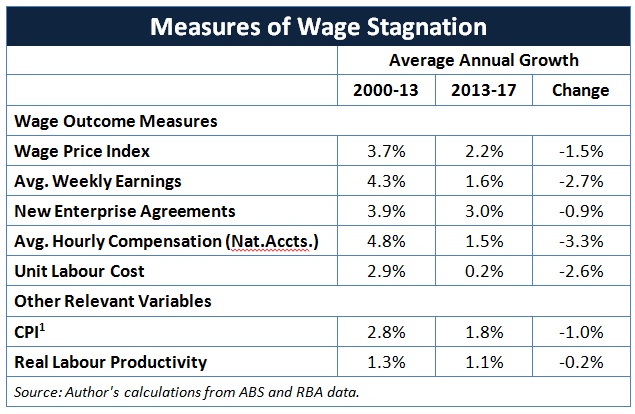
    Annual wage growth fluctuated around 4 to 5 percent during the first decade of the century.  Wage growth fell sharply but temporarily during the GFC – but then quickly regained pre-crisis norms from 2011 through 2013.  After 2013, however, wage growth has decelerated dramatically: to 2 percent or even lower.  In fact, by the broadest measure of labour compensation (wages, salaries, and superannuation contributions paid per hour of work), there has been virtually no nominal wage growth in the past year.  Consumer prices, meanwhile, continue to grow at around 2 percent per year (and even faster, if escalating housing prices are taken into account).  Real earnings, therefore, are flat or falling.

    What is “Normal” Wage Growth?

    Any shortfall in wage growth below the pace of consumer price increases (corresponding to a decline in the real purchasing power of workers’ incomes) is a clear sign of labour market dysfunction.  But even flat real wages (ie. nominal wages that just keep pace with inflation) are problematic.  After all, wages are supposed to reflect ongoing growth in real labour productivity (or at least that’s what the economics textbooks tell us).  So wages should actually consistently grow faster than consumer price inflation, to fairly reflect the enhanced real output of each hour of labour.

    Therefore, a “normal” benchmark for wage growth might be the sum of long-run consumer price inflation (the RBA’s 2.5 percent target) plus average productivity growth (running around 1.5 percent per year over the past three decades).  That suggests a “normal” benchmark for annual nominal wage growth should be 4 percent per year.  Australian wage growth in the pre-GFC period generally fit that definition of “normal.”  But since 2013 wages shifted to a significantly lower trajectory.

    Joining the Dots

    Contrary to the assumptions of free-market economics, there is no guarantee that wages will automatically grow in line with labour productivity, as a result of automatic market mechanisms.  Power is always a key factor in income distribution.  And labour markets never “clear,” so that labour supply (the number of workers) equals labour demand (the number of jobs).  In fact, inflation-targeting policy deliberately aims to maintain a certain level of unemployment (5 percent is the target in Australia) to suppress wage demands and protect profits.

    The systematic and structural disempowerment of workers and their unions over the neoliberal era is therefore the most relevant factor in the deceleration of wage growth, and the erosion of labour’s share of total GDP.  Some obvious indicators of that dramatic shift in economic and political power include:

    • A steady erosion in the real “bite” of minimum wages, which have fallen from 60 percent of median wages in 1990 to around 45 percent today.
    • The collapse of trade union membership in the face of legal restrictions, harassment, and full-protection for “free riders.” Today just 9 percent of private sector workers, and less than 5 percent of young workers, are union members.
    • A corresponding collapse in collective industrial action.  Adjusted for the size of the workforce, the frequency of strikes and other industrial disputes has declined by 97 percent from the 1970s to the present decade.
    • The relegation of industry awards to a baseline “safety net,” instead of a system for supporting ongoing progress in wages and working conditions.
    • The generally pro-business shifts in economic policy, including tax cuts, deregulation, privatisation, and globalisation, which have also shifted economic power in favour of employers and hence indirectly suppressed wage growth.

    To begin to rebuild wage growth, restore labour’s share of GDP, and achieve greater equality in labour incomes will require a comprehensive, multidimensional effort to restore the power of all these wage-supporting institutions.  The ACTU is tackling this challenge with gusto, with its ambitious “Change the Rules” campaign.  The goal is to propose a consistent, holistic vision for repairing the institutions that support workers and their wages – and then building a strong grass roots campaign to push politicians of all stripes to adopt that vision.

    On the other hand, if we follow the advice of Scott Morrison and Philip Lowe, and simply wait for supply and demand forces to rescue wages from their current doldrums, we are going to be waiting a very long time.

    You might also like

    Centre For Future Work to evolve into standalone entity

    The Centre for Future Work was established by the Australia Institute in 2016 to conduct and publish progressive economic research on work, employment, and labour markets. Supported by the Australian Union movement, the centre produced cutting edge research and led the national conversation on economic issues facing working people: including the future of jobs, wages

  • Subsidising Billionaires: Simulating the Net Incomes of UberX Drivers in Australia

    Subsidising Billionaires: Simulating the Net Incomes of UberX Drivers in Australia

    by Jim Stanford

    Uber’s rapid growth in point-to-point transportation services has become the most potent symbol of the growth of the so-called “gig economy”: where people perform work on an irregular, on-demand basis, paid by the task, and without the stability or security of traditional paid employment. The expansion of this model has raised concerns regarding the erosion of labour standards and entitlements (including minimum wages, paid leave, and superannuation). This report simulates the net hourly incomes received by UberX drivers in six Australian cities, and finds that they almost certainly earn much less than would be required under relevant minimum wage standards.

    The report considers gross revenues generated by a typical urban fare (traveling 10 km, and taking 22 minutes to complete), according to UberX’s published rate schedule. After deducting Uber’s various fees, net taxes, and the costs of providing and maintaining the vehicle, the driver is left with an average of just $8.29 from that fare (barely one-third of the gross revenue they collect).  Accounting for unpaid time spent waiting for the next fare and collecting the passenger from their pick-up point, this translates into a net hourly wage (before personal income tax) of $14.62 per hour.  This is well below the national statutory minimum wage, and less than half the level of the weighted-average minimum wage (including casual loading and penalty rates for evening and weekend work) that would apply to waged employees under Australia’s Passenger Vehicle Transportation Award.  The underpayment of UberX drivers in Australia constitutes a subsidy paid by them to the company amounting to hundreds of millions of dollars per year; and this underpayment of drivers (in Australia and elsewhere) has been essential to the dramatic expansion of Uber’s market value (most recently estimated at almost $50 billion U.S.).

    These findings confirm that the use of digital platforms to organise and compensate irregular work, and the ability of businesses (including large global firms like Uber) to classify their workers as independent businesses in their own right, are undermining the effectiveness of traditional labour market protections (such as the minimum wage, superannuation entitlements, paid leave, and others).  The report calls on Australian lawmakers and regulators to urgently address the gaps in existing labour laws, to ensure that traditional labour protections are available to workers in the “gig economy.”


    Full report

    Share

  • The Future of Work Is What We Make It

    The Future of Work Is What We Make It

    by Jim Stanford

    In October the Senate of Australia launched an important new inquiry into the Future of Work and the Future of Workers.  The terms of reference for the inquiry include:

    1. “The future earnings, job security, employment status and working patterns of Australians;
    2. The different impact of that change on Australians, particularly on regional Australians, depending on their demographic and geographic characteristics;
    3. The wider effects of that change on inequality, the economy, government and society;
    4. The adequacy of Australia’s laws, including industrial relations laws and regulations, policies and institutions to prepare Australians for that change;
    5. International efforts to address that change.”

    Given the close correspondence between this mandate, and the research focus of the Centre for Future Work, we were very glad to make a submission to this inquiry.

    Our full 35-page submission is available here. It synthesizes much of our previous research on wages, job quality, the effects of automation, precarious work, the “gig” economy, and other dimensions of the future of work.  As we state in our introduction to the submission,

    “Australians have expressed growing concern about their future ability, and that of their children and grandchildren, to support themselves and their families through paid work.  After all, for the vast majority of society, paid work is the dominant method to earn income to pay for the necessities of life.  A few are able to live off the proceeds of their financial wealth, business investments, or other capital assets; but most of us have to work for a living.  So the availability, stability, and earning potential of paid work is a crucial determinant of individual and collective well-being.  There is no more important factor in the economic and social success of any society, than being able to provide its members with decent, secure employment.”

    One important but under-reported issue tackled by our submission is the negative impact of now-ubiquitous electronic surveillance and discipline systems in Australian workplaces. We argue that this practice has contributed to the severe stagnation of wages in Australia’s economy in recent years, by altering the trade-off in staffing strategy between offering positive inducements for performance (“carrots,” such as higher wages and greater job security), versus reliance on negative sanctions (“sticks,” including discipline and discharge).  Unconstrained electronic surveillance reduces the cost of the “stick,” hence reducing the compulsion on employers to reward good performance with rising wages.

    Among the recommendations contained in our submission, therefore, we suggest that the use of electronic monitoring and surveillance should be limited through stronger privacy rights.  The power of employers to discharge workers solely on the basis of electronic ratings should also be curtailed — ensuring instead that normal progressive discipline procedures are followed in any discharge.


    Full report

    Share

  • Historical Data on the Decline in Australian Industrial Disputes

    Historical Data on the Decline in Australian Industrial Disputes

    by Jim Stanford

    The Fair Work Commission’s ruling to pre-emptively block industrial action (including restrictions on overtime and a one-day work stoppage) by Sydney-area train workers has brought renewed attention to the legal and administrative barriers which limit collective action by Australian workers. 

    The Sydney trains experience is a high-profile example of a much larger trend.  Across the national economy, work stoppages have become extremely rare – and the extraordinary discretionary ability of industrial authorities to restrict or prevent industrial action is an important reason why.

    The Centre for Future Work has compiled a database of historical work stoppage data, going back to 1950, including the incidence of work stoppages and the numbers of work days lost as a result (both in absolute terms and relative to the size of the employed workforce).

    The main findings of this historical review include:

    • The relative frequency of industrial action (measured by days lost in disputes per 1000 workers employed) declined 97 percent from the 1970s to the present decade.
    • There were only 106 disputes across Australia during the first nine months of 2017. The low number of stoppages last year may set a record low for the postwar era (final year-end statistics will be released in March).
    • There is a close statistical relationship between the near-disappearance of strike activity and the deceleration of wage growth, which has also fallen to the lowest rates in the postwar era. Over the postwar period, every decline in the frequency of work stoppages of about 60 lost days per 1000 was associated with a one percentage point deceleration in wage increases.
    • Strike activity in Australia is very low compared to other industrial countries.


    Full report

    Share