Author: Jim Stanford

  • A Fair Share for Australian Manufacturing

    A Fair Share for Australian Manufacturing

    Manufacturing Renewal for the Post-COVID Economy
    by Jim Stanford

    New research from the Centre for Future Work reveals that Australia ranks last among all OECD countries for manufacturing self-sufficiency. The COVID-19 pandemic has reminded Australians of the importance of being able to manufacture a full range of essential equipment and supplies; and the COVID recession has created a large economic void that a revitalised manufacturing sector could help to fill in coming years.

    This report, A Fair Share for Australian Manufacturing, describes the strategic importance of the manufacturing sector to Australia’s future prosperity, and provides an inventory of policy tools that could help rebuild the sector to a size proportional to our domestic needs for manufactured products.

    While the report documents the decline of domestic manufacturing in recent years, it also reveals the enormous potential benefits that would be generated by rebuilding manufacturing back to a size  proportional to our national needs: including $180 billion in new sales, $50 billion in additional GDP, and over 400,000 new jobs.

    Key Findings:

    • Australia ranks last in manufacturing self-sufficiency among all OECD countries. Australians use $565 billion worth of manufactures each year, however, we only produce $380 billion. Therefore, Australia produces only 68% (just over two-thirds) of what we use: less than any other OECD economy.
    • The COVID-19 pandemic has highlighted the strategic importance of domestic manufacturing capacity. Disruptions in global supply chains and protectionist trade policies by foreign governments have increased risks we might not be able to access essential products (like health equipment and supplies) when we need them.
    • Manufacturing is not just ‘another’ sector of the economy. For several concrete reasons, manufacturing carries a strategic importance to broader national prosperity and security.
      • Australians purchase and use more manufactured goods over time; and manufacturing output is growing around the world. Allowing domestic manufacturing to decline, while our use of manufactured products grows, undermines national economic performance.
      • Manufacturing is the most innovation-intensive sector in the whole economy. No country can be an innovation leader without a strong manufacturing base.
      • Manufactured goods account for over two-thirds of world merchandise trade. A country that cannot successfully export manufactures will be shut out of most trade.
      • Manufacturing anchors hundreds of thousands of other jobs throughout the economy, thanks to its long and complex supply chain. Billions of dollars’ worth of supplies and inputs are purchased by manufacturing facilities, supporting many other sectors of the economy.
      • Manufacturing offers high-quality jobs, full-time hours and above-average incomes. And thanks to strong productivity growth and the capacity to apply modern technology, manufacturing offers the prospect of rising incomes in the future.

    If we rebuilt a manufacturing sector that was broadly proportionate to our needs, our manufacturing industry would grow by almost 50% – generating enormous benefits in jobs, incomes, innovation and exports.

    Report summary


    Full report

    Share

  • Submission to the 2020 annual wage review

    Submission to the 2020 annual wage review

    by Jim Stanford

    The Centre for Future Work has made a submission to the 2020 annual wage review conducted by the Fair Work Commission. The submission compiles evidence showing that the annual minimum wage adjustments (which flow through into wages specified in the Modern Awards, as well as some enterprise agreements and individual contracts) have played a more important role in recent years in supporting the overall level of wage growth in Australia’s labour market. Without relatively strong minimum wage increases since 2017 (of 3% or higher for three consecutive years), Australian wage growth would still be languishing at all-time record lows of under 2% per year.

    In this context, the Centre argued it is vital the Commission proceed with a normal, healthy minimum wage increase for 1 July, 2020, with full flow-through into Award wages. Otherwise wage growth will slump significantly (to an estimated 0.7%, or even lower), heightening the risk of economy-wide deflation.

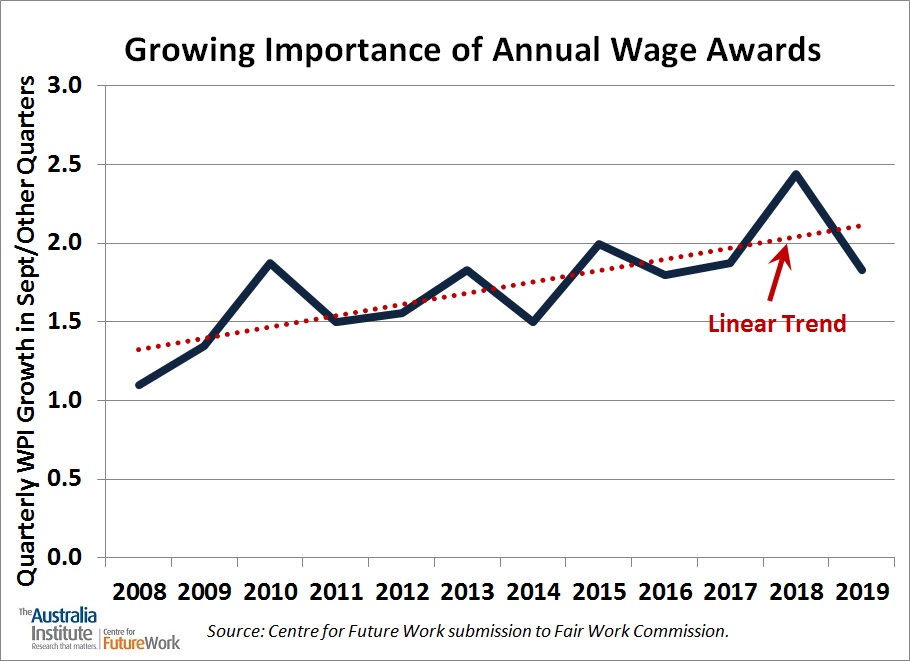
    The submission also provided new analysis on the seasonal pattern of wage growth in Australia’s labour market. In recent years, quarterly wage growth has been twice as strong in the quarter that contains the annual wage award, as in the rest of the year. That attests to the growing structural importance of the annual award in supporting wages, and preventing wage growth from falling even lower.

    September Quarterly Wage Premium

    The Centre’s submission was reported in the Australian Financial Review, and other media.


    Full submission

    Share

  • The Long-Term Consequences of Wage Freezes for Real Wages, Lifetime Earnings, and Superannuation

    The Long-Term Consequences of Wage Freezes for Real Wages, Lifetime Earnings, and Superannuation

    by Jim Stanford

    New research from the Centre for Future Work has dramatised the lasting consequences for workers’ lifetime incomes – even after they retire – of wage freezes.

    A wage freeze is often described as a “temporary sacrifice,” that supposedly ends once normal annual wage increments are restored. However, this report confirms that the legacy of even a temporary pay freeze is a permanent reduction in lifetime incomes and superannuation, which can easily ultimately result in hundreds of thousands of dollars of lost income. These long-term effects are illustrated with reference to a real-world example: an 18-month pay freeze imposed on workers at Jetstar in 2014-2016.

    Many Australian employers have frozen the pay of their workers in recent years, typically justified on grounds of temporary financial duress. However, those pay freezes have a lasting negative impact on the long-run trajectory of wages. As a result, workers lose tens of thousands of dollars of income through the rest of their careers. To cap the losses, employers must implement special one-time catch-up pay increases to restore the pre-freeze trajectory of wages.

    To illustrate the lasting, cumulative impact of pay freezes on workers’ lifetime incomes, a new Briefing Paper from the Centre for Future Work considers the case of an 18-month wage freeze implemented in 2014-16 by Jetstar. The pay freeze was implemented amidst financial losses at the airline. However, since then the airline (and its parent firm, Qantas) have returned to strong profitability, and executive compensation has soared. Normal 3% wage increases were restored beginning March 2016, and a one-time bonus payment was made at that time as “compensation” for the sacrifice of Jetstar workers. But the current incomes of Jetstar workers are still thousands of dollars per year lower than if the pay freeze had not been imposed.

    The report considers three distinct categories of losses resulting from a pay freeze:

    1. Loss of real purchasing power while the freeze is in effect.
    2. Loss of future income resulting from the permanent downward shift in pay trajectory.
    3. Loss of superannuation contributions and investment income resulting from lower pay.

    The report quantifies these cumulating costs for the case of the pay freeze at Jetstar. Jetstar workers could lose $150,000 or more in cumulative earnings by the time they retire, despite the restoration of annual wage increments after 2016 and the one-time bonus. Moreover, workers’ superannuation accounts will also be suppressed accordingly: because of lower employer contributions (resulting from lower earnings) and lost investment income. On the basis of typical investment performance, the report estimates potential superannuation losses of $40,000 or more by the time Jetstar workers retire. Some workers could lose over $200,000 in lifetime incomes and superannuation because of the “temporary” wage freeze.

    The only way to stop these ongoing losses from getting bigger (let alone to compensate workers for losses already incurred) is to implement additional catch-up wage increases that bring wages back to their pre-freeze trajectory. In the case of the Jetstar wage freeze, that would require a one-time increase of 6.1%.

    The Jetstar case is just one of many instances of wage freezes being imposed on Australian workers in recent years, in both the private and public sector. The legacy of those wage freezes contributes to the ongoing stagnation of real wages in the Australian labour market, and to the historic shift in income distribution away from workers and toward businesses and investors. While it may seem as if a wage freeze is a “temporary” sacrifice, without offsetting catch-up adjustments it nevertheless continues to impose ongoing economic harm on affected workers.


    Full report

    Share

  • Needle in a Haystack

    Needle in a Haystack

    Searching for the Impact of Tax Cuts on Consumer Spending and Economic Growth
    by Jim Stanford

    The latest economic statistics have confirmed that Australia’s economy is barely limping along – with quarterly GDP growth of just 0.4%. One of the weakest spots in the report was consumer spending, which recorded its weakest performance since December 2008 (amidst the worst days of the Global Financial Crisis). This was despite the supposed benefit of recent Commonwealth government tax cuts in boosting disposable income and stimulating more spending.

    Analysis from Dr. Jim Stanford shows that the tax cut is in fact completely invisible in the macroeconomic data.

    Among the major findings of the report:

    • Consumer spending stagnated despite expensive tax cuts provided by the newly-reelected Coalition government. Income taxes paid by Australians declined by over $4 billion in the quarter. But fearing future recession, Australians socked away those savings: personal savings grew by $6 billion in the quarter, more than taxes fell.
    • Because of the sharp increase in the saving rate, none of the aggregate tax savings showed up in new consumer spending. The propensity of Australians to consume from their pre-tax income actually declined in the quarter. In other words, the effect of the tax cut had zero measurable impact on aggregate consumer spending.
    • Wage growth slowed further in the September quarter – with the Wage Price Index increasing by just 2.2% over year-ago levels. With slowing wage growth and higher-than-expected unemployment, Australian consumers simply cannot afford to boost their spending, despite the tax cuts.
    • One-tax tax cuts have an insignificant effect on disposable incomes, compared to the benefits of restoring normal wage growth in Australia. In just one year, a restoration of normal wage growth would boost incomes by $12 billion – 3 times the value of the tax cuts. Compounded over just 3 years, normal wage increases would lift incomes by a cumulative total of $75 billion, and consumer spending by $50 billion. Restoring wage growth, not cutting taxes, is the key to turning around Australia’s flagging economy.


    Full report

    Share

  • The Relationship Between Superannuation Contributions and Wages in Australia

    The Relationship Between Superannuation Contributions and Wages in Australia

    by Jim Stanford

    New research from the Centre for Future Work shows that scheduled increases in employers’ minimum statutory superannuation contributions would have no negative effects on future wage growth, and that Australia’s economy can afford both higher wages and higher employer contributions to superannuation.

    The research refutes claims made by some commentators and lobbyists that higher superannuation contributions would automatically lead to lower wages, and hence would be self-defeating. The new research finds no statistical evidence for that claim in Australian empirical data.

    The paper reviews economic statistics from the introduction of superannuation to the present. On average, wages were more likely to accelerate and grow at a faster rate when the superannuation guarantee (SG) rate was increased, than to decelerate or grow more slowly. This indicates a slight positive correlation between wages growth and changes in employers’ minimum SG rate.

    The paper also reviews theoretical predictions and empirical findings from previously published economic research. Even under very restrictive and unrealistic assumptions about competitive market-clearing behaviour in labour markets, the expectation of a fully offsetting one-for-one trade off between wages and SG contributions only occurs in the special cases of perfectly inelastic labour supply, or perfect substitutability between voluntary and policy-induced personal savings. Neither of those conditions prevail in practice. More realistic economic models (that allow for responsiveness in labour supply, minimum wages, and other real-world features) do not anticipate a full trade-off – and many expect no trade-off at all.

    The paper concludes that current record-low wage growth in Australia cannot be “fixed” by abandoning scheduled increases in the SG rate (which is currently legislated to grow from 9.5% of wages to 12% over a five-year period, beginning 1 July 2021). Abandoning those increases would only further suppress the total compensation received by workers, which has been falling steadily as a share of GDP for decades. Instead, weak wage growth should be tackled with direct wage-boosting policies; the determination of wages and superannuation contributions are largely independent policy decisions.


    Full report

    Share

  • Submission to the Senate Standing Committee on Education and Employment

    Submission to the Senate Standing Committee on Education and Employment

    Inquiry into Proposed Amendments to the Fair Work Act (“Ensuring Integrity”)
    by Jim Stanford

    Despite its deafening silence on industrial relations issues during the recent election, the re-elected Coalition government is charging ahead with an aggressive plan to change Australia’s labour laws. And business lobbyists are lining up to endorse its direction. First out of the gate is a plan to amend the Fair Work Act, in the cynically mis-named “Ensuring Integrity” bill, to introduce harsh new sanctions on unions and union officials.

    Our Director Dr. Jim Stanford was recently invited to testify before the Senate Standing Committee on Education and Employment on the bill, and its likely economic and social consequences.

    The bill contains 4 substantive sections, which would extend the scope of permissable actions in the Federal Court to disqualify union officials (including elected leaders) from their posts, place unions under court administration, and deregister unions altogether. These severe actions can be sparked by a wide range of supposed offences: including civil court matters, matters not related to officials’ role with their unions, and activities (like organising strikes and protests) that are considered normal and legitimate in most industrial countries. The bill would also empower the Fair Work Commission to prohibit union mergers on vague “public interest” grounds.

    It is hard to fathom that in an economic context marked by unprecedented stagnation in wages, growing polarisation of income and opportunity, and a looming potential recession, the measures contemplated in this Bill have somehow become the top labour market priority of the country’s government.


    Full submission

    Share

  • Update on Penalty Rates and Job-Creation: Two Years Later

    Update on Penalty Rates and Job-Creation: Two Years Later

    by Jim Stanford

    July 1 marked the implementation of the next stage of reduced penalty rates in the retail and hospitality industries in Australia. It is now two full years since the first reductions were imposed for Sunday and holiday work in several segments of retail and hospitality. Once fully phased in, these reductions will reduce wage payments in the two broad industries by an estimated $1.25 billion per year – at a time when concerns over weak wages and their impacts on the Australian economy are growing.

    Employers argued before the Fair Work Commission that if their Sunday and holiday labour costs were reduced, they would hire more workers, and the Commission cited this logic in accepting employer demands for lower penalties. Now, with two full years of experience since the first reductions, there is growing evidence that the penalty rate reductions have not spurred job creation in retail and hospitality. To the contrary, our new report shows that employment growth in retail and hospitality has been far slower than in other parts of the economy (where penalty rates remained constant) — and job-growth in the two sectors actually slowed by more than half after penalty rates began to fall.

    This briefing paper, authored by Dr Jim Stanford (Director and Economist of the Centre for Future Work) reviews disaggregated employment statistics for 19 Australian industries in the two years after the first penalty rate reductions were imposed on 1 July, 2017.

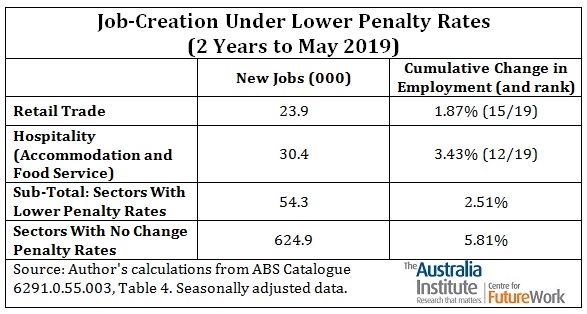
    The retail sector created 24,000 new jobs in the two years since 1 July 2017, and the broad hospitality sector (including accommodation and food & beverage services) created 30,000. In both cases, over 100% of the new jobs were part-time — both sectors actually shed full-time work during this period. The rate of job-creation was less than half as fast during the last two years in both sectors, as it had been in the two years before penalty rate cuts began — even though the pace of job-creation in the broader economy accelerated during the last two years.

    Penalty Rate Chart

    The retail sector ranked 15th out of 19 sectors in job-creation over the past two years; hospitality ranked 12th. Their combined rate of job-creation (up by 2.5% over the two years) was less than half the combined rate of job-creation in the 17 sectors which had no change in penalty rates. 92% of all jobs created in the last two years were created in sectors with constant penalty rates. The two sectors with reduced penalty rates created just 8% of new jobs in this period — even though they accounted for 18% of total employment at the time the penalty rate reductions began.

    It is clear that lower penalty rates have not ignited new hiring in either of these sectors. Instead, job-creation in both sectors has deteriorated well below economy-wide averages in this period. Clearly it takes more than cheapening labour costs to create jobs. Stronger consumer spending (a goal which would be supported by higher wages, not lower wages) is far more important to hiring decisions in these two domestic service industries.


    Full report

    Share

  • Kick-Starting Wage Growth: What the Commonwealth Government Could do NOW

    Kick-Starting Wage Growth: What the Commonwealth Government Could do NOW

    by Jim Stanford

    Australia’s economy continues to endure historically slow growth in wages and salaries, that is undermining household incomes, consumer spending, and economic growth. The Commonwealth government continues to predict an imminent rebound in wages – like in its most recent budget, where it yet again forecast wage growth accelerating quickly to 3.5% per year. But is the government willing to actually do anything to support wages?

    The Centre for Future Work has released new research showing that just 3 specific actions by the Commonwealth government would lead to a significant rise in national wage growth, adding over $10 billion per year to aggregate wage income within three years. That doesn’t single-handedly solve the whole wages crisis, but it would be a big improvement.

    The three measures simulated in the report include:

    1. Reversal of the reductions in penalty rates for Sunday and public holiday work in the retail and hospitality sectors.
    2. Introduction of a “living wage” mandate for Australia’s federal minimum wage, moving it toward a level that would lift full-time full-year workers above standard benchmarks of relative poverty.
    3. Removal of the Commonwealth government’s restrictive cap on wage increases for its own employees, and restoration of normal collective bargaining and traditional rates of wage increase.

    Those three measures alone would boost wages for an estimated 3.3 million Australian workers, by a total of over $10 billion per year once fully implemented.That is equivalent to a 1.25% boost in aggregate national wage income, thus helping to lift overall wage growth in the economy as a whole from current sluggish rates (of 2.3%, according to most recent data) back toward normal historical rates (of 3.5% per year or more).

    The report also considers broader positive benefits from supporting wage growth, including: stronger consumer spending (estimated to rise by $8.5 billion per year), stronger GDP growth (as businesses respond to the increase in purchasing power with expanded output and hiring), stronger government revenues (expected to rise by over $1 billion per year from these measures alone), and a positive spillover onto wage settlements in the rest of the labour market (as employers are pressured keep up with renewed wage growth).


    Full report

    Share

  • Union Organising and Labour Market Rules: Two Sides of the Same Coin

    Union Organising and Labour Market Rules: Two Sides of the Same Coin

    by Jim Stanford

    International evidence is clear that there is a strong, positive correlation between a country’s protection of labour freedoms, and the organising success and economic influence of unions. Improvements in basic labour rights and freedoms tend to be associated with increases in union membership (as a share of total employment). And stronger union membership, in turn, is associated with broader collective bargaining coverage, less poverty among working people, and less inequality.

    Australia has a poor record of protecting basic worker and labour rights and freedoms: including rights to assembly, rights to organise, rights to due process, and rights to strike. According to the World Economic Forum (a generally business-friendly international policy organisation), Australia ranks 5th last among OECD countries in protecting worker rights.

    A new study from the Centre for Future Work documents the correlation between workers’ rights and union organising – and shows they are two sides of the same coin. And that correlation between workers’ rights and the success of unions suggests that unions in Australia will need to continue their campaign to “Change the Rules” of Australia’s labour market (including improving basic rights for workers to organise, bargain collectively, and take industrial action). Winning better legal and regulatory protections for workers seems essential to workers’ ability to build stable, influential unions, and use those unions to improve their lives.

    Australian trade unions are contemplating the after-effects of the Coalition’s surprising victory in the 2019 federal election. The union movement and other social advocates built a successful public campaign to “change the rules” of Australia’s labour market – including lifting the minimum wage (to a living wage level), preserving other labour market protections (like penalty rates), limiting the spread of insecure work, and strengthening collective bargaining freedoms. The Coalition government is not sympathetic to that agenda; and though it barely discussed labour policy issues during the campaign, it may now try to shift labour policies even further in favour of employers.

    However, despite an unreceptive political climate for advocating labour reforms with the present federal government, the evidence presented in this report suggests that the broad campaign for an expansion of both labour market rights and union capacity should continue. The efforts of Australian unions and their allies since 2017 have been effective in strengthening public awareness of labour market injustices, and building support for obvious remedies. They have even led to incremental changes in policies by governments and institutions at all levels (even including, to a modest extent, the Commonwealth government). Most importantly, the international evidence is clear that eventually winning changes in the rules of labour market and industrial relations will be essential, as a complement (not a substitute) for unions’ continuing efforts to expand membership, extend collective bargaining, and lift wages.

    This analysis suggests that Australia faces a dual challenge: improving protection of workers’ basic rights and freedoms, and strengthening workers’ collective ability (given those rights and freedoms) to achieve better economic outcomes (like wage increases and job security). International evidence is also clear that societies in which the benefits of economic growth are shared more broadly across working and middle-income households demonstrate better economic and social outcomes. Rebuilding the labour practices and institutions necessary for more inclusive and stable prosperity will require progress along both of those tracks: greater respect for basic labour rights, and stronger unions and collective bargaining systems.


    Full report

    Share

  • Estimating Wage Trends From Personal Income Tax Data

    Estimating Wage Trends From Personal Income Tax Data

    by Jim Stanford

    New analysis of income tax data confirms a dramatic slowdown in Australian wages in recent years – and the slowdown is worse than previous statistics indicated.

    The research is contained in a new report from the Centre for Future Work at the Australia Institute.  It shows that average nominal wages in Australia grew just 1.7% per year between 2012-13 (when the wage slowdown took hold) and 2016-17 (most recent tax data available). That’s below the average national rate of inflation over that period (1.9%), resulting in a decline in the average real wage.

    While the wage slowdown was experienced across the country, some regions were particularly hard-hit. Real wage losses were especially large in Queensland and Western Australia. Moreover, the impact was disproportionate in regional communities in both states — located in some of the most fiercely contested electorates in the current federal election campaign. This suggests that public anger over falling real wages could be politically pivotal to the result on May 18.

    The new research uses a novel source of data on wages: personal tax returns, summarised in Australian Tax Office reports. The data is produced on a financial-year basis (less frequently than other wage statistics, such as those publishedby the Australian Bureau of Statistics). However, the tax data allow a more precise disaggregation of wage trends by state, community, and electorate.

    The 1.7% estimate of annual national wage growth from 2012-13 through 2016-17 based on the ATO data was a full half-point slower than the 2.2% growth reported for the same period in the ABS’s commonly-cited Wage Price Index (issued quarterly by the Bureau). The WPI series makes adjustments for changes in the composition of employment, in order to create a hypothetical fixed “bundle” of jobs. As a result, the impact of changes in job quality (such as the rise of part-time work, casualisation, and ‘gigs’) is not reflected in the WPI results. In the tax data, in contrast, all of these factors affect the evolution of realised average wages and salaries reported per tax-filer. This is thus a more complete and accurate indicator of the evolution of earnings actually received by Australian workers.

    Analysis of tax data also confirms that while wage growth in all parts of the country fell to historic lows, two states were especially hard-hit: Queensland and Western Australia. In those states, wages grew more slowly than elsewhere, and real income losses were larger. Real wages fell by over 3% in Queensland, and over 5% in WA, during that four-year period.

    Those two states are home to some of the most tightly contested electorates in the current federal election. The tax data allow calculation of wage trends by electorate – a level of detail not possible with other data sources.

    The report estimates wage trends for 17 marginal electorates in the two hard-hit states: including all electorates decided by less than a 5% margin in the 2016 election. Real wages fell in every one of the marginal electorates. In 7 seats (6 of which are currently represented by Liberal or LNP members) the cumulative decline in real wages exceeds 5%.

    “Perhaps it is not a coincidence that some of the tightest contests in the current federal election are precisely in those communities where real wages have declined the most,” said Dr. Jim Stanford, Economist and Director of the Centre for Future Work, and author of the report. “Public anger over cost-of-living issues is clearly understandable, given this hard evidence that real wages in these communities have fallen substantially.”

    “It would be a poetic irony for the whole election to be decided by frustrated voters in these hard-hit marginal electorates, which have been seemingly left behind by economic growth in the rest of the country.”


    Full report

    Share