Author: Jim Stanford

  • Healthy humans drive the economy: we’re now witnessing one of the worst public policy failures in Australia’s history

    Originally published in The Conversation on January 12, 2022

    Australians are getting a stark reminder about how value is actually created in an economy, and how supply chains truly work.

    Ask chief executives where value comes from and they will credit their own smart decisions that inflate shareholder wealth. Ask logistics experts how supply chains work and they will wax eloquent about ports, terminals and trucks. Politicians, meanwhile, highlight nebulous intangibles like “investor confidence” – enhanced, presumably, by their own steady hands on the tiller.

    The reality of value-added production and supply is much more human than all of this. It is people who are the driving force behind production, distribution and supply.

    Labour – human beings getting out of bed and going to work, using their brains and brawn to produce actual goods and services – is the only thing that adds value to the “free gifts” we harvest from nature. It’s the only thing that puts food on supermarket shelves, cares for sick people and teaches our children.

    Even the technology used to enhance workers’ productivity – or sometimes even replace them – is ultimately the culmination of other human beings doing their jobs. The glorious complexity of the whole economy boils down to human beings, using raw materials extracted and tools built by other human beings, working to produce goods and services.

    A narrow, distorted economic lens

    The economy doesn’t work if people can’t work. So the first economic priority during a pandemic must be to keep people healthy enough to keep working, producing, delivering and buying.

    That some political and business leaders have, from the outset of COVID-19, consistently downplayed the economic costs of mass illness, reflects a narrow, distorted economic lens. We’re now seeing the result – one of the worst public policy failures in Australia’s history.

    The Omicron variant is tearing through Australia’s workforce, from health care and child care, to agriculture and manufacturing, to transportation and logistics, to emergency services.

    The result is an unprecedented, and preventable, economic catastrophe. This catastrophe was visited upon us by leaders – NSW Premier Dom Perrotet and Prime Minister Scott Morrison in particular – on the grounds they were protecting the economy. Like a Mafia kingpin extorting money, this is the kind of “protection” that can kill you.

    NSW Premier Dominic Perrottet’s decision to relax COVID-19 restrictions in December has turned into both a health and economic disaster. Bianca De Marchi/AAP

    Effect as bad as lockdowns

    On a typical day in normal times, between 3% and 4% of employed Australians miss work due to their own illness. Multiple reports from NSW indicate up to half of workers are now absent due to COVID: because they contracted it, were exposed to it, or must care for someone (like children barred from child care) because of it. With infections still spreading, this will get worse in the days ahead.

    Staffing shortages have left hospitals in chaos, supermarket shelves empty, supply chains paralysed. ANZ Bank data, for example, shows economic activity in Sydney has fallen to a level lower than the worst lockdowns.

    Spending in Sydney and Melbourne now near lockdown conditions
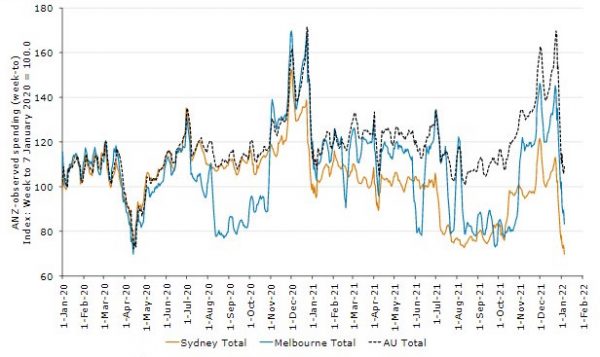
    ANZ Research

    If relaxing health restrictions in December (as Omicron was already spreading) was motivated by a desire to boost the economy, this is an own-goal for the history books.

    Relaxing isolation rules

    Now the response to Omicron ravaging labour supply is to relax isolation requirements for workers who have contracted, or been exposed to, COVID-19.

    The first step was to shift the goalposts on “test, trace, isolate and quarantine” arrangements by redefining “close contact”.

    On December 29 the Prime Minister said it was important to move to a new definition “that enables Australia to keep moving, for people to get on with their lives”. The next day National Cabinet approved a definition such that only individuals having spent at least four hours indoors with a COVID-infected person needed to isolate.

    Australians certainly want supply chains to keep moving. That won’t happen by simply pretending someone with three hours and 59 minutes of face-to-face indoor contact with Omicron is safe. Putting asymptomatic but exposed and potentially infected people back to work will only accelerate the spread.

    The second step has been to reduce the isolation period for those who do pass this tougher “close contact” test. At its December 30 meeting National Cabinet agreed to a standard isolation period of seven days (ten days in South Australia), down from 14 days.

    For “critical workers” in essential services including food logistics, the NSW and Queensland governments have gone even further, allowing employers to call them back to work so long as they are asymptomatic.

    Snatching defeat from the jaws of victory

    This follows a US precedent, despite scientific evidence indicating contagion commonly lasts longer than 5 days.

    Employers will use this change to pressure exposed and even sick workers to return to work, risking their own health, colleagues, customers, and inevitably spreading the virus further.

    Copying US COVID protocols only guarantees US-style infection rates. In fact, since 5 January, Australia’s seven-day rolling average infections per million now exceed that of the US.

    Our Wold in Data, CC BY

    From one of the best COVID responses in the world to one of the worst, Australia has snatched defeat from the jaws of victory.

    It’s not too late to limit the carnage

    The idea that health considerations had to be balanced with economic interests was always a false dichotomy. A healthy economy requires healthy workers and healthy consumers.

    The Omicron surge has created an economic emergency that will be difficult to endure.

    But it’s not too late to limit further avoidable contagion. Infection prevention practices (including masks, capacity limits, prohibitions on group indoor activities, PPE and distancing in workplaces, and free and accessible rapid tests) must be restored and enforced.

    Income supports for workers who stay home must be restored. Staffing strategies need to emphasise steady, secure jobs, rather than outsourcing and gig arrangements which have facilitated contagion.

    Above all, our policy makers need to remember the economy is composed of human beings, and refocus their attention on keeping people healthy. Protecting people is the only thing that can protect the economy.


    You might also like

    Centre For Future Work to evolve into standalone entity

    The Centre for Future Work was established by the Australia Institute in 2016 to conduct and publish progressive economic research on work, employment, and labour markets. Supported by the Australian Union movement, the centre produced cutting edge research and led the national conversation on economic issues facing working people: including the future of jobs, wages

  • Ideas Into Motion

    Ideas Into Motion

    Progressive Economics and Social Change Movements
    by Jim Stanford

    Our research at the Centre for Future Work is motivated by a deep commitment to improving the jobs, working conditions, and living standards of working people in Australia and around the world. We combine our knowledge of economics, our quantitative and qualitative research, and our connections with trade unionists and social movements to develop arguments and evidence that supports campaigns for decent work, stronger communities, and sustainability.

    Our Director, Dr. Jim Stanford, was recently asked to contribute his ideas on the links between progressive economics and real-world social change movements for a forthcoming collection: The Handbook of Alternative Theories of Political Economy, edited by Frank Stilwell, Tim Thornton, and David Primrose, forthcoming in 2022 from Edward Elgar Press in the UK.

    In the essay, Jim reflects on his own experiences trying to integrate progressive economic theorising and research with on-the-ground campaigns for economic, social, and environmental justice. While there is a natural synergy between progressive economics and social change organising, there are also challenges and barriers to more effective partnership between these two worlds. The essay proposes several ‘best practices’ that both researchers and activists can consider as they try to forge stronger cooperation.


    Full report

    Share

  • The Future of Work in Journalism

    Information industries have lost some 60,000 jobs in Australia in the last 15 years, almost half during the COVID-19 pandemic. And a new research report highlights the need for active policy supports to stabilise the media industry, and protect the public good function of quality journalism.

    The new report, The Future of Work in Journalism, was written by Dr. Jim Stanford with the Centre for Future Work at the Australia Institute. It catalogues the employment and economic damage wrought in media and information industries by the combination of technological change, new business models, and globalisation.

    “It is ironic that we supposedly live in an ‘information economy,’ but Australia’s capacity to contribute fully and successfully to that information era is crumbling due to financial losses and massive job destruction,” Stanford said.

    Major findings of the report include:

    • The broader information, media, and telecommunications industry lost over 30,000 jobs between 2007 (its peak employment) and 2019. Publishing was the worst-affected sub-sector, losing over half of its jobs as newspapers and other print media grappled with new technologies and major losses.
    • New jobs in digital activities (such as internet publishing) are not offsetting the loss of work in conventional media.
    • Jobs remaining in the media industry have become more insecure: with almost one-third part-time, and a growing share casual and contractor positions.
    • Real wages are falling in the media industry, despite a dramatic increase in labour productivity. Real value-added per employee in media industries has been growing at 4% per year since 2012, but real labour compensation has been falling.

    “Workers in these industries are producing more with less, despite the turmoil of technological change, job losses, and restructuring,” Stanford said. “But that extraordinary effort is not translating into more secure or better paid jobs – quite the contrary.”

    The report argues that quality journalism is a ‘public good’ in a modern democracy, because of its importance in distributing reliable information (including on emergencies, like the pandemic) to citizens. The failure of private markets to sustainably supply this service (due to corporate concentration, unrestrained ‘free riding’ on content produced by other, and globalisation) necessitates public policy action to stabilise the industry and support continued journalism.

    The report makes several suggestions for policy measures to sustain journalism despite those market failures, including publicly-funded journalism, stronger property rights for content-creators, tax reforms, stronger anti-trust regulations (on major digital monopolies like Google and Facebook), and stronger support for training and vocational education in the sector.

    The report was commissioned by the Media, Entertainment and Arts Alliance (MEAA), the union representing journalists and other media workers. Marcus Strom, the MEAA’s Media Federal President, said: “The report makes it clear that years of disruption, undermining and neglect have left Australian journalism and journalists in a fragile state.”

    Strom urged the Commonwealth government to step up its support for domestic journalism. ““Public interest journalism is a public good. It informs and entertains Australians, ensures the public’s right to know and holds the powerful to account. If we want that to continue, then there is no time to waste to address the many challenges facing those working in journalism and the entire media industry.”


    Full report

    Share

  • Shock Troops of the Pandemic

    Shock Troops of the Pandemic

    Casual and Insecure Work in COVID and Beyond
    by Jim Stanford

    New research confirms that workers in casual and insecure jobs have borne the lion’s share of job losses during the COVID-19 pandemic – both the first lockdowns in 2020, and the more recent second wave of closures.

    Since May, workers in casual and part-time jobs have suffered over 70% of job losses from renewed lockdowns and workplace closures. Casual workers have been 8 times more likely to lose work than permanent staff. And part-timers have been 4.5 times more likely to lose work than full-timers.

    “Workers in insecure jobs have been the shock troops of the pandemic,” said Jim Stanford, Economist with the Centre for Future Work and author of the report. “They suffered by far the deepest casualties during the first round of layoffs. Then they were sent back into battle, as the economy temporarily recovered. But now their livelihoods are being shot down again, in mass numbers.”


    Full report

    Share

  • Family & Domestic Violence Leave Review (AM2021/55)

    Family & Domestic Violence Leave Review (AM2021/55)

    Expert Report of Dr. James Stanford
    by Jim Stanford

    As one of its first legislative acts, the new Commonwealth government is proposing to provide 10 days of paid leave for victims of family and domestic violence, as a right enshrined in Australia’s National Employment Standards. This will provide victims of FDV with important economic security as they work to address or escape their situations. Access to such leave has been shown to be effective in reducing the subsequent incidence of violence, and assisting victims and their families in rebuilding their lives.

    The legislation comes on the heels of an initial decision by the Fair Work Commission to enshrine 10 days paid FDV leave as a provision in Modern Awards.

    Our Director, Dr Jim Stanford, appeared as an expert witness last year before the FWC inquiry on this matter. He presented testimony estimating the ultimate impact of 10 days paid FDV leave on total labour costs in the Australian economy. He found that the final impact of this provision on total labour costs was almost too small to be measured (equivalent to an increase in labour costs of one-sixtieth of one percent — not enough to be visible in aggregate economic data). These costs are easily outweighed by the economic benefits of reducing the incidence of FDV.

    Dr Stanford’s full expert report is available below (as originally published by the FWC as part of its Family and domestic violence leave review 2021).


    Full submission

    Share

  • Call for Applications: Laurie Carmichael Distinguished Fellow

    Call for Applications: Laurie Carmichael Distinguished Fellow

    Share

    As recently announced, the Centre for Future Work and the Australia Institute are honoured to house the Carmichael Centre, a new research centre recognising and continuing the legacy of union leader Laurie Carmichael. A key component of the Centre will be the Laurie Carmichael Distinguished Fellow, a research and educational position funded for an initial 3-year period.

    We have launched a search for the first Carmichael Fellow. Please see the below call for applications for further information. Applications close at midnight (AEDT) on Monday, 18 January. Thank you for your interest in the Carmichael Centre!


    Related documents


    Position description

    You might also like

    Job Opening: Carmichael Distinguished Research Fellow

    by Jim Stanford

    The Carmichael Centre at the Centre for Future Work invites applications for the Laurie Carmichael Distinguished Research Fellow position. It’s a three-year posting, with awesome potential to explore a range of progressive issues related to unions, collective bargaining, industrial policy, and workers’ education.

    Carmichael Centre Announces Appointment of Prof. David Peetz as Laurie Carmichael Distinguished Research Fellow

    by Jim Stanford

    The Carmichael Centre at the Australia Institute’s Centre for Future Work is proud to announce the appointment of Prof. David Peetz, one of Australia’s most outstanding labour policy experts, as the new Laurie Carmichael Distinguished Research Fellow. Prof. Emeritus Peetz has recently retired from a long career at Griffith University, where he served as Professor

  • Employment Aspects of the Transition from Fossil Fuels in Australia

    Employment Aspects of the Transition from Fossil Fuels in Australia

    by Jim Stanford

    New research by the Centre for Future Work, commissioned by health care industry super fund HESTA, finds that a planned transition of Australia’s labour market away from fossil fuel jobs could occur without involuntary layoffs or severe disruption to communities—if governments focus on a planned and fair transition. That transition needs to include: a clear, long-term timeline, measures to facilitate inter-industry mobility and voluntary severance as fossil fuels are phased-out, and generous retraining and diversification policies.

    Released following the UN Climate Ambition Summit (12 Dec), which highlighted the need for Australia to accelerate the phase-out of fossil fuels, the report finds that delaying climate policy cannot protect the quantity or quality of fossil fuel jobs, which will inevitably decline as the global energy system shifts quickly to renewables. To best protect these workers and communities, pro-active transition planning must start now.

    Key findings of the report include:

    • With strong commitments to alternative employment creation (including, but not limited to, jobs in renewable energy projects), a transition away from fossil fuels can occur without involuntary layoffs or severe disruption to communities.
    • Direct employment in fossil fuel industries is relatively small, just 1% of total Australian employment, and in any single year the overall economy produces twice as many new jobs, as are employed in total in fossil fuel industries.
    • Health care and social services employs 13 times as many people as fossil fuels. At current rates, it would take just two years of new work in health care alone to fully offset all current jobs in fossil fuel industries.
    • Fossil fuel jobs are especially important in some communities, but the number of such communities is small. In just 11 out of 350 Australian communities do fossil fuel jobs make up over 5% of local employment. Strong, focused supports, paid for by the country as a whole, can help those communities adapt to the coming change.
    • Examples of previous transitions in other countries (including Germany, Canada, and Spain) confirm that fossil fuel sectors can be phased out with no involuntary redundancies.

    Dr Jim Stanford, Economist and Director of the Centre for Future Work, and author of the report, highlighted the benefits of long-term planning, an announced timetable, and pro-active transition supports (including supported early retirement, job mobility across sites as fossil fuels phase out, and ambitious regional development and diversification efforts) to avoiding involuntary redundancies or economic damage to regional communities.

    “In fact if managed well, most people currently employed in the fossil fuel industry will not even need to find alternative work: as the industry gradually winds down, most will transition directly from fossil fuel work into retirement, or other forms of voluntary severance.”

    The report was commissioned by HESTA, the industry super fund in the health care sector, and a leader in adjusting its investment portfolio to be consistent with the movement toward net-zero emissions. Mary Delahunty, HESTA’s Head of Impact, noted that “Investment back into a nation’s ‘caring economy’ – health, education and social services – is the most effective way to stimulate economic activity and creates higher-quality, more sustainable, long-term growth.”

    “This report demonstrates that with appropriate investment this can go even further, supporting a manageable, sustainable phase-out of fossil fuel jobs,” Delahuunty added.

    “HESTA was the first major Australian super fund to commit to a total portfolio ‘net zero by 2050’ emissions target as part of our ambitious Climate Change Transition Plan. Supporting a planned transition is crucial to us achieving these ambitious goals and to protecting the long-term value of our members’ investments.”


    Full report

    Share

  • Rebooting Australian Aluminium

    Rebooting Australian Aluminium

    The Economic, Social and Environmental Potential of the Portland Smelter
    by Jim Stanford

    A new report from the Centre for Future Work highlights the continuing economic importance of Alcan’s aluminium smelter in Portland, VIC, and discusses the potential of new renewable energy technologies to underpin the facility’s rejuvenation and long-term viability.

    The report updates previous research by the Centre on the far-reaching impacts of the facility for employment, incomes, exports, and tax revenues. It also identifies the growing capability of renewable power sources to support heavy industrial activities like smelting.

    Main findings of the report include:

    • The closure of Portland would reduce Australian national GDP by $800 million, exports by $840 million, household incomes by $250 million, Commonwealth government revenues by $192 million, and Victoria state government revenues by $50 million. (All figures annual.)
    • A total of 3600 direct and indirect jobs would be lost as a result of the facility’s closure – with the economy of southwestern Victoria suffering the worst blow.
    • Rapid developments in renewable energy technology could significantly improve both the cost and the reliability of electricity supply to the Portland smelter. Already renewable energy enjoys a 30% saving in levelised costs compared to coal (which currently powers the majority of Portland’s consumption). That advantage will widen in future years, driven by falling costs for both renewable generation and storage.
    • Global businesses, including top-tier manufacturers which purchase aluminium and aluminium components, are increasingly demanding high sustainable production standards from all of their suppliers – including aluminium ingots and components. Australia’s endowment of renewable energy resources gives us a major head start in responding to this trend.
    • In addition to renewable power sources, new technologies can also allow aluminium smelters to operate with significantly lower power inputs for several hours at a time, on relatively frequent occasions, without damaging capital equipment. This ‘frequent demand response’ technology effectively allows the smelter to act as a huge battery for the electricity system, and could even generate significant incremental revenue for the smelter (supplementing sales from aluminium production).

    Reinvesting in the Portland facility, including in a secure and sustainable electricity supply, holds the potential to lead a broader revitalisation of aluminium manufacturing in Australia, and contribute to advances in sustainable manufacturing.

    The update was commissioned by the Australian Workers Union.


    Full report

    Share

  • Pay Equity in Community Services

    Pay Equity in Community Services

    The Consequences of Federal Budgetary Decisions
    by Jim Stanford

    The failure of the Commonwealth to confirm that it will maintain funding for community service organisations could threaten up to 12,000 jobs in that sector, at a moment when those services are critical to Australia’s pandemic-damaged economy.

    That’s the conclusion of new research on the economic importance of Commonwealth pay equity funding, conducted by the Centre for Future Work at the Australia Institute.

    The federal government has been stalling on whether it will continue $576.5 million in supplemental funding for federally-supported community services, currently set to expire in the current (2020-21) financial year.

    The special funding was part of the Commonwealth government’s legislated 9-year timetable to phase in pay equity wage adjustments in community services.

    If that funding is not renewed (either by incorporation into a higher level of core funding for affected organisations, or through the extension of explicit pay equity supplements), the resulting funding shortfall will undermine and reverse the progress that has been made toward pay equity since the 2012 pay equity order.

    The loss of federal pay equity supplements would inevitably produce some combination of staffing cuts and wage cuts, as organisations respond to such a significant loss of funding.

    If experienced fully through staff cuts, the end of federal supplements would result in the loss of close to 12,000 jobs in federally-supported community organisations.

    Alternatively, if the brunt of the funding cut is experienced through effective wage reductions (achieved through a range of potential channels described in the paper), it will reduce annual incomes for federally-funded community service workers by as much as $15,000 for full-time staff.

    The implementation of pay equity in community services has made a measurable difference to Australia’s (slow and uneven) progress toward closing the gender pay gap.

    The Centre for Future Work report found that the health and social services industry (which includes these community service organisations) has reduced the gender pay gap by more than any other industry in the years since the pay equity reform was announced. Those past gains will be undermined and reversed unless federal funding consistent with new pay equity norms is quickly confirmed


    Full report

    Share

  • The Robots are NOT Coming

    The Robots are NOT Coming

    (And why that’s a bad thing…)
    by Jim Stanford

    Startling new research from the Centre for Future Work has shown that Australia’s economy is now regressing in its use of new technology, with negative implications for productivity, incomes, and job quality.

    The report compiles 8 statistical indicators confirming that the pace of innovation and automation in Australia’s economy has slowed down dramatically in the last decade.

    Major findings of the report include:

    • Business investment in new machinery (including robots) is weaker than at any point in Australia’s postwar history.
    • Business spending on new research and technology has also been falling in Australia, and now ranks well behind the average of other industrial countries (and even some emerging economies, like China).
    • The average amount of machinery and equipment used by the typical Australian worker has been declining since 2014, and has since fallen by 6%.
    • Because of less automation and innovation, average productivity in Australia’s economy has also been declining for three straight years – also the weakest performance in Australia’s postwar history.

    The findings contrast sharply with the common concern that robots and other forms of automation will threaten future job security for Australian workers.

    “In fact, the biggest problem is that Australian businesses are not investing nearly enough in new technology, not that they are investing too much,” said Dr. Jim Stanford, author of the report and Economist and Director of the Centre for Future Work.

    “The decline in average capital intensity and average productivity in the Australian economy is very unusual, and very concerning, because it suggests a structural regression in our overall economic development.”

    “The unprecedented weakness of business investment in new technology does not mean that Australian jobs are somehow safer. To the contrary, the failure of business investment means that even more jobs will be located in low-productivity, low-tech, low-wage industries – with terrible implications for wages and job quality.”

    “Business leaders love to complain that Australia’s productivity problems are due to red tape, taxes, and unions. In fact, the evidence is clear that their own failure to invest in new capital and new technology explains the stagnation in productivity. Instead of blaming others for this outcome, business leaders need to look in the mirror.”


    Full report

    Share