Author: admin

  • The Reserve Bank needs to acknowledge the failures of the inflation target

    The Reserve Bank needs to acknowledge the failures of the inflation target

    Share

    A comprehensive review of inflation released today by the Australia Institute’s Centre for Future Work reveals that the inflation targeting in place since the early 1990s is not the neutral policy many assume it is. In that time inflation has missed the target more from below than above, and has coincided with a shift of national income away from workers to profits as wages have stagnated.

    One clear example of the bias of a low-inflation target is the stagnant growth of real household income per capita during the years prior to the pandemic when inflation growth was below the Reserve Bank’s target rate of 2%.

    For a record 33 straight months from September 2016 through May 2019 while real household incomes flatlined, the Reserve Bank kept the cash rate stable at 1.5% despite throughout all this period inflation was below 2%.

    And yet as soon as inflation goes above the target ceiling of 3% the Reserve Bank seeks to increase interest rates quickly to reduce economic activity and also wages growth, even though wages lag well behind inflation.

    “As the Federal Government undertakes its review of the RBA’s mandate and operations, these broad political-economic dimensions of monetary policy must be considered carefully,” said Dr Greg Jericho, Labour Market and Fiscal Policy Director at the Centre for Future Work.

    “There is no evidence at all that a tight labour market, rising wages, or labour costs more generally have anything to do with the surge in inflation since the COVID pandemic. To the contrary, the evidence is clear that wages have had a dampening impact on inflation in this period.

    “The Reserve Bank and the Federal Government need to take a more careful, balanced look at the nature, causes, and consequences of the upsurge in inflation since the pandemic, before leaping to conclusions that are unjustified – and imposing policy responses that do more harm than good.

    “Since the end of 2019 real wages have fallen 3.1% and are expected to fall even further. The inability of wages to keep up with inflation has seen real wages fall back to 2012 levels. This highlights how the real victims of rising inflation have been workers, and the last thing they should be asked to do is suffer even more in the interests of pursuing an arbitrary inflation target.”


    Related research

  • Yesterday’s Tomorrow Today – a new podcast from the Carmichael Centre at the Centre for Future Work

    Yesterday’s Tomorrow Today – a new podcast from the Carmichael Centre at the Centre for Future Work

    Share

    The Centre for Future Work and the Carmichael Centre are pleased to announce the launch of a new podcast project titled Yesterday’s Tomorrow Today, presented by the Laurie Carmichael Distinguished Research Fellow at the Carmichael Centre, Dr Mark Dean, and comedian and ecology researcher, Duncan Turner.

    Laurie Carmichael believed that a worker-centred agenda for technological change was important to achieving better outcomes for society, with workers and their unions playing a pivotal role in shaping technology and skills for social progress.

    The films reviewed in Yesterday’s Tomorrow Today often depict the opposite of a worker-led future of technological change. It’s the aim of the podcast to break down what this looks like, and to suggest what an alternative future – one that benefits workers and humanity – might look like.

    Listeners of YTT can expect podcast episodes to feature accessible political-economic analysis laced with good humour, reflections on accurate (and not-so-accurate) predictions of a future shaped by the neoliberal surveillance state, and a rotating list of special guests, including Dr Jim Stanford, Lily Raynes (Anne Kantor Fellow at the Centre for Future Work), Matt Grudnoff (Senior Economist at The Australia Institute) and more to come.

    Don’t forget to like and subscribe to Yesterday’s Tomorrow Today wherever you get your podcasts and be sure to leave a review – this is what helps other listeners to find and subscribe to YTT, making sure we can keep reaching working people far and wide.

    Listen to the first episode – a review of 1987’s RoboCop – and what it warned us about deindustrialisation, gentrification, privatisation and police militarisation (also available on Apple Podcasts, Google Podcasts and Spotify).


    You might also like

  • International Seafarers Suffer $65 Million in Wage Theft Annually in Australian Waters

    International Seafarers Suffer $65 Million in Wage Theft Annually in Australian Waters

    Share

    Seafarers working on foreign-registered freight ships in Australian waters face regular theft of wages and other entitlements due to legal loopholes and lax enforcement of labour standards, according to a new research report published today by the Australia Institute’s Centre for Future Work.

    The report, titled Robbed At Sea, examines records of wage inspections conducted over the last decade by the International Transport Federation (ITF), a global federation of maritime and other transportation unions. The ITF sponsors a small team of 4 inspectors in Australia, to conduct spot checks of international vessels visiting our ports.

    Key points:

    • Over the last decade, in close to 5000 inspections in Australian ports the ITF found 70% of ships failing to meet minimum international standards for wage payment and other core labour standards – with resulting recovery orders totaling $38 million over that time.
    • But the ITF team can only inspect a tiny fraction of all foreign vessels visiting Australian ports: about 450 per year, or just 2.5% of visits by foreign-registered ships in that time. On the basis of reasonable assumptions regarding the prevalence of wage theft in the other, uninspected ships, the report estimates total wage theft from international seafarers across the Australian shipping industry of some $65 million per year.
    • Seafarers on foreign-registered vessels (often flying ‘flags of convenience’ to evade labour and tax rules) usually come from low-wage developing countries, and have little power to resist exploitation by unethical ship owners, contractors, and sub-contractors.
    • Stronger rules in port countries (like Australia) are necessary to offer greater protection while they are in Australian waters. But the report identified several loopholes and enforcement failures that explain why these seafarers are routinely exploited, even when delivering cargo from one Australian port to another.

    “Australia prides itself on being a country that respects the rule of law, and a fair go for workers. Yet we are allowing some of the most vulnerable workers in the entire global economy to be ruthlessly and knowingly exploited, right here in our own waters,” said Rod Pickette, co-author of the report.

    “Repeated inspections have confirmed routine wage theft and other exploitation in our ports,” said Lily Raynes, co-author of the report.

    “But those inspections are just the tip of the iceberg. Clearly this exploitation is a normal feature of international shipping, and Australia has both a moral and an economic responsibility to stop it within our jurisdiction,” Ms Raynes said.

    The report makes ten specific recommendations for reducing the incidence of wage theft from international seafarers in Australian waters.

    Report Recommendations Include:

    • Closing a current legal loophole which allows foreign-registered ships to conduct two trips between Australian ports without needing to respect the Fair Work Act or the Seagoing Industry Award
    • Strengthening inspection resources for the Australian Maritime Safety Authority and the Fair Work Ombudsman to ensure that existing rules are better respected

    The report was prepared in cooperation with the International Transport Federation’s Australian Shipping Inspectorate.

    It is being released to commemorate World Maritime Day (Thursday, 29 September) – an annual opportunity to raise awareness about the risks and exploitation faced in international seafarers.


    Related research

  • Exit Poll: Overwhelming Majority of Australians Want Wage Growth in Line with Cost of Living

    Exit Poll: Overwhelming Majority of Australians Want Wage Growth in Line with Cost of Living

    Share

    As the Fair Work Commission prepares to announce this year’s increase in the national minimum wage, new polling data shows that the vast majority of Australians support lifting wages to keep up with rising inflation.

    The Australia Institute conducted a special exit poll, surveying a nationally representative sample of 1,424 Australians on the evening of Saturday May 21, following the federal election. Among other questions, the survey asked about voters’ attitudes towards cost of living and low wage growth.

    Key Findings:

    • An overwhelming majority of Australians (83%) support wage increases that keep up with cost of living, only 10% disagree.
      • Strong support for boosting wages to keep up with inflation was expressed across all voting intentions (Coalition 79% agree, 13% disagree; Labor 88% agree, 8% disagree; Greens 83% agree, 11% disagree; PHON 70% agree, 14% disagree; IND/other 84% agree, 7% disagree.)
    • In this context, criticism directed at Mr. Albanese during the election campaign for agreeing that wage increases should keep pace with inflation more likely hurt the Coalition campaign, not the Labor leader.
      • 39% of respondents felt Labor was best placed to address the issues of wages and the cost of living, compared to 26% who felt the Coalition had the stronger position.
    • Almost two in three Australians (65%) believe their nominal incomes have lagged behind inflation in the past year.
      • Regarding what can be done to ameliorate this problem, Australians were evenly divided: about half of respondents believe government policies can significantly alter the course of wage growth, while the other half do not.

    “Our research shows that while conservative commentators might be alarmed at the idea that wages should increase as fast as prices, among the voting public the idea seems reasonable and fair,” said Dr Jim Stanford, Economist and Director of the Centre for Future Work.

    “There is no economic basis for the view that wages keeping up with inflation will only cause further inflation. The current cost of living crisis is clearly due to factors (like supply chain disruptions and global energy prices) that have nothing to do with Australian wages.

    “Unit labour costs in Australia are falling, not increasing. Workers should not be punished further with falling real wages for a problem they did not create.

    “Wages can and should keep pace with rising prices to protect the real living standards of Australian workers, while the true causes of inflation are addressed.”


    Related research

  • Joseph E. Stiglitz Australian Speaking Tour: July 2022 ‘The Role of Government in the Modern Economy’

    Joseph E. Stiglitz Australian Speaking Tour: July 2022 ‘The Role of Government in the Modern Economy’

    Share

    Nobel Laureate, former World Bank Chief Economist, and best-selling author Professor Joseph E. Stiglitz will visit Australia in July 2022 to discuss the need to expand the role of governments, unions, and civil society.

    The tour, hosted by the Australia Institute, will see Professor Stiglitz speak at a wide range of events for the general public, policymakers, unions, civil society, investors and philanthropists.

    “Professor Joseph Stiglitz is not only one of the world’s leading intellectuals and policy advisers, he has a unique ability to translate complex economic issues into language that both engages and informs, something essential for our democracy to flourish,” said Ben Oquist, executive director of the Australia Institute.

    “The Australia Institute is delighted to host such a guest at such an important time in Australia’s economic policy debates. The essential and expanding role for government in driving economic prosperity is too little discussed. We hope this tour can help address that deficit.”

    Professor Stiglitz will visit Sydney, Hobart, Canberra, and Melbourne in July 2022


  • One in Five Worked with COVID Symptoms; Sick Leave Entitlements Must Be Strengthened

    One in Five Worked with COVID Symptoms; Sick Leave Entitlements Must Be Strengthened

    Share

    Almost one in five Australians (and a higher proportion of young workers) acknowledge working with potential COVID symptoms over the course of the pandemic, according to new opinion research released today by the Australia Institute’s Centre for Future Work.

    The research confirms the public health dangers of Australia’s patchwork system of sick leave and related entitlements, as new ABS data released today indicates 32% of Australian households had one or more members exhibiting COVID symptoms in April.

    Key Findings:

    • More than one in three (37%) employed Australians have no access to statutory paid sick leave entitlements (including workers hired under casual employment arrangements, and self-employed workers). Another 12% had access only to pro-rated part-time entitlements.
    • When the pandemic hit Australia, therefore, barely half (51%) of employed workers could count on regular full-time income if they had to stay home from work.
    • Almost one in five respondents (19%), and a higher proportion of young workers (29%), acknowledged working with potential COVID symptoms at some point during the pandemic. This highlights the public health dangers of Australia’s patchwork system of sick leave and related entitlements.
    • Polling results also confirm that a significant proportion of workers (17%) also attended work after exposure to someone possibly infected with COVID.
    • Given inadequate sick pay entitlements and the surprising share of workers attending work in violation of public health advice, perhaps it is not surprising that 18% of workers did not feel safe attending their normal workplaces during the pandemic.
    • Australia’s sick pay entitlements are clearly inadequate to allow workers to stay home from work when health advice requires it. The expansion of non-standard and insecure forms of work (including part-time work, casual jobs, contractor positions, and ‘gigs’) has heightened concern that many workers do not have the effective ability to stay home from work for health reasons.
    • Government should expand sick pay entitlements to cover all workers, and also implement strategies to limit and reduce the incidence of insecure work: including by constraining employers’ use of ‘permanent casual’ arrangements, sham contracting, and on-demand gigs, none of which provide normal and healthy paid leave entitlements.
    • Unfortunately, the current Federal Government has done the opposite by reinforcing the shift toward insecure working arrangements – including through its 2021 amendments to the Fair Work Act, which cemented and expanded employers’ rights to hire workers on a casual basis (with no sick pay) in virtually any job they wish.

    “Our research shows that too many workers are not following public health guidelines and isolation instructions, to the detriment of their own health, and the health of their colleagues and the broader community,” said Dr Jim Stanford, economist and director of the Australia Institute’s Centre for Future Work.

    “Millions of workers have either used up all the paid sick leave they are entitled to, or do not receive sick pay entitlements in the first place. There is no doubt this has contributed to the epidemic of people attending work with possible COVID symptoms.

    “With incomplete sick leave coverage, workers face a devil’s choice: between staying home to protect themselves, their colleagues and the public; or going to work regardless simply to make ends meet.

    “The policy implications of this analysis are clear. The government needs to expand sick pay entitlements to cover all workers, including those in casual employment and self-employed situations.”


    Related research

  • Wages Will Continue to Lag Without Targeted Wage-Boosting Measures: New Report

    Wages Will Continue to Lag Without Targeted Wage-Boosting Measures: New Report

    Share

    A comprehensive review of Australian wage trends indicates that wage growth is likely to remain stuck at historically weak levels despite the dramatic disruptions experienced by the Australian labour market through the COVID-19 pandemic. The report finds that targeted policies to deliberately lift wages are needed to break free of the low-wage trajectory that has become locked in over the past nine years.

    The report, The Wages Crisis: Revisited, authored by three of Australia’s leading labour policy experts: Professor Andrew Stewart from Adelaide Law School, Dr Jim Stanford from the Centre for Future Work, and Associate Professor Tess Hardy from Melbourne Law School, updates analysis and recommendations from their 2018 edited book, The Wages Crisis in Australia.

    The report shows that annual nominal wage growth recovered after initial lockdowns during the pandemic – but rebounded only to the same slow pace (just above 2% per year) recorded for several years prior to COVID. Unprecedented fluctuations in employment and labour supply, including a significant decline in the official unemployment rate, do not seem to have altered wage growth, which is still tracking at the slowest sustained pace in post-war history.

    “It is striking that despite so much turmoil in our labour market during and after the pandemic, wage growth is still stuck at historically weak rates,” noted Professor Andrew Stewart.

    The research found little correlation between the lasting slowdown in wage growth after 2013, and changes in supply-and-demand balances in the labour market.

    “Traditional market forces did not cause the wages crisis, and market forces are unlikely to be able to fix it – even with a relatively low unemployment rate,” said Dr Jim Stanford.

    Instead, the authors identified nine policy and institutional factors which were more important in explaining the deceleration of wages, including: the erosion of collective bargaining coverage; inadequate minimum wages; pay restraint imposed on public sector workers; and widespread wage theft.

    The problem of restrained compensation in public and human services reaches further than just the pay caps imposed directly on public servants. Wages in publicly funded services (like aged care, the NDIS, and early child education) are also held back by inadequate funding and weak labour standards in those programs.

    The report makes special mention of the need to improve wages in aged care, in the wake of the recent Royal Commission’s finding that wages in the sector must be improved as a top priority in improving care standards and attracting the new workers the sector needs.

    “A combination of underfunding, outsourcing, and precarious employment has suppressed wages for some of the most important jobs in our economy,” commented Associate Professor Tess Hardy. “The Aged Care Royal Commission identified this problem, and directed government to solve it, but so far the government has done nothing to improve wages.”

    The authors suggest that nominal wages should grow faster than 4% per year in coming years, to restore healthy relationships with productivity growth, inflation, and national income distribution. But a resuscitation of wage growth will not occur without proactive wage-boosting policies.

    The authors list five broad measures to quickly support wage growth. One is a proposal for a new statutory definition of employment. This would prevent businesses from drafting contracts that present workers as being self-employed, even if in reality they have no business of their own. The authors predict that such arrangements will become far more widespread, including in the growing gig economy, in the wake of two recent decisions by the High Court.

    “The High Court has said that employment status has to be determined by what your contract says, not what you actually do. That opens the door to much wider use of contractor models, even when the actual conditions of work clearly indicate an employment-like relationship”, said Prof Stewart. “Without urgent action to prevent minimum wage laws being avoided in that way, the negative impacts on wages will steadily become much worse.”


    Related research

  • Pandemic Workforce Crisis Requires TAFE Investment in Early Childhood Education to Boost Economy: Report

    Pandemic Workforce Crisis Requires TAFE Investment in Early Childhood Education to Boost Economy: Report

    Share

    A new report has found pandemic workforce shortages should be tackled through investment in Early Childhood Education and Care (ECEC) to boost employment, unlock productivity and support life-long development outcomes for children.

    The research report launched today, ‘Educating for Care: Meeting Skills Shortages in an Expanding ECEC Industry’ has called for the sector to be treated as an ‘industry of national strategic importance’ with greater investment in TAFE to train staff.

    Key Findings:

    • The number of job vacancies in Early Childhood Education and Care sector have doubled since the pandemic with providers reporting 6000 job vacancies per month
    • Australia is failing to train & retain its ECEC workforce, problem is set to worsen as 41,500 new graduates will be required per year by 2030
    • Beyond direct benefits, ECEC expansion boosts productivity across the economy by unlocking labour market participation of parents
    • Early childhood education enhances the long-term potential of Australia’s economy by providing children with education opportunities to expand lifetime learning, employment, & incomes
    • Among the 10 key recommendations,  is that ECEC should be viewed as an ‘industry of national strategic importance’, similar to the manufacturing industry

    “Workforce shortages have been a problematic reality of the pandemic, both within the Early Childhood Education sector and across the broader economy,” said Dr. Mark Dean, Distinguished Research Fellow at the Carmichael Centre, and report author.

    “The early childhood education and care workforce crisis is set to get worse. This represents a huge opportunity: greater investment in TAFE training and secure jobs can unlock economic growth and deliver better outcomes for our children and the Australian economy.

    “It would be foolish to overlook the full and proper funding of Australia’s state- and territory-based TAFE systems in our post-pandemic economic reconstruction, rather than seeing it as an essential component.

    “To tackle the problem, education and care for preschool-aged children should be provided by well-trained and experienced workers. Like any industry, attracting and retaining quality early childhood education staff will require quality, secure jobs.

    “To meet the workforce needs of expanded ECEC coverage, ramping up high-quality vocational education for ECEC workers must be an immediate and highest-order priority.

    “A vital prerequisite in this effort is establishing a stable, professional, well-supported ECEC workforce, by providing extensive education and training of ECEC workers, and their entry to secure, well-paid career pathways.”


    Related research

  • Free Undergraduate Education to Save Universities and Jobs: Report

    Free Undergraduate Education to Save Universities and Jobs: Report

    Share

    The next federal government can save universities, make undergraduate education free for all Australians and employ tens of thousands of staff securely by lifting the public spend on higher education to just one per cent of GDP, according to a landmark new report.

    The Australia Institute’s Centre For Future Work report shows, if the federal government brings its annual investment in higher education into line with the OECD average, we could fix the destruction inflicted by the COVID pandemic and make universities more accessible and affordable for all Australians.

    Following decades of funding cuts, government inaction and the pandemic, more than 40,000 jobs were lost in public tertiary education in the 12 months to May 2021, 35,000 of those at public universities.

    National Tertiary Education Union (NTEU) National President Dr Alison Barnes said “Higher education needs to be made a priority in this election. The future of hundreds of thousands of staff and millions of students depends on it.

    “The state of the sector now is deeply concerning. It is the consequence of the Morrison Government’s decision to exclude universities from JobKeeper, hike student fees, cut funding per student place, entrench casualisation and decimate curiosity-driven research funding.

    “Thousands of jobs have been lost at public universities and the staff who are left are being kept on casual or short-term contracts. Those staff can’t plan for their future and often have their pay stolen by money-hungry universities who have built their business models on wage theft and insecure work.

    “The next Australian Government could remove the financial barrier to higher education, employ more than 26,000 staff in secure full-time jobs, restore research funding, reduce the over-reliance on casual staff and establish a new higher education agency to improve governance.

    “Free undergraduate education would be transformative for current and future students who are now facing more expensive degrees, mounting student debt and even the threat of being kicked off HECS if they don’t pass their courses.”

    Australia Institute economist and the report’s author Eliza Littleton said “As devastating as the pandemic has been for Australia’s universities, the sector was being distorted and damaged by corporatisation, casualisation, and privatisation long before COVID arrived.

    “Australia needs an ambitious national vision for higher education that re-aligns the sector with its public service mission, and with the needs of students, staff, and wider society.

    “Australia can choose a future for higher education that facilitates a stronger economy, social mobility and enhanced democracy – all the while generating a source of high-quality careers for many thousands of Australians.”

    The report’s recommendations include: 

    • Free undergraduate education for Australian students
    • Adequate public funding for universities
    • Fully-funded research
    • Measures to ensure secure employment
    • Improved higher education governance
    • Caps on vice-chancellor salaries; and
    • Transparency in data collection.

    Related research

  • Universal Public Early Child Education in Australia Would Pay For Itself: Research Report

    Universal Public Early Child Education in Australia Would Pay For Itself: Research Report

    Share

    Making Early Child Education and Care (ECEC) universal in Australia would pay for itself by unlocking women’s labour supply, boosting GDP and growing government revenues by billions, according to new research from the Australia Institute’s Centre for Future Work.

    With cost of living shaping up as a key election issue, policy experts say boosted funding would ease the pressure on families, while boosting the economy.

    Key Findings:

    • ECEC funding is lower in Australia than other countries, yet private revenues (mostly paid by parents) are higher. Australian parents currently pay more but get less
    • Matching the ECEC funding levels of Nordic countries would generate 292,000 new jobs, directly, downstream and via increased women’s employment
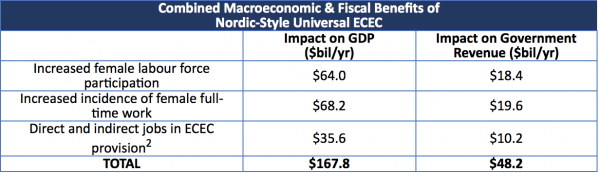
    • If Australian women had the same participation and full-time employment rates as Nordic women Australia’s GDP would be some $132b per year higher
    • Government funding for public and non-profit childcare generates one-third more employment and GDP than funding for private for-profit firms
    • The economic activity supported by expanded funding for public and non-profit ECEC centres would boostAustralian GDP by a further $35b
    • The combined boost to GDP would create an additional $48b in government revenue, more than the cost of providing the childcare services in the first place

    “This is a program that literally pays for itself,” said report author and Senior Economist at the Australia Institute, Matt Grudnoff.

    “This would create tens of billions of dollars in new GDP, hundreds of thousands of jobs and billions of dollars in government revenue – above and beyond the cost of providing those services in the first place.

    “A high-quality, accessible, and non-profit Early Child Education and Care system would facilitate the expanded paid work effort of hundreds of thousands of Australian women, helping close the gender pay gap.

    “At a moment when employers are complaining about a labour shortage, there is an obvious answer: support hundreds of thousands of women to increase their labour supply.

    “Expanded ECEC must be done right, to maximise the potential economic and social benefits. Funding must be directed to not-for-profit and public centres which put top priority on quality – not subsidising the profits of private investors who see children as a profit centre, not a social priority.

    “Childcare is a significant cost-of-living issue for many families with many spending more on childcare than groceries or utilities.

    “This is one of the smartest investments we could make for parents, for employment and for our society. It’s a no-brainer.”

    The report, The Economic Benefits of High-Quality Universal Early Child Education compared ECEC funding levels in Australia to other OECD countries.

    The below table summarises the combined impacts on GDP and tax revenues (for all levels of government) from the increase in labour force participation and full-time work by women, and the direct and indirect jobs associated with ECEC supply.


    Related research