Author: admin

  • Australian and Global Union Leader Sharan Burrow to Deliver Second Annual Carmichael Lecture

    Australian and Global Union Leader Sharan Burrow to Deliver Second Annual Carmichael Lecture

    Share

    Former Australian Council of Trade Unions president Sharan Burrow will deliver the second annual Carmichael Lecture on August 16.

    Ms Burrow, who was ACTU president for a decade from 2000, was also general secretary of the International Trade Union Confederation between 2010 and 2022.

    She will speak on the topic ‘Global Worker Solidarity for a Peaceful, Sustainable World’. Ms Burrow will also answer audience questions, facilitated by newly elected ACTU Assistant Secretary Joseph Mitchell.

    “Sharan Burrow has been an inspiring voice for economic, social and environmental justice for many years, in Australia and around the world,” said Dr Jim Stanford, Director of the Centre for Future Work at the Australia Institute, home of the Carmichael Centre.

    “At a time of global polycrisis, as we face profound economic, geopolitical and ecological uncertainty, we are honoured that Sharan is able to share her experiences and her advice about how trade unionists can unite to build a better world,” Dr Stanford said.

    The Laurie Carmichael Lecture is an annual keynote address co-sponsored by the Carmichael Centre, which is an initiative of the Australia Institute’s Centre for Future Work, and RMIT University.

    The lecture is named in honour of Laurie Carmichael, the legendary manufacturing trade union leader who passed away in 2018 at the age of 93. Last year, the inaugural Laurie Carmichael Lecture featured Nobel Prize-winning economist Joseph E. Stiglitz.

    Event details:

    Date: Wednesday, 16 August 2023

    Time:

    • 5.30pm Doors open (event registration)

    • 6.00pm Event starts

    • 7.15pm Event concludes

    Venue: RMIT Building 80, Level 2, Lecture Theatre 7, 445 Swanston Street Melbourne, VIC 3000

    Attendance at the lecture is free, but advance registration is essential.


  • Fair Work: 5.75% Award Wage Boost will not cause “Wage-Price Spiral”

    Fair Work: 5.75% Award Wage Boost will not cause “Wage-Price Spiral”

    Share

    Today’s 5.75% award wage increase is a necessary boost for the lowest paid workers but does not keep pace with inflation.

    The Fair Work Commission (FWC) has today explicitly said this increase “will consequently not cause or contribute to any ‘wage price spiral’”.

    Key Points:

    • Award wage increase of 5.75% is less than inflation, which is running at 7%. (This covers approx. 20% of workers)
    • FWC Commission have said explicitly this will not cause or contribute to a so-called ‘wage-price spiral’
    • FWC acknowledges the increase “will not maintain the real value of modern award minimum wages nor reverse the reduction in real value which has occurred”
    • Australia Institute research shows excess corporate profits, not wages, are the major driver of inflation
    • Fair Work Commission also increased the national minimum wage by 8.65% (this covers approx 0.7% of workers)

    “This is a necessary boost, but insufficient to keep the lowest paid workers ahead of inflation,” said Dr. Greg Jericho, Policy Director at the Australia Institute’s Centre for Future Work.

    “It’s significant that the Fair Work Commission has explicitly said this will “not cause or contribute to any wage-price spiral”. At a time when companies are making record profits, our research shows profits, not wages, are the major driver of inflation.

    “The FWC notes it “will make only a modest contribution to total wages growth in 2023-24 and will consequently not cause or contribute to any wage-price spiral.

    “The FWC has made it clear the Reserve Bank can not blame low paid workers wages for driving inflation in the event they raise interest rates next week.”

    Excerpt from Fair Work Commission Decision:

    As the total wages of modern award-reliant workers constitute a limited proportion of the national wage bill, we are confident that the increase we have determined will make only a modest contribution to total wages growth in 2023-24 and will consequently not cause or contribute to any wage-price spiral.

    We acknowledge that this increase will not maintain the real value of modern award minimum wages nor reverse the reduction in real value which has occurred over recent years.


  • Profit-Price Spiral an Inconvenient Truth for Big Business: Economists

    Profit-Price Spiral an Inconvenient Truth for Big Business: Economists

    Share

    Despite a mainstream shift in the national conversation away from baseless claims of a “wage-price spiral”, some big business proponents and conservative economists appear unwilling to accept the economic evidence of a profit-price spiral.

    New media reports today quoting former Australian Competition and Consumer Commission Chair Rod Sims have reaffirmed the findings of Australia Institute research showing excess profits from companies like Coles and Woolworths are significant contributors to inflation.

    Key Points:

    “That the business lobby has been unable to disprove a single number from our research is a testament to the careful, evidence-based nature of our work,” said Dr. Jim Stanford, Director of the Centre for Future Work and report author.

    “It’s notable that many of the voices now seeking to cast doubt on the evidence behind a profit-price spiral were silent during the prolonged rhetoric on the existence of a wage-price spiral.

    “The report ‘Profit-Price Spiral: the Truth Behind Australia’s Inflation’ contained new macroeconomic data confirming that increasing profit margins per unit of real output in Australia’s economy account for a strong majority (over two-thirds at that time, based on September quarter 2022 data) of above-target inflation since the outbreak of the COVID pandemic in early 2020. The data we presented on the surge in profits, coincident with rising inflation, is clear, sourced to ABS data, and has not been challenged.

    “The RBA’s internal correspondence about our report (released as part of a freedom of information request) in fact replicated and verified our finding that rising profit margins account for the bulk of increased nominal valuations in Australia, comparing end-2019 to late-2022.

    “Macroeconomic trends since then (including December quarter 2022 data released after our initial report) confirm that unit profit margins are still elevated.

    “Contrary to the view of some Australian commentators, numerous high-quality research reports from think tanks, universities, and even central banks in other countries have confirmed the importance of rising profit margins in explaining the acceleration of inflation since the COVID pandemic, using methodological approaches similar to our own statistical decomposition. We cited several of those complementary studies in our follow-up report, Profits and Inflation in Mining and Non-Mining Sectors, and other similar research has been published more recently.

    “The main thrust of the critical commentary on our report has not been to challenge its empirical findings on the rapid increase in profits, but rather to deny that any generalised increase in profitability has been the cause of the inflation. Some claim that the rise in profits has been limited to the mining sector, which somehow doesn’t ‘count’ – even though products produced by that sector (including petrol, gas, and other fossil fuels) have been a leading source of recent inflation.

    “Our subsequent research showed that profit margins have also increased (albeit less dramatically) in several non-mining sectors. Others claim that swollen profits are just a side-effect of inflation that was caused by other forces (usually including supposed excess wage growth or consumer disposable incomes). That debate over the direction of causation is rather moot: the undeniable reality is that profits are at all-time record levels in Australia, while workers’ real wages continue to decline.

    “Business peak bodies who argue for continued wage suppression desperately want to hide the reality that they have profited from the inflation that is causing a crisis in living standards. This explains their interest in trying to challenge our findings.

    “The Australia Institute stands by its research. Arguing about the dimensions, causes, and remedies of the inflation problem is a normal part of the national economic debate. We look forward to similar scrutiny being applied to those arguing that wages are driving inflation in Australia.”
  • Workplace Law Reform Must Limit Cancer of ‘Gig Work’ in Care Economy: Research

    Workplace Law Reform Must Limit Cancer of ‘Gig Work’ in Care Economy: Research

    Share

    New research reveals the growth of ‘gig’ employment in the NDIS and care sector is undermining minimum employment conditions for tens of thousands of workers, with thousands of workers likely earning below-award wages, missing out on superannuation and experiencing inferior WHS protections and gender pay equality outcomes.

    Researchers have recommended limits are placed on the growth of gig work in the NDIS as part of the third tranche of the Commonwealth Government’s industrial relations reforms later for later this year. Researchers say the promised reforms to ‘Employee-like’ forms of work should be used to protect minimum employment standards and quality service delivery for care workers and consumers.

    Key findings

    • The gig work model is growing in the care economy and NDIS, undermining wages, conditions and gender pay equality
    • Care workers on platforms are younger, less experienced and more likely to be migrant workers than workers in the broader care and support workforce.
    • Platform care work is insecure on-demand work, working time is fragmented, pay can be unpredictable. Many workers’ earnings are equivalent to below award-level pay.
    • Worker-friendly flexibility is limited and is mainly only possible in short hours jobs. Flexibility comes at the expense of a living wage.
    • Care and support platform workers are isolated and largely invisible, working in private homes without organisational supervision, support, guidance or training.
    • In platform and other independent contracting arrangements, risks and responsibilities for care quality and client safety are devolved to individual workers.
    • Platforms compete by avoiding the costs and risks of business fluctuations, of employing workers and of accountability for care and support quality and safety. Costs and risks are devolved to low-paid and insecure frontline workers.
    • Platforms profit from retaining funds that are allocated for employong workers and providing training and supervision.

    “Unregulated gig work is a cancer for workers rights in Australia,” said Dr Fiona Macdonald, Policy Director, at the Australia Institute’s Centre for Future Work.

    “The growth of gig work on digital platforms in the care economy eats away at minimum employment conditions and shifts risk on to care consumers and staff.

    “Care is a public good. Stopping the gigification of disability and aged care workforces is necessary to prevent public funding allocations for essential workers’ wages, superannuation, training and supervision from being diverted to profits.

    “Sector-specific reforms are currently being considered for the road transport industry. Yet, in the public care and support sectors, the same concerns—safety, sustainability and viability—are being approached through disconnected policy processes, rather than being addressed head on.

    “The Women’s Budget Statement reiterated the Government’s commitment to ‘a sustainable and productive care and support economy that delivers quality care and decent jobs’. Gig care work should be addressed with a view to gender equality.

    “We are seeing the Gigification of care work and, without protections, we will risk seeing this spread to other sectors of the labour market.”

    Recommended policy responses:

    • The Government has committed to reforms to ‘Employee-like’ forms of work in 2023
    • These reforms must be designed to restore full employment rights and benefits to all care and support workers, including minimum wages, super & WHS
    • Comprehensive employment minimum standards should apply for all care and support workers, regardless of employment status
      Digital platforms in the care sector should be bound by mandatory codes of conduct

    Related research

  • 7% Minimum Wage Rise Would Tackle Inflation, not Feed it: Research

    7% Minimum Wage Rise Would Tackle Inflation, not Feed it: Research

    Share

    A 7% National Minimum Wage rise for low paid workers would help tackle the rising cost of living for those on award wages while having a virtually undetectable impact on economy-wide prices, new research from leading economists at the Centre for Future Work has found.

    The data comes as the Fair Work Commission deliberates about how much to boost the nominal wages for some of Australia’s lowest paid workers including cleaners, early childhood educators, hospitality workers and carers who are struggling in the cost of living crisis.

    Key Points:

    • The national minimum wage (NMW) has increased less than inflation for the past two years.
    • By June the NMW will be at least 4.2% in real value below where it was in 2020.
    • Despite this business groups continue to advocate for another below inflation increase.
    • Research from the Centre For Future Work reveals that the impact of a NWM rise on inflation is negligible and much less than that driven by profits.
    • Over the past 25 years there has been no correlation between increases in the NMW and inflation growth over the following year.
    • The ACTU’s call for a 7% rise would at most cause economy-wide prices to increase by an average of 0.4% – even if wage increases were fully passed on to consumers by companies.
    • That increase in prices would fit easily within the RBA’s inflation target range (2.5% plus or minus 0.5%).
    • With company profits at historic records, companies could readily absorb the costs of a higher minimum wage, rather than passing them on to consumers. They could fully absorb those costs through a reduction of just 1.4% in total company profits.
    • Suggestions that business can’t afford a 7% increase are false.
    • Suggestions that it would set off inflation are wrong.

    “This research shows that for low paid workers struggling with the cost of living a 7% wage is a solution to, rather than the driver of, inflation,” said Dr. Greg Jericho, Policy Director at the Australia Institute’s Centre for Future Work.

    “Over the past 25 years there has been no correlation between increases in the National Minimum Wage and inflation growth in the following year.

    “We need to move from thinking that workers are the ones who must always carry the burden. After 3 years of soaring profits during the pandemic, many sectors of the economy can afford to slightly reduce their margins and still make strong profits.

    “Low-paid workers have suffered a massive loss of real wages at the same time company profits have been rising. The 7% rise would be a small recompense for the workers who have seen their living standards deteriorate over the past two year.

    “Previous Australia Institute research has demonstrated how excess corporate profits, not wages, are driving post-pandemic inflation in Australia.

    “The fact is that average real wages in Australia fell 4.5% last year, the largest drop in a single year on record. That needs to be fixed, starting with the lowest paid who are carrying Australia.”

    The past two years have seen the minimum wage rise by less than inflation, causing a significant decline in the real purchasing power of millions of workers covered by the Modern Award system. This marks the first time in a quarter-century that the minimum wage has had a deflationary impact on the economy (that is, increased by less than the inflation rate) over successive years.


  • Women Earn $1m less than men & $136,000 Less in Super over Working Life

    Women Earn $1m less than men & $136,000 Less in Super over Working Life

    Share

    New research released on International Women’s Day reveals Australian women earn $1.01m less over their working lives than men, based on median income data.

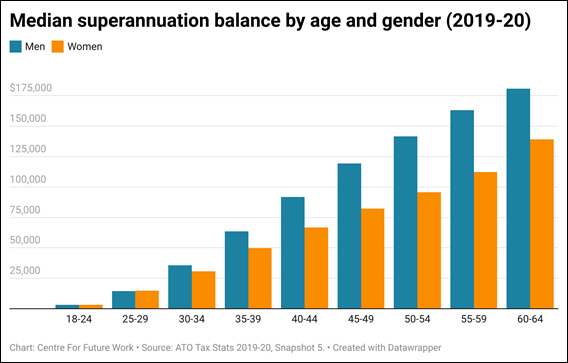
    Women earn $136,000 less in superannuation over their working lives than men, based on median income data. Women earning the median wage will accumulate approximately $393,676 in super, $151,000 below what is considered a ‘comfortable retirement’. The average super balance in Australia in 2023 is $150k.

    Experts say if the gender pay gap was eliminated women would be $3 billion per week better off.

    Despite the gender pay gap narrowing slowly, based on data from the past decade it will only be eradicated by the year 2053 when more than 60% of the current workforce will be retired.

    Key Points:

    • Australian women on a median income will earn $1.01m less over their working lives on average than their male counterparts.
    • Australian women on a median income will earn $136,000 less in superannuation over their working lives than their male counterparts.
      • Women earning the median wage will accumulate approximately $393,676 in super, $151,000 below what is considered a ‘comfortable retirement.
      • The average super balance in Australia in 2023 is $150k.
    • Experts say if the gender pay gap was eliminated women would be $3 billion per week better off.
    • The gender pay gap is narrowing so slowly that it will not fully close for another 30 years until 2053. At that stage 60% of people currently working will have retired.
    • The Gender wage gap in Australia (15.3%) is more than double what it is in New Zealand (6.7%)
    • The gender gap occurs across all occupations and industries:
      • Men have higher average salaries than women in 95% of all occupations, including those where women dominate the workforce. For example, women account for 99% of all midwives, and yet are paid on average 19% less.
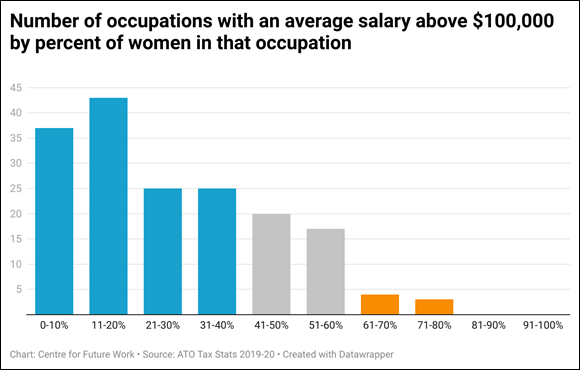
        • 80 occupations in which men make up 80% or more of the workforce have an average salary above $100,000.
        • By contrast zero occupations in which women make up 80% or more of the workforce have an average salary above $100,000.

    “For the average woman in Australia, the gender pay gap will be more than $1.01m over her working life, based on conservative estimates,” said Senior Economist Eliza Littleton from the Australia Institute’s Centre for Future Work.

    “There’s been a noisy political debate about super in Australia for the past week, but this data shows that based on median income data Australian women will earn $136,000 less than their male counter parts over their working life. When you consider that the average super balance in Australia right now is approximately $150,000, that’s a huge disparity.

    “Australian women continue to be paid less than men on average across all industries and occupations, costing us more than $3b across the economy each week.

    “We know that older women are one of the most vulnerable groups when it comes to poverty and homelessness in Australia.

    “Australian women shouldn’t have to wait until the year 2053 for substantive equality. We deserve equity today and our research makes several sensible policy recommendations for the Labor Government to action.”

    Policy recommendations:

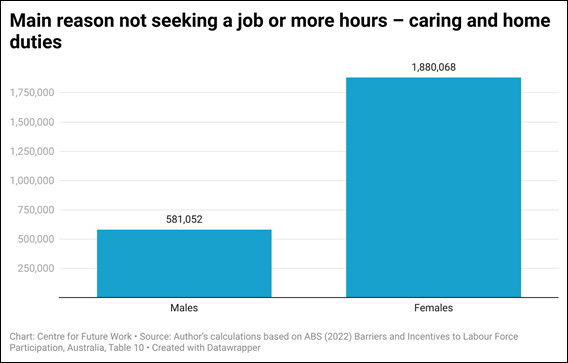
    • Greater access to free or more affordable earlier childhood education & care: Australia Institute research shows if Australia had the same labour force participation rates as Nordic countries do, then the economy would be $60 billion, or 3.2% of GDP, larger (Grudnoff and Denniss, 2020).
    • More paid parental leave for both parents: Australia’s PPL scheme is well behind international standards. The OECD average PPL scheme is 60 weeks in total, with 24.6 weeks reserved for mothers, 10.4 weeks for fathers and 25.4 weeks that can be flexibly distributed (OECD, 2022). With a 20-week scheme, Australia unsurprisingly ranks low – 30th out of 38 countries for the duration of paid leave entitlements. Extending leave entitlements and encouraging a more even distribution of childcare would help reduce the career and financial penalty of having children both for all parents, but especially women. Additionally, making it mandatory for superannuation to be paid while a person is taking paid parental leave would help to reduce the gendered super gap.
    • Greater family-friendly work practices: Some workplaces and workers have managed to maintain flexible working arrangements, but this should be standardised, expanded and embedded in employment relations frameworks to make balancing work and care more achievable across the workforce. Breaking down rigid job design in male-dominated jobs could also help with reducing entrenched gendered segregation by industry and occupation.
    • Deliberate policy to lift the wages for industries dominated by women — most urgently in the care sector: Women dominated sectors, especially in the care industry are among the lowest paid work. The 2021 Royal Commission into Aged Care Quality and Safety recommended that gig work, independent contracting and other ‘indirect’ employment arrangements be restricted in the publicly-funded aged care sector. This needs to be agreed to.
    • Address insecure work: Further reforms should include rights to family-friendly working time arrangements and stable work as minimum standards for all employees in the National Employment Standards.
    • Full recommendations in attached report

    Related research

  • Profit-Price Spiral: Excess Profits Fuelling Inflation & Interest Rates, not Wages

    Profit-Price Spiral: Excess Profits Fuelling Inflation & Interest Rates, not Wages

    Share

    New empirical research reveals the main driver for inflation in Australia is excess corporate profits, not wages, and that inflation would have stayed within the RBA target band if corporates had not squeezed consumers through the pandemic via excess price hikes.

    The dramatic expansion of business profits has gone mostly ignored by the RBA and other macroeconomic policy-makers, who have focused instead on a supposed ‘wage-price’ spiral which does not exist. This suggests the focus of the RBA on wage restraint is misplaced and unfair, and that interest rates would be far lower today if companies had not gouged customers at the checkout.

    The report Profit-Price Spiral: The Truth Behind Australia’s Inflation (attached) comes in the same week supermarket giants Woolworths and Coles posted soaring profits, with banks, gas and petrol companies posting similarly soaring returns.

    Key Findings:

    • A Profit-Price spiral is the main driver of inflation in Australia, rather than a supposed “Wage-Price” spiral, which does not exist
    • As of the September quarter of 2022 (most recent data available), Australian businesses increased prices by a total of $160 billion per year over and above their higher expenses for labour, taxes, and other inputs, and over and above profits generated by growth in real economic output
    • Without the inclusion of those excess profits in final prices for Australian-made goods and services, inflation since the pandemic would have been much slower: an annual average of 2.7% per year, barely half of the 5.2% annual average actually recorded since end-2019.
    • That pace of inflation would have fallen within the RBA’s target inflation band (equal to its 2.5% target, plus-or-minus 0.5%)
    • Excess corporate profits account for 69% of additional inflation beyond the RBA’s target. Rising unit labour costs account for just 18% of that inflation
    • The RBAs 9 back-to-back interest rate rises would have been unlikely without excess profits and prices based on the RBA’s own policy framework
    • Real wages in Australia fell 4.5% in 2022, the largest fall on record

    “This empirical evidence shows excess corporate profits are the main culprit driving inflation, not workers’ wages,” said Dr. Jim Stanford from the Australia Institute’s Centre for Future Work.

    “For Australians doing it tough this data would be aggravating.

    “We’ve been told a story that workers need to restrict wage growth and accept a permanent reduction in living standards in order to fix inflation. This evidence shows that’s an economic fairytale.

    “ABS data shows that without excess price hikes through the pandemic, inflation would likely be within the RBA target band, and hence there would be no need for the nine extreme, back-to-back interest rate rises that are crushing households and mortgage holders, fuelling the cost-of-living crisis.

    “The pain experienced by workers through current inflation contrasts sharply with unprecedented increases in business profitability at the same time.

    “Through this episode of post-COVID inflation, real wages have declined rapidly, labour’s share of GDP has declined, and corporate profits have set records. That is completely opposite from the experience of the 1970s, when real wages rose, labour’s share of GDP increased, and corporate profit margins fell.

    “History confirms that fears of a 1970s-style ‘wage price spiral’ are simply not justified or grounded in reality. Instead, inflation in Australia since the pandemic clearly reflects a profit-price dynamic.”

    The new report ‘Profit-Price Spiral: The Truth Behind Australia’s Inflation’ is attached and comes from the Australia Institute’s Centre for Future Work, by Dr. Jim Stanford.

    Supermarkets, banks and petrol companies have recently posted huge profits:


    Related research

  • Deal on IR Reforms Sets Stage for Faster Wage Growth

    Deal on IR Reforms Sets Stage for Faster Wage Growth

    Share

    Industrial Relations Reform Sets Stage for Significant Acceleration of Wage Growth.

    A legislative consensus reached over the weekend to approve reforms to industrial relations laws sets the stage for rebuilding collective bargaining and a significant acceleration of wage growth, according to research from the Australia Institute’s Centre for Future Work.

    “These reforms will lift wage growth and improve fairness in workplaces across Australia, big and small, in all sectors of the economy,” said Dr Jim Stanford, Economist and Director of the Centre for Future Work.

    “These measures will rebuild collective bargaining, enhance gender equity, ensure greater transparency, and equip workers with critical tools to pursue fair treatment,” Dr Stanford said.

    Research published by the Centre for Future Work suggests collective bargaining coverage will rebound under the new laws, which will allow for multi-employer collective bargaining in certain circumstances. Bargaining coverage in Australia has declined dramatically since 2013, with just 11% of private sector workers now covered by a current enterprise agreement. That fall in coverage has been the largest single cause of record-slow wage growth over the last decade.

    Based on the historical relationship between bargaining coverage and wage growth, rebuilding coverage toward pre-2013 levels will lift nominal wage growth by 1.6 percentage points per year. Additional wage growth of that magnitude would lift annual incomes for a typical worker by almost $1500 in just one year, and a cumulative total of almost $24,000 over five years.

    Another provision in the reform package is a new limit on the ability of employers to unilaterally terminate expired enterprise agreements during their renegotiation. Many employers have used this loophole to wipe out years of collective bargaining gains. A recent example was Qantas’s threat earlier this year to terminate its agreement for cabin crew. Centre for Future Work modeling shows that could have cost senior staff as much as $67,000 per year. This so-called ‘nuclear option’ in employers’ arsenal will be prohibited under the new laws.

    “With the post-pandemic acceleration of inflation, many years of wage stagnation have now tipped over into the fastest decline in real wages in Australian history,” said Dr Stanford.

    “This bill is a needed and timely response to an unprecedented crisis in workers’ living standards.

    “I congratulate the legislators, including Minister Tony Burke, Greens Leader Adam Bandt, and Senator David Pocock, for negotiating this package and working to approve it in Parliament,” Dr Stanford said.


    Related research

  • Australians Working 6 Weeks Unpaid Overtime, Costing Economy Over $92 Billion: Go Home on Time Day Report

    Australians Working 6 Weeks Unpaid Overtime, Costing Economy Over $92 Billion: Go Home on Time Day Report

    Share

    New research shows Australian workers are on average working 6 weeks unpaid overtime per year, costing over $92 billion dollars in unpaid wages across the economy. The average worker is losing over $8,000 per year or $315 per fortnight due to what researchers have branded “time theft”.

    23 November 2022 marks Go Home on Time Day, an initiative run by the Australia Institute’s Centre for Future Work, and now in its fourteenth year.

    Economists have recommended a ‘Right to Disconnect’ to tackle what they say is the systemic problem of unpaid overtime. The research reveals that employers are profiting from 2.5 billion hours of time theft worth over $92 billion in unpaid wages amid a cost-of-living crisis and declining real wages.

    Key Findings:

    • The average Australian worker performs 6 weeks unpaid overtime per year, worth over $8,000 per worker per year
    • The ‘Right to Disconnect’ is supported by six in seven (84%) workers, and has recently been recommended by the Senate Select Committee on Work & Care
    • Across the workforce, this equates to $92 billion in lost income per year, roughly the same as the Commonwealth’s annual expenditure on healthcare
    • Workers share of national income is at an all-time low of 44% in 2022, while the profit share of income is at an almost record high of 30%
    • Respondents reported 4.3 hours of unpaid work per week, equivalent to 15% of total working hours. This equates to 224.3 hours per year per worker, or six standard 38- hour work weeks.
    • Across the whole labour market, over half of all workers (56%) are unsatisfied with their working hours
    • Almost one in two (46%) workers in Australia reported that they wanted more paid hours
    • 84% workers support the Federal Government legislating a ‘Right to Disconnect’ that directs employers to avoid contacting workers outside of work hours, unless in an emergency, with only 8% who oppose

    Negative impacts from unpaid overtime:

    • The most commonly experienced negative consequences were physical tiredness (35%), followed by stress and anxiety (32%), and being mentally drained (31%), each affecting around a third of workers.
    • Over a quarter of workers reported that overtime interfered with their personal life and relationships (27%), and 17% responded that it led to disrupted or unfulfilling non-work time.
    • One in five workers identified that working outside scheduled hours negatively affected their relationship with work, with 22% who reported reduced motivation to work and 19% experienced poor job satisfaction.

    “Our research shows unpaid overtime is a systemic, multibillion-dollar problem which robs Australian workers of time and money,” said Eliza Littleton, research economist at the Australia Institute and report author.

    “This is time theft. Unpaid overtime harms our quality of life and reduces our time with family, friends, and those we care for.

    “This Go Home on Time Day, our research reveals that unpaid overtime is robbing Australian workers and the economy of over $92 billion per year. This time theft only further exacerbates our current cost of living crisis.

    “With workers share of national income at the lowest point ever, a focus on reducing unpaid overtime would improve quality of life and ease the cost of living pressure for millions.

    “The prevalence of overtime suggests that ‘availability creep’ has eroded the boundaries between work and life.

    “Workplace laws could be updated, including creating a ‘Right to Disconnect’ as recommended by the Senate Select Committee into Work & Care, and as exists for employees of Victoria Police, and Queensland Teachers”


    Related research

  • Restoring Collective Bargaining Coverage Would Boost Wage Growth: Research Report

    Restoring Collective Bargaining Coverage Would Boost Wage Growth: Research Report

    Share

    Proposed reforms to Australia’s industrial relations laws are likely to support higher coverage for collective bargaining in the national labour market, and provide a boost to stagnant wage growth according to new research from the Centre for Future Work.

    The report reviews historical data on the erosion of collective bargaining in Australia, and its close correlation to the slowdown in wage growth visible after 2013. The authors find that the decline of collective bargaining coverage (which fell by almost half in the private sector since 2013) explains over 50% of the change in wage growth during that same time.

    “Restoring collective bargaining is vital to any strategy to get wages growing again in Australia,” said Dr. Jim Stanford, co-author of the report and Director of the Centre for Future Work.

    “International evidence indicates that requires the ability to undertake bargaining at a multi-employer level.”

    Key Points from Report:

    • Each one percentage point loss of bargaining coverage has been associated with a reduction in annual wage growth of 0.15 percentage points.
    • There is a clear and predictable relationship between countries which support broader multi-employer bargaining, and the level of bargaining coverage which they achieve.
    • The reforms contemplated in the Secure Jobs, Better Wages legislation would incrementally restore collective bargaining coverage in Australia: by relaxing current restrictions on multi-employer bargaining, and supporting bargaining through other measures (such as limitations on employer termination of enterprise agreements, stronger dispute settlement provisions, and streamlined processes for approving new agreements).
    • These reforms would elevate bargaining coverage in Australia toward a level typical of other countries where most bargaining still occurs at the enterprise level (as would be true under these reforms), but supplemented by some multi-employer bargaining and broader coordination. The OECD has identified a group of these countries, with an average bargaining coverage rate of 33%.
    • That would reverse most (but not all) of the loss in coverage experienced over the past decade.
    • Considering the observed correlation between bargaining coverage and wage growth, this would lead to an improvement in nominal wage growth of 1.6 percentage points per year.
    • Just one year of wage growth at this faster pace would boost annual earnings for a worker with average full-time wages by $1473. That increment would expand to $8300 by the fifth year of (compounded) faster wage growth. On a cumulative basis over the first five years alone, the average worker would receive additional income of almost $24,000.
    • The 1.6-percentage-point increment in annual wage growth would boost aggregate wage incomes by $15 billion in the first year, and $75 billion in the fifth year.

    Related research