Tag: Jim Stanford

  • Manufacturing the Energy Revolution

    Manufacturing the Energy Revolution

    Australia’s Position in the Global Race for Sustainable Manufacturing
    by Charlie Joyce and Jim Stanford

    Australia needs to respond quickly to powerful new incentives for sustainable manufacturing now on offer in the U.S. and several other industrial countries, or risk being cut out of lucrative new markets for manufactured products linked to renewable energy systems.

    That is the finding of a major new report from the Centre for Future Work. The report catalogues new incentives for production of batteries, electric vehicles, renewable energy generation and transmission equipment, and other renewable energy products provided under the Biden Administration’s Inflation Reduction Act and parallel public programs.

    Many other industrial countries, including the EU, China, Japan, Korea, and Canada have already implemented major new incentives to support the expansion of the manufactured products and technologies that will be required for those systems.

    Australia is considering its response, but with no clear announced strategy yet.

    The report provides evidence that the U.S. incentives and content requirements are sparking an unprecedented expansion in manufacturing investment in the U.S. and other industrial countries.

    This response confirms that active climate industrial policies are having an outsized effect on the volume and location of sustainable manufacturing investment. It also confirms that Australia must move quickly to respond to this new industrial landscape, or risk losing its chance to leverage our renewable energy resources into lasting, diversified industrial growth.

    The report notes that Australia has many advantages in the global race for sustainable manufacturing – including an unmatched endowment of renewable energy sources and ample deposits of critical minerals. However, the painful legacy of decades of policy neglect for domestic manufacturing has left Australia’s industrial base in poor shape to seize the opportunities being opened up by the global energy transition.

    The report estimates the proportional fiscal effort that would be required to match the American IRA in the Australian context. The government would need to commit $83 to $138 billion over 10 years in fiscal supports and incentives to match U.S. benchmarks.

    The report also catalogues several qualitative best practices that should be incorporated in the Australian response to the IRA, to generate maximum economic, social and environmental impact: including strong labour and environmental standards attached to subsidized projects, public equity participation, and parallel investments in training for workers to fill the new jobs.

    The paper was released at the 4th National Manufacturing Summit, being held at Old Parliament House in Canberra from 830am to 430 pm on Thursday, August 3, co-sponsored by Weld Australia, the Centre for Future Work, and several industry bodies.


    Full report

    Share

  • We need more than a definition change to fix Australia’s culture of permanent ‘casual’ work

    Originally published in The Conversation on July 31, 2023

    The surprising thing about the Albanese government’s announced reforms to “casual” employment is not that they’re happening.

    It’s that employer advocates are getting so excited about them, despite the small number of people they will affect and the small impact they will have.

    That’s not to say the changes aren’t needed. Rather, true reform of the “casual” employment system, of which this is just a first but important step, has a lot further to go to resolve the “casual problem”.

    What is the ‘casual problem’?

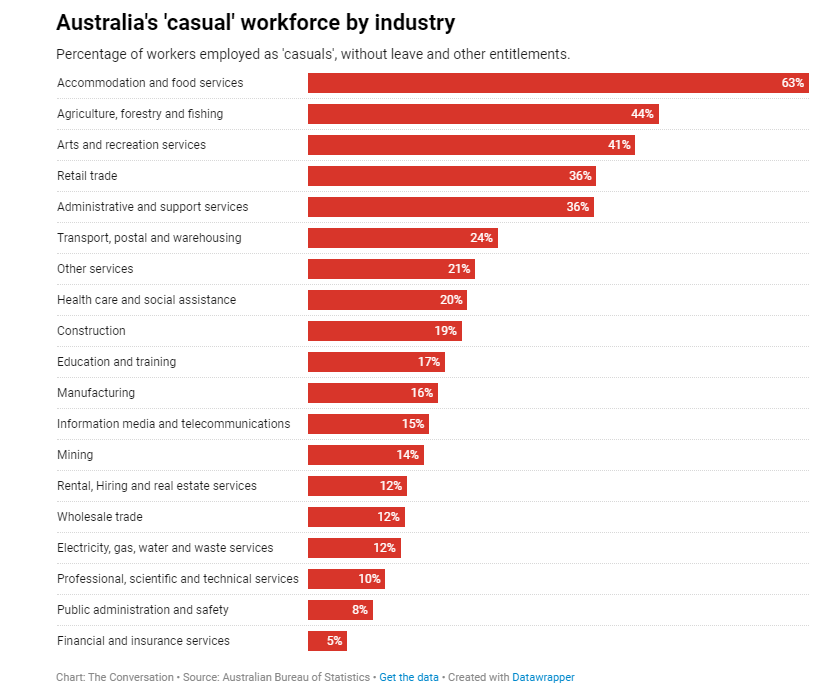
    This problem is that most “casual” workers aren’t really casual at all — as shown by analysis that I and colleague Robyn May did, using unpublished data from the Australian Bureau of Statistics (ABS).

    The premise for hiring them is that the work is intermittent, short-term and unpredictable. But, as you can see from the chart, the last time the ABS collected these data, a majority of “casuals” worked regular hours.
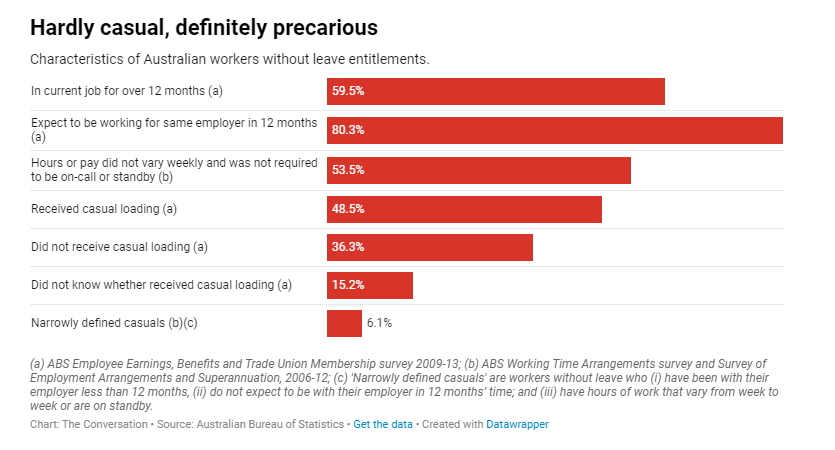
    Almost 60% of “casuals” had been in the job for more than a year. About 80% expected to still be there in a year’s time.

    Only 6% of “casuals” (1.5% of employees) worked varying hours (or were on standby), had been with their employer for a short time, and expected to be there for a short time.

    Even now, some “casuals” have been doing the same “casual” work for over 20 years.

    Permanent ‘casuals’

    All this has led to a class of “permanent casuals” – a nonsense term. They should more accurately be called “permanently insecure”.

    The one thing “casuals” have in common is they’re not entitled to sick leave or annual leave, and they are in a precarious employment situation. Their contract of employment only lasts till the end of their work day.

    That means they have much less power than other workers. So little power, in fact, that barely half of them even get the casual loading they are meant to be paid in compensation for not receiving other entitlements.

    On average, low-paid “casuals” get less pay than equivalent permanent workers, despite the loading.
    Changing legal definitions

    Not many “casuals” have been brave enough to challenge this exploitative relationship. But when they did a few years ago, Australia’s courts agreed permanent casual work was nonsensical.

    To be a “casual worker”, there had to be no promise of ongoing employment. A court would judge this not just by what was in the formal contract of employment but also by what the employer actually did. If they kept hiring you, week after week, on a predictable roster, you weren’t casual.

    In 2018, mine worker Paul Skene challenged his classification as a casual worker, arguing he had done pretty much the same work, with a few changes along the way, for five years.

    The Federal Court agreed he wasn’t a casual employee and should be back-paid annual leave. Another mine worker, Robert Rossato, had a similar victory in 2020.

    Employer organisations were “outraged” by the “billions” in back pay they could be forced to pay for having misclassified ongoing workers as casuals. They lobbied the Morrison government to amend the law, and challenged the rulings in the High Court.

    The Morrison government changed the law in early 2021, to give primacy to the written contract, ignore employer behaviour, and protect employers from back-pay claims.

    Later that year the High Court overturned the Federal Court decisions, ruling it was the written employment contract that mattered. If that was worded a certain way, you couldn’t test whether a worker was “casual” by whether the employer treated them that way afterwards.

    Labor promised to overturn these interpretations, and that’s what this proposal does.

    What will the legislation change?

    The details of the government’s plan is still not clear, but it is likely it will seek to amend the Fair Work Act to revert to something close to the pre-2020 definition of casual work, with a procedural twist.

    It will again be possible to judge whether an employee is “casual” based on employer behaviour. And an employee who repeatedly works a similar roster can, after six months, demand “permanency” – meaning rights to sick leave, annual leave, and better protection against arbitrary sacking.

    The twist: until they demanded “permanency” they won’t be entitled to any leave. So employers will be protected against claims for back pay.

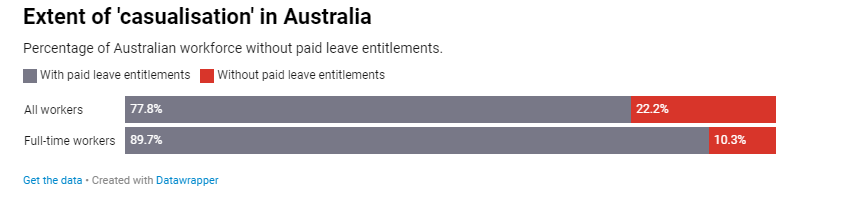
    Theoretically this could affect hundreds of thousands of “casual” workers. In reality, it will likely help far fewer.
    Suppose you’re a “casual” labour hire worker in mining. You can tell what time you’ll start work on the first Friday next June. You go to your employer — the labour hire company — and say: “Make me permanent.” The labour hire company says: “We can’t. You might not have a job tomorrow.”

    And indeed, now that you’ve asked, maybe you won’t have a job. So would you really ask?

    It will depend critically on the protections offered to workers who ask to convert, and how credible they are to workers.

    Most people only expect a few people to make the demand. Workplace relations minister Tony Burke says he believes only a “very small proportion” of “casuals” working regular shifts will do so.

    Part of that reluctance will be fear of the consequences, and part of it will be that many casuals rely on their casual loading. About half of “casuals” are on the award minimum rate, compared with 15% of “permanent” full-time workers. Most cannot afford to “choose” to trade the money for holidays and other entitlements.

    If you’re not getting the casual loading, you’ve got nothing to lose — except your job. If the power imbalance means you don’t get the loading, you won’t fancy your chances.

    So, it will just work for a small number or workers – though it’s likely to be very important to them.

    More needs to be done

    In short, this is a good step but more needs to be done.

    In most other wealthy countries all workers – including temporary workers – are entitled to annual leave. That’s not the case in Australia, because of the “casual” ruse. These laws will not change that.

    There should be universal leave entitlements. Sure, there needs to be a loading where work is unpredictable, and hence so short-term that leave entitlements would not be practical.

    But everyone else should get annual and sick leave, and minimum award wages should be high enough that low-wage workers don’t have to rely on the casual loading to get by.

    The challenge should be about how we transition to that situation.


    You might also like

    “Permanent Casuals,” and Other Oxymorons

    by Jim Stanford

    Recent legal decisions are starting to challenge the right of employers to deploy workers in “casual” positions on an essentially permanent basis. For example, the Federal Court recently ruled that a labour-hire mine driver who worked regular shifts for years was still entitled to annual leave, even though he was supposedly hired as a “casual.” This decision has alarmed business lobbyists who reject any limit on their ability to deploy casual labour, while avoiding traditional entitlements (like sick pay, annual leave, severance rights, and more). For them, a “casual worker” is anyone who they deem to be casual; but that open door obviously violates the intent of Australia’s rules regarding casual loading.

  • Blame Game on Inflation has Only Just Begun

    Originally published in The Canberra Times on June 8, 2023

    Every inflationary episode embodies a power struggle within society over who benefits from inflation, who loses out – and who will bear the cost of getting inflation back down.

    That’s because inflation never affects all prices and incomes evenly. Some prices shoot up, while others grow slowly or decline. Some incomes keep pace with rising prices (or even outpace them), while others lag far behind. Thus the impacts of inflation are always uneven. And this sparks economic and political controversy.

    This distributional conflict is readily visible in current Australian inflation. As prices took off after the lockdowns, corporate profits surged dramatically, reaching their highest share of GDP ever by 2022.

    Meanwhile, wages – which were historically weak even before the pandemic – lagged far behind. In the last two years, consumer prices rose 12.5% (and more for essentials, like food and energy). Average wages grew less than half as much – barely 6% – in the same time.

    That means the purchasing power of workers’ wages is falling. It’s the biggest and fastest real wage cut in postwar history – and record profits from those higher prices are the corollary of workers’ falling real incomes.

    Despite the fact that wages have lagged, not led, recent inflation, the powers-that-be are still targeting workers to bear the brunt of the anti-inflation effort.  The Reserve Bank is now using high interest rates to cool off employment and slow wage growth.

    This inflation has produced clear winners, and clear losers. So it’s a myth to proclaim that inflation “hurts all Australians,” pretending we can all join together in a shared national effort to wrestle prices to the ground.

    Our Centre for Future Work published research showing just how lopsided the impacts of inflation have been in Australia. We analysed official national accounts data from the ABS, including income flows, output data,  and changes in average economy-wide prices.

    From end-2019 (just before the pandemic) to September 2022 (latest data at the time), higher corporate unit profits accounted for 69% of excess inflation (over and above the RBA’s 2.5% target). Unit labour costs accounted for just 18%, and other stakeholders (including small business) the remainder.

    This confirmed that workers are the victims of inflation, not its cause, and raised big questions about the RBA’s determination to target wages (not profits) for tough anti-inflation medicine. Our findings sparked widespread interest and anger. So business peak bodies, and business-friendly commentators, have launched a steady stream of attacks against our report since its release in February.

    RBA and Treasury officials also disagree with our conclusions. They have not challenged our actual numbers: indeed, internal RBA memos replicated and confirmed our finding that wider corporate profit margins account for the lion’s share of higher prices since 2019.

    But despite this evidence, these officials deny soaring corporate profits are a concern in the anti-inflation battle. Profits grew most dramatically in the energy and mining industries, they say. This is certainly true – due in part to sky-high prices paid by Australians for petrol, gas, and other resource-intensive products. So we can’t magically exclude this super-profitable sector from our analysis of inflation, nor our plan for tackling it.

    They also claim profits outside of mining have not increased. This is false: non-mining profits have been less spectacular than resources, but profit margins have widened significantly, reinforcing inflation. Consumers are reminded of this every time they visit a supermarket, book an airline ticket, or try to rent an apartment.

    In sum, these arguments cannot deny that business has profited mightily from the current inflation – especially, but not solely, in energy and mining – while workers have suffered.

    A flip side of this class conflict over inflation was starkly visible last week, when the Fair Work Commission announced a 5.75% increase in Award wages. That doesn’t quite keep up with inflation, but it sure helps.

    Within minutes, the same corporate lobbyists so offended by our research, lined up to denounce the wage increase as inflationary. They want Australia’s lowest-paid workers, whose living standards have already declined, to sacrifice further. Little wonder business peak bodies hate ay public attention on their own record profits.

    The blame game over inflation will get more heated in the months ahead. Inflation is likely to ease, as many of the unique post-pandemic factors (supply chains, energy price shock, pent-up demand) that underpinned firms’ price increases gradually abate. But real wages have fallen – and workers, understandably, want to repair that damage.

    So workers will demand wage gains in excess of inflation. And by all rights, they deserve that. That need not cause further inflation, especially if record high profit margins come back to earth.

    Corporations, however, want to sustain their record profits as long as possible. They want to keep wages down, and the RBA seems determined to help. So buckle up: the great Aussie debate over inflation is just getting started.

    Jim Stanford is Economist and Director of the Centre for Future Work at the Australia Institute, and the author of Profit-Price Spiral: The Truth About Australia’s Inflation.


    You might also like

    Dutton’s nuclear push will cost renewable jobs

    by Charlie Joyce

    Dutton’s nuclear push will cost renewable jobs As Australia’s federal election campaign has finally begun, opposition leader Peter Dutton’s proposal to spend hundreds of billions in public money to build seven nuclear power plants across the country has been carefully scrutinized. The technological unfeasibility, staggering cost, and scant detail of the Coalition’s nuclear proposal have

  • Commonwealth Budget 2023-24

    Commonwealth Budget 2023-24

    Significant Progress for Workers, Much More to Do

    The Commonwealth government’s 2023-24 budget reveals a progressive government seeking to help lower paid workers and those struggling to pay bills, support public health care, and pursue investments towards a net zero economy. But it is very much a first step, and leaves much more work to be done to repair past harms done to workers, low-income Australians, public services and infrastructure, and the environment.

    This briefing reviews the main features of the budget from the perspective of workers and labour markets. Some of its measures are very positive, such as fiscal support for higher wages for aged care workers, increased JobKeeper benefits, and enhanced Commonwealth Rent Assistance.

    Contrary to concerns that a big-spending budget would exacerbate inflation, this budget will have little impact on overall aggregate demand. In fact, it will pro-actively reduce inflation through its new $500 energy relief plan. Contrary to conservative economists who claim this budget will fuel inflation, in reality the forecasts confirm historically slow growth in public demand in both 2022-23 and 2023-24.

    Despite these positive measures, the budget also contains disappointing aspects. Most importantly, the Stage 3 tax cuts remain on schedule. And while they are only set to begin in 2024-25, they hang over these budget figures like a dark spectre.

    The budget papers also confirm the economy is far from buoyant. The next 18 months are expected to see economic growth well-below average. Households are reacting to three years of falling real wages, and eleven painful increases in interest rates, by severely constraining consumer spending. Slowing job creation and declining real wages are taking their toll on overall economic growth, highlighting again that the key to a strong economy is strong employment and wage growth.

    Please read our research team’s full review of this historic budget.


    Full report

    Share

  • Minimum wages and inflation

    Minimum wages and inflation

    by Greg Jericho and Jim Stanford

    New research from the Centre for Future Work at the Australia Institute has revealed how rises in the minimum wage have almost no impact on inflation and given the collapse in the value of the minimum wage in real terms over the past 2 years, a 7% increase is a necessary recompense for Australia’s lowest paid workers.

    Each year the Fair Work Commission conducts the Annual Wage Review (AWR) which determines the national minimum and award wages. And each year it is met with a chorus of cries from business groups, conservative politicians and commentators that Australia’s economy will surely break should the minimum wage be raised too much.

    Over the past two years however, the minimum wage has risen by less than inflation, causing a significant decline in the real purchasing power of millions of workers covered by the Modern Award system. This marks the first time in a quarter-century that the minimum wage has had a deflationary impact on the economy (that is, increased by less than the inflation rate) over successive years.

    Despite this fall, once again, submissions from business groups to this year’s AWR have called for rises below inflation, and have cited concerns about a wage-price spiral as justification for advocating a further erosion of low-paid worker’s living standards.

    But research by Greg Jericho and Jim Stanford shows that minimum wage increases over the past 25 years have had little to no impact on inflation at all. It also demonstrates that a 1% increase in the minimum wage and all Modern Award wages – even if completely passed through into higher prices – would result in a virtually undetectable 0.06% increase in economy-wide prices. So small is this that a mere 0.2% fall in profits would be enough to cancel any impact on prices at all.

    The research reveals that the call from the Australian Council of Trade Unions for a 7% increase in the national minimum wage would make up a portion (but not all) of the real wage losses, workers have experienced in the past two years. Even if fully passed on in higher prices, with no reduction in current record-high business profits, a 7% minimum wage hike would at most translate into an increase of just 0.4% in economy-wide prices.

    Alternatively, that 0.4% rise could be offset by just a 1.4% reduction in total corporate profits.

    With inflation passing its peak, there is no cause for concern that a minimum wage rise of 7% (equal to the annual rate to the March quarter) would add fuel to the inflation fire.

    This reinforces recent research by the Centre for Future Work that profit margins are presently at record highs in Australia, because companies have increased prices since the pandemic far more than their own input costs. This gives companies ample cushion to absorb the cost of higher minimum wages, with no impact on prices at all.

    In sum, the impact of minimum wage increases on average prices is thus little more than a rounding error. But for the 20% of employees who earn either the national minimum wage or wages set under Modern Awards, a strong minimum wage increase will be vital. It will ensure that the lowest paid, who have already been most hurt by inflation, are not forced to suffer more due to an inflationary upsurge that was ultimately spurred by higher profits, not wages.


    Full report

    Share

  • Profits and Inflation in Mining and Non-Mining Sectors

    Profits and Inflation in Mining and Non-Mining Sectors

    More detail on the causes and consequences of the profit-price spiral
    by Greg Jericho and Jim Stanford

    New research from the Centre for Future Work at the Australia Institute has shed further light on the role of higher corporate profits in driving higher prices in Australia since the COVID pandemic.

    A previous report from the Centre showed that 69% of excess inflation (above the Reserve Bank’s 2.5% target) since end-2019 arose from higher unit corporate profit margins, while only 18% was due to labour costs. The new research provides detail on the distribution of those excess profits across different sectors in the Australian economy.

    By far the biggest profits were recorded in the mining sector, where corporate operating profits surged 89% since the onset of the pandemic. Those profits resulted from sky-high prices for fossil fuel energy (including petroleum products, gas, and coal). Thanks to those price hikes, the mining sector now captures over half of all corporate profits in the entire Australian economy.

    Less spectacular but significant increases in corporate profits are visible in several other sectors of the economy, too – not just mining. Profits swelled rapidly in wholesale trade, manufacturing, transportation, and other strategic sectors.

    In these strategic industries, businesses could exploit supply chain disruptions, consumer desperation, and oligopolistic market power to increase prices well beyond production costs.

    In other sectors (including arts & recreation, hospitality, and telecommunications) profits have been flat or falling since the pandemic.

    Early signs in 2023 that inflation (and corporate profits) had peaked, and were returning to normal, have been thrown into question by a renewed threat of profit-price inflation: the OPEC+ cartel decided earlier this month to curtail oil production to boost world prices.

    Policy-makers need to acknowledge the role of record profits in driving recent inflation – and develop alternative policy responses (such as price caps in strategic markets, excess profit taxes, and targeted fiscal support for working and low-income households) to manage current inflation in a fairer and more effective way.


    Full report

    Share

  • The housing market has cooled, but housing unaffordability remains a long way off

    Originally published in The Guardian on March 16, 2023

    House prices are falling but housing unaffordability remains high

    The most recent data on the value of dwelling around Australia reveals the prices in most capital cities have fallen over the past year and are likely to keep doing so for some months. But the data also shows that housing affordability remains a long way from repairing the decades of damage.

    In his Guardian Australia column, policy director, Greg Jericho, notes that the impact of interest rate rises has definitely caused the housing market to come off the boil. In most capital cities median house prices are now below what they were a year ago. Coming as this does off data suggesting wages are not rising as fast as the Reserve Bank feared, and amid the ructions in the USA financial system after the Silicon Valley Bank collapse, the Reserve Bank certainly has enough reason to not raise rates again.

    But while the fall in house prices does help those trying to buy a home, the decrease in affordability is highlighted by the fact that while house prices are mostly below what they were a year ago, they are well above what they were 2 years ago in all capital cities. And those rises have been well above the growth in wages in that time.

    Jericho notes that in Sydney for example, wages and house prices from 2003-2013 largely rose in line but over the past decade house prices have surged above wages. Had prices instead continued to rise in line with wages the median house price in Sydney would now be $863,000 rather than $1,270,000.

    This disconnect is replicated around the country with house prices being some 60% above what they would have been had they risen along with wages. In Hobart the current median house price of $727,000 is some 133% above the price it would have been had they rinse in line with wages in Tasmania of $297,000.

    This disconnect highlights the need for tax reform of the housing market, an increase in supply including increased median density housing, and especially public housing.

    And above all we need wages to no longer be left behind.


    You might also like

    Centre For Future Work to evolve into standalone entity

    The Centre for Future Work was established by the Australia Institute in 2016 to conduct and publish progressive economic research on work, employment, and labour markets. Supported by the Australian Union movement, the centre produced cutting edge research and led the national conversation on economic issues facing working people: including the future of jobs, wages

  • The Fiscal, Economic, and Public Health Dangers of Water Privatisation

    The Fiscal, Economic, and Public Health Dangers of Water Privatisation

    by Jim Stanford

    Safe drinking water and sewage services are one of the most essential elements of public infrastructure in our society. Communities cannot survive and thrive without reliable water services. Providing those services is core business for any municipal or regional government.

    But beyond the obvious importance of good water systems to life, health, and well-being, the water system also constitutes a valuable economic asset in the overall portfolio of public enterprise (see box). Investments in high-quality water and sewage systems represent enormous sums of fixed capital. The financial and operational dimensions of water systems are significant to the fiscal and macroeconomic functioning of the whole state economy.

    In this context, suggestions that the Sydney Water system might be sold to private investors raise a wide range of significant concerns: regarding the efficiency and safety of their continued operation, access to healthy and affordable water services for state residents, and the economic implications for customers, workers, and state government itself. A new research report from the Centre for Future Work reviews some of those concerns, and considers the likely consequences of Sydney Water’s potential privatisation.

    Main findings of the report include:

    • Sydney Water represents an essential public asset, important for both economic as well as public health reasons
    • Sydney Water boasts total assets of almost $24 billion, public equity of $8 billion, annual revenues of $2.8 billion, and dividend and tax payments to the people of NSW that averaged $870 million per year since 2018
    • The state earns far more from dividend payments arising from its equity in Sydney Water, than it would pay in interest on an equivalent amount of public debt
    • Selling the utility would impose a significant fiscal cost on the state through lost dividend and tax revenues
    • Experience with privately-owned water systems in other countries suggests water charges would rise significantly under private ownership, largely because of higher interest costs, higher debt, and higher dividend payouts
    • Based on UK and US studies, Sydney Water customers could see their annual water bills grow under private ownership by 39% to 59% (or by an average of between $174 and $264 per customer per year).

    The report was commissioned by the NSW & ACT Branch of the Australian Services Union.


    Full report

    Share

  • Australian Inflation Reflects a Historic Redistribution from Workers to Bosses

    Originally published in The Conversation on April 7, 2023

    The upsurge of inflation since the COVID-19 lockdowns has not had equal impacts on all Australians. Workers and low-income people have experienced the worst losses: both because their incomes, in most cases, have not kept up with prices, and because they are more dependent on essential goods and services (like shelter, food, and energy) than higher-income households.

    Meanwhile, business profits have expanded strongly through this inflationary episode. Companies haven’t just passed along higher input costs to their customers. Rather, they have taken advantage of the conjuncture of factors related to the pandemic (supply shortages and disruptions, consumer desperation and pent-up demand, and oligopolistic pricing power) to push up prices far higher than needed to cover their own costs.

    The result has been a process of ‘profit-price inflation’: higher profit margins are both a cause and consequence of rapid inflation. Centre for Future Work Director Jim Stanford discusses the distributional impacts of recent inflation in this new commentary for The ConversationUnderlying Australia’s inflation problem is a historic shift of income from workers to corporate profits


    You might also like

  • Profit-Price Spiral: The Truth Behind Australia’s Inflation

    Profit-Price Spiral: The Truth Behind Australia’s Inflation

    by Jim Stanford

    Workers in Australia have suffered considerable economic losses as a result of accelerating inflation since the onset of the COVID pandemic. Reaching a year-over-year rate of 7.8% by end-2022, inflation has rapidly eroded the real purchasing power of workers’ incomes; average wages are currently growing at less than half the pace of prices. Now, severe monetary tightening by the Reserve Bank of Australia (through higher interest rates) is imposing additional pain on millions of workers. Tens of billions of dollars of household disposable income are being diverted away from consumer spending, into extra interest payments made to banks and other lenders. Most ominously, signs of macroeconomic slowdown from higher interest rates portend job losses and even greater income losses in the month ahead.

    The pain experienced by workers through this inflationary episode contrasts sharply with an unprecedented upsurge in business profitability at the same time. Additional profits resulted from businesses increasing prices for the goods and services they sell, above and beyond incremental expenses for their own purchases of inputs and supplies. This dramatic expansion of business profits (taking gross corporate profits to almost 30% of national GDP, the highest in history) has been mostly unremarked on by the RBA and other macroeconomic policy-makers. They have focused instead on the supposed risk of a ‘wage-price’ spiral. However, new empirical evidence confirms the dominant role of business profits in driving higher prices in Australia – not wages. This suggests the focus of monetary policy on wage restraint is misplaced and unfair.

    Major findings:

    • As of the September quarter of 2022 (most recent data available), Australian businesses had increased prices by a total of $160 billion per year over and above their higher
      expenses for labour, taxes, and other inputs, and over and above new profits generated by growth in real economic output.
    • Without the inclusion of those excess profits in final prices for Australian-made goods and services, inflation since the pandemic would have been much slower than was experienced in practice: an annual average of 2.7% per year, barely half of the 5.2% annual average actually recorded since end-2019.
    • That pace of inflation would have fallen within the RBA’s target inflation band (equal to its 2.5% target plus-or-minus 0.5%). Even within the RBA’s own policy rule, therefore, current painful interest rate hikes would be unnecessary.
    • A second scenario considered below allows for modest nominal inflation in unit profit margins, consistent with the RBA’s 2.5% target – once again, above and beyond the costs of other inputs (including labour and taxes) and the growth of profits due to expanded real output. Even in this scenario, inflation would have averaged just 3.3% since the pandemic, only slightly above the target band, and current harsh interest rate changes would again have been unnecessary.
    • Analysis of the income flows associated with excess inflation since end-2019 confirm the dominance of corporate profits in the acceleration of inflation since the pandemic. Excess corporate profits account for 69% of additional inflation beyond the RBA’s target. Rising unit labour costs account for just 18% of that inflation.
    • The distributional dimensions of post-COVID inflation (falling real wages, falling labour share of GDP, and record corporate profits) are completely opposite from the experience of the 1970s (when real wages rose, the labour share of GDP increased, and corporate profit margins fell). This historical comparison confirms that fears of a 1970s-style ‘wage price spiral’ are not justified. Instead, inflation in Australia since the pandemic clearly reflects a profit-price dynamic.


    Full report

    Share