Tag: Jim Stanford

  • The Australia Institute’s Centre for Future Work

    Labour mobility is a significant contributor to Pacific Islands’ economies.

    Australia and New Zealand’s temporary labour migration schemes for Pacific workers have expanded into more industries including personal care work in aged care.

    This has led to the loss of skilled health workers from Pacific Island countries, including registered nurses, to lower-skilled personal care jobs overseas.

    Workers who take up temporary migration in Australia and New Zealand are vulnerable to being underpaid and exploited, due to their visa status.

    This report examines the need for reform of labour migration systems and greater consultation with workers.


    Full report


    Factsheet
    Australia dumps its care crisis on the Pacific – new report

    Share

  • Want to lift workers’ productivity? Let’s start with their bosses

    Originally published in The New Daily on August 18, 2025

    Business representatives sit down today with government and others to talk about productivity. Who, according to those business representatives, will need to change the way they do things?

    The elephant in the room is that it is business that has the biggest influence on productivity. Certainly, it has a much bigger impact than workers, who typically get the blame when things go wrong.

    The factor that most shapes how productive workers are, we must remember, is the technology they work with. It is management that is responsible for the decisions about what technology a business introduces, and how. Workers often do not have much of a say.

    It is not workers who make the decisions about how much money is available for investment. It is not workers who make the decision about which particular technologies to buy, install and use. It is not workers who decide how much money should be allocated to the training of workers to use the new technology, or how those workers should be deployed. It is management.

    Sure, there is lots of evidence that, when workers have a say at work, productivity is higher. But managers often don’t give them a chance to have more than a token say, if they have any say at all. Any attempts by governments to legislate that workers decide or influence decisions on those matters are opposed by business bodies in Australia.

    How much effort workers put in to their job also shapes productivity. But lazy workers don’t last long in jobs these days, and most restrictive work practices went out the window in the 1980s. If a business continued to use workers who do not put effort into their job, the finger would very quickly be pointed at the managers who decided to do that and to not have the performance management systems that would overcome that problem.

    Some characteristics of workers do make a difference, but they are often still matters in the hands of management to control.

    Output will be better with an educated and skilled workforce. If people can do more things with their brains, they will be more productive. Yet management decides on the qualifications demanded of successful applicants for jobs. Management decides how much pay to offer to attract qualified workers to apply for and fill skilled vacancies. Management decides on the training provided to workers.

    Management decides on job quality which, studies show, is positively related to performance.

    Management decides on how much a business pursues diversity, equity and inclusion practices, which (despite shenanigans in the US) have also been shown to benefit innovation and firm performance.

    So it’s no surprise that a couple of years ago the Productivity Commission, after looking at OECD evidence, said that the “productivity gains from upskilling managers could be three times higher than for upskilling workers”.

    The problem for Australia is that, overall, the quality of Australian management is not that good. One survey showed that Australia “ranks low in almost all the people management dimensions”.

    The Productivity Commission commented in its 2023 five-yearly review that “managerial capability varies, but generally lags other countries” and observed that “limited management capability may be holding back Australia’s productivity growth”. It added that its consultations had “provided insights into some of the consequences for innovation of poor management capability”.

    The main response by top management seems to be to pay itself more. But a study as far back as 2004 found that the average pay gap between CEO pay and average earnings was “at least three times higher than that required to maximise organisational performance”. Leaders might say they’re tied to performance bonuses, but somehow when profits go down, the formula or the base get changed, and the CEO’s pay packet is saved.

    When that doesn’t increase productivity, it’s blame the unions. But that wears a bit thin when only one in eight workers is unionised these days. Or cut penalty rates, or some other aspect of workers’ pay! But lower wages just reduce the incentive to introduce new technology.

    What the studies do show about the impact of workplace relations on productivity is that it’s not whether a workforce is unionised that matters, it’s the quality of relations between workers and management that counts — and that is very much in the hands of management.

    After all, research shows that workers do want a co-operative relationship with management — which, despite management wishes, is not the same as acquiescing to every management whim. If their union didn’t want co-operation, the workers would quit the union. The trouble is, if management didn’t want genuine co-operation, it will just blame the workers, and up its own pay because it’s dealing with a difficult situation.

    There are no prizes for expecting business to blame others for Australia’s productivity problems. But an honest debate would look at what management can do better.


    You might also like

  • Australia does not have a “productivity crisis” – new research

    Australia does not have a “productivity crisis” – new research

    by Jim Stanford

    Share

    New research by The Australia Institute reveals there is little evidence of a “productivity crisis” in Australia, despite claims to the contrary from business leaders and politicians. 

    Like the rest of the world, productivity has been sluggish since the COVID pandemic, but that is largely due to businesses failing to adequately invest in machinery, equipment, technology and skills, at a time when many are recording record profits.

    The research also reveals that disappointing productivity is not the cause of the problems facing Australian households, like falling real wages, high prices, high interest rates and the unaffordability of housing.

    Key findings:

    • If real wages had grown at the same rate of productivity since 2000, average wages would be 18% – or $350 per week – higher.
    • Australian businesses now invest less than half as much in research and development as those in other OECD countries.
    • Higher productivity does not automatically “trickle down” to workers in terms of improved wages or living standards.
    • Productivity benefits are trending toward high-paid executives, shareholders and profits, rather than workers.
    • Business claims that productivity can be improved by wage cuts, tax cuts, deregulation or reduced unionisation are false.
    • The idea that workers should “tighten their belts and make do with less” to improve productivity is a lie.

    “Productivity has become an excuse for big, profitable businesses to do whatever they like,” said Greg Jericho, Chief Economist at The Australia Institute‘s Centre for Future Work.

    “Peter Dutton said he’d tear up the new right-to-disconnect laws, saying they hampered productivity, as if allowing employers to call staff any time of the day or night would somehow make them more efficient. This research dispels that kind of nonsense.

    “Australia’s so-called ‘productivity crisis’ is massively exaggerated. Low productivity is not to blame for the problems facing households today, like soaring interest rates, prices or low wage growth.

    “This research also shows that sluggish productivity is caused by companies investing far less in things like machinery, equipment and research.

    “The benefits of productivity should not go straight to profits, shareholders or fat cat CEOs. They should be shared with workers in the form of wages which grow at a similar rate.

    “That way productivity would deliver its true purpose: to provide economic prosperity and a higher quality of life for everyone.”


    Related research

  • Productivity in the Real World

    Productivity in the Real World

    What it is, what it isn’t, and how to make it work better for workers
    by Jim Stanford

    Claims that Australia faces a productivity crisis are overblown. Weak productivity didn’t cause the current problems facing Australian workers (falling real wages, high interest rates, unaffordability of essentials like housing and energy). Nor will higher productivity fix these problems.

    Faith that higher productivity will automatically trickle down, to be shared by all workers, is unfounded. Pro-active measures to lift wages and living standards are needed if stronger productivity growth is to support stronger living standards.

    This report presents empirical evidence showing that productivity growth in recent decades has not been equally reflected in higher real wages and better living standards.

    • Productivity grew four times faster since 2000 than average wages adjusted for consumer prices; it grew almost twice as fast as average wages adjusted for producer prices.
    • If workers had received wage increases since 2000 that matched productivity growth, wages would be as much as 18% higher than they are at present – worth $350 per week, or $18,000 per year.
    • Over time, the failure of wages to keep up with productivity has created a “productivity debt” effectively owed to workers, worth hundreds of thousands of dollars per worker.

    The fruits of productivity growth have been disproportionately captured in the form of business profits, dividend payouts, and executive compensation. It is only through deliberate measures to ensure productivity growth is reflected in improved compensation and conditions for workers that Australian workers can have any confidence their contributions to improved productivity will pay off in better lives. Repairing the link between productivity and mass prosperity, by strengthening the institutions of distribution and pushing wealth downward (rather than hoping it will trickle down automatically), is as important to Australia’s future productivity as any labour-saving technological breakthrough.

    The report concludes with a broad agenda of high-level policy themes that should be pursued to challenge and support Australian workplaces to become more productive – and to ensure the resulting gains are broadly shared.


    Productivity in the Real World


    Factsheet
    Australia does not have a “productivity crisis” – new research

    Share

  • Dutton’s nuclear push will cost renewable jobs

    Dutton’s nuclear push will cost renewable jobs

    by Charlie Joyce

    Dutton’s nuclear push will cost renewable jobs

    As Australia’s federal election campaign has finally begun, opposition leader Peter Dutton’s proposal to spend hundreds of billions in public money to build seven nuclear power plants across the country has been carefully scrutinized.

    The technological unfeasibility, staggering cost, and scant detail of the Coalition’s nuclear proposal have brought criticism from federal and state governments, the CSIRO, the Climate Council, the Electrical Trade Union (ETU), the Climate Change Authority, the Australia Institute, and independent energy experts.

    The CSIRO, among others, has refuted the Coalition’s claim that nuclear will be cheaper than renewables; instead, they have shown the energy produced by Australian reactors would cost approximately eight times more than the same amount of energy produced by renewables. If this cost is passed on to consumers, the average household would pay $590 per year more on their power bill. Unsurprisingly, Australia Institute polling has found that fewer than one in twenty Australians (4%) are prepared to pay this nuclear premium.

    The cost alone should be enough to bury this nuclear proposal. But it is also important to recognise how the Coalition’s plan will impact – and fail – workers.

    False promises

    The Coalition has proposed that large nuclear reactors would be built on the sites of five operational or recently decommissioned coal fired power stations: Liddell and Mount Piper in New South Wales, Tarong and Callide in Queensland, and Loy Yang in Victoria. In doing so, the Coalition has promised that nuclear energy would be a source of stable and plentiful work for the communities where coal-fired power plants are phasing down.

    This is a false promise. Six coal fired power stations have already closed in the past decade, with 90% of Australia’s remaining coal-fired power stations set to close in the next decade. These communities are already undergoing structural adjustment, and they need new sources of employment now. But this is not what the Coalition’s plan delivers. The Coalition outlines that the first two nuclear reactors would not come online until the mid-2030s – more than a decade from now – while the remainder would be completed by 2050.

    And energy and technology experts agree that even this timeline is impossible. On average, a nuclear reactor takes 9.4 years just to build in countries with established and capable nuclear industries. Former Australian Chief Scientist Alan Finkel has estimated that it would take until the mid-2040s at the earliest for Australia to build an operational nuclear reactor. Moreover, analysis from the Institute for Energy, Economic & Financial Analysis (IEEFA) has found that, in economies comparable to Australia’s, every single nuclear reactor project experienced multi-year delays and cost blowouts of up to three and a half times over budget. It is hard to see how Australia, which lacks the experienced workforce, training and research base, or regulatory framework, would buck this trend.

    Lost jobs

    While the Coalition’s nuclear plan would not bring jobs to the communities that need them, it might have the real effect of depressing investment in renewables.

    Renewable energy already generates approximately 40% of Australia’s energy and is by far the cheapest form of electricity. Renewable energy industries already account for the employment of tens of thousands of workers, and Jobs and Skills Australia estimates that approximately 240,000 new workers will be required in industries associated with clean energy by 2030.

    But this requires ongoing and expanding investment in renewables, which the Coalition’s nuclear policy is likely to derail. The Clean Energy Council has estimated that by capping renewable energy to 54% of total use (as the Coalition’s modelling has assumed), 29GW of renewable energy generation projects would not be built – squandering an expected 37,700 full-time-equivalent construction jobs and 5,000 ongoing jobs in operations and maintenance. By limiting renewables investment, prolonging fossil fuel usage, and diverting investment towards nuclear energy, the full employment opportunities of the renewable energy transition are lost.

    Scarce and dangerous work

    If the Coalition’s nuclear plan does come to fruition it will hardly create any ongoing jobs for the communities that have undergone structural readjustment. According to analysis from the Nuclear Energy Agency, while the peak period of construction of the average 1GW nuclear power plant can demand up to 3,500 workers, ongoing operations and maintenance will only require about 400 workers – with only a quarter of these being onsite blue-collar jobs that might provide work for the people who will have lost jobs with the closure of coal-fired power stations. Most jobs will be in administration, regulatory compliance, energy, marketing, sales, science and emergency personnel – and many of them are likely to be located away from the nuclear facility itself.

    Disturbingly, any jobs on-site may put the health of workers at risk. Recent analysis of multiple studies of the health impacts of nuclear power plant employment across multiple countries found that workers have a significantly higher risk of mesothelioma and circulatory disease due to exposure to radiation. Nearby residents also exhibit a significantly higher risks of cancer, with children under the age of five at particular risk. And this does not even factor in the risk of sudden plant failure and reactor meltdown on workers and communities – a risk sharpened by the Coalition’s plan for these reactors to be built on geological fault lines with heightened earthquake risk.

    Australian workers have much to gain from the renewable energy transition, including cheaper power, new clean technology industries, and hundreds of thousands of new jobs. The Coalition’s nuclear plan only brings false promises, lost jobs, and – if the plan comes to fruition – few jobs and potentially dangerous work.


    You might also like

  • Leaving Money on the Table: Foregone Economic Gains from Continued SRS Underfunding

    Leaving Money on the Table: Foregone Economic Gains from Continued SRS Underfunding

    By locking in public school underfunding, Australia misses out on important economic, labour market, and fiscal benefits.
    by Jim Stanford

    The Commonwealth government’s current offer to fund public schools to just 22.5% of the agreed Schooling Resource Standard would leave much of the current school funding shortfall unrepaired. This would squander many of the economic benefits that would otherwise result from full public school funding. Based on disaggregation of previous estimates of the economic benefits generated by stronger school funding and hence scholastic outcomes, we estimate the failure to fulfil the 25% Commonwealth contribution required for full SRS funding would ultimately forego GDP gains of $3.5 to $5 billion per year, and impose net fiscal costs on government (all levels) of $0.6 to $1.5 billion per year.

    International and Australian research has confirmed the substantial economic and fiscal benefits of well-funded and accessible public schools. Extrapolating international evidence, previous research from the Centre for Future Work estimated cumulating Australian GDP gains reaching $18-$25 billion per year after two decades, as a result of fully meeting SRS funding standards for public schools. Those gains are experienced via increased employment and value-added in the school sector; improved productivity and wage outcomes for school graduates; and reduced income support and social expenditures as a result of better overall education. Higher GDP would in turn generate revenue gains for government that exceed the expense of meeting SRS funding benchmarks in the first place.

    The failure to fully fund public schools is clearly a case of false economy. The relatively small amounts of money ‘saved’ in the near term, are more than offset by long-run underperformance according to numerous indicators: school attainment and completion, productivity, GDP, and fiscal balances. The Commonwealth government is leaving money on the table, with its failure to fully meet SRS funding requirements.


    Full report

    Share

  • Would you like a recession with that? New Zealand shows the danger of high interest rates

    Would you like a recession with that? New Zealand shows the danger of high interest rates

    by Matt Grudnoff

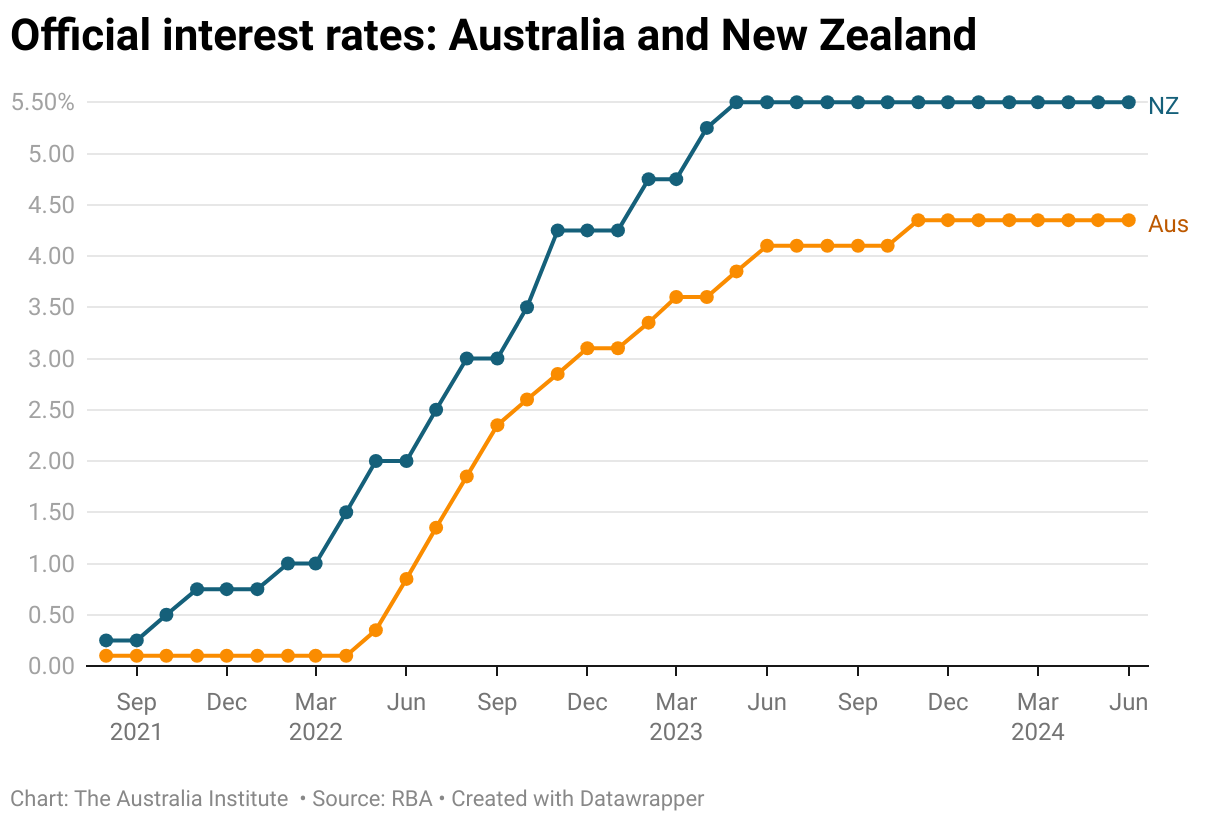
    New Zealand’s central bank raised interest rates more than Australia and went into a recession – twice.

    Recently there have been calls for the Reserve Bank to increase interest rates because inflation has remained “sticky” at 3.5%-4%. These calls are coming even though this may push Australia into recession. This horrifying scenario is being shrugged off by some as the price we have to pay to get inflation down – but the experience of New Zealand shows higher interest rates do not always bring down inflation, but they can very much lead to recessions.

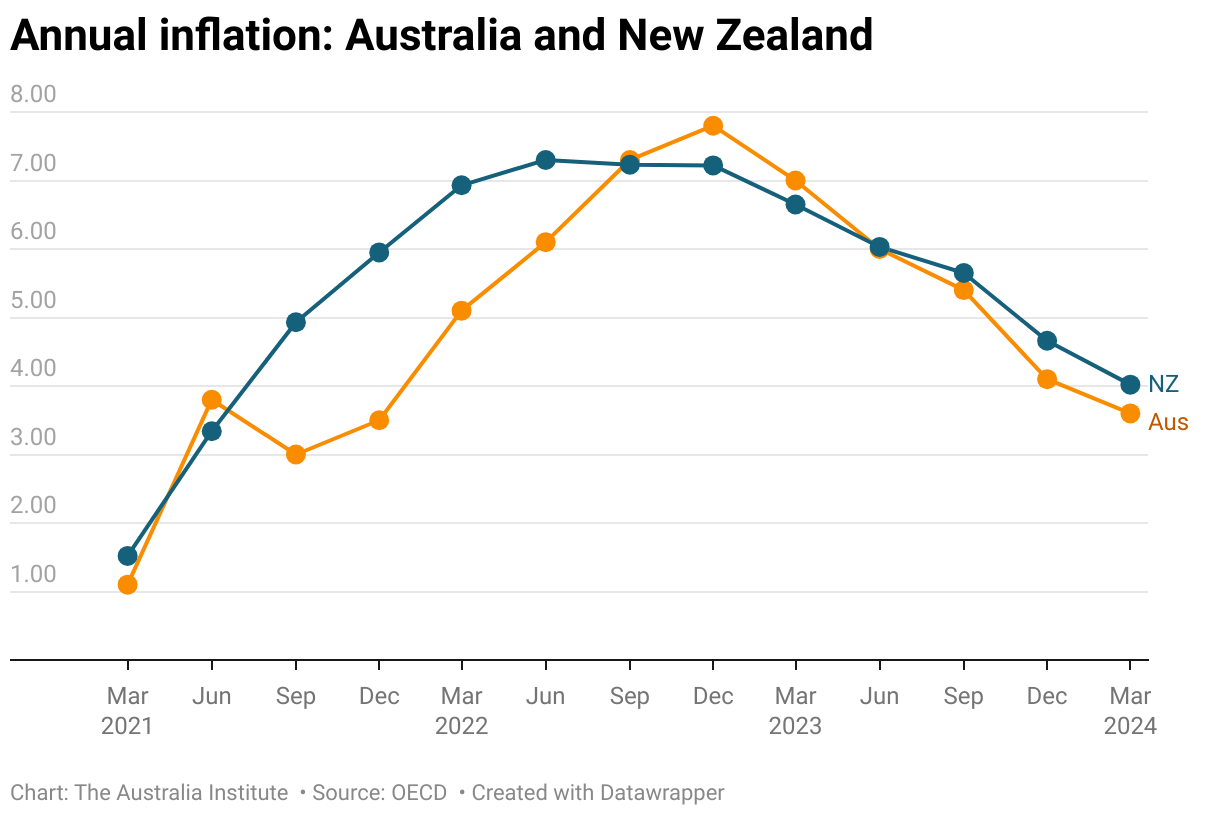
    The June quarter CPI is due out this week, and many economists predict that it will increase slightly from the current 3.6%. This comes after consistent falls in the rate of inflation since the end of 2022. In fact, the inflation rate has fallen from 7.8% in December 2022 to 3.6% in March 2024.

    But a more than halving in the inflation rate is not enough for the armchair inflation hawks who are determined to see the inflation rate back into the Reserve Bank’s target band as soon as possible and regardless of the cost.

    The idea that the costs of slightly elevated inflation are in any way comparable to the costs of a recession is just ridiculous. Recessions cause widespread suffering, unemployment, and economic scaring that can last for a decade or more.

    Now that wages are growing faster than inflation, the costs of inflation are minimal, particularly when it is less than a percentage point above the target band.

    Even worse, higher interest rates are unlikely to bring inflation down any faster.

    Normally inflation is caused when the economy is booming, incomes and spending is rapidly rising, and businesses can’t keep up with all the additional demand. In this situation, higher interest rates act by reducing spending and slowing the booming economy.

    The inflation Australia and the rest of the world are facing is not that kind of inflation. It is a much more uncommon kind of inflation that is caused by supply shocks. Supply shocks increase the costs that businesses face which leads to increased prices. Importantly higher costs can’t be fixed by increasing interest rates, making them a far less effective policy response.

    As former governor Philip Lowe pointed out, there is very little that monetary policy can do to offset supply shocks, and you should “let the supply shock wash through the system.”

    New Zealand is a case in point. It has increased its official interest rate faster and higher than Australia. While Australia’s cash rate is at 4.35%, New Zealand’s rate is at 5.5%.

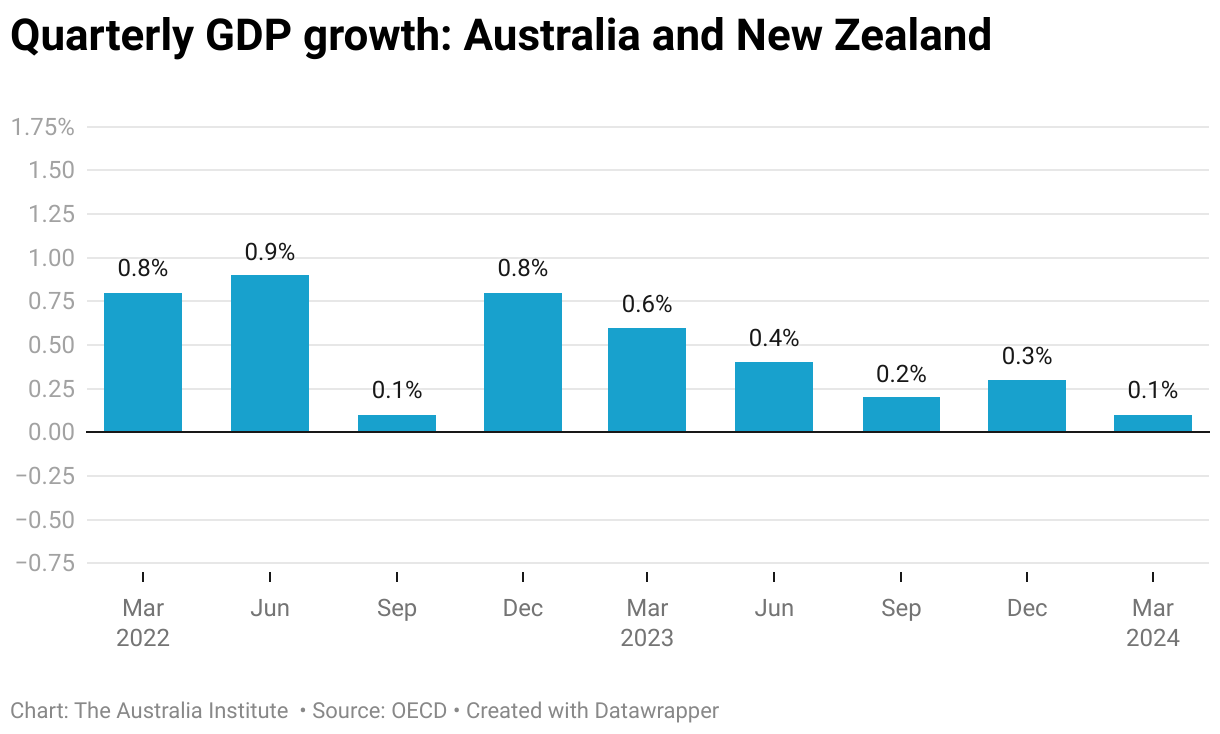
    The New Zealand economy has been dipping in and out of technical recession for 18 months. A technical recession is two consecutive quarter of negative economic growth – and New Zealand has experience that twice.

    By comparison Australia’s, economic growth has slowed but it has continued to remain positive.

    The problem for New Zealand is that the higher interest rates and slower economic growth have not led to a faster drop in inflation. If we compare the inflation in New Zealand and Australia, we can see that while inflation in New Zealand took off earlier than in Australia, both countries are seeing inflation come down at about the same pace.

    This should be a warning to the Reserve Bank that higher interest rates might work to crash the economy, pushing up unemployment, and heaping more misery on Australian households, but they will do little to bring down prices.

    Inflation is already on its way down as the supply shocks that set off this bout of inflation resolve themselves. When the June quarter inflation rate comes out, it might show the path back to the target band is not completely smooth. It may even increase slightly. But this is a time when the Reserve Bank needs to show courage and ignore the armchair critics and keep interest rates on hold.

    Inflation is coming down and a recession would be the worst possible outcome.


    Related research

    You might also like

  • Budget 2024-25: Resists Austerity, Reduces Inflation, Targets Wage Gains

    Budget 2024-25: Resists Austerity, Reduces Inflation, Targets Wage Gains

    Important support to help with cost-of-living challenges, but more needed

    Commonwealth Treasurer Jim Chalmers delivered his 2024-25 budget to Parliament. While it booked a surplus for 2023-24 (the second consecutive surplus), it increased total spending for future years, and forecasts continued small deficits. In the wake of the economic slowdown resulting from RBA interest rate hikes, this new spending is needed and appropriate.

    Targeted cost of living measures will directly reduce inflation in some areas (like energy and rents), while helping working Australians deal with higher prices in others (including reworked State 3 tax cuts, and support for higher wages for ECEC and aged care workers). Unlike previous years, the budget is projecting real wage gains in coming years that are actually likely to materialise — however, the damage from recent real wage cuts will take several years to repair, and further support for strong wage growth will be required, from both fiscal policy and industrial laws. The budget also spelled out initial steps in the government’s Future Made in Australia strategy to build renewable energy and related manufacturing industries; these steps are welcome but need to be expanded, and accompanied by strong and consistent measures to accelerate the phase-out of fossil fuels.

    Our team of researchers at the Centre for Future Work has parsed the budget, focusing on its impacts on work, wages, and labour markets. Please read our full briefing report.


    Full report

    Share

  • Video: The Right to Disconnect is NOT Bad for Productivity

    Video: The Right to Disconnect is NOT Bad for Productivity

    by Jim Stanford

    The Right to Disconnect legislation being passed recently has attracted criticism from Opposition leader Peter Dutton and business groups, who say it’s bad for productivity.

    They may need to learn some basic maths, because they couldn’t be more wrong.

    Centre for Future Work Director Dr Jim Stanford explains.

    Research indicates the average Australian worker performs 280 hours of unpaid overtime per year, equating to more than $130 billion across the labour market.

    The new legislation’s ‘reasonableness’ test still grants employers great scope to contact workers out of hours when it is genuinely necessary.

    Nevertheless, merely affirming that workers don’t need to be on call 24-7, and should be allowed to turn off their devices after work, has sparked loud complaints from old-school guardians of work attitudes.

    Read more in this article: https://australiainstitute.org.au/post/the-big-error-at-heart-of-right-to-disconnect-opposition/


    You might also like

  • The Irrelevance of Minimum Wages to Future Inflation

    The Irrelevance of Minimum Wages to Future Inflation

    Minimum and award wages should grow by 5 to 10 per cent this year
    by Jim Stanford and Greg Jericho

    A significant increase to the minimum wage, and accompanying increases to award rates, would not have a significant effect on inflation, according to new analysis by the Centre for Future Work at the Australia Institute.
    The analysis examines the correlation between minimum wage increases and inflation going back to 1997, and it finds no consistent link between minimum wage increases and inflation.

    The report, co-authored by Greg Jericho (Policy Director) and Jim Stanford (Director), finds that a minimum wage rise of between five and 10 per cent in the Fair Work’s Annual Wage Review, due in June, is needed to restore the real buying power of low-paid workers to pre-pandemic trends, but would not significantly affect headline inflation.

    Key findings of the report include:

    • Last year’s decision, which lifted the minimum wage by 8.65 per cent and other award wages by 5.75 per cent, offset some but not all of the effects of recent inflation on real earnings for low-wage workers.
    • At the same time, inflation fell by 3 full percentage points.
    • There has been no significant correlation between rises in the minimum wage and inflation since 1997.
    • Raising wages by 5 to 10 per cent this year would offset recent inflation and restore the pre-pandemic trend in real wages for award-covered workers.
    • Even if fully passed on by employers, higher award wages would have no significant impact on economy-wide prices.
    • A 10 per cent increase in award wages could be fully offset, with no impact on prices at all, by just a 2 per cent reduction in corporate profits – still leaving profits far above historical levels.

    “Australia’s lowest paid workers have been hardest hit by inflation since Covid. There is a moral imperative to restore quality of life for these Australians and this analysis shows that there is no credible economic reason to deny them,” Jericho said.

    “It’s vital the Fair Work Commission ensure that the minimum wage not only keeps up with inflation, but also grows gradually in real terms – as was the trend before the pandemic.


    Full report


    Factsheet
    Increasing minimum wage would not drive inflation up: new report

    Share