Tag: Jim Stanford

  • Needle in a Haystack

    Needle in a Haystack

    Searching for the Impact of Tax Cuts on Consumer Spending and Economic Growth
    by Jim Stanford

    The latest economic statistics have confirmed that Australia’s economy is barely limping along – with quarterly GDP growth of just 0.4%. One of the weakest spots in the report was consumer spending, which recorded its weakest performance since December 2008 (amidst the worst days of the Global Financial Crisis). This was despite the supposed benefit of recent Commonwealth government tax cuts in boosting disposable income and stimulating more spending.

    Analysis from Dr. Jim Stanford shows that the tax cut is in fact completely invisible in the macroeconomic data.

    Among the major findings of the report:

    • Consumer spending stagnated despite expensive tax cuts provided by the newly-reelected Coalition government. Income taxes paid by Australians declined by over $4 billion in the quarter. But fearing future recession, Australians socked away those savings: personal savings grew by $6 billion in the quarter, more than taxes fell.
    • Because of the sharp increase in the saving rate, none of the aggregate tax savings showed up in new consumer spending. The propensity of Australians to consume from their pre-tax income actually declined in the quarter. In other words, the effect of the tax cut had zero measurable impact on aggregate consumer spending.
    • Wage growth slowed further in the September quarter – with the Wage Price Index increasing by just 2.2% over year-ago levels. With slowing wage growth and higher-than-expected unemployment, Australian consumers simply cannot afford to boost their spending, despite the tax cuts.
    • One-tax tax cuts have an insignificant effect on disposable incomes, compared to the benefits of restoring normal wage growth in Australia. In just one year, a restoration of normal wage growth would boost incomes by $12 billion – 3 times the value of the tax cuts. Compounded over just 3 years, normal wage increases would lift incomes by a cumulative total of $75 billion, and consumer spending by $50 billion. Restoring wage growth, not cutting taxes, is the key to turning around Australia’s flagging economy.


    Full report

    Share

  • Precarity and Job Instability on the Frontlines of NDIS Support Work

    Precarity and Job Instability on the Frontlines of NDIS Support Work

    The national roll-out of the NDIS holds the prospect of a significant enhancement in both the resources allocated to disability services in Australia, and the autonomy and flexibility of service delivery for people with disability. But it also constitutes an enormous logistical and organisational challenge. And the market-based service delivery model built into the NDIS is exacerbating those challenges, by unleashing a widespread fragmentation and casualisation of work in disability services.

    In this new report, researchers document the experience of front-line disability service workers under the NDIS based on first-hand qualitative interviews.

    The report was a joint initiative of two leading academic researchers (Prof. Donna Baines, formerly of the University of Sydney, and Dr. Fiona Macdonald of RMIT) and the Centre for Future Work. Researchers conducted detailed face-to-face interviews with 19 front-line disability service workers, mostly in the Newcastle, NSW region. (Newcastle was one of the locations chosen for NDIS trials, so workers in the region have more experience with the reality of NDIS delivery problems.)

    The interviews indicated 8 major problems negatively affecting the stability, quality and sustainability of work for disability support workers:

    1. The new system is not providing sufficient support for participants with intellectual and other cognitive disabilities, including in designing and managing individual programs of care;
    2. DSWs are experiencing increased instability and precarity in their jobs, elevated levels of mental and physical stress, and irregular hours and incomes;
    3. New workers joining the disability services sector are often less skilled, less trained, less experienced, and sometimes reluctant;
    4. DSWs experience particular challenges working in the private realm of NDIS clients’ homes;
    5. The informal and inconsistent provision of transportation and other necessary functions to NDIS clients results in a significant shift of costs and risks to workers;
    6. DSWs are experiencing increased levels of violence in their work;
    7. Relationships with managers have changed dramatically under the new system, undermining effective supervision, coaching, and training; and
    8. Worker turnover, given the insecurity of work and income and the challenging conditions of work, is extreme.

    The deterioration in job stability and working conditions under the NDIS will inevitably impact on the quality of service experienced by NDIS clients; it will also exacerbate the overarching challenge of recruitment and retention facing disability service providers as they try to attract the 80,000 new full-time equivalent workers required to operate the scaled-up NDIS.

    The researchers conclude with several policy recommendations to improve the quality and stability of work for disability support workers, and the quality of care for participants.


    Full report

    Share

  • The Relationship Between Superannuation Contributions and Wages in Australia

    The Relationship Between Superannuation Contributions and Wages in Australia

    by Jim Stanford

    New research from the Centre for Future Work shows that scheduled increases in employers’ minimum statutory superannuation contributions would have no negative effects on future wage growth, and that Australia’s economy can afford both higher wages and higher employer contributions to superannuation.

    The research refutes claims made by some commentators and lobbyists that higher superannuation contributions would automatically lead to lower wages, and hence would be self-defeating. The new research finds no statistical evidence for that claim in Australian empirical data.

    The paper reviews economic statistics from the introduction of superannuation to the present. On average, wages were more likely to accelerate and grow at a faster rate when the superannuation guarantee (SG) rate was increased, than to decelerate or grow more slowly. This indicates a slight positive correlation between wages growth and changes in employers’ minimum SG rate.

    The paper also reviews theoretical predictions and empirical findings from previously published economic research. Even under very restrictive and unrealistic assumptions about competitive market-clearing behaviour in labour markets, the expectation of a fully offsetting one-for-one trade off between wages and SG contributions only occurs in the special cases of perfectly inelastic labour supply, or perfect substitutability between voluntary and policy-induced personal savings. Neither of those conditions prevail in practice. More realistic economic models (that allow for responsiveness in labour supply, minimum wages, and other real-world features) do not anticipate a full trade-off – and many expect no trade-off at all.

    The paper concludes that current record-low wage growth in Australia cannot be “fixed” by abandoning scheduled increases in the SG rate (which is currently legislated to grow from 9.5% of wages to 12% over a five-year period, beginning 1 July 2021). Abandoning those increases would only further suppress the total compensation received by workers, which has been falling steadily as a share of GDP for decades. Instead, weak wage growth should be tackled with direct wage-boosting policies; the determination of wages and superannuation contributions are largely independent policy decisions.


    Full report

    Share

  • Young Workers are “Shock Troops” of Precarious Labour Market

    Young Workers are “Shock Troops” of Precarious Labour Market

    by Jim Stanford

    Share

    Dr. Jim Stanford, Director of the Centre for Future Work, appeared before the National Youth Commission on 31 October in Sydney to discuss the challenges facing young workers in Australia’s labour market.

    The National Youth Commission into Youth Employment and Transitions has been holding an inquiry in communities across Australia to document the situation of young workers, who are experiencing much lower rates of employment and income than other workers.

    Stanford’s submission argued that young workers are like the “shock troops” of the precarious labour market: the ones sent in first to confront an especially dangerous situation. The rise of precarious work in all its forms – part-time work, casual jobs, labour hire, temporary positions, marginal self-employment, and digitally mediated ‘gigs’ – now dominates youth employment patterns. And that situation will not automatically disappear as young workers get older and gain experience. Rather, evidence suggests that without policy measures to stabilise and improve jobs, this will be a permanent shift that gradually affects most workers. Already, less than half of employed Australians are working in a ‘traditional’ full-time permanent wages jobs with normal entitlements (like paid holidays, sick leave, and superannuation). For young workers, that ratio is less than one in five.

    Stanford argued for targeted measures to stimulate more youth hiring into stable positions, an ambitious effort to rebuild vocational education in Australia and strengthen pipelines to post-education jobs, and a broader commitment to full-employment macroeconomic policy.


    Related documents


    Presentation slides

    You might also like

    Centre For Future Work to evolve into standalone entity

    The Centre for Future Work was established by the Australia Institute in 2016 to conduct and publish progressive economic research on work, employment, and labour markets. Supported by the Australian Union movement, the centre produced cutting edge research and led the national conversation on economic issues facing working people: including the future of jobs, wages

  • The Future of Work for Australian Graduates

    The Future of Work for Australian Graduates

    The Changing Landscape of University Employment Transitions in Australia
    by Alison Pennington and Jim Stanford

    The Centre for Future Work has released a major new report documenting the new challenges faced by Australian university graduates in finding jobs that are stable, rewarding, and utilise their newly-developed skills. The report was prepared in conjunction with Graduate Careers Australia.

    The world of work is being transformed by a complex and interdependent set of forces – including technology, changes in workplace organisation and employment relationships, environmental and demographic challenges, and more. No group of workers will confront the reality of constant change more directly than young workers. As new entrants to the labour market, they cannot count on the protection of previous structures or practices to insulate them from coming changes. They immediately face the challenges of an increasingly precarious job market – one in which less than half of all employed Australians now fill a traditional “standard” job (full-time, permanent, paid work offering normal entitlements like paid leave and superannuation).

    Holding a university degree is still a vital and valuable asset for young workers entering this challenging and unstable milieu for the first time. Individuals with university degrees are more likely to be employed, to have more stable jobs, and to be paid more. But despite this relative advantage enjoyed by university graduates, employment conditions have become much more challenging even for graduates. Rates of graduate employment in full-time work are down significantly over the past decade, and there is evidence of a growing mismatch and underutilisation of university graduates in positions that do not fully or even partly utilise their hard-won knowledge and skills. At the same time, employer complaints about supposed skills shortages and the dearth of “job-ready” graduates are as loud as ever; the report documents that those complaints need to be interpreted with considerable scepticism.

    Australia’s higher education system could do a much better job at anticipating the needs for highly-skilled workers in the future, evolving their program offerings in light of those needs, and then assisting students as they traverse their university educations and find meaningful, relevant work.

    This comprehensive new report from the Centre for Future Work, developed in conjunction with Graduate Careers Australia (an association that has worked to gather data and make recommendations regarding university graduate employment issues) provides an overview of the prospects and challenges faced by future university graduates. The report confirms that university education makes a vital, essential, and valuable contribution to Australians’ prosperity: both at an individual level for those who have attained higher education, and at the macroeconomic and social level. But it catalogues gaps and failures in crucial education-to-jobs transitions, considers the most likely factors contributing to those gaps and failures (while dispensing with some commonly-cited but unconvincing myths and stereotypes), and makes several concrete recommendations for policy change and innovation.

    Key findings of the report include:

    • Employment outcomes for university graduates have deteriorated notably since the GFC. Full-time work placements have deteriorated (from 85% in 2008 to 73% in 2018, measured by full-time employment 4 months after graduation). Many graduates report being underemployed: both quantitatively (working fewer hours than they want) and qualitatively (in jobs that do not fully or even partially use their hard-won expensive skills), and insecure work has become a big problem for graduates (like for others in the labour market).
    • Employers continue to complain about pressing “skills shortages” hampering their growth opportunities. But careful empirical data suggests this claim is questionable. Reported skills shortages in most occupations have in fact eased considerably since the GFC.
    • Another stereotype not backed up by hard data is the common assumption that STEM and technical skills are in the most short supply, and that STEM graduates will have the best employment outcomes. For example, math grads have one of the worst full-time employment placement rates of any discipline. Employers report they especially seek applicants with verbal, social, problem-solving, and communication skills.
    • Vocational degrees (tied to specific occupations, often regulated – like health care, engineering or teaching) have the best employment placement rates.
    • Therefore, the solution to graduate employment challenges must include better strategies for directly linking degrees to jobs: for example, through paid placements, occupational licensing, and accreditation.
    • Australia’s system for planning skills / higher education / job placement functions is fragmented, and often contradictory. We could learn a lot from other countries (especially in Europe) which have taken a more hands-on and direct approach to forecasting future skill requirements, planning higher education offerings accordingly, and channeling graduates directly into relevant career opportunities.
    • The report makes 9 specific recommendations to improve university-to-work transitions for future graduates, including establishing a national higher education planning capacity, and creating a timely and high-quality labour force information system.
    • An overarching recommendation in the report is a call for a new social compact for universities as major actors in Australia’s skills system. This includes increased public funding for universities attached to requirements for national policy coordination among universities, expanded employment-to-jobs programming, and stronger mechanisms connecting public research to the development of an innovation-intensive, high-value export-oriented industry policy.

    Download the full report, The Future of Work for Australian Graduates: The Changing Landscape of University-Employment Transitions in Australia, by Alison Pennington and Dr. Jim Stanford. There is also a 12-page summary report available for download. The report was commissioned by Graduate Careers Australia.


    Full report


    Summary report

    Share

  • Messing With Success

    Messing With Success

    Victoria’s Puzzling Turn to Austerity
    by Troy Henderson and Jim Stanford

    The Centre for Future Work has released new research estimating the negative impacts on wages and spending power of the Victoria government’s proposed 2% cap on wage increases for the state’s large public sector workforce.

    In recent years, Victoria’s economy has consistently been the strongest in Australia: with the most new jobs, the fastest growth in wages, and the biggest expansion in output. The state government has been both a key cause of that growth, and a major beneficiary of it. New expenditures on expanded public services and infrastructure have been crucial engines of the state’s growth. In turn, that strong growth generated huge fiscal dividends for the state government, through a robust, diversified and growing revenue base.

    Given this positive history, it seems inexplicable that the state government would now mimic tools of fiscal austerity that have been implemented, with negative and unintended consequences, in other Australian jurisdictions. The government has imposed a stringent cap on public sector wage increases: 2% per year over the coming four-year period. That cap falls well below relevant benchmarks: including growth rates for state GDP, state revenues, overall state wage growth, and Reserve Bank targets for both wage and price inflation. It also falls far below what the state’s elected representatives will receive in their own wage increase this year – including, in particular, the Premier and Treasurer, who have been awarded an 11.8% salary increase.

    The wage cap would artificially suppress total state public sector compensation by over $3 billion over the coming four years – compared to normal compensation patterns. It would short-circuit a badly-needed recovery in wage growth that is just taking hold in Victoria’s broader labour market. It would damage consumer spending, exert a chilling impact on private sector wage settlements, and do particular damage to regional communities which depend especially strongly on public sector jobs and incomes. The negative spillover effects of this unnecessary cap would extend throughout Victoria’s economy, totalling far more than the direct $2 billion hit to wages.

    The wage cap would be exacerbated by a secondary, equally puzzling austerity measure announced in the state’s 2019-20 budget: an increase in the so-called “efficiency dividend,” to take effect form 2020-21, that would impose an effective and homogeneous budget cut on departments and programs. This expanded “efficiency dividend” is justified as a tool for eliciting greater efficiency in service delivery; in practice it amounts to a mindless, across-the-board cut in expenditures, service delivery, and potentially employment.

    There is no fiscal problem that justifies either of these austere measures. The state government is not experiencing a deficit; it plans to generate consistent annual operating surpluses over the next four years. Its total revenues will continue to grow strongly. Financial analysts and debt rating agencies are unanimous that the state’s net debt and interest payments are fully manageable, and the government’s net worth remains strongly positive.

    In sum, the Victoria state government enjoys a healthy and enviable fiscal position; there is no fiscal argument at all for the imposition of these unnecessary forms of fiscal austerity. The government’s flirtation with austerity, despite the proven success (both economic and political) of its previous, more expansive approach, is puzzling and concerning. And it will undermine the positive economic success which explains why Victoria currently leads Australia in employment, growth, and incomes.

    The state government in Victoria faces no fiscal challenges that could justify either of these forays into the realm of austerity. The paper concludes with five key recommendations:

    1. The state government should abandon the imposition of a wage cap on state public sector workers.
    2. Instead, the state government should enter into normal negotiation of enterprise agreements in all broader public sector enterprises and agencies. The state’s fiscal outlook is obviously a relevant and important factor in those negotiations, but it does not justify the imposition of direct wage controls.
    3. The state government should abandon the proposed increase in the annual “efficiency dividend,” which has proven to be a blunt and ineffective budgetary strategy.
    4. Instead, the state should undertake an open-ended program review of departments and agencies. The goal of this review should be enhancing genuine efficiency – defined as improving the effectiveness and quality of public service delivery – rather than attempting to attain a target budget cut.
    5. Finally, the state should commit to no forced redundancies during the course of that program review. Any identified redeployments (motivated genuinely by improving service and better allocating existing resources) should be attained through relocation, retraining, and voluntary severance.

    Please read the Centre’s full report, Messing With Success: Victoria’s Puzzling Turn to Austerity, by Troy Henderson and Dr. Jim Stanford. The report was commissioned by CPSU Victoria.


    Full report

    Share

  • Five Contrarian Insights on the Future of Work

    Five Contrarian Insights on the Future of Work

    by Jim Stanford

    Share

    In this comprehensive but readable commentary, our Director Jim Stanford challenges five stereotypical claims that are often advanced in debates over the future of work.

    1. Work is not disappearing; it can’t.
    2. Technology is not accelerating.
    3. “Gigs” aren’t even new.
    4. Technology is often more about relationships than productivity.
    5. Skills are not a magic bullet.

    The commentary was prepared for the My Labour, Our Future conference held last month in Montreal, Canada to mark the 100th Anniversary of the founding of the International Labour Organization. We thank the organizers and the Atkinson Foundation for permission to repost the paper.


    Related documents


    Full paper

    You might also like

    Centre For Future Work to evolve into standalone entity

    The Centre for Future Work was established by the Australia Institute in 2016 to conduct and publish progressive economic research on work, employment, and labour markets. Supported by the Australian Union movement, the centre produced cutting edge research and led the national conversation on economic issues facing working people: including the future of jobs, wages

  • Submission to the Senate Standing Committee on Education and Employment

    Submission to the Senate Standing Committee on Education and Employment

    Inquiry into Proposed Amendments to the Fair Work Act (“Ensuring Integrity”)
    by Jim Stanford

    Despite its deafening silence on industrial relations issues during the recent election, the re-elected Coalition government is charging ahead with an aggressive plan to change Australia’s labour laws. And business lobbyists are lining up to endorse its direction. First out of the gate is a plan to amend the Fair Work Act, in the cynically mis-named “Ensuring Integrity” bill, to introduce harsh new sanctions on unions and union officials.

    Our Director Dr. Jim Stanford was recently invited to testify before the Senate Standing Committee on Education and Employment on the bill, and its likely economic and social consequences.

    The bill contains 4 substantive sections, which would extend the scope of permissable actions in the Federal Court to disqualify union officials (including elected leaders) from their posts, place unions under court administration, and deregister unions altogether. These severe actions can be sparked by a wide range of supposed offences: including civil court matters, matters not related to officials’ role with their unions, and activities (like organising strikes and protests) that are considered normal and legitimate in most industrial countries. The bill would also empower the Fair Work Commission to prohibit union mergers on vague “public interest” grounds.

    It is hard to fathom that in an economic context marked by unprecedented stagnation in wages, growing polarisation of income and opportunity, and a looming potential recession, the measures contemplated in this Bill have somehow become the top labour market priority of the country’s government.


    Full submission

    Share

  • Stuck-in-the-Mud’ Workers Not to Blame for Wage Stagnation

    Stuck-in-the-Mud’ Workers Not to Blame for Wage Stagnation

    by Jim Stanford

    The Commonwealth Treasury raised eyebrows recently with a new research report that seemed to pin the blame for record-weak wage increases on workers’ reluctance to quit their jobs in search of better-paying alternatives. The report was presented to the recent conference of the Economic Society of Australia, and elicited gleeful headlines in conservative newspapers blaming “stubborn” workers for their own poor wage results.

    In this commentary, which originally appeared in 10 Daily, Dr Jim Stanford argues that Treasury has mis-identified the true source of the problem. With so few decent job opportunities available, it’s rational that many workers would choose to stick with their current jobs – despite stagnant wages and poor conditions.

    When in Doubt, Blame the Workers

    Blaming the victim is a long and dishonourable tradition in labour policy debate. Unemployed workers on the dole for months at a time? Clearly they aren’t looking hard enough for work. Low-wage workers stuck in dead-end jobs? Clearly they didn’t invest in their own “human capital.” Young workers facing a never-ending series of gigs? Clearly they don’t have the discipline to stick with a real job.

    A new highwater mark in this lamentable practice was surely set this week with a research paper from the Commonwealth Treasury. The report examined historically weak growth in Australian wages over the last several years. It proposed a novel but far-fetched explanation: workers are failing to leave their existing jobs to seek out better-paying opportunities elsewhere. This stick-in-the-mud attitude explains why wages aren’t growing.

    The formal paper contained all sorts of statistical cautions and academic nuances. But that was lost on the legion of gleeful pundits who seized on its findings, pointing their accusing fingers at complacent, “stubborn” workers for their own low wages. Never mind obvious actions that could directly boost wages: things like raising the minimum wage, restoring collective bargaining (which has all but disappeared from private sector workplaces), or abolishing the Commonwealth government’s own strict 2% limit on wage increases for its own employees.

    No, it’s far easier to ascribe record-low wage growth to some perverse characteristic of the workers themselves. After all, the forces of supply and demand are always working their magic: allocating resources efficiently and ensuring everyone gets paid according to their “productivity.” If that payment isn’t enough to live on – well, that must be your fault, not the market’s.

    In this approach the Treasury follows in the footsteps of other efforts by economic experts to ascribe blame for lousy wages anywhere but on Australia’s labour policies – which for many years have been premised on the assumption that government should stay out of the way, and let private market forces do their thing.

    For example, consider Dr Philip Lowe, Governor of the Reserve Bank of Australia. Even he expresses grave concern about the consequences of weak wage growth, highlighting the dangers to economic growth, consumer finances, and even social stability. But he, too, has ultimately blamed workers for the problem: they are not demanding enough from their bosses, perhaps because they’ve been overly intimidated by fears of job loss arising from about globalisation and robots.

    The Productivity Commission has also weighed in with a robust defense of existing labour market practices; if anything, they say, market forces should be further freed, not reined in. For example, its chair recently proposed eliminating current requirements that enterprise agreements (including those implemented unilaterally by employers, with no union involvement) cannot undercut minimum standards specified in Modern Awards. Will weakening these minimum protections somehow drive wages up? That’s hard to believe – but in any event, if workers really want higher wages, he said, they must acquire the right skills and boost their productivity.

    We should be deeply suspicious of any economic theory that rests on an assumption of collective irrationality by large numbers of people: like Australia’s 12-million-strong workforce. It is true that workers are less likely to voluntarily quit their jobs in recent years – certainly less than the heady 2000s, when many could quit a job one day and get a better paying one the next. Instead, workers are now imbued with a deep sense of insecurity.

    Especially if you’re in the lucky minority who holds a permanent full-time job with normal entitlements (like paid holidays and superannuation), you will naturally be tempted to hang onto it – not because you are unimaginative and lazy, but because you know full well there aren’t many other opportunities out there. Quality jobs are in short supply. And there are almost 3 million underutilised Australians (including unemployed, underemployed, and marginally attached workers) who need and want one. In that context it’s hardly irrational to hold onto your current job. Rather, it’s a predictable response to insecurity.

    Moreover, the insecurity and powerlessness felt by workers is no accident. It’s the deliberate outcome of a generation of labour and social policies predicated precisely on instilling fear and discipline among workers – assuming that will lead to greater obedience and productivity. Newstart has been frozen for a generation; protections against dismissal have been dismantled; steady jobs have been casualised or converted into gigs.

    In that context, there’s little hope of successfully demanding a raise from your boss: more likely, they’ll brand you a troublemaker and not renew your contract. And with strong restrictions on union activity and collective bargaining, there is little institutional possibility for workers to wield collective bargaining power.

    Even if Australia’s workers were to suddenly and collectively develop itchy feet, and abandon their posts en masse in search of greener pastures, wages would still be stuck in the doldrums: there are too many workers chasing too few jobs, and there are no institutional supports (like collective bargaining) to help workers win a better share of the pie.

    But never mind. The high priests of economic policy would still come up with other reason to blame the victims for their own plight – not the system. Perhaps their choice of music. Or their insistence on eating smashed avocado for Sunday brunch. Or their bad planning in being born into families without inherited wealth.

    After six hard years of virtually zero real wage growth, maybe this is a good time to look at what’s wrong with the way Australia’s labour market is working. Instead of blaming the workers who can’t get a raise.


    You might also like

  • Update on Penalty Rates and Job-Creation: Two Years Later

    Update on Penalty Rates and Job-Creation: Two Years Later

    by Jim Stanford

    July 1 marked the implementation of the next stage of reduced penalty rates in the retail and hospitality industries in Australia. It is now two full years since the first reductions were imposed for Sunday and holiday work in several segments of retail and hospitality. Once fully phased in, these reductions will reduce wage payments in the two broad industries by an estimated $1.25 billion per year – at a time when concerns over weak wages and their impacts on the Australian economy are growing.

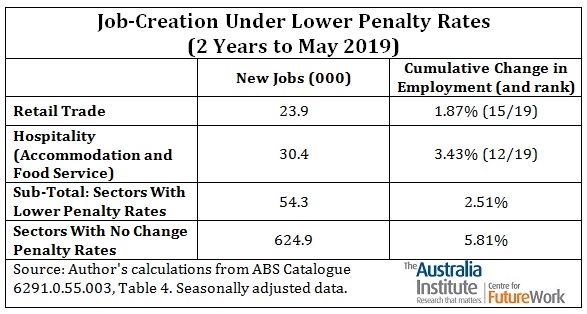
    Employers argued before the Fair Work Commission that if their Sunday and holiday labour costs were reduced, they would hire more workers, and the Commission cited this logic in accepting employer demands for lower penalties. Now, with two full years of experience since the first reductions, there is growing evidence that the penalty rate reductions have not spurred job creation in retail and hospitality. To the contrary, our new report shows that employment growth in retail and hospitality has been far slower than in other parts of the economy (where penalty rates remained constant) — and job-growth in the two sectors actually slowed by more than half after penalty rates began to fall.

    This briefing paper, authored by Dr Jim Stanford (Director and Economist of the Centre for Future Work) reviews disaggregated employment statistics for 19 Australian industries in the two years after the first penalty rate reductions were imposed on 1 July, 2017.

    The retail sector created 24,000 new jobs in the two years since 1 July 2017, and the broad hospitality sector (including accommodation and food & beverage services) created 30,000. In both cases, over 100% of the new jobs were part-time — both sectors actually shed full-time work during this period. The rate of job-creation was less than half as fast during the last two years in both sectors, as it had been in the two years before penalty rate cuts began — even though the pace of job-creation in the broader economy accelerated during the last two years.

    Penalty Rate Chart

    The retail sector ranked 15th out of 19 sectors in job-creation over the past two years; hospitality ranked 12th. Their combined rate of job-creation (up by 2.5% over the two years) was less than half the combined rate of job-creation in the 17 sectors which had no change in penalty rates. 92% of all jobs created in the last two years were created in sectors with constant penalty rates. The two sectors with reduced penalty rates created just 8% of new jobs in this period — even though they accounted for 18% of total employment at the time the penalty rate reductions began.

    It is clear that lower penalty rates have not ignited new hiring in either of these sectors. Instead, job-creation in both sectors has deteriorated well below economy-wide averages in this period. Clearly it takes more than cheapening labour costs to create jobs. Stronger consumer spending (a goal which would be supported by higher wages, not lower wages) is far more important to hiring decisions in these two domestic service industries.


    Full report

    Share