Tag: Jim Stanford

  • Webinar: Protecting Jobs and Incomes During the Pandemic

    Webinar: Protecting Jobs and Incomes During the Pandemic

    by Jim Stanford

    Share

    The COVID-19 pandemic is producing an unprecedented shutdown of large parts of the national and global economies. Our Director Dr. Jim Stanford provided an overview of the coming recession, how it differs from previous downturns, and the best ways for government to respond to protect Australians as much as possible from the economic fall-out.

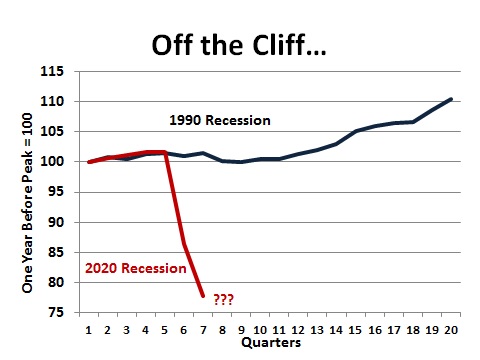
    Jim titled his presentation “Off the Cliff”, highlighting that the immediate shutdown of so much of Australia’s work and production is producing an economic contraction unlike anything experienced in history.

    Comparing Recessions

    Watch a video recording of the webinar:

    And/or download Jim’s slides below.

    This webinar was part of the Australia Institute’s weekly pandemic webinar series.


    Related documents


    Presentation slides

    You might also like

    Dutton’s nuclear push will cost renewable jobs

    by Charlie Joyce

    Dutton’s nuclear push will cost renewable jobs As Australia’s federal election campaign has finally begun, opposition leader Peter Dutton’s proposal to spend hundreds of billions in public money to build seven nuclear power plants across the country has been carefully scrutinized. The technological unfeasibility, staggering cost, and scant detail of the Coalition’s nuclear proposal have

  • Open Letter From Economists and Policy Experts: Wage Subsidy to Protect Jobs During Pandemic

    Open Letter From Economists and Policy Experts: Wage Subsidy to Protect Jobs During Pandemic

    by Jim Stanford

    Share

    109 Australian economists and policy experts have signed an open letter, initiated by the Centre for Future Work, supporting a government wage subsidy to prevent mass unemployment during the coming economic downturn resulting from the COVID-19 pandemic.

    The letter and the full list of signatories is reprinted below. It has been forwarded to Prime Minister Morrison.

    Public Statement from Economists and Public Policy Experts:

    A Wage Subsidy to Protect Jobs During the Coronavirus Shutdown

    The unprecedented public health measures required to deal with the COVID-19 pandemic are causing a dramatic shutdown of work and production in several key sectors of Australia’s economy. Immediate full or partial closures of activity are occurring in several consumer-facing industries (such as hospitality, retail, airlines, recreation and personal services). But before long, spillover losses will be experienced in other sectors, too: including wholesale trade and logistics, manufacturing, business services, education, and others. Consumer and business confidence has been deeply shocked, and that will magnify the negative economic effects of the pandemic.

    The coming recession will be unprecedented in Australian history – in both its speed and its depth. Without immediate action, we expect that 1-2 million workers, or even more, could lose their jobs in coming weeks. That would drive unemployment to 15% or higher, overwhelm income support programs, and leave hundreds of thousands of businesses unable to function – even after the immediate health danger passes.

    This is a dangerous and dramatic moment in Australia’s economic history. It is imperative that the federal and state governments act immediately and powerfully to protect Australian workers and businesses from the worst of the coming downturn. Important steps have been taken to expand access and benefit levels for income support payments to Australian workers (including casuals, contractors, and gig workers) losing work because of the pandemic. This is a helpful, but on its own inadequate, response. Government must also act forcefully to prevent mass job losses in coming weeks – not just provide support to those who do lose work.

    In this regard, we recommend that the Commonwealth government immediately implement a large-scale wage subsidy scheme, similar to those already enacted in several other industrial countries (including, variously, the UK, Denmark, New Zealand, the Netherlands, South Korea, and Ireland). Under these programs, government directly pays to employers (for a limited period of time) a majority portion of wages (between 70 and 90%) to cover the wages of workers who would otherwise be stood down from their positions. The measure can apply to non-standard workers (including contractors and self-employed). It can also be integrated with measures to support short time working as an alternative to complete redundancy. The wage subsidy is paid to firms experiencing severe losses of revenue and business (beyond a specified threshold). It would cover most of the wage bills for workers who can no longer work for economic reasons, up to a specified ceiling (perhaps the level of full-time median earnings). This program will be expensive – but governments everywhere have recognised that this unprecedented crisis requires them to do everything in their power to protect people, jobs, communities and the economy.

    To date, Australia’s response to the pandemic has been uncertain, inconsistent and inadequate. Immediate, powerful action to keep millions of Australians in their jobs, instead of pushing them into an overloaded and complex Centrelink system, would significantly ease the pandemic’s painful economic effects. It would underpin financial stability for millions of households through the coming terrible weeks or months. And it would preserve the viability of hundreds of thousands of Australian businesses, allowing them to resume work and production as soon as the health restrictions are eased.

    We the undersigned support the proposal for a strong wage subsidy program to keep workers in employment through the coming downturn, and we urge the Commonwealth government to implement such a policy quickly.

    Download full list of signatories below.


    Related documents


    List of signatories

    You might also like

    Dutton’s nuclear push will cost renewable jobs

    by Charlie Joyce

    Dutton’s nuclear push will cost renewable jobs As Australia’s federal election campaign has finally begun, opposition leader Peter Dutton’s proposal to spend hundreds of billions in public money to build seven nuclear power plants across the country has been carefully scrutinized. The technological unfeasibility, staggering cost, and scant detail of the Coalition’s nuclear proposal have

  • Submission to the 2020 annual wage review

    Submission to the 2020 annual wage review

    by Jim Stanford

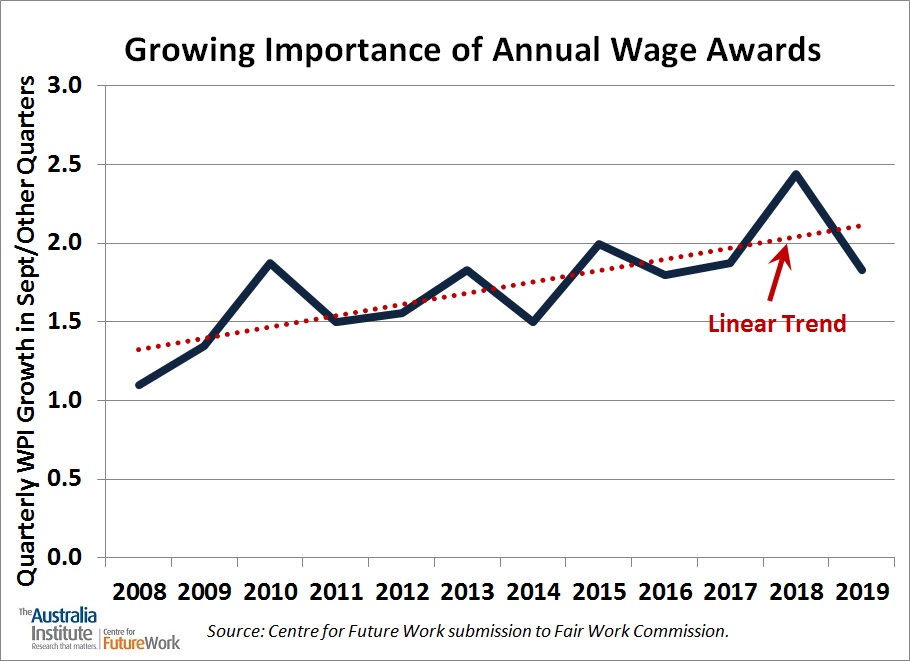
    The Centre for Future Work has made a submission to the 2020 annual wage review conducted by the Fair Work Commission. The submission compiles evidence showing that the annual minimum wage adjustments (which flow through into wages specified in the Modern Awards, as well as some enterprise agreements and individual contracts) have played a more important role in recent years in supporting the overall level of wage growth in Australia’s labour market. Without relatively strong minimum wage increases since 2017 (of 3% or higher for three consecutive years), Australian wage growth would still be languishing at all-time record lows of under 2% per year.

    In this context, the Centre argued it is vital the Commission proceed with a normal, healthy minimum wage increase for 1 July, 2020, with full flow-through into Award wages. Otherwise wage growth will slump significantly (to an estimated 0.7%, or even lower), heightening the risk of economy-wide deflation.

    The submission also provided new analysis on the seasonal pattern of wage growth in Australia’s labour market. In recent years, quarterly wage growth has been twice as strong in the quarter that contains the annual wage award, as in the rest of the year. That attests to the growing structural importance of the annual award in supporting wages, and preventing wage growth from falling even lower.

    September Quarterly Wage Premium

    The Centre’s submission was reported in the Australian Financial Review, and other media.


    Full submission

    Share

  • The Same Mistake Twice

    The Same Mistake Twice

    The Self-Defeating Consequences of Public Sector Pay Freezes
    by Troy Henderson and Jim Stanford

    New research from the Australia Institute’s Centre for Future Work reveals the consequences of freezing public service pay, both for public sector workers and for the broader economy.

    Governments are devoting unprecedented resources to protecting Australians against the health and economic effects of the pandemic, but a contradictory push to adopt fiscal austerity measures is also becoming apparent. Leaders of governments at all levels — federal, state and local council — have already announced plans to freeze wages and cancel previously agreed pay raises for public servants.


    Full report

    Share

  • Responding to the Economic Emergency

    Originally published in New Matilda on March 21, 2020

    The scale and scope of the economic downturn caused by COVID-19 will be unprecedented in our lifetimes. Mainstream economists have belatedly realised the pandemic will cause an economic downturn, but they are not yet appreciating the size of that downturn, nor the unconventional responses that will be required. Simply calling for government “stimulus” is sadly inadequate, given the complete shut-down of work and production that is occurring in many sectors of the economy. The task is no longer supporting markets with incremental “pump-priming.” What’s needed is a war-like effort, led by government, to mobilise every possible resource to protect Australians’ health and livelihoods. Money is not an object – and this epic effort should not be held back by normal acquiescence to private-sector priorities and decisions.

    That’s the core message of new analysis by Centre for Future Work Director Dr. Jim Stanford, published today by the Australian journal New Matilda.

    Stanford’s article outlines the immediate economic measures needed to both confront the health emergency and prevent households and firms from collapsing:

    • Immediate mobilization of resources to protect health: including more staff at health facilities, quick deployment of off-site and mobile testing capacities, home support for people quarantined or recovering, and quick expansion of equipment and facilities where possible.
    • Income protection for workers: including for casuals, self-employed, gig-workers, and many part-timers who don’t have effective access to sick pay. Incomes must be protected for all workers (regardless of employment status), through mandated special payments (as proposed by the ACTU).
    • Other direct income supplements: similar to the one-time payments distributed in 2009, as well as more targeted aid (like higher Newstart).
    • Debt relief and business assistance: emergency financing will be needed to keep firms viable in many industries (including airlines, other transportation, tourism, and hospitality). Other parts of society also need protection from creditors; foreclosures and evictions should be prohibited, and other personal and credit card debts deferred.

    But Stanford also discusses the longer-run challenge that will face the Australian economy: the pandemic is imposing a shock that is far too powerful and all-encompassing for private market players to autonomously recover from. The economy will need unprecedented and lasting investments by government to repair and expand public infrastructure and services, and directly put Australians back to work:

    “There is enormous need for urgent rebuilding required in our economy and our communities. Repairing and strengthening health care infrastructure comes first, but other priorities, too, are urgent: like sustainable transit, green energy, non-market housing, aged care and early child education. The case for mobilising resources under the leadership of governments and public institutions, and employing millions of Australians to do that work, is compelling. We can repair the damage of this crisis (and better prepare for the next one), deliver valuable services, and create millions of jobs. All we need is the willingness to imagine a different model of organizing and leading economic activity.”

    Please read the full article, We Need Wage Guarantees And Radical Restructure, Not More ‘Stimulus’, published by New Matilda.


    You might also like

    Dutton’s nuclear push will cost renewable jobs

    by Charlie Joyce

    Dutton’s nuclear push will cost renewable jobs As Australia’s federal election campaign has finally begun, opposition leader Peter Dutton’s proposal to spend hundreds of billions in public money to build seven nuclear power plants across the country has been carefully scrutinized. The technological unfeasibility, staggering cost, and scant detail of the Coalition’s nuclear proposal have

    Centre For Future Work to evolve into standalone entity

    The Centre for Future Work was established by the Australia Institute in 2016 to conduct and publish progressive economic research on work, employment, and labour markets. Supported by the Australian Union movement, the centre produced cutting edge research and led the national conversation on economic issues facing working people: including the future of jobs, wages

  • Gender Inequality in Australia’s Labour Market: A Factbook

    Gender Inequality in Australia’s Labour Market: A Factbook

    by Alison Pennington and Jim Stanford

    While women have made some progress in closing the wage gap and other dimensions of gender inequality in Australia, they still face daunting and persistent barriers to their full participation and compensation in Australia’s economy.

    That’s the conclusion from a new factbook on gender economic inequality in Australia, released by the Centre for Future Work to coincide with International Women’s Day on 8 March.

    The factbook compiles evidence on over 60 different statistical indicators of gender inequality in Australia, organised into 18 different subject groupings. It paints a composite picture of how women are blocked from full participation in work and economic activity, experience greater precarity in employment, are paid less for their efforts, and experience other forms of exploitation (including violence and sexual assault in workplaces).

    Some of its more startling findings include:

    • The true wage gap between women and men is much larger than often reported. The commonly-cited gender wage gap of 14% only applies to women working in full-time positions, and excludes bonuses and overtime payments. However, women have less access to full-time jobs, and receive far less bonus and supplementary income than men. The gender gap in total wage income is 32% – more than twice as wide.
    • Women are much more subject to precarious and insecure work arrangements than men. They are far more likely to be employed in part-time, casual, and temporary positions than men. Only 43% of employed Australian women work in a traditional full-time permanent job with normal entitlements (such as paid sick leave, holidays, and superannuation). The rest all experience one or more dimensions of precarity in their jobs. That compares to 57% of men in permanent full-time jobs with entitlements.
    • Women who undertake self-employment are especially vulnerable. The report shows that 47% of self-employed women are in vulnerable business positions: working part-time, and working either without incorporation or without any other employees (or both). That compares to 19.% of self-employed men.
    • Women are now more likely to be members of a union than men, and make up more than half of union members. Women who are in a union earn 29% more per week than women who are not in a union. For part-time workers, the union advantage is even bigger: women union members earn 44% more than non-members

    “The statistical evidence is overwhelming that women are a long way from achieving equality in Australia’s workplaces,” said Alison Pennington, Senior Economist at the Centre for Future Work and co-author of the factbook.

    “These systemic and structural barriers to full participation and fair compensation are holding Australian women back and our economy is weaker for it.

    “Australian women need to be able to work and earn to their full potential. This requires powerful measures to support women workers in all aspects of their lives; from quality affordable childcare to much stronger protections against violence and sexual harassment.”


    Full report

    Share

  • Financialisation and the Productivity Slowdown

    Financialisation and the Productivity Slowdown

    by Anis Chowdhury

    There has been much discussion in recent months about the apparent slowdown in Australian productivity growth. Rather than dredging up the usual wish-list of the business community (more deregulation, more privatisation, and more deunionisation), it’s time to look at the deeper, structural factors behind stagnant productivity. In this commentary, Dr. Anis Chowdhury, Associate of the Centre for Future Work, looks to the perverse role of our overdeveloped financial sector in slowing down productivity-enhancing investment and innovation.

    Financialisation and the Productivity Conundrum

    by Anis Chowdhury

    There has been much angst at the slower or stagnant productivity growth experienced recently in Australia. Ross Gittins, the Sydney Morning Herald’s much respected Economics Editor, summarised some of the discussions reflecting on the causes and remedies of the productivity problem in his recent piece, ‘Productivity problem? Start at the bottom, not the top’ (SMH, 2 March 2020).

    The phenomenon of slow productivity growth is neither unique to Australia nor recent. It has been observed globally over the past few decades, especially in the developed world, as highlighted in recent reports on global economic health (e.g. United Nations, World Economic Situation and Prospects 2020, and the World Bank’s Global Economic Prospects 2020). The trend accelerated since the global financial crisis (GFC) of 2008-2009, as emphasised by Maurice Obstfeld, IMF’s former Chief Economist, at the joint BIS-IMF-OECD conference on weak productivity (10 January 2018).

    The UN report notes that “as firms around the globe have become more reluctant to invest, productivity growth has continued to decelerate.” It attributes much of the slowdown to significantly lower contributions from capital deepening (investment in machinery, technology, etc.). Subdued productivity growth is also proposed as one of the reasons for slow growth of real wages and falling share of labour income in GDP, contributing to rising inequality – although even more rapid productivity growth is no guarantee, of course, of rising wages or greater equality.

    The World Bank report observes that to rekindle productivity growth, a comprehensive approach is necessary for “facilitating investment in physical, intangible, and human capital; encouraging reallocation of resources towards more productive sectors; fostering firm capabilities to reinvigorate technology adoption and innovation; and promoting a growth-friendly macroeconomic and institutional environment.”

    While similar observations can also be found in the OECD and IMF reports, none offer explanations as to why this is happening, that reach beyond orthodox excuses – like  uncertainty due to Brexit and US-China trade tensions. The Bank of International Settlements (BIS), OECD and IMF also included such factors as unconventional monetary policy (very low or negative real interest rates) and financial frictions (e.g. firm-level financial fragilities and tightening credit conditions) as possible causes of weak investment and the productivity slowdown since the GFC.

    Financialisation

    However, one can trace the deeper cause of the long-term declining trend in productivity growth since the 1970s to financialisation: that is, the dominance of finance over the real economy. This is visible globally in the increasing role of financial motives, financial markets, financial actors and financial institutions in the operation of the domestic and international economies.

    Beginning with the collapse of the Bretton Woods system in August 1971, when President Nixon unilaterally withdrew US commitment to gold convertibility of currencies, the process of financialisation gathered pace in the 1980s. This coincided with the neoliberal counter revolution against Keynesian economics, and the coming to power of Margaret Thatcher in the UK and Ronald Reagan in the US. All this ushered in an era of multinational corporation-led globalisation. In turn, this led to rapid growth of international trade, foreign direct investment and capital flows – all mutually reinforcing – and the consolidation of finance’s domination over the real economy.

    Several features of this era of financialisation have direct implications for productivity. They include:

    • Rapid expansion of financial markets, and the proliferation of financial institutions, instruments and services with the de-regulation and liberalisation of the financial system, blurring the distinction between speculative and patient investors;
    • The banking sector becoming more concentrated, less regionalised and more internationalised with the decline of mutual, co-operative and State ownership of banks and financial institutions;
    • Financial intermediation shifting from banks and other institutions to financial markets, thus the axiomatic ‘invisible hand’ of supposedly anonymous, self-regulating financial markets replacing the ‘visible hand’ of relationship banking;
    • Nonfinancial corporations increasingly deriving profitability from their financial as opposed to their productive activities;
    • Financial institutions increasingly becoming owners of equity, and real decision-making power shifting from corporate boardrooms to global financial markets pursuing shareholder value;
    • Managerial remuneration packages increasingly becoming linked to short-term profitability and share price performance rather than to longer-term growth prospects.

    These features, by and large, have adversely affected levels of real capital investment and innovation, due to the inexorable pressure of financial interests for the pursuit of short-term profits and dividends. Shareholders (most of whom are financial institutions) demand from corporations a bigger, faster distribution of profits. The lower retention of profits ratio, and share buybacks to boost share price together imply reduced internal finance for real investment, R&D, and technology upgrading.

    Corporate managers act in the interests of the financial sector as they too profit personally from increasing stock market valuations – often linked to reduction of employment. This has meant chronic job insecurity and underinvestment in on-the-job training. Increased insecurity also discourages workers to invest in their own skill upgrading.

    Thus, the overall effect of financialisation on investment, technology adoption, skill upgrading has been negative, with adverse consequences for productivity and decent jobs.

    Misallocation

    An overgrown financial system also costs the economy on a daily basis by attracting too many talented workers to ultimately unproductive careers in the financial sector. Talented students are disproportionately attracted to finance courses in preference to liberal arts or social sciences; moreover, bright engineering and science graduates are increasingly engaged in the financial sector, where they can earn many times more. Research at BIS shows that when skilled labour works in finance, the financial sector grows more quickly at the expense of the real economy – disproportionately harming R&D intensive industries.

    In his Fred Hirsch Memorial Lecture (15 May 1984), Nobel Laureate James Tobin doubted the value of “throwing more and more of our resources, including the cream of our youth, into financial activities remote from the production of goods and services, into activities that generate high private rewards disproportionate to the social productivity.”

    Rent seeking

    Luigi Zingales titled his 2015 presidential address to the American Finance Association, ‘Does finance benefit society?’. While acknowledging the need for a sophisticated financial sector, he doubted whether the growth of the financial sector in the last forty years has

    been beneficial to society. He argued on the basis of both theory and empirical evidence that a large component of that growth has been pure rent seeking.

    According to Gerry Epstein and Juan Antonio Montecino, the  US financial sector captured rents “through a variety of mechanisms including anticompetitive practices, the marketing of excessively complex and risky products, government subsidies such as financial bailouts, and even fraudulent activities… By overcharging for products and services, financial firms grab a bigger slice of the economic pie at the expense of their customers and taxpayers.”

    Robert Jenkins listed more ‘misdeeds’ of UK banks. These range from mis-selling (e.g. of payment protection insurance, interest rate swaps), manipulation of markets (e.g. precious metals markets, US Treasury Market auction/client sales, energy markets), aiding and abetting tax evasion and money laundering for violent drug cartels, collusion with Greek authorities to mislead EU policy makers on meeting Euro criteria, and more.

    All this sounds too familiar to us in Australia after the Hayne Royal Commission into misconduct in the financial services industry.

    A drag on the real sector

    The power of finance has become a drag on the development of the real sector in a number of ways.

    First, the manner in which the financial sector has grown has not been conducive for

    real investment and savings. Finance has failed to act as an intermediary between savers and investors, and to allocate and monitor funds for real investment.

    Second, the growth of financial markets and speculation have diverted resources into

    what are essentially zero-sum games.

    Third, the rush to financial liberalisation and the failures of the regulatory systems produced more frequent financial crises, with increasing depth and width. An over-abundance of (cash) finance is used primarily to fund a proliferation of short-term, high-risk investments in newly developed financial instruments, such as derivatives — Warren Buffett’s ‘financial weapons of mass destruction’ that blew up the global financial system in 2007–08.

    Thus, real capital formation which increases overall economic output has slowed down, as profit owners, looking for the highest returns in the shortest possible time, reallocate their investments to more profitable financial markets.

    With financial speculators now panicking in the face of the spread of the COVID-19 virus, in the context of inflated and debt-heavy financial valuations, we could be poised for another chapter in this repeating saga.

    Way out

    No amount of corporate tax cuts or suppression of labour rights in the name of structural reform will solve the productivity conundrum. What is really required is the taming of finance.

    Finance can positively contribute to economic progress, but only when the ‘ephor’ is ‘governed’ and ‘directed’ by State regulation to structure accumulation and distribution into socially useful directions.

    The earlier era of financialisation during the late 19th century and early 20th century ended with the Great Depression. John Maynard Keynes wrote in ‘The Grand Slump of 1930’, “there cannot be a real recovery . . . until the ideas of lenders and the ideas of productive borrowers are brought together again . . . .”. He thought, “seldom in modern history has the gap between the two been so wide and so difficult to bridge.”

    Fortunately, the policymakers listened to Keynes and regulated finance to serve the real economy. This produced nearly three decades of the ‘golden age’ of capitalism, ending in the 1970s.

    But the gap between finance and the real economy is now even wider and more difficult to bridge. It will require a lot of political will and courage to confront the very powerful finance capital which has changed the rules of the game to facilitate rent-seeking practices of a self-serving global elite.

    Dr. Anis Chowdhury is an Adjunct Professor at Western Sydney University (School of Social Sciences) and the University of New South Wales (School of Business, ADFA), and an Associate of the Centre for Future Work.

    You might also like

  • The Long-Term Consequences of Wage Freezes for Real Wages, Lifetime Earnings, and Superannuation

    The Long-Term Consequences of Wage Freezes for Real Wages, Lifetime Earnings, and Superannuation

    by Jim Stanford

    New research from the Centre for Future Work has dramatised the lasting consequences for workers’ lifetime incomes – even after they retire – of wage freezes.

    A wage freeze is often described as a “temporary sacrifice,” that supposedly ends once normal annual wage increments are restored. However, this report confirms that the legacy of even a temporary pay freeze is a permanent reduction in lifetime incomes and superannuation, which can easily ultimately result in hundreds of thousands of dollars of lost income. These long-term effects are illustrated with reference to a real-world example: an 18-month pay freeze imposed on workers at Jetstar in 2014-2016.

    Many Australian employers have frozen the pay of their workers in recent years, typically justified on grounds of temporary financial duress. However, those pay freezes have a lasting negative impact on the long-run trajectory of wages. As a result, workers lose tens of thousands of dollars of income through the rest of their careers. To cap the losses, employers must implement special one-time catch-up pay increases to restore the pre-freeze trajectory of wages.

    To illustrate the lasting, cumulative impact of pay freezes on workers’ lifetime incomes, a new Briefing Paper from the Centre for Future Work considers the case of an 18-month wage freeze implemented in 2014-16 by Jetstar. The pay freeze was implemented amidst financial losses at the airline. However, since then the airline (and its parent firm, Qantas) have returned to strong profitability, and executive compensation has soared. Normal 3% wage increases were restored beginning March 2016, and a one-time bonus payment was made at that time as “compensation” for the sacrifice of Jetstar workers. But the current incomes of Jetstar workers are still thousands of dollars per year lower than if the pay freeze had not been imposed.

    The report considers three distinct categories of losses resulting from a pay freeze:

    1. Loss of real purchasing power while the freeze is in effect.
    2. Loss of future income resulting from the permanent downward shift in pay trajectory.
    3. Loss of superannuation contributions and investment income resulting from lower pay.

    The report quantifies these cumulating costs for the case of the pay freeze at Jetstar. Jetstar workers could lose $150,000 or more in cumulative earnings by the time they retire, despite the restoration of annual wage increments after 2016 and the one-time bonus. Moreover, workers’ superannuation accounts will also be suppressed accordingly: because of lower employer contributions (resulting from lower earnings) and lost investment income. On the basis of typical investment performance, the report estimates potential superannuation losses of $40,000 or more by the time Jetstar workers retire. Some workers could lose over $200,000 in lifetime incomes and superannuation because of the “temporary” wage freeze.

    The only way to stop these ongoing losses from getting bigger (let alone to compensate workers for losses already incurred) is to implement additional catch-up wage increases that bring wages back to their pre-freeze trajectory. In the case of the Jetstar wage freeze, that would require a one-time increase of 6.1%.

    The Jetstar case is just one of many instances of wage freezes being imposed on Australian workers in recent years, in both the private and public sector. The legacy of those wage freezes contributes to the ongoing stagnation of real wages in the Australian labour market, and to the historic shift in income distribution away from workers and toward businesses and investors. While it may seem as if a wage freeze is a “temporary” sacrifice, without offsetting catch-up adjustments it nevertheless continues to impose ongoing economic harm on affected workers.


    Full report

    Share

  • Meet the New Boss, Same as the Old Boss

    Originally published in Canadian Dimension on February 11, 2020

    In a new guest commentary for the journal Canadian Dimension, Centre for Future Work Director Jim Stanford argues that existing power relationships in the labour market are being reinforced, more than disrupted, by the process of technological change.

    Stanford highlights seven ways in which the nature of work and employment is demonstrating a fundamental continuity, despite changes in technology and work organisation: ranging from the predominance of wage labour in the economy, to employers’ continuing interest in extracting maximum labour effort for the least possible labour cost.

    “I have started to conclude there is more constancy than change in the world of work. In particular, the central power relationships that shape employment in a capitalist economy are not fundamentally changing: to the contrary, they are being reinforced… As a result, I suspect the future of work will look a lot like its past, at least as it has existed over the past two centuries. Where work is concerned, it is truly a case of ‘back to the future.’”

    Stanford rejects the common assumption that changes in employment relationships (such as the rise of “gig” jobs, and other forms of precarious work) are driven primarily by technology–stressing instead the importance of discrete choices within enterprises and society as a whole about what kinds of technology are developed, and how they are implemented. Improvements in work are certainly possible, but only when workers are able to exert active, organised pressure on employers and governments.

    Please read Stanford’s full commentary, Meet the New Boss, Same as the Old Boss (‘Who’ soundtrack optional!).


    You might also like

    Centre For Future Work to evolve into standalone entity

    The Centre for Future Work was established by the Australia Institute in 2016 to conduct and publish progressive economic research on work, employment, and labour markets. Supported by the Australian Union movement, the centre produced cutting edge research and led the national conversation on economic issues facing working people: including the future of jobs, wages

  • Seminar Presentation: Superannuation & Wages in Australia

    Seminar Presentation: Superannuation & Wages in Australia

    by Jim Stanford

    Share

    Centre for Future Work Director Jim Stanford gave a seminar presentation in Sydney on 21 November based on his research paper about the historical and empirical relationship between superannuation contributions and wage growth.

    Watch a summary version of his talk below.

    The full paper is posted at: The Relationship Between Superannuation Contributions and Wages in Australia.


    Related research

    You might also like

    Centre For Future Work to evolve into standalone entity

    The Centre for Future Work was established by the Australia Institute in 2016 to conduct and publish progressive economic research on work, employment, and labour markets. Supported by the Australian Union movement, the centre produced cutting edge research and led the national conversation on economic issues facing working people: including the future of jobs, wages