Tag: Charlie Joyce

  • Rough times ahead for Australia’s economy as oil, gas and coal companies celebrate

    Originally published in The Guardian on November 24, 2022

    The latest economic outlook from the OECD highlights the precarious path for Australia over the next few years.

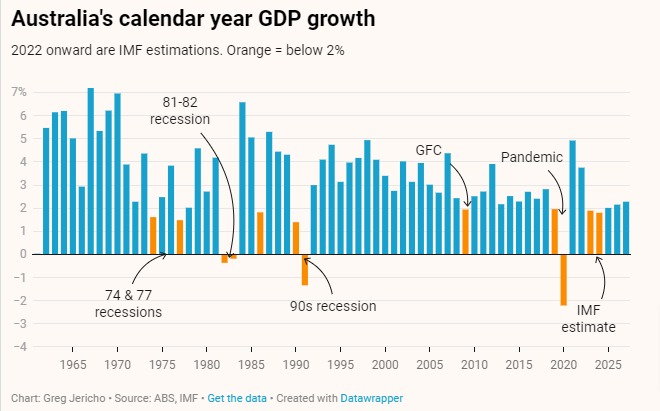
    As Labour market and Fiscal Policy Director, Greg Jericho, notes in in his Guardian Australia column, the OECD predicts in both 2023 and 2024 Australia’s economy will grow by less than 2%. In the past such weak growth has been associated with recessions. And while a recession is not predicted, unlike for the UK and Germany, the OECD also notes the risks that lie ahead.

    One major problem is that most nations around the world are lifting interest rates to attempt to slow their economies and thus reduce inflation. The OECD notes however that when nations act in concert the impact of higher interest rates on slowing the economy is greater, while the impact on slowing inflation is weaker.

    Given Australia has a higher proportion of mortgage holders with variable rates this increases the risk that higher interest rates will slow our economy more than in other nations, and still have less impact on inflation.

    But one sector of the economy are rejoicing at the current conditions that are causing the rising inflation – energy companies.

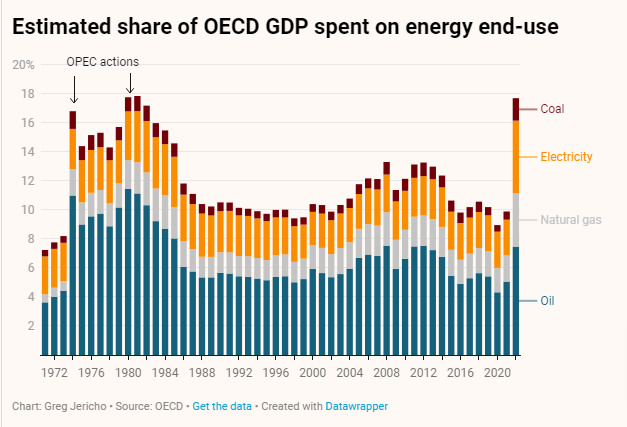
    The OECD notes that the share of GDP being spent on energy by OECD nations is higher now than it was during the OPEC crisis in 1974 and 1980. The evidence again is clear that a windfall profits tax should be levied on coal, oil and gas companies who a reaping massive profits while the cost of living rises sharply for households.


    You might also like

    Australia’s Gas Use On The Slide

    by Ketan Joshi

    The Federal Government has released a new report that includes projections of how much gas Australia is set to use over the coming decades. There is no ambiguity in its message: Australia reached peak gas years ago, and it’s all downhill from here:

    Dutton’s nuclear push will cost renewable jobs

    by Charlie Joyce

    Dutton’s nuclear push will cost renewable jobs As Australia’s federal election campaign has finally begun, opposition leader Peter Dutton’s proposal to spend hundreds of billions in public money to build seven nuclear power plants across the country has been carefully scrutinized. The technological unfeasibility, staggering cost, and scant detail of the Coalition’s nuclear proposal have

  • Job Opening: Carmichael Distinguished Research Fellow

    Job Opening: Carmichael Distinguished Research Fellow

    by Jim Stanford

    Share

    The Carmichael Centre at the Centre for Future Work invites applications for the Laurie Carmichael Distinguished Research Fellow position. It’s a three-year posting, with awesome potential to explore a range of progressive issues related to unions, collective bargaining, industrial policy, and workers’ education.

    Applications are due at 11:59 pm 21 November 2022. The Melbourne-based position will start in January. Please see job description and application details below. Come and join our team!

    *   *   *   *   *

    The Carmichael Centre is a project housed within the Centre for Future Work at the Australia Institute, to acknowledge the legacy of former union leader Laurie Carmichael. Laurie passed away in 2018 after a lifetime of outstanding service and innovative leadership to the trade union and social justice movements in Australia. His legacy touches on numerous themes that remain relevant and pressing today, including:

    • The importance of active industrial policy to develop Australia’s value-added industries.
    • The importance of skills and vocational education to a strong economy and labour market.
    • The importance of strong union education programs to the development of an effective and vibrant cadre of union leaders and activists.
    • The importance of shorter working hours and superannuation to the quality of life of working people.
    • The importance of actively integrating economic, labour market and social policies, in a multi-dimensional plan for achieving full economic and social equality.
    • The importance of peace and resistance to war.

    The Carmichael Centre is established to:

    • Increase public awareness of Laurie Carmichael’s life, achievements, and ideas.
    • Undertake and publish new research into themes relevant to Laurie’s legacy (including trade unionism, vocational education, and labour and social policy).
    • Contribute to modern efforts to educate trade unionists in political-economy and related subjects.
    • Celebrate the achievements of the union movement and inspire emerging leaders.

    To that end, the Carmichael Centre hosts a 3-year research and public education position, the Laurie Carmichael Distinguished Research Fellow, awarded to a mid-career or senior researcher in labour and industrial relations, political-economy, or a related field.

    The Fellow will undertake and publish new research, and undertake other educational and commentary activities, consistent with the themes and progressive vision expressed by Laurie Carmichael, and the goals of the Centre.

    The Fellow will be employed by the Australia Institute, and would work from our office in Melbourne.

    Compensation for the position will be consistent with experience of the successful candidate (and will include superannuation contributions and related employment expenses).

    Prospective candidates for the Fellow must demonstrate the following attributes:

    • Proven record of high-quality research and publication in fields relevant to the Carmichael Centre’s goals.
    • Demonstrated history of commitment to and engagement in the trade union movement.
    • Capacity and willingness to engage in the range of activities (including research, education, public commentary, and public events) that will be required of the role.

    Applicants are invited for the Carmichael Fellow. Applications must include a cover letter describing the applicant’s interest and experience in trade unionism and the themes relevant to the Carmichael Centre; a full resume (listing relevant experience and publications); and 2 letters of reference.

    Applications should be submitted electronically by 11:59 pm AEDT on Monday 21 November, 2022, to:

    recruitment@australiainstitute.org.au

    Only applicants selected for an interview will be contacted. Online interviews will be held in early December. The successful candidate will commence work in January, 2023.

    Thank you for your interest in the Carmichael Centre!


    You might also like

    Dutton’s nuclear push will cost renewable jobs

    by Charlie Joyce

    Dutton’s nuclear push will cost renewable jobs As Australia’s federal election campaign has finally begun, opposition leader Peter Dutton’s proposal to spend hundreds of billions in public money to build seven nuclear power plants across the country has been carefully scrutinized. The technological unfeasibility, staggering cost, and scant detail of the Coalition’s nuclear proposal have

  • Webinar on Wages, Prices, and Power

    Webinar on Wages, Prices, and Power

    Share

    The Australian Council of Trade Unions is sponsoring a series of webinars for union members, delegates, officials, and leaders on the current crisis in the cost of living in Australia. The surge in inflation since economic re-opening after COVID lockdowns has obviously intensified that crisis. But the seeds for it were planted long ago: by a decade of historically weak wage growth, a speculative property price bubble, and a systematic efforts to weaken collective bargaining and unionisation.

    Jim Stanford (Economist and Director) and Greg Jericho (Policy Director, Labour Market and Fiscal) from the Centre for Future Work are providing keynote presentations as part of this series. Below is a recording of the first of these presentations, presented by Jim.

    For other resources on inflation, how it is undermining real living standards for workers, and how to fix it (without throwing the whole economy into recession – an even bigger risk!), please see:

    The Wages Crisis: Revisited (Centre for Future Work overview of falling real wages, by Andrew Stewart, Jim Stanford, and Tess Hardy)

    An Economy That Works for People (ACTU Macroeconomics Discussion Paper)

    The Cure of Inflation Looks Worse than the Disease (latest Guardian Australia column by Greg Jericho)


    Related research

    You might also like

    Dutton’s nuclear push will cost renewable jobs

    by Charlie Joyce

    Dutton’s nuclear push will cost renewable jobs As Australia’s federal election campaign has finally begun, opposition leader Peter Dutton’s proposal to spend hundreds of billions in public money to build seven nuclear power plants across the country has been carefully scrutinized. The technological unfeasibility, staggering cost, and scant detail of the Coalition’s nuclear proposal have

  • With a global recession looming the cure of inflation looks to be worse than the disease

    Originally published in The Guardian on October 13, 2022

    This week the IMF released its latest World Economic Outlook. And the outlook is dire. Economic growth around the world was downgraded with recession-like conditions being predicted for many advanced economies including the USA, UK and much of the EU.

    As policy director, Greg Jericho, notes in his Guardian Australia column, the outlook is not much better for Australia. The IMF is now predicting that in 2023 and 2024 Australia’s GDP will grow less than 2%. Such meagre growth in the past has been consistent with periods of recession.

    The report should serve as a stark warning to central banks around the world that their efforts to limit inflation by sharply raising interest rates is becoming more and more likely to end with a recession and the resultant massive loss of jobs that will follow. Experience from the 1980s and 1990s where similar recessions followed extreme tightening of monetary policy suggests it can take a long time to reverse the damage.

    While the Reserve Bank is somewhat constrained because it needs to be mindful of the rate rises in the USA that weaken the value of the Australian dollar, the IMF report should cause them to weigh much more the costs of sharply slowing growth through interest rate rises.

    We know that current efforts to limit inflation growth are mostly involving workers taking a real wage hit. Having to endure rising unemployment and a recession after 2 years of already extreme falls in living standards would be disastrous, especially while profits continue to rise.


    You might also like

    Dutton’s nuclear push will cost renewable jobs

    by Charlie Joyce

    Dutton’s nuclear push will cost renewable jobs As Australia’s federal election campaign has finally begun, opposition leader Peter Dutton’s proposal to spend hundreds of billions in public money to build seven nuclear power plants across the country has been carefully scrutinized. The technological unfeasibility, staggering cost, and scant detail of the Coalition’s nuclear proposal have

  • The GDP figures show the ongoing shift of the national income to profits

    Originally published in The Guardian on September 8, 2022

    The June quarter GDP figures released by the Bureau of Statistics showed that over the past year the economy grew a seemingly strong 3.6%.

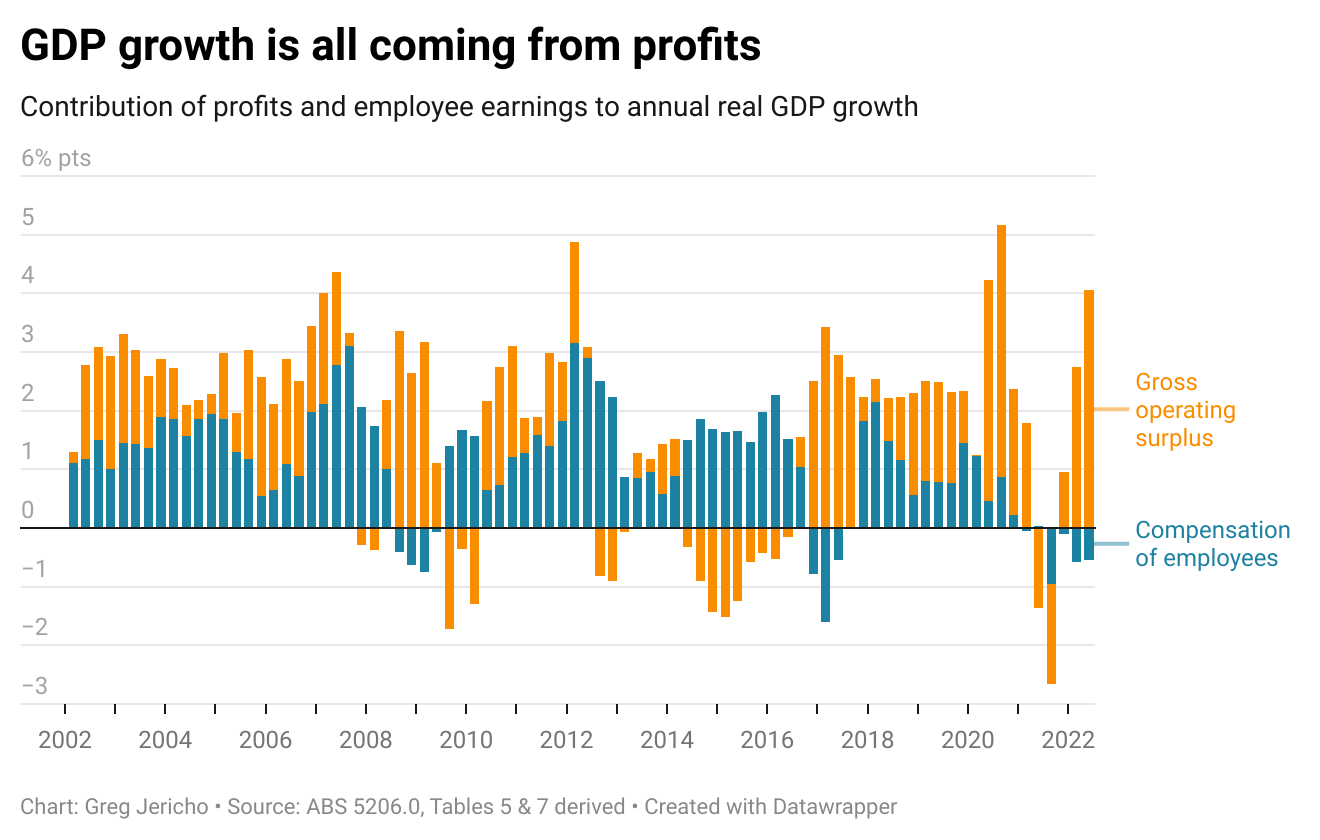
    But as labour market and fiscal policy director Greg Jericho notes in the Guardian Australia column, beneath those good numbers are a lot of problems, not the least of which is that wages continue to fail to keep up with inflation. Over the past year the total compensation of employees rose 7% but inflation in the national accounts rose 8.3%. Over the same period corporate profits went up 25%. We are at the absurd state of affairs where GDP is rising strongly, but real wages are not.

    We now have a situation where a record low share of national income is going to employees and a record high share is going to profits.

    The talk is always about lifting productivity and wages will follow, but the story for far too long now has really been productivity rising and profits following.


    You might also like

    Dutton’s nuclear push will cost renewable jobs

    by Charlie Joyce

    Dutton’s nuclear push will cost renewable jobs As Australia’s federal election campaign has finally begun, opposition leader Peter Dutton’s proposal to spend hundreds of billions in public money to build seven nuclear power plants across the country has been carefully scrutinized. The technological unfeasibility, staggering cost, and scant detail of the Coalition’s nuclear proposal have

  • Market power costs consumers, workers and the whole economy

    Originally published in The Guardian on August 25, 2022

    For most of the past 40 years whenever the discussion turns to the need to lift productivity, invariably the conversation is dominated by business groups and various media commentators who suggest the solution is more labour market flexibility. Just a bit more flexibility and productivity will improve!

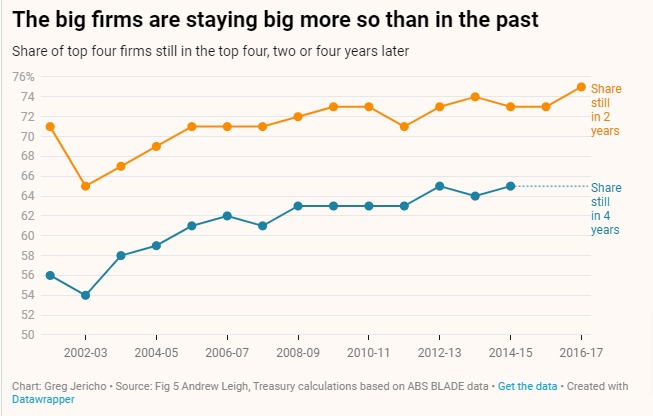
    But a speech by the assistant minister for competition, Andrew Leigh, reveals that businesses themselves and the way in which the major players are allowed to dominate industries is a significant drag on productivity growth.

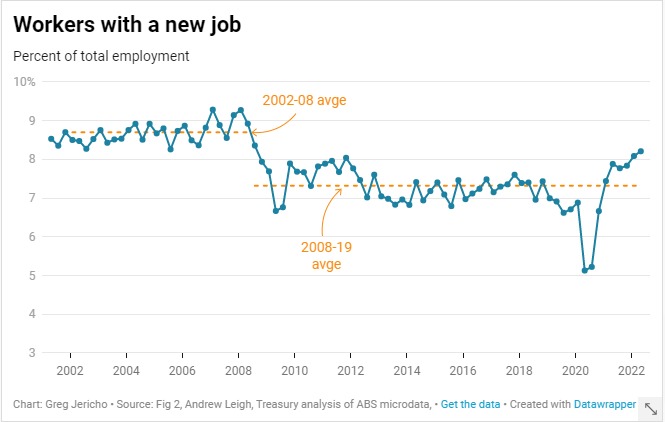
    In his Guardian Australia column, labour market and fiscal policy director Greg Jericho, reviews Dr Leigh’s speech and notes that over the past 20 years market concentration has increased across the whole economy. Over this time there has been a fall in the percent of new firms entering industries and also in established firms leaving. This produces a more sluggish economy where the need to innovate and pursue more productive operations is diminished. It also leads to firms being able to markup their prices by more each year as they consolidate their power, and also feel less need to offer better wages as the competition for labour falls.

    While wages growth crucially requires fair bargaining arrangements that enables workers to negotiate better wages, when workers have fewer options to pursue better paying jobs at other more productive workplaces, the number of workers switching jobs declines and so too does the market pressure to pay wages.

    Dr Leigh notes that this “decline in economic dynamism” needs greater policy focus, and his speech is an excellent corrective to the belief that improved productivity is all about taking away worker rights and giving more power to businesses to hire and fire.

    Australian business groups and many on the conservative side of politics love to talk up free-market competition, but the past 20 years has shown the markets are less about competition and more about concentration. And while profits have risen, workers and households have been left worse off.


    You might also like

    Dutton’s nuclear push will cost renewable jobs

    by Charlie Joyce

    Dutton’s nuclear push will cost renewable jobs As Australia’s federal election campaign has finally begun, opposition leader Peter Dutton’s proposal to spend hundreds of billions in public money to build seven nuclear power plants across the country has been carefully scrutinized. The technological unfeasibility, staggering cost, and scant detail of the Coalition’s nuclear proposal have

  • A decade of real wages growth lost as prices soar ahead of wages growth

    Originally published in The Guardian on July 28, 2022

    The latest inflation figures from the Bureau of Statistics reveal just how much workers have been left behind. Writing in Guardian Australia, labour market and fiscal policy director Greg Jericho notes that while the focus is on the biggest annual increase in inflation since the introduction of the GST, the data also shows that real wages have fallen drastically.

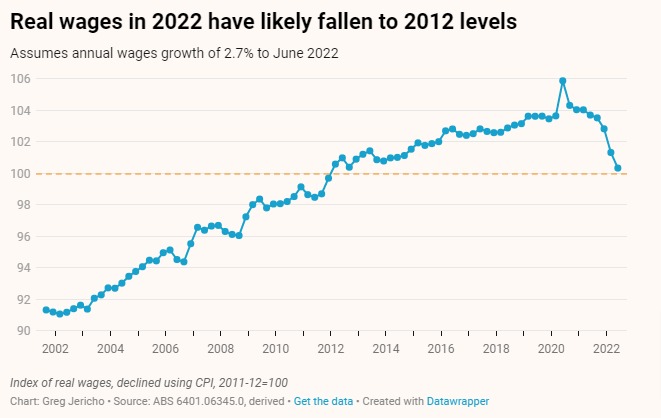
    Given prices grew 6.1%, but wages are expected only to achieve around 2.7% growth in the 12 months to June, it remains abundantly clear that inflation is not being driven by labour costs. Indeed given real wages have likely fallen around 3.4% in the past year, wages are currently extremely deflationary.

    Real wages have now fallen for 8 consecutive quarters sending the purchasing power of employees back to 2012 levels.

    While the economy has rebounded and profits have risen strongly with that of prices, the “recovery” from the pandemic has very much been on the backs of workers who have effectively lost a decade’s worth of growth in real wages.

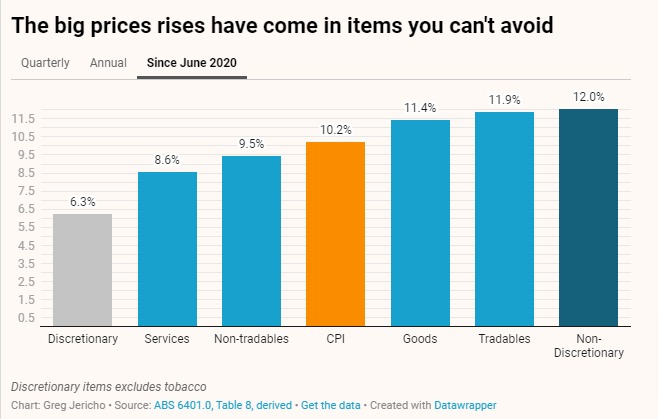
    Even worse, given the greatest price rises have occurred for essential commodities, it is clear low to median income workers are hurting much more than those who devote less of their spending on essentials than does the average household.

    All this is occurring with unemployment at near 50-year lows. It is now abundantly clear that the labour market systematically disempowers employees and needs to be reformed.


    You might also like

    Dutton’s nuclear push will cost renewable jobs

    by Charlie Joyce

    Dutton’s nuclear push will cost renewable jobs As Australia’s federal election campaign has finally begun, opposition leader Peter Dutton’s proposal to spend hundreds of billions in public money to build seven nuclear power plants across the country has been carefully scrutinized. The technological unfeasibility, staggering cost, and scant detail of the Coalition’s nuclear proposal have

  • The Job Summit needs to produce a fairer labour market

    Originally published in The Guardian on July 21, 2022

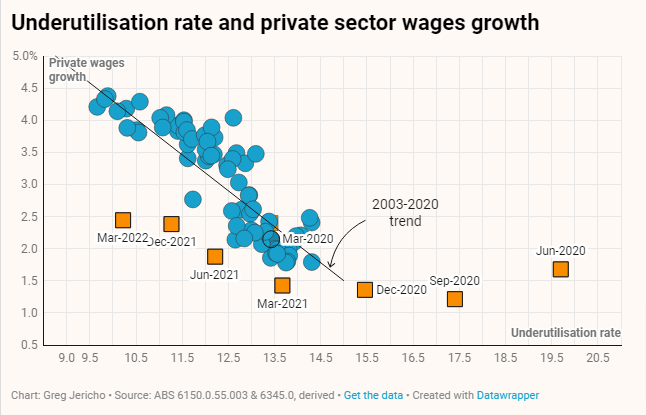
    Despite unemployment at nearly 50 years lows, it will be little surprise to workers that wages growth is only at 3 year highs. Over the past decade the relationship between wages growth and unemployment has shifted such that levels of unemployment that would have once seen wages growing at more than 4% are now associated with growth of well below 3%.

    This has not happened by accident or some “invisible hand” of the free market. Decades of industrial relations legislation has purposefully reduced the ability for workers to organise and bargain for better wages.

    Labour market policy director, Greg Jericho writes in Guardian Australia that we are now also seeing for the first time a shift in the relationship between wages and underutilisation.

    These changes have meant that employees are receiving ever smaller slices of the national income pie.

    The past 24 years have also displayed that theory of increasing productivity resulting in better wages, works better in the economic textbook than reality. In just 7 of those 24 years, have real wages outgrown productivity – and 4 of those year were because of highly unusual cases of productivity actually declining.

    The Job Summit in September needs to be a time for a reset – a time to acknowledge that the labour market is not fairly weighted and that workers are not getting their fair share.


    You might also like

    Dutton’s nuclear push will cost renewable jobs

    by Charlie Joyce

    Dutton’s nuclear push will cost renewable jobs As Australia’s federal election campaign has finally begun, opposition leader Peter Dutton’s proposal to spend hundreds of billions in public money to build seven nuclear power plants across the country has been carefully scrutinized. The technological unfeasibility, staggering cost, and scant detail of the Coalition’s nuclear proposal have

  • Profits push up prices too, so why is the RBA governor only talking about wages?

    Originally published in The Conversation on June 27, 2022

    Reserve Bank of Australia governor Phillip Lowe has invoked memories of the 1970s, warning wage growth must be restrained to contain Australia’s surging inflation.

    In the 1970s, Lowe said last week, “we got into trouble because wages growth responded mechanically to the higher inflation rate”. Now, with inflation above 5%, and tipped to reach 7% by the end of the year, he wants want people to keep in mind an “anchoring point” for wage growth of 3.5%.

    That 3.5% represents the central bank’s long-standing judgement that wage growth equal to the RBA’s ideal inflation target (2.5%) plus productivity growth (typically more than 1% a year, currently above 2%) is economically sustainable.

    Lowe says “if wage increases become common in the 4% and 5% range” that will make it harder to get inflation back to his target. But that prospect seems so remote it’s a wonder why he focused on it. Particularly when he said nothing about about the role of ever higher profits on increasing prices.

    Wages increases aren’t the problem.

    Nominal wage growth has languished well below that 3.5% benchmark since 2012. The last time wages grew at more than 4% was 2009.

    Over the past decade, wages have fallen further and further behind the level implied by the RBA’s magic formula. During this time Lowe (governor since 2016) repeatedly cited weak wages as a key factor keeping inflation below the bank’s 2-3% target – but nothing happened.

    So why is he now ringing alarm bells about wages growing too fast? It’s not at all clear when broad wage growth will even regain 3.5%, let alone surge faster.

    The Fair Work Commission’s decision this month to raise the minimum wage by 5.2% and wages for other award-covered workers by 4.6% will boost the pay for about a quarter of workers. But even that can’t be considered “inflationary” by any stretch of imagination. In real terms, the minimum wage will fall again this year, as it did last year.

    Most other workers have little chance of doing as well.

    Wage gains from enterprise bargaining agreements (covering about 35% of workers) remain subdued. In the latest 12-month period they delivered an average increase of just 2.6%.

    For the 38% of workers on individual contracts – now the most common pay-setting method in Australia’s individualised labour market – there is even less reason to expect wage growth to suddenly accelerate.

    Profits have played a bigger role

    Labour is not the only component in production costs: a considerable profit margin is also built into final prices. In fact, after decades of capital’s share of GDP increasing while labour’s declines, those profits have become more important in price-setting.

    That’s a big change from the 1970s, when the narrative about wage-driven inflation became so firmly locked into the national policy discourse.

    Indeed, by the end of 2021, corporations made 62 cents in gross profit for every dollar they paid in labour compensation. That’s the highest in history – and more than twice the rate in the 1970s.

    Yet while the RBA warns darkly about rising labour costs, the growing importance of profits in driving higher prices is not mentioned. This reflects an ideological bias that wages are a “cost” item that must be tightly controlled, while profit is assumed to be a legitimate “reward” to businesses that efficiently supply the market with something valuable.

    Calculating profit costs
    The Australian Bureau of Statistics calculates several measures of unit labour costs – the cost of employing labour per “unit” of production. It does not publish a measure of “unit profit cost” – what gets paid in profit per unit of production. But perhaps it should. That might motivate greater attention to the role of profit margins in current inflation.

    In lieu of ABS data, however, we can create a broad measure of unit profit cost by comparing the growth of nominal corporate profits to the growth of real output (similar to the methodology for measuring unit labour costs).

    As shown in the following graph, since the start of the COVID-19 pandemic unit profit cost has surged 24%, compared with a 4% increase in the nominal unit labour cost (which, being over two years, is still below the RBA’s inflation target.

    Blaming the victims
    Warnings about wages misdiagnose the source of current inflation. They blame the victims of falling real wages for a problem they did not cause.

    The RBA acknowledges the upsurge in inflation was initially fuelled by COVID-19 disruptions – including supply chain problems, global energy prices and major (but temporary) shifts in the composition of consumer demand.

    But corporations with pricing power (particularly potent in sectors like energy, housing and groceries) took advantage of those disruptions to fatten their profit margins. They have profited from inflation, while workers lost out.

    Now workers are being told they must swallow further real wage cuts to fix the inflation that enriched their employers.

    Once the RBA confronts the issue of inflated profits as both a cause and a consequence of current inflation, we then might discuss labour’s role. Until then, workers are justified in fighting to protect their real incomes.

    You might also like

    Dutton’s nuclear push will cost renewable jobs

    by Charlie Joyce

    Dutton’s nuclear push will cost renewable jobs As Australia’s federal election campaign has finally begun, opposition leader Peter Dutton’s proposal to spend hundreds of billions in public money to build seven nuclear power plants across the country has been carefully scrutinized. The technological unfeasibility, staggering cost, and scant detail of the Coalition’s nuclear proposal have

  • The election campaign needs to tackle climate change

    Originally published in The Guardian on April 21, 2022

    In the week before the election campaign began the IPCC released its latest report that contained warnings that deep, rapid and sustained emissions reductions are needed to prevent temperatures from rising 1.5C or 2C above pre-industrial levels.

    And yet, as policy director Greg Jericho notes in his column in Guardian Australia, the issue has been virtually ignored in the election campaign thus far – with most focus being on the “costs” of reducing emissions rather than a focus on the need to do so, or that the cost of renewable energy has fallen so far that “maintaining emission-intensive systems may, in some regions and sectors, be more expensive than transitioning to low emission systems”.

    There need to be a focus on the jobs in a low-emissions economy rather than a belief that Australia can keep avoiding the reality of climate change.


    You might also like

    Dutton’s nuclear push will cost renewable jobs

    by Charlie Joyce

    Dutton’s nuclear push will cost renewable jobs As Australia’s federal election campaign has finally begun, opposition leader Peter Dutton’s proposal to spend hundreds of billions in public money to build seven nuclear power plants across the country has been carefully scrutinized. The technological unfeasibility, staggering cost, and scant detail of the Coalition’s nuclear proposal have