Tag: Charlie Joyce

  • Australia’s emissions are rising at a time they need to fall quickly

    Originally published in The Guardian on August 31, 2023

    The latest quarterly greenhouse gas emissions survey shows that Australia is heading in the wrong direction – and that needs calling out.

    The latest Quarterly Greenhouse Gas Emissions data came and went last Friday with little coverage. As Policy Director, Greg Jericho writes in his Guardian Australia column this meant that much of the terrible news was missed.

    In the past year, Australia’s greenhouse gas emissions have increased with the rise in transport emissions undoing any of the good that comes from falling emissions out of the electricity sector. At a time when we should be on a clear path to reducing emissions by at least 43% below the 2005 level by 2030, we are heading in the opposite direction.

    The figures also highlight the weakness of our 2030 target. The only reason we are even halfway to achieving that cut is because Australia includes land use in its calculations. Without including the faux cuts in emissions that come from using 2005 and the massive land-clearing that occurred that year as a baseline, Australia’s emissions would be just 1.6% below 2005 levels.

    Next week the June quarter GDP figures will be released.  We know exactly when they will be released and they will receive massive coverage, including a press conference by the Treasurer soon after 11:30am on Wednesday. By contrast, the quarterly greenhouse gas emissions data is released at random times with now warning and without any minister fronting media to discuss, explain and defend the government’s policies.

    We need to treat the greenhouse gas emissions release with the same level of attention we give to GDP, and we need to demand what the government is doing to ensure in 3 months time with the next release the figures will show a fall, rather than a rise.


    You might also like

    Dutton’s nuclear push will cost renewable jobs

    by Charlie Joyce

    Dutton’s nuclear push will cost renewable jobs As Australia’s federal election campaign has finally begun, opposition leader Peter Dutton’s proposal to spend hundreds of billions in public money to build seven nuclear power plants across the country has been carefully scrutinized. The technological unfeasibility, staggering cost, and scant detail of the Coalition’s nuclear proposal have

  • Urgent Need for Australia’s Climate Industry Policy

    Originally published in The New Daily on August 28, 2023

    For the first time in decades, Australia is talking about industry policy.

    And the interest is coming from all sides.

    At Labor’s recent national conference, the Electrical Trade Union (ETU) led a successful motion demanding the Commonwealth government invest big money to support domestic clean technology industries.

    The Business Council of Australia (BCA) released last week a report that called for a reinvigorated government industry policy to develop advanced manufacturing and renewable sectors, among others.

    Several landmark reports, including by the Centre for Future Work, have all reached the same conclusion: Government must invest big in industry policy to accelerate the clean energy transition and build Australian renewable industries.

    No doubt about climate crisis

    Business, unions, and civil society are all singing from the same sheet. Clearly, something has changed – but why?

    The past year has seen tectonic shifts in the global policy landscape.

    The climate crisis is now impossible to ignore.

    The past eight years have been the eight hottest on record – and July may have been the hottest month in 120,000 years. The northern hemisphere has been buffeted by floods, fires and natural disasters, and Australia is anxiously anticipating the coming El Niño summer.

    The costs of climate inaction are clear. However, awareness is also growing of the profound opportunities of climate action.

    In the United States, President Joe Biden has embraced climate action as an economic and jobs opportunity. Decarbonisation has been put at the heart of his administration’s “modern American industrial strategy”.

    The Inflation Reduction Act (IRA) and the Infrastructure and Jobs Act direct between $US750 billion and $US1.2 trillion to expand clean tech manufacturing, renewable energy generation, and sustainable infrastructure.

    In just its first year, this legislation has driven massive private sector investment, and already created more than 170,000 new green jobs.

    In China, long-term government investment and industry planning in renewable tech has given that country global dominance in the clean energy supply chain.

    Last year, the Chinese government invested $US546 billion into clean energy – more than the rest of the world combined. This included the installation of 107GW of solar output, roughly equivalent to the entire historical installed capacity of the US.

    The International Energy Agency (IEA) estimates China holds 60 per cent of global manufacturing capacity for most clean technologies.

    The rush is on to keep up

    Suddenly, the world is rushing to keep up with the US and China’s investment.

    The European Union now plans to invest more than $US1 trillion into renewables over the next decade and the EU is expected to reach 2030 clean energy targets years ahead of schedule.

    The governments of Japan, Canada, South Korea, India, and even Saudi Arabia are also all investing substantially in clean tech manufacturing.

    Back in Australia, senior government ministers declare their ambitions to make Australia a “renewable energy superpower”. But it takes more than just aspiration to achieve that.

    Across the world, big money is being spent empowering renewable industries. The global clean technology race has begun, and Australia is barely on the track.

    The Australian government must act now.

    Promisingly, the Commonwealth government set aside funding in the 2023 budget to investigate the changing global, clean energy, industrial landscape and prepare Australian policy responses before the end of this year.

    This suggests the government already realises its present policies – including the National Reconstruction Fund, the Powering the Regions Fund, and the Clean Energy Finance Corporation – are inadequate to this competitive challenge.

    The bottom line is that we need to spend more – much more.

    Centre for Future Work research presented to the recent National Manufacturing Summit estimates Australia must spend between $83 billion to $138 billion over the next decade to proportionately match the US IRA in fiscal supports.

    The ETU and the Australian Manufacturing Workers Union (AMWU) have gone further, suggesting a total investment of $152 billion.

    More than just spending

    But spending alone is not the answer.

    To ensure a new Australian industry policy actually works to drive decarbonisation, rebuild manufacturing, secure supply chains, and create secure, well-paid jobs, that money must be spent effectively.

    This means any government support for private industry comes with conditions attached, particularly concerning fair pay, secure working arrangements, and rights to collective bargaining.

    This means planning and co-ordination across various levels of government, the private sector, trade unions, and other stakeholders to ensure policy has maximum impact and money is spent where it is needed most.

    This means developing an expanded, skilled, and inclusive workforce through investment in apprenticeships and TAFEs.

    This means ongoing performance monitoring, backed by enforceable
    requirements (like claw-back provisions) to ensure businesses receiving public finance are accountable to public expectations.

    And beyond just grants and subsidies, government should not be afraid to make direct, public equity investment in private, clean-technology companies.

    This ensures the Australian public will share in the profits of successful subsidised ventures, not just bear the cost of unsuccessful ones.

    The growing consensus around the need for a new Australian industry policy provides an opportunity to reshape the Australian economy, rebuild manufacturing, and create thousands of secure jobs – all while acting on the climate crisis.

    It’s time for the Commonwealth government to make it happen.


    You might also like

    Dutton’s nuclear push will cost renewable jobs

    by Charlie Joyce

    Dutton’s nuclear push will cost renewable jobs As Australia’s federal election campaign has finally begun, opposition leader Peter Dutton’s proposal to spend hundreds of billions in public money to build seven nuclear power plants across the country has been carefully scrutinized. The technological unfeasibility, staggering cost, and scant detail of the Coalition’s nuclear proposal have

  • Manufacturing the Energy Revolution

    Manufacturing the Energy Revolution

    Australia’s Position in the Global Race for Sustainable Manufacturing
    by Charlie Joyce and Jim Stanford

    Australia needs to respond quickly to powerful new incentives for sustainable manufacturing now on offer in the U.S. and several other industrial countries, or risk being cut out of lucrative new markets for manufactured products linked to renewable energy systems.

    That is the finding of a major new report from the Centre for Future Work. The report catalogues new incentives for production of batteries, electric vehicles, renewable energy generation and transmission equipment, and other renewable energy products provided under the Biden Administration’s Inflation Reduction Act and parallel public programs.

    Many other industrial countries, including the EU, China, Japan, Korea, and Canada have already implemented major new incentives to support the expansion of the manufactured products and technologies that will be required for those systems.

    Australia is considering its response, but with no clear announced strategy yet.

    The report provides evidence that the U.S. incentives and content requirements are sparking an unprecedented expansion in manufacturing investment in the U.S. and other industrial countries.

    This response confirms that active climate industrial policies are having an outsized effect on the volume and location of sustainable manufacturing investment. It also confirms that Australia must move quickly to respond to this new industrial landscape, or risk losing its chance to leverage our renewable energy resources into lasting, diversified industrial growth.

    The report notes that Australia has many advantages in the global race for sustainable manufacturing – including an unmatched endowment of renewable energy sources and ample deposits of critical minerals. However, the painful legacy of decades of policy neglect for domestic manufacturing has left Australia’s industrial base in poor shape to seize the opportunities being opened up by the global energy transition.

    The report estimates the proportional fiscal effort that would be required to match the American IRA in the Australian context. The government would need to commit $83 to $138 billion over 10 years in fiscal supports and incentives to match U.S. benchmarks.

    The report also catalogues several qualitative best practices that should be incorporated in the Australian response to the IRA, to generate maximum economic, social and environmental impact: including strong labour and environmental standards attached to subsidized projects, public equity participation, and parallel investments in training for workers to fill the new jobs.

    The paper was released at the 4th National Manufacturing Summit, being held at Old Parliament House in Canberra from 830am to 430 pm on Thursday, August 3, co-sponsored by Weld Australia, the Centre for Future Work, and several industry bodies.


    Full report

    Share

  • If the unemployment rises to 4.5% who is likely to lose their job?

    Originally published in The Guardian on July 13, 2023

    The RBA is currently targeting a 4.5% unemployment rate, and that is going to hurt young, low skilled and low paid workers,

    The next 12 months ahead look to be a time of rising wages, and rising unemployment. The Reserve Bank is trying to raise unemployment in order to prevent rising wages. It’s target of 4.5% will see around 130,000 to 150,000 more people unemployed than is currently the case.

    Labour market policy director, Greg Jericho, in his Guardian Australia column, examines which workers are likely to be the ones who will lose their jobs.

    In a bitterly ironic point, he notes that these are the same workers whom Deputy Governor of the Reserve Bank Michele Bullock recently boasted were the ones who had gained the most from the strong employment growth of the past 18 months:

    people on lower incomes and with less education who have benefited the most from the strong labour market conditions

    More worrying is that the Reserve Bank’s own estimates suggest that the rises in unemployment over the next year will see Australia breach the “sahm Rule” of recession, in which the unemployment rate rises more than 05%pts in a year. Oddly however the RBA’s correspondence on the issue revealed in an FOI disclosure has them suggesting that for Australia the recession trigger is a 0.75% rise.

    Either way, history suggests that when unemployment rises in a year by the amount the RBA is estimating it usually keeps rising.

    The RBA’s own estimates show just how close to a recession the economy is set to go in the next year. It already looks likely to hit workers with low skills and low paid jobs, and if the RBA gets it wrong, it will quickly hit many more of society.


    You might also like

    Dutton’s nuclear push will cost renewable jobs

    by Charlie Joyce

    Dutton’s nuclear push will cost renewable jobs As Australia’s federal election campaign has finally begun, opposition leader Peter Dutton’s proposal to spend hundreds of billions in public money to build seven nuclear power plants across the country has been carefully scrutinized. The technological unfeasibility, staggering cost, and scant detail of the Coalition’s nuclear proposal have

  • Blame Game on Inflation has Only Just Begun

    Originally published in The Canberra Times on June 8, 2023

    Every inflationary episode embodies a power struggle within society over who benefits from inflation, who loses out – and who will bear the cost of getting inflation back down.

    That’s because inflation never affects all prices and incomes evenly. Some prices shoot up, while others grow slowly or decline. Some incomes keep pace with rising prices (or even outpace them), while others lag far behind. Thus the impacts of inflation are always uneven. And this sparks economic and political controversy.

    This distributional conflict is readily visible in current Australian inflation. As prices took off after the lockdowns, corporate profits surged dramatically, reaching their highest share of GDP ever by 2022.

    Meanwhile, wages – which were historically weak even before the pandemic – lagged far behind. In the last two years, consumer prices rose 12.5% (and more for essentials, like food and energy). Average wages grew less than half as much – barely 6% – in the same time.

    That means the purchasing power of workers’ wages is falling. It’s the biggest and fastest real wage cut in postwar history – and record profits from those higher prices are the corollary of workers’ falling real incomes.

    Despite the fact that wages have lagged, not led, recent inflation, the powers-that-be are still targeting workers to bear the brunt of the anti-inflation effort.  The Reserve Bank is now using high interest rates to cool off employment and slow wage growth.

    This inflation has produced clear winners, and clear losers. So it’s a myth to proclaim that inflation “hurts all Australians,” pretending we can all join together in a shared national effort to wrestle prices to the ground.

    Our Centre for Future Work published research showing just how lopsided the impacts of inflation have been in Australia. We analysed official national accounts data from the ABS, including income flows, output data,  and changes in average economy-wide prices.

    From end-2019 (just before the pandemic) to September 2022 (latest data at the time), higher corporate unit profits accounted for 69% of excess inflation (over and above the RBA’s 2.5% target). Unit labour costs accounted for just 18%, and other stakeholders (including small business) the remainder.

    This confirmed that workers are the victims of inflation, not its cause, and raised big questions about the RBA’s determination to target wages (not profits) for tough anti-inflation medicine. Our findings sparked widespread interest and anger. So business peak bodies, and business-friendly commentators, have launched a steady stream of attacks against our report since its release in February.

    RBA and Treasury officials also disagree with our conclusions. They have not challenged our actual numbers: indeed, internal RBA memos replicated and confirmed our finding that wider corporate profit margins account for the lion’s share of higher prices since 2019.

    But despite this evidence, these officials deny soaring corporate profits are a concern in the anti-inflation battle. Profits grew most dramatically in the energy and mining industries, they say. This is certainly true – due in part to sky-high prices paid by Australians for petrol, gas, and other resource-intensive products. So we can’t magically exclude this super-profitable sector from our analysis of inflation, nor our plan for tackling it.

    They also claim profits outside of mining have not increased. This is false: non-mining profits have been less spectacular than resources, but profit margins have widened significantly, reinforcing inflation. Consumers are reminded of this every time they visit a supermarket, book an airline ticket, or try to rent an apartment.

    In sum, these arguments cannot deny that business has profited mightily from the current inflation – especially, but not solely, in energy and mining – while workers have suffered.

    A flip side of this class conflict over inflation was starkly visible last week, when the Fair Work Commission announced a 5.75% increase in Award wages. That doesn’t quite keep up with inflation, but it sure helps.

    Within minutes, the same corporate lobbyists so offended by our research, lined up to denounce the wage increase as inflationary. They want Australia’s lowest-paid workers, whose living standards have already declined, to sacrifice further. Little wonder business peak bodies hate ay public attention on their own record profits.

    The blame game over inflation will get more heated in the months ahead. Inflation is likely to ease, as many of the unique post-pandemic factors (supply chains, energy price shock, pent-up demand) that underpinned firms’ price increases gradually abate. But real wages have fallen – and workers, understandably, want to repair that damage.

    So workers will demand wage gains in excess of inflation. And by all rights, they deserve that. That need not cause further inflation, especially if record high profit margins come back to earth.

    Corporations, however, want to sustain their record profits as long as possible. They want to keep wages down, and the RBA seems determined to help. So buckle up: the great Aussie debate over inflation is just getting started.

    Jim Stanford is Economist and Director of the Centre for Future Work at the Australia Institute, and the author of Profit-Price Spiral: The Truth About Australia’s Inflation.


    You might also like

    Dutton’s nuclear push will cost renewable jobs

    by Charlie Joyce

    Dutton’s nuclear push will cost renewable jobs As Australia’s federal election campaign has finally begun, opposition leader Peter Dutton’s proposal to spend hundreds of billions in public money to build seven nuclear power plants across the country has been carefully scrutinized. The technological unfeasibility, staggering cost, and scant detail of the Coalition’s nuclear proposal have

  • Commonwealth Budget 2023-24

    Commonwealth Budget 2023-24

    Significant Progress for Workers, Much More to Do

    The Commonwealth government’s 2023-24 budget reveals a progressive government seeking to help lower paid workers and those struggling to pay bills, support public health care, and pursue investments towards a net zero economy. But it is very much a first step, and leaves much more work to be done to repair past harms done to workers, low-income Australians, public services and infrastructure, and the environment.

    This briefing reviews the main features of the budget from the perspective of workers and labour markets. Some of its measures are very positive, such as fiscal support for higher wages for aged care workers, increased JobKeeper benefits, and enhanced Commonwealth Rent Assistance.

    Contrary to concerns that a big-spending budget would exacerbate inflation, this budget will have little impact on overall aggregate demand. In fact, it will pro-actively reduce inflation through its new $500 energy relief plan. Contrary to conservative economists who claim this budget will fuel inflation, in reality the forecasts confirm historically slow growth in public demand in both 2022-23 and 2023-24.

    Despite these positive measures, the budget also contains disappointing aspects. Most importantly, the Stage 3 tax cuts remain on schedule. And while they are only set to begin in 2024-25, they hang over these budget figures like a dark spectre.

    The budget papers also confirm the economy is far from buoyant. The next 18 months are expected to see economic growth well-below average. Households are reacting to three years of falling real wages, and eleven painful increases in interest rates, by severely constraining consumer spending. Slowing job creation and declining real wages are taking their toll on overall economic growth, highlighting again that the key to a strong economy is strong employment and wage growth.

    Please read our research team’s full review of this historic budget.


    Full report

    Share

  • Wealth inequality across generations will only fuel voter disenchantment

    Originally published in The Guardian on April 13, 2023

    Millennials are not becoming more conservative as they age – and the rigged housing market is just one reason why

    While income inequality is an often discussed topic, wealth inequality is just as pernicious though often less discussed issue. Worse still the inequality of wealth across generations has lasting impacts for people into retirement.

    Policy director Greg Jericho writes in his Guardian Australia column how economic policies of the past few decades has served to provide those with wealth more of it, while depriving younger people of gaining a foothold that previous generations had.

    The issue is most acute with housing. Housing affability is often debated with some suggesting that because of lower interest rate than in the past owning a home is not as difficult as in the past. But the reality is that the size of the mortgage relative to incomes is so much greater than in the past that even with lower interest rates payments account for much more income than they used to. Whereas for those entering the housing market in the 1980s one incomes was often more than enough, now two incomes is a necessity.

    But what is often forgotten is that while interest rates were higher at times in the 1980s and 1990s those rates fell and with them did the payments all the while incomes rose. As a result those who bought homes in the 1980s and 1990s saw their repayments as a share of income fall to very low levels – levels unheard of now.

    And while the arguments about whether housing is more or less affordable can turn on definitions of affordability, the fact is that for the first time fewer than half of people aged 30-34 own their own home.  That’s not through choice, but through the reality of a housing market that is locking out younger people.

    This in turn sees younger generations have less wealth at  their age than did their parents and grandparents.

    It is little surprise that Millennials are not becoming more conservative in their voting as they age in the same way that did Baby Boomers and Gen Xers. The wealth inequality will have ongoing repercussions for political parties who have in the past taken it as given that older voters will vote for them.


    You might also like

    Dutton’s nuclear push will cost renewable jobs

    by Charlie Joyce

    Dutton’s nuclear push will cost renewable jobs As Australia’s federal election campaign has finally begun, opposition leader Peter Dutton’s proposal to spend hundreds of billions in public money to build seven nuclear power plants across the country has been carefully scrutinized. The technological unfeasibility, staggering cost, and scant detail of the Coalition’s nuclear proposal have

    Australia’s Gas Use On The Slide

    by Ketan Joshi

    The Federal Government has released a new report that includes projections of how much gas Australia is set to use over the coming decades. There is no ambiguity in its message: Australia reached peak gas years ago, and it’s all downhill from here:

  • With the impact of rate rises still to come the RBA is wise to pause

    Originally published in The Guardian on April 6, 2023

    Perhaps as much as a third of the rate rises since April have yet to fully hit the economy

    Since April the Reserve Bank has increased the cash rate by 350 basis points from 0.1% to 3.60% – the fastest and largest increase since the late 1980s. But as policy director Greg Jericho notes in his Guardian Australia column, perhaps as much as a third of the rate rises have yet to fully flow through to the economy.

    While the interest rate of new mortgages has risen the full amount, the average rate of all mortgages has only risen around 209 basis points – with many mortgage holders still yet to have their repayments increase due to the rate rates in December, let alone those in February and March.

    The Reserve Bank noted this in its statement and stressed the need to gather more information before deciding whether to increase rates or keep them steady.

    The most recent GDP figures show the economy overall has slowed and the signs of inflation are that the peak has been reached and much like the USA, it is not heading down. While the path to 3% inflation might take some time there seems little sense of long-term expectations rising and the 350 basis points worth of rises makes it clear the RBA is prepared to act if it believes inflation is accelerating.

    The Centre For Future Work has been calling for a pause in the rates and it welcomes this decision by the RBA.  There is minimal risk from observing the data after 10 successive rate rises. And workers whose wages have not kept pace with inflation will be relieved that the RBA is paying heed to warnings that slowing the economy too fast in an environment where inflation has peaked only increases the risks of sending the economy into a recession


    You might also like

    Dutton’s nuclear push will cost renewable jobs

    by Charlie Joyce

    Dutton’s nuclear push will cost renewable jobs As Australia’s federal election campaign has finally begun, opposition leader Peter Dutton’s proposal to spend hundreds of billions in public money to build seven nuclear power plants across the country has been carefully scrutinized. The technological unfeasibility, staggering cost, and scant detail of the Coalition’s nuclear proposal have

  • Jailing climate protestor Violet Coco shows anti-protest laws have gone too far

    Originally published in The Canberra Times on December 11, 2022

    The anti-protest laws that have swept the country are a threat to us all, even if you’ve never attended a protest in your life. Governments are writing and passing laws which authorise companies to legally cause harm to our community and environment, while jailing individuals seeking to stop such harm through non-violent protest.

    The draconian jail sentence handed down to climate protestor Violet Coco is grossly disproportionate and should ring alarm bells for anyone concerned about living in a free and fair democracy.

    Coco was part of a protest that stopped one lane of traffic on the Sydney Harbour Bridge for 28 minutes and she has been sentenced to jail for 15 months and refused bail. Jail is supposed to be a last resort, but this is a harsh sentence that would usually be reserved for breaching an AVO, or for serious and repeated property and theft offences. For comparison, a Canberra man was recently sentenced to 15 months jail for his role in kidnapping, beating and waterboarding another man over a dispute about missing drugs. Violet Coco was peaceful and didn’t physically harm anyone yet received a similar sentence. Are we really content to be a country that doles out prison sentences for the crime of mildly inconveniencing people?

    No matter if you support or oppose their methods, non-violent protest can be an act of community service. Like the pain signals our brain sends us when we are injured – protest is one way we know there is an injury to our community or to our natural environment that needs to be stopped or repaired.

    Draconian anti-protest laws have now been passed in several states including New South Wales, Victoria and more recently Tasmania. The laws have passed with the support of both the Labor and Liberal parties and are mainly targeted at environmental and climate protestors, though you can bet that governments won’t stop with environmental protestors.

    The purpose of these anti-protest laws is not to protect the community, but to limit the right to protest and to protect business interests above democratic interests. In its submission on Tasmania’s new anti-protest laws, the Australia Institute Tasmania, said: “[The law] continues to preference businesses’ ability to carry out work over the right of people to protest by giving broad powers to police to arrest peaceful protestors and imposing harsh penalties”.

    Tasmania’s laws could see a community member protesting the destruction of old growth forests on a forestry site face a penalty of over $13,000 or two years in prison. Obstructing a business while trespassing risks one year imprisonment. These are similar penalties to those  who trespass while holding a gun, drug another person or perpetrate aggravated assault. Under Tasmania’s new laws, holding a placard will be treated roughly the same as holding a gun.

    We know these laws aren’t passed to protect the interests of the Australian community because while Violet Coco is going to jail for causing a temporary traffic jam, companies that cause real and lasting damage to the environment and the community get away virtually scot free.

    For example, no executive from Rio Tinto went to jail for permanently destroying 46,000 years of world history and heritage in the Juukan Gorge rock shelters.. No coal company executive has ever been jailed for helping to cause climate change, which is turbo-charging the extreme weather events wreaking havoc and billions of dollars in damages upon communities across the country every year. Australia has one of the worst extinction rates for mammals, yet for decades we have chosen to exempt native forest logging from our national environmental laws that are supposed to protect threatened species, something the federal Labor government is now seeking to rectify. Companies are routinely authorised by governments to cause harm to community and to our natural environment while individuals are punished for peacefully protesting to stop such harms.

    Often it is governments that impose harms on the community. Until the Freedom Rides of the 1960s, public pools were still segregated in parts of Australia, prohibiting Aboriginal people from swimming with white people. Homosexuality was a crime in Tasmania until 1997 when years of protest resulted in gay law reforms, and let us not forget equal marriage has only been legal for five years. And former Greens Leader Bob Brown was once shot at during protests against logging at Tasmania’s Farmhouse Creek and he was arrested again this year, fighting the same fight to protect Australia’s forests.

    Whether it be the struggle for basic human rights, like the abolition of slavery, women’s suffrage and the fight for equal marriage, or to struggle to protect our natural world from destruction, like the battle to end whaling in the Southern Ocean, or to stop the destruction of the Amazon rainforest—many just causes are radical until they become inevitable.

    The Franklin River blockade saw around 1500 people arrested and 600 jailed, including Bob Brown who spent 19 days in Risdon Prison. But the day after his release in 1983, he was elected as the first Green in Tasmania’s Parliament. The Franklin River flows freely today thanks to those protestors. Australians owe a debt of gratitude to all those protestors who have been willing to risk jail to stand up for what’s right. But just because protestors are willing to risk jail, does not make harsh jail sentences for protests any less draconian or anti-democratic.

    Some people may not agreewith the methods of climate protestors, but causing a traffic jam is hardly a reason to send someone to jail for more than a year. Especially not when climate change is fuelling extreme weather events that are severely impacting Australians across the country. It is imperative that all of us fight to repeal the anti-democratic laws that have been passed by state governments around the country. Because the reality is that the right to peacefully protest is as fundamental to a healthy democracy as free and fair elections.


    You might also like

    Dutton’s nuclear push will cost renewable jobs

    by Charlie Joyce

    Dutton’s nuclear push will cost renewable jobs As Australia’s federal election campaign has finally begun, opposition leader Peter Dutton’s proposal to spend hundreds of billions in public money to build seven nuclear power plants across the country has been carefully scrutinized. The technological unfeasibility, staggering cost, and scant detail of the Coalition’s nuclear proposal have

    Centre For Future Work to evolve into standalone entity

    The Centre for Future Work was established by the Australia Institute in 2016 to conduct and publish progressive economic research on work, employment, and labour markets. Supported by the Australian Union movement, the centre produced cutting edge research and led the national conversation on economic issues facing working people: including the future of jobs, wages

  • The Reserve Bank needs to watch that it doesn’t push the economy off a cliff

    Originally published in The Guardian on December 1, 2022

    For most of this year, the warnings and news about inflation have been one of hope for the best but experience the worst. Predictions of future inflation growth have continually been revised upwards and with it has been the suggestion that interest rates need to keep rising.

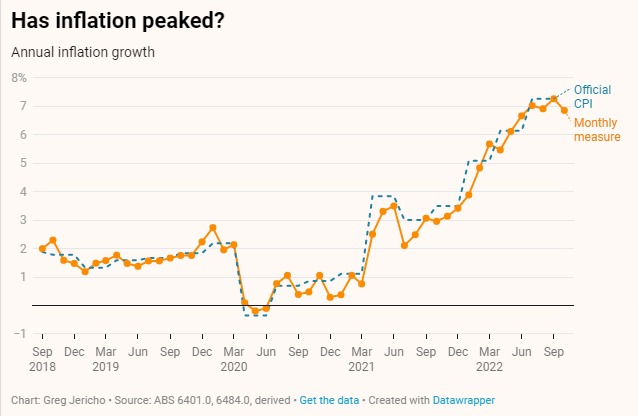
    But as Labour Market and Fiscal Policy Director, Greg Jericho, notes in his Guardian Australia column, the latest monthly inflation figures out yesterday suggest that maybe the peak could be lower than anticipated.

    While the monthly figures can be a little erratic, they do closely align with the quarterly “official” CPI figures and in October the ABS estimates that annual inflation growth fell from 7.3% to 6.9%. Better still this makes 4 months in a row where inflation has remained around 7%, rather than increasing quickly as it has since the middle of last year.

    Combined with the latest Retail Trade figures released this week which showed the dollar amount spent in the shops fell in October, and the volume of spending falling even faster, there are solid signs that the interest rate rises are having an impact.

    This means the Reserve Bank needs to be very cautious as much of the impact of the rate rises from September October and November has yet to flow through into the data. And because the rates of existing mortgages take longer to rise than do rates for new home loans this also means that even were the RBA to halt rate rises, for most mortgage holders rates will still be about to rise over the next few months.

    The IMF, OECD, Treasury and the RBA itself all forecast a sharp slowing of Australia’s economy next year and into 2024. The rationale has been that this is the cost of needing to reduce inflation, but the central bank needs to be very careful that it does not commit overkill. With the economy and consumer spending already slowing, and inflation showing some good signs that growth is no longer increasing at a rapid rate, the RBA should strongly consider not increasing the rate next week in its final board meeting of the year.


    You might also like

    Dutton’s nuclear push will cost renewable jobs

    by Charlie Joyce

    Dutton’s nuclear push will cost renewable jobs As Australia’s federal election campaign has finally begun, opposition leader Peter Dutton’s proposal to spend hundreds of billions in public money to build seven nuclear power plants across the country has been carefully scrutinized. The technological unfeasibility, staggering cost, and scant detail of the Coalition’s nuclear proposal have