Blog

  • The Economic Importance of Public Services in Regional Communities in NSW

    The Economic Importance of Public Services in Regional Communities in NSW

    by Troy Henderson

    Public sector austerity has become a “policy fad” in Australia, at all levels of government. Its hallmarks are unnecessary public sector wage caps, outsourcing, downsizing, privatisation and the imposition of so-called “efficiency dividends” which allegedly drive productivity growth but in reality cut spending and reduce the quality of public services. These policies of austerity are not justified by economic theory, especially not in conditions of chronic macroeconomic weakness, unemployment, and underemployment (such as characterise most areas of Regional NSW). They may be politically convenient for political leaders positioning themselves as “tough on deficits,” but in reality they impose a wide range of harmful economic and social consequences. At best they represent lazy thinking in policy; at worst they constitute deliberate attempts to erode the public sector and the critical services it provides.


    Full report

    Share

  • A Comprehensive and Realistic Strategy for More and Better Jobs

    A Comprehensive and Realistic Strategy for More and Better Jobs

    by Jim Stanford

    Share

    The Australian Council of Trade Unions has released a major policy paper outlining an ambitious, multi-faceted program to address the chronic shortage of work, and the steady erosion of job quality, in Australia. The full paper, Jobs You Can Count On, is available on the ACTU’s website.  It contains specific proposals to stimulate much stronger job-creation, reduce unemployment and underemployment, improve job quality (including through repairs to Australia’s industrial relations system), and ensure that all communities (including traditionally marginalised populations like indigenous peoples, women, youth, and people with disability) have full access to the decent work opportunities that the plan would generate.

    Dr. Jim Stanford, Director of the Centre for Future Work, reviewed the ACTU’s paper in detail, and prepared an evaluation of its proposals and likely effects. Stanford endorsed the policy’s complementary set of expansionary macroeconomic measures, which would strengthen every major component of aggregate demand in the national economy: including government programs, capital investment, net exports, and consumer spending. He also emphasised the importance of the paper’s vision for a stronger labour market information and planning system, which will be essential to effectively match workers with jobs as the labour market tightens.

    Stanford estimated that the ACTU’s plan, if implemented consistently over a five-year period, would be capable of achieving the following outcomes:

    • Unemployment rate falling to 4 percent or lower.
    • Share of full-time work rebounding toward 75 percent of employment (since employers will be pressured by falling unemployment to create full-time jobs).
    • Underemployment rate falling to fall to 5 percent or lower.
    • Incidence of casual work declining below 20 percent.
    • Labour force participation rising by at least 2 percentage points, especially among young workers.
    • Nominal wage growth accelerating to traditional rates of 4 percent per year.

    Read the complete ACTU paper, Jobs You Can Count On.


    Related documents


    Report review

    You might also like

  • Government Spending Power Could Support Stronger Wage Growth

    Government Spending Power Could Support Stronger Wage Growth

    Share

    Australia’s state and federal governments could help solve the problem of stagnant wages by better leveraging their own spending power.

    New research from the Centre for Future Work at The Australia Institute demonstrates a strong connection between government spending and working conditions across the economy.

    “Weak labour market conditions, including record-weak wage growth, could be improved by linking public spending in all forms to improved job quality and compensation,” said Dr. Jim Stanford, Director of the Centre for Future Work.

    The Centre for Future Work report finds three main avenues through which government spending could lift wages and working conditions:

    1. Direct work and production undertaken within government and its departments and agencies (the public sector).
    2. Arms-length service-producing organisations which depend on government funding (the non-profit sector).
    3. Private-sector firms which supply government and public agencies with goods and services (the private sector).

    “It is ironic that Treasurers are always praying for stronger wage growth with every year’s budget in order to generate stronger growth and stronger revenues. Yet governments don’t pursue obvious opportunities to actually achieve that wage growth by linking labour standards to their own expenditure policies,” said Dr Stanford.

    “This is clearly a lost opportunity. Australia’s government sector is by far the single largest part of Australia’s economy.

    “This economic footprint, if wielded consistently to achieve higher wages and better jobs, could have a powerful impact on labour market outcomes.”

    Australian government economic footprint at a glance:

    • Total expenditures of over $660 billion per year, equal to 36 percent of Australia’s GDP.
    • Expenditures on current production of public goods and services of over $330 billion per year (18.5 percent of GDP), and further spending on capital investments of over $85 billion (another 5 percent of GDP).
    • Direct public sector employment of close to 2 million workers, with millions more jobs indirectly dependent on government injections of spending power.
    • Fiscal support for public and community services by arms-length non-profit agencies, worth at least another 4 percent of GDP.
    • Goods and services procured from private-sector suppliers equivalent to around 10 percent of GDP (or about $175 billion per year).

    Related research

  • Raising the Bar: How Government Can Use its Economic Leverage to Lift Labour Standards Throughout the Economy

    Raising the Bar: How Government Can Use its Economic Leverage to Lift Labour Standards Throughout the Economy

    by Jim Stanford

    For at least five years now, Australia’s labour market has demonstrated signs of a structural shift that has undermined traditional patterns of wage determination, and eroded the quality and security of work. The economic and social consequences of this sea change in the world of work are severe and far-reaching: flat real wages (the worst labour income growth since the Great Depression), a severing of the traditional relationship between wage and productivity growth, a steady expansion of insecure work in various forms, growing inequality in income distribution (both between factors and across households), and a precipitous decline in collective representation and enterprise bargaining (especially in the private sector). Governments tell Australians to simply be patient, and let “market forces” do their work; wages will pick up and economic benefits will soon “trickle down.” But there is no reason to expect these concerning labour market challenges to resolve themselves. Instead, the whole history of Australia’s economy reminds us that pro-active policy efforts are always necessary to broadly distribute the fruits of economic growth to workers and their families.


    Full report

    Share

  • Wages, Taxes, and the Budget

    Wages, Taxes, and the Budget

    by Jim Stanford and Troy Henderson

    The Coalition government’s 2018 budget features a plan to cut personal income taxes for many Australians over the next several years. The government claims it wants to reward lower- and middle-income wage-earners with tax savings.  However, the biggest personal tax reductions would not be experienced until 2022 and beyond (after at least two more federal elections).  And the biggest savings go to those with incomes over $200,000 per year (the richest 3 percent of tax-filers).

    Our Briefing Note on the 2018 Budget explores the relationships between wages and taxes, and shows that working to reverse the recent unprecedented wage stagnation is the key to achieving ongoing improvements in living standards – not pre-election tweaks in the tax code.

    Our budget analysis finds that:

    • The boost in disposable incomes for most Australians from these changes will be miniscule, not making any measurable difference to their standard of living.
    • The biggest cause of stagnating living standards in Australia has been the deceleration of wage increases since 2012. The budget assumes that wage growth will suddenly rebound in coming years to more traditional rates (of 3.5 percent per year). This assumption underpins the government’s revenue forecasts – but there is no plan for achieving faster wage growth.
    • To the contrary, the government’s continuing labour policies will suppress future wage increases. This includes its own 2 percent cap on wage increases for federal public sector workers; the government is restraining wage growth for its own employees to barely half of what it hopes for the whole economy.
    • Restoring normal wage patterns would boost disposable incomes for Australian workers many times more than tweaks to personal tax rates and thresholds.

    For example, for a worker earning $60,000 per year (higher than the median income of Australians), the Coalition tax plan will increase disposable income by $530 by the last year of the budget period (2021-22).  In contrast, annual normal wage increases (of 3.5 percent per year) would boost disposable income that same year by almost $6000 – 11 times as much.


    Full report

    Share

  • Don’t blame it on the deficit: WA

    Don’t blame it on the deficit: WA

    Share

    A report released today by the Australia Institute’s Centre for Future Work shows Western Australia’s recent budget deficit is the result – not the cause – of deteriorating economic conditions.

    Contrary to calls for fiscal austerity and public sector downsizing, being made in response to the emergence of fiscal deficits in WA, the report showed that budget deficits played a useful role in stabilizing the economy during times of economic downturn, and will automatically recede as the economy recovers.

    “In reality there should be no alarm about the WA state deficit. Deficits are acceptable, and positive, during periods of weak economic growth.” says the Australia Institute’s Senior Economist, Dr. Cameron Murray.

    “In fact, that deficit merely confirms that state fiscal policy is doing what it is supposed to: providing essential public services and providing a solid base for private-sector economic activity.”

    “It is wrong to immediately conclude that the only response to a deficit must be some combination of cutting spending, reducing public sector employment, freezing or reducing public sector wages, and selling public assets.”

    The report found public sector payrolls grew modestly through the 2014-17 period.  That modest growth, in contrast to the contraction in private payrolls, supported a cumulative total of $3 billion dollars in additional GDP; $1.3 billion in additional consumer spending; and $450 million in additional state revenues.

    “During WA’s recession we’ve seen compensation growth slow down in both the public and private sectors,” says Murray.

    “Importantly however, the modest, continuing wage growth we did see in the public sector acted as an automatic stabiliser, reducing the severity of WA’s downturn.”

    Total economic activity, including economic activity in the private sector, was also found to be higher as a result of the government slowly but steadily increasing its spending on public servants and the services they provide.

    “Those deficits arose in the wake of the slowdown in mining activity and corresponding deceleration of employment and economic growth, and over-zealous fiscal austerity is not the solution.”

    “Continuing growth in public sector wages and maintaining public spending during weak economic periods generates positive spillover effects for the rest of the economy,” says Murray.

    More recently, positive signs of recovery in the state economy are quickly and automatically producing a reduction in the size of the deficit.  The report recommends the state government focus on supporting that continuing recovery, rather than reducing the government’s own contribution to it.


    Related research

  • The Consequences of Fiscal Austerity in Western Australia

    The Consequences of Fiscal Austerity in Western Australia

    by Cameron Murray and Troy Henderson

    This report critically responds to the call for fiscal austerity and public sector downsizing, being made in response to the emergence of fiscal deficits in Western Australia (WA). Those deficits arose in the wake of the slowdown in mining activity and corresponding deceleration of employment and economic growth. Many observers immediately conclude that the only response to a deficit must be some combination of cutting program spending, reducing public sector employment, freezing or reducing public sector wages, and selling public assets.

    In reality, there should be no alarm about the WA state deficit. To the contrary, that deficit merely confirms that state fiscal policy is in fact doing what it is supposed to: namely, provide essential public services that make a key contribution to quality of life and the health of communities, and provide a solid base for private-sector economic activity (including helping to stabilise private-sector activity through its inevitable ups and downs). Knee-jerk spending cuts or asset sales in response to deficits that are caused by cyclical developments in the private-sector economy would only make matters worse in the short-run – and they would significantly undermine the public sector’s capacity to provide sustainable public services in the long-run.

    This paper explains the important economic functions played by the automatic stabilisers that are built into the tax-and-spending system of the state economy. It discusses the normal and even desirable functions of public debt, and catalogues the ongoing economic and social value of good quality public sector employment. All of these factors provide needed context for debates over the direction of fiscal policy in WA in the wake of the mining downturn and subsequent recession.

    The key findings and recommendations of the report include:

    1. A budget surplus can be a very effective way to slow economic growth, especially during a recession. The assumption that government should achieve a surplus as quickly as possible is fundamentally wrong.
    2. Deficits are acceptable – and positive – during periods of weak economic growth. Attempts to forcibly repair budget deficits during recessions will make the economic situation worse.
    3. Western Australia’s recent budget deficit is the result – not the cause – of deteriorating economic conditions. The budget deficit has helped to stabilise overall economic conditions in WA in an economically efficient manner.
    4. WA’s deficit and debt service charges are not large relative to the productive capacity of the state economy, nor to the overall revenue base of the state government. Indeed, WA’s interest payments are smaller as a share of total state government revenue than is the case for many large corporations and millions of households.
    5. The automatic stabiliser function of the budget should be amplified through additional discretionary counter-cyclical policy measures, such as increased government spending and investment during economic slumps.
    6. Privatisation of state assets is an accounting trick that does not actually improve the deficit (instead, it trades one asset for another on the government’s balance sheet), and will weaken the government’s fiscal position if the privatised asset generated revenue at a higher margin than the government pays interest on its debt.
    7. Public sector employment in WA has stagnated since the onset of the recession in 2013. In fact, Western Australia has the third lowest level of total public sector employment (14.5 percent) as a share of total employment of any state. The assumption that the state’s public sector is bloated is factually wrong. 
    8. Between 2013 and 2017, state public sector employment was essentially stable (at around 110,600 full-time equivalent workers). But during this period, WA’s resident population continued to increase (adding around 100,000 new residents). Therefore, WA’s public sector workforce has not kept up with the population it must serve.
    9. During the 2014 to 2017 recession, labour incomes in the private sector declined, shrinking at an average annual rate of 2.4 percent per year. In contrast, total wages and salaries paid in the public sector continued to grow at a modest but positive rate (of 3.9 percent per year). This continued, normal growth in public sector income helped to moderate the negative economic effects of the recession in the private sector.
    10. Like other forms of government spending, public sector payrolls acted as an automatic stabiliser during the recession – despite deliberate (and ill-advised) government efforts to suppress public expenditure. If public compensation had declined at the same rate as private compensation between 2014 and 2017, consumer spending, state output, and even the state government’s own revenues would have been lower than they were.


    Full report

    Share

  • Rebuilding the NSW Workers Compensation System

    Rebuilding the NSW Workers Compensation System

    by Ian Watson and Jim Stanford

    Workers compensation benefits in New South Wales were dramatically reduced in 2012 by a newly-elected state government, citing an alleged financial crisis in the system.  Benefit payments (adjusted for inflation) declined 25 percent in just five years – and some cuts are still being imposed on injured workers and their families (including some losing benefits entirely).  But even as injured workers suffered the consequences of these benefit cuts, the financial position of the workers compensation system suddenly transformed from “famine to feast”: the supposedly dire deficit which justified the cutbacks disappeared entirely within one year, and by mid-2013 the fund was already back in surplus.  The system’s total surplus now exceeds $4 billion.

    This report reveals the artificial nature of the supposed crisis which justified the 2012 cuts, and highlights the continuing positive financial trends that are generating ever larger surpluses.  It proposes a five-year timetable for restoring benefits to injured workers in NSW, without increasing average premium levels or incurring funding deficits.

    There is no fiscal or moral justification for injured workers to continue to suffer reduced benefits, while the workers compensation system carries a multi-billion dollar surplus – poised to get even bigger in the years ahead.  Unions NSW commissioned the Centre for Future Work to conduct an independent review of the system’s financial position.  Our full 95-page report, Restoring Dignity and Respect: Rebuilding NSW’s Workers Compensation System, reviews the system’s roller-coaster ride over the past decade, and highlights the artificial and temporary nature of the financial circumstances which were invoked to justify cuts in 2012.  It documents and explains the improvements in injury rates, premium revenue, and financial markets that underpin the continued surplus-generating capacity of the system. 

    The report confirms that ample resources are available to fund a gradual but ambitious repair in benefit entitlements for injured workers in the years ahead, centred around Unions NSW’s 12-point vision for a fair, effective, and sustainable workers compensation system. The report makes 10 core recommendations to the state government and icare directors, including:

    1. Maintain overall effective average premium rates at current level.
    2. Simplify and make more transparent the formulae for calculating premiums for specific employers.
    3. Undertake an independent actuarial review of the cost of reversing specific components of the 2012 policy changes, and otherwise improving benefits (including the twelve reform principles outlined by Unions NSW).
    4. Develop a staged timetable for restoring and enhancing benefits, with liabilities increased by $1 billion annually over the next five years.
    5. Impose a moratorium on the cessation of monthly benefits under Section 39, and restore benefits for injured workers who have been cut off.
    6. Revise capital funding policy to target full funding (100 percent) of adjusted present value liabilities (including a cushion to reflect an 80-percent probability risk margin).
    7. Monitor financial balances of the system, and adjust the timing of benefit improvements accordingly.
    8. Release terms of the contract with EML (now monopoly private provider of core insurance and clams management services to the system), and investigate the potential for in-sourcing its services.
    9. Detailed evaluation of the performance of icare’s investment program to explain fully the recent underperformance of its investment income.
    10. Implement a meaningful tripartite system of consultation and governance.

    Under the five-year timetable, benefits for injured workers would be repaired in several stages, with no increase in average effective premium rates, and still exceeding full funding of obligations (including a $2 billion cushion for risk margin).  There is no fiscal excuse for treating injured workers with the callous disrespect they have endured since 2012.  That legacy cannot be reversed overnight, but it can be reversed with a significant and responsible commitment to rebuild the integrity of the program over the coming years.

    Relative to total labour costs and to NSW’s economy, workers compensation premiums have never been lower: down 60 percent since 2009.  When workplace injuries occur, society has an obligation to provide workers with compensation they can count on.  This report confirms that NSW is fully capable of meeting this responsibility.  It is simply a matter of political and fiscal priority on the part of the state government, to ensure it happens.


    Full report

    Share

  • A Portable Training Entitlement System for the Disability Support Services Sector

    A Portable Training Entitlement System for the Disability Support Services Sector

    by Rose Ryan and Jim Stanford

    A new proposal for a portable training system for disability support workers under the NDIS would help to ensure the program achieves its goal of delivering high-quality, individualised services to people with disabilities. The proposal is developed in a new report from the Centre for Future Work.

    Under the plan, disability support workers would receive credit for one hour of paid training, for every 50 hours worked in NDIS-funded service delivery.  Those credits would be vested with each individual worker, allowing them to accumulate credits even if they work for multiple employers or directly (as sole traders) for NDIS participants.  The training system thus takes account of the very flexible and mobile nature of work in this growing sector. 

    The system would allow a typical disability support worker to access one three-day upgrading course per year. A corresponding system of advanced recognised qualifications (and matching job classifications) would provide specialised pathways allowing disability support workers to develop their careers over time, thus reducing the very high staff turnover that has bedevilled the roll-out of NDIS services.

    The proposal is detailed in a new 70-page report, A Portable Training Entitlement System for the Disability Support Services Sector, co-authored by Dr. Rose Ryan and Dr. Jim Stanford.

    The NDIS has the potential to enrich the lives of people with disabilities through customised individual packages of services. But to achieve that goal, the system must facilitate ongoing investments in specialised skills and qualifications, rather than relying on short-term ‘gigs’ performed by high-turnover, casualised workers.

    Most disability support workers are employed in part-time or casual jobs, and spending on staff training by established service providers has shrunk as the NDIS has been rolled out.  The NDIS is expected to spur massive job-creation in coming years, adding as many as 70,000 full-time-equivalent positions, but evidence is accumulating that the quality of many jobs is very poor, undermining stability of the workforce and the quality of delivered services.

    Cost estimates suggest the overall scheme would require $192 million per year in additional funding, which the authors suggest should be delivered through a separate state-Commonwealth funding stream (to avoid undermining the revenue base for delivered services). Compared to the $22 billion annual pricetag for the NDIS, the authors suggest this cost is modest: less than one cent on the dollar to support the development of a workforce with state-of-the-art knowledge and training.


    Full report

    Share

  • Wages Crisis Has Obvious Solutions

    Wages Crisis Has Obvious Solutions

    by Jim Stanford

    Mainstream economists and conservative political leaders profess “surprise” at the historically slow pace of wage growth in Australia’s labour market. They claim that wages will start growing faster soon, in response to the normal “laws of supply and demand.”  This view ignores the importance of institutional and regulatory factors in determining wages and income distribution.  In fact, given the systematic efforts in recent decades to weaken wage-setting institutions (including minimum wages, the awards system, and collective bargaining), it is no surprise at all that wages have slowed to a crawl.  And the solutions to the problem are equally obvious: rebuild the power of those institutions, to support workers in winning a better share of the economic pie they produce.

    This recent commentary, by Centre for Future Work Director Jim Stanford, appears in the March 2018 issue of Australian Options magazine, and is reprinted with permission.

    Wage Crisis Has Obvious Solutions

    By Jim Stanford

    When the head of the central bank declares wages are too low, and urges workers to demand more money, you know you have a problem.

    After all, central bankers are traditionally the “party poopers” of the economy: they are the ones who march in and take away the punch bowl, as soon as the party gets rolling.  Yet here was Governor Philip Lowe, Governor of the Reserve Bank of Australia, urging party-goers to turn up the volume.  It’s like he was pouring bottles of straight tequila into the punchbowl, instead of taking it away – desperately trying to turn a boring flop into a wild shindig.

    Mr. Lowe made his surprising call at a conference last year on Australia’s economic outlook at Australian National University.  He said weak wage growth was holding back national purchasing power and economic growth, and contributing to too-low inflation (which has languished below his bank’s official 2.5 percent target for several years running).

    But while his acknowledgement of the consequences of wage stagnation was refreshing, his diagnosis of the causes was incomplete and unconvincing.  In fact, Governor Lowe almost seemed to blame the victims of wage stagnation – namely, Australia’s workers – for the problem.  They were unduly worried about losing their jobs to robots or imports, he suggested; they should feel more “confident” in asking for higher wages.  He has clearly not experienced the reality of Australia’s dog-eat-dog labour market in recent years, or felt the desperation that drives workers, especially young workers, to accept any job on offer.

    (Incidentally, the RBA’s own enterprise agreement signed last year will raise base wages by just 2 percent per year over the next 3 years … below the bank’s own inflation target!)

    While mainstream economists and policy-makers belatedly recognise the economic and social damage resulting from weak wages (even Treasurer Scott Morrison frets about the negative effect of slow wage growth on his budget balance), they’ve been distinctly reticent to connect the dots about the causes of the problem – and its obvious solutions.  Lowe, Morrison, and their colleagues pretend wages will pick up automatically as the economy grows and the labour market tightens.  But with official unemployment only a tick above 5 percent (still the RBA /Treasury estimate of “full employment,” according to their discredited but still operational NAIRU model), yet wages still decelerating, this faith in a market solution is increasingly far-fetched.

    Measuring the Slowdown

    The stagnation of Australian wages is visible by many indicators.  The most common “headline” source is the ABS’s quarterly Wage Price Index, which reports an index of wages calculated from a representative sample of jobs (the methodology is similar to the Consumer Price Index).  The WPI therefore measures changes in average hourly compensation holding constant the bundle of jobs which make up the overall labour market.

    However, one important factor in weak wages has been the changing composition of work.  In particular, the growth of part-time, casual, and irregular jobs has undermined the overall level (and stability) of labour incomes.  These changes are not captured in the WPI.  Similarly, changes in average hours worked per week (due to growing part-time work) are also excluded from the WPI.  So the WPI data understates the true extent of the wage slowdown.

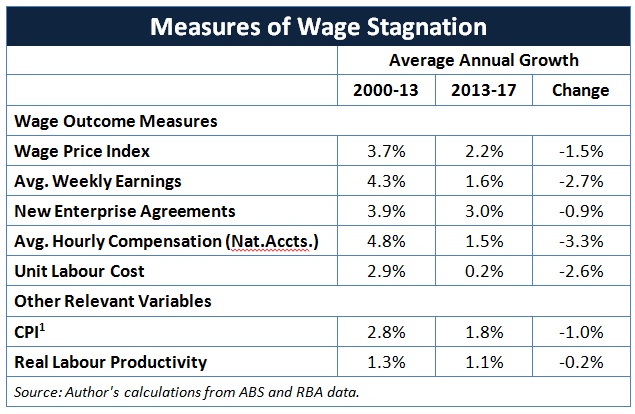
    Other ways of measuring the wage slowdown show an even bigger drop-off in wage growth.  These include average weekly earnings, the pay increases specified in enterprise agreements, and estimates of average labour compensation generated through GDP statistics.  Trends in all these indicators are summarised in the accompanying table.  Whatever measure is chosen, it is clear that there has been a dramatic slowdown in wage growth – especially visible since 2013.
    Annual wage growth fluctuated around 4 to 5 percent during the first decade of the century.  Wage growth fell sharply but temporarily during the GFC – but then quickly regained pre-crisis norms from 2011 through 2013.  After 2013, however, wage growth has decelerated dramatically: to 2 percent or even lower.  In fact, by the broadest measure of labour compensation (wages, salaries, and superannuation contributions paid per hour of work), there has been virtually no nominal wage growth in the past year.  Consumer prices, meanwhile, continue to grow at around 2 percent per year (and even faster, if escalating housing prices are taken into account).  Real earnings, therefore, are flat or falling.

    What is “Normal” Wage Growth?

    Any shortfall in wage growth below the pace of consumer price increases (corresponding to a decline in the real purchasing power of workers’ incomes) is a clear sign of labour market dysfunction.  But even flat real wages (ie. nominal wages that just keep pace with inflation) are problematic.  After all, wages are supposed to reflect ongoing growth in real labour productivity (or at least that’s what the economics textbooks tell us).  So wages should actually consistently grow faster than consumer price inflation, to fairly reflect the enhanced real output of each hour of labour.

    Therefore, a “normal” benchmark for wage growth might be the sum of long-run consumer price inflation (the RBA’s 2.5 percent target) plus average productivity growth (running around 1.5 percent per year over the past three decades).  That suggests a “normal” benchmark for annual nominal wage growth should be 4 percent per year.  Australian wage growth in the pre-GFC period generally fit that definition of “normal.”  But since 2013 wages shifted to a significantly lower trajectory.

    Joining the Dots

    Contrary to the assumptions of free-market economics, there is no guarantee that wages will automatically grow in line with labour productivity, as a result of automatic market mechanisms.  Power is always a key factor in income distribution.  And labour markets never “clear,” so that labour supply (the number of workers) equals labour demand (the number of jobs).  In fact, inflation-targeting policy deliberately aims to maintain a certain level of unemployment (5 percent is the target in Australia) to suppress wage demands and protect profits.

    The systematic and structural disempowerment of workers and their unions over the neoliberal era is therefore the most relevant factor in the deceleration of wage growth, and the erosion of labour’s share of total GDP.  Some obvious indicators of that dramatic shift in economic and political power include:

    • A steady erosion in the real “bite” of minimum wages, which have fallen from 60 percent of median wages in 1990 to around 45 percent today.
    • The collapse of trade union membership in the face of legal restrictions, harassment, and full-protection for “free riders.” Today just 9 percent of private sector workers, and less than 5 percent of young workers, are union members.
    • A corresponding collapse in collective industrial action.  Adjusted for the size of the workforce, the frequency of strikes and other industrial disputes has declined by 97 percent from the 1970s to the present decade.
    • The relegation of industry awards to a baseline “safety net,” instead of a system for supporting ongoing progress in wages and working conditions.
    • The generally pro-business shifts in economic policy, including tax cuts, deregulation, privatisation, and globalisation, which have also shifted economic power in favour of employers and hence indirectly suppressed wage growth.

    To begin to rebuild wage growth, restore labour’s share of GDP, and achieve greater equality in labour incomes will require a comprehensive, multidimensional effort to restore the power of all these wage-supporting institutions.  The ACTU is tackling this challenge with gusto, with its ambitious “Change the Rules” campaign.  The goal is to propose a consistent, holistic vision for repairing the institutions that support workers and their wages – and then building a strong grass roots campaign to push politicians of all stripes to adopt that vision.

    On the other hand, if we follow the advice of Scott Morrison and Philip Lowe, and simply wait for supply and demand forces to rescue wages from their current doldrums, we are going to be waiting a very long time.


    You might also like

    Centre For Future Work to evolve into standalone entity

    The Centre for Future Work was established by the Australia Institute in 2016 to conduct and publish progressive economic research on work, employment, and labour markets. Supported by the Australian Union movement, the centre produced cutting edge research and led the national conversation on economic issues facing working people: including the future of jobs, wages