Blog

  • Possibly Surprising Insights on the Future of Work

    Possibly Surprising Insights on the Future of Work

    by Jim Stanford

    Share

    Trade unionists are gathering this week at the ACTU’s triennial Congress in Brisbane.  Jim Stanford, Director of the Centre for Future Work, participated in a panel on the Future of Work (an apt title!) at the Congress.

    His presentation was “5 Possibly Surprising Insights on the Future of Work”.

    More detail on the issues raised in his presentation is provided in the Centre’s recent submission to the Senate Inquiry on the Future of Work and the Future of Workers.


    Related documents


    Presentation Slides


    Factsheet

    Related research

    You might also like

    Centre For Future Work to evolve into standalone entity

    The Centre for Future Work was established by the Australia Institute in 2016 to conduct and publish progressive economic research on work, employment, and labour markets. Supported by the Australian Union movement, the centre produced cutting edge research and led the national conversation on economic issues facing working people: including the future of jobs, wages

  • Centre for Future Work at #ACTUCongress18

    Centre for Future Work at #ACTUCongress18

    by Jim Stanford

    Share

    Trade unionists from across Australia are gathering in Brisbane this week for the 2018 Congress of the Australian Council of Trade Unions. And the Centre for Future Work will be there!

    Come and check out our information booth in the exhibitors’ area: meet our staff, learn more about our work, and sign up for updates.

    Our Director Jim Stanford will be presenting as part of a session on The Future of Work (good title!), Tuesday July 17 at 2:15 pm in conference room P1.

    And we will be distributing copies of a brochure with links to some of our most recent research (attached below).

    We are glad that our research can support the campaign to #ChangeTheRules!


    Related documents


    Brochure

    Related research

    You might also like

    Commonwealth Budget 2025-2026: Our analysis

    by Fiona Macdonald

    The Centre for Future Work’s research team has analysed the Commonwealth Government’s budget, focusing on key areas for workers, working lives, and labour markets. As expected with a Federal election looming, the budget is not a horror one of austerity. However, the 2025-2026 budget is characterised by the absence of any significant initiatives. There is

  • Penalty rate cuts fail to ignite jobs boom

    Penalty rate cuts fail to ignite jobs boom

    Share

    Reduced Sunday and holiday penalty rates for retail and hospitality workers failed to ignite the boom in employment as promised by employer groups who supported the change.

    A new report from The Australia Institute’s Centre for Future Work examined employment and working hours in the retail and hospitality industries in the year since penalty rates were first cut.

    The report found, since the initial penalty rate reduction imposed by the Fair Work Commission on 1 July 2017:

    • The retail sector in particular performed very badly relative to the rest of the economy.
    • Total employment was unchanged in the year ending in May 2018, continuing a long-term trend of employment stagnation.
    • Full-time employment declined by 50,000 positions.
    • Average weekly hours of work declined by more than a full hour, and the underemployment ratio (share of workers who want more hours) grew almost 2 percentage points.
    • The hospitality sector (accommodation and food services) experienced similar results, including weak job-creation, a loss of full-time employment, shorter average hours of work, and higher underemployment.

    “Far from experiencing a jobs boom, the retail and hospitality sectors have significantly underperformed the rest of the economy in terms of both hiring and working hours,” says Dr. Jim Stanford, Director of the Centre for Future Work.

    “Most industries where penalty rates were unchanged did far better at job-creation than the two sectors where penalty rates were cut.

    “Employer representatives argued that reducing labour costs for work on Sundays and holidays would spur a big expansion in employment, one group even predicted 40,000 new jobs. Our report found that was simply not the case.

    “Based on a number of criteria, the retail and hospitality sectors performed among the worst of any Australian industries in the year since penalty rates were first cut.

    “While lower penalty rates are not the cause of the poor performance, our research certainly disproves inflated claims by employers and government that cutting labour costs would unleash a jobs boom.

    “If we really want more jobs, we should boost wages, improve job security, and strengthen purchasing power throughout the economy. Cutting penalty rates does the opposite.”


    Related research

  • Penalty Rates and Employment: One Year Later

    Penalty Rates and Employment: One Year Later

    by Jim Stanford and Tanya Carney

    On 1 July 2018, workers in several retail and hospitality industries will experience a second reduction in the penalty rates they receive for working on Sundays and public holidays.  The reductions were ordered by the Fair Work Commission, and follow an initial reduction imposed on 1 July 2017.

    Employer representatives argued that by reducing labour costs for work on Sundays and holidays, lower penalty rates would spur a big expansion in employment, via both new hiring and longer hours for existing workers.  One lobbyist predicted 40,000 new jobs.  Another said improved employment was “a certainty.”

    But a new report from the Centre for Future Work has examined employment and working hours in the retail and hospitality industries in the year since the first penalty rate reduction.  Far from spurring a jobs boom in the two sectors, they have actually significantly underperformed the rest of the economy on all of the indicators considered.

    The report reviews detailed data on employment, full-time employment, average hours of work, underemployment, and the incidence of short-hours work (under 20 hours per week).  By all these criteria, the retail and hospitality sectors performed among the worst of any other industries in the year since penalty rates were first cut.  Most industries where penalty rates did not change, created more work than the two sectors where penalty rates were cut.

    The retail sector in particular has performed very badly relative to the rest of the economy.  Total employment was unchanged in the year ending in May 2018 (according to most recent ABS data).  Full-time employment declined by 50,000 positions.  Average weekly hours of work declined by more than a full hour, and the underemployment ratio (share of workers who want more hours) grew almost 2 percentage points.

    The report does not suggest that lower penalty rates caused this poor performance (although it probably incrementally worsened underlying macroeconomic weakness, in particular stagnation in consumer incomes, that is the main cause of poor employment performance).  But the data certainly disprove inflated claims by employers and government that by cutting labour costs, the penalty rates decision would unleash a jobs boom in retail and hospitality.

    If we really want to strengthen employment conditions (in these and other sectors), we must emphasize stronger wages and incomes, stronger public and private investment, and strong purchasing power throughout the economy.  Cutting penalty rates (and other policy measures that have suppressed wage growth in recent years) won’t solve those problems — it will make them worse.


    Full report

    Share

  • Manufacturing Rebound Could Be Cut Short By Skills Shortage

    Manufacturing Rebound Could Be Cut Short By Skills Shortage

    Share

    After years of decline, Australia’s manufacturing industry is finally recovering – adding almost 50,000 jobs in the last year, one of the best job-creation records of any sector in the whole economy. But that recovery could be cut short by growing shortages of skilled workers, according to a new report on vocational training in manufacturing.

    The new report from the Centre for Future Work identifies key factors behind the rapid emergence of skills shortages in manufacturing, including:

    • The sector’s ageing workforce, creating a looming demographic transition for skilled worker
    • The highly specific nature of manufacturing skills (across sectors and occupations), creating difficulty for workers moving from between shrinking sectors to growing sectors
    • The need for new skills and ongoing training as companies adopt advanced manufacturing techniques and new digital technologies.

    “Manufacturing is again making a positive contribution to Australia’s economic progress after over a decade of decline. We don’t want to squander this potential,” said Dr. Jim Stanford, Director of the Centre for Future Work.

    “If Australia doesn’t get its act together on vocational training, this will be a wasted opportunity for manufacturing.

    “Recent experiments with market-based vocational training have been a waste, they have damaged confidence in the skills system among both potential students and employers.

    “Stable, well-funded, high-quality public institutions must be the anchors of any successful VET system.

    “Public institutions are the only ones with the resources, the connections, and the stability to provide manufacturers with a steady supply of world-class skilled workers.

    “No sector feels the pain of the failure of vocational training more than manufacturing, precisely because advanced skills are so essential for the success of advanced manufacturing techniques.

    “Manufacturing stakeholders need to work together to strengthen vocational education and training.”

    Key principles for rebuilding vocational education in manufacturing, discussed in the report, include:

    • A greater reliance on courses and apprenticeships through public-sector TAFE (rather than private providers)
    • Phased-in retirement programs to allow senior workers to pass on their skills to new apprentices
    • Inclusion of provisions guaranteeing access to further training in industry awards and enterprise agreements.

    The report was co-authored by Dr. Jim Stanford and Dr. Tanya Carney and prepared for the Second Annual National Manufacturing Summit at Parliament House on 26 June 2018.

    The National Manufacturing Summit engages leading representatives from all parts of Australian manufacturing: businesses, peak bodies, unions, universities, the financial sector, suppliers and government. The growing problem of skills shortages is a priority focus for this year’s Summit.


    Related research

  • Advanced Skills for Advanced Manufacturing

    Advanced Skills for Advanced Manufacturing

    by Jim Stanford and Tanya Carney

    Australia’s manufacturing industry is at a crossroads.  After years of decline, the sector has finally found a more stable economic footing, and many indicators point to an expansion in domestic  manufacturing in the coming years.  Manufacturing added almost 50,000 new jobs in the last year – making it one of the most important sources of new work in the whole economy.

    However, one key factor that could hold back that continuing recovery is the inability of Australia’s present vocational education and training system, damaged by years of underfunding and failed policy experimentation, to meet the needs of manufacturing for highly-skilled workers.  The skills challenge facing manufacturing is all the more acute because of the transformation of the sector toward more specialised and disaggregated advanced manufacturing  processes.  This naturally implies greater demand for highly-trained workers, in all its occupations: production workers, licensed trades, technology specialists, and managers.

    To sustain the emerging turnaround in manufacturing, the sector has an urgent need for a concerted and cooperative effort to strengthen vocational education and training. This report contributes to that process: by cataloguing the emerging skills challenges facing manufacturing, reviewing the failures of the existing approach to vocational education in this sector (and across Australia’s economy as a whole), and proposing twelve key principles for reform.

    This report, by Dr. Tanya Carney and Dr. Jim Stanford, was prepared by the Centre for Future Work for the Second Annual National Manufacturing Summit.  The Summit, held at Parliament House on 26 June 2018, will gather leading representatives from all major stakeholders in Australia’s manufacturing sector: business, unions, universities, the financial sector, suppliers and government. They will consider the industry’s prospects and identify promising, pragmatic policy measures to support a sustained industrial turnaround.  It is a highly appropriate forum at which to begin a discussion about multi-partite efforts to rebuild vocational education and address the looming skills challenges facing manufacturing.


    Full report

    Share

  • The Dimensions of Insecure Work in Australia

    The Dimensions of Insecure Work in Australia

    by Jim Stanford

    Share

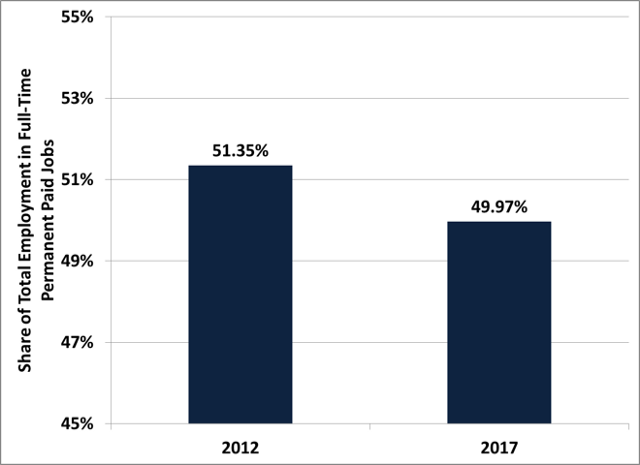
    Less than half of employed Australians now hold a “standard” job: that is, a permanent full-time paid job with leave entitlements. That’s the startling finding of a new report on the growing insecurity of work published by the Centre for Future Work.

    Share of Workers in Full-Time Paid Employment with Leave Entitlements. Source: Centre for Future Work calculations from ABS Catalogues 6291.0.55.003, EQ04 (2017), and 6333.0 Tables 2.3 and 9.1 (2012).

    The report, The Dimensions of Insecure Work: A Factbook, reviews eleven statistical indicators of the growth in employment insecurity over the last five years: including part-time work, short hours, underemployment, casual jobs, marginal self-employment, and jobs paid minimum wages under modern awards.

    All these indicators of job stability have declined since 2012, thanks to a combination of weak labour market conditions, aggressive profit strategies by employers, and passivity by labour regulators. Together, these trends have produced a situation where over 50 per cent of Australian workers now experience one or more of these dimensions of insecurity in their jobs - and less than half have access to “standard,” more secure employment.

    “Australians are rightly worried about the growing insecurity of work, especially for young people,” said Dr. Jim Stanford, one of the co-authors of the report. “Many young people are giving up hope of finding a permanent full-time job, and if these trends continue, many of them never will.”

    The report also documents the low and falling earnings received by workers in insecure jobs. While real wages for those in permanent full-time positions (the best-paid category) have grown, wages for casual workers have declined. And part-time workers in marginal self-employed positions (including so-called “gig” workers) have fared the worst: with real wages falling 26 percent in the last five years.

    “Given current labour market conditions and lax labour standards, employers are able to hire workers on a ‘just-in-time’ basis,” Dr. Stanford said. “They employ workers only when and where they are most needed, and then toss them aside. This precariousness imposes enormous risks and costs on workers, their families, and the whole economy.”

    Dr. Stanford called on policy-makers to address growing precarity with stronger rules to protect workers in insecure jobs (such as provisions for more stable schedules, and options to transition to permanent from casual work). He also stressed the need for economic policies that target the creation of permanent full-time jobs.


    Related research

    You might also like

    Centre For Future Work to evolve into standalone entity

    The Centre for Future Work was established by the Australia Institute in 2016 to conduct and publish progressive economic research on work, employment, and labour markets. Supported by the Australian Union movement, the centre produced cutting edge research and led the national conversation on economic issues facing working people: including the future of jobs, wages

  • Insecure work: The New Normal

    Insecure work: The New Normal

    by Jim Stanford

    Most Australians know in their guts that it’s pretty hard to find a traditional permanent job these days.  And now the statistics confirm it: less than half of employed Australians have one of those “standard” jobs.  And more than half experience one or more dimensions of insecurity: including part-time, irregular, casual, contractor, and marginally self-employed jobs.

    In this commentary article published originally by Ten Daily, Our Director Dr. Jim Stanford summarises the findings of the Centre’s recent report on “The Dimensions of Insecure Work.”

    If You Have A Stable Full-Time Job You’re An Endangered Species

    Ask any young job-seeker about their prospects of finding a permanent full-time job, and they won’t know whether to laugh or cry.  Sure, they might get a few hours of work here, a few hours there: piecing together disparate “gigs” in hopes of paying the rent.

    But landing a permanent full-time job with a regular salary and basic benefits (like paid holidays and superannuation)?  Dream on.

    It’s no surprise that young workers experience the insecurity of modern work most brutally: they don’t have experience, seniority, or connections to help them in their hunt.  But precarious work now affects Australians of any age, in all sectors of the economy, not just those trying to break in.  What was once considered a “standard” job – the kind where you know where and when you will work, and how much you will earn – now feels like the exception, not the rule.  And in fact, the hard numbers now confirm it: insecure work has indeed become the new normal.

    With co-author Dr. Tanya Carney, I recently assembled data on eleven different dimensions of job insecurity, based on official statistics from the Australian Bureau of Statistics and other government sources.  We considered many aspects of the problem: including the rise of part-time work, casual jobs, people working very short hours, temporary foreign workers, and workers in nominally “self-employed” positions.

    In every case, there has been a marked increase in insecurity in recent years.  A turning point was reached in 2012, as the mining investment boom (that underpinned several years of strong job conditions) turned down.  That boom, and associated macroeconomic expansion, had masked longer-run structural shifts in the nature of employment – but only for a while.  But now, since 2012, the sea-change in employment relationships is starkly visible.

    It was when we put all of these different indicators of insecurity together, that a startling conclusion became clear.  The standard “job” has been whittled away on all sides – by part-time work, by casual and temporary jobs, by shifting more tasks to supposedly independent contractors and self-employed gig workers.  And in 2017, for the first time since these statistics have been collected, the proportion of employed Australians filling a standard job fell below 50 percent.  Less than half of employed Australians now work in a permanent full-time paid position with basic entitlements (like sick pay and paid holidays).

    In other words, most employed Australians experience one or more dimensions of insecurity in their jobs.  Insecure work, once on the margins of the labour market, is now the norm.  In fact, many workers experience multiple aspects of this insecurity.

    For example, part-time marginally self-employed workers are among the most insecure of all.  They have no employees of their own; most aren’t even incorporated.  They get a tax number, and then scrabble from gig to gig – accepting outsourced work from large firms who once hired actual employees to perform these tasks.  Their incomes, low to start with, have declined a shocking 26 percent in real terms since 2012.  They now make, on average, barely one-third as much as a typical paid full-time permanent employee.

    Surprisingly, some defenders of the status quo in Australia’s labour market deny any problem with job security.  For example, Craig Laundy, Australia’s Minister for Small Business, claims insecure work is not actually more common, and defends casual work as “a completely appropriate way for many businesses and many employees to conduct their relationship.” Business lobbyists also deny work has become any less secure.

    But this flies in the face of both the official statistics, and the lived experience of millions of Australians struggling to find stable employment. And the increasing precarity of modern work in turn produces a spate of economic, social and political consequences.  Households can’t predict their future income; they also can’t make long-run financial commitments (like buying a home, supporting children through higher education, or saving for retirement).  Consumer spending and financial stability suffer, as does growth and job-creation.

    Politically, the frustration of millions of Australians about this chronic insecurity will inevitably bubble up at the polling booths.  Job insecurity has reached a tipping point, now that less than half of all employed workers fill standard permanent full-time jobs.  Sooner or later, a political tipping point will also be reached: as Australians react against the erosion of the ideal of a “fair go.”

    For this reason, hopeful politicians should be ready to present convincing ideas for restoring job stability and shared prosperity, in the lead-up to the next Commonwealth election.  Denying that there is even a problem, will not likely do the trick.

    Jim Stanford is Economist and Director of the Centre for Future Work at the Australia Institute. With Tanya Carney he is co-author of The Dimensions of Insecure Work: A Factbook.


    You might also like

    Centre For Future Work to evolve into standalone entity

    The Centre for Future Work was established by the Australia Institute in 2016 to conduct and publish progressive economic research on work, employment, and labour markets. Supported by the Australian Union movement, the centre produced cutting edge research and led the national conversation on economic issues facing working people: including the future of jobs, wages

  • The Dimensions of Insecure Work: A Factbook

    The Dimensions of Insecure Work: A Factbook

    by Tanya Carney and Jim Stanford

    This factbook reviews eleven different dimensions of job security in Australia, and documents a clear and multi-faceted deterioration in the overall stability of work in the period from 2012 (the peak of the resources investment boom) to the present.


    Full report

    Share

  • For First Time, Less than Half of Workers Have a ‘Standard Job’

    For First Time, Less than Half of Workers Have a ‘Standard Job’

    Share

    For the first time on record, less than half of employed Australians hold a ‘standard job’: that is, a permanent full-time paid job with leave entitlements.

    A new report by the Centre for Future Work at the Australia Institute looks at the growing insecurity of work in Australia.

    The report reviews 11 statistical indicators of the growth in employment insecurity over the last five years, including: part-time work, short hours, underemployment, casual jobs, marginal self-employment, and jobs paid minimum wages under modern awards.

    All these indicators of job stability have declined since 2012, leading to a majority of Australian workers now experiencing one or more of these indicators of job – and less than half have access to what was once considered a ‘standard job’.

    “Australians are rightly worried about the growing insecurity of work. We are now seeing less than half of employed Australians holding a ‘standard job’, with dependable hours, pay, and benefits” said Dr. Jim Stanford, director of the Centre for Future Work.

    “In particular, many young people are giving up hope of finding a permanent full-time job – and if these trends continue, many of them never will.”

    The report also documents the low and falling earnings received by workers in insecure jobs:

    • While real wages for those in the best paid job category – permanent full-time jobs – have grown, wages for casual workers have declined.
    • Part-time workers in marginal self-employed positions (including so-called ‘gig economy’ workers) have fared the worst, with real wages falling 26 percent in the last five years.

    “Given current labour market conditions and lax labour standards, employers are able to hire workers on a ‘just-in-time’ basis, employing workers only when and where they are most needed and then tossing them aside afterwards,” said Dr Stanford.

    “This insecurity imposes enormous risks and costs on workers, their families, and the whole economy.”

    Dr. Stanford called on policy-makers to address growing job precarity with stronger rules to protect workers in insecure jobs, such as provisions for more stable schedules, and options to transition to from casual work to permanent positions. He also stressed the need for economic policies that target the creation of permanent full-time jobs.


    Related research