Category: International & Security Affairs

Research branch

  • New Video: Australia Needs a Pay Rise!

    New Video: Australia Needs a Pay Rise!

    by Jim Stanford

    Share

    Jim Stanford, Director of the Centre for Future Work, was recently featured in a new video produced in collaboration with United Voice and the Flip production company.

    ANAPR Logo

    The video highlights the problems of wage stagnation in Australia’s economy, and the need to “Change the Rules” – including proposals for sector-wide collective bargaining practices, especially important in low-wage sectors such as early child education. The video has great graphics and production values, and is accompanied by a useful infographic. Download short and long versions of the film, and the infographic, through the links below:

    Shorter version (2:45)

    Longer version (4:03)

    Infographic

    ANAPR Logo

    Many thanks to the team at United Voice and Flip for their talented work on this project!


    You might also like

    Dutton’s nuclear push will cost renewable jobs

    by Charlie Joyce

    Dutton’s nuclear push will cost renewable jobs As Australia’s federal election campaign has finally begun, opposition leader Peter Dutton’s proposal to spend hundreds of billions in public money to build seven nuclear power plants across the country has been carefully scrutinized. The technological unfeasibility, staggering cost, and scant detail of the Coalition’s nuclear proposal have

  • The Year Past, and the Year to Come

    The Year Past, and the Year to Come

    by Jim Stanford in Workforce Magazine
    Originally published in Workforce Magazine on December 14, 2018

    Workforce (a labour relations bulletin published by Thomson-Reuters) recently surveyed major IR figures in Australia on what they saw as the big issues in 2018, and what they expect as the major talking points for 2019. Jim Stanford, economist and Centre for Future Work director, was one of those surveyed, and here are his remarks. 

    What was the most important issue or event in industrial relations this year?

    I would choose the union movement’s “Change the Rules” campaign, which really gathered focus and momentum as the year went on. Of course, unions have been dissatisfied with the state of labour laws, and the erosion of labour rights, for years. But this year, together with other community advocates, they have built a very effective and focused advocacy campaign that I think will have a major impact on labour policy in Australia. Examples of its potential include the big rallies held in Melbourne and other cities in October; the important role that the union movement’s independent door-knocking and phone-banking campaign played in the expanded majority won by the Daniel Andrews govt in Victoria; and the generally high profile of news and debates around the issues of wages and workplace fairness in the media and public commentary.

    The current atmosphere is very reminiscent of the “Your Rights at Work” initiative that the ACTU and its affiliates organised in 2006-07 – and that ended up making a significant difference in the 2007 election (when John Howard lost his seat).

    There is a qualitative difference in this incarnation of the union movement’s organising, however: while union activists obviously are hoping to influence the results of the next election, they are self-consciously and explicitly planning on a longer-run effort to shift public opinion regarding core issues of work and fairness.

    Their agenda of proposed reforms would take several years to implement: including lifting the minimum wage to a “living wage” level, modernising labour laws (so Uber drivers and other gig workers would be protected), changing the structure of enterprise bargaining to allow multi-firm and industry-wide bargaining, and more.

    And they are advancing that agenda as an independent campaign, not as an arm of the Labor party. That positions them well to continue to advance the debate after the election … whoever wins.

    By carefully focusing its energies, building a strong “boots on the ground” infrastructure in communities (including crucial marginal electorates), and building strong public support for the core values underpinning the campaign (tapping into continuing Australian faith in fairness), I think this movement will reshape both public opinion about work and wages, as well as Australia’s labour policy framework.

    What are you most/least looking forward to in 2019?

    There will be a Commonwealth election sometime during the first half of 2019 (perhaps sooner rather than later, if the current disarray in Canberra is any indication).

    I look forward to seeing labour issues – and in particular, the stagnation of wages in Australia, and the growing gap between Australia’s egalitarian tradition and the grim economic reality that most workers presently face – feature as one of the top three issues in the campaign. Most workers have had no increase in real wages over the past five years; millions have fallen behind (especially given escalating prices for housing and other essentials). The present govt knows that this festering economic  frustration issue could be very damaging.

    There’s an opportunity in Australia right now to move the needle: imagine a modernised approach to labour policy: including labour standards that adapt to ongoing change in the economy (like gig jobs), a more ambitious crack-down on wage theft and other  illegal practices, and a revitalisation of Australia’s commitment to a ‘fair go.’

    However, I am not looking forward to the rolling out of some pretty tired warnings and threats about how modernising labour laws and addressing inequality will somehow threaten Australia’s economic viability.

    We can expect many dire threats about how the proposals for reform will drag Australia back to the “bad old 1970s” – a time, interestingly, when GDP growth, job-creation, productivity growth, and real wage growth were all significantly superior to the current era.

    This rhetoric ignores the growing consensus among economists that more equality actually strengthens economic performance – by supporting consumer spending and aggregate demand, avoiding the economic, fiscal and social costs of exclusion and inequality, and boosting govt revenues.

    The doomsday prophecies we can expect to hear from the usual suspects should be understood as the last gasps of a vision of trickle-down economic policy that has lost its credibility, in Australia and around the world.


    Related documents


    Attachment

    You might also like

    Dutton’s nuclear push will cost renewable jobs

    by Charlie Joyce

    Dutton’s nuclear push will cost renewable jobs As Australia’s federal election campaign has finally begun, opposition leader Peter Dutton’s proposal to spend hundreds of billions in public money to build seven nuclear power plants across the country has been carefully scrutinized. The technological unfeasibility, staggering cost, and scant detail of the Coalition’s nuclear proposal have

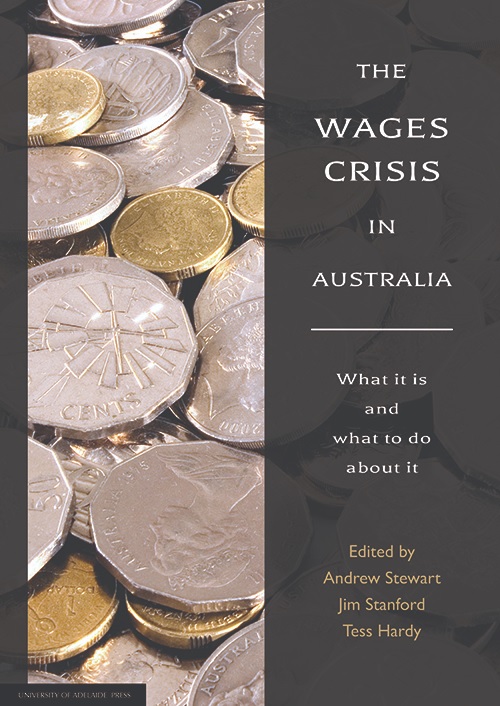
  • New Book: The Wages Crisis in Australia

    New Book: The Wages Crisis in Australia

    by Jim Stanford, Andrew Stewart and Tess Hardy

    Share

    Australian wage growth has decelerated in recent years to the slowest sustained pace since the 1930s. Nominal wages have grown very slowly since 2012; average real wages (after adjusting for inflation) have not grown at all. The resulting slowdown in personal incomes has contributed to weak consumer spending, more precarious household finances, and even larger government deficits.

    Cover

    The wage slowdown has elicited concern from economists and political leaders across the spectrum. Even Dr. Philip Lowe, Governor of the Reserve Bank of Australia, has called it a “crisis,” and suggested that faster wage growth would be beneficial for the economy.

    This new collection of 20 essays by leading labour market experts and commentators in Australia explores the causes, consequences, and potential solutions to this problem.  The book is published by University of Adelaide Press. The book was launched in Melbourne on 29 November, with remarks from Natalie James, former Commonwealth Fair Work Ombudsman and Chair of the Victorian Inquiry Into the On-Demand Workforce.

    Through the links below you may access excerpts from the book, links to participating authors, and supplementary material (including commentary, other readings, and videos). Our hope is that this collection will spark a needed debate in Australia about how to get wages back on track.

    About the Editors:

    Andrew Stewart is the John Bray Professor of Law at the University of Adelaide and a Legal Consultant to the law firm Piper Alderman.

    Tess Hardy is a Senior Lecturer at Melbourne Law School, and Co-Director of the Centre for Employment and Labour Relations Law.

    Jim Stanford is Economist and Director of the Centre for Future Work at the Australia Institute.


    A digital edition of the book is available for free download from University of Adelaide Press. Paperback copies can be ordered for $60 from Federation Press; please submit inquiries to info@federationpress.com.au.


    Related documents


    Natalie James Launch Speech


    Introduction


    Conclusion

    You might also like

  • The Dimensions of Insecure Work in Australia

    The Dimensions of Insecure Work in Australia

    by Jim Stanford

    Share

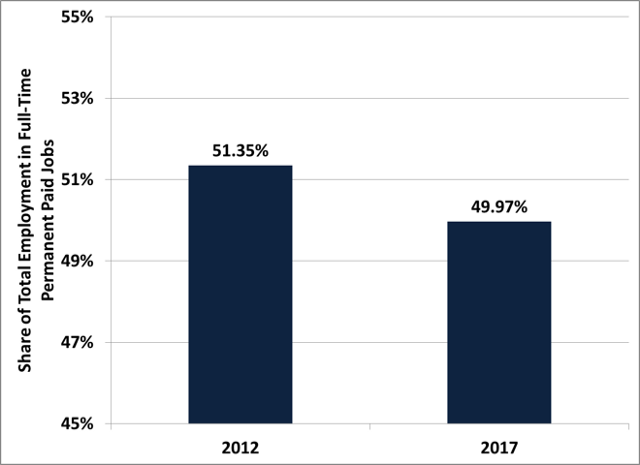
    Less than half of employed Australians now hold a “standard” job: that is, a permanent full-time paid job with leave entitlements. That’s the startling finding of a new report on the growing insecurity of work published by the Centre for Future Work.

    Share of Workers in Full-Time Paid Employment with Leave Entitlements. Source: Centre for Future Work calculations from ABS Catalogues 6291.0.55.003, EQ04 (2017), and 6333.0 Tables 2.3 and 9.1 (2012).

    The report, The Dimensions of Insecure Work: A Factbook, reviews eleven statistical indicators of the growth in employment insecurity over the last five years: including part-time work, short hours, underemployment, casual jobs, marginal self-employment, and jobs paid minimum wages under modern awards.

    All these indicators of job stability have declined since 2012, thanks to a combination of weak labour market conditions, aggressive profit strategies by employers, and passivity by labour regulators. Together, these trends have produced a situation where over 50 per cent of Australian workers now experience one or more of these dimensions of insecurity in their jobs - and less than half have access to “standard,” more secure employment.

    “Australians are rightly worried about the growing insecurity of work, especially for young people,” said Dr. Jim Stanford, one of the co-authors of the report. “Many young people are giving up hope of finding a permanent full-time job, and if these trends continue, many of them never will.”

    The report also documents the low and falling earnings received by workers in insecure jobs. While real wages for those in permanent full-time positions (the best-paid category) have grown, wages for casual workers have declined. And part-time workers in marginal self-employed positions (including so-called “gig” workers) have fared the worst: with real wages falling 26 percent in the last five years.

    “Given current labour market conditions and lax labour standards, employers are able to hire workers on a ‘just-in-time’ basis,” Dr. Stanford said. “They employ workers only when and where they are most needed, and then toss them aside. This precariousness imposes enormous risks and costs on workers, their families, and the whole economy.”

    Dr. Stanford called on policy-makers to address growing precarity with stronger rules to protect workers in insecure jobs (such as provisions for more stable schedules, and options to transition to permanent from casual work). He also stressed the need for economic policies that target the creation of permanent full-time jobs.


    Related research

    You might also like

    Centre For Future Work to evolve into standalone entity

    The Centre for Future Work was established by the Australia Institute in 2016 to conduct and publish progressive economic research on work, employment, and labour markets. Supported by the Australian Union movement, the centre produced cutting edge research and led the national conversation on economic issues facing working people: including the future of jobs, wages

  • The Difference Between Trade and ‘Free Trade’

    Originally published in The Guardian on March 19, 2018

    U.S. President Donald Trump’s recent trade policies (including tariffs on steel and aluminium that could affect Australian exports) have raised fears of a worldwide slide into protectionism and trade conflict.  Trump’s approach has been widely and legitimately criticised.  But his argument that many U.S. workers have been hurt by the operation of current free trade agreements is legitimate; conventional economic claims that free trade benefits everyone who participates in it, have been discredited by the reality of large trade imbalances, deindustrialization, and displacement.

    Can progressives respond to the real harm being done by current trade rules, without endorsing Trump-like actions – which will almost certainly hurt U.S. workers more than they will help?  Centre for Future Work Director Jim Stanford has proposed several key principles to guide a progressive vision of international trade: one that would capture the potential benefits of greater trade in goods and services, while managing the downsides (instead of denying that there are any downsides).

    Dr. Stanford’s commentary was recently published in the Australian Guardian.  The column generated follow-up coverage and commentary in Australia and internationally.  For example, here is an interview with Phillip Adams on ABC Radio National’s Late Night Live.

    Here is an edited version of Dr. Stanford’s commentary:

    Progressives Alternatives to So-Called Free Trade Deals

    U.S. President Donald Trump’s bellicose policies, including new tariffs on steel and aluminium, have raised fears of a worldwide slide into protectionism and trade conflict.  Trump’s unilateral and xenophobic approach to trade policy is reprehensible and dangerous from any perspective.  But many progressives feel conflicted about Trump’s actions.  After all, he is challenging business-friendly trade deals (including the TPP and NAFTA) which labour, social and environmental advocates opposed for years.  And while his policies will clearly make life worse for working and poor people in the U.S., he is nevertheless speaking to their actual experience: unlike free trade defenders, who continue to pretend that the tide of globalisation has lifted all boats.

    But many progressives feel conflicted about Trump’s actions.  After all, he is challenging business-friendly trade deals (including the TPP and NAFTA) which labour, social and environmental advocates opposed for years.  And while his policies will clearly make life worse for working and poor people in the U.S., he is nevertheless speaking to their actual experience: unlike free trade defenders, who continue to pretend that the tide of globalisation has lifted all boats.

    Given Trump’s domination of the debate, progressives need to work quickly to distinguish our critique of globalisation from his.  In particular, we must flesh out a vision of trade policy reforms that would genuinely help those harmed by globalisation, while rejecting the nationalism and racism that underlies Trump’s appeal.

    Established policy elites still ridicule Trump’s belief that trade deals have contributed to the misery and inequality afflicting working class communities in America (and, for that matter, Australia).  For them, globalisation must produce winners but no losers.  And they trot out theoretical economic models (premised on assumptions of full employment and costless adjustment) to buttress their case.  They concede the gains from trade may not have been evenly shared.  But they deny that globalisation has anything to do with the erosion of living standards experienced in so many once-prosperous working communities.

    This patronising denial is precisely what got Trump elected in the first place.  It’s not that depressed industrial towns in Pennsylvania, Ohio, and Wisconsin (the states that put Trump over the top) didn’t “share in the benefits” of free trade.  It’s that their economic viability was destroyed by it.

    Acknowledging that globalisation produces losers as well as winners, allows us to imagine policies to moderate the downsides of trade – and purposefully share the upsides.  The next step is to make a crucial distinction between trade and ‘free trade.’  The former is the pragmatic day-to-day flow of goods and services between countries.  The latter is the set of specific, lopsided rules embodied in the plethora of trade and investment agreements enacted over the last generation.

    These ‘free trade’ rules often have very little to do with actual trade: describing tariff elimination, for example, usually takes up just a tiny part of the text of each trade deal.  The rest is devoted to a raft of provisions securing and protecting the rights of private companies to do business anywhere they want, on predictable and favourable terms.

    Proof of the dissonance between trade and ‘free trade’ is provided by Australia’s lacklustre trade performance over the last two decades.  Exports of actual goods and services constitute a smaller share of total GDP today, than at the turn of the century.  Sure, the volume of resource exports has surged – not surprisingly, since that’s what our trading partners wanted.  But resource prices have been shaky, and meanwhile our other value-added exports flagged badly. If the goal of all the free trade agreements signed since then (a dozen) was to boost Australia’s exports, they failed miserably.  But of course, that wasn’t the goal: the deals were actually intended to cement a business-friendly policy environment, even in sectors that have nothing to do with international trade.

    Progressives can endorse mutually beneficial international trade, and even international flows of direct investment, without accepting the lopsided, business-dominated vision of ‘free trade’ agreements.  In fact, a progressive approach to managing globalisation would actually boost real trade more effectively: by supporting purchasing power on all sides, and avoiding the contractionary race-to-the-bottom unleashed by current free trade rules.

    Here are several key principles central to a more hopeful and inclusive vision of globalisation:

    Preserve the power to regulate:  Free trade deals assume government intervention in markets (regulating prices, service standards, investment, and more) is inherently illegitimate and wasteful; they establish “ratchet” rules to limit regulation and public ownership, and lock-in deregulation over time.  The failure of market competition in so many areas – in Australia’s case, including electricity, vocational education, and employment services – reaffirms that trade deals must not inhibit governments from regulating businesses, no matter where they are owned.

    Eliminate investment preferences:  ‘Free trade’ deals proffer all kinds of preferences and rights for businesses and investors that have no necessary connection at all to actual trade.  Chief among these are the unique quasi-judicial rights and powers granted to corporations (such as investor-state dispute settlement panels); these are an affront to democracy.  Progressive trade policy would abolish these preferences, and subject corporations and their owners to the same laws and processes the rest of us face.  Similarly, progressive trade deals would aim to relax monopoly patent rights (for drug companies and others), rather than strengthening them.

    Manage capital and currencies:  Foreign direct investments in real businesses that produce actual goods and services can certainly benefit host communities, but only so long as those operations are subject to normal public interest and regulatory oversight.  Retaining the capacity to regulate foreign investment is essential to capturing maximum benefits from foreign investment.  On the other hand, volatile, speculative flows of financial capital and foreign exchange have less upside, and more downside.  In particular, rules should prevent the common practice of suppressing exchange rates to gain artificial advantage in international competition.

    Social clauses that mean something:  Most ‘free trade’ deals, the TPP included, feature token language about protecting labour and environmental standards.  These provisions are window-dressing: responding to fears that global competition will spark a downward spiral in social standards.  Typically these clauses simply commit signatories to follow their own laws – with no requirement that those laws are decent to start with.  Progressive trade deals would have safeguards that are enforceable, including requiring participating jurisdictions to respect universal standards or lose preferential trade rights.  Where trade partners have different standards (such as, for example, levying varying degrees of carbon pricing), border adjustments must be permitted so that trade competition does not undermine environmental and social progress.

    Balanced adjustment:  Trade and investment flows never automatically settle at a balanced position – even if a “level playing field” in labour and environmental standards was actually achieved.  That’s because competition always has uneven effects, producing both winners and losers.  Countries that experience loss of employment and production through global competition (a possibility denied by free trade theory, but commonplace in practice) must be supported with measures to safeguard domestic employment, facilitate adjustment, and boost exports.  Chronic surplus countries (like China and Germany) must recycle excess earnings into expanding their own imports, thus bearing a fair share of adjustment – rather than forcing deficit countries to do all the heavy lifting.

    Active, inclusive domestic policies:  Opposition to trade liberalisation is relatively mild in the highly trade-exposed social-democratic countries of Europe: like the Nordic countries, Germany, and Netherlands.  Their extensive networks of social protections provide average workers with reasonable confidence they won’t be economically tossed aside for any reason: whether trade competition, or some other disruption.  That’s why a key component of progressive trade policy must be a general commitment to social protection, inclusion, and job-creation. A general context of security and equity better facilitates adjustments of any kind, in response to any source of change.  Indeed, collecting healthy taxes from successful industries, and reinvesting them in priorities like infrastructure, training, and communities, is precisely how to harvest the much-trumpeted gains from trade – and pro-actively share them throughout society.  That’s much more feasible than hoping those benefits will somehow trickle down of their own accord.

    Claims by policy elites that international trade is the engine of all progress are vastly overblown.  Our well-being mostly depends on what we do with our skills, energies and innovation right here at home.  But real international trade and investment, properly managed, can certainly make a contribution to prosperity.  And progressives can advance a vision of a more balanced, inclusive globalisation that has nothing in common with Donald Trump.


    You might also like

  • Job Opportunity – Research Economist

    Job Opportunity – Research Economist

    Share

    The Centre for Future Work invites applications for an economist to join our research team in labour market research and policy analysis, working from our offices in Sydney or Canberra.

    Deadline for applications is December 21 2017.

    It’s a chance to be part of our growing team, and to make a contribution to strong, progressive policy research on jobs, employment, fairness, and the future of work!

    Please download the full notice below for more details.


    Related documents


    Position description

    You might also like

    Dutton’s nuclear push will cost renewable jobs

    by Charlie Joyce

    Dutton’s nuclear push will cost renewable jobs As Australia’s federal election campaign has finally begun, opposition leader Peter Dutton’s proposal to spend hundreds of billions in public money to build seven nuclear power plants across the country has been carefully scrutinized. The technological unfeasibility, staggering cost, and scant detail of the Coalition’s nuclear proposal have

  • Job Growth No Guarantee of Wage Growth

    Originally published in The Sydney Morning Herald on November 17, 2017

    Measured by official employment statistics, Australia’s labour market has improved in recent months: full-time employment has grown, and the official unemployment rate has fallen. But dig a little deeper, and the continuing structural weakness of the job market is more apparent. In particular, labour incomes remain unusually stagnant. In this commentary, Centre for Future Work Associate Dr. Anis Chowdhry reflects on the factors explaining slow wage growth — and what’s required to get wages growing.

    Job Growth No Guarantee of Wage Growth

    by Dr. Anis Chowdhury

    ‘Remarkable’ jobs growth raises hopes for wages” was the headline for a recent Sydney Morning Herald opinion piece by Clancy Yeates. He bases this claim on “some brighter news on the labour market to balance the bad: there is something of a jobs boom under way”. Apparently “more jobs have been created in 2017 in net terms than any year since 2005, with 371,000 new net jobs so far this year”. Clancy Yeates also points to “the lowest number of unemployed people per unfilled position since 2012”.

    This optimism is also shared by the Treasury Secretary John Fraser. In his opening statement at the recent Senate budget estimates hearing on 25 October, he said, “We expect that a period of stronger growth and falling unemployment will lift wages in the next few years.” He further noted, “We do expect that as the cyclical constraints that have weighed on the economy recede wages growth will accelerate.”

    The RBA also holds a similar optimistic view. Philip Lowe, the RBA Governor, in his September statement observed, “Employment growth has been stronger over recent months and has increased in all states. The various forward-looking indicators point to solid growth in employment over the period ahead. … stronger conditions in the labour market should see some lift in wages growth over time.” He had the same positive view in his October statement.

    But can we really be so confident that job growth will eventually lead to wage growth? And even if it does, would it be strong enough to catch up and compensate for the losses incurred from such a long period of wage stagnation?

    Unfortunately, the answer to these questions is a resounding ‘NO’. This so-called remarkable jobs growth will not result in an eventual wage growth sufficient to close the wages gap. This has been confirmed by the latest data showing wages rose by less than expected last quarter; even a significant mandated jump in the minimum wage failed to lift the rate of growth of workers’ pay across the economy. The most broad measure of average earnings growth (derived from GDP statistics) has actually turned negative – the weakest since the mid-1960s.

    The reason for this contradiction is very simple – it is rooted in the different nature of new and old jobs. Jobs, whether part-time or full-time, are now more insecure. Just consider some recent news. The NAB has announced 6,000 job cuts by 2020 even when it announced $6.6 billion profit! Earlier Telstraconfirmed 1,400 job cuts.

    Job insecurity is not just a phenomena in the private sector. Governments – State and Commonwealth – have also joined the new trend. For example, the NSW department of Finance Services and Innovation has notified the union representing the cleaners that employment guarantees in place since 1994 “will not be extended in the new contracts from 2018”.

    The optimists seemed to have decided to ignore what Alan Greenspan, the former chairman of the US Federal Reserve, said in his Congressional hearing two decades ago (on 26 February, 1997). Explaining why “the rate of pay increase still was markedly less than historical relationships with labor market conditions would have predicted”, he said: “Atypical restraint on compensation increases … appears to be mainly the consequence of greater worker insecurity.”

    He clearly elevated job insecurity to major status in the Fed’s policy analysis. Workers have been too worried about keeping their jobs to push for higher wages. And this has been sufficient to hold down inflation without the added restraint of higher interest rates.

    But Greenspan also implied that workers’ fear of losing their jobs was not in itself a sufficient explanation for their failure to push for significant wage increases. The sense of job insecurity has to be rising over time; that is, continually getting worse. Because once the level of insecurity leveled off, and workers become accustomed to their new level of uncertainty, their confidence may revive and the upward pressure on wages would resume. That is particularly true when the unemployment rate is low, as it is today (at least officially).

    However, looking at the length of contracts, Jeff Borland, a leading Australian labour economist, finds no evidence of increased job insecurity in Australia. Others have reported similar findings, while others cite different data to indicate a growth in insecurity. A new ABS survey also showed that while there had been an increase in the number of people with more than one job since 2010-11, those doing multiple jobs as a proportion of the workforce had remained almost completely unchanged at 6%.

    Job insecurity is notoriously difficult to measure. It is not the length of contracts or whether a job is full-time or part-time, that matters. It is the constant threat of losing jobs or pay conditions despite tenure due to constant restructuring that the workers fear. It is the news like that from the ice cream manufacturer Street wanting to terminate its enterprise agreement, or announcements like the one from the NSW department of Finance Services and Innovation, which generate the sense of job insecurity.

    It is this sense of job insecurity and fear of not finding a decent job after losing one (as experienced, for example, when Holden and Toyota recently closed down) which Alan Greenspan had in mind when he calibrated Fed’s monetary policy levers. Thus, there has to be continuous restructuring in the guise of addressing falling or stagnant productivity to keep lid on wages, while the real intent is creating fears among the working class.

    When nearly half the Australian families (41%) feel job security is chief among their concerns, this supposedly remarkable jobs growth won’t generate pressure for wage growth as hoped by the optimists. “Insecure, stressed, and underemployed: The daily reality for millions of Australians”, is how David Taylor summarised the labour market in Australia. This is experienced even as profits are growing at their highest rate in two decades.

    Governments – State and Federal – should worry about rising job insecurity, instead of adding fuel to the fire with their own employment restructuring initiatives. The high level of job insecurity doesn’t just have an effect on wage growth and inflation. Recent research has found that it “cuts to the core of identity and social stability – and can push people towards extremism”. We all have a stake in creating more secure jobs, and fairly rewarding those who perform them.


    You might also like

    Dutton’s nuclear push will cost renewable jobs

    by Charlie Joyce

    Dutton’s nuclear push will cost renewable jobs As Australia’s federal election campaign has finally begun, opposition leader Peter Dutton’s proposal to spend hundreds of billions in public money to build seven nuclear power plants across the country has been carefully scrutinized. The technological unfeasibility, staggering cost, and scant detail of the Coalition’s nuclear proposal have

  • Economists Debunk Job-Creation Claims of Penalty Rate Cut

    Economists Debunk Job-Creation Claims of Penalty Rate Cut

    Share

    The Fair Work Commission has ruled that penalty rates for Sunday and public holiday work in the retail and hospitality sectors should be reduced, which would reduce hourly wages on those days by up to $10 per hour. Business lobbyists predict this will spark a hiring surge in stores and restaurants, as employers take advantage of lower wages to extend hours and ramp up operations. The economic logic of this claim is highly suspect, however – especially in light of the fundamental factors which truly limit employment in these sectors (namely, the sluggish growth of personal incomes). 78 Australian economists have signed a public letter debunking these job-creation claims, arguing that the FWC’s decision will lead to more inequality, not more employment.

    A 3-person drafting committee wrote the letter and circulated it among the economics community.  The committee included Stephen Koukoulas (Managing Director of Market Economics), John Quiggin (Dept. of Economics, University of Queensland), and our own Jim Stanford (Economist and Director of the Centre for Future Work). See the full letter, and list of signatories, below.


    Related documents


    Public letter

    You might also like

    Dutton’s nuclear push will cost renewable jobs

    by Charlie Joyce

    Dutton’s nuclear push will cost renewable jobs As Australia’s federal election campaign has finally begun, opposition leader Peter Dutton’s proposal to spend hundreds of billions in public money to build seven nuclear power plants across the country has been carefully scrutinized. The technological unfeasibility, staggering cost, and scant detail of the Coalition’s nuclear proposal have

  • Denying The Downside Of Globalization Won’t Stop Populism

    Originally published in The Huffington Post on October 11, 2016

    The rise of anti-globalization sentiment, including in Australia, poses a big challenge to mainstream politicians who’ve been trumpeting the virtues of free trade for decades.

    Treasurer Scott Morrison recently started pushing back, delivering a staunch defense of globalization to an audience in Sydney. Like other world leaders responding to the wave of populism, Mr. Morrison doubled down with strong claims about the universal, lasting benefits of free trade. Australians may be anxious about their economic future, he conceded. But don’t blame globalization.

    Globalization “increases our living standards and always has,” Mr. Morrison bluntly proclaimed. Free trade, immigration and inward foreign investment are “the very sources of … prosperity.” Resisting globalization, he suggested, is like thinking “we can pull the doona over our head and insulate ourselves.”

    Denying any potential downside to globalization, and deriding critics as hiding from reality, will not defuse the wave of anger that put four One Nation senators into Parliament. Contrary to Mr. Morrison’s claims, there is ample evidence that Australia’s trade performance has deteriorated badly in recent years, despite –- or perhaps because of -– the acceleration of free trade.

    Globalization, as currently practiced, is imposing real, lasting damage in many parts of Australia, and producing a fertile political environment for nationalism and xenophobia. The political and policy responses to that danger must go beyond denial.

    Mr. Morrison stressed the effectiveness of his government’s trade agenda, especially what he called new “export trade deals” with China, Korea, and Japan. (This curious terminology deliberately neglects that free trade agreements are also intended to facilitate imports!) “The results are there to see,” he said.

    Or are they? As a share of GDP, Australia’s exports have declined significantly since the turn of the century, even as government inked several free trade pacts. Services exports also contracted relative to GDP. And ironically, Australia did worse with its free trade partners, than with the world as a whole.

    For example, we now have one year of experience under free trade with Japan and Korea. Perversely, Australian exports to both countries declined in the first year: by 9 percent for Korea, and 16 percent to Japan. Yet Australia’s imports from Japan and Korea surged by 14 percent and 24 percent, respectively.

    Therefore, Australia enjoyed more exports, and a better trade balance, without free trade than with it. In the first months of free trade with China, Australia’s exports are also declining. Similarly, under Australia’s trade pacts with the U.S., Thailand, Singapore and Chile, imports grew much faster than exports — and in some cases exports didn’t grow at all.

    There’s little reason to believe that new deals being pursued by Canberra (with India, Indonesia and the Trans Pacific Partnership) would have any better results.

    The cumulation of many bilateral trade deficits is an overall global payments imbalance that is driving Australia deeply into international debt. Australia’s current account deficit reached $77.5 billion last year: the biggest ever (in nominal terms). Relative to GDP, that’s the second-largest of any OECD country — behind only the U.K. (another hotbed of populism). It’s even worse than precarious emerging economies (like Brazil, South Africa or Turkey).

    Mr. Morrison actually celebrated this large international deficit last week, suggesting it allows Australia to invest more and grow faster. But he has it perfectly backwards. Business investment is contracting rapidly in Australia, not growing. And with Australia buying so much more from the rest of the world than it sells, we end up with less production, fewer jobs and less income. The gap can be offset with growing international debt, but only for a while.

    This miserable trade performance is clearly contributing to Australia’s weak labour market: declining total hours of employment, disappearing full-time jobs and unprecedented wage stagnation. So disaffected Australians aren’t making it up when they conclude their prospects have diminished, and no amount of boosterism can change that reality.

    Moreover, they have sound reasons to blame globalization as one important factor (certainly not the only one) for their predicament.

    If Mr. Morrison and other free-traders want to truly counter the divisive and dangerous ideas of nationalism and xenophobia, they should start by acknowledging that globalization does indeed have a downside, not just an upside. Then they must move to implement policies -– like balanced trade, job creation, stronger income security, and better vocational education — to assist those Australians who have been harmed by it.


    You might also like

    The Difference Between Trade and ‘Free Trade’

    by Jim Stanford in The Guardian

    U.S. President Donald Trump’s recent trade policies (including tariffs on steel and aluminium that could affect Australian exports) have raised fears of a worldwide slide into protectionism and trade conflict.  Trump’s approach has been widely and legitimately criticised.  But his argument that many U.S. workers have been hurt by the operation of current free trade

  • Looking for “Jobs and Growth”: Six Infographics

    Looking for “Jobs and Growth”: Six Infographics

    Share

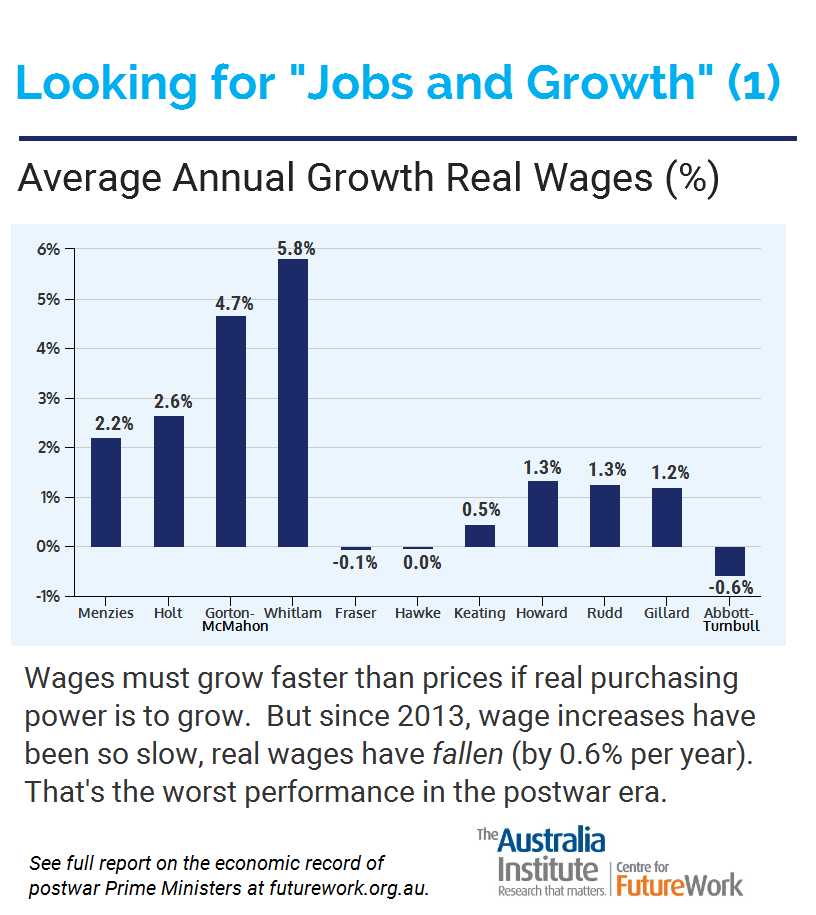
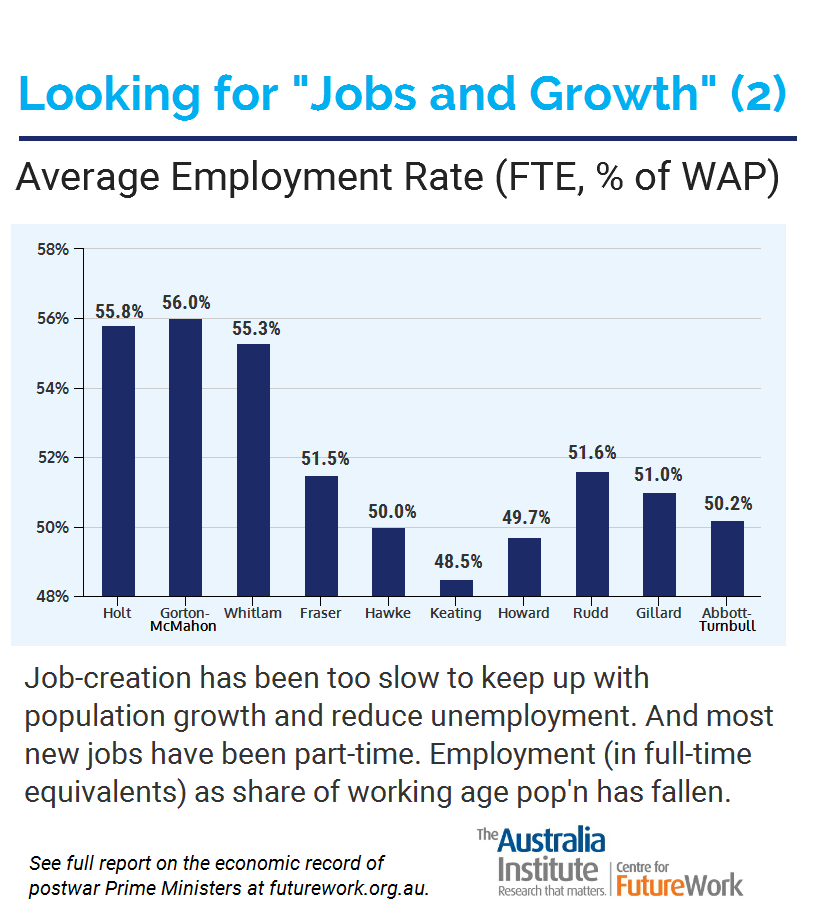
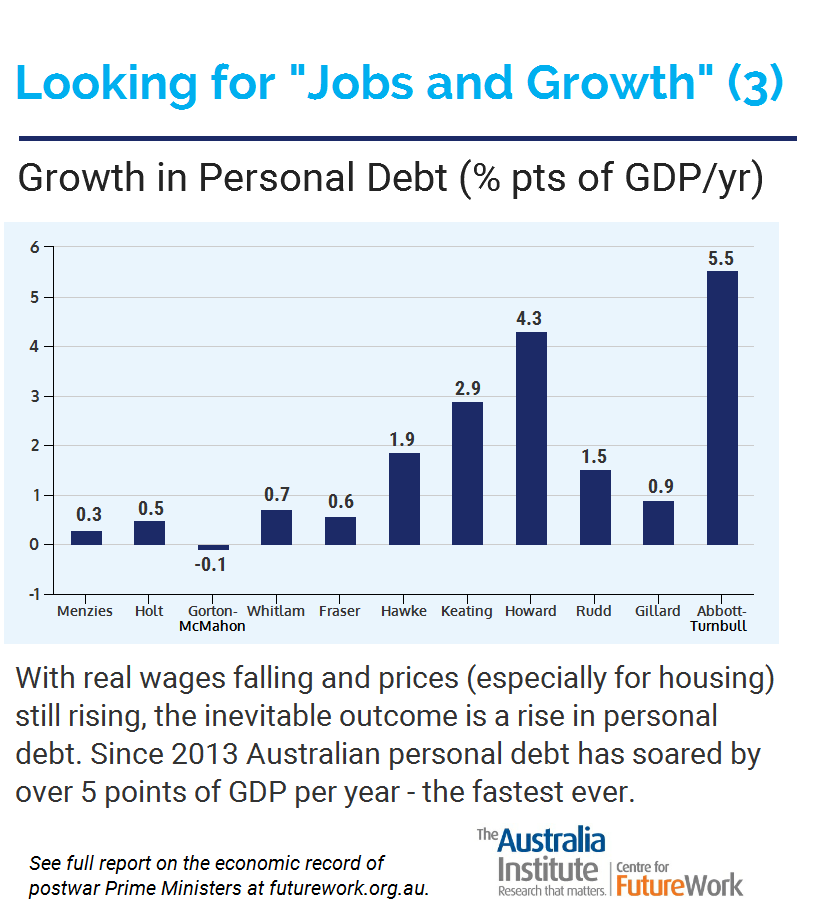
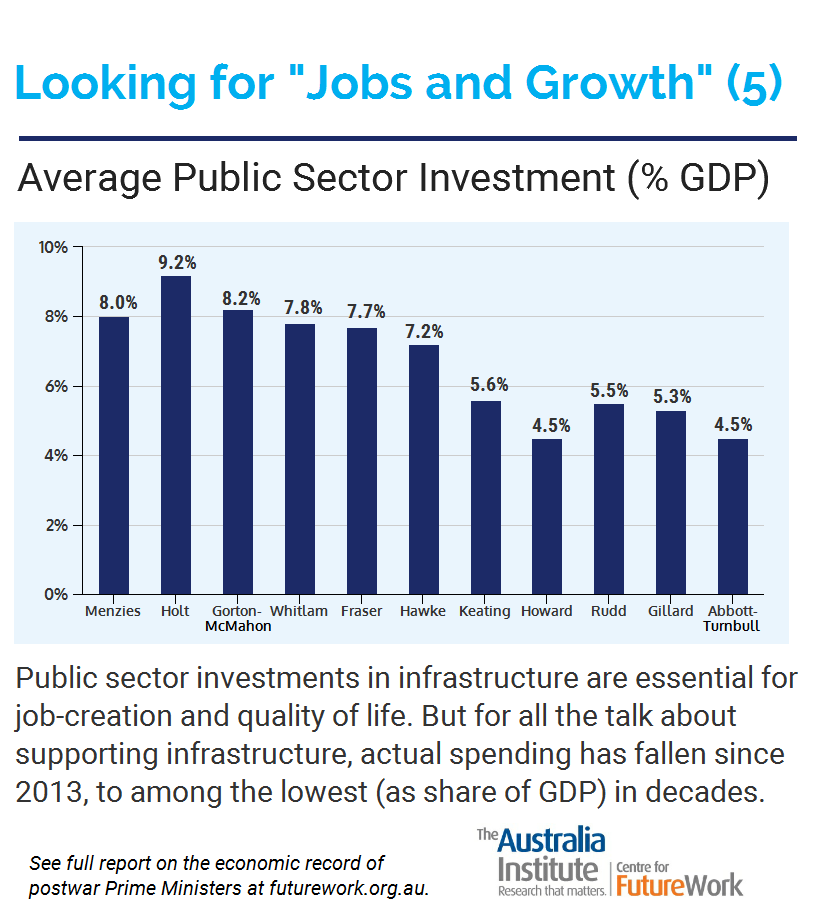
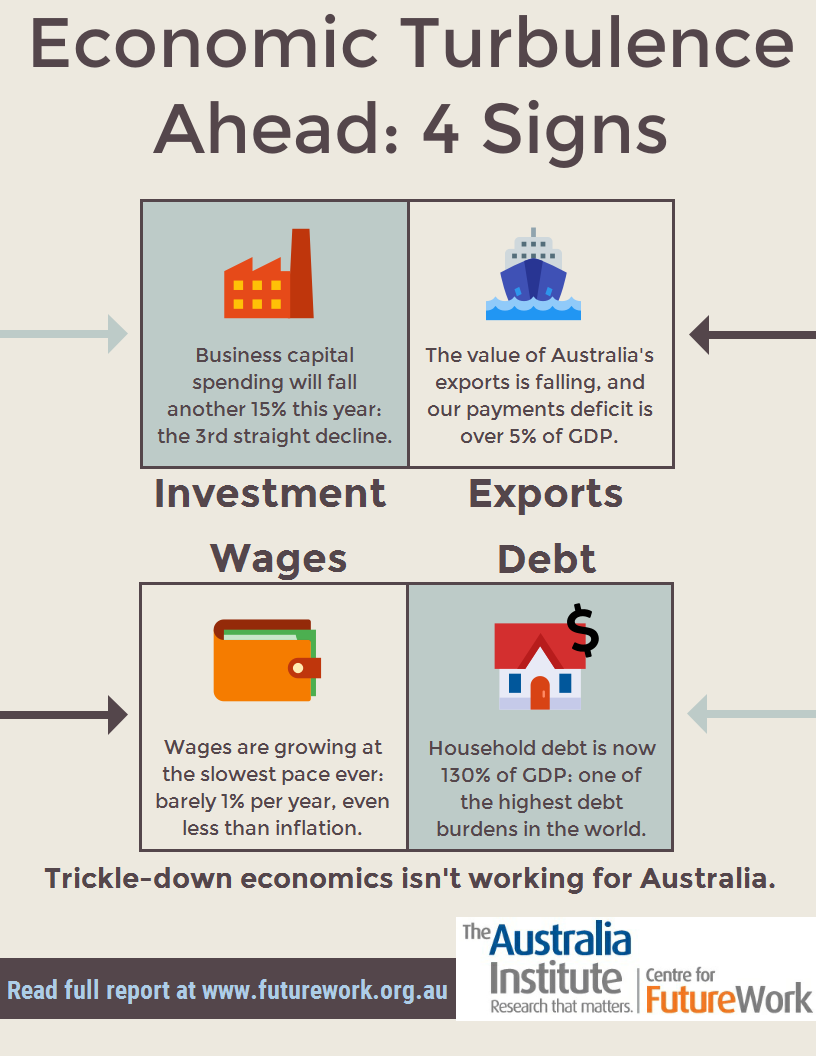
    We have prepared six shareable infographics based on material in our research paper, “Jobs and Growth… and a Few Hard Numbers,” which compared Australia’s economic performance under the respective postwar Prime Ministers.

    The infographics summarize several of the specific economic variables considered in the full report, dating back to 1950 (and Prime Minister Menzies) in most cases.

    Average Annual Growth, Real Wages
    Average Employment Rate
    Growth in Personal Debt
    Average Annual Growth, Business Investment
    Public Sector Investment
    4 Signs of Turbulence Ahead

    Related research

    You might also like

    Dutton’s nuclear push will cost renewable jobs

    by Charlie Joyce

    Dutton’s nuclear push will cost renewable jobs As Australia’s federal election campaign has finally begun, opposition leader Peter Dutton’s proposal to spend hundreds of billions in public money to build seven nuclear power plants across the country has been carefully scrutinized. The technological unfeasibility, staggering cost, and scant detail of the Coalition’s nuclear proposal have

    Centre For Future Work to evolve into standalone entity

    The Centre for Future Work was established by the Australia Institute in 2016 to conduct and publish progressive economic research on work, employment, and labour markets. Supported by the Australian Union movement, the centre produced cutting edge research and led the national conversation on economic issues facing working people: including the future of jobs, wages