Category: International & Security Affairs

Research branch

  • Australia dumps its care crisis on the Pacific – new report

    Australia dumps its care crisis on the Pacific – new report

    Share

    Skilled health workers from Pacific Island countries are being poached to plug Australia’s shortage of care workers, leaving the health systems in their home countries on the brink of collapse, according to new research.

    A report by the Centre for Future Work at The Australia Institute and Public Services International has also found that when workers get to Australia, many are being deskilled, underpaid and exploited.

    Care workers have been added to the Pacific Australia Labor Mobility (PALM) scheme, traditionally aimed at seasonal agriculture workers like fruit pickers. This has led to skilled health workers – like nurses – quitting their jobs to take up better paid but lower skilled jobs in Australia.

    The report details the harrowing state of the health systems in Fiji, Papua New Guinea, Samoa, the Solomon Islands and Vanuatu. Many health services and hospitals have been decimated, operating at 30-40 percent capacity or below.

    The research reveals that not only are Pacific workers doing lower-skilled care jobs in Australia, they are vulnerable to poor treatment, due to their visa status.

    “Workers have the right to cross borders for a better life for themselves and their families,” said Fiona Macdonald, Director of the Centre for Future Work at The Australia Institute.

    “But the current system is broken. It is rich countries taking from poor countries and giving nothing back. Australia and New Zealand are offloading their own care crises to their Pacific neighbours.

    “Australia has vowed to invest in the health systems of its Pacific neighbours, not destroy them. It should be helping to build better, safer health facilities and train workers, not lure them away.

    “We are taking workers out of a system already at breaking point, giving them jobs which are below their skill level and failing to protect them from exploitation and mistreatment.

    “The recruiting and labour hire systems, including international schemes like PALM, need urgent reform. This should start with meaningful dialogue with the workers themselves.”


    Related research

  • Addressing the health workforce crisis in the Pacific

    Labour mobility is a significant contributor to Pacific Islands’ economies.

    Australia and New Zealand’s temporary labour migration schemes for Pacific workers have expanded into more industries including personal care work in aged care.

    This has led to the loss of skilled health workers from Pacific Island countries, including registered nurses, to lower-skilled personal care jobs overseas.

    Workers who take up temporary migration in Australia and New Zealand are vulnerable to being underpaid and exploited, due to their visa status.

    This report examines the need for reform of labour migration systems and greater consultation with workers.


    Full report


    Factsheet
    Australia dumps its care crisis on the Pacific – new report

    Share

  • Australian Sovereignty and the Path to Peace – 2025 Laurie Carmichael Lecture

    Australian Sovereignty and the Path to Peace – 2025 Laurie Carmichael Lecture

    This year’s lecture was delivered by the Hon Doug Cameron, former NSW Senator, on September 10 in the Solidarity Hall at the Victorian Trades Hall Council.

    The Laurie Carmichael Lecture is an annual keynote lecture hosted by the Carmichael Centre, an initiative of the Australia Institute’s Centre for Future Work, in partnership with RMIT University’s Business and Human Rights Centre (BHRIGHT). It is supported by the ACTU, the AMWU, the AEU, and The Australia Institute.


    2025 LAURIE CARMICHAEL LECTURE

    Share

  • Dutton’s nuclear push will cost renewable jobs

    Dutton’s nuclear push will cost renewable jobs

    by Charlie Joyce

    Dutton’s nuclear push will cost renewable jobs

    As Australia’s federal election campaign has finally begun, opposition leader Peter Dutton’s proposal to spend hundreds of billions in public money to build seven nuclear power plants across the country has been carefully scrutinized.

    The technological unfeasibility, staggering cost, and scant detail of the Coalition’s nuclear proposal have brought criticism from federal and state governments, the CSIRO, the Climate Council, the Electrical Trade Union (ETU), the Climate Change Authority, the Australia Institute, and independent energy experts.

    The CSIRO, among others, has refuted the Coalition’s claim that nuclear will be cheaper than renewables; instead, they have shown the energy produced by Australian reactors would cost approximately eight times more than the same amount of energy produced by renewables. If this cost is passed on to consumers, the average household would pay $590 per year more on their power bill. Unsurprisingly, Australia Institute polling has found that fewer than one in twenty Australians (4%) are prepared to pay this nuclear premium.

    The cost alone should be enough to bury this nuclear proposal. But it is also important to recognise how the Coalition’s plan will impact – and fail – workers.

    False promises

    The Coalition has proposed that large nuclear reactors would be built on the sites of five operational or recently decommissioned coal fired power stations: Liddell and Mount Piper in New South Wales, Tarong and Callide in Queensland, and Loy Yang in Victoria. In doing so, the Coalition has promised that nuclear energy would be a source of stable and plentiful work for the communities where coal-fired power plants are phasing down.

    This is a false promise. Six coal fired power stations have already closed in the past decade, with 90% of Australia’s remaining coal-fired power stations set to close in the next decade. These communities are already undergoing structural adjustment, and they need new sources of employment now. But this is not what the Coalition’s plan delivers. The Coalition outlines that the first two nuclear reactors would not come online until the mid-2030s – more than a decade from now – while the remainder would be completed by 2050.

    And energy and technology experts agree that even this timeline is impossible. On average, a nuclear reactor takes 9.4 years just to build in countries with established and capable nuclear industries. Former Australian Chief Scientist Alan Finkel has estimated that it would take until the mid-2040s at the earliest for Australia to build an operational nuclear reactor. Moreover, analysis from the Institute for Energy, Economic & Financial Analysis (IEEFA) has found that, in economies comparable to Australia’s, every single nuclear reactor project experienced multi-year delays and cost blowouts of up to three and a half times over budget. It is hard to see how Australia, which lacks the experienced workforce, training and research base, or regulatory framework, would buck this trend.

    Lost jobs

    While the Coalition’s nuclear plan would not bring jobs to the communities that need them, it might have the real effect of depressing investment in renewables.

    Renewable energy already generates approximately 40% of Australia’s energy and is by far the cheapest form of electricity. Renewable energy industries already account for the employment of tens of thousands of workers, and Jobs and Skills Australia estimates that approximately 240,000 new workers will be required in industries associated with clean energy by 2030.

    But this requires ongoing and expanding investment in renewables, which the Coalition’s nuclear policy is likely to derail. The Clean Energy Council has estimated that by capping renewable energy to 54% of total use (as the Coalition’s modelling has assumed), 29GW of renewable energy generation projects would not be built – squandering an expected 37,700 full-time-equivalent construction jobs and 5,000 ongoing jobs in operations and maintenance. By limiting renewables investment, prolonging fossil fuel usage, and diverting investment towards nuclear energy, the full employment opportunities of the renewable energy transition are lost.

    Scarce and dangerous work

    If the Coalition’s nuclear plan does come to fruition it will hardly create any ongoing jobs for the communities that have undergone structural readjustment. According to analysis from the Nuclear Energy Agency, while the peak period of construction of the average 1GW nuclear power plant can demand up to 3,500 workers, ongoing operations and maintenance will only require about 400 workers – with only a quarter of these being onsite blue-collar jobs that might provide work for the people who will have lost jobs with the closure of coal-fired power stations. Most jobs will be in administration, regulatory compliance, energy, marketing, sales, science and emergency personnel – and many of them are likely to be located away from the nuclear facility itself.

    Disturbingly, any jobs on-site may put the health of workers at risk. Recent analysis of multiple studies of the health impacts of nuclear power plant employment across multiple countries found that workers have a significantly higher risk of mesothelioma and circulatory disease due to exposure to radiation. Nearby residents also exhibit a significantly higher risks of cancer, with children under the age of five at particular risk. And this does not even factor in the risk of sudden plant failure and reactor meltdown on workers and communities – a risk sharpened by the Coalition’s plan for these reactors to be built on geological fault lines with heightened earthquake risk.

    Australian workers have much to gain from the renewable energy transition, including cheaper power, new clean technology industries, and hundreds of thousands of new jobs. The Coalition’s nuclear plan only brings false promises, lost jobs, and – if the plan comes to fruition – few jobs and potentially dangerous work.


    You might also like

  • Commonwealth Budget 2025-2026: Our analysis

    Commonwealth Budget 2025-2026: Our analysis

    by Fiona Macdonald

    Share

    The Centre for Future Work’s research team has analysed the Commonwealth Government’s budget, focusing on key areas for workers, working lives, and labour markets.

    As expected with a Federal election looming, the budget is not a horror one of austerity. However, the 2025-2026 budget is characterised by the absence of any significant initiatives.
    There is very little in this budget that is new, other than some surprise tax cuts, which are welcome given they mostly benefit people on low incomes

    There are continuing investments in some key areas supporting wages growth where it is solely needed and for rebuilding important areas of public good. However, there remains much that needs to be done in the next parliament, whoever is in government.

    “The budget does deliver a welcome tax cut targeted towards those on low incomes” Chief Economist Greg Jericho notes, “but the lack of new spending and initiatives highlights the need for policies from all political parties in the coming election campaign that address inequality and the needs of people who have been most hurt by cost of living rises over the past three years.”

    Read our full budget briefing paper for more information


    Related research

    You might also like

    Dutton’s nuclear push will cost renewable jobs

    by Charlie Joyce

    Dutton’s nuclear push will cost renewable jobs As Australia’s federal election campaign has finally begun, opposition leader Peter Dutton’s proposal to spend hundreds of billions in public money to build seven nuclear power plants across the country has been carefully scrutinized. The technological unfeasibility, staggering cost, and scant detail of the Coalition’s nuclear proposal have

  • Would you like a recession with that? New Zealand shows the danger of high interest rates

    Would you like a recession with that? New Zealand shows the danger of high interest rates

    by Matt Grudnoff

    New Zealand’s central bank raised interest rates more than Australia and went into a recession – twice.

    Recently there have been calls for the Reserve Bank to increase interest rates because inflation has remained “sticky” at 3.5%-4%. These calls are coming even though this may push Australia into recession. This horrifying scenario is being shrugged off by some as the price we have to pay to get inflation down – but the experience of New Zealand shows higher interest rates do not always bring down inflation, but they can very much lead to recessions.

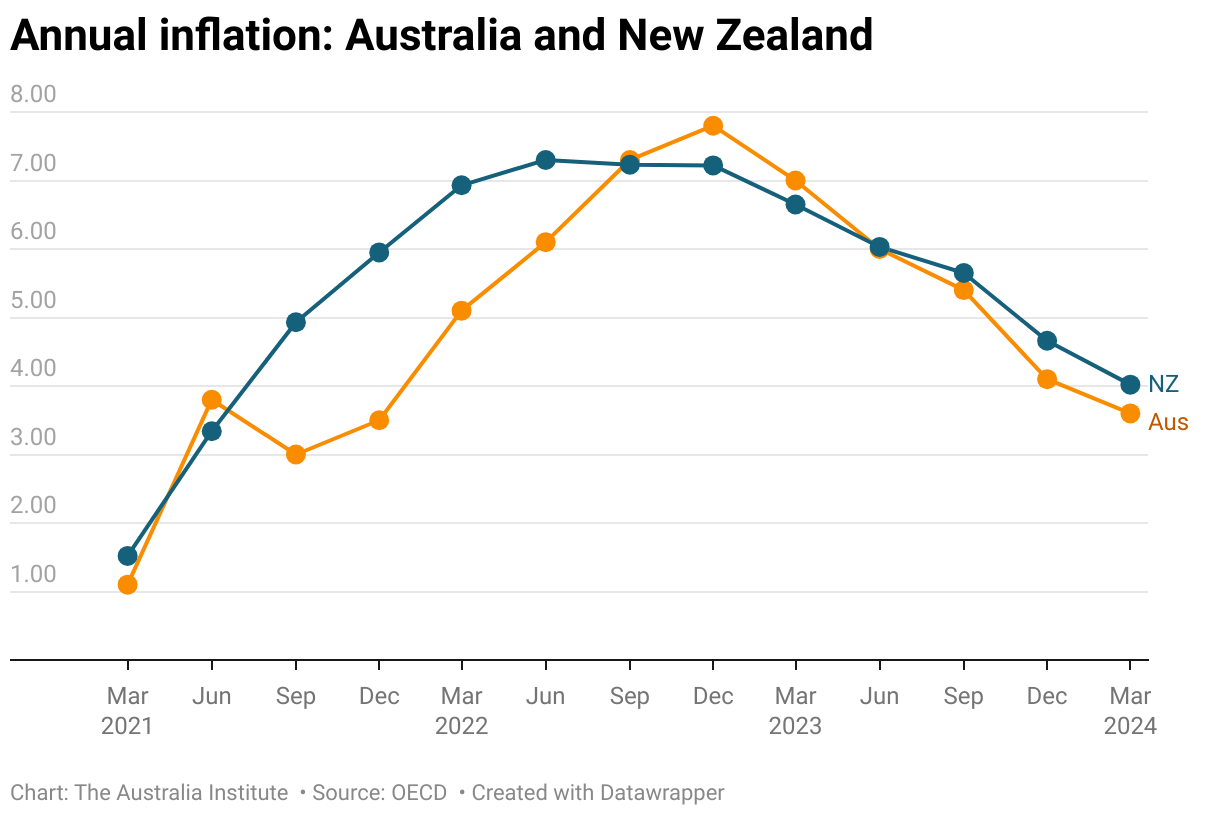
    The June quarter CPI is due out this week, and many economists predict that it will increase slightly from the current 3.6%. This comes after consistent falls in the rate of inflation since the end of 2022. In fact, the inflation rate has fallen from 7.8% in December 2022 to 3.6% in March 2024.

    But a more than halving in the inflation rate is not enough for the armchair inflation hawks who are determined to see the inflation rate back into the Reserve Bank’s target band as soon as possible and regardless of the cost.

    The idea that the costs of slightly elevated inflation are in any way comparable to the costs of a recession is just ridiculous. Recessions cause widespread suffering, unemployment, and economic scaring that can last for a decade or more.

    Now that wages are growing faster than inflation, the costs of inflation are minimal, particularly when it is less than a percentage point above the target band.

    Even worse, higher interest rates are unlikely to bring inflation down any faster.

    Normally inflation is caused when the economy is booming, incomes and spending is rapidly rising, and businesses can’t keep up with all the additional demand. In this situation, higher interest rates act by reducing spending and slowing the booming economy.

    The inflation Australia and the rest of the world are facing is not that kind of inflation. It is a much more uncommon kind of inflation that is caused by supply shocks. Supply shocks increase the costs that businesses face which leads to increased prices. Importantly higher costs can’t be fixed by increasing interest rates, making them a far less effective policy response.

    As former governor Philip Lowe pointed out, there is very little that monetary policy can do to offset supply shocks, and you should “let the supply shock wash through the system.”

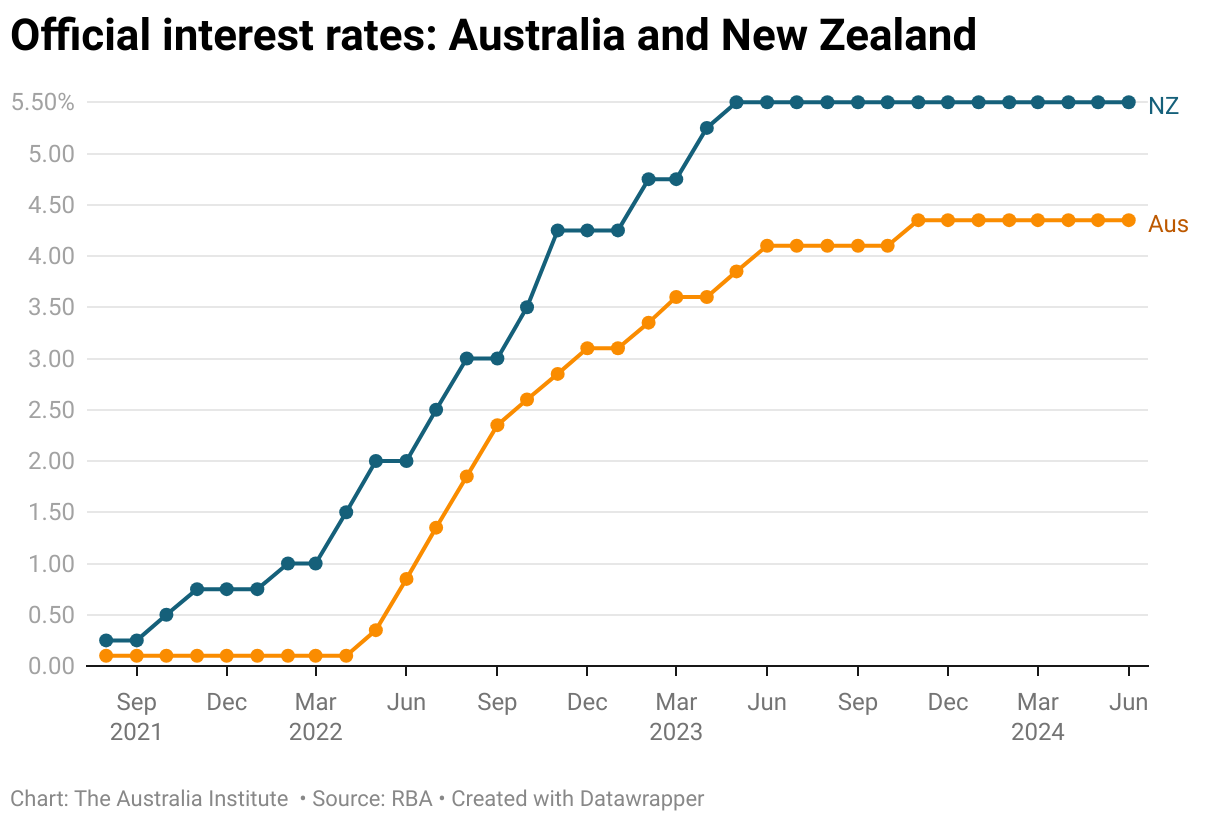
    New Zealand is a case in point. It has increased its official interest rate faster and higher than Australia. While Australia’s cash rate is at 4.35%, New Zealand’s rate is at 5.5%.

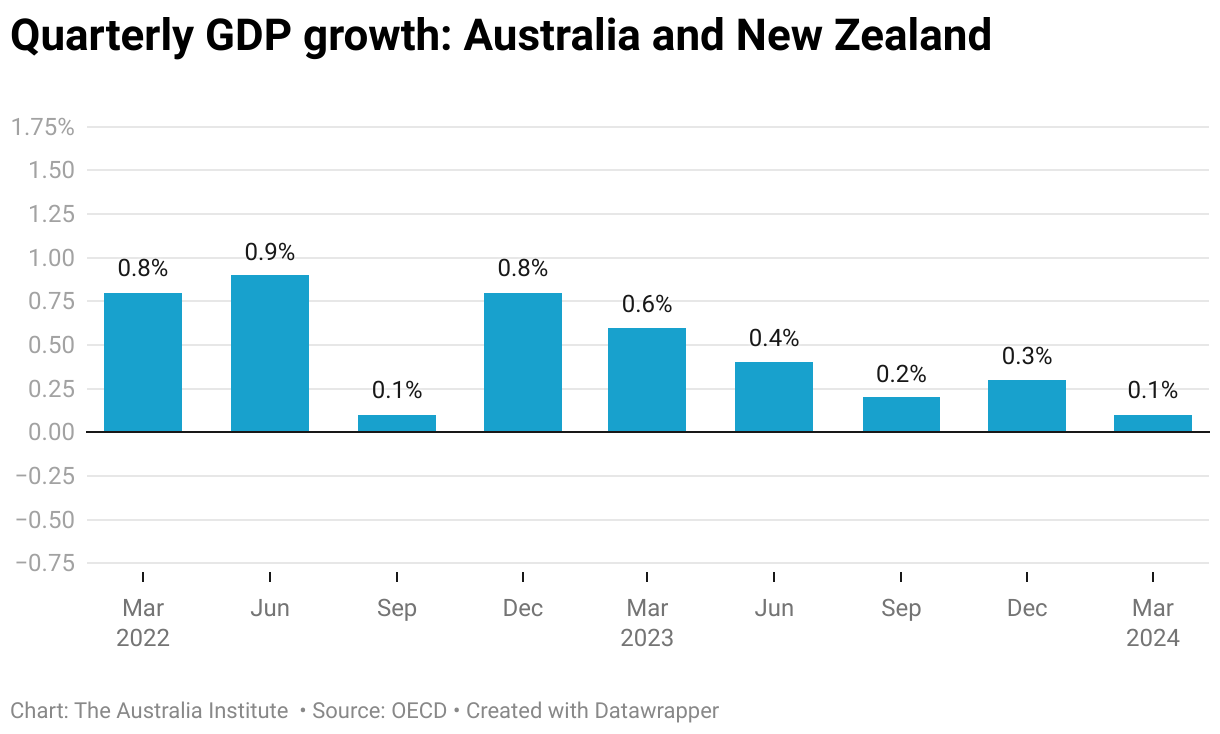
    The New Zealand economy has been dipping in and out of technical recession for 18 months. A technical recession is two consecutive quarter of negative economic growth – and New Zealand has experience that twice.

    By comparison Australia’s, economic growth has slowed but it has continued to remain positive.

    The problem for New Zealand is that the higher interest rates and slower economic growth have not led to a faster drop in inflation. If we compare the inflation in New Zealand and Australia, we can see that while inflation in New Zealand took off earlier than in Australia, both countries are seeing inflation come down at about the same pace.

    This should be a warning to the Reserve Bank that higher interest rates might work to crash the economy, pushing up unemployment, and heaping more misery on Australian households, but they will do little to bring down prices.

    Inflation is already on its way down as the supply shocks that set off this bout of inflation resolve themselves. When the June quarter inflation rate comes out, it might show the path back to the target band is not completely smooth. It may even increase slightly. But this is a time when the Reserve Bank needs to show courage and ignore the armchair critics and keep interest rates on hold.

    Inflation is coming down and a recession would be the worst possible outcome.


    Related research

    You might also like

  • Webinar: Stop passing the buck -Workers’ compensation and ‘gig’ workers

    Webinar: Stop passing the buck -Workers’ compensation and ‘gig’ workers

    by Lisa Heap

    Share

    Workers’ compensation and rehabilitation are amongst the most important legal issues facing the ‘gig’ economy. This reflects the potential vulnerability of these workers and their families, co-workers, and community to harsh and long term consequences from injuries. For a while, it looked like federal industrial policy might ‘solve’ the workers compensation problem by redefining ‘gig’/platform workers as employees.

    However, the policy decision to enshrine minimum rights for a separate ‘employee-like’ category of workers leaves gig workers outside the scope of workers compensation protections.

    In this discussion we will hear from those researching and advising on the reforms necessary to better protect injured gig workers, a worker who has been seriously injured, and those who are organising and advocating for policy and law reform.

    Free Event – Register Now

    Speakers:

    • Michael Kaine – National Secretary Transport Workers’ Union
    • Professor Emeritus David Peetz – Carmichael Centre’s Laurie Carmichael Distinguished Research Fellow.

    When:
    Thursday, July 18, 2024 at 12:30 pm AEST

    Where:
    Zoom


    You might also like

    Dutton’s nuclear push will cost renewable jobs

    by Charlie Joyce

    Dutton’s nuclear push will cost renewable jobs As Australia’s federal election campaign has finally begun, opposition leader Peter Dutton’s proposal to spend hundreds of billions in public money to build seven nuclear power plants across the country has been carefully scrutinized. The technological unfeasibility, staggering cost, and scant detail of the Coalition’s nuclear proposal have

  • “I studied economics to better understand the world and equip me with better tools to serve society”

    “I studied economics to better understand the world and equip me with better tools to serve society”

    Share

    Prof Anis Chowdhury, an Associate of the Centre for Future Work, was recently appointed Emeritus Professor at Western Sydney University, in honour of his decades of influential work in progressive macroeconomics and development economics. Prof Chowdhury’s address on occasion of his installment provides an overview of his evolution as a progressive economist and significant impact on global policy:

    Installment Address, Emeritus Professor Anis Chowdhury, Western Sydney University, June 2024

    Chancellor, Deputy Vice-Chancellor, colleagues, guests, ladies and gentlemen – and of course, graduands.

    Thank-you Deputy Vice-Chancellor for your generous introduction. My sincere thanks to the Board of Trustees for approving me for this prestigious title.

    I recognise the Traditional Custodians of the lands where our campuses are located, and pay my respects to all First Nations Elders past and present.

    I join my voice to all calls to honour their right to self-determination and development, as enshrined in the landmark 2007 UN Declaration on the Rights of Indigenous Peoples.

    Incidentally, at the UN, the first report I provided significant input into, was State of the World’s Indigenous Peoples 2009, and drafted, was Report on the World Social Situation 2010.

    My passion for human rights, equity and justice is the product of my time. I was born in 1954, a year before the leaders of newly-decolonised Africa and Asia met in solidarity in Bandung, Indonesia.

    Indonesia’s founding President Soekarno reminded, “our unhappy world [is] torn and tortured, … because the dogs of war are unchained once again”.

    He called for “Moral Violence … in favour of peace”, to “demonstrate to the minority of the world … that we, the majority, are for peace, not for war”.

    At school in the 1960s, we were constantly inspired by calls against all forms of discrimination, violence and exploitation in favour of peace, humanity and social justice.

    Despite the wave of decolonisation, we remembered Soekarno’s warning: colonialism “was not dead”. Instead, it took “its modern dress … It is a skilful and determined enemy, … appears in many guises… [and] does not give up its loot easily”.

    In solidarity with Franz Fanon’s ‘Wretched of the Earth’, I was a student activist, joining protest movements against the Vietnam War, Indonesia’s invasion of East Timor and India’s annexation of Sikkim; condemning the murders of the likes of Che Guevara and Salvador Allende; demanding the end of apartheid in South Africa; and joining Bangladesh’s liberation war.

    Today, my involvement in these movements would be labelled as “radicalism”; back then, it was the norm.

    I studied economics to better understand the world and equip me with better tools to serve society. My father, a doctor, readily agreed, socio-economic ills are the root cause of many diseases.

    In universities in the 1970s, dissent and debate were encouraged as ways to develop humanist and universalist views; to think big; and to become movers and shakers. We were inspired by world leaders like Gough Whitlam, and Tanzania’s freedom leader Julius Nyerere. Of course, Nelson Mandela stood tall.

    The 1970s were significant.

    • Bangladesh became an independent nation in 1971.
    • In 1972, the Club of Rome warned of the unsustainability of current consumption and production.
    • In 1974, the UN called for a “New International Economic Order” to end economic colonialism.
    • And the people of Vietnam defeated the US superpower in 1975.

    Alas, the 1980s slid us backwards, commodifying everything, including education. Universities turned into mass degree factories, and economics moved from the social science faculty, to business schools.

    Unfortunately, it was not just ‘Gordon Gekko’, but a Nobel Laureate economist, Milton Friedman, who promoted the idea that “greed is good”.

    Then came wars instigated by lies, against the urging of the UN Security Council; and the gleeful murder of half a million children as “collateral damage” justified as “a price worth paying”.

    We started this decade with rich nations stockpiling Covid-19 vaccines and blocking poor countries’ access to drugs, testings and vaccines to protect big pharma profits.

    Now, we’ve descended to the lowest point of our post-war history, with the massacre of over 40,000 Palestinians – mostly women and children – and those in high office openly calling for the total annihilation of a colonised people. The ICC and ICJ are threatened by the leaders of the free world acting like a mafioso cartel.

    How much lower can we descend?

    Has civilization progressed at all?

    We cannot resolve our differences with dialogue; and modern killing machines have replaced sticks and stones where might is right.

    Have I lost hope? NO.

    I look at the bright moments like Bob Hawke’s leadership of the anti-apartheid BDS movement that liberated South Africa and Nelson Mandela.

    Student protests and encampments for Gaza all around the world, including at Western Sydney University, maintain my faith in the power of active citizens.

    Under this “moral violence” for peace, universities are reconnecting with their essential humanity and their duty of care.

    As we celebrate our academic achievements today, we must also remember the students and teachers of Gaza’s razed universities.

    We must not lose sight of the real-world impacts of our academic pursuits. My knowledge of economics was enriched by my social and political activism. When I was in Indonesia to advise on the recovery from the Asian financial crisis and to draft National Human Development Report, I lived outside the gated community to understand the daily struggle of those who lost livelihoods.

    In 1970, Friedman wrote, “the social responsibility of business is to increase its profits”.

    Dear new business graduands, as I congratulate you, I also urge you to purge the world of this obnoxious Friedmanite idea that is destroying our planet and tearing our communities apart.

    Look instead to the “Social Business Model” of Bangladesh’s Nobel Laureate Muhammad Yunus.

    Work on the right side of history; stand up for justice and liberation; spread the “moral violence” for peace; and put people and planet before profit.

    Thank-you.


    You might also like

    Centre For Future Work to evolve into standalone entity

    The Centre for Future Work was established by the Australia Institute in 2016 to conduct and publish progressive economic research on work, employment, and labour markets. Supported by the Australian Union movement, the centre produced cutting edge research and led the national conversation on economic issues facing working people: including the future of jobs, wages

    Dutton’s nuclear push will cost renewable jobs

    by Charlie Joyce

    Dutton’s nuclear push will cost renewable jobs As Australia’s federal election campaign has finally begun, opposition leader Peter Dutton’s proposal to spend hundreds of billions in public money to build seven nuclear power plants across the country has been carefully scrutinized. The technological unfeasibility, staggering cost, and scant detail of the Coalition’s nuclear proposal have

  • Fixing the work and care crisis means tackling insecure and unpredictable work

    Originally published in The New Daily on March 8, 2024

    The Fair Work Commission is examining how to reduce insecurity and unpredictability in part-time and casual work to help employees better balance work and care.

    The Commission is reviewing modern awards that set out terms and conditions of employment for many working Australians to consider how workplace relations settings in awards impact on work and care. This follows a 2023 finding by the Senate Select Committee Inquiry into Work and Care last year that there is a “work and care crisis”.

    The Select Committee’s final report noted “too many Australians are working in conditions that lack predictable hours and thus pay”, making it difficult to manage their care responsibilities with paid work.

    Insufficient income to meet family needs, inability to plan, inability to access suitable care, high stress levels and lack of time for life are some of the negative impacts of insecure and unpredictable part-time and casual work for workers with caring responsibilities.

    Women are overrepresented in part-time and casual jobs, as they continue to provide most unpaid care for children, elderly parents, and sick or disabled family members. Among women, casual employment is most common among 15 to 34 year-olds, while for men it is highest among those aged 65 years and older. Women’s casual employment is linked to child-rearing.

    Pay rates in casual jobs are often lower than for employees in equivalent permanent part-time and full-time jobs, despite casual loadings. Underemployment is also high and unpredictable working hours are common among casual and part-time employees, including in services sectors such as retail and care. In both sectors, insecure casual jobs provide workers with very little control over their work hours. Lack of control over hours is often a feature of permanent part-time jobs as well as casual jobs

    In a job with unpredictable hours it can be extremely difficult to organise and manage the costs of care. For example, for parents, uncertainty of working hours and income can make access to reliable and affordable childcare impossible. Unpredictable short-hours rosters can make it barely worth working at all as income may not cover the costs of formal childcare.

    Good quality, secure part-time jobs have long been regarded as essential for greater gender equality in employment, including as part-time jobs can support better sharing of care among men and women. However, the expansion of part-time work in the Australian economy since the 1980s has been an expansion of casual and part-time jobs that are highly insecure, often low-paid and with poorer conditions, protections and entitlements than most full-time jobs.

    It is possible to make casual and part-time jobs more secure and predictable. The Fair Work Commission’s analysis of industrial awards shows that there are many provisions in awards applying to part-time and casual employment that contribute to insecurity and lack of predictability. Award provisions include, for example, short minimum payments periods, broken shifts, poor guarantees around minimum and regular hours of work, little or no payment for travel time between different work locations, little or no notice of roster changes and poor compensation for being on-call.

    Secure work and a living wage are fundamental to good work and care arrangements. Secure work doesn’t just mean ongoing work or protection from unfair dismissal. Secure work entails adequate and predictable work hours, reasonable flexibility of working time, compensation for unsocial hours, safety at work and access to union representation.

    Worker-carers should also have rights to carer’s leave and personal leave, regardless of their employment arrangements. Systems of portable leave entitlements could help all workers manage care and work at all stages of their working lives. These and other leave entitlements would have the benefit of supporting a better sharing of care.

    The Fair Work Commission’s will complete its review in the middle of 2024. It is to be hoped that this leads to improved working conditions for worker carers, enabling men and women to care and work without paying the price through job insecurity.


    You might also like

  • We Cannot Truly Value ‘Care’ Until Workers Using Digital Labour Platforms Get Fair Pay and Conditions

    Originally published in Women’s Agenda on January 23, 2024

    Unless minimum employment standards for care and support workers using digital labour platforms are guaranteed, decades of slow progress towards proper recognition of care work and equal pay for women could be undone.

    Australia risks returning to the days when the value of a female care worker’s effort and their working conditions were largely determined in private, informal relationships out of sight and out of the scope of regulation that protects most other workers.

    For most of the 20th Century, women workers providing care and assistance to people in private residences were explicitly excluded from the industrial relations system that ensured rights and standards, including minimum wages and employment conditions, for 90 per cent of Australian workers.

    Homecare and other social and community services workers were only recognised as workers at the end of the century, after long and enormously difficult struggles by women and their unions.

    Finally, in the 1990s, for the first time, care and support workers gained regulated minimum standards of pay and conditions. Previously, as unregulated workers, they had extremely low pay rates and some of the worst working conditions in Australia.

    Fast forward thirty years to 2024. The care and support workforce is still highly feminised. It is large and it is growing 3 times faster than other sectors in the Australian economy. Most care and support jobs are still relatively low-paid and insecure.

    Today, however, the need for fair pay, better quality jobs, and career paths for care and support workers has the attention of government and other policy makers. In the wake of the pandemic there is greater appreciation of how the quality of these jobs impacts on the quality of care and support for the aged and people with disability.

    And it is very clear that, if we are to successfully tackle Australia’s gender pay gap and women’s economic inequality, we must ensure better pay and career pathways for care and support workers.

    But now, digital or ‘gig’ labour platforms are undermining the slow progress that has been made towards proper recognition and valuing of care work. This is because most platforms, through which aged care and disability support workers connect with people requiring care and support, insist that workers are independent contractors.

    Platforms compete in the NDIS and aged care markets by using independent contractors to provide cheaper services, while other service providers directly employ workers. Platforms profit from avoiding the costs of employment, including superannuation, training and supervision. Platform workers have no minimum employment standards.

    Digital platform care and support workers have a lot in common with previous care and domestic workers who, for most of the 20th Century, were invisible and isolated, and struggled to have their labour recognised as work.

    Platform workers are without any rights to minimum rates of pay, working time standards, superannuation or other benefits and protections they would have as employees. They mostly perform their labour without peer support, organisational supervision and training, and they are cut off from opportunities for development and promotion.

    Opponents of employment standards for platform care and support workers don’t see it like this. They argue standards are not needed as workers are “entrepreneurs” who set their own rates, earn more than employees, enjoy the flexibility of working when and where they want, and are doing this work as a “side hustle” on top of more substantial jobs.

    None of this is true of the majority of care and support workers on platforms. Most (70 per cent) believe they are employees of the platform, even though they’re not. Even the platforms’ own data shows that workers from groups likely to be vulnerable to exploitation – migrants and younger workers – are over-represented on platforms. Many workers are paid below the relevant award minimum pay rate.

    It makes little sense to refer to jobs as side hustles when 4 out of 5 home and community-based care and support jobs (on and off platforms) are part-time, often short-hours jobs.

    Just because jobs are part-time, or a worker holds multiple jobs, doesn’t mean fair pay and working conditions don’t matter.

    For decades, women had to put up with undervalued work while employers, economists and public policy makers argued women worked in care jobs for love rather than money, and their earnings were not essential income. Present-day arguments opposing minimum standards are a little different, however, they would achieve the same end, perpetuating undervaluation and gender inequality.


    You might also like