Category: International & Security Affairs

Research branch

  • Webinar: How TAFE Can Drive Australia’s Skills and Jobs Recovery

    Webinar: How TAFE Can Drive Australia’s Skills and Jobs Recovery

    by Alison Pennington

    Share

    With millions facing unemployment and crisis-accelerated job transitions, public investment in the skills and earning capabilities of Australians will be critical to our post-pandemic recovery.

    To mark National TAFE Day and the release of new research by the Centre for Future Work on the economic and social benefits of the TAFE system, The Australia Institute hosted a timely discussion on how the TAFE system can drive a COVID-era skills and jobs recovery with ACTU President Michele O’Neil, Correna Haythorpe, federal president of the Australian Education Union, and Alison Pennington, Senior Economist at the Centre for Future Work.

    The webinar was presented as part of the Australia Institute’s widely acclaimed Economics of a Pandemic webinar series and explored why the TAFE system has been in turmoil, the historic role it has played generating a more skilled workforce and productive economy, and how we can fix it.


    Related documents


    Presentation slides

    Related research

    You might also like

  • Repairing Universities & Skills Key to Meeting COVID-Era Challenges

    Repairing Universities & Skills Key to Meeting COVID-Era Challenges

    by Alison Pennington

    Share

    Training must play a vital role in reorienting the economy after the pandemic, supporting workers training for new jobs including millions of young people entering a depressed labour market without concrete pathways to work. But what kind of jobs will we be doing in 2040? And how prepared is Australia’s skills system (and universities specifically) to play this important role now?

    Our Senior Economist Alison Pennington was interviewed by UTS The Social Contract podcast on how COVID-19 is reshaping relations between universities, government and industry. 

    Alison explains how the pandemic economic crisis presents significant challenges to Australia’s fragmented, underfunded and unplanned skills system wounded from decades of failed marketisation policies, and why sustained public investments in skills and jobs pathways will be essential to solving our economic and social challenges. 

    Listen to the episode on Whooshkaa. She is joined by Megan Lilly, head of Workforce Development at the Australian Industry Group.


    You might also like

    Centre For Future Work to evolve into standalone entity

    The Centre for Future Work was established by the Australia Institute in 2016 to conduct and publish progressive economic research on work, employment, and labour markets. Supported by the Australian Union movement, the centre produced cutting edge research and led the national conversation on economic issues facing working people: including the future of jobs, wages

  • Unleashing a National Reconstruction Plan Fit for Our Era

    Originally published in Newcastle Herald on June 9, 2020

    Our nation is confronting the most significant economic challenge in nearly a century. Australia’s own experience of long-term, sustained public investment during post-war reconstruction shows direct tools of government planning and investment will be essential to our recovery today. Yet Scott Morrison continues to pretend his hands are tied: “if there’s no business, there’s no jobs, there’s no income, there’s nothing.”

    In this commentary originally published in the Newcastle Herald Centre for Future Work Senior Economist Alison Pennington explains why Australia needs a public spending program proportionate to the nature, speed and depth of this crisis, and outlines some priorities for a public-led post-COVID-19 reconstruction plan.

    Why governments must spend, spend, spend to save the Australian economy

    Our nation faces the most significant economic challenge in nearly a century. GDP will likely contract at least 20 per cent compared to pre-pandemic levels, with millions of jobs already on the scrapheap.

    Unbelievably, a top priority for governments has become freezing or cutting wages, public sector pay freezes and an industrial relations power play to kill the Awards system.

    Recent research on impacts of the NSW government’s proposed public sector wage freeze shows over 1100 jobs will be lost from workers’ lower consumption.

    Cutting wages and dooming working people to poverty is senseless. But governments refuse to learn from our own historical crisis responses in the GFC and the Great Depression.

    We recovered from the GFC better than other countries because government invested in keeping people in jobs (key word here is “invested”).

    Others countries that walked the austerity path were mired for years with lower growth and higher unemployment.

    But stimulus soon ran dry and critical failures of the business-led economy were painfully evident before the pandemic: declining business investment in new capital and innovation; the slowest sustained pace of wages growth since WWII; rising inequality; an explosion in insecure jobs and the labour underutilisation rate.

    It will be impossible for this emaciated economy to “snap back”. We need a powerful public policy response proportionate to the nature, speed and depth of this crisis. Discrete government stimulus programs will not cut it.

    But Scott Morrison continues to pretend his hands are tied: “if there’s no business, there’s no jobs, there’s no income, there’s nothing.” Market ideologues said this for 10 years during the Depression.

    They tried to convince people government was powerless to fix joblessness and protect living standards, heralding a private-sector recovery that never came.

    But there is something called public investment, Prime Minister. It’s what we did on a mass coordinated scale to ensure we didn’t return to the economic and social turmoil of the Depression.

    And it’s this fully-fledged comprehensive national government spending program we need now.

    Government must break the investment gridlock. There are many priorities for a public-led post-COVID-19 reconstruction plan including: repairing and expanding our public healthcare and education systems; a sustained public investment program, for transportation, energy, utilities, and social housing; and building our renewable energy systems and networks.

    We have the most educated generation in our history, and young workers have been disproportionately affected by the decline in hours worked and unemployment in this crisis.

    Let’s expand genuine career pathways before we lose a generation of skills, passion and potential.

    Universities have been decimated by the loss of foreign students and exclusion from the JobKeeper wage subsidy.

    Meanwhile, the disastrously privatised VET system cannot meet the needs of our economy for skilled workers. We need a complete reconstruction of the post-secondary skills system, with government funding injected into pillar institutions in both public universities and TAFE.

    Ensuring public money is targeted to people’s needs demands greater participation across all levels of society.

    We need to open avenues for collective representation – not shut them down. In the rebuild, we need new localised reconstruction and jobs plans, especially for regional communities rebuilding from bushfires, anti-union laws lifted and a new sectoral bargaining system to increase participation and coordination of workers across industries.

    The only actor with sufficient investment power and planning capacity to lead economic reconstruction is government.

    With the private sector wounded, it’s time we got comfortable with invoking direct tools of public investment, tools forced out of favour during a generation of market-worshipping neoliberal policy but which are essential to our recovery today.

    This is a historic crossroads moment.

    Should government refuse to take up the investment mantle they will plunge millions into misery only to endow a smaller layer of business the power to restructure a harsher, more unequal economy.

    In 1942, years before the war ended, our national government formed a National Reconstruction Department to begin planning for post-war rebuilding.

    We can unleash another national reconstruction plan fit for our era. One with a commitment to full employment at its heart, that pulls us through COVID-19 with stronger public services, and paves our way to a sustainable future.


    You might also like

    Dutton’s nuclear push will cost renewable jobs

    by Charlie Joyce

    Dutton’s nuclear push will cost renewable jobs As Australia’s federal election campaign has finally begun, opposition leader Peter Dutton’s proposal to spend hundreds of billions in public money to build seven nuclear power plants across the country has been carefully scrutinized. The technological unfeasibility, staggering cost, and scant detail of the Coalition’s nuclear proposal have

    Centre For Future Work to evolve into standalone entity

    The Centre for Future Work was established by the Australia Institute in 2016 to conduct and publish progressive economic research on work, employment, and labour markets. Supported by the Australian Union movement, the centre produced cutting edge research and led the national conversation on economic issues facing working people: including the future of jobs, wages

  • Australia Needs Universal Paid Sick Leave To Get Through the Pandemic

    Australia Needs Universal Paid Sick Leave To Get Through the Pandemic

    by Alison Pennington

    Chief Medical Officer Brendan Murphy recently issued a directive that going to work with the ‘sniffles’ is ‘off the agenda for every Australian in the foreseeable future.’ But with millions of workers without access to paid sick leave, government plans to lift restrictions on economic activity could risk dangerous and costly outbreaks. 

    In this commentary, which originally appeared in 10 Daily, Centre for Future Work Senior Economist Alison Pennington discusses the consequences of low paid sick leave coverage for worker safety and public health efforts during the pandemic, and reviews the merits of a universal paid sick leave scheme to address both COVID-19 and precarious work.

    ‘No More Heroics Going To Work Sick’ Sounds Fine Unless You Have No Paid Leave

    Remember the Codral ‘soldier on’ television commercial? “With Codral you can soldier on”.

    In 2008 a concerned citizen on a WA hospital pandemic influenza committee complained to the Advertising Standards Bureau (ASB), worried the ‘soldier on’ message would ingrain community habits that could undermine emergency efforts during a national/international pandemic.

    The ASB dismissed the complaint, agreeing that Codral was designed to self-medicate for “sniffles”, not for more serious influenza symptoms.

    Now fast-forward to the present day. The world is facing a global pandemic. It’s clear the decision has not aged well.

    Outlining plans to get people back to work, Chief Medical Officer Brendan Murphy announced last week “no more heroics”. Going to work with a sniffle is now “off the agenda for every Australian for the foreseeable future”.

    I welcome Murphy’s sentiment. Changing social attitudes and behaviours is key to infection control.

    But sentiment isn’t policy.

    Murphy’s public health directive is out of touch with the reality for working Australians who, Codral or not, continue to soldier on in a labour market marred by precarity, low wages, and jobs without basic sick leave protections.

    In fact, more than 3.3 million workers have no access to sick leave – almost one in three workers. This includes almost one-quarter of the workforce employed on a casual basis. One million more are independent contractors, including many so-called ‘gig workers’ — better described as misclassified employees like food delivery drivers.

    Casuals without sick leave are often the most vulnerable workers in the economy. As unemployment surges they will feel increasingly pressured to work every shift they can. There are real financial consequences of taking unpaid leave from the workplace. The bills don’t stop rolling in. Rent needs to be paid.

    Even before the pandemic, going to work sick is not some benign workplace habit. Taking sick leave is perceived by many bosses as a lack of commitment to the job. Workers are often punished for absences with diminished opportunities and disciplinary performance management akin to bullying. This fuels high levels of presenteeism — even for those with sick leave entitlements.

    The new COVID-19 work regime is exposing society-wide risks of unequal sick leave coverage. About 30 percent of the workforce have the potential to work from home — predominantly professionals, managers and administrative workers. Insulated from contagion, remote workers are paid almost 25 percent more than those working outside the home. They’re more likely to be permanent, full-time workers with sick leave.

    Meanwhile millions of essential workers across supermarkets, transport, cleaning and community and social services go to work each day exposed to both income precarity and higher viral loads, all without the ‘safety’ of sick leave and secure work.

    The common factor in the two major workplace COVID-19 outbreaks at Cedar Meats and Newmarch House aged-care facility is labour hire: on-call work with no guarantee of future shifts. And no sick leave.

    To put it bluntly: in a pandemic, insecure jobs with no sick leave will literally kill people.

    The Fair Work Commission introduced two weeks unpaid sick leave for half the private sector workforce in April. Unpaid sick leave is, however, useless in preventing workers coming to work unwell if the outcome of sickness is still financial punishment.

    This is why Australia needs universal paid sick leave: a system that allows for up to four weeks of leave to account for the full incubation, treatment and recovery lifecycle of COVID-19.

    It’s easy to do this. The New Zealand Ardern Government introduced a sick leave scheme for all NZ businesses, organisations and self-employed people under hardship due to COVID-19 from day dot. Australian policymakers have been slow to act on sick leave reform, but it can act now.

    A universal sick leave scheme can be publicly funded and transferred to employers at a future date when they’re in better shape. To signal the transfer of obligations, the entitlement should be entered into the National Employment Standards (NES) — the set of minimum employment conditions covering all employees — with an additional scheme for independent contractors not covered by the NES.

    The elephant in the room is that government intends to plough on with a ‘bosses knows best’ industrial relations agenda that would expand casual jobs (without sick leave), cut wages, and undermine workplace coordination needed to contain the disease.

    But it will be impossible to resume economic activity without universal paid sick leave — lest we risk dangerous and costly outbreaks.

    Trust, discipline and sacrifice has been demonstrated by Australians to flatten the curve and ensure community safety. It’s time government reflected this good will in people’s working lives.

    The virus doesn’t care about the employment status of its host. We must combine principles of public health with safe, secure jobs.

    Taking a codral won’t help us soldier on through this pandemic. Legislating universal paid sick leave will.


    You might also like

  • Webinar: Protecting Jobs and Incomes During the Pandemic

    Webinar: Protecting Jobs and Incomes During the Pandemic

    by Jim Stanford

    Share

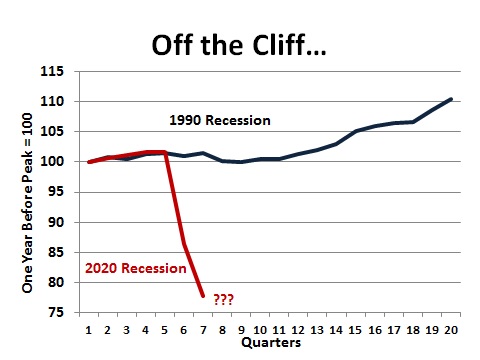
    The COVID-19 pandemic is producing an unprecedented shutdown of large parts of the national and global economies. Our Director Dr. Jim Stanford provided an overview of the coming recession, how it differs from previous downturns, and the best ways for government to respond to protect Australians as much as possible from the economic fall-out.

    Jim titled his presentation “Off the Cliff”, highlighting that the immediate shutdown of so much of Australia’s work and production is producing an economic contraction unlike anything experienced in history.

    Comparing Recessions

    Watch a video recording of the webinar:

    And/or download Jim’s slides below.

    This webinar was part of the Australia Institute’s weekly pandemic webinar series.


    Related documents


    Presentation slides

    You might also like

    Dutton’s nuclear push will cost renewable jobs

    by Charlie Joyce

    Dutton’s nuclear push will cost renewable jobs As Australia’s federal election campaign has finally begun, opposition leader Peter Dutton’s proposal to spend hundreds of billions in public money to build seven nuclear power plants across the country has been carefully scrutinized. The technological unfeasibility, staggering cost, and scant detail of the Coalition’s nuclear proposal have

  • Open Letter From Economists and Policy Experts: Wage Subsidy to Protect Jobs During Pandemic

    Open Letter From Economists and Policy Experts: Wage Subsidy to Protect Jobs During Pandemic

    by Jim Stanford

    Share

    109 Australian economists and policy experts have signed an open letter, initiated by the Centre for Future Work, supporting a government wage subsidy to prevent mass unemployment during the coming economic downturn resulting from the COVID-19 pandemic.

    The letter and the full list of signatories is reprinted below. It has been forwarded to Prime Minister Morrison.

    Public Statement from Economists and Public Policy Experts:

    A Wage Subsidy to Protect Jobs During the Coronavirus Shutdown

    The unprecedented public health measures required to deal with the COVID-19 pandemic are causing a dramatic shutdown of work and production in several key sectors of Australia’s economy. Immediate full or partial closures of activity are occurring in several consumer-facing industries (such as hospitality, retail, airlines, recreation and personal services). But before long, spillover losses will be experienced in other sectors, too: including wholesale trade and logistics, manufacturing, business services, education, and others. Consumer and business confidence has been deeply shocked, and that will magnify the negative economic effects of the pandemic.

    The coming recession will be unprecedented in Australian history – in both its speed and its depth. Without immediate action, we expect that 1-2 million workers, or even more, could lose their jobs in coming weeks. That would drive unemployment to 15% or higher, overwhelm income support programs, and leave hundreds of thousands of businesses unable to function – even after the immediate health danger passes.

    This is a dangerous and dramatic moment in Australia’s economic history. It is imperative that the federal and state governments act immediately and powerfully to protect Australian workers and businesses from the worst of the coming downturn. Important steps have been taken to expand access and benefit levels for income support payments to Australian workers (including casuals, contractors, and gig workers) losing work because of the pandemic. This is a helpful, but on its own inadequate, response. Government must also act forcefully to prevent mass job losses in coming weeks – not just provide support to those who do lose work.

    In this regard, we recommend that the Commonwealth government immediately implement a large-scale wage subsidy scheme, similar to those already enacted in several other industrial countries (including, variously, the UK, Denmark, New Zealand, the Netherlands, South Korea, and Ireland). Under these programs, government directly pays to employers (for a limited period of time) a majority portion of wages (between 70 and 90%) to cover the wages of workers who would otherwise be stood down from their positions. The measure can apply to non-standard workers (including contractors and self-employed). It can also be integrated with measures to support short time working as an alternative to complete redundancy. The wage subsidy is paid to firms experiencing severe losses of revenue and business (beyond a specified threshold). It would cover most of the wage bills for workers who can no longer work for economic reasons, up to a specified ceiling (perhaps the level of full-time median earnings). This program will be expensive – but governments everywhere have recognised that this unprecedented crisis requires them to do everything in their power to protect people, jobs, communities and the economy.

    To date, Australia’s response to the pandemic has been uncertain, inconsistent and inadequate. Immediate, powerful action to keep millions of Australians in their jobs, instead of pushing them into an overloaded and complex Centrelink system, would significantly ease the pandemic’s painful economic effects. It would underpin financial stability for millions of households through the coming terrible weeks or months. And it would preserve the viability of hundreds of thousands of Australian businesses, allowing them to resume work and production as soon as the health restrictions are eased.

    We the undersigned support the proposal for a strong wage subsidy program to keep workers in employment through the coming downturn, and we urge the Commonwealth government to implement such a policy quickly.

    Download full list of signatories below.


    Related documents


    List of signatories

    You might also like

    Dutton’s nuclear push will cost renewable jobs

    by Charlie Joyce

    Dutton’s nuclear push will cost renewable jobs As Australia’s federal election campaign has finally begun, opposition leader Peter Dutton’s proposal to spend hundreds of billions in public money to build seven nuclear power plants across the country has been carefully scrutinized. The technological unfeasibility, staggering cost, and scant detail of the Coalition’s nuclear proposal have

  • Responding to the Economic Emergency

    Originally published in New Matilda on March 21, 2020

    The scale and scope of the economic downturn caused by COVID-19 will be unprecedented in our lifetimes. Mainstream economists have belatedly realised the pandemic will cause an economic downturn, but they are not yet appreciating the size of that downturn, nor the unconventional responses that will be required. Simply calling for government “stimulus” is sadly inadequate, given the complete shut-down of work and production that is occurring in many sectors of the economy. The task is no longer supporting markets with incremental “pump-priming.” What’s needed is a war-like effort, led by government, to mobilise every possible resource to protect Australians’ health and livelihoods. Money is not an object – and this epic effort should not be held back by normal acquiescence to private-sector priorities and decisions.

    That’s the core message of new analysis by Centre for Future Work Director Dr. Jim Stanford, published today by the Australian journal New Matilda.

    Stanford’s article outlines the immediate economic measures needed to both confront the health emergency and prevent households and firms from collapsing:

    • Immediate mobilization of resources to protect health: including more staff at health facilities, quick deployment of off-site and mobile testing capacities, home support for people quarantined or recovering, and quick expansion of equipment and facilities where possible.
    • Income protection for workers: including for casuals, self-employed, gig-workers, and many part-timers who don’t have effective access to sick pay. Incomes must be protected for all workers (regardless of employment status), through mandated special payments (as proposed by the ACTU).
    • Other direct income supplements: similar to the one-time payments distributed in 2009, as well as more targeted aid (like higher Newstart).
    • Debt relief and business assistance: emergency financing will be needed to keep firms viable in many industries (including airlines, other transportation, tourism, and hospitality). Other parts of society also need protection from creditors; foreclosures and evictions should be prohibited, and other personal and credit card debts deferred.

    But Stanford also discusses the longer-run challenge that will face the Australian economy: the pandemic is imposing a shock that is far too powerful and all-encompassing for private market players to autonomously recover from. The economy will need unprecedented and lasting investments by government to repair and expand public infrastructure and services, and directly put Australians back to work:

    “There is enormous need for urgent rebuilding required in our economy and our communities. Repairing and strengthening health care infrastructure comes first, but other priorities, too, are urgent: like sustainable transit, green energy, non-market housing, aged care and early child education. The case for mobilising resources under the leadership of governments and public institutions, and employing millions of Australians to do that work, is compelling. We can repair the damage of this crisis (and better prepare for the next one), deliver valuable services, and create millions of jobs. All we need is the willingness to imagine a different model of organizing and leading economic activity.”

    Please read the full article, We Need Wage Guarantees And Radical Restructure, Not More ‘Stimulus’, published by New Matilda.


    You might also like

    Dutton’s nuclear push will cost renewable jobs

    by Charlie Joyce

    Dutton’s nuclear push will cost renewable jobs As Australia’s federal election campaign has finally begun, opposition leader Peter Dutton’s proposal to spend hundreds of billions in public money to build seven nuclear power plants across the country has been carefully scrutinized. The technological unfeasibility, staggering cost, and scant detail of the Coalition’s nuclear proposal have

    Centre For Future Work to evolve into standalone entity

    The Centre for Future Work was established by the Australia Institute in 2016 to conduct and publish progressive economic research on work, employment, and labour markets. Supported by the Australian Union movement, the centre produced cutting edge research and led the national conversation on economic issues facing working people: including the future of jobs, wages

  • Job Opportunity: Research Economist

    Job Opportunity: Research Economist

    Share

    The Centre for Future Work invites applications for an economist to join our research team in labour market research and policy analysis. The position may be at a junior or senior level, and the successful candidate may work from our offices in either Sydney or Canberra.

    The successful candidate will offer:

    • A graduate degree in economics or a closely related discipline.
    • Knowledge of and experience with a wide range of labour issues, preferably including: labour market statistics and trends; characteristics and determinants of employment; industrial relations and collective bargaining; wage determination and inequality; gender, racial, and demographic aspects of labour markets; the impact of technology on employment; macroeconomic policy and labour markets; and others.
    • Demonstrated ability to write to deadline for professional and popular audiences in a credible, succinct, and accessible manner.
    • Strong quantitative skills, including ability to access statistical data, analyse it (including familiarity with statistical tools), and report it in a variety of textual, tabular and graphical formats.
    • Confident communication skills, including ability to speak to public audiences, classrooms, and the media.
    • Ability to work collegially with other members of a research team.
    • Commitment to a progressive vision of work and fairness, including the goals of equality, participation, collective representation and trade unionism.

    Responsibilities of the position will include:

    • Research and completion of several project-length research papers, briefing notes, and shorter commentary articles per year on a range of topics related to labour markets and labour market policy.
    • Ongoing monitoring and analysis of labour market data and information.
    • Helping to maintain relevant websites and databases.
    • Public speaking, presentations, lectures and courses, media interviews, and related communication and educational activities.
    • Minimal office and administrative functions.

    Ability to undertake occasional out-of-town travel (including overnight travel) is essential, as is ability to successfully work in a self-managed and autonomous manner.

    The position will be offered on a one-year term-limited basis, with possibility for renewal. Salary will be commensurate with qualifications and experience.

    Applications are especially invited from women, indigenous persons, other racial and linguistic communities, people with disabilities, and other marginalised communities.

    Please forward applications (including contact information, qualifications, experience, two samples of written work, and names and contact details for two references) in confidence to cfwjob@tai.org.au. Please cite “Economist Job Application” in the subject field of your message; supporting documents should be attached in pdf format. Receipt of applications will be acknowledged by e-mail. Only candidates selected for an interview will then be contacted; no phone calls please.

    Applications must be received by 5:00 pm AEDT on Wednesday 9 October, and interviews will be conducted in Sydney on Wednesday 23 October 2019.

    The Centre for Future Work is an initiative of the Australia Institute, Australia’s leading progressive research institution. Thank you for your interest in the Centre for Future Work.


    You might also like

    Dutton’s nuclear push will cost renewable jobs

    by Charlie Joyce

    Dutton’s nuclear push will cost renewable jobs As Australia’s federal election campaign has finally begun, opposition leader Peter Dutton’s proposal to spend hundreds of billions in public money to build seven nuclear power plants across the country has been carefully scrutinized. The technological unfeasibility, staggering cost, and scant detail of the Coalition’s nuclear proposal have

  • 124 Labour Policy Experts Call for Measures to Promote Stronger Wage Growth

    124 Labour Policy Experts Call for Measures to Promote Stronger Wage Growth

    Share

    124 labour policy experts have today published an open letter calling for proactive measures to help accelerate the rate of wages growth in Australia’s economy. The legal experts, economists, and other policy analysts agreed that “stronger wages in the future would contribute to a stronger, more balanced and fairer Australian economy,” and they proposed several broad strategies to boost wages.

    The letter has generated substantial media coverage, including articles in the ABC, The Guardian, and The New Daily.

    A comprehensive story also appeared in Workplace Express, which we attached below with the journal’s permission. (To subscribe to Workplace Express for comprehensive coverage of labour policy issues, please visit their site.)

    Richard Denniss, Chief Economist at the Australia Institute, also tied the open letter into his powerful column on the causes of wage stagnation.

    The open letter was initiated and circulated by the 3 co-editors of a recent collection of research essays on the wages slowdown (The Wages Crisis in Australia: What it is and what to do about it, published by the University of Adelaide Press):

    • Prof. Andrew Stewart, John Bray Professor of Law, Adelaide Law School
    • Dr. Jim Stanford, Economist and Director, Centre for Future Work
    • Dr. Tess Hardy, Senior Lecturer and Co-Director, Centre for Employment and Labour Relations Law, University of Melbourne

    “There is a growing and legitimate concern in Australia over the erosion of real living standards. Boosting wage growth is the best way to reinvigorate the promise of shared prosperity that is essential to a healthy and productive society,” said Dr. Stanford.

    “This is not a problem that is going to fix itself”, added Professor Stewart. “We need to see a policy response from governments at all levels – and an acceptance that lifting wage growth can help the economy, not harm it.

    Dr. Hardy said, “The problem of stagnant wages is a complex one. While there is no singular or straightforward solution, it is increasingly clear that combatting the current wages crisis will require concrete and decisive action.”

    Included among 124 co-signers of the letter are numerous distinguished policy experts, including:

    Prof. Roy Green, Emeritus Professor, Innovation Adviser, and former Dean of Business School, University of Technology Sydney: “In current conditions, wage increases can be a significant driver of growth and productivity through the incentive effect on capital investment, and the demand effect on capacity expansion. Keeping wages depressed is not only disadvantageous for workers but it is bad for business and the wider economy.”

    Prof. Sara Charlesworth, Distinguished Professor of Gender, Work and Regulation in the School of Management at RMIT University: “Wages fully reflecting the value of the work women undertake are vital to their well-being and fundamental to gender equality.”

    Prof. John Quiggin, ARC Australian Laureate Fellow, School of Economics, University of Queensland: “For decades, government policy has been designed to weaken unions and push wages down. It’s time to put that process into reverse.”


    Related documents


    Open letter ad


    Full open letter


    Workplace Express Story

    You might also like

    Dutton’s nuclear push will cost renewable jobs

    by Charlie Joyce

    Dutton’s nuclear push will cost renewable jobs As Australia’s federal election campaign has finally begun, opposition leader Peter Dutton’s proposal to spend hundreds of billions in public money to build seven nuclear power plants across the country has been carefully scrutinized. The technological unfeasibility, staggering cost, and scant detail of the Coalition’s nuclear proposal have

  • Job Creation Record Contradicts Tax-Cut Ideology

    Job Creation Record Contradicts Tax-Cut Ideology

    by Jim Stanford

    The Australian Bureau of Statistics released its detailed biennial survey of employment arrangements this week (Catalogue 6306.0, “Employee Earnings and Hours“). Once every two years, it takes a deeper dive into various aspects of work life.

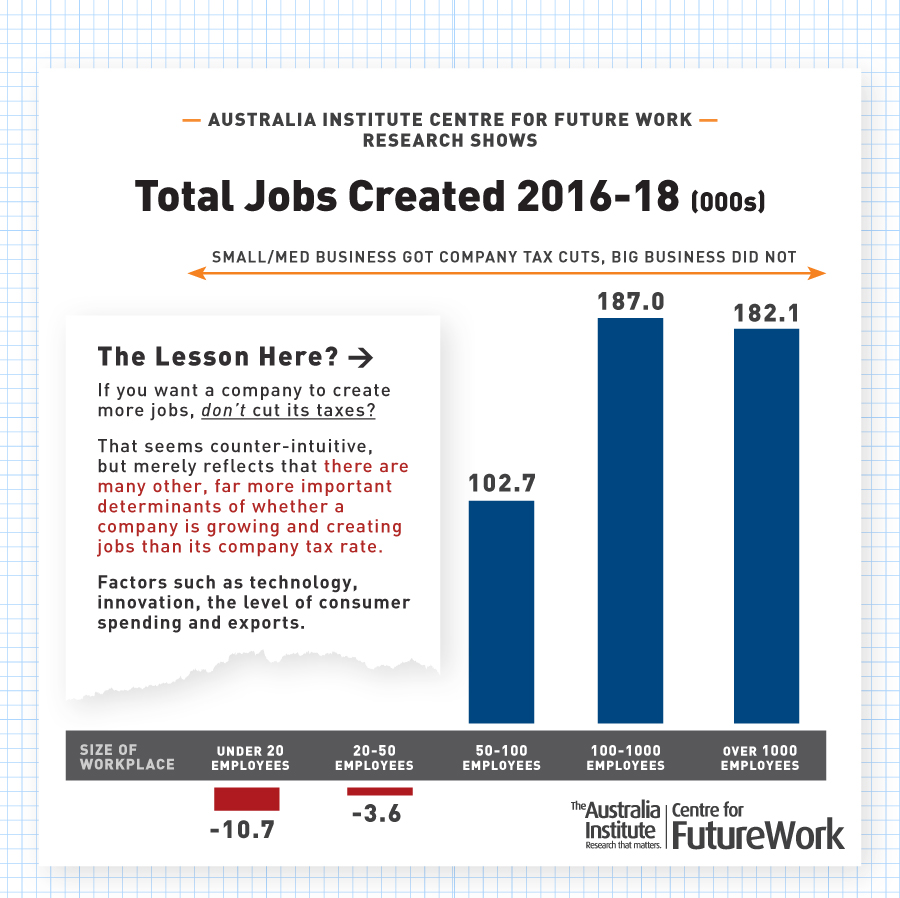
    Buried deep in the dozens of statistical tables was a very surprising breakdown of employment by size of workplace.  It turns out, surprisingly, that Australia’s biggest workplaces (both private firms and public-sector agencies) have been the leaders of job-creation over the last two years.

    This runs against the common refrain that small business is the “engine of growth.”  In fact, workplaces with less than 50 employees actually shed employees (14,000 in total) since 2016.  Curiously, it was only smaller businesses that received the much-vaunted reduction in company tax (from 30 to 27.5 per cent), also beginning in 2016.

    Firm Size and Job Creation

    The tax rate for small and medium-sized businesses began to fall in 2016, first for the smallest firms (with turnover under $2 million), and then for firms with up to $50 million revenue.  The tax is not tied to the number of employees in a business, but the vast majority of firms which have received the tax cut have less than 50 employees.  Yet that is the group that has reduced its workforce since the tax cuts began to be phased in.

    In contrast, very large workplaces (with over 1000 employees) added 182,000 new jobs over the two years.  Workplaces with between 100 and 1000 employees added 187,000.  Very few of those workplaces would have received the reduction in company taxes (since most would exceed the $50 million annual revenue threshold).

    Workplaces between 50 and 100 employees created a net total of 103,000 new jobs between 2016 and 2018.  Some of those firms would have received the tax cut, and some not — depending on the nature of the business and the amount of total turnover generated per employee.

    The data on job-creation by firm size is detailed on Table 13 of Data Cube 1, in the “Downloads” section of the ABS report. The data refers to waged employees, not including owner-managers of businesses.

    The share of small businesses (under 50 employees) in total employment declined by two percentage points — since they were reducing their workforces, while larger companies were growing.  Small businesses (under 50 employees) now account for 34 per cent of all employees, compared to 36 percent in 2016.

    Why would large companies that didn’t get a tax cut create new jobs faster than companies which did benefit from the Coalition tax cuts? (The small business tax cuts are estimated to reduce federal revenues by $29.8 billion over the first decade.) Simple: there are dozens of different factors which determine whether a company is profitable or not, and whether it chooses to grow.  Tax rates are just one of those variables.  Others include:

    • Growth in consumer demand.
    • The company’s investments in product quality, innovation, and design.
    • Production costs.
    • Interest rates and financing costs.
    • Business confidence and expectations.
    • Management capacity.
    • International competition.

    Trends in all these other factors can easily overwhelm the marginal impact of lower tax rates.  Small business sales in particular have been held back by stagnant wages among Australian workers.  Even companies which experience higher profits due to lower tax rates may choose to simply accumulate those profits, or pay them out to shareholders in dividends and share buy-backs (instead of expanding payrolls).  Empirical evidence shows this has been the dominant impact of U.S. business tax cuts implemented by Donald Trump.

    Changes in tax rates can even have offsetting effects which undermine business conditions and hence reduce job-creation: if the revenue lost to tax cuts results in corresponding reductions in government program spending or infrastructure investments (as seems likely), then overall business conditions might be weakened, not strengthened.

    The reduction in employment by the businesses which most benefited from the expensive business tax cuts over the past two years should lead policy-makers of all persuasions to reconsider the argument that this is an effective way to stimulate growth and job-creation. However, in October the government announced it wanted to accelerate the next stages of the small business tax cuts — taking the rate down to 25 per cent five years faster than originally planned.

    So far, the policy is akin to shooting oneself in the foot.  Instead of reloading the gun to do it again even sooner, perhaps this is a good time to reconsider whether the strategy makes any sense at all.


    You might also like

    Commonwealth Budget 2025-2026: Our analysis

    by Fiona Macdonald

    The Centre for Future Work’s research team has analysed the Commonwealth Government’s budget, focusing on key areas for workers, working lives, and labour markets. As expected with a Federal election looming, the budget is not a horror one of austerity. However, the 2025-2026 budget is characterised by the absence of any significant initiatives. There is

    Dutton’s nuclear push will cost renewable jobs

    by Charlie Joyce

    Dutton’s nuclear push will cost renewable jobs As Australia’s federal election campaign has finally begun, opposition leader Peter Dutton’s proposal to spend hundreds of billions in public money to build seven nuclear power plants across the country has been carefully scrutinized. The technological unfeasibility, staggering cost, and scant detail of the Coalition’s nuclear proposal have