Category: Democracy & Accountability

Research branch

  • Profile: Combining Economics and Social Justice

    Profile: Combining Economics and Social Justice

    by Jim Stanford

    Share

    The Centre for Future Work’s Director Dr. Jim Stanford was recently profiled in a feature article published in In The Black, the journal of CPA Australia (the professional body for certified accountants in Australia). The profile, by journalist Johanna Leggatt, discusses the history of the Centre for Future Work, and Stanford’s philosophy of using popular economic knowledge to strengthen movements for social change and workers’ rights.

    We are pleased to reprint (download below), with kind permission from In the Black, this profile, titled The People’s Economist. Many thanks to the journal and to Ms. Leggatt for the generous article!


    Related documents


    Full article

    You might also like

    Centre For Future Work to evolve into standalone entity

    The Centre for Future Work was established by the Australia Institute in 2016 to conduct and publish progressive economic research on work, employment, and labour markets. Supported by the Australian Union movement, the centre produced cutting edge research and led the national conversation on economic issues facing working people: including the future of jobs, wages

  • Porter IR Bill a Wish List for Business

    Originally published in The Conversation on December 9, 2020

    Industrial Relations Minister Christian Porter tabled an omnibus bill on 9 December containing multiple amendments to Australia’s labour laws, including the Fair Work Act. In theory, the bill is the outcome of a series of IR reform discussions the government launched during the early months of the COVID-19 pandemic. At the time it heralded a new spirt of cooperation between business, unions, and the government — but that spirit didn’t last long. The bill accepts numerous business demands that will further liberalise casual work, undermine genuine collective bargaining, and generally suppress wages even more than they already are.

    This commentary is a longer version of an assessment of the new legislation prepared by Jim Stanford (originally published in The Conversation).

    We Were In This Together… For a Very Short Time

    By Jim Stanford

    “We are all in this together,” Prime Minister Morrison solemnly intoned to Parliament in April. And during those first frightening weeks of the pandemic, there was a brief moment when it seemed like Australia’s industrial relations protagonists actually believed it. For a short time, businesses, unions, and government put aside their usual differences and worked together to get through this existential threat. For example, they negotiated quick agreements to alter dozens of Modern Awards and enterprise agreements, adjusting rules and rosters to help keep Australians on the job.

    Then, building on that spirit of cooperation, the government kicked off a new process to seek consensus around further improvements to workplace laws. The government abandoned its pre-COVID effort to impose harsh new restrictions on unions. Instead, five tables were established with business, union, and government leaders, debating reforms to improve the fairness and efficiency of the IR system. Some observes even smelled a new era of Accord-making in the wind.

    Well, the Kumbaya moment didn’t last long. Within weeks the parties retreated to their corners and their standard speaking points. No meaningful consensus emerged on any issue from any table. Even tentative proposals – like an idea, supported by unions and the Business Council, to combine fast-track approval of union-negotiated enterprise agreements with greater flexibility in determining their suitability – were shot down in partisan gunfire by the more strident business lobbyists.

    Now, in the absence of consensus, the government has picked up its traditional hymn book and is once again singing the praises of ‘flexibility’ and deunionisation. IR Minister Christian Porter tabled a series of changes in Parliament Wednesday that will further skew the already lopsided balance of power between employers and workers.

    The government didn’t just take business’s side in the debates at those 5 discussion tables: it went even further. One of the biggest changes in the new legislation (suspending rules that prevent enterprise agreements from undercutting the minimum standards of Modern Awards) wasn’t even discussed at the IR tables. This confirms that the IR gloves are off once again.

    If passed in the Senate, Porter’s omnibus bill will reset several aspects of current labour relations:

    Suspending the BOOT: At present, the Fair Work Commission (FWC) must ensure enterprise agreements (EAs) do not undercut minimum standards guaranteed in the Modern Awards. The new legislation instructs the FWC to approve EAs even if they fail this ‘Better Off Overall Test’ (BOOT), so long as the deal is nominally supported by affected workers (more on this below) and deemed to be in the ‘public interest.’ It is important to remember that Australia (unique among industrial countries) allows employers to implement EAs unilaterally, without any involvement by a union. The BOOT is thus necessary to prevent EAs (especially non-union EAs) from undermining workers’ minimum rights. Porter’s suspension of the BOOT is planned for two years. But even if it is restored after that (which is uncertain), EAs negotiated during that window will remain in effect for years afterward. Even after they expire, under Australian law they remain in effect until replaced with new EAs, or terminated by the FWC – neither of which is likely in non-union settings.

    EA Approval Process: Anticipating that non-BOOT-compliant EAs will be actively opposed by unions, Porter’s legislation includes complementary measures aimed at speeding those deals through the FWC. Unions will be restricted from intervening around EAs they were not involved in negotiating – even non-union EAs where no union was involved. And the process must normally be completed within 21 days, thus limiting opportunities for affected workers to learn about and resist sub-Award provisions.

    Defining Casual Work: The growing use of casual labour was a hot topic at the IR reform tables. Porter’s legislation clarifies the definition of casual work in the most expansive way possible: a casual job is any position deemed casual by the employer, and accepted by the worker, for which there is no promise of regular continuing employment. In other words, any job can be casual, so long as workers are desperate enough to accept it. This will foster the further spread of casual labour. Most important, it removes a big potential liability faced by employers as a result of recent court decisions, under which they might have owed back-pay for holidays and sick leave to casual staff who worked regular shifts.

    Casualising Part-Timers: Further casualisation will be attained through new rules regarding rosters and hours for permanent part-time workers. Porter’s bill would extend flexibility provisions originally implemented earlier this year – during that brief moment of pandemic-induced cooperation. The rules allow employers to alter hours for regular part-timers without incurring overtime penalties or other costs (currently required under some Modern Awards). This will allow employers to effectively use part-time workers as yet another form of casual, just-in-time labour.

    Long-Term Project Agreements: Finally, Porter has granted one more big wish from the business list: allowing super-long enterprise agreements at major new projects. Agreements would last for up to eight years, and can be signed, sealed and delivered before any workers start on the job (thus denying them any input into the process). Under the revised BOOT provisions, they could also undercut the minimum standards of the Awards.

    These changes are being advertised as a boost for post-pandemic job-creation, but this claim is hollow. In fact, the changes in part-time and casual rules will actually discourage new hiring: since existing workers can be costlessly flexed in line with employer needs, there is no need to hire anyone else. Weaker BOOT protections will spur a wave of new EAs: most union-free, and aimed at reducing (not raising) compensation and standards. This makes a mockery of the goals of collective bargaining, and grants Australian employers further opportunity to suppress labour costs (already tracking at their slowest pace in postwar history).

    So what do we make of that short-lived spirit of togetherness which purportedly sparked this whole process? In retrospect, it seems to have been just an opportunity for Coalition leaders to pose as visionary statesmen during a time of crisis. Now, mere months later, the government is back to its old script – and the pandemic is just another excuse to scapegoat unions, drive down wages, and fatten business profits.


    You might also like

    IR Bill Will Cut Wages & Accelerate Precarity

    by Alison Pennington in Jacobin

    The Morrison government has proposed sweeping changes to labour laws that will expand unilateral employer power to cut wages and freely deploy casual labour. Together, the Coalition’s proposed changes will accelerate the incidence of insecure work, undermine genuine collective bargaining, and suppress wages growth. Impacts will be felt across the entire workforce – casual and permanent workers alike.

    Centre For Future Work to evolve into standalone entity

    The Centre for Future Work was established by the Australia Institute in 2016 to conduct and publish progressive economic research on work, employment, and labour markets. Supported by the Australian Union movement, the centre produced cutting edge research and led the national conversation on economic issues facing working people: including the future of jobs, wages

  • The Pandemic is Our Clarion Call to Rebuild Good Jobs

    Originally published in The Age on November 5, 2020

    Victorians emerging from lockdowns now confront Australia’s harsh COVID-era work reality marked by more insecure jobs, mass unemployment, and long-term work at the kitchen table.

    In this commentary, which originally appeared in The Age, Centre for Future Work Senior Economist Alison Pennington discusses what the pandemic reveals about Australia’s high levels of insecure work, new work-from-home risks, and how rebuilding more secure labour markets will be critical to creating more good jobs in our post-COVID recovery.


    You might also like

    Dutton’s nuclear push will cost renewable jobs

    by Charlie Joyce

    Dutton’s nuclear push will cost renewable jobs As Australia’s federal election campaign has finally begun, opposition leader Peter Dutton’s proposal to spend hundreds of billions in public money to build seven nuclear power plants across the country has been carefully scrutinized. The technological unfeasibility, staggering cost, and scant detail of the Coalition’s nuclear proposal have

  • Feature Interviews: Worker Voice in a Changing World of Work

    Feature Interviews: Worker Voice in a Changing World of Work

    by Jim Stanford and Alison Pennington

    Share

    The Centre for Future Work’s Jim Stanford, and Alison Pennington feature in a collection of interviews on technology, work, climate, and the role of unions, for a new online course Power, Politics and Influence at Work delivered by the University of Manchester, UK.

    Video recordings of the interviews are available here:

    The videos were recorded for a 5-week on-line course Power, Politics and Influence at Work run by the University of Manchester. The Centre’s staff are featured alongside several leading scholars, trade union activists and international agencies such as the ILO/Oxfam.

    Academics and researchers Tony Dundon, Miguel Martinez Lucio, Emma Hughes and Roger Walden designed the course for labour and NGO activists and students interested in labour market equalities, work and employment. Registration is free.


    You might also like

    Centre For Future Work to evolve into standalone entity

    The Centre for Future Work was established by the Australia Institute in 2016 to conduct and publish progressive economic research on work, employment, and labour markets. Supported by the Australian Union movement, the centre produced cutting edge research and led the national conversation on economic issues facing working people: including the future of jobs, wages

    IR Bill Will Cut Wages & Accelerate Precarity

    by Alison Pennington in Jacobin

    The Morrison government has proposed sweeping changes to labour laws that will expand unilateral employer power to cut wages and freely deploy casual labour. Together, the Coalition’s proposed changes will accelerate the incidence of insecure work, undermine genuine collective bargaining, and suppress wages growth. Impacts will be felt across the entire workforce – casual and permanent workers alike.

  • Budget’s Illusory Hope for Business-Led Recovery

    Budget’s Illusory Hope for Business-Led Recovery

    by Jim Stanford

    Share

    The Commonwealth government tabled its 2020-21 budget on 6 October, six months later than the usual timing because of the dramatic events associated with the COVID-19 pandemic and resulting recession. There is no doubt it is a budget unlike any other in Australia’s postwar history. While the budget certainly unleashes unprecedented fiscal power, its underlying logic and specific policy design are unsatisfactory in many ways. We present here analysis and commentary on several aspects of the budget, drawing on input from all of the Centre’s research staff: Economist and Director Dr. Jim Stanford, Senior Economist Alison Pennington, and Economist Dan Nahum.

    Key conclusions of our analysis include:

    • This budget says explicitly that Australia’s economic reconstruction after COVID-19 is to be trusted almost entirely to private business – helped along with generous tax cuts and business subsidies.
    • The need to strengthen public services (like health care, child care, and higher and vocational education) is largely ignored, as is the need to preserve and strengthen income security programs (with the phase-out of JobKeeper and cuts to JobSeeker going ahead).
    • Tax cuts, whether targeted at businesses or high-income households, will have little impact on actual spending and job-creation.
    • The government needs a more forceful, hands-on, and sustained reconstruction plan to ensure that the economy does not get ‘stuck’ in its current state of partial recovery. That needs much more public sector leadership, vision, and funding.
    • The government admits that wage growth is going to get weaker before it gets stronger – but is doing nothing about that critical problem (which will undermine consumer spending far more than tax cuts will stimulate it).

    Download our full review of the 2020-21 budget below.


    Related documents


    2020-21 Budget Analysis

    You might also like

    Commonwealth Budget 2025-2026: Our analysis

    by Fiona Macdonald

    The Centre for Future Work’s research team has analysed the Commonwealth Government’s budget, focusing on key areas for workers, working lives, and labour markets. As expected with a Federal election looming, the budget is not a horror one of austerity. However, the 2025-2026 budget is characterised by the absence of any significant initiatives. There is

    Centre For Future Work to evolve into standalone entity

    The Centre for Future Work was established by the Australia Institute in 2016 to conduct and publish progressive economic research on work, employment, and labour markets. Supported by the Australian Union movement, the centre produced cutting edge research and led the national conversation on economic issues facing working people: including the future of jobs, wages

  • Webinar: How TAFE Can Drive Australia’s Skills and Jobs Recovery

    Webinar: How TAFE Can Drive Australia’s Skills and Jobs Recovery

    by Alison Pennington

    Share

    With millions facing unemployment and crisis-accelerated job transitions, public investment in the skills and earning capabilities of Australians will be critical to our post-pandemic recovery.

    To mark National TAFE Day and the release of new research by the Centre for Future Work on the economic and social benefits of the TAFE system, The Australia Institute hosted a timely discussion on how the TAFE system can drive a COVID-era skills and jobs recovery with ACTU President Michele O’Neil, Correna Haythorpe, federal president of the Australian Education Union, and Alison Pennington, Senior Economist at the Centre for Future Work.

    The webinar was presented as part of the Australia Institute’s widely acclaimed Economics of a Pandemic webinar series and explored why the TAFE system has been in turmoil, the historic role it has played generating a more skilled workforce and productive economy, and how we can fix it.


    Related documents


    Presentation slides

    Related research

    You might also like

  • Victorian Inquiry Offers Novel Routes to Regulating Gig Work

    Victorian Inquiry Offers Novel Routes to Regulating Gig Work

    by Alison Pennington

    Findings from a landmark inquiry commissioned by the Andrews Victorian government into the work conditions in the “on demand” (gig) economy have been released. The report’s findings are timely with COVID-era unemployment surging and an expanding pool of vulnerable workers relying on “gig” work to meet living costs.

    This commentary outlines the key findings of the On-Demand Inquiry.

    Victorian Inquiry Offers Novel Routes to Regulating Gig Work

    Findings from a landmark inquiry commissioned by the Victorian government into the work conditions in the “on demand” (gig) economy have been released. The Inquiry confirms workplace laws have failed to keep pace with economic change.

    Release of the report’s findings are timely with COVID-era unemployment surging and an expanding pool of vulnerable workers relying on “gig” work to meet living costs. How do platform “digital sweatshops” work?

    Platform business models recruit workers without access to secure and better compensated jobs (especially migrant and young workers). Jobs performed are often menial and without adequate safety protections. Gig workers lack stable work schedules or incomes, and receive wages that often fall well-below social norms and legal minimums.

    The major recommendations by the Inquiry chaired by former Fair Work Ombudsman Natalie James include:

    • A more systematic application of the “work test” currently used to classify workers as employees or independent contractors by codifying the test in the Fair Work Act (rather than common law). This would create a nationally coherent framework for extending protections including minimum pay and conditions to gig workers genuinely working for another’s business.
    • Alter competition laws and establish a new industry Award to enable gig workers to bargain collectively with platforms.
    • Strengthen the gig work regulatory regime through industry codes of conduct between platforms, governments and unions for non-employee gig workers, overseen by the Australian Competition and Consumer Commission, and allow an independent tribunal to oversee work status determinations.

    We commend the Inquiry on the ambitious scale of the investigation, and the innovative pathway proposed for gig work regulation.

    Three Centre for Future Work reports on gig work in Australia were cited in the final report. Research by Director Jim Stanford (with Andrew Stewart from University of Adelaide) featured in the report’s major recommendation that collective bargaining rights be extended to gig workers to lift pay and conditions of gig work.

    Read our full submission to the Inquiry — Turning Gigs Into Decent Jobs — by Jim Stanford and Alison Pennington.


    You might also like

    Centre For Future Work to evolve into standalone entity

    The Centre for Future Work was established by the Australia Institute in 2016 to conduct and publish progressive economic research on work, employment, and labour markets. Supported by the Australian Union movement, the centre produced cutting edge research and led the national conversation on economic issues facing working people: including the future of jobs, wages

  • Repairing Universities & Skills Key to Meeting COVID-Era Challenges

    Repairing Universities & Skills Key to Meeting COVID-Era Challenges

    by Alison Pennington

    Share

    Training must play a vital role in reorienting the economy after the pandemic, supporting workers training for new jobs including millions of young people entering a depressed labour market without concrete pathways to work. But what kind of jobs will we be doing in 2040? And how prepared is Australia’s skills system (and universities specifically) to play this important role now?

    Our Senior Economist Alison Pennington was interviewed by UTS The Social Contract podcast on how COVID-19 is reshaping relations between universities, government and industry. 

    Alison explains how the pandemic economic crisis presents significant challenges to Australia’s fragmented, underfunded and unplanned skills system wounded from decades of failed marketisation policies, and why sustained public investments in skills and jobs pathways will be essential to solving our economic and social challenges. 

    Listen to the episode on Whooshkaa. She is joined by Megan Lilly, head of Workforce Development at the Australian Industry Group.


    You might also like

    Centre For Future Work to evolve into standalone entity

    The Centre for Future Work was established by the Australia Institute in 2016 to conduct and publish progressive economic research on work, employment, and labour markets. Supported by the Australian Union movement, the centre produced cutting edge research and led the national conversation on economic issues facing working people: including the future of jobs, wages

  • Pandemic Shows Australia Needs Domestic Manufacturing

    Pandemic Shows Australia Needs Domestic Manufacturing

    by Jim Stanford

    Disruptions in global supplies of essential medical equipment have served as a wake-up call to Australians that it is always vital for a country to retain the capacity to domestically produce manufactured products that may be crucial to national security and well-being.

    In this commentary, Centre for Future Work Economist Dan Nahum reviews the qualitative reasons why manufacturing retains a special strategic importance to the overall economy, and discusses the potential synergies between the development of sustainable energy resources and a revitalisation of manufacturing.

    Rebooting the Australian Manufacturing Sector in the Era of Coronavirus and Climate Change

    Since the COVID-19 crisis emerged, Australians have been starkly reminded of the importance of being able to manufacture goods domestically. International shortages of, and restrictions on, the export of medical equipment and personal protective equipment have given us all a fright. While thankfully critical shortages have not yet emerged, the crisis has confirmed that being able to domestically produce a full range of essential manufactures is a matter of national wellbeing.

    For many years the conventional economic wisdom was that as a high-wage, resource-rich economy, Australia was unable to competitively manufacture — nor did it need to. Between digging up raw materials and shipping them to Asian trading partners (subsequently paying a premium for reimported manufactures made from those resources) and our pivot to a ‘service economy’, we could somehow sidestep the need to produce what we materially use. Even Treasurer Josh Frydenberg has now conceded that unbalanced strategy is not viable.

    It’s true the extraction of our extraordinary mineral endowment made some Australians wealthy, but in a lopsided way: unbalanced reliance on resource extraction, combined with the long decline of manufacturing, has made Australia far more unequal — indeed, we are now more unequal than most OECD nations. Additionally, this myopic economic focus has put us at the mercy of boom-and-bust cycles in global demand for our resources.

    There are many core reasons why Australia needs a healthy, proportionate manufacturing sector:

    • Australians are buying more manufactured goods over time; and manufacturing output is growing around the world. The absolute decline of manufacturing in Australia is an exception to the experience of other industrialised countries.
    • Manufacturing is the most innovation-intensive sector in the whole economy. No country can be an innovation leader without manufacturing.
    • Manufactured goods account for over two-thirds of world merchandise trade. A country that cannot successfully export manufactures will be shut out of most trade.
    • Production costs in Australia are not expensive relative to other industrial countries (now that the Australian dollar is once again trading in normal range).
    • Even small remote countries (like Korea, Ireland, New Zealand and Israel) are increasing their manufacturing output, and preserving and creating manufacturing jobs. Their experience demonstrates that we cannot blame geographic isolation for our deindustrialisation.
    • Manufacturing anchors hundreds of thousands of other jobs throughout the economy, thanks to its long and complex supply chain. A myriad of supplies and inputs are purchased by manufacturing facilities.

    There’s another key reason to be optimistic about Australian manufacturing — if we create an appropriate policy environment for it. Australia is poised to take advantage of our bountiful renewable energy endowment to reinvigorate manufacturing, on the foundation of plentiful, competitive, and reliable power.

    Read The Centre for Future Work’s report Powering Onwards: Australia’s Opportunity to Reinvigorate Manufacturing through Renewable Energy, which considers the potential and actual connections between renewables and manufacturing in detail.

    The following core policy levers would help to ensure that Australia’s manufacturing sector thrives in decades to come, enhancing our prosperity and our national security:

    Targeted Tax Incentives: No-strings-attached tax cuts for corporations do not stimulate investment, innovation, or employment. Rather, fiscal incentives are more effective when they are linked directly to investment. Examples include accelerated depreciation provisions (allowing companies to write off the cost of new investments faster), investment tax credits, and public co-investments in specific strategic projects.

    Investing Public Funds in Key Industries: International experience confirms that public financial assets can effectively lever greater capital investment in key industries. These include state-owned development banks (as in Japan and Korea) or other forms of sovereign wealth (as in Singapore, the UAE, and Norway). Public investment vehicles have been used successfully — indeed profitably — in numerous applications in Australia (for example, the CEFC to finance sustainable energy projects). The same principles can apply in manufacturing investment. Additionally, industry super funds could play a larger role in financing the development of strategic products and sectors.

    Innovation: Empirical evidence shows successful innovation must be embodied in the hands-on process of ‘learning by doing’. And there is no other sector more directly connected to the innovation process than manufacturing. Government needs to provide tangible, direct support to innovation in manufacturing. We need better systems for linking public innovation activity with commercial applications. And we can emulate successful public equity investments in innovation-intensive businesses in other countries (like the effective methods for financing innovative firms used in Israel, Finland, and Ireland).

    Sector Strategies: Government needs to identify manufacturing sub-sectors with the right criteria for success, and then co-ordinate investment and growth. These sector strategies must engage all relevant sector stakeholders (business, unions, educational institutions, research organisations, state and local governments). Even businesses which compete with each other can benefit when the whole sector succeeds. Criteria for identifying high-potential sectors include innovation, export orientation, productivity, and strong supply chain linkages.

    Networks, Eco-Systems, and Clusters: Successful modern industrial policy relies centrally on connections and collaboration among players from different firms, agencies, and stakeholders. Research shows that spillovers among these diverse sector participants, and the sharing of knowledge between them, are crucial to the development of ‘critical mass’ in any high-tech industry. Often, these networks and clusters are geographically concentrated. Government cannot simply ‘create’ clusters, but it can facilitate their emergence.

    Industrial Infrastructure: Government investments in public capital assets of all kinds will play a crucial role in fostering manufacturing growth. Infrastructure investments help to offset the sustained weakness of private investment, and improve weak macroeconomic conditions. One key focus of infrastructure investment should include facilities and services which support manufacturing: ranging from transportation infrastructure, to utility connections (especially renewable energy), to modern training facilities (to help better integrate TAFE and university training with industry). We should maximise the use of Australian-made manufacturing content in those (and all other) infrastructure projects.

    Connecting Renewable Energy Investment to Manufacturing: Given Australia’s superabundance of renewable resources, Australia should position itself as the world’s renewable energy superpower. Renewable energy is appropriate for most industrial applications, including heavy industry, and now offers lower costs than fossil fuel sources (including gas). To expedite the transition to renewable energy, the manufacturing sector requires stability in energy policy, industrial strategies to take advantage of Australia’s renewable energy endowment, and government partnerships with firms that can benefit from and add value to Australia’s renewable energy endowment.

    Skills and Capacities: Enhancing the future skills and capacities of workers must be a vital component of future sector strategies. Consistent funding for skills training at all levels is essential, as are efforts to more closely link training programs with future workforce needs in strategic sectors. Germany’s apprenticeship system is perhaps the most outstanding international role model in this area.

    Leveraging Procurement: Australian governments are massive purchasers of manufactured goods. An obvious way to support domestic manufacturing is to ensure those expenditures generate the maximum possible boost to domestic industry. This also helps to reduce the final net cost of the program: since the government collects additional revenues through the new work spurred by domestic procurement decisions, offsetting the public expenditure. Other countries regularly utilise domestic content targets in procurement to support domestic producers. Australia can do the same.

    Trade that Goes Both Ways: International trade is essential to the viability of most manufacturing due to the importance of economies of scale in production. Australian trade negotiators need to do far more than mutual tariff reduction to stimulate Australian manufactured exports. And Australian agencies (like Austrade) can be much more proactive in promoting Australia’s exports, through initiatives like expanded credit financing, initiatives to leverage Australian participation in global supply chains, and government support for international marketing.

    A thriving manufacturing sector confers important benefits across the whole economy. Even more importantly, a large and adaptable manufacturing sector offers resilience against periodic crises such as COVID-19. If Australia does not add value through the expansion of our manufacturing sectors, we can anticipate that our relative standard of living will decline, and our vulnerability to future supply disruptions and health crises will only increase. We can and must build a manufacturing sector that is economically and ecologically sustainable, and that adds complexity and resilience to Australia’s economy.

    See the Centre for Future Work’s previous research on the Australian manufacturing sector:

    Manufacturing Still Matters (2016) shows that manufacturing, far from being inherently doomed in Australia, is quite viable. Similar countries manufacture successfully. It provides an agenda of policy recommendations for support of the sector.

    Manufacturing: A Moment of Opportunity (2017) demonstrates that while the Australian public underestimate the size and therefore strategic economic importance of the sector, it enjoys strong popular support. Furthermore, the report identifies some promising signs of future growth in the sector.

    From Consensus to Action: Report from the First National Manufacturing Summit (2018) summarises the key findings of the first National Manufacturing Summit, including areas of strong policy consensus reached among the business, industry peak bodies, trade unions, government departments, academic institutions and vocational training providers and other summit delegates. The report also identifies several priorities for further policy research.

    Advanced Skills for Advanced Manufacturing (2018) argues that Australia’s present vocational education and training system, damaged by years of underfunding and failed policy experimentation, is a weak link in meeting the needs of the industry. High-skilled, high-paid jobs rely on a strong VET sector, and this report identifies twelve key reforms to achieve that.

    Auto Shutdown Another Economic Blow (2016) analyses the causes and impacts of the closure of the Australian car manufacturing industry. It notes that secondary job losses will be several times larger than the direct jobs eliminated at the car plants.

    Penny Wise and Pound Foolish (2016) analyses the impact of the NSW government’s decision to source railroad rolling stock manufacturing work to Korea rather than taking advantage of the opportunity to procure domestically. Governments need to account for the full range of potential costs and benefits of their procurement decisions (job creation, industry development, government revenues, and so on), not simply minimise the up-front purchase cost.


    You might also like

    Post-COVID Manufacturing Renewal Represents Potential $50 Billion Boost to Economy

    New research from the Australia Institute’s Centre for Future Work reveals that Australia ranks last among all OECD countries for manufacturing self-sufficiency. While this indicator confirms the dramatic decline of domestic manufacturing in recent years, it also reveals the enormous potential benefits that would be generated by rebuilding manufacturing back to a size proportional to our national needs: including $180 billion in new sales, $50 billion in additional GDP, and over 400,000 new jobs.

    Centre For Future Work to evolve into standalone entity

    The Centre for Future Work was established by the Australia Institute in 2016 to conduct and publish progressive economic research on work, employment, and labour markets. Supported by the Australian Union movement, the centre produced cutting edge research and led the national conversation on economic issues facing working people: including the future of jobs, wages

  • Webinar: Protecting Jobs and Incomes During the Pandemic

    Webinar: Protecting Jobs and Incomes During the Pandemic

    by Jim Stanford

    Share

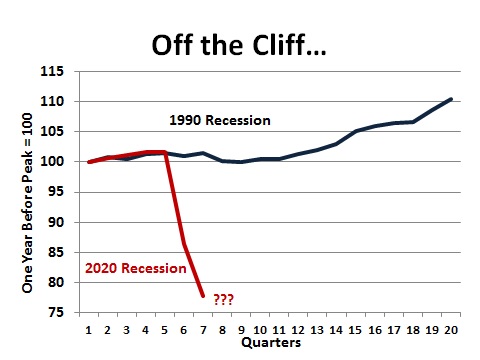
    The COVID-19 pandemic is producing an unprecedented shutdown of large parts of the national and global economies. Our Director Dr. Jim Stanford provided an overview of the coming recession, how it differs from previous downturns, and the best ways for government to respond to protect Australians as much as possible from the economic fall-out.

    Jim titled his presentation “Off the Cliff”, highlighting that the immediate shutdown of so much of Australia’s work and production is producing an economic contraction unlike anything experienced in history.

    Comparing Recessions

    Watch a video recording of the webinar:

    And/or download Jim’s slides below.

    This webinar was part of the Australia Institute’s weekly pandemic webinar series.


    Related documents


    Presentation slides

    You might also like

    Dutton’s nuclear push will cost renewable jobs

    by Charlie Joyce

    Dutton’s nuclear push will cost renewable jobs As Australia’s federal election campaign has finally begun, opposition leader Peter Dutton’s proposal to spend hundreds of billions in public money to build seven nuclear power plants across the country has been carefully scrutinized. The technological unfeasibility, staggering cost, and scant detail of the Coalition’s nuclear proposal have