Category: Democracy & Accountability

Research branch

  • Minimum Wage to Rise 3% for 2019-20

    Minimum Wage to Rise 3% for 2019-20

    by Jim Stanford

    The Fair Work Commission has announced a 3% hike in Australia’s national Minimum Wage, effective July 1, taking it to $19.49 per hour. That increase is lower than the 3.5% increase implemented last year.

    In our judgment, this is inadequate to meet the needs of low-wage workers – and the needs of Australia’s macroeconomy.

    In explaining this year’s smaller boost to wages for the lowest-paid Australians, the FWC argued that recent weak GDP growth (and the risk of Australia’s first recession in 28 years) requires it to be cautious in boosting wages. But that argument is completely backward. The weakest component of GDP growth in the last year has been consumer spending – which actually declined in volume terms in the March quarter. Consumer spending accounts for half of all GDP, and nothing boosts consumer spending more directly than increasing workers’ pay.

    Another argument raised  by the FWC is equally unconvincing: it pointed out that incremental tax cuts promised by the incoming Coalition government will supplement incomes for low- and middle-income workers. But those tax cuts are of no value for the hundreds of thousands of Australian workers who currently pay no income tax (since their wages are too low). And even for middle-income workers, the benefits from those tax cuts are far smaller than the steady improvements in income resulting from healthy ongoing wage increases.

    The Centre for Future Work recently compared the impacts of tax cuts to regular wage gains, and the conclusion is clear: regular annual wage increases are the only way to sustainably improve living standards over time. Please see our research here. Moreover, workers ultimately PAY for those tax cuts in foregone services (which must inevitably be reduced due to fiscal constraints), so the net contribution of tax cuts to living standards is non-existent.

    Many commentators have pointed out that the 3% increase is higher than the current rate of inflation. In fact, inflation is currently running at 0% (in the March quarter), reflecting very weak macroeconomic conditions. Indeed, weak wages are part of the cause for very weak inflation: unit labour costs are the biggest influence on prices. If wage increases are restrained purely because inflation is low, this risks setting off a downward, deflationary cycle in wages and prices. Normal wage increases (in the range of traditional rates of 4% per year or more) are essential to anchor price levels, even in times of macroeconomic weakness.

    So any increase in the minimum wage is higher than current inflation – but that is cold comfort. RBA Governor Dr Philip Lowe has indicated that annual 3.5% wage increases are necessary (when combined with ongoing productivity growth) for the economy to match the RBA’s 2.5% inflation target. In that regard, the FWC should have aimed higher with this year’s increase.

    International and Australian evidence (including from the RBA itself) is clear: minimum wage increases do not “destroy” jobs. Stronger purchasing power is essential to offset other sources of weakness in the macroeconomy, including very poor business investment. In our judgment, the FWC should have increased the minimum wage by twice as much (6%), in order to boost consumer incomes and spending power, and move toward a “Living Wage” for low-income Australians. (See our primer on the Living Wage.)

    Despite those criticisms, this 3% raise for close to 1/4 of Australian employees will provide a crucial boost to wage growth. And it is much better than the under-2% raises for non-Award workers that the private labour market is still delivering. We recently studied the impact of last year’s minimum wage increase on average wage growth. We found it single-handedly explained one-third of all the increase in wages last year.

    The importance of active measures to boost wages has never been clearer. Waiting for “market forces” to reverse recent record weakness in wage growth will not work. Pro-active policies to support wage growth are essential to build more balanced and sustainable economic momentum. And nothing is more important in that policy mix than strong, sustained increases in the minimum wage.


    You might also like

  • Scourge Pricing’: Understanding and Challenging Uber’s Business Model

    Scourge Pricing’: Understanding and Challenging Uber’s Business Model

    by Alison Pennington

    Share

    Centre for Future Work Economist Alison Pennington recently gave a keynote address to hundreds of delegates at the ATIA International Taxi Conference, held this year in Gold Coast, QLD.

    Her presentation discussed the historical, economic, and moral context for the rise of “gig-economy” businesses, such as Uber. She reviewed Uber’s business model, and the company’s recent IPO, in detail, arguing that it depends on underpayment of its drivers – who for all practical purposes are “employees,” even if current labour laws do not always explicitly recognise them as such.

    Growing competition, regulatory and legal problems, and growing resistance to the ultra-precarious and low-wage incomes offered in this type of work suggest that the future success of digital platform businesses like Uber is very much in doubt.

    Pennington also referenced findings of our previous paper estimating the net incomes of Uber-X drivers in 6 Australian cities.

    Please view Alison Pennington’s full presentation below.


    Related documents


    Presentation slides

    You might also like

    The REAL Diary of an Uber Driver

    by Jim Stanford

    ABC recently announced plans for a new 6-part television drama called “Diary of an Uber Driver.”  The Centre for Future Work’s Director Jim Stanford wonders if this drama will truly constitute insightful drama – or whether it will serve to whitewash the labour practices of a controversial, exploitive industry.

    Centre For Future Work to evolve into standalone entity

    The Centre for Future Work was established by the Australia Institute in 2016 to conduct and publish progressive economic research on work, employment, and labour markets. Supported by the Australian Union movement, the centre produced cutting edge research and led the national conversation on economic issues facing working people: including the future of jobs, wages

  • Denying Wages Crisis Won’t Make It Go Away

    Denying Wages Crisis Won’t Make It Go Away

    by Jim Stanford

    As the great novelist Isaac Asimov wrote, “The easiest way to solve a problem is to deny it exists.” Business leaders and sympathetic commentators have adopted that advice with gusto, during current public debates over the unprecedented weakness of Australian wages.

    Even as Australian voters express great concern over stagnant wages, and strong support for policy measures to boost wages (like restoring penalty rates and lifting minimum wages), business leaders continue to claim that wages are doing just fine, thank you.

    In this commentary, Centre for Future Work director Jim Stanford challenges this attitude of denial. The empirical evidence is overwhelming, he argues, that traditional wage mechanisms have broken down in Australia – and as a result workers are not getting a healthy share of the productivity they produce.

    Denying Wages Crisis Won’t Make it Go Away

    by Jim Stanford

    As the great novelist Isaac Asimov wrote, “The easiest way to solve a problem is to deny it exists.” Business-oriented commentators have adopted that advice with gusto, during current public debates over the unprecedented weakness of Australian wages.

    Since 2013 average wages have been growing at about 2% per year. That’s the slowest sustained growth since the end of the Second World War. Wages have barely kept up with consumer prices in this time, which means that workers haven’t had a real wage increase (measured by the purchasing power of their incomes) in six years.

    Meanwhile, in contrast to the freeze in real wages, labour productivity has continued to move ahead: by around 1% per year. The traditional assumption that real wages will automatically reflect higher labour productivity was never justified. Productivity growth creates economic space for higher wages (without impinging on profit margins), but there’s never a guarantee that productivity growth will automatically trickle down to the workers who produce it. Workers need the power to demand and win those increases. Nowadays, however, there’s no visible link between wages and productivity at all.

    The grim trend in wages has sparked grassroots anger in working class families and communities across Australia. Workers have seen prices for many essentials growing, and their wages barely — if at all — keeping up. The promise of a “fair go,” and the dream of middle-class prosperity, seems further and further away. Labor leader Bill Shorten declared that the current election would be “a referendum on wages.” Given the bubbling frustration among Aussie battlers, that prediction is credible: and if it comes true, would pose a direct challenge to both the credibility of the business community, and the electoral fortunes of the current government.

    So defenders of the status quo are now invoking a healthy dose of denial. (And, no, we don’t mean the river in Africa!). They deny there is anything untoward about recent wage trends. They deny that inequality is getting worse. And they deny the role of institutional changes (like weaker labour laws and declining unions) in explaining those trends.

    In other words, there’s nothing to worry about. Nothing to see here, folks. And certainly nothing to justify changing the direction of labour policy in Australia — which for over 30 years has focused on suppressing wages, not stimulating them.

    A good example of this denial in action was provided this week by a long commentary from Michael Stutchbury, editor-in-chief of the Australian Financial Review. The article argues that the focus of union campaigners and social advocates on wage stagnation and growing inequality is unjustified, and that Australian workers have in fact been treated fairly. His specific claims include:

    • Real wages are higher than they were 15 years ago.
    • Real wages have kept pace with productivity growth, and workers have received their “fair share” of productivity gains.
    • Labour is receiving the same share of GDP as it did 60 years ago — and to the extent that the capital share of national income has grown, that has also benefited workers (who he terms “quasi-capitalists”).
    • There has been no significant increase in inequality.
    • Taking steps to restore union bargaining power and reform other labour institutions are not necessary, and wouldn’t work anyway.

    Similar claims have been advanced by other business-friendly commentators and conservative politicians — all pushing back against the ambitious demands of the #ChangeTheRules movement to strengthen wage-supporting policies and institutions (like minimum wages, penalty rates, and collective bargaining). But Stutchbury’s commentary is notable both for the scope of his claims, and for his aggressive dismissal that there’s anything wrong with Australia’s labour market at all. Let’s review the facts relating to each of his major claims in turn:

    #1 Real wages are higher than they were 15 years ago

    Yes, real wages are higher than they were 15 years ago. But they are not higher than they were 6 years ago. As explored thoroughly in the recent collection of research published by the University of Adelaide Press (The Wages Crisis in Australia), Australia’s wage trajectory changed dramatically beginning around 2013. That’s when nominal wage growth decelerated suddenly: from traditional annual increases of 3.5 to 5% per year, to an average of 2% since then. Consequently, real wages have been stagnant. Ignoring this sudden and notable change by stretching the frame of comparison further back in history does not erase the painful memory of the last several years. As the song goes, “What have you done for me lately?”

    Selective time frames cannot defuse the stark statistical reality: since the Liberal-National Coalition took office in 2013, real living standards for Australians have stagnated or (for many) declined. That’s not solely due to the government’s own wage-suppressing policies: which have included measures like capping public sector wage growth, attacking unions, and underfunding public services. But they certainly made matters worse.

    Figure 1: Real Weekly Wages, 1995–2018
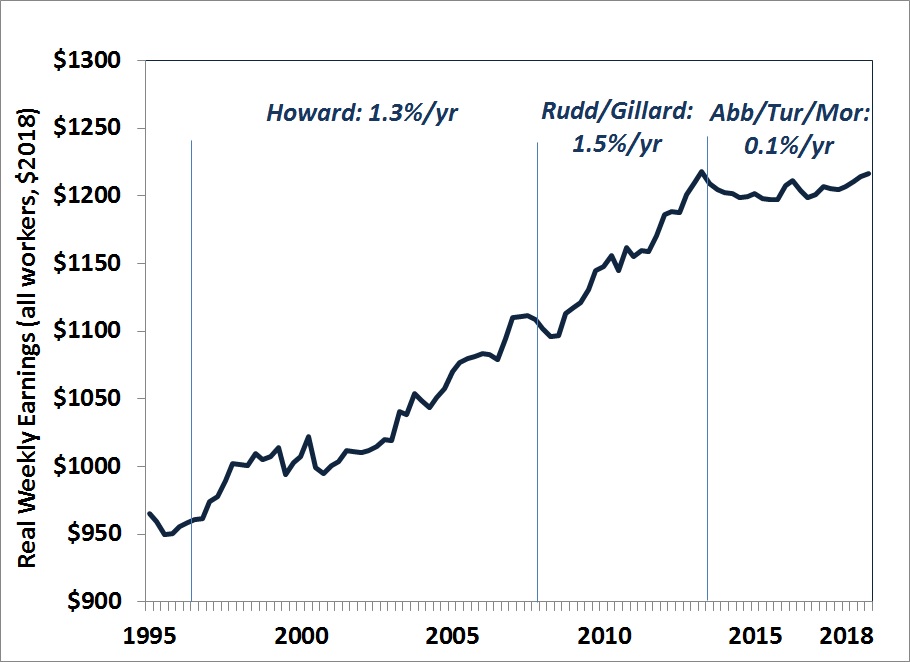
    Figure 1

    Source: Author’s calculations from ABS Catalogues 6302.0 and 6401.0.

    #2 Real wages have kept pace with productivity growth

    This claim is clearly false over any meaningful time horizon. Labour productivity has been chugging along since the turn of the century, at an average rate of about 1.25%. Some years it grows faster, some years slower. Productivity growth measures tend to be especially volatile, since they are computed as the implicit ratio of other, separately collected statistics (namely, total output and total hours worked). Some years reported productivity doesn’t seem to grow at all; some years it seems to grow very quickly.

    Even before the cessation of real wage growth around 2013, real wages were consistently lagging well behind productivity growth. Since then, of course, real wages have stopped growing at all, so the gap between wages and productivity has widened. From 2000 to the present, real wages have grown half as much as real labour productivity.

    Figure 2: Labour Productivity and Real Wages, 2000–2018
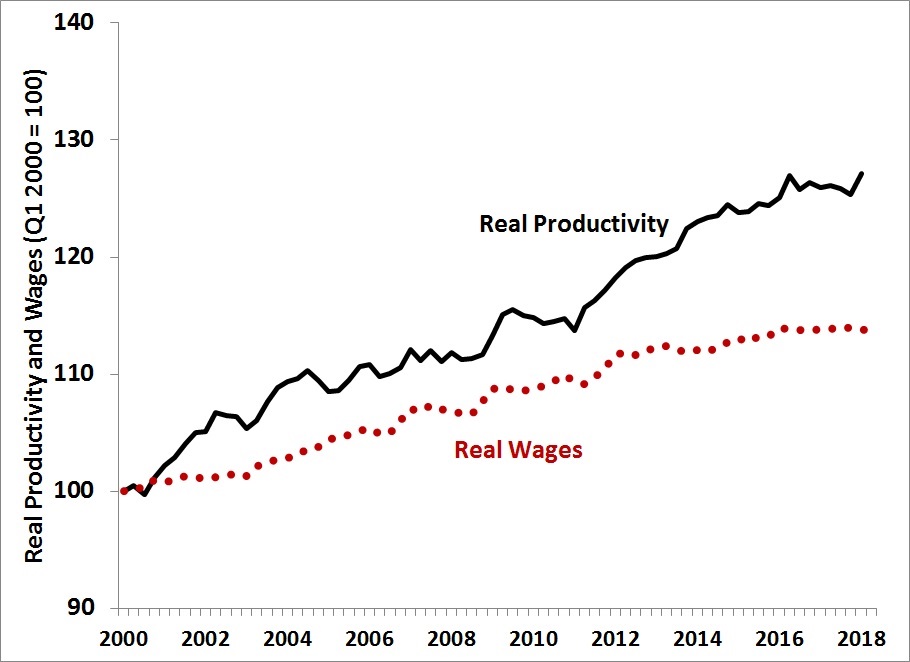
    Figure 2

    <>Source: Author’s calculations from ABS Catalogues 5206.0, 6345.0, and 6401.0.

    Stutchbury, like some other analysts, makes much of the difference between two different methods of measuring real wages: nominal wages can be deflated by consumer prices (which matter most to workers, as depicted in Figure 2) or by the average prices of the output they produce (which matter most to their bosses). Those two price series can move in different directions for a while: usually because of the price volatility of the natural resource exports that make up a significant share of Australia’s GDP. Hence the real “consumer” wage can differ from the real “producer” wage.

    But over the long-run the two price measures have moved in step, and hence the choice of deflator does not affect the conclusion that wages and productivity are no longer tied at the hip (in fact, they never were). Stutchbury actually concedes that if we use producer prices (rather than consumer prices), real wages have in fact lagged behind productivity (or, as he optimistically puts it, they “haven’t quite kept pace”). But then he makes a silk purse out of this sow’s ear by arguing that the relative cheapening of labour will stimulate more job-creation (another hollow business promise). In this mindset, it doesn’t really matter whether wages are keeping up with productivity, or not: everything is awesome in any event.

    #3 Labour’s share of GDP is the same as it was 60 years ago

    Unlike Stutchbury’s other claims, this one is actually true — but his interpretation of the statistic is hilariously one-sided. The labour share of GDP is defined as the total value of labour compensation (including wages, salaries, and other compensation including superannuation contributions) relative to the total output of the economy. It’s a rough-and-ready, but convenient, summary measure of workers’ overall share of the economic pie they help bake. Its evolution depends directly on the relationship between real wages and labour productivity discussed above. If productivity grows faster than real wages (as has been the case), then the labour share of GDP must decline — it’s arithmetically inevitable.

    Workers’ share of Australian GDP grew steadily through the vibrant economic expansion of the initial postwar decades, for several reasons. Waged employment became the dominant way for Australians to support themselves (replacing farming and small business activity). Real wages grew rapidly, driven by industrialisation, strong unions, and Australia’s then-ambitious set of egalitarian distributional policies. The labour share peaked in the mid-1970s, and then entered a long, irregular decline. (For more details and analysis of that decline, please see our special research symposium.)

    Figure 3: Labour Compensation as Share of Australian GDP, 1960–2018
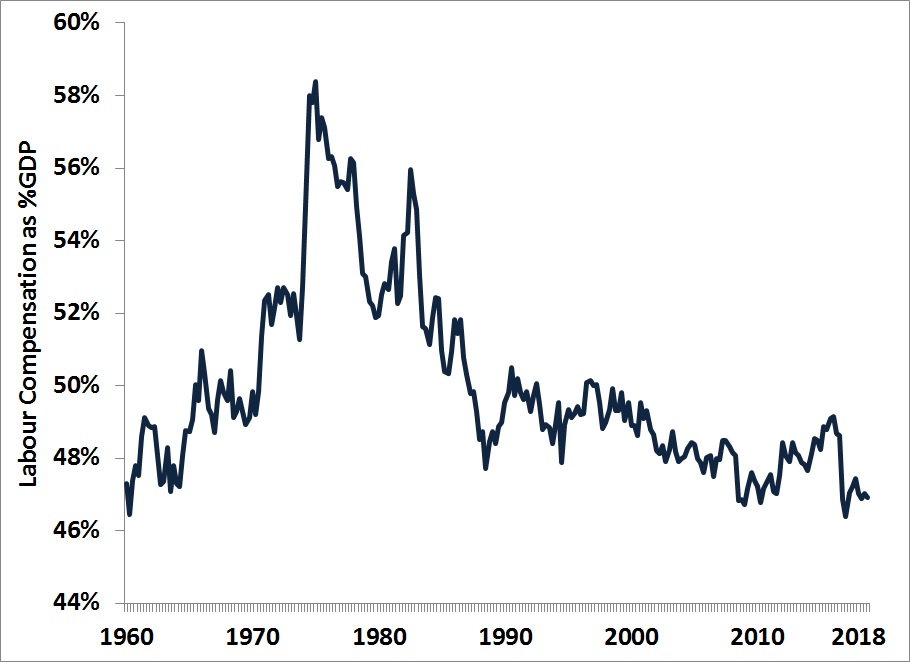
    Figure 3

    Source: Author’s calculations from ABS Catalogue 5206.0.

    <>By 2018, labour compensation averaged just under 47% of total GDP. That’s the lowest in six decades — in fact, the lowest of any calendar year since the ABS began collecting quarterly GDP data in 1959. Strictly speaking, Stutchbury is correct to say that the labour share of GDP is roughly the same as it was 60 years ago. But not many people could look at Figure 3 above, and conclude that “nothing happened”!

    To the contrary, the figure actually tells a dramatic story about the enormous swings of Australia’s postwar economic and social history. Several decades of expansive, inclusive growth, propelled by an ambitious commitment to redistribution and a growing social wage, pushed the labour share up. That was followed by several decades of active efforts to suppress wages, retrench public services, and reallocate income to business and investors. That drove the labour share back down. In essence, the relative gains Australian workers made during the postwar “Golden Age” have now been fully reversed. And there’s no reason to assume that the downhill trend in Figure 3 will suddenly and autonomously stop — without a multidimensional effort to rebuild the institutions that underpin workers’ capacity to demand and win a bigger share of the pie.

    Stutchbury suggests that the decline in labour’s share of GDP partly reflects accounting treatment of property ownership — reflected in a category of income the ABS calls “gross operating surplus for dwellings.” This claim is thoroughly unconvincing. The share of labour compensation in total GDP declined by over 10 percentage points since peaking in the mid-1970s. That was almost perfectly offset by a mirror-image increase (of over 9 percentage points of GDP) in the share of gross corporate profits in GDP. Clearly, the dominant story has been one of redistribution of income from workers to their employers.

    Accounting estimates of “operating surplus” on dwellings (some owner-occupied, some not) has also grown, but more modestly (less than 3 percentage points over the same period), and not at all since 1990 (when Australian home-ownership rates plateaued). And that flow of imputed income has begun shrinking since 2016, pulled down by the accelerating deflation of the property bubble. To suggest that workers have been compensated for declining relative wages by the side-effects of a property bubble (that made some look like “millionaires” on paper) is ridiculous. In reality, the increase in imputed property income has been more than offset by the decline in mixed income on small business (which has fallen by almost 4 percentage points of GDP since 1975); this may imply a shift in the focus of small-scale entrepreneurship from running real businesses, to investing in property.

    Stutchbury’s claim that workers themselves are now “quasi-capitalists” is familiar, far-fetched, and self-serving. He argues that because of the importance of superannuation funds in overall capital ownership, workers have a direct stake in the growing dominance ands profitability of business in Australian society, But suppressing wages over your entire working life, in hopes of gaining some incremental income from your super investments late in life, is obviously a chump’s game. It ignores the myriad of other factors that will undermine the income of those workers when they retire: not least being the direct correlation between stagnant wages and corresponding suppression of the superannuation contributions paid by employers (which are fixed as a proportion of those wages).

    #4 There has been no significant increase in inequality

    Coalition politicians and other defenders of the status quo have been making this claim for years. Many point to indicators showing that inequality was actually slightly worse in 2008 (just before the GFC hit, when business profits and stock market valuations peaked) than at present. That’s because the loss of (inflated) asset after the crisis had disproportionate impact on the rich people who own most of those assets. (Try not to cry.) But that’s hardly a sign that Australia is somehow becoming a fairer, more sharing society. And measured over a longer-term horizon, there is no doubt that income distribution in Australia has become more polarised.

    An especially dramatic indicator of rising inequality is the about-face in the share of total income received by the richest 1% of Australian households. That share declined steadily through the egalitarian postwar decades, falling by half between 1950 and 1980 (to 4.4% of total personal income). Lest we feel too sorry for the unfortunate souls in the 1%, their slice of the pie was still 4.4 times larger than proportional — and, of course, they also benefited (like other Australians) from the rapid growth in total incomes (the total pie) during that period. Since then, the deliberate redirection of national income from wages to profits, and the disproportionate salary increases received by top executives and other well-off individuals, have propelled the top income share right back to where it started. By 2015, the richest Australians had fully recouped the relative losses they experienced during the postwar Golden Age. The plutocracy had been restored.

    Figure 4: Income Share of Top 1% of Households
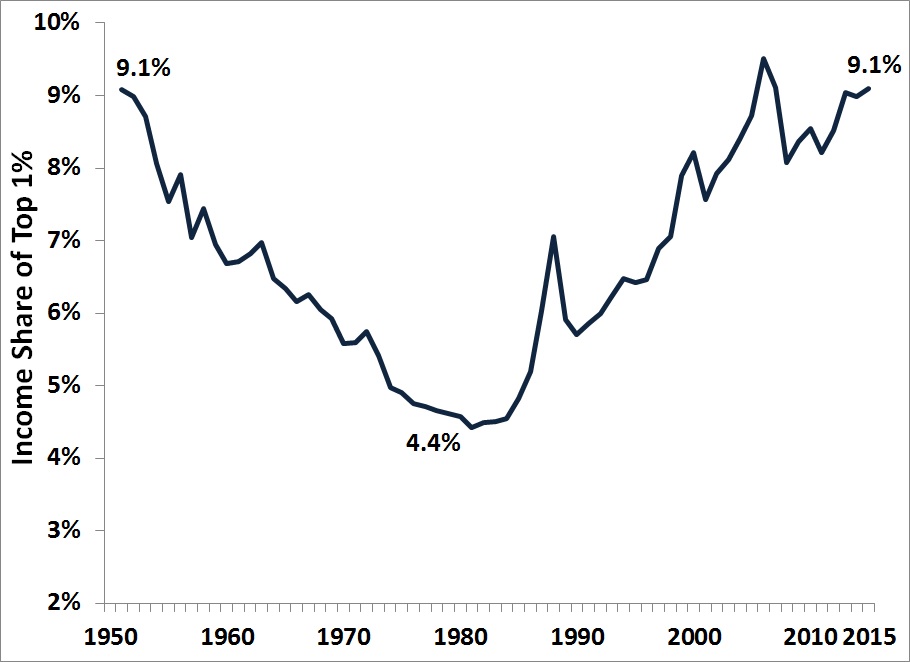
    Figure 4

    Source: World Inequality Database.

    Many other statistics confirm the long-run growth of inequality in Australia over the past generation of business-oriented neoliberal economic and social policy. Other measures of income polarisation (like the Gini coefficient, or the ratio of incomes of the top tenth of households to the bottom tenth) confirm wider inequality today, compared to the 1980s. Australia was once renowned as one of the most egalitarian countries in the world, with income distribution comparable to Scandinavia. Today we rank in the lower-third of industrial countries according to equality — and getting worse.

    #5 Stronger unions and labour rules won’t make a difference

    Commentators like Stutchbury don’t support unions in the first place. And they deny that workers have any problems that unions could help solve. Nevertheless, they want to nip in the bud any stirring of sentiment that restoring collective bargaining (and other wage-supporting measures, like minimium wages, penalty rates, or a stronger awards system) would make any difference. To this end he cites a recent RBA discussion paper as evidence that stronger unions would not solve the problem — a problem which, recall, Stutchbury believes doesn’t exist.

    Stutchbury’s reference to RBA research is misleading on several grounds. First, he assigns the finding to the Reserve Bank itself, when in fact he refers to a discussion paper written by two of its researchers (James Bishop and Iris Chan). The paper explicitly warns that its views and conclusions should not be attributed to the RBA (but Stutchbury did anyway).

    Second, the discussion paper does not argue that stronger unions would not affect wages, contrary to Stutchbury’s implication. Rather, it makes a much narrower, highly nuanced empirical claim: it suggests that the decline of union membership in recent decades has not been associated with a reduction in the impact of unions on wage gains in enterprise agreements (EAs). The paper explicitly does not consider other potential channels through which unions influence wages — such as via the level or growth of wages for workers who are not covered by EAs, or via the impact of unions on the terms of modern awards or individual contracts. (We will explore the specific methodology and findings of that discussion paper elsewhere; see also recent work by Alison Pennington which describes in detail the dramatic decline of enterprise bargaining in Australia’s private sector.)

    The core claim of the Bishop-Chan paper is that the proportion of Australian workers covered by the terms of an enterprise agreement which had some kind of union involvement has not changed much in recent years. Therefore, the slowdown in wages cannot be attributed to the erosion of union bargaining power; unions are as involved in wage bargaining as in the past. We believe this claim is both empirically wrong and analytically misleading.

    Data from the federal government itself confirms a dramatic fall in the share of employees covered by current federally registered EAs since 2013 — not coincidentally, exactly as the unprecedented stagnation of Australian wages took hold. Current EA coverage has plunged by over one-third in just 6 years. The decline in coverage has been especially severe in private sector workplaces, where less than 12% of workers now benefit from the protection of a collective agreement.

    Figure 5: Coverage by Current Federally-Registered Enterprise Agreements (% Employees)
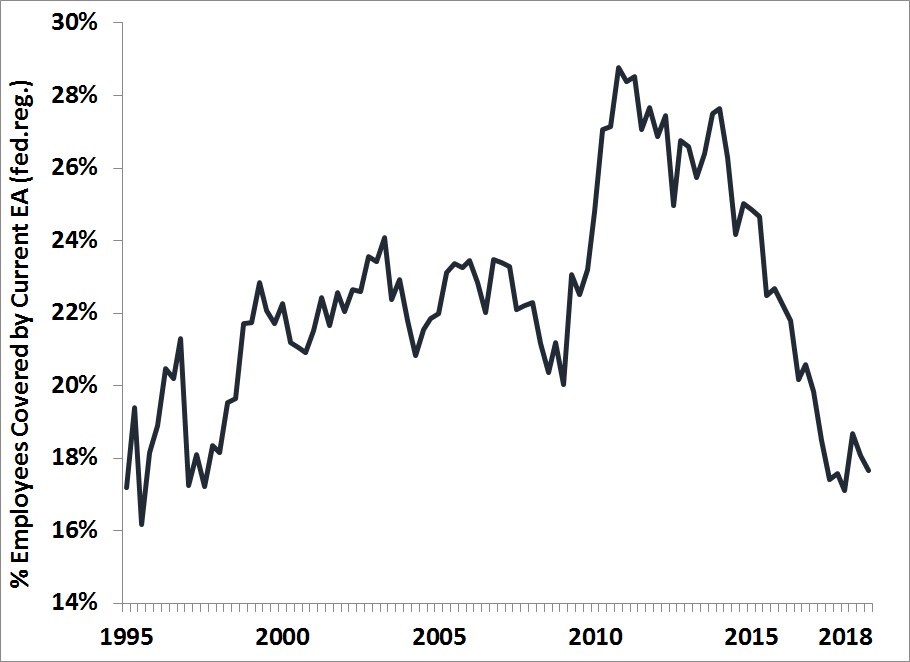
    Figure 5

    <>Source: Author’s calculations from Dept. of Small Business and Jobs data and ABS Catalogue 6291.055.003.

    Figure 5 does not include all collective agreements: around 5% of Australian workers are covered by agreements registered with state industrial relations commissions — almost all in public sector situations — which are not counted in the federal database. But that share has also shrunk in recent years, so the total erosion in EA coverage has been even worse than portrayed in Figure 5. Alternative data on EA coverage (from the ABS) includes the large number of workplaces in Australia with expired EAs: contracts that still exist on paper, but which (except for rare exceptions) no longer mandate wage increases. It is clearly illegitimate to assume that expired EAs have the same force as current ones, especially regarding wage growth.

    The Bishop-Chan paper focuses on EAs with “union involvement”. About 90% of the workers portrayed in Figure 5 are covered by enterprise agreements which feature some form of union involvement (as recorded by the Fair Work Commission); this statistic is crucial for the authors’ conclusion that union power has not waned. But the FWC’s definition of “union involvement” is very broad, and cannot be interpreted as proof of unions’ continuing bargaining power. A union can play no role at all in negotiating an enterprise agreement, yet still “sign on” to that agreement in order to formalise its legal right to play a role in enforcing its provisions (for whatever members it represents in that workplace). That union will then be identified by the FWC as being involved in that EA, even if its participation in the “bargaining” process was non-existent. This minimal level of “union involvement” in EA-making has become more common due to declining union membership and resulting resource constraints — which have made it effectively impossible for many unions to perform their traditional role in collective bargaining in all the workplaces where their members work. This grim reality helps to explain the dramatic increase in the number of expired, non-renegotiated enterprise agreements that has been a key factor in the rapid decline of EA coverage.

    Despite the challenges they face (including Australia’s uniquely intrusive restrictions on union access and activity, dues collection, and industrial action), unions still exert a powerful influence on wages. Average wages for union members in Australia are 27% higher than for non-members. And annual wage increases specified in EAs have averaged more than 1 full percentage point higher than the overall (slowing) growth in wages since 2013.

    Joining a union, and getting covered by a genuinely negotiated collective agreement, are still sure-fire ways to lift your wages. But the empirical evidence is crystal clear that the proportion of Australian workers benefiting from these supports has shrunk dramatically, and this is undeniably linked to the simultaneous and unprecedented deceleration in wage growth. “Changing the rules” to revitalise collective bargaining, and provide workers with some bargaining power to offset the current dominance of employers over wage determination, would make a huge difference to Australia’s stagnant incomes. And that’s exactly what has made commentators like Stutchbury so nervous.

    * * * * *

    Competing claims to being the “best economic managers” traditionally play an important role in Australian election campaigns, and the current contest is no exception. But for the large majority of Australians whose economic well-being depends, first and foremost, on the earnings they generate from paid employment, the jargon is ringing painfully hollow. From the standpoint of wages, the last six years have been the most disappointing since the end of the Second World War.

    Many factors help to explain the miserable performance of wages since 2013. But the phenomenon is not universal: in several countries, including Germany and Japan, wage growth has accelerated during this period, not slowed down, and Australia’s wage slowdown since 2013 has been the worst of any major industrial country. Active government policy has certainly played an important role in this poor performance. Within months of his 2013 appointment as the Abbott government’s Employment Minister, Eric Abetz was warning darkly of the dangers of a 1970s-style “wages breakout” — and implementing policies (starting with strict caps for public sector workers) to prevent it. Well, Mr. Abetz and his colleagues got what they asked for: wage growth plunged to unprecedented lows, and shows no robust indication of an imminent rebound. As federal Treasurer Mathias Cormann later let slip, this downward “flexibility” of wages is in fact a “design feature” of Australia’s current labour policy framework. His accidental assertion was as true as it was surprising.

    Since wages are the major source of income for most Australians, this turn of events has been deeply unpopular. Campaigners from unions and anti-poverty groups have emphasised the dangers of stagnant wages and inequality, and are receiving strong public support. Opposition politicians have proposed far-reaching measures to reinvigorate wage growth. But the current government would rather talk about something else — and by denying there is a problem, business leaders and sympathetic commentators are trying to help turn the page.

    Their efforts are unbelievable on statistical grounds. And they’re unlikely to be much more effective on a political level.

    Dr. Jim Stanford is Economist and Director of the Centre for Future Work, based at the Australia Institute @JimboStanford


    You might also like

  • Economics 101 for the ABCC

    Economics 101 for the ABCC

    by Jim Stanford

    Share

    The Australian Building and Construction Commission’s decision to press charges against 54 steelworkers for attending a political rally, with potential fines of up to $42,000 per person, is abhorrent on any level. No worker should face this kind of intimidation for participating in peaceful protest.

    But why is the ABCC, established to police construction workers and their unions, now going after steelworkers? It claims that since the factory they work at sells steel to construction sites, it is in effect part of the construction industry. But that claim, if taken seriously, means that the whole economy – and all workers – are subject to the ABCC’s crusade.

    In this commentary, Jim Stanford explains the basic economics of supply chains to the autocrats at the ABCC.

    Economics 101 for the ABCC

    by Jim Stanford

    Democratic-minded people of any political stripe were shocked by the announcement last week that the Australian Building and Construction Commission (ABCC) will take legal action against individual steelworkers who participated in a union protest march last October.  The ABCC was reestablished by the Coalition government in 2016 to supposedly uphold the rule of law in construction. But almost all of its actions are taken against unions, it mostly ignores employers. It was obviously created as part of a broader government effort to vilify, harass, and hamstring trade unions.

    Now the ABCC is pressing charges against 53 workers at Liberty OneSteel (and 1 union organiser) who missed work to attend a union-organised protest march in Melbourne – where they joined 150,000 other demonstrators. The Commission argues the workers’ participation constituted an unauthorised “strike,” and hence they should be punished far more severely than if they had simply missed a day’s work (say, to go fishing). They now face personal fines of up to $42,000 each: if all 54 are convicted and receive the maximum penalty, the fines would total over $2.25 million.

    This intimidation and repression against peaceful political protest is both abhorrent and frightening. In a normal democratic country, this sort of repression would be dismissed in the courts as a blatant violation of democratic rights – and morally rejected by civil society as a step toward totalitarianism. It is only because of Australia’s unusual, even bizarre history of top-down state policing of industrial relations that this police-state activity is somehow “normalised.”

    One of the most shocking aspects of the ABCC’s crusade, however, is that it isn’t even directed at the construction industry: the targeted individuals all work at a steel factory. The Commission argues that since some of the steel produced by OneSteel is used in building construction, the factory is considered part of the construction sector (as per the terms of the Building and Construction Industry Improvement (BCII) Act).

    That argument, if taken seriously, would grant the ABCC power to police workers and their political activity throughout the entire Australian economy. It is a matter of simple economics that any industry in the economy purchases inputs (both goods and services) from dozens of other industries. For the minions at the ABCC who may have never studied economics, this is called a “supply chain.” And thanks to technology, outsourcing, and globalisation, supply chains are longer and more complex than ever.

    In fact, if the entire construction supply chain is considered part of “construction,” then essentially the whole economy is construction. Because virtually every industry in the country sells something to construction companies.

    To see this, check out the Australian Bureau of Statistics’ magnificent annual “input-output table.”  It’s a number-cruncher’s dream: a gigantic matrix that describes the cross-cutting supply chains that feed into every industry. The ABCC might wish to review the latest edition before getting too carried away with its hunt for subversives in every closet.

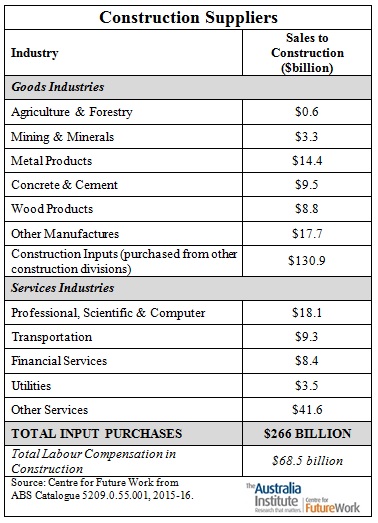
    The ABS table includes 113 different industries. Of those, fully 109 sell something to the construction industry. This includes everything from raw materials to sophisticated manufactures, from scientific laboratories to catering. The table below lists a few of the biggest construction suppliers – both goods and services. But virtually no part of the national economy is not connected somehow to construction.

    Construction Suppliers

    In total, construction firms purchase over one-quarter of a trillion dollars’ worth of supplies and services from those 109 industries (including purchases from other divisions of construction). In fact, the input purchases of the construction industry are four times bigger than the wages and salaries paid to construction workers – revealing again that the ABCC’s obsession with policing construction labour is mightily misplaced.

    Here are some of the more interesting sectors which report sales to the construction industry in the ABS tables:

    • Fishing and hunting ($70 million): Perhaps for trophies of big game to hang over the fireplace mantles of luxury homes?
    • Bakery products ($50 million): Donuts and pies, ‘nuff said.
    • Beer manufacturing ($4 million): This seems at first to be a gross underestimation. However, keep in mind that input-output tables do not include goods and services consumed by construction workers on their own time (in which case, this figure would surely measure in the billions!). Rather, it only includes purchases (tax deductible, of course) made by the companies. You can guess who drank the beer.
    • Veterinary medicines ($7 million): Must be for the nasty pit bulls at construction sites.
    • Gambling ($59 million): Given Australia’s speculative property bubble, it’s not a stretch to consider the whole housing industry to be a form of “gambling”!
    • Public order and safety ($769 million): That’s a biggie: security guards, CCTV cameras, and safety supplies. Conceivably the inflated salaries of the ABCC executives might even show up here: since they act in essence like a state police force.

    Of the 113 industries tracked by the input-output tables, only 4 do not report any sales to the construction sector. But even those sectors probably have some connection to the builders – perhaps once or twice removed:

    • Aquaculture: Construction purchasers buy from the fishing and hunting sector, but not from aquaculture. They must think wild salmon tastes better.
    • Library and other information services: Contrary to classist stereotypes, construction workers do indeed read books.
    • Primary and secondary education: The industry spends a lot on vocational and tertiary education; but school-level training isn’t counted (perhaps because it was completed before construction workers started their jobs).
    • Residential care and social assistance: This is certainly a necessary input for many construction workers – but only after they retire, are injured, or made redundant, and hence have left the industry.

    In short, basic economics confirms that the construction industry’s supply chains stretch into virtually every nook and cranny of the whole economy. If the overzealous autocrats at the ABCC are serious that their dominion extends to anyone who supplies construction, then their dominion extends to all of us.

    And that is an important, if unintended, lesson. If we allow this outrageous attack on the fundamental rights of assembly and expression of construction workers to proceed, then we are all ultimately vulnerable to the same repression. An injury to one really is an injury to all.


    You might also like

    Centre For Future Work to evolve into standalone entity

    The Centre for Future Work was established by the Australia Institute in 2016 to conduct and publish progressive economic research on work, employment, and labour markets. Supported by the Australian Union movement, the centre produced cutting edge research and led the national conversation on economic issues facing working people: including the future of jobs, wages

  • Budget 2019-20: Ooops, They Did It Again!

    Budget 2019-20: Ooops, They Did It Again!

    by Jim Stanford

    Share

    You would think that after 5 consecutive years of wage forecasts that wildly overestimated actual experience, the government might have learned from its past errors – and published a wage forecast more in line with reality. But not this government. They are still trying to convince Australian workers, who haven’t seen real average wages rise in over 5 years, that better times are just around the corner. And rosy wage forecasts are helpful in justifying their equally optimistic revenue forecasts: since if Australians are earning more money, they will be paying more taxes!

    So the 2019-20 Commonwealth budget, tabled Tuesday evening by Treasurer Josh Frydenberg, featured another valiant prediction that fast wage growth is indeed still “just around the corner.” Despite a slowdown in wage growth in the last months of 2018, this budget simply replicates last year’s wage forecast – but delayed by one more year. Crucially, there  is no discussion justifying why Australian workers might have confidence in this year’s forecast, when the last five so widely missed the mark (and always in the same direction).

    Our analysis of the 2019-20 Commonwealth budget focuses on the wages crisis facing Australian workers, and challenges the claim that cutting personal tax cuts can somehow compensate workers for the fact that their wages are not growing.

    Annual wage increases generate compounding benefits for workers and their families: since each year’s raise is applied against a larger and larger base. That cannot happen with tax cuts: to the contrary, their incremental effect can only shrink over time (as tax rates get lower and lower). Moreover, tax cuts always come with a significant cost: the loss of foregone public services, income supports and infrastructure that is the inevitable consequence of government’s shrinking revenue base.

    The tax cuts in this budget increase disposable incomes for workers by less than 1% (and by zero for the lowest-wage workers). In contrast, just one year of a normal wage increases delivers several times more benefits. And annual increases over three years (the term of the next government) delivers benefits dozens of times larger.

    Please read and share our full analysis of the 2019-20 budget below, which explains in detail how tax cuts cannot compensate for stagnant wages. You are also invited to view and share this short video summarising the argument (prepared with the help of our colleagues at the Australia Institute).


    Related documents


    2019-20 Commonwealth budget analysis

    You might also like

    Commonwealth Budget 2025-2026: Our analysis

    by Fiona Macdonald

    The Centre for Future Work’s research team has analysed the Commonwealth Government’s budget, focusing on key areas for workers, working lives, and labour markets. As expected with a Federal election looming, the budget is not a horror one of austerity. However, the 2025-2026 budget is characterised by the absence of any significant initiatives. There is

  • Jobs and a Living Wage

    Originally published in Arena on April 1, 2019

    Australians tend to bring a fair bit of swagger to international comparisons of economic performance. After all, Australia has experienced twenty-eight consecutive years of economic growth without a recession—a record for industrial countries. We are the ‘lucky country’, with one of the highest material living standards in the world, a wealth of natural resources, and a ‘no worries’ ability to withstand global economic shocks.

    The Australian policy journal Arena has published a wide-ranging article by Centre for Future Work Director Jim Stanford on the labour market issues at play in the current federal election.

    Stanford argues that the sense of “superiority” which typically accompanies economic debates during Australian election campaigns is muted in the current contest, because of the poor performance of the labour market in recent years. Unemployment and especially underemployment remain high; the quality of work has deteriorated; and wages have experienced their weakest performance since the end of the Second World War.

    Visit Arena’s website to read the full article.


    You might also like

  • 124 Labour Policy Experts Call for Measures to Promote Stronger Wage Growth

    124 Labour Policy Experts Call for Measures to Promote Stronger Wage Growth

    Share

    124 labour policy experts have today published an open letter calling for proactive measures to help accelerate the rate of wages growth in Australia’s economy. The legal experts, economists, and other policy analysts agreed that “stronger wages in the future would contribute to a stronger, more balanced and fairer Australian economy,” and they proposed several broad strategies to boost wages.

    The letter has generated substantial media coverage, including articles in the ABC, The Guardian, and The New Daily.

    A comprehensive story also appeared in Workplace Express, which we attached below with the journal’s permission. (To subscribe to Workplace Express for comprehensive coverage of labour policy issues, please visit their site.)

    Richard Denniss, Chief Economist at the Australia Institute, also tied the open letter into his powerful column on the causes of wage stagnation.

    The open letter was initiated and circulated by the 3 co-editors of a recent collection of research essays on the wages slowdown (The Wages Crisis in Australia: What it is and what to do about it, published by the University of Adelaide Press):

    • Prof. Andrew Stewart, John Bray Professor of Law, Adelaide Law School
    • Dr. Jim Stanford, Economist and Director, Centre for Future Work
    • Dr. Tess Hardy, Senior Lecturer and Co-Director, Centre for Employment and Labour Relations Law, University of Melbourne

    “There is a growing and legitimate concern in Australia over the erosion of real living standards. Boosting wage growth is the best way to reinvigorate the promise of shared prosperity that is essential to a healthy and productive society,” said Dr. Stanford.

    “This is not a problem that is going to fix itself”, added Professor Stewart. “We need to see a policy response from governments at all levels – and an acceptance that lifting wage growth can help the economy, not harm it.

    Dr. Hardy said, “The problem of stagnant wages is a complex one. While there is no singular or straightforward solution, it is increasingly clear that combatting the current wages crisis will require concrete and decisive action.”

    Included among 124 co-signers of the letter are numerous distinguished policy experts, including:

    Prof. Roy Green, Emeritus Professor, Innovation Adviser, and former Dean of Business School, University of Technology Sydney: “In current conditions, wage increases can be a significant driver of growth and productivity through the incentive effect on capital investment, and the demand effect on capacity expansion. Keeping wages depressed is not only disadvantageous for workers but it is bad for business and the wider economy.”

    Prof. Sara Charlesworth, Distinguished Professor of Gender, Work and Regulation in the School of Management at RMIT University: “Wages fully reflecting the value of the work women undertake are vital to their well-being and fundamental to gender equality.”

    Prof. John Quiggin, ARC Australian Laureate Fellow, School of Economics, University of Queensland: “For decades, government policy has been designed to weaken unions and push wages down. It’s time to put that process into reverse.”


    Related documents


    Open letter ad


    Full open letter


    Workplace Express Story

    You might also like

    Dutton’s nuclear push will cost renewable jobs

    by Charlie Joyce

    Dutton’s nuclear push will cost renewable jobs As Australia’s federal election campaign has finally begun, opposition leader Peter Dutton’s proposal to spend hundreds of billions in public money to build seven nuclear power plants across the country has been carefully scrutinized. The technological unfeasibility, staggering cost, and scant detail of the Coalition’s nuclear proposal have

  • A Historic Opportunity to Change Direction

    A Historic Opportunity to Change Direction

    by Jim Stanford

    Share

    A unique conjuncture of economic and political factors has created an opportunity for a historic change in the direction of Australia’s workplace and industrial policies. That’s the conclusion of Dr. Jim Stanford, Economist and Director of the Centre for Future Work, in a major review article published in Economic and Labour Relations Review, an Australian academic journal.

    In a broad overview of the current problems in Australia’s labour market, and the weaknesses of existing labour market policies, Stanford argues that the prospects are ripe for a fundamental shift in the emphasis of Australian industrial laws and labour standards.

    “A combination of political and macroeconomic factors has created a historic opportunity to turn away from the individualised, market-driven labour market policy that has prevailed since the 1980s, in favour of a more interventionist and egalitarian approach,” Stanford writes.

    He provides evidence on the dual failure of Australia’s job market: there is not enough work for those who want and need it, and the quality of work has deteriorated badly. Both of those problems have undermined wage growth in recent years. But longer-term structural changes in labour market and industrial policies are also to blame: “The deterioration in job quality and distributional outcomes is the long-term legacy of the post-1980s shift away from Australia’s earlier tradition of equality-seeking institutional structures and regulatory practice.”

    Stanford argues that deep political and economic changes are opening a once-in-a-generation possibility for a redirection of labour and workplace policies. The political shift reflects more than just the traditional “horse race” between leading parties, as an election approaches. Rather, they reveal growing public frustration over the evaporation of the “fair go” and the dimming prospects for inclusive prosperity. These political shifts have broken the traditional bipartisan endorsement of business-friendly labour policies which shaped Australia’s labour market over the last generation.

    At the same time, major macroeconomic challenges are reinforcing the need for a future Australian government to consider a different approach to supporting incomes and growth. The effects of restrictive labour policies on wages and inequality were moderated and disguised for some years by Australia’s vibrant investment and growth conditions. But now growth is slowing dramatically (due to the property price downturn, weak consumer finances, and weak business investment), and so the harsh effects of employer-oriented workplace policies are being felt undiluted by millions of working Australians.

    “There is growing sentiment among many researchers, industrial relations practitioners and worker advocates that Australia’s current industrial relations and labour policy regime (with its reliance on an eroding enterprise bargaining system, its severe constraints on union membership and activity and its network of fraying statutory protections) is in need of fundamental and multidimensional change,” Stanford concludes.

    Dr. Stanford’s review article, “A Turning Point for Labour Market Policy in Australia,” appears in Economic and Labour Relations Review, a peer-reviewed journal based at UNSW. Free public access to the article has been provided by the journal for a limited time: please visit this site to see the full article.

    Stanford’s review was also reported in a feature article by The Saturday Paper‘s Mike Seccombe on the important role that wages and workplace issues will play in the coming federal election campaign.


    You might also like

    Centre For Future Work to evolve into standalone entity

    The Centre for Future Work was established by the Australia Institute in 2016 to conduct and publish progressive economic research on work, employment, and labour markets. Supported by the Australian Union movement, the centre produced cutting edge research and led the national conversation on economic issues facing working people: including the future of jobs, wages

  • 8 Things to Know About the Living Wage

    8 Things to Know About the Living Wage

    by Jim Stanford

    Share

    There has been a lot of discussion about “living wages” in recent years – in Australia, and internationally. And now the idea has become a hot election topic. The ACTU wants the government to boost the federal minimum wage so it’s a true living wage. Opposition leader Bill Shorten has hinted he’s open to the idea. Business leaders predict economic catastrophe if the minimum wage is increased.

    As the debate heats up, here’s a quick guide to 8 things you need to know about the living wage:

    #1. The debate is new. But the idea is old. And it was invented in Australia!

    In 1907 a conciliation and arbitration judge named H.B. Higgins decreed (in the famous “Sunshine Harvester” case) that wages should be sufficient to meet the “normal needs of an average employee, regarded as a human being in a civilized community.”  He actually calculated the wage that would be required for a full-time worker (then assumed male) to adequately support himself, his wife, and three children. At the time, the living wage was 7 shillings (or around 70 cents) per day.

    Of course, our idea of a standard “family” has changed a lot since then. We have fewer kids, and most women now work for pay outside of the home. But the idea of linking the minimum wage, to the actual costs associated with a minimum decent standard of living, is still valid.

    #2. Working for minimum wage is a recipe for poverty.

    From that humble beginning in 1907, Australia’s minimum wage evolved over time. It’s now adjusted annually by the Fair Work Commission. But the link to the concrete costs of running a household has been abandoned. These days the Commission looks at various factors (including profits, inflation, employment trends, and inequality) in setting the minimum. But it does not explicitly consider whether a minimum wage is sufficient to pay for basic living costs. And in reality, it is not.

    A full-time worker on the national minimum wage today ($18.93 per hour) makes $719 per week – and that assumes they work a full 38-hour schedule.  (In reality, most low-wage workers can’t get enough hours of work, on top of their low hourly rate.)  That’s only about 45% of average weekly earnings for all Australian workers.  And it’s certainly not enough to run a household, and pay for a decent standard of living. So Australia’s minimum wage is certainly well below a true “living wage.” Minimum wage workers, especially those with any dependents, are likely to live in poverty.

    #3: How do you measure the living wage?

    A common international threshold for defining low income is at 60% of the median earnings of full-time workers. (The median is the point exactly half-way between the top and the bottom of the income distribution; it differs from the average, which is unduly pulled up by a few very high-earners at the top.) Median earnings for full-time employees in Australia are presently close to $1500 per week. The minimum wage would thus have to increase to $23 per hour or more, to ensure that a full-time worker reached 60% of the median.

    Another method of calculating a living wage is to gather data on the actual costs of operating a basic household for a specific family type (often assumed to be two adults and two children, but other configurations are possible). In addition to the necessities of life (food, clothing, and shelter), a living wage must also allow for other expenses associated with full and healthy participation in society: such as internet, transportation, school supplies, a minimal level of entertainment expenses, insurance, and more. There are no luxuries in this budget – just a basic, decent standard of living consistent with modern social expectations.

    After adjusting for income taxes and transfers (like the family tax benefit and the child care subsidy), we then calculate the pre-tax income required to meet that basic standard of living. That in turn can be converted into an hourly living wage, by assuming a certain amount of paid work by the adults in the household (perhaps one working full-time and one working part-time).

    This “bottom-up” methodology has been utilised by living wage campaigns in several countries – but not yet Australia. The research confirms that current minimum wages are not compatible with healthy families and communities. The estimated living wage benchmark can then be used to lobby for increases in the legal minimum – or even to push individual employers to voluntarily pay a living wage.

    #4. For a generation, Australia’s minimum wage has lagged behind a living wage.

    In 1985 Australia’s minimum wage equaled 65% of median earnings (above that 60% threshold discussed above). It declined steadily relative to overall wages over the next two decades. Successive governments were focused on reducing wages, and fostering more dog-eat-dog competition in labour markets. (Last week Finance Minister Mathias Cormann actually admitted his government was trying to keep wages low as a matter of policy.)

    Over time, the minimum wage declined to a low of 52% of median wages in 2008. It bounced back slightly since then, helped along by a decent minimum wage hike (of 3.5%) last year. But the minimum wage still falls well short of any conception of a true living wage.

    #5. Isn’t Australia’s minimum wage higher than in other countries?

    It’s certainly higher than in America: where the minimum wage has been frozen at $7.25 for the last decade. It’s now equal to just 33% of median wages there – by far the lowest of any industrial country. No wonder many millions of full-time workers there still live in poverty. Not exactly a role model for Australia.

    In dollar terms, Australia’s minimum wage is higher than many countries. Some business lobbyists even complain Australia already has one of the “highest minimum wage in the world.”  But that claim is not true in any meaningful sense. Living costs are also very high in Australia compared to elsewhere. And international wage comparisons must consider deviations in exchange rates and other factors. It’s better to compare minimum wages across countries using the ratio of minimum to median wages discussed above.  By that standard, Australia’s minimum wage ratio is below several other countries, including France (the highest), Israel, Portugal, New Zealand, and even Turkey.

    #6: New Zealand is increasing its minimum wage – and fast.

    In fact, our neighbours across the ditch are quickly putting Australia’s minimum wage to shame. The minimum wage there (presently $16.50 per hour) is already higher as a share of median wages (above 60%) than in Australia. But the new Labour-Greens-NZ First government has been increasing it substantially, as one of its first policies. The minimum wage will grow 25% over the government’s four-year term – by which time it will equal approximately 68% of median wages.

    #7: Economists have changed their mind on minimum wages.

    Business leaders and market-friendly economists used to argue that increasing the minimum wage will inevitably cause unemployment. After all, they believed, if something is more expensive, people will buy less of it (the “buyers,” in this case, being employers). But this simplistic logic has been thoroughly discredited by a whole new generation of economic research on the effects of minimum wages on employment. Starting with a path-breaking study of minimum wages and fast food employment in New Jersey in the 1990s (by economists David Card and Alan Krueger), economists now realise the traditional supply-and-demand story is wrong.

    In fact, they have discovered several reasons why higher minimum wages do not have any significant negative impact on employment – and in some cases can actually lead to higher employment. These reasons include:

    • Improving labour force participation and retention among low-wage workers.
    • Reducing job turnover and the costs of searching for new jobs and new workers.
    • Offsetting the uncompetitive “monopsony” power of very large employers, which otherwise restrict their own hiring in order to help suppress wages.
    • Boosting consumer spending by putting more money in workers’ pockets – an effect which is especially beneficial for small business.

    Hundreds of studies of minimum wages in various countries have found little impact on employment in either direction. Even Australia’s Reserve Bank confirmed that recent increases in the minimum wage had no visible negative effect on employment.

    Further counter-evidence that higher minimum wages do not destroy jobs – and lower minimum wages do not create them – is provided by the experience of Australia’s recent cut in penalty rates for retail and hospitality workers on Sundays and holidays. Employers said this reduction in wages would lead to more jobs and longer hours. However, research by the Centre for Future Work showed those two sectors have been among the worst job-creators in Australia’s economy since penalty rates were cut. In fact, the retail sector eliminated 50,000 full-time jobs in the year under lower penalty rates.

    #8: A living wage would reduce poverty and boost incomes.

    In sum, higher minimum wages have little impact on employment one way or the other. Job-creation depends mostly on macroeconomic conditions and aggregate purchasing power. Higher minimum wages are proven to lift incomes for low-wage workers and reduce inequality. Committing to a true living wage in Australia, would ensure that people who work full-time, year-round are lifted out of poverty, and provide a badly-needed boost to Australia’s stagnant wages. It would be a powerful step in creating a fairer labour market.

    Median wage data from ABS catalogue 6306.0, “Employee Earnings and Hours.” Average wage data from ABS catalogue 6302.0, “Average Weekly Earnings.” Both refer to 2018.


    You might also like

  • Job Creation Record Contradicts Tax-Cut Ideology

    Job Creation Record Contradicts Tax-Cut Ideology

    by Jim Stanford

    The Australian Bureau of Statistics released its detailed biennial survey of employment arrangements this week (Catalogue 6306.0, “Employee Earnings and Hours“). Once every two years, it takes a deeper dive into various aspects of work life.

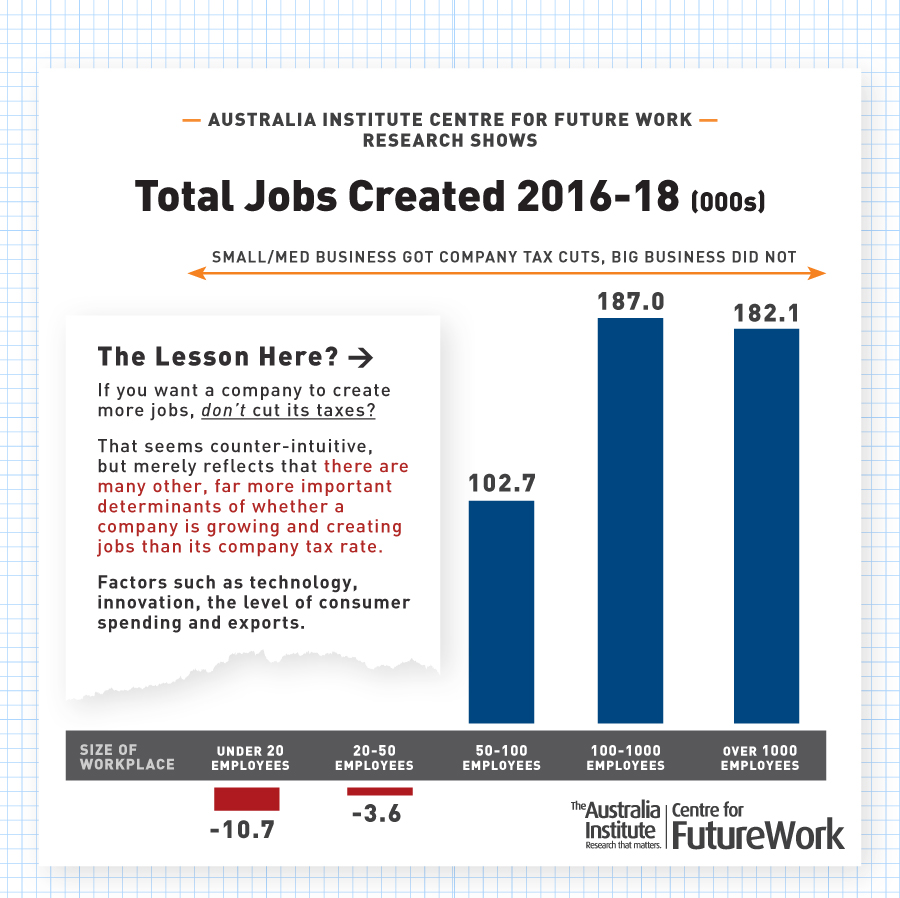
    Buried deep in the dozens of statistical tables was a very surprising breakdown of employment by size of workplace.  It turns out, surprisingly, that Australia’s biggest workplaces (both private firms and public-sector agencies) have been the leaders of job-creation over the last two years.

    This runs against the common refrain that small business is the “engine of growth.”  In fact, workplaces with less than 50 employees actually shed employees (14,000 in total) since 2016.  Curiously, it was only smaller businesses that received the much-vaunted reduction in company tax (from 30 to 27.5 per cent), also beginning in 2016.

    Firm Size and Job Creation

    The tax rate for small and medium-sized businesses began to fall in 2016, first for the smallest firms (with turnover under $2 million), and then for firms with up to $50 million revenue.  The tax is not tied to the number of employees in a business, but the vast majority of firms which have received the tax cut have less than 50 employees.  Yet that is the group that has reduced its workforce since the tax cuts began to be phased in.

    In contrast, very large workplaces (with over 1000 employees) added 182,000 new jobs over the two years.  Workplaces with between 100 and 1000 employees added 187,000.  Very few of those workplaces would have received the reduction in company taxes (since most would exceed the $50 million annual revenue threshold).

    Workplaces between 50 and 100 employees created a net total of 103,000 new jobs between 2016 and 2018.  Some of those firms would have received the tax cut, and some not — depending on the nature of the business and the amount of total turnover generated per employee.

    The data on job-creation by firm size is detailed on Table 13 of Data Cube 1, in the “Downloads” section of the ABS report. The data refers to waged employees, not including owner-managers of businesses.

    The share of small businesses (under 50 employees) in total employment declined by two percentage points — since they were reducing their workforces, while larger companies were growing.  Small businesses (under 50 employees) now account for 34 per cent of all employees, compared to 36 percent in 2016.

    Why would large companies that didn’t get a tax cut create new jobs faster than companies which did benefit from the Coalition tax cuts? (The small business tax cuts are estimated to reduce federal revenues by $29.8 billion over the first decade.) Simple: there are dozens of different factors which determine whether a company is profitable or not, and whether it chooses to grow.  Tax rates are just one of those variables.  Others include:

    • Growth in consumer demand.
    • The company’s investments in product quality, innovation, and design.
    • Production costs.
    • Interest rates and financing costs.
    • Business confidence and expectations.
    • Management capacity.
    • International competition.

    Trends in all these other factors can easily overwhelm the marginal impact of lower tax rates.  Small business sales in particular have been held back by stagnant wages among Australian workers.  Even companies which experience higher profits due to lower tax rates may choose to simply accumulate those profits, or pay them out to shareholders in dividends and share buy-backs (instead of expanding payrolls).  Empirical evidence shows this has been the dominant impact of U.S. business tax cuts implemented by Donald Trump.

    Changes in tax rates can even have offsetting effects which undermine business conditions and hence reduce job-creation: if the revenue lost to tax cuts results in corresponding reductions in government program spending or infrastructure investments (as seems likely), then overall business conditions might be weakened, not strengthened.

    The reduction in employment by the businesses which most benefited from the expensive business tax cuts over the past two years should lead policy-makers of all persuasions to reconsider the argument that this is an effective way to stimulate growth and job-creation. However, in October the government announced it wanted to accelerate the next stages of the small business tax cuts — taking the rate down to 25 per cent five years faster than originally planned.

    So far, the policy is akin to shooting oneself in the foot.  Instead of reloading the gun to do it again even sooner, perhaps this is a good time to reconsider whether the strategy makes any sense at all.


    You might also like

    Commonwealth Budget 2025-2026: Our analysis

    by Fiona Macdonald

    The Centre for Future Work’s research team has analysed the Commonwealth Government’s budget, focusing on key areas for workers, working lives, and labour markets. As expected with a Federal election looming, the budget is not a horror one of austerity. However, the 2025-2026 budget is characterised by the absence of any significant initiatives. There is

    Dutton’s nuclear push will cost renewable jobs

    by Charlie Joyce

    Dutton’s nuclear push will cost renewable jobs As Australia’s federal election campaign has finally begun, opposition leader Peter Dutton’s proposal to spend hundreds of billions in public money to build seven nuclear power plants across the country has been carefully scrutinized. The technological unfeasibility, staggering cost, and scant detail of the Coalition’s nuclear proposal have