Category: Democracy & Accountability

Research branch

  • Of 3’s, and Other Important Labour Market Numbers

    Of 3’s, and Other Important Labour Market Numbers

    by Jim Stanford

    Will an unemployment rate with a 3 in front it, ensure that we also get wage growth with a 3 in front of it? Don’t count on it.

    Prime Minister Scott Morrison set tongues wagging this week with a confident pledge that Australia’s unemployment rate could have “a 3 in front of it” this year. It’s a theme that will loom large in his campaign for reelection later this year.

    In this commentary, Centre for Future Work Director Jim Stanford considers whether a low unemployment rate is an accurate indicator of the state of the labour market — and whether, even if achieved, it would reignite wage growth and solve other problems holding back Australia’s labour market.

    The unemployment rate was 4.2% in December, so Mr Morrison’s prediction may not be as brave as might seem: it would only take a .3-point drop to achieve that magical ‘3’. The official unemployment rate often bounces by more than that (in either direction) in any given month, purely due to measurement errors or shifts in recorded labour force participation. So his prediction will likely come true. But is it the economic triumph that he and his political allies will claim?

    A lower unemployment rate is obviously better than a higher unemployment rate. But the unemployment rate itself has lost much of its value as an indicator of the state of the labour market. There are large pools of unutilised and underutilised labour in our economy that are not captured by the official unemployment measure.

    Equally important, assumptions that a historically low unemployment rate will automatically correct many of the labour market problems that Australia has experienced in recent years are misplaced. Problems like wage stagnation, falling real wages, income inequality and poverty (even among employed people), and the economic exclusion of sectors of society (such as indigenous and immigrant communities, and people with disability) all require more concerted and targeted actions to fix.

    Please see Jim’s full commentary: Of 3’s, and Other Important Labour Market Numbers.


    You might also like

    Centre For Future Work to evolve into standalone entity

    The Centre for Future Work was established by the Australia Institute in 2016 to conduct and publish progressive economic research on work, employment, and labour markets. Supported by the Australian Union movement, the centre produced cutting edge research and led the national conversation on economic issues facing working people: including the future of jobs, wages

  • CPI Numbers Don’t Tell the Whole Story

    Originally published in The Guardian on February 3, 2022

    With the rise in inflation as Australia’s economy struggles with re-opening and supply chain problems, each release of the Consumer Price Index (CPI) generates headlines and political debate. But the CPI doesn’t necessarily provide a full reading of price pressures: depending on who you are, and what you buy. In this column published in the Guardian Australia, Greg Jericho (new policy director for the Centre for Future Work) dissects several measurement issues related to this most-watched economic statistic.

    Jericho shows that inflation measurements can very widely for different types of household. Those with limited incomes (including government benefit recipients), who spend more of their income on ‘non-discretionary’ items, face an especially large threat to their real living standards as inflation picks up.

    See Greg’s full column, “With inflation on the rise, Australia’s cost of living will dominate the election debate,” in the Guardian Australia.


    You might also like

  • Centre for Future Work Announces Two Senior Appointments

    Centre for Future Work Announces Two Senior Appointments

    by Jim Stanford

    Share

    The Centre for Future Work at the Australia Institute is pleased to announce the appointment of two senior staff to its team of labour policy researchers.

    Greg Jericho will join the Centre on 1 February as Policy Director: Labour Market and Fiscal. Greg is an economist and well-known columnist for The Guardian in Australia; he currently teaches at the University of Canberra. He will continue writing his Guardian column, while overseeing new research projects for the Centre on issues of employment, wages, insecure work, and related topics.

    Dr Fiona Macdonald will join the Centre on 1 March as Policy Director: Industrial and Social. Fiona is presently Vice-Chancellor’s Senior Research Fellow at the School of Management, RMIT University, and an internationally recognised expert on caring labour, gender and work, and industrial relations policy. She has published extensively on the Awards system, working conditions and compensation in human and caring services, and violence at workplaces. Fiona will oversee new research at the Centre on industrial relations reform, social policy, and caring labour.

    The two Policy Directors join the Centre’s existing research team, which includes: Economist and Director Jim Stanford; Senior Economist Alison Pennington; Economist Dan Nahum; and Mark Dean, Distinguished Research Fellow at the Carmichael Centre.

    “This is a critical moment in the history of work and industrial relations in Australia,” said Dr Stanford, the Centre’s Director. “The addition of Greg Jericho and Fiona Macdonald to our team will greatly enhance our capacity to investigate the threats facing work and workers, and to develop progressive policy responses that could achieve a better future of work.”

    “I am very excited to join the Centre for Future Work,” said Jericho. “At such a crucial moment, being able to push the policy debate in the interests of fairness for workers is of utmost importance. I look forward to working with the great team at the Centre and the Australia Institute to continue producing quality research that leads the political and policy debates.”

    “As a long-time admirer of the Centre, I am thrilled to be joining its research team,” said Dr. Macdonald. “I look forward to contributing to the Centre’s important work, including in the vital areas of the care economy and gender equality. Work is changing rapidly, and the Centre’s research empowers those working for a fairer, more equal labour market.”

    Greg Jericho will work out of the Australia Institute’s central office in Canberra. Fiona Macdonald will be based in Melbourne.

    Greg Jericho can be followed on Twitter at @GrogsGamut. Fiona Macdonald can be followed at @DrFionaMac.


    You might also like

    Centre For Future Work to evolve into standalone entity

    The Centre for Future Work was established by the Australia Institute in 2016 to conduct and publish progressive economic research on work, employment, and labour markets. Supported by the Australian Union movement, the centre produced cutting edge research and led the national conversation on economic issues facing working people: including the future of jobs, wages

    Carmichael Centre Announces Appointment of Prof. David Peetz as Laurie Carmichael Distinguished Research Fellow

    by Jim Stanford

    The Carmichael Centre at the Australia Institute’s Centre for Future Work is proud to announce the appointment of Prof. David Peetz, one of Australia’s most outstanding labour policy experts, as the new Laurie Carmichael Distinguished Research Fellow. Prof. Emeritus Peetz has recently retired from a long career at Griffith University, where he served as Professor

  • Snatching Defeat from the Jaws of Victory: Labour Market Implications of Australia’s Failed COVID Strategy

    Snatching Defeat from the Jaws of Victory: Labour Market Implications of Australia’s Failed COVID Strategy

    by Jim Stanford

    Share

    As COVID and recession gripped the world, through 2020 and most of 2021 Australia recorded one of the best outcomes: lower infection, fewer deaths, and a faster, stronger economic recovery. That seeming victory has been squandered, however by the appalling and infuriating events of recent weeks. Purportedly in the name of ‘protecting the economy’, key political leaders (led by the Commonwealth and NSW governments) threw the doors open to the virus at exactly the wrong time: just as the super-infectious Omicron variant was taking hold.

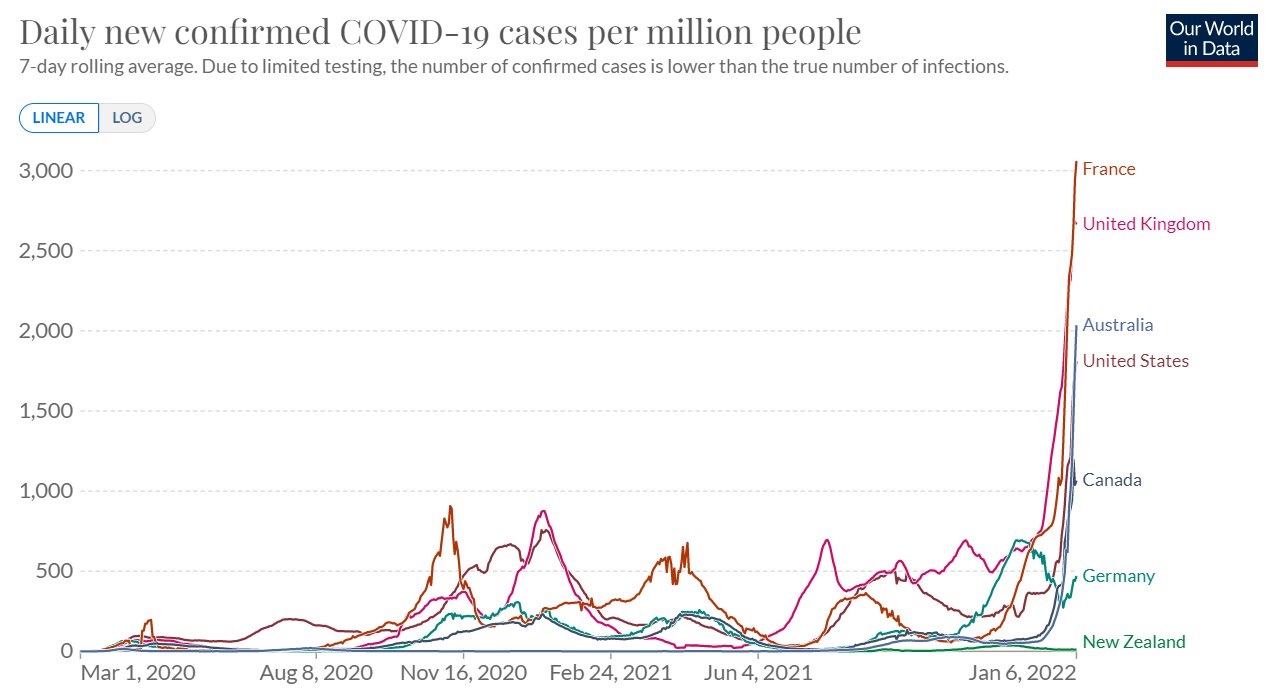
    The resulting surge in infections has been among the worst in the industrialised world (worse than the U.S. now, as shown in the following graph from Our World in Data). The implications of this massive outbreak for work, workers, production, and the economy have been as predictable as they are devastating. One-third or more of workers in the most-affected regions cannot attend work: because they contracted COVID, were exposed to it, or must care for others (like children barred from child care and soon, possibly, schools).

    Our Centre for Future Work team has been active in highlighting the risks of ‘letting it rip’, analysing the failures of isolation and income support programs, and reminding everyone that keeping workers healthy must be the first priority in keeping the economy healthy. Here is a selection of our recent interventions:

    New COVID Cases per Million (7-day rolling)

    • Our Director Jim Stanford reminded policy-makers in this commentary in The Conversation that human labour is the critical input to production at all stages of value-added and supply chains, and if policy-makers acknowledged the centrality of work to the economy they would not have made such destructive choices. The article was reposted by the ABC, the Sydney Morning Herald, and other platforms, and viewed over a half-million times.
    • Senior Economist Alison Pennington has exposed the flaws in government isolation and testing systems. For example, she highlighted the perverse incentives created by the NSW government’s punitive $1000 fine for failing to register a positive RAT test — never mind the governments’ failures to make tests available, and support workers (with necessary income benefits) to isolate. Her analysis was shared thousands of times, and featured in multiple news coverage (including News.com, The New Daily, and Yahoo Finance) of the flawed NSW policy.
    • Alison further detailed the flaws in changes to the Commonwealth government’s isolating support payments, in this commentary in The New Daily. By punitively excluding hundreds of thousands from isolation benefits, the policy will accelerate contagion and make supply chain problems even worse down the road.
    • Our experts have been featured in numerous other reports on the supply chain problems arising from the Omicron surge, including these reports on Channel 10, Today, The Age, ABC Online, and The Guardian.
    • Our Economist Dan Nahum linked the surge in Omicron contagion to the spread of insecure work arrangements in Australian workplaces. And the Centre’s previous work on how COVID has accentuated the dominance of casual and insecure work in Australia’s labour market shows that without urgent action to improve job quality, the labour market will be even more vulnerable to the inevitable future disruptions from this continuing crisis.

    Our team of experts will continue monitoring the dangerous labour market developments arising from Omicron, and flawed government responses to it. Please watch our site and follow our Twitter feed for regular updates.


    You might also like

    Centre For Future Work to evolve into standalone entity

    The Centre for Future Work was established by the Australia Institute in 2016 to conduct and publish progressive economic research on work, employment, and labour markets. Supported by the Australian Union movement, the centre produced cutting edge research and led the national conversation on economic issues facing working people: including the future of jobs, wages

  • The great (gendered) resignation is not what you think. It’s worse

    Originally published in Crikey on November 25, 2021

    The great resignation is apparently upon us — workers are walking away from bad jobs. But in Australia, the exodus of women from the workforce says more about structural barriers than worker empowerment.

    Have you heard? The so-called great resignation is afoot. A world where an empowered workforce say “no” to bad bosses and a life dictated by work. In the US, increased job departures have been coined a “revolution in workers’ expectations”.

    Australian workers were squeezed for an average 6.1 hours unpaid overtime per week in 2021 – a substantial increase on 2020.  If only expectations matched reality.

    In Australia, employers crow about shortages in low-paid, “churn and burn” jobs of which they refuse to improve the quality. Meanwhile, 700,000 people are unemployed, and 1.3 million are in jobs, but need more work. Around 1 million more aren’t looking for work, but want to work and are available. The ABS calls them “marginally attached” and “discouraged” workers.

    Women know a thing or two about being discouraged. Far from quitting as an act of righteous agency, they’ve lost their jobs during lockdowns against their will. It’s material. Less “life’s too short to work 24/7”. More “my kids need care immediately”.

    The explosion in caring demands associated with lockdowns fell disproportionately to women – as in 2020, when women’s average hours caring for children and performing household tasks rose faster than for men, reaching 5.1 hours per day (versus 3.1 for men).

    In February 2021, 175,000 women didn’t look for work even though they were available and ready to start within four weeks because they had pressing caring responsibilities.

    Even if women loaded with caring demands wanted to retain their jobs, the odds were stacked against them. They hold the majority of low-hours insecure jobs without protections against sacking. When bosses want to shed jobs to save bottom lines, women cop it worst.

    68% of all jobs lost between May and October were held by women (205,000 jobs). Women’s participation in the job market fell 1.7 percentage points. Nearly all (90%) of women’s jobs lost were part-time.

    Little acknowledged, the latest job vacancies data mirror women’s exodus from paid work. In August, vacancies were highest in healthcare, administration and retail. These are all industries employing 50% or more women. All are in the bottom-half of industries by average weekly earnings.

    The question is, as wallets open, beers flow and economic activity resumes, what’s bringing women back to work? A couple shifts at minimum wage, and higher COVID-19 contagion risks to boot. All to pay for one day of high-cost childcare? Hardly appealing.

    An empowered workforce can walk away from bad jobs. But structural barriers stop women from participating in the first place.

    High-cost childcare is a clear barrier for women workers. Before the pandemic, over half of non-employed women with young children said high-cost childcare was the biggest influence on their decision not to work.

    Australia’s outdated paid parental scheme bakes “primary” and “secondary” carers into family structures – reinforcing the exodus of women from work, and blocking the equal participation of fathers in raising their children.

    The so-called great resignation is gendered. But women shouldn’t have to resign themselves to the revolving door of crap jobs and important caring responsibilities.

    We’ve come a long way since the 1950s when conservative norms dictated women’s labour should be unpaid and confined to the home. Women have better access to the world of paid work now. But their relegation to insecure, low-paid, and junior roles shows we have much further to go.

    And it’s government policies that holds us back.

    Australian women need genuine measures to support them in all aspects of their lives; from free early childhood care and education, better work-family balance policies, pay equity, and more opportunities for decent jobs.

    Only then, can women imagine a world where they are empowered through work.


    You might also like

    Centre For Future Work to evolve into standalone entity

    The Centre for Future Work was established by the Australia Institute in 2016 to conduct and publish progressive economic research on work, employment, and labour markets. Supported by the Australian Union movement, the centre produced cutting edge research and led the national conversation on economic issues facing working people: including the future of jobs, wages

  • What Next for Casual Work? Professor Andrew Stewart webinar recording

    What Next for Casual Work? Professor Andrew Stewart webinar recording

    Share

    Casual employment has dominated Australia’s labour market recovery from COVID-19. And the right of employers to hire staff on a casual basis in almost any role they choose – including jobs that on their face appear have permanent characteristics – seems to have been cemented by recent amendments to the Fair Work Act, and by the High Court’s recent ruling in the WorkPac v. Rossato case.

    What do these new developments mean for the further spread of casual and precarious work? What are the other implications of the High Court ruling for future employer strategies? And what options remain for limiting the spread of casual and insecure work? To examine these matters and their implications, we were recently joined by renowned labour law expert Professor Andrew Stewart from the University of Adelaide.

    Andrew’s highly informative presentation can be viewed below:


    You might also like

    “Permanent Casuals,” and Other Oxymorons

    by Jim Stanford

    Recent legal decisions are starting to challenge the right of employers to deploy workers in “casual” positions on an essentially permanent basis. For example, the Federal Court recently ruled that a labour-hire mine driver who worked regular shifts for years was still entitled to annual leave, even though he was supposedly hired as a “casual.” This decision has alarmed business lobbyists who reject any limit on their ability to deploy casual labour, while avoiding traditional entitlements (like sick pay, annual leave, severance rights, and more). For them, a “casual worker” is anyone who they deem to be casual; but that open door obviously violates the intent of Australia’s rules regarding casual loading.

  • The Future of Work in Journalism

    Information industries have lost some 60,000 jobs in Australia in the last 15 years, almost half during the COVID-19 pandemic. And a new research report highlights the need for active policy supports to stabilise the media industry, and protect the public good function of quality journalism.

    The new report, The Future of Work in Journalism, was written by Dr. Jim Stanford with the Centre for Future Work at the Australia Institute. It catalogues the employment and economic damage wrought in media and information industries by the combination of technological change, new business models, and globalisation.

    “It is ironic that we supposedly live in an ‘information economy,’ but Australia’s capacity to contribute fully and successfully to that information era is crumbling due to financial losses and massive job destruction,” Stanford said.

    Major findings of the report include:

    • The broader information, media, and telecommunications industry lost over 30,000 jobs between 2007 (its peak employment) and 2019. Publishing was the worst-affected sub-sector, losing over half of its jobs as newspapers and other print media grappled with new technologies and major losses.
    • New jobs in digital activities (such as internet publishing) are not offsetting the loss of work in conventional media.
    • Jobs remaining in the media industry have become more insecure: with almost one-third part-time, and a growing share casual and contractor positions.
    • Real wages are falling in the media industry, despite a dramatic increase in labour productivity. Real value-added per employee in media industries has been growing at 4% per year since 2012, but real labour compensation has been falling.

    “Workers in these industries are producing more with less, despite the turmoil of technological change, job losses, and restructuring,” Stanford said. “But that extraordinary effort is not translating into more secure or better paid jobs – quite the contrary.”

    The report argues that quality journalism is a ‘public good’ in a modern democracy, because of its importance in distributing reliable information (including on emergencies, like the pandemic) to citizens. The failure of private markets to sustainably supply this service (due to corporate concentration, unrestrained ‘free riding’ on content produced by other, and globalisation) necessitates public policy action to stabilise the industry and support continued journalism.

    The report makes several suggestions for policy measures to sustain journalism despite those market failures, including publicly-funded journalism, stronger property rights for content-creators, tax reforms, stronger anti-trust regulations (on major digital monopolies like Google and Facebook), and stronger support for training and vocational education in the sector.

    The report was commissioned by the Media, Entertainment and Arts Alliance (MEAA), the union representing journalists and other media workers. Marcus Strom, the MEAA’s Media Federal President, said: “The report makes it clear that years of disruption, undermining and neglect have left Australian journalism and journalists in a fragile state.”

    Strom urged the Commonwealth government to step up its support for domestic journalism. ““Public interest journalism is a public good. It informs and entertains Australians, ensures the public’s right to know and holds the powerful to account. If we want that to continue, then there is no time to waste to address the many challenges facing those working in journalism and the entire media industry.”


    Full report

    Share

  • Active Policy Measures Needed to Stop Decline of Journalism

    Active Policy Measures Needed to Stop Decline of Journalism

    Share

    The media and information industries have lost some 60,000 jobs in Australia over the last 15 years. With almost half of those jobs lost during the COVID-19 pandemic, new research shows active policy supports are urgently needed to stabilise and protect the ‘public good’ function of journalism.

    A new report by the Australia Institute’s Centre for Future Work, The Future of Work in Journalism, catalogues the employment and economic damage wrought in media and information industries by the combination of technological change, new business models, and globalisation. The report was commissioned by the Media Entertainment & Arts Alliance (MEAA), who are urging the Federal Government to step up its support for Australian domestic journalism.

    Key findings:

    • The broader information, media, and telecommunications industry lost over 30,000 jobs between 2007 (its peak employment) and 2019.
    • Publishing was the worst-affected sub-sector, losing over half of its jobs as newspapers and other print media grappled with new technologies and major losses. Almost 30,000 more jobs have also been lost in this sector since the start of the COVID-19 pandemic.
    • New jobs in digital activities (such as internet publishing) are not offsetting the loss of work in conventional media.
    • Jobs remaining in the media industry have become more insecure: with almost one-third of positions part-time, and a growing share of casual and contractor positions.
    • Real wages are falling in the media industry, despite a dramatic increase in labour productivity.
    • Real value-added per employee in media industries has been growing at 4% per year since 2012, but real labour compensation has been falling.

    “It is ironic that we supposedly live in an ‘information economy’ yet Australia’s capacity to contribute fully and successfully to that information era is crumbling due to financial losses and massive job destruction,” said Dr Jim Stanford, director of the Australia Institute’s Centre for Future Work.

    “Workers in industries like journalism are producing more than ever despite the turmoil of technological change, job losses and restructuring. But the extraordinary effort by workers is not translating into more secure or better paid jobs—quite the contrary.

    “Quality journalism is a public good, with the distribution of reliable information to citizens the key to a well-functioning modern democracy—particularly in times of crisis, like the pandemic. The failure of private markets to sustainably supply this service necessitates public policy action to stabilise the industry and support continued quality journalism,” Dr Stanford said.

    Marcus Strom, the Media Entertainment & Arts Alliance’s (MEAA) Media Federal President, urged the Commonwealth Government to step-up its support for domestic journalism.

    “The report makes clear that years’ of disruption, undermining and neglect have left Australian journalism and journalists in a fragile state,” said Marcus Strom, Media Federal President at the MEAA.

    “Public interest journalism is a public good. It informs and entertains Australians, ensures the public’s right to know, and holds the powerful to account. If Australians want that to continue, then there is no time to waste to address the many challenges facing journalism,” Mr Strom said.


    Related research

  • Fair Pay Agreements: How Workers in NZ Are Getting Their Share

    Fair Pay Agreements: How Workers in NZ Are Getting Their Share

    by Alison Pennington

    Share

    Across the ditch, the Ardern government in New Zealand is undertaking an ambitious and multi-dimensional effort to address low wages, inequality, and poor job quality. NZ unions have just won the introduction of Fair Pay Agreements, planned for implementation in 2022. FPAs will allow working people to bargain collectively across sectors and start to correct the income and power imbalance between workers and employers.

    The Centre for Future Work hosted a special webinar with Craig Renney, Economist & Director of Policy for the New Zealand Council of Trade Unions. In the recorded webinar, Craig explains key FPA policy details including design & coverage of the system, and how FPAs can lift wages and labour standards, stop the ‘race to the bottom’, and rebuild worker bargaining power in NZ. The webinar is the first in the Centre’s exciting new webinar series exploring key labour market topics related to work, wages, and fairness. Hosted by our Senior Economist Alison Pennington.

    Craig Renney’s presentation slides presented for the webinar are available below.

    The Centre for Future Work has published research on several ambitious progressive labour reforms pursued in New Zealand. For more, please read Workplace Policy Reform in New Zealand: What are the Lessons for Australia?, by Alison Pennington.


    Related documents


    Presentation slides

    Related research

    You might also like

    IR Bill Will Cut Wages & Accelerate Precarity

    by Alison Pennington in Jacobin

    The Morrison government has proposed sweeping changes to labour laws that will expand unilateral employer power to cut wages and freely deploy casual labour. Together, the Coalition’s proposed changes will accelerate the incidence of insecure work, undermine genuine collective bargaining, and suppress wages growth. Impacts will be felt across the entire workforce – casual and permanent workers alike.

  • When the Show Cannot Go On: Rebooting Australia’s Arts & Entertainment Sector After COVID-19

    When the Show Cannot Go On: Rebooting Australia’s Arts & Entertainment Sector After COVID-19

    Share

    New research from the Australia Institute’s Centre for Future Work, written by Senior Economist Alison Pennington and Monash University’s Ben Eltham, reveals the ongoing, devastating impact of COVID-19 on Australia’s arts and entertainment sector and provides a series of recommendations to government that would reboot the creative sector following the crisis.

    Key Findings:

    • The arts and entertainment sector is a significant employer in Australia that makes a substantial contribution to the economy.
    • More people work in broad cultural industries (over 350,000) than many other areas of the economy that are receiving greater policy supports, including aviation (40,500) and coal mining (48,900).
    • Despite years of significant funding pressures and policy neglect, the arts and entertainment sector contributed $17 billion in GDP to the Australian economy in 2018-19.
    • However, due to their disproportionately insecure and precarious labour market conditions, arts and entertainment sector workers are experiencing significant ruptures in their employment arrangements due to COVID-19 and the federal government has not adequately responded to the scale and severity of the crisis.
    • Looking ahead, adequate support to rebuild the sector should include: expanding funding to community arts organisations and artists; introducing a new Commonwealth creative fellowships program; creating a whole-of-Australia public streaming platform; introducing an Australian content quota on all services, including international streaming platforms; introducing a digital platforms levy to fund a merged-content production fund; better coordinating cultural policy between federal, state and local government levels, especially during the COVID-19 recovery; and strengthening pay and conditions for arts and entertainment sector workers.

    Quotes attributable to Ben Eltham, School of Media, Film and Journalism, Monash University: 

    “COVID-19 has badly damaged Australia’s arts and cultural sector. Rolling lockdowns and health restrictions have devastated the live entertainment sector. Around the world, millions of artists and cultural workers have been thrown out of work by the pandemic,” Eltham said.

    “Tens of thousands of artists now face lockdowns across major cities without adequate protections for their jobs, incomes and productions.

    “The Morrison government’s policy response to the crisis has been late and inadequate. The Morrison government’s attacks on universities, the ABC and local production quotas are all bad news for the future of Australian culture.

    “The pandemic has changed the way we think about creativity and culture. Australians have turned to the arts in their time of need, embracing cultural pastimes during extended lockdowns. We have rediscovered the value of culture, even as the pandemic has spread.

    “Old arguments about government spending have been turned on their head. For many artists, JobKeeper was the first time they had been able to draw a steady, liveable income from their craft. The massive cash injection shows that Australians can afford a better society and culture if we want.”

    Quotes attributable to Alison Pennington, Senior Economist, Centre for Future Work at the Australia Institute: 

    “Destructive market-first policies eroded the richness and diversity of arts and culture in Australia long-before COVID-19 hit. Endless short-term grant cycles and philanthropic dependency is not a place the arts and culture sector should “snap back” to,” Pennington said.

    “Australia needs a total public-led reboot of the arts. This cultural reconstruction must ensure that the sector does not just survive the pandemic, but stands ready to flourish on the other side. It must lay the groundwork for a sustainable, vibrant future for the arts and culture, built through ambitious public investment and planning across many sectors of our cultural economy.

    “Australia’s arts and cultural sector needs an ambitious public investment program to provide reliable funding for arts organisations from the grassroots-up, provide arts education to all children, and rebuild cultural labour markets to ensure that artists and cultural workers earn decent, living incomes.”


    Related research