Category: Democracy & Accountability

Research branch

  • Unemployment Rate Does Not Tell the Whole Story

    Unemployment Rate Does Not Tell the Whole Story

    by Anis Chowdhury

    Three days before the federal election, new ABS data confirmed that Australian wage growth is still stuck at historically weak rate (up just 2.4% year over year to March 2022). One day later, another ABS release showed another small decline in the unemployment rate, which is now below 4%. Most of the decline was due to people leaving the labour market (rather than new jobs being created). But the data is being cited by the current government as a sign that better wage growth is just around the corner.

    In this commentary, CFW Associate Dr Anis Chowdhury explains why a lower unemployment rate, on its own, is not a solution to Australia’s labour market and social challenges.

    Don’t Be Fooled: A Lower Unemployment Rate is Not a Magic Bullet

    Two days before the federal election, comes news that Australia’s unemployment rate had slipped below 4% in March, to 3.9% – the lowest rate in 48 years.

    But this aggregate number hides some hard realities for struggling vulnerable people. For example, the youth unemployment rate increased to 8.8%. About 3 million Australian workers lack basic job security. That includes some 2.4 million workers in casual positions, with no paid leave entitlements. A further 500,000 are on fixed-term contracts. A survey by PwC found that anxiety about the economic future intensified due to the pandemic. Some 56% of Australians now believe few people will have stable, long-term employment in the future (more than two years).

    Meanwhile, the labour force participation rate decreased to 66.3% in March as workers continue to suffer from the pandemic’s scars – including mental health challenges and long COVID’s debilitating health issues. So this apparent labour market tightening is misleading: it is mainly due to this decline in the participation rate, as well as pandemic restrictions on migrant workers (including students and seasonal travellers) which have sharply constrained the size of Australia’s labour force.

    Most telling, Australia’s recent falling unemployment rate is having little effect on wages growth; wages grew 2.4% in the year to March, up only marginally on the 2.3% from the previous reading; and less than half the 5.1% rate of inflation.

    Rising interest rates will now deliver a further blow to the living conditions of ordinary citizens as they struggle to service their debts. With household debt equal to about 120% of annual GDP, Australian households are among the most indebted in the world. As the Reserve Bank is poised to raise interest rates further, Andrew McKellar of the Australian Chamber of Commerce has warned that Australians “have to be very careful”; interest rate hikes are “set to affect Australian businesses nationwide across a number of sectors”.

    So it’s not being alarmist to warn that a recession could be just around the corner: one that would see unemployment rising alongside inflation. The Reserve Bank has little control over the factors (mainly global supply chain disruptions, and rising food and fuel prices) that have led the current cost-of-living inflation. Past history suggests that central banks’ efforts to disinflate the economy produce slower growth, higher unemployment, and often recessions.

    Address the deeper malaises

    No matter who wins the current federal election, the incoming government will have to tackle deeper malaises in the Australian economy. They include stagnating productivity growth and the falling labour income share in GDP.

    Australia’s aggregate labour productivity growth (real output per hour) has stayed mainly in a band between 1.2 and 2.5% per year during the last 50 years; it fell to 0.2% during 2018-2019, but has rebounded since the pandemic (averaging 2% per year from end-2019 through end-2021). Productivity growth is a key source of long term economic and income growth, and as such, is an important determinant of a country’s average living standards. Productivity gains also drive down the cost of goods and services and enhance international competitiveness.

    The impact of productivity growth on standards of living has been undermined, however, by capital’s capture of productivity gains. Real wages have grown much more slowly than real labour productivity (and now, with surging inflation, real wages are falling rapidly). Thus, labour income’s share in Australia steadily declined from the peak of around 58.5% in the mid-1970s to a record low of 46% of GDP at end-2021, as the gap between productivity growth and real wage growth widened.

    Among many factors, wage-suppressing policies and increased job insecurity have contributed to this dismal outcome. More than half of Australian participants in the PwC survey (61%) felt the government should act to protect jobs, with that opinion more acute among 18-34 year-olds (63%) than those over 65 (50%).

    Both the Reserve Bank of Australia and Treasury have made clear, Australia’s low wage growth is a major drag on the economy. But low wage growth was not accidental; the former Coalition Finance Minister, Matthias Cormann, now OECD Secretary-General, described (downward) flexibility in the rate of wage growth as “a deliberate design feature of our economic architecture”.

    Looking after workers is good economic policy

    Coalition leaders attacked Labor leader Albanese’s support for raising the minimum wage, claiming without evidence that a big increase in the minimum wage might force some workplaces to close. The business lobbies also joined the chorus.

    But is this opposition to higher wages grounded in good economics? The available historical evidence, as well as theoretical considerations, say: “no”.

    Robert Bosch, the German industrialist, engineer and inventor, founder of Robert Bosch GmbH (electrical co), introduced 8-hour working days in 1906, free Saturdays in 1910, and other benefits for his workers. He said: “I don’t pay good wages because I have a lot of money; I have a lot of money because I pay good wages.”

    Henry Ford, the American industrialist, the founder of the Ford Motor Company, and developer of the assembly line, doubled the pay of his workers to $5 a day in 1914. In justifying his decision he said: “Of course the higher wage drew a more productive worker.  But that wasn’t the real reason. The fact was, it was no good mass-producing a cheap automobile if there weren’t masses of workers and farmers who could afford to buy it.”

    Both Bosch and Ford realised that better pay and working conditions attract better workers and raise their productivity. They also knew that better pay and working conditions also lead to higher sales and revenues. Therefore, overall profit rises despite a higher labour cost. It is no wonder that both their companies not only survived but also became leading global companies.

    Singapore, which began its industrialisation by initially taking advantage of cheap labour, has used a deliberate high-wage policy since the early 1980s to move toward high value-added activities. It thus maintained its dynamism not by cutting wages and working conditions, but by incentivising companies (in part through higher wages) to upgrade skills and technology, and hence improve productivity.

    In other words, regular upward adjustment of wages can be an effective industry policy tool for accelerating innovation, upgrading, and productivity. Hence, higher wages and better working conditions do not necessarily cause loss of competitiveness in the international market.

    Industry-wide bargaining can boost productivity and real wages

    More than half a century ago two leading Australian academics – WEG Salter and Eric Russel – argued for tying wage increases in any industry to productivity trends across the whole industry, through a system of industry-wide bargaining. By adhering to industry-wide average productivity-based wage increases, they argued, industry bargaining raises relative unit labour costs of firms with below-industry-average productivity, thereby forcing them to improve their productivity or else exit the industry. At the same time, firms with above-industry-average productivity enjoy lower unit labour costs, hence higher profit rates for reinvestment – favouring the growth of more efficient firms. As mentioned earlier, Singapore used this approach to restructure its industry in the 1980s towards higher value-added activities, with great success.

    In contrast, trying to compete on the basis of low wages is a recipe for failure. Low-wage countries typically demonstrate lower productivity; and research by a leading French economist, Edmond Malinvaud, showed that a reduction in wage rates has a depressing effect on capital intensity.

    Salter’s research implies that the availability of a growing pool of low paid workers makes firms complacent with regard to innovation and technological or skill upgrading. Under-paid labour provides a way for inefficient producers and obsolete technologies to survive. Firms become caught in a low-level productivity trap from which they have little incentive to escape – a form of ‘Gresham’s Law,’ whereby bad labour standards drive out good. The discipline imposed on all firms as a result of negotiated industry-wide wage increases forces all of them to innovate and become more efficient.

    Need wide-ranging policy shifts

    Of course, industry-wide bargaining alone cannot solve all the problems of wage inequity or wage stagnation. It must be part of a broader suite of policy measures, to provide all-round support for greater equality and inclusive prosperity.

    For example, the next government should also address the system that produces sky-rocketing executive pay at the expense of workers. The annual CEO pay survey shows a drastic jump of an average of 24% during the pandemic, with annual bonuses soaring by 67% – the highest increase in recent record, while workers are suffering real income losses.

    A lower marginal tax rate is one of the incentives for the executives to pay themselves heftily, but tax cuts are not found to boost growth or employment. Share options for CEOs, which encourage job cuts and discourage re-investment, also must be reined in.

    If anything is making the Australian economy vulnerable, it is the growing economic disparity between self-serving executive compensation and stagnant wages for the rest of the population.


    You might also like

  • Webinar: Changes to the SCHADS Award and Next Steps to Improve Job Quality in Human Services

    Webinar: Changes to the SCHADS Award and Next Steps to Improve Job Quality in Human Services

    Share

    The Fair Work Commission recently announced important changes to the SCHADS Award (which sets minimum standards for workers in home care, disability services, community agencies, and other vital services) as part of its award review process. This culminates several years of research and advocacy by unions representing workers in these sectors, aimed at improving job quality and stability in these vital but undervalued positions. The Centre for Future Work provided expert testimony to the Commission as part of its review.

    We recently hosted a special webinar to discuss the Commission’s changes, their significance, and what comes next in the struggle to improve and properly value work in human services.

    The webinar featured two representatives from the Australian Services Union, which was centrally involved in the campaign for these changes: Emeline Gaske, Assistant National Secretary for the ASU, and Michael Robson, National Industrial Coordinator. They reviewed the economic and policy context for the review, the specific changes that have been announced, how they will be implemented, and the next steps in lifting the quality of work in these vital sectors. The conversation was chaired by our Policy Director for Industrial and Social issues, Dr. Fiona Macdonald.


    You might also like

  • Real wages are shrinking, these figures put it beyond doubt

    Originally published in The Conversation on May 18, 2022

    Every three months the Bureau of Statistics releases the lesser-known cousin of the consumer price index. It’s called the Wage Price Index (WPI) and it records changes in the overall level of wages, in the same way the price index records changes in the overall level of consumer prices.

    Read the full article Real wages are shrinking, these figures put it beyond doubt on The Conversation.


    You might also like

    Denying Wages Crisis Won’t Make It Go Away

    by Jim Stanford

    As the great novelist Isaac Asimov wrote, “The easiest way to solve a problem is to deny it exists.” Business leaders and sympathetic commentators have adopted that advice with gusto, during current public debates over the unprecedented weakness of Australian wages.

  • To really address housing affordability we need to think differently

    Originally published in The Guardian on May 16, 2022

    The current election campaign has seen the two major parties put forward housing policies, both of which to varying degrees are aimed at the demand side of the equation.

    The problem is that for many decades, housing policies have overwhelmingly been geared toward increasing demand within the private-sector housing market. This has only served to pump prices and make it harder for first-home buyers to enter the market, and also increasing the age that people are buying their first home.

    Policy Director, Greg Jericho, writes in a column for Guardian Australia, that we need to instead focus on the supply side – increasing the stock of housing – and we also need to be bold enough to look outside the typical private-sector model.

    The Australia Institute’s Nordic Policy Centre has proposed a number of measures that have been pursued in Norway, Sweden and Finland that show the solution to housing affordability is not about creating tax distortions that benefit homeowners or which serve only to transfer money from low-income people to the wealthy, but instead treats housing as a need rather than just a wealth-building asset.

    After decades of failure, the solution to housing affordability needs to be something other than more policies designed to lift housing prices.


    You might also like

    Centre For Future Work to evolve into standalone entity

    The Centre for Future Work was established by the Australia Institute in 2016 to conduct and publish progressive economic research on work, employment, and labour markets. Supported by the Australian Union movement, the centre produced cutting edge research and led the national conversation on economic issues facing working people: including the future of jobs, wages

  • Real wages should rise – anything else means declining living standards

    Originally published in The Guardian on May 12, 2022

    This week the election campaign has turned to discussion about the increase to the minimum wage, with suggestions that an increase either in line with the curent rate of inflation of 5.1% or marginally above it (such as the ACTU’s proposal of a 5.5% increase) would bring about a return to 1970s style wage sprials.

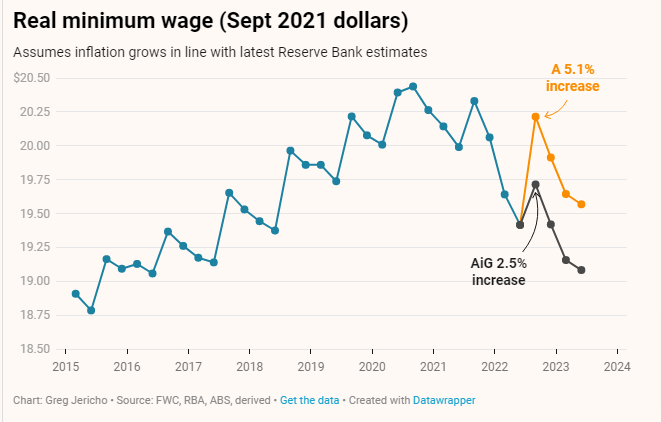
    Labour market policy director, Greg Jericho, in his column in Guardian Australia, however notes that wages should grow faster than inflation, and so long as real wages are not outpacing productivity growth then such rises are not exerting any inflationary pressure. He also shows that given the recent estimates for inflation by the Reserve Bank, a 5.1% increase would not be enough to prevent the minimum wage falling in real terms over the next financial year.

    The problem is not that wages have been fuelling inflation, but that for the past 20 years real wages have risen slower than productivity.

    We need to change the debate from a reflex that assumes low wages is the ideal to realising that given workers are the economy they should be rewarded fairly for their efforts and improvements in productivity.

    You cannot say the economy is healthy if real wages are falling, and most certainly not if the lowest paid in Australia are seeing their living standards decline.


    You might also like

  • Why commentary that wages growing in line with inflation will drive up inflation is completely misguided

    Originally published in The Guardian on May 11, 2022

    Today the opposition leader, Anthony Albanese was asked about wages in the following exchange:

    Journalist: “You said that you don’t want people to go backwards. Does that mean that you would support a wage hike of 5.1% just to keep up with inflation?

    Anthony Albanese: “Absolutely”.

    Any other response would be to suggest that real wages – and thus people’s ability to purchase goods and services with the money they earn – should decline.

    The suggestion that wages rising in line with inflation or even marginally above inflation will increase inflation in a “return to the 1970s” wage spiral ignores basic economics and the advice of the Treasury department.

    Real wages should rise – and unless they are outpacing productivity there is no case to be made that they are driving inflation.

    This very point was made in February by the Secretary of the Treasury, Steven Kennedy when he noted

    “if we can achieve productivity growth of 1.5 per cent, then nominal wages [assuming inflation of 2.5 per cent] can grow at four per cent and put no pressure on inflation”[i].

    The problem is not that wages are growing too fast, but that over the past 3 years they have not kept pace with inflation and productivity growth.

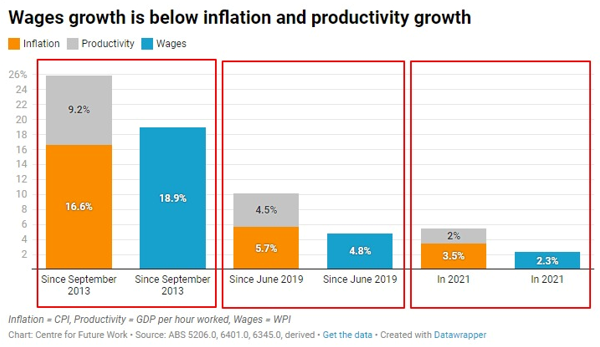
    From June 2019 to the end of 2021 inflation has increased 5.7% and productivity has grown by 4.5%. And yet rather than wages growth being equal to the sum of those two measures, nominal wages in that period increased just 4.8%, and real wages have fallen 0.8%. Real wages have thus declined, while real labour productivity increased.

    The evidence is clear that wages did not cause the current surge in inflation. There is no reason to believe that suppressing wages will cause inflation to moderate. Asking workers to accept a permanent reduction in their real living standards to fight inflation that they did not cause is neither fair nor economically sensible.

    The Reserve Bank has rightly suggested that it will keep an eye on labour costs, however it should be noted that in the 12 months to March while the Consumer Price Index grew 5.1%, the Producer Price Index, which measures the inflation of input costs, rose 4.9%, and nominal unit labour costs grew just 4.0%. This confirms that inflation is not being driven by labour costs.

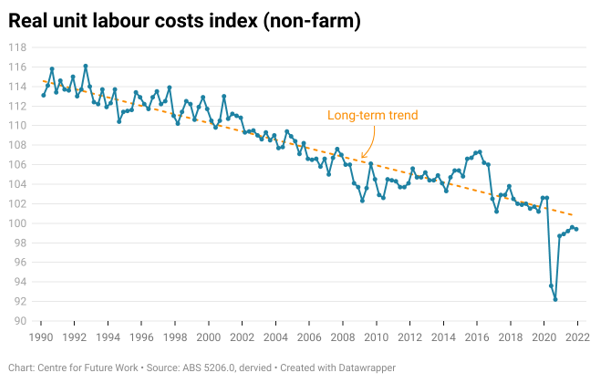
    Moreover, Non-farm, Real Unit Labour Costs are now 3.1% below their pre-pandemic level of December 2019.

    That decline is even faster than the long-term trend.

    Real unit labour costs index (non-farm)

    A fall in real wages will only continue the transfer of national income from workers to corporate profits – something which also occurred when inflation was falling. Workers were told then to accept lower wages growth (and also public-sector wage caps) because inflation was low. Now they are being told to accept lower wages because inflation is high – and for no fault of their own.

    [i] Economics Legislation Committee, 16 February 2022.


    You might also like

  • Rate rises are going to cause a housing affordability crunch

    Originally published in The Guardian on May 5, 2022

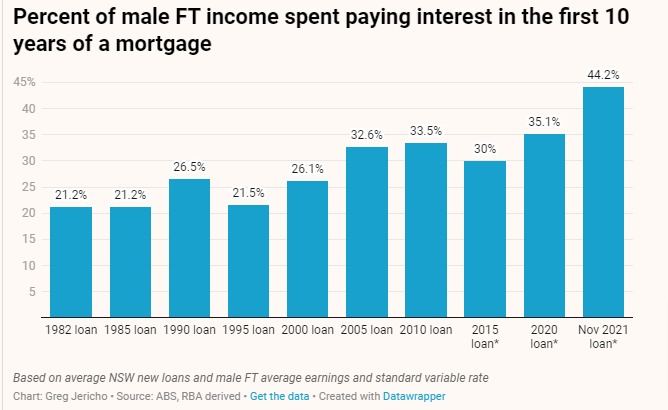
    For most of the past decade the talk about housing affordability has focussed on house prices. As fiscal policy director, Greg Jericho notes in his Guardian Australia column, falling interest rates since November 2010 have made paying off a mortgage less onerous than it otherwise would have given the soaring house prices.

    But that is about to change.

    The signal that interest rates are going to rise by possibly 2.5% points over the next 18 months means that for new mortgage holders the cost of repaying a mortgage is going to be harder than ever before – harder even than when interest rates hit 17% in 1990.

    It is a hit that will only exacerbate standard of living problems as wages will struggle to keep up with the rising cost of of holding a mortgage – especially given the belief that wage rises need to be contained below inflation rises continues in economic debate.


    You might also like

  • The election campaign needs to tackle climate change

    Originally published in The Guardian on April 21, 2022

    In the week before the election campaign began the IPCC released its latest report that contained warnings that deep, rapid and sustained emissions reductions are needed to prevent temperatures from rising 1.5C or 2C above pre-industrial levels.

    And yet, as policy director Greg Jericho notes in his column in Guardian Australia, the issue has been virtually ignored in the election campaign thus far – with most focus being on the “costs” of reducing emissions rather than a focus on the need to do so, or that the cost of renewable energy has fallen so far that “maintaining emission-intensive systems may, in some regions and sectors, be more expensive than transitioning to low emission systems”.

    There need to be a focus on the jobs in a low-emissions economy rather than a belief that Australia can keep avoiding the reality of climate change.


    You might also like

    Dutton’s nuclear push will cost renewable jobs

    by Charlie Joyce

    Dutton’s nuclear push will cost renewable jobs As Australia’s federal election campaign has finally begun, opposition leader Peter Dutton’s proposal to spend hundreds of billions in public money to build seven nuclear power plants across the country has been carefully scrutinized. The technological unfeasibility, staggering cost, and scant detail of the Coalition’s nuclear proposal have

  • We (still) need to talk about insecure work

    Originally published in The New Daily on April 18, 2022

    Business groups and conservative media are happy to discuss insecure work as if it is nothing new – stable and part of a healthy economy that provides workers with independence. But this is not the case, with insecure forms of work – casual, gigs, temporary work and short-term contracts – taking up a growing share of jobs in Australia.

    Taking this perspective to task in a piece for The New Daily, Jim Stanford and Mark Dean discuss how a much broader range of forms of insecure work face many workers in Australia today, with the issue not getting any better. This is not even a trend created by unavoidable conditions created by the pandemic; it has rather been a deliberate outcome of the federal government’s labour market policies. Simply pretending it isn’t an issue won’t make it go away; nor will it provide us with sustainable solutions to the precarious situation that will keep facing more and more workers until the problem of insecure work is adequately addressed


    You might also like

    Centre For Future Work to evolve into standalone entity

    The Centre for Future Work was established by the Australia Institute in 2016 to conduct and publish progressive economic research on work, employment, and labour markets. Supported by the Australian Union movement, the centre produced cutting edge research and led the national conversation on economic issues facing working people: including the future of jobs, wages

  • The election campaign needs to be more than a quiz show

    Originally published in The Guardian on April 14, 2022

    The election campaign thus far has been dominated with gotcha questions that unfortunately have missed the vital need to examine the different policies on offer at a time when Australia’s economy is in a state of extreme flux.

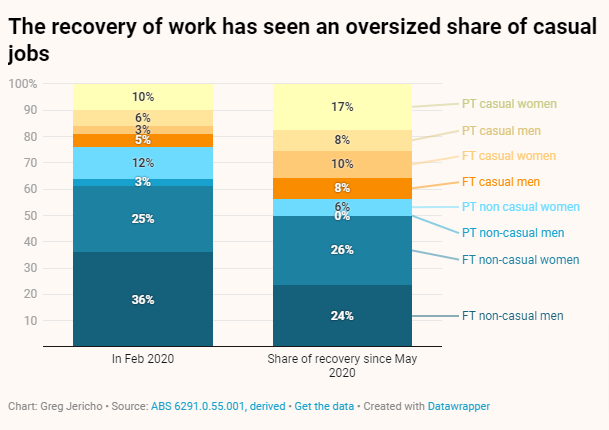
    Labour market and fiscal policy director, Greg Jericho writes in his Guardian Australia column that the recovery from the depths of the pandemic has overwhelmingly been on the backs of casual workers. It also has seen a large increase in the gap between people on JobSeeker and the number of unemployed. The rise of low paying, insecure work that has helped bolster the employment figures has also meant people who are working but still earning less than enough to keep out of poverty is remaining high.


    You might also like

    Dutton’s nuclear push will cost renewable jobs

    by Charlie Joyce

    Dutton’s nuclear push will cost renewable jobs As Australia’s federal election campaign has finally begun, opposition leader Peter Dutton’s proposal to spend hundreds of billions in public money to build seven nuclear power plants across the country has been carefully scrutinized. The technological unfeasibility, staggering cost, and scant detail of the Coalition’s nuclear proposal have

    Commonwealth Budget 2025-2026: Our analysis

    by Fiona Macdonald

    The Centre for Future Work’s research team has analysed the Commonwealth Government’s budget, focusing on key areas for workers, working lives, and labour markets. As expected with a Federal election looming, the budget is not a horror one of austerity. However, the 2025-2026 budget is characterised by the absence of any significant initiatives. There is