Author: annamations

  • Manufacturing: A Moment of Opportunity

    Manufacturing: A Moment of Opportunity

    by Jim Stanford and Tom Swann

    In conjunction with the National Manufacturing Summit, titled “From Opportunity to Action,” at Parliament House in Canberra on June 21, 2017, the Centre for Future Work has released a new research paper on the opportunities to sustain and expand manufacturing jobs in Australia.

    Our new report, Manufacturing: A Moment of Opportunity, by Jim Stanford and Tom Swann, challenges the general tone of pessimism which accompanies many discussions about manufacturing in Australia.  Manufacturing has survived a brutal decade of global and domestic challenges.  It’s still here, it’s still one of Australia’s largest employers, and it still makes a disproportionate and strategic contribution to overall national prosperity.  Even more interesting, there are some intriguing signs that manufacturing might be turning a corner.

    The paper also presents new public opinion research showing that Australians continue to express strong support for manufacturing and its role in the economy.  Australians consistently underestimate the size and performance of manufacturing — perhaps influenced by the negative tone of much reporting of the sector.  But they deeply value its importance as a source of good jobs, exports, and national prosperity.  And they will support — by margins of five-to-one — targeted policies to help manufacturing succeed here.


    Full report

    Share

  • Budget Wrap-Up

    Budget Wrap-Up

    Share

    Commonwealth Treasurer Scott Morrison tabled his 2017-18 budget in Parliament House on May 9, and the Centre for Future Work’s Director Jim Stanford was there in the lock-up to analyse its likely impacts. Here are some of our main impressions and comments:

    Wage Growth and Deficit Reduction

    Several commentators have highlighted the budget’s highly optimistic assumptions regarding future job-creation and wage growth incorporated into the budget forecast. The government is anticipating an immediate and sustained acceleration of all of the factors that contribute to the wage base for tax revenue: faster job-creation, significantly faster growth in hourly pay, and dramatically faster growth in total wages and salaries.

    Back in the real world, the labour market has been underperforming on ALL THREE of those components: slow job-growth, record slow growth in hourly wages, and falling weekly hours of work (due to the dramatic expansion of part-time and irregular work). For all of these reasons, total wages and salaries paid out in the economy (which forms the major basis for personal tax collections, both income and GST) actually declined in the latest quarter of GDP (Dec 2016).
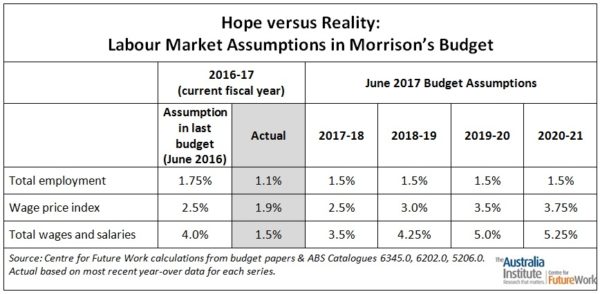
    This table summarises the main wage assumptions in Mr. Morrison’s budget, contrasting them to the latest actual figures on each of the three criteria. The last budget (2016-17) missed the mark badly on all three criteria — but the likely undershooting error will be huge by the end of this budget’s forward estimates, unless there is a dramatic and sustained acceleration of employment and wages growth.

    Director Jim Stanford pointed out in this Huffington Post column that the current weakness in Australian wages is not an accident, nor is it likely to reverse automatically. Chronically weak aggregate labour market conditions, combined with structural attacks on the institutions that support wages (including unions, minimum wages, penalty rates, and others), have caused the unprecedented stagnation of wage incomes in Australia. The macroeconomic consequences of this state of affairs have been widely acknowledged — even by the government itself. (Mr. Morrison himself spoke recently of his concern with the impact of wage stagnation on his own budget targets.)

    As Stanford put it in his Huffington Post commentary, the contradiction between the government’s wage-suppressing economic and regulatory policies, and its hope that wage growth will nevertheless power the way to a balanced budget, is both glaring and unsustainable:

    “[Morrison’s] rose-coloured labour market assumptions will be sabotaged by his own government’s continuing war on workers and wages. And that’s one important reason why his hopeful deficit targets will not be realised.”

    General Optimism Regarding Revenue

    The budget’s optimistic wage growth assumptions are just one factor behind an overall revenue forecast that is downright ebullient. The main force behind the projected return to a balanced budget is an enormous assumed increase in tax revenues — very ironic coming from a government that regularly derides the alleged “tax-and-spend” procilivities of its opponents. Over the four years of the forward projection, annual revenues are expected to expand $120 billion by 2020-21 (or 30 percent). As a share of GDP, revenues are expected to swell by 2.2 percentage points, reaching the highest share (25.4% of GDP) since the peak of the mining boom (in 2005-06).

    There is no clear explanation of where these huge new revenues come from – especially given the revenue-reducing effect of other budget measures, including company tax cuts, the elimination of the deficit repair levy for high-income earners, last year’s bracket adjustments, and others. There are some modest revenue measures in the budget: including the 0.5% Medicare levy increase (after 2019), the levy on bank liabilities, and a new levy on employers who hire migrant labour. But those policy decisions account for just 6.5% of all new revenues assumed to be received over the coming 4 years — and they will be more than offset by the revenue losses from the other measures (especially the company tax cuts).

    If revenues stay constant as a share of GDP (instead of magically growing), the budget will be $45 billion short in 2020-21 – and the forecast small surplus will evaporate into a large continuing deficit. Indeed, as our colleagues at the Australia Institute have pointed out, this budget marks the fourth consecutive four-year LNP timetable for balancing the budget. The government’s tough talk on the dangers of deficit-financing, and stated intention to quickly achieve balance, have proven hollow. Many of its proposed spending cutbacks have been successfully resisted by community campaigning. And its rosy revenue forecasts have been consistently unfounded. There is no reason to believe this year’s four-year deficit elimination timetable is any more realistic than the last three.

    Robbing Peter to Pay Paul

    On the spending side, the government is announcing some modest new spending initiatives, totaling $9 billion over 4 years.

    But at the same time, they are announcing spending cuts to a wide range of programs (including higher education, welfare, and civil servants) – totaling $10 billion over the same period.

    The net impact of new policy decisions on spending is therefore $1 billion in the negative. Despite the promise of “better times” in the future, the government’s discretionary actions will reduce aggregate funding for the programs that Australians depend on.

    A Target Everyone Can Love: The Big Banks

    The government’s new 6 basis point “levy” on bank liabilities (ie. on outstanding loans) is forecast to raise $6.2 billion over 4 years.

    Many analysts believe this tax will be passed on to borrowers (since it is defined as a proportion of lending), and the government has not provided a convincing refutation of this concern. The levy is equivalent to a slight increase in the cost of capital for new lending. (In fact, this new “levy” is smaller than recent increases in interest rates which the banks have already passed on to their borrowers.)

    The government’s claim that the ACCC, with increased funding, will ensure the banks do not pass on the costs of the levy is laughable — as is its claims that competition from smaller banks will keep the big banks in line. Unless there is outright collusion and price-setting between the banks (something that is rare and unnecessary anyway), there is nothing illegal about passing on higher costs to consumers. Indeed, the ability to do this is precisely what explains the banks’ consistent above-normal profits (earning return on equity of 15 percent or more each and every year).

    At any rate, once the banks start to benefit from the full 5% reduction in their own corporate taxes (by 2026-27), they will still be saving billions each year on a net basis.

    The eminent economist Prof. Geoffrey Harcourt, a good friend of our Centre, put it this way in a blog comment:

    “The discussions on the levy/tax on the big four banks in the 2017 budget are often hysterical and beside the point. Because banks play an essential role in the running of the economy, they need protection through a guarantee from the government. Because of their oligopolistic market structure, they are in a privileged position to make large profits, a portion of which reflects their necessary privileged position, rather than any merit of their own. Common sense suggests that it would be both efficient and equitable that the banks be allowed to receive, say, the average rate of profits ruling in the economy as a whole without being taxed differently than any other form of enterprise in Australia. If their overall rates of profit are greater than the average – which they certainly are – the differences between the two sets of rates should be subject to a higher rate of tax so that the community at large receives a return on the privileged position the banks have been necessarily granted. The proposed levy is roughly akin to this proposal, which is tackling an equitable puzzle. It should not, in principle, be related to what is happening to the budget overall and especially to the sizes of any deficits or surpluses. These should reflect the outcome of attempting to meet the real aims of good government starting with achieving and sustaining full employment and sustainable growth.”

    Infrastructure Spending: Show Us the Money

    The government is boasting of $75 billion in infrastructure funding and financing over the next ten years. It is impossible to know how much of this represents new funds, nor when the funds would be delivered. Keep in mind that at present the government already spends over $18 billion per year on capital (or $200 billion over the next decade): both on new projects, and offsetting the wear and tear of existing assets. So the $75 billion “plan” ($7.5 billion per year) may or may not represent a substantial ramp-up in new capital spending by Canberra.

    In fact, the details of the budget do not seem to indicate any enormous expansion in capital spending. Net capital spending (after depreciation) is projected to decline in 2017-18: to just $0.5 billion, the smallest since 2002-03. (See Budget Table 3, reprinted below.) In essence, in the first year of the budget, the government will spend barely enough to offset depreciation of existing assets.
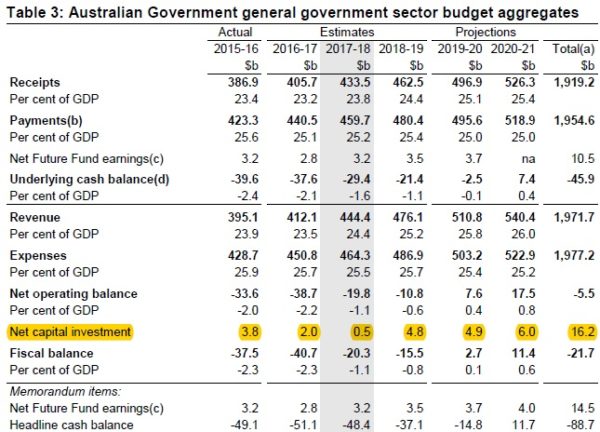
    Net investment grows in later years, but not dramatically. And as a share of GDP, net capital spending by the Commonwealth is projected to average just 0.2% of GDP over the forward projections. Over the last ten years, in contrast, it averaged 0.25% of GDP. In other words, under this budget, net Commonwealth capital spending will actually shrink relative to the economy.

    It is easy to come up with “big numbers” when talking about infrastructure programs (especially by summing totals over many years), and associated ribbon-cutting ceremonies will attract much attention. But there is no concrete evidence that this budget will accomplish the real and sustained increase in Commonwealth government capital spending that is needed. Commonwealth capital spending has declined in recent years compared to earlier decades, and there is no evidence that this budget will change that trend.

    Migrant Labour and Apprentices

    The government is imposing a new “head tax” on employers who hire foreign migrants: $1200 to $1800 per year per head for temporary migrants, and $3000 to $5000 for each permanent migrant (on a one-time basis). The revenues from this levy will be used to fund support for apprenticeships in conjunction with the states, to a total of $1.2 billion over the next 4 years.

    Funding skill programs through a tax on migrant labour is not an effective way to rebuild Australia’s battered vocational education system – nor is it an effective way to regulate employers’ over-reliance on temporary foreign migrants (rather than recruiting and training Australian workers). Indeed, the scale of revenues anticipated by the government suggests that incoming migrant labour will continue to constitute a major force in Australia’s labour market.

    Effectively regulating and reforming Australia’s migrant labour system – limiting its use to classifications where skilled workers are truly unavailable, and ensuring that migrant workers are entitled to the same protections as all other workers – would in fact undermine the head tax revenues that the government is now counting on.

    Check Out The Australia Institute’s Budget Analysis

    Our colleagues at the Australia Institute have also generated some useful and punchy commentary on the budget: see it all (including a hilarious podcast with economists Richard Denniss and Matt Grudnoff) on the Institute’s Budget Wrap page.


    You might also like

    Commonwealth Budget 2025-2026: Our analysis

    by Fiona Macdonald

    The Centre for Future Work’s research team has analysed the Commonwealth Government’s budget, focusing on key areas for workers, working lives, and labour markets. As expected with a Federal election looming, the budget is not a horror one of austerity. However, the 2025-2026 budget is characterised by the absence of any significant initiatives. There is

    Centre For Future Work to evolve into standalone entity

    The Centre for Future Work was established by the Australia Institute in 2016 to conduct and publish progressive economic research on work, employment, and labour markets. Supported by the Australian Union movement, the centre produced cutting edge research and led the national conversation on economic issues facing working people: including the future of jobs, wages

  • Economists Debunk Job-Creation Claims of Penalty Rate Cut

    Economists Debunk Job-Creation Claims of Penalty Rate Cut

    Share

    The Fair Work Commission has ruled that penalty rates for Sunday and public holiday work in the retail and hospitality sectors should be reduced, which would reduce hourly wages on those days by up to $10 per hour. Business lobbyists predict this will spark a hiring surge in stores and restaurants, as employers take advantage of lower wages to extend hours and ramp up operations. The economic logic of this claim is highly suspect, however – especially in light of the fundamental factors which truly limit employment in these sectors (namely, the sluggish growth of personal incomes). 78 Australian economists have signed a public letter debunking these job-creation claims, arguing that the FWC’s decision will lead to more inequality, not more employment.

    A 3-person drafting committee wrote the letter and circulated it among the economics community.  The committee included Stephen Koukoulas (Managing Director of Market Economics), John Quiggin (Dept. of Economics, University of Queensland), and our own Jim Stanford (Economist and Director of the Centre for Future Work). See the full letter, and list of signatories, below.


    Related documents


    Public letter

    You might also like

    Dutton’s nuclear push will cost renewable jobs

    by Charlie Joyce

    Dutton’s nuclear push will cost renewable jobs As Australia’s federal election campaign has finally begun, opposition leader Peter Dutton’s proposal to spend hundreds of billions in public money to build seven nuclear power plants across the country has been carefully scrutinized. The technological unfeasibility, staggering cost, and scant detail of the Coalition’s nuclear proposal have

  • Don’t Pop Champagne Corks Over Longest Growth Streak

    Don’t Pop Champagne Corks Over Longest Growth Streak

    by Anis Chowdhury

    On April 1, Australia will surpass the Netherland’s old record to mark the longest unbroken expansion of real GDP in modern history. While this result permits much chest-thumping on the part of some politicians, we should never assume that there is an automatic correlation between GDP growth and the well-being of people, society, and the environment.

    In this guest commentary, Prof. Anis Chowdhury – a new Associate of the Centre for Future Work, and a distinguished global economist – provides some important perspective on this longest expansion in history.

    Little to Rejoice About in Australia’s Record-Long Expansion

    by Anis Chowdhury

    On April 1, Australia will overtake the Netherlands to lay claim to the title of the longest economic expansion on record, entering our 104th quarter of economic growth, as the nation narrowly avoided slipping into a technical recession.

    With the release of the GDP figure on 1 March, the government expressed a sigh of relief. It showed that Australia’s economy grew by 1.1 per cent in the last quarter, after slipping 0.5 per cent in the three months to December 1.

    Should we rejoice at this?

    It seems, Treasurer Scott Morrison thinks so. As the government is breathing easy, the Treasurer responded by saying “Our growth continues to be above the OECD average and confirms the successful change that is taking place in our economy as we move from the largest resources investment boom in our history to broader-based growth.”

    To be fair, the Treasurer was also cautious and acknowledged that nation’s economic growth “cannot be taken for granted and is not being experienced by all Australians in all parts of the country in the same way”.

    However, with this cautionary note the Treasurer has contradicted himself. If the nation’s growth cannot be guaranteed; if all Australians in all parts of the country are not sharing the benefit of this longest stint of growth, then it is simply not broad-based; nor is it inclusive.

    The nation’s growth still comes largely from mining, agriculture, forestry and fishing, as its manufacturing sector continues to shrink. The share of manufacturing in GDP now stands at around 6 per cent which is less than half what was four decades ago. Despite the longest growth stint, Australia still remains a primary-producing, two-speed economy.

    Australia’s terms of trade — the ratio of the nation’s export prices to its import prices — grew by 9.1 per cent, thanks to strong price rises in coal and iron ore, marking a 15.6 per cent improvement on the December 2015 quarter.

    Thus, Australia’s economic growth continues to be driven by commodity price booms, behind which is the economic expansion in emerging Asian economies, mainly China and India. If these economies sneeze, Australia will catch a cold. Hence, the Treasurer is correct, the “nation’s growth cannot be guaranteed”; it cannot be sustained.

    Even if it is sustained, it is not sustainable in the sense of ensuring social stability and protecting the environment. Australia’s current development trajectory is unlikely to achieve the Agenda 2030, the most ambitious and transformative goals for sustainable development adopted by the nations of the world in September 2015 at the United Nations.

    Let us reflect on some key indicators. First, Australia’s official unemployment rate edges up to 5.9 per cent in February, from 5.7 per cent in January, while underemployment skyrocketed to 1.1 million. The staggering underemployment is more a structural problem than a result of cyclical phenomena. The rise in unemployment and underemployment happened, even when we were told that labour market flexibility would boost employment – the main argument put forward in supporting recent cuts in penalty rates.

    Second, even without the penalty rate cuts, wages growth has been stagnant. The 1.1 per cent GDP growth that technically saved the economy from a recession, was accompanied by falling employee compensations by 0.5 per cent.

    Thus, the 0.9 per cent increase in household consumption, contributing 0.5 per cent to growth, which according to the Treasurer, was a key factor in bolstering the post-mining boom economy, seems to have been debt-driven. No wonder, Australia’s household debt at close to 125 per cent of GDP, is now the third highest in the world. At 187 per cent of household income, the RBA’s worries about household debts are not unfounded.

    Third, the divide between rich and poor is growing in Australia, according to a new national survey, which found more than a quarter of households have experienced a drop in income. At the same time, the socio-economic conditions of indigenous Australians remains shamefully at the Third World level. They don’t live as long as other Australians. Their children are more likely to die as infants. And their health, education and employment outcomes are worse than non-Indigenous people. Despite promising to close this gap on health, education and employment, the 2017 “Closing the Gap” report card finds that we are failing on six out of seven key measures. With less than year until the first wave of “Closing the Gap” deadlines, the road to reducing Indigenous disadvantage appears ever longer.

    Fourth, the latest Australia’s Environment Report 2016 reveals that Australia’s biodiversity is under increased threat and has, overall, continued to decline. It also reveals that pressures on the environment has increased from coalmining and the coal-seam gas industry, habitat fragmentation and degradation, invasive species, litter in our coastal and marine environments, and greater traffic volumes in our capital cities.

    While the quality of growth and overall socio-economic well-being continue to regress, what is the response from government? Regrettably, it is the same mantra: “repair the budget”; “cut welfare expenditure”; “cut wages and employment conditions”; “cut company tax”; “cut environmental regulation”, etc.

    Why these cuts? Because they will help keep our triple A credit rating! In the words of the Treasurer, “We must take the necessary steps to keep expenditure under control structurally, to boost investment, to maintain the AAA credit rating…”

    That is a huge leap of faith in the face of contrary findings world-wide, including Australia, that these sorts of measures do not boost investment; they do not fix the structural problems in the economy; they do not close the societal divide (between the rich and the poor, between indigenous peoples and the rest of Australia); and they do not protect our biodiversity or mitigate pressure on our environment.

    Public policies for structural transformation and environmentally sound, inclusive growth are for the brave hearts, not for the meek who remain hostage to the unaccountable credit rating agencies.


    You might also like

    Centre For Future Work to evolve into standalone entity

    The Centre for Future Work was established by the Australia Institute in 2016 to conduct and publish progressive economic research on work, employment, and labour markets. Supported by the Australian Union movement, the centre produced cutting edge research and led the national conversation on economic issues facing working people: including the future of jobs, wages

  • Employers’ pyrrhic penalty rates win reflects self-defeating economics

    Originally published in The Sydney Morning Herald on February 24, 2017

    The Fair Work Commission unveiled its long-awaited decision on penalty rates for Sunday and holiday work this week. Penalty rates for most retail and hospitality workers will be cut, by up to 50 percentage points of the base wage. Hardest hit will be retail employees: their wages on Sundays will fall by $10 an hour or more. For regular weekend workers, that could mean $6000 in lost annual income.

    The equity implications of the commission’s decision are odious. Store clerks and baristas are already among the least-paid, least-secure members of Australia’s workforce. The retail and hospitality workforce is disproportionately female, young and immigrant. Most work part time, and casual and labour-hire positions are common. In short, the burden of this decision will be borne by those who can least afford it.

    Penalty rate cut: how did it happen?

    Workplace reporter Nick Toscano contextualises the Fair Work Commission’s announcement on Thursday that Sunday penalty rates paid in retail, fast food, hospitality and pharmacy industries will be reduced from the existing levels.

    Remember, too, that it’s in retail and hospitality that recent scandals regarding underpayment of wages and other violations of labour law have been rife. Weakening labour standards that are already poorly enforced thus constitutes a double jeopardy for service workers.

    It’s notable that the commission only targeted low-paid service workers with this review of penalty rates. There are many other people who need to work Sundays and holidays, including emergency personnel, essential service workers, healthcare workers and others. The commission stressed it wasn’t calling for those workers to lose their penalties, too (although employers everywhere are no doubt preparing to push to extend this precedent to other industries). If it’s all about changing “cultural norms” regarding weekend work, then why have these low-paid service jobs been singled out?

    All of this says much about the political and economic context for the Fair Work Commission’s deliberations. There was no emergency in Australia’s retail and hospitality sector; no crisis that needed immediate attention. It’s not that stores and restaurants couldn’t do business on Sundays under the existing rules; any casual observer can attest to the brisk trade that now takes place right through the weekend. It’s just that those businesses would be considerably more profitable if wages were lower.

    So penalty rates became the target of a sustained pressure campaign by business, backed by conservative political leaders. The commission heard those complaints and acceded to them. Whatever the precise wording of the commission’s legislative mandate, it was never envisioned as a mechanism for rolling back employment standards; it was supposed to protect them. This decision will therefore spark a political debate not only over the merits of this specific decision, but over the commission’s overall mandate and function.

    The politics of that debate will be complicated. Coalition leaders are hiding behind the commission’s supposed neutrality – although they are clearly pleased with the decision (and many explicitly lobbied for it). Labor’s response, meanwhile, is coloured by the fact that it created this commission; Bill Shorten now promises to adjust its mandate. None of this will stop the anger among working-class families who’ll lose income because of this decision. The threat to penalty rates was a potent doorstep issue for union campaigners across Australia before the last election, which the Coalition almost lost. It will be an even hotter button in the next one.

    The economics of the rollback are even more muddled than the politics. Retail lobbyists claim the decision will unleash a surge of new job creation, but those promises are hollow. After all, the market for retail and hospitality services depends primarily on the strength of domestic consumer spending power – more so than any other part of the economy. Australians have a certain amount of disposable income. Will they shop more, and eat out more, just because stores and restaurants stay open longer? Of course not.

    To the contrary, slashing retail and hospitality wages can only undermine demand for the very services that these businesses are selling. It’s incredibly ironic that, even as the commission’s Judge Iain Ross read his judgment on live television, the Australian Bureau of Statistics was releasing yet another dismal report on national wage trends. Average weekly earnings in the period to last November grew at an annualised rate of just 0.4 per cent: slower than any other point in the history of the data, and well behind the rate of inflation. This reflects both the stagnation of hourly wages, and the continuing shift to part-time and casual work (for which retail and hospitality employers are among the worst culprits).

    So this won’t increase the amount of money Australians have to spend in shops and restaurants. Instead, there will be an incremental decline. If stores actually do stay open longer hours, the same spending must now be spread across longer operating hours, driving down productivity. Retail lobbyists should be careful what they ask for.

    Meanwhile, employment in these industries will continue to reflect bigger, structural forces. For example, the whole Australian retail sector has created precisely zero net jobs over the last three years, largely because of the structural shift to big-box retailing (which employs fewer workers per unit of sales). That’s not going to change just because big-box stores can now pay their staff $10 an hour less.

    In short, Australia’s economy isn’t held back because wages are too high. It’s held back because wages are too low. And the stagnation of wages is no accident: it’s the cumulative result of years of deliberate efforts to weaken the power of wage-setting institutions (including unions, minimum wages and awards). The Fair Work Commission chopped away a little more of that edifice this week.

    The greatest irony is that it’s retail and hospitality businesses – which led the push to cut weekend wages – that confront the weakness of household spending power most directly. Each employer may individually celebrate the prospect of paying lower wages. Yet for their industry as a whole, this decision is collectively irrational and ultimately self-defeating.

    Jim Stanford is economist and director of the Centre for Future Work at The Australia Institute.


    You might also like

  • Hard to Get Away: Is the paid holiday under threat in Australia?

    Hard to Get Away: Is the paid holiday under threat in Australia?

    by Troy Henderson

    The focus of this year’s Go Home on Time Day is the threat to the “Great Aussie Holiday.”  Thanks to the rise of precarious work in all its forms, a growing share of Australian workers (about one-third, according to our research) have no access to something we once took for granted: a paid annual holiday.  Moreover, about half of those who ARE entitled to paid annual leave, don’t use all of their weeks – in many cases because of work-related pressures.  And recent decisions by the Fair Work Commission allowing for the “cash out” of annual leave, mean that this great cultural institution – the Aussie holiday – is very much in jeopardy.

    Check out our  special in-depth report, prepared by Troy Henderson of the University of Sydney, documenting these multiple threats to the Aussie holiday, and cataloguing the many economic, social, and health consequences that occur when we don’t get a break from work.


    Full report

    Share

  • Excessive Hours and Unpaid Overtime: An update

    Excessive Hours and Unpaid Overtime: An update

    by Tom Swann and Jim Stanford

    The focus of this year’s Go Home on Time Day is the threat to the “Great Aussie Holiday.”  Thanks to the rise of precarious work in all its forms, a growing share of Australian workers (about one-third, according to our research) have no access to something we once took for granted: a paid annual holiday.  Moreover, about half of those who ARE entitled to paid annual leave, don’t use all of their weeks – in many cases because of work-related pressures.  And recent decisions by the Fair Work Commission allowing for the “cash out” of annual leave, mean that this great cultural institution – the Aussie holiday – is very much in jeopardy.

    We have updated our regular calculations of the value of workers’ time that is effectively “stolen” each year by employers through massive amounts of unpaid overtime regularly worked in all industries and occupations. 


    Full report

    Share

  • Go Home on Time: Wednesday 23 November

    Go Home on Time: Wednesday 23 November

    Share

    The Centre for Future Work is proud to host this year’s Go Home on Time Day. It’s the eighth annual edition of this event, which draws light-hearted attention to a serious issue: the economic, social, and health consequences of excess working hours.

    This year’s Go Home on Time Day is Wednesday, November 23.  Visit our special Go Home on Time Day website for more information, to download posters and other materials, and use our online calculator to estimate the value of YOUR unpaid overtime.

    The focus of this year’s Go Home on Time Day is the threat to the “Great Aussie Holiday.”  Thanks to the rise of precarious work in all its forms, a growing share of Australian workers (about one-third, according to our research) have no access to something we once took for granted: a paid annual holiday.  Moreover, about half of those who ARE entitled to paid annual leave, don’t use all of their weeks – in many cases because of work-related pressures.  And recent decisions by the Fair Work Commission allowing for the “cash out” of annual leave, mean that this great cultural institution – the Aussie holiday – is very much in jeopardy.

    Check out our  special in-depth report, Hard to Get Away: Is the paid holiday under threat in Australia?, prepared by Troy Henderson of the University of Sydney, documenting these multiple threats to the Aussie holiday, and cataloguing the many economic, social, and health consequences that occur when we don’t get a break from work.

    We have also updated our regular calculations of the value of workers’ time that is effectively “stolen” each year by employers through massive amounts of unpaid overtime regularly worked in all industries and occupations: Excessive Hours and Unpaid Overtime: An Update.


    Related documents


    Participating workplace poster


    Missed hours poster


    Negative impacts poster


    Leave pass

    Related research

    You might also like

  • What’s Wrong With Privatization?

    What’s Wrong With Privatization?

    by Jim Stanford

    Share

    You know that the tides of public opinion are starting to turn, when even the head of the Australian Competition and Consumer Commission, Mr. Rod Sims, will come out in public and criticize the usual claims that privatization is good for efficiency and national well-being.

    Our Director Jim Stanford recently spoke with Unions NSW about this surprising development, and the general flaws in the argument for privatization.


    You might also like

    Centre For Future Work to evolve into standalone entity

    The Centre for Future Work was established by the Australia Institute in 2016 to conduct and publish progressive economic research on work, employment, and labour markets. Supported by the Australian Union movement, the centre produced cutting edge research and led the national conversation on economic issues facing working people: including the future of jobs, wages

  • The Flawed Economics of Cutting Penalty Rates

    The Flawed Economics of Cutting Penalty Rates

    by Jim Stanford

    It was a “sleeper” issue in the recent election, and led to the defeat of some high-profile Liberal candidates.  But now the debate over penalty rates for work on weekends and public holidays shifts to the Fair Work Commission.  The economic arguments in favour of cutting penalties (as advocated by lobbyists for the retail and hospitality sectors) are deeply flawed.

    Penalty rates for working on weekends were an important “sleeper” issue in the recent federal election.  On the surface, both Labor and the Coalition agreed the future of penalty rates would be determined by the Fair Work Commission.  But that superficial consensus couldn’t hide deep differences in what the respective parties were actually hoping for.  Labor explicitly urged the FWC to maintain existing penalties: double-time on Sundays, and time-and-a-half for Saturdays.  Many Coalition candidates, on the other hand, endorsed a reduction in penalties – consistent with the views of business lobbyists who want lower operating costs on weekends.

    At the grass-roots level, meanwhile, the issue resonated strongly with significant numbers of voters.  Union activists launched an 18-month “Save Our Weekend” campaign, knocking on tens of thousands of doors in marginal seats before the election was even called.  Opinion polls showed strong support for retaining (or even increasing) weekend penalty rates; respondents opposed cutting penalties by two-to-one margins, or more.  The swing against the Coalition in ridings targeted by the penalty rates campaign was nearly twice as large (6 percentage points) as the national swing.

    Penalty rates will remain a charged issue in the political arena.  But for now, the main attention shifts to the FWC, whose decision is expected in coming weeks.  The Commission should reject the entreaties of retail and restaurant employers for lower penalties, because the economic case for cutting penalties looks shakier all the time.

    Employers in all sectors routinely claim that cutting wages will strengthen job-creation.  But this purported trade-off between compensation and employment is refuted by macroeconomic evidence.  Indeed, historical data suggest higher wages are more often associated with stronger employment outcomes, not weaker: in part because household consumption spending (which depends directly on wages) is crucial for overall spending power and hence economic vitality.  The retail and hospitality industries have been the most aggressive advocates of weaker penalty rates.  Yet ironically, it is in these sectors that the argument for wage-cutting is weakest of all.

    After all, employment in stores and restaurants depends directly on the level of consumer spending.  And this demand constraint is more binding in domestic service sectors than any other part of the economy.  In export-oriented industries, employers can at least pretend that lower labour costs will boost sales (by undercutting foreign competition and hence winning new business).  Even here the argument is not convincing, since in practice global competitiveness depends more on productivity, quality, and innovation than on low wages.  But in non-traded domestic sectors, where Australians produce services for other Australians, the logic falls apart completely.

    Remember, Australian consumers already spend far more than they earn.  That’s why average consumer debt is growing rapidly: now equal to 125 percent of national GDP.  How could making it less costly for shops and cafes to open on weekends, somehow unleash new reservoirs of spending power, and stimulate tens of thousands of new jobs?  In macroeconomic terms it’s simply not possible.

    Keeping businesses open for longer hours on weekends, doesn’t mean consumers have more money in their wallets.  Instead, the same amount of retail and hospitality spending must now be spread across longer opening hours.  If anything, that hurts productivity and profitability, and will eventually lead to the closure of some retail and hospitality firms that were already operating on the financial edge.

    It’s the same reason why opening a new shopping mall cannot, on its own, increase total employment levels.  Unless there are other factors driving an expansion in broader incomes and spending, opening one store must inevitably lead to a closure somewhere else.

    It’s especially laughable to hope that cheaper weekend labour could somehow attract new business to Australia’s stores and cafes.  Are penalty rate opponents expecting a surge in tourists from China, perhaps – who were just waiting for cheaper Sunday shopping before booking their trips?

    In short, the very industries pushing hardest for reduced penalties – retail and hospitality – are the ones most dependent on the spending power of domestic consumers.  Hence they would directly experience the most economic blowback from their own wage cuts.

    Indeed, there is abundant evidence that unprecedented stagnation in wages is already undermining growth and job creation.  Nominal wages are inching along at their slowest pace in recorded history (barely 1 percent per year).  Real wages, adjusted for inflation, have been falling since 2013.  Economists of all persuasions have highlighted the resulting weakness in household incomes as a key factor behind sluggish growth, rising personal debt, and unemployment and underemployment.

    Ultimately, rolling back penalties would simply constitute a major effective wage cut for workers who are already among the worst-paid in society.  It will exacerbate the broader wage stagnation that is holding back Australian growth.  And it will whet the appetites of other employers for more wage suppression – now on grounds of “keeping up” with the advantages granted to retail and hospitality.

    Australia needs higher wages, not lower.  Let’s hope the Fair Work Commission sees this big picture.


    You might also like

    Centre For Future Work to evolve into standalone entity

    The Centre for Future Work was established by the Australia Institute in 2016 to conduct and publish progressive economic research on work, employment, and labour markets. Supported by the Australian Union movement, the centre produced cutting edge research and led the national conversation on economic issues facing working people: including the future of jobs, wages