Author: annamations

  • The Australia Institute’s Centre for Future Work

    Labour mobility is a significant contributor to Pacific Islands’ economies.

    Australia and New Zealand’s temporary labour migration schemes for Pacific workers have expanded into more industries including personal care work in aged care.

    This has led to the loss of skilled health workers from Pacific Island countries, including registered nurses, to lower-skilled personal care jobs overseas.

    Workers who take up temporary migration in Australia and New Zealand are vulnerable to being underpaid and exploited, due to their visa status.

    This report examines the need for reform of labour migration systems and greater consultation with workers.


    Full report


    Factsheet
    Australia dumps its care crisis on the Pacific – new report

    Share

  • Hello world!

    Welcome to WordPress. This is your first post. Edit or delete it, then start writing!

  • Addressing the health workforce crisis in the Pacific

    Labour mobility is a significant contributor to Pacific Islands’ economies.

    Australia and New Zealand’s temporary labour migration schemes for Pacific workers have expanded into more industries including personal care work in aged care.

    This has led to the loss of skilled health workers from Pacific Island countries, including registered nurses, to lower-skilled personal care jobs overseas.

    Workers who take up temporary migration in Australia and New Zealand are vulnerable to being underpaid and exploited, due to their visa status.

    This report examines the need for reform of labour migration systems and greater consultation with workers.


    Full report


    Factsheet
    Australia dumps its care crisis on the Pacific – new report

    Share

  • Want to lift workers’ productivity? Let’s start with their bosses

    Originally published in The New Daily on August 18, 2025

    Business representatives sit down today with government and others to talk about productivity. Who, according to those business representatives, will need to change the way they do things?

    The elephant in the room is that it is business that has the biggest influence on productivity. Certainly, it has a much bigger impact than workers, who typically get the blame when things go wrong.

    The factor that most shapes how productive workers are, we must remember, is the technology they work with. It is management that is responsible for the decisions about what technology a business introduces, and how. Workers often do not have much of a say.

    It is not workers who make the decisions about how much money is available for investment. It is not workers who make the decision about which particular technologies to buy, install and use. It is not workers who decide how much money should be allocated to the training of workers to use the new technology, or how those workers should be deployed. It is management.

    Sure, there is lots of evidence that, when workers have a say at work, productivity is higher. But managers often don’t give them a chance to have more than a token say, if they have any say at all. Any attempts by governments to legislate that workers decide or influence decisions on those matters are opposed by business bodies in Australia.

    How much effort workers put in to their job also shapes productivity. But lazy workers don’t last long in jobs these days, and most restrictive work practices went out the window in the 1980s. If a business continued to use workers who do not put effort into their job, the finger would very quickly be pointed at the managers who decided to do that and to not have the performance management systems that would overcome that problem.

    Some characteristics of workers do make a difference, but they are often still matters in the hands of management to control.

    Output will be better with an educated and skilled workforce. If people can do more things with their brains, they will be more productive. Yet management decides on the qualifications demanded of successful applicants for jobs. Management decides how much pay to offer to attract qualified workers to apply for and fill skilled vacancies. Management decides on the training provided to workers.

    Management decides on job quality which, studies show, is positively related to performance.

    Management decides on how much a business pursues diversity, equity and inclusion practices, which (despite shenanigans in the US) have also been shown to benefit innovation and firm performance.

    So it’s no surprise that a couple of years ago the Productivity Commission, after looking at OECD evidence, said that the “productivity gains from upskilling managers could be three times higher than for upskilling workers”.

    The problem for Australia is that, overall, the quality of Australian management is not that good. One survey showed that Australia “ranks low in almost all the people management dimensions”.

    The Productivity Commission commented in its 2023 five-yearly review that “managerial capability varies, but generally lags other countries” and observed that “limited management capability may be holding back Australia’s productivity growth”. It added that its consultations had “provided insights into some of the consequences for innovation of poor management capability”.

    The main response by top management seems to be to pay itself more. But a study as far back as 2004 found that the average pay gap between CEO pay and average earnings was “at least three times higher than that required to maximise organisational performance”. Leaders might say they’re tied to performance bonuses, but somehow when profits go down, the formula or the base get changed, and the CEO’s pay packet is saved.

    When that doesn’t increase productivity, it’s blame the unions. But that wears a bit thin when only one in eight workers is unionised these days. Or cut penalty rates, or some other aspect of workers’ pay! But lower wages just reduce the incentive to introduce new technology.

    What the studies do show about the impact of workplace relations on productivity is that it’s not whether a workforce is unionised that matters, it’s the quality of relations between workers and management that counts — and that is very much in the hands of management.

    After all, research shows that workers do want a co-operative relationship with management — which, despite management wishes, is not the same as acquiescing to every management whim. If their union didn’t want co-operation, the workers would quit the union. The trouble is, if management didn’t want genuine co-operation, it will just blame the workers, and up its own pay because it’s dealing with a difficult situation.

    There are no prizes for expecting business to blame others for Australia’s productivity problems. But an honest debate would look at what management can do better.


    You might also like

  • Australia’s Gas Use On The Slide

    Australia’s Gas Use On The Slide

    by Ketan Joshi

    Share

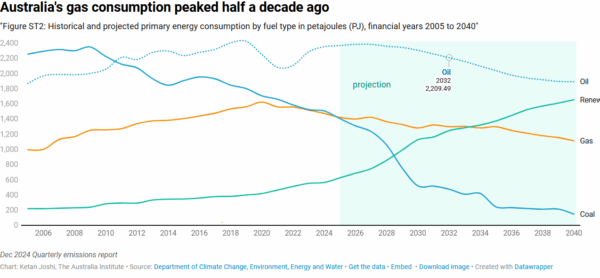
    The Federal Government has released a new report that includes projections of how much gas Australia is set to use over the coming decades. There is no ambiguity in its message: Australia reached peak gas years ago, and it’s all downhill from here:

    “Gas consumption is projected to decline to 2040 as electrification increases across the economy and renewables and storage take an increasing share of electricity generation”, wrote the Department of Climate Change, Energy, Environment and Water (DCCEEW).

    This doesn’t sit well with the Prime Minister’s recent claims that more gas is needed for “firming” renewable energy. Figures from the Australian Energy Market Operator (AEMO)’s 2024 Integrated System Plan (ISP) show just how little gas is likely to be required in Australia’s electricity system.

    In AEMO’s ‘step change’ scenario, there isn’t a single year where gas generates more than its historical peak in the National Electricity Market. In this scenario, more gas was burned in the past 16 years than is burned over the next 25 years.

    In short: while gas might serve occasional use during low wind and sun periods, Australia simply will not end up using large amounts of it.

    It is weird, then, that Australia has a massive pipeline of planned fossil gas extraction projects. Many of them are justified on the grounds that they’re required to help Australia decarbonise its power grids, with more than 1,000 new petajoules coming online by 2027, according to the latest government projects report.

    The chart below compares the above projections of Australia’s domestic gas use to projections of the volume of gas exports, prepared by the separate Department of Resources and Energy (DISER). It makes it pretty clear where all the new gas is going – exports.

    Only looking at new gas production capacity, and only looking at the proportion that has a clear operation date, that is still around 11 times the amount of gas projected to be used in the power sector. In fact, the use of LNG for FY23 was greater just for processing LNG than the entire power sector in Australia:

    This analysis by climate expert Tim Baxter lays it out in even more detail.

    “Again, more than 3,000 petajoules of gas were exported from Western Australia in 2022–23. If the entire transition to clean energy were to stand dead still as if renewables weren’t already going gang-busters — in Western Australia renewable energy generation has increased by an average of 20% each year for the past five years — we would need just 2.5% of that gas to keep the lights on for the state”.

    It is pretty simple: Australia does not need to be expanding its fossil gas production, least of all to run fossil gas power stations. It’s a hollow fossil fuel industry talking point, and the Federal Government should know better than to repeat it.


    You might also like

    Centre For Future Work to evolve into standalone entity

    The Centre for Future Work was established by the Australia Institute in 2016 to conduct and publish progressive economic research on work, employment, and labour markets. Supported by the Australian Union movement, the centre produced cutting edge research and led the national conversation on economic issues facing working people: including the future of jobs, wages

  • Dutton’s nuclear push will cost renewable jobs

    Dutton’s nuclear push will cost renewable jobs

    by Charlie Joyce

    Dutton’s nuclear push will cost renewable jobs

    As Australia’s federal election campaign has finally begun, opposition leader Peter Dutton’s proposal to spend hundreds of billions in public money to build seven nuclear power plants across the country has been carefully scrutinized.

    The technological unfeasibility, staggering cost, and scant detail of the Coalition’s nuclear proposal have brought criticism from federal and state governments, the CSIRO, the Climate Council, the Electrical Trade Union (ETU), the Climate Change Authority, the Australia Institute, and independent energy experts.

    The CSIRO, among others, has refuted the Coalition’s claim that nuclear will be cheaper than renewables; instead, they have shown the energy produced by Australian reactors would cost approximately eight times more than the same amount of energy produced by renewables. If this cost is passed on to consumers, the average household would pay $590 per year more on their power bill. Unsurprisingly, Australia Institute polling has found that fewer than one in twenty Australians (4%) are prepared to pay this nuclear premium.

    The cost alone should be enough to bury this nuclear proposal. But it is also important to recognise how the Coalition’s plan will impact – and fail – workers.

    False promises

    The Coalition has proposed that large nuclear reactors would be built on the sites of five operational or recently decommissioned coal fired power stations: Liddell and Mount Piper in New South Wales, Tarong and Callide in Queensland, and Loy Yang in Victoria. In doing so, the Coalition has promised that nuclear energy would be a source of stable and plentiful work for the communities where coal-fired power plants are phasing down.

    This is a false promise. Six coal fired power stations have already closed in the past decade, with 90% of Australia’s remaining coal-fired power stations set to close in the next decade. These communities are already undergoing structural adjustment, and they need new sources of employment now. But this is not what the Coalition’s plan delivers. The Coalition outlines that the first two nuclear reactors would not come online until the mid-2030s – more than a decade from now – while the remainder would be completed by 2050.

    And energy and technology experts agree that even this timeline is impossible. On average, a nuclear reactor takes 9.4 years just to build in countries with established and capable nuclear industries. Former Australian Chief Scientist Alan Finkel has estimated that it would take until the mid-2040s at the earliest for Australia to build an operational nuclear reactor. Moreover, analysis from the Institute for Energy, Economic & Financial Analysis (IEEFA) has found that, in economies comparable to Australia’s, every single nuclear reactor project experienced multi-year delays and cost blowouts of up to three and a half times over budget. It is hard to see how Australia, which lacks the experienced workforce, training and research base, or regulatory framework, would buck this trend.

    Lost jobs

    While the Coalition’s nuclear plan would not bring jobs to the communities that need them, it might have the real effect of depressing investment in renewables.

    Renewable energy already generates approximately 40% of Australia’s energy and is by far the cheapest form of electricity. Renewable energy industries already account for the employment of tens of thousands of workers, and Jobs and Skills Australia estimates that approximately 240,000 new workers will be required in industries associated with clean energy by 2030.

    But this requires ongoing and expanding investment in renewables, which the Coalition’s nuclear policy is likely to derail. The Clean Energy Council has estimated that by capping renewable energy to 54% of total use (as the Coalition’s modelling has assumed), 29GW of renewable energy generation projects would not be built – squandering an expected 37,700 full-time-equivalent construction jobs and 5,000 ongoing jobs in operations and maintenance. By limiting renewables investment, prolonging fossil fuel usage, and diverting investment towards nuclear energy, the full employment opportunities of the renewable energy transition are lost.

    Scarce and dangerous work

    If the Coalition’s nuclear plan does come to fruition it will hardly create any ongoing jobs for the communities that have undergone structural readjustment. According to analysis from the Nuclear Energy Agency, while the peak period of construction of the average 1GW nuclear power plant can demand up to 3,500 workers, ongoing operations and maintenance will only require about 400 workers – with only a quarter of these being onsite blue-collar jobs that might provide work for the people who will have lost jobs with the closure of coal-fired power stations. Most jobs will be in administration, regulatory compliance, energy, marketing, sales, science and emergency personnel – and many of them are likely to be located away from the nuclear facility itself.

    Disturbingly, any jobs on-site may put the health of workers at risk. Recent analysis of multiple studies of the health impacts of nuclear power plant employment across multiple countries found that workers have a significantly higher risk of mesothelioma and circulatory disease due to exposure to radiation. Nearby residents also exhibit a significantly higher risks of cancer, with children under the age of five at particular risk. And this does not even factor in the risk of sudden plant failure and reactor meltdown on workers and communities – a risk sharpened by the Coalition’s plan for these reactors to be built on geological fault lines with heightened earthquake risk.

    Australian workers have much to gain from the renewable energy transition, including cheaper power, new clean technology industries, and hundreds of thousands of new jobs. The Coalition’s nuclear plan only brings false promises, lost jobs, and – if the plan comes to fruition – few jobs and potentially dangerous work.


    You might also like

  • Commonwealth Budget 2025-2026: Our analysis

    Commonwealth Budget 2025-2026: Our analysis

    by Fiona Macdonald

    Share

    The Centre for Future Work’s research team has analysed the Commonwealth Government’s budget, focusing on key areas for workers, working lives, and labour markets.

    As expected with a Federal election looming, the budget is not a horror one of austerity. However, the 2025-2026 budget is characterised by the absence of any significant initiatives.
    There is very little in this budget that is new, other than some surprise tax cuts, which are welcome given they mostly benefit people on low incomes

    There are continuing investments in some key areas supporting wages growth where it is solely needed and for rebuilding important areas of public good. However, there remains much that needs to be done in the next parliament, whoever is in government.

    “The budget does deliver a welcome tax cut targeted towards those on low incomes” Chief Economist Greg Jericho notes, “but the lack of new spending and initiatives highlights the need for policies from all political parties in the coming election campaign that address inequality and the needs of people who have been most hurt by cost of living rises over the past three years.”

    Read our full budget briefing paper for more information


    Related research

    You might also like

    Dutton’s nuclear push will cost renewable jobs

    by Charlie Joyce

    Dutton’s nuclear push will cost renewable jobs As Australia’s federal election campaign has finally begun, opposition leader Peter Dutton’s proposal to spend hundreds of billions in public money to build seven nuclear power plants across the country has been carefully scrutinized. The technological unfeasibility, staggering cost, and scant detail of the Coalition’s nuclear proposal have

  • Budget briefing paper 2025-2026

    The Centre for Future Work’s research team has analysed the Commonwealth Government’s budget.

    As expected with a Federal election looming, the budget is not a horror one of austerity. However, the 2025-2026 budget is characterised by the absence of any significant initiatives.  There is very little in this budget that is new other than the surprise tax cuts, which are welcome given they benefit mostly those on low-incomes. There are continuing investments in some key areas supporting wages growth, where it is sorely needed, and rebuilding important areas of public good. However, there remains much that needs to be done in the next parliament.

    This briefing paper reviews some of the main features of the budget, focusing on those aspects targeting and impacting on workers, working lives and labour markets.

    The establishment of a $1 billion Green Iron Investment Fund to provide capital grants to green iron projects is a significant investment. With $500 million of this fund going to the troubled Whyalla steelworks this investment should ensure ongoing integrity in the management of this vital industrial asset. We believe the government should take a significant ongoing stake in the ownership of the Whyalla steelworks. The $2 billion Green Aluminium Production Credit, to incentivise Australian aluminium smelters to switch to renewable electricity before 2036, is a necessary and welcome policy to assist the transition to a low emissions economy. Unfortunately, the credit is not available until 2028-2029.

    New and ongoing support for students in TAFE and in higher education are important cost-of-living measures while also making education and training more inclusive and accessible. There is some new funding for previously announced initiatives that support workers and wages growth and some funding for new wage increases in the female-dominated, and low-paid, aged care and early childhood education and care sectors; demonstrating the government’s commitment to addressing long-standing undervaluation of feminised care occupations. Continuing government support will be needed as the current Fair Work Commission review of awards to address undervaluation progresses.

    Other reforms in ECEC, along with previously announced changes to paid parental leave and carer payments, provide welcome, but belated, support for working parents and carers. It is disappointing to see that the opportunity has been missed to raise Job Seeker and Youth Allowances from their grossly inadequate levels.


    Full report

    Share

  • The Limits of CGE Modelling

    The Limits of CGE Modelling

    The surprising assumptions behind computable general equilibrium models and the implications of not knowing about them
    by Richard Denniss and Matt Saunders

    Economic modelling is a central element of economic and policy debate in Australia. Yet the assumptions that underpin the most commonly used macroeconomic models are rarely discussed even though they fundamentally influence model results. Too often, models are used as a tool of persuasion rather than providing objective policy advice.


    Full report

    Share

  • Submission to Industrial Relations Victoria Inquiry on Restricting Non-Disclosure Agreements (NDAs) in Workplace Sexual Harassment Cases

    Submission to Industrial Relations Victoria Inquiry on Restricting Non-Disclosure Agreements (NDAs) in Workplace Sexual Harassment Cases

    by Lisa Heap and David Peetz

    It is generally reported that NDAs can benefit victim-survivors by providing anonymity and privacy where that is the victim-survivor’s choice. However, it is also reported that power imbalances between victim-survivors on the one hand and perpetrators and employers/organisation on the other have left workers feeling they had little choice but to sign NDAs.

    NDAs have had the impact of silencing victim-survivors, disguising the actions of perpetrators and covering up the prevalence of sexual harassment and other forms of gender-based violence and harassment within organisations. At times, this has enabled harassers to remain in the same workplace or move within industries and continue to engage in sexual harassment.

    The focus of this submission is on the issues of transparency associated with NDAs and the impact of these agreements on public interest concerns regarding the prevention of sexual harassment and other forms of gender-based violence and harassment at work. We believe that greater transparency regarding the practices associated with settling sexual harassment claims will lead to greater accountability. This accountability should be supported by legislative reforms that mandate minimum conditions such as those set out in this submission.


    Full report

    Share