Author: annamations

  • The Future of Transportation Work: Special Series, WA Transport

    The Future of Transportation Work: Special Series, WA Transport

    by Jim Stanford and Matt Grudnoff

    A special 6-part series of short articles from WA Transport Magazine:

    Researchers have identified the transportation industry as one of the sectors likely to be most affected by the coming implementation of new technologies: such as self-driving vehicles, artificial intelligence, and automated logistics systems. How will transportation workers fare as these technologies are rolled out, and what measures can be taken – by employers, governments, unions, educational institutions, and other stakeholders – to ease the transitions?

    Earlier this year the Centre for Future Work completed a comprehensive review of factors influencing the future of work in transportation industries, commissioned by TWUSUPER (the main industry super fund serving the transportation sector). The report (co-authored by Jim Stanford and Matt Grudnoff) concluded that technology is not the only factor transforming work in transportation; in fact, if anything, accelerating changes in the nature of employment relationships (including the spread of independent contractor roles, “gigs”, and other forms of insecure work) are having a bigger immediate impact. Moreover, with appropriate planning, consultation, negotiation, and investments in training and adjustment, the employment impacts of new technology could clearly be managed without undue harm or displacement – but only if all stakeholders commit to an inclusive, collaborative process of planning and adjustment.

    In the wake of our report, the industry journal WA Transport has published a very readable compendium of short articles, each exploring a different aspect of our report.

    With the kind permission of WA Transport, we reprint those articles here. Together they are a useful resource for leaders and educators in the transportation industry.

    Part I: The Economic Importance of Transportation

    Part II: Transportation Work Today

    Part III: Twin Drivers of Change

    Part IV: Applications of New Technology in Transportation

    Part V: Work Organisation and Employment Relationships

    Part VI: Change Scenarios and Policy Implications

    We thank TWUSUPER for the opportunity to undertake this research, and WA Transport for publishing this series of articles.


    Part I: The Economic Importance of Transportation


    Part II: Transportation Work Today


    Part III: Twin Drivers of Change


    Part IV: Applications of New Technology in Transportation


    Part V: Work Organisation and Employment Relationships


    Part VI: Change Scenarios and Policy Implications

    Share

  • “Permanent Casuals,” and Other Oxymorons

    “Permanent Casuals,” and Other Oxymorons

    by Jim Stanford

    Recent legal decisions are starting to challenge the right of employers to deploy workers in “casual” positions on an essentially permanent basis. For example, the Federal Court recently ruled that a labour-hire mine driver who worked regular shifts for years was still entitled to annual leave, even though he was supposedly hired as a “casual.” This decision has alarmed business lobbyists who reject any limit on their ability to deploy casual labour, while avoiding traditional entitlements (like sick pay, annual leave, severance rights, and more). For them, a “casual worker” is anyone who they deem to be casual; but that open door obviously violates the intent of Australia’s rules regarding casual loading.

    Here is a commentary from Jim Stanford, Director of the Centre for Future Work, discussing the implications of these decisions for the mis-use of casual work.  The commentary was originally published on the Ten Daily website.

    Time to rethink reliance on casual work

    Casual work has become a pervasive feature of Australia’s labour market. Until the 1990s, almost all workers, even part-timers, had permanent jobs with reasonably predictable schedules and access to normal work-related entitlements (like paid holidays and sick time). But then employers became obsessed with achieving “flexibility” in hiring. Flexibility sounds like a good thing, but in practice it meant granting employers more freedom to disemploy their workers, with no notice and no severance costs. The downside for workers is lack of certainty in rostering, poor job security, and no access to paid leave. That makes it impossible to make major purchases, plan child care, or take family holidays.

    At last count, around 25 percent of paid employees in Australia (or over 2.5 million workers) were employed on a casual basis. The incidence of casual work has grown noticeably since 2012, when the mining investment boom ended and the overall labour market weakened. Casual work has grown fastest in full-time positions, and among male workers. For young workers (under 25), casual work is especially ubiquitous: 55 percent work casual.  OECD data indicates that Australia now has the highest incidence of temporary work of any industrial country.

    Because it is so common, casual work has become “normalised” in the eyes of employers and policy-makers.  For example, Craig Laundy, former Commonwealth Minister for the Workplace, endorsed casual work enthusiastically this year, saying it is “a completely appropriate way for many businesses and many employees to conduct their relationship.”  Even business lobbyists admit that most casual staff actually work regular and predictable schedules.

    With this normalisation, many industries in Australia now rely on casual work as a permanent, core feature. Instead of using casual workers to meet temporary or seasonal fluctuations in demand, thousands of employers tap a permanent pool of casual workers to meet ongoing staffing requirements. Workers can be stuck on casual status even if they work regular shifts, for years at a time.

    In theory, employers pay a price for this super-flexibility: Australia’s casual loading rules require a 25 percent wage penalty to be paid to casual workers: compensation for lack of access to paid sick leave and holidays, and for the insecurity and instability attached to casual work. In practice, many employers do not pay this wage premium – effectively “hiding it” in lower base wages, or else evading it entirely (especially for young and foreign workers who do not understand the rules). But even if they do pay casual loading, employers should be prevented from abusing casual work as is now commonplace. After all, the inherent insecurity of casual work imposes a cost on workers and their families – a cost that grows if that insecurity is permanent.

    A series of recent legal decisions, however, is now challenging the assumption that casual work can be normal, legitimate and universal. Three particularly important cases could force employers to rethink their reliance on casual staffing:

    • A Federal Court judgment has ordered a labour hire company to pay retroactive annual leave to a mine driver who worked casual for several years, even though he was assigned to regular shifts. Employers complain this ruling somehow amounts to “double-dipping:” they claim that paying the 25 percent casual loading somehow entitles employers to deny paid holidays and other normal rights, even to long-term staff. That assumption has now been refuted.
    • The Fair Work Commission has decided to harmonise evening and Saturday penalty rates between casual and permanent workers in the retail sector. Until now, casuals were denied penalties of up to 25 percent of base wages for those shifts, compared to permanent workers. Now the penalties for casual workers will be raised to the same level as for permanent staff (although, perversely, the Commission is also in the process of cutting penalty rates for all workers on Sundays and holidays).
    • Another Fair Work Commission ruling affecting 85 different modern awards affirmed the right of casual staff to request conversion to permanent status after working regular shifts for a year. Employers can turn down those requests, but only if they would result in major changes in the applicant’s hours of work, or are otherwise “unreasonable.”

    Employers are pushing back hard against these precedents – and they seem to have the ear of the federal government. Business lobbyists predict billions in back payments arising from the annual leave decision, and are demanding legislative changes to avoid those costs. Kelly O’Dwyer, Minister for Jobs and Industrial Relations, has promised to investigate the idea. Some business groups are even proposing a brand new category of “perma-flexi” workers, who would receive a (smaller) wage loading for accepting casual status for years at a time. Anxious to preserve this highly profitable staffing practice, business leaders seem oblivious to the oxymoron inherent in their proposal for permanent casual work.

    Business complaints about the costs of treating casual workers fairly ring hollow. The 25 percent casual loading system was never intended as a carte blanche: that is, a kind of “permit” that granted employers permission to keep workers in perpetual insecurity, denied access to basic security and regular entitlements. Employers who used casual workers only where originally intended – that is, in temporary or irregular shifts – can continue to do so without significant extra costs.

    However, while promising, these recent decisions do not fully address the misuse of casual work. Casual workers should have broader options to convert to permanent status after shorter periods (say, six months) in a regular position.  And the application of casual employment rules (which deny termination pay and notice of dismissal to workers, as well as access to paid leave) should be restricted to carefully-defined and genuine situations of temporary or volatile demand.

    Nevertheless, these recent decisions are an important recognition that employers have been abusing this form of employment. And they are a wake-up call to employers, who should now think hard about reducing their reliance on casual staffing – and get back to creating steady jobs that workers (and their families) can count on.


    You might also like

    IR Bill Will Cut Wages & Accelerate Precarity

    by Alison Pennington in Jacobin

    The Morrison government has proposed sweeping changes to labour laws that will expand unilateral employer power to cut wages and freely deploy casual labour. Together, the Coalition’s proposed changes will accelerate the incidence of insecure work, undermine genuine collective bargaining, and suppress wages growth. Impacts will be felt across the entire workforce – casual and permanent workers alike.

  • Infographic: The Shrinking Labour Share of GDP and Average Wages

    Infographic: The Shrinking Labour Share of GDP and Average Wages

    by Jim Stanford

    Share

    The Centre for Future Work recently published a symposium of research investigating the long-term decline in the share of Australian GDP paid to workers (including wages, salaries, and superannuation contributions). The four articles, published in a special issue of the Journal of Australian Political Economy, documented the erosion of workers’ share of national income, its causes, and consequences.

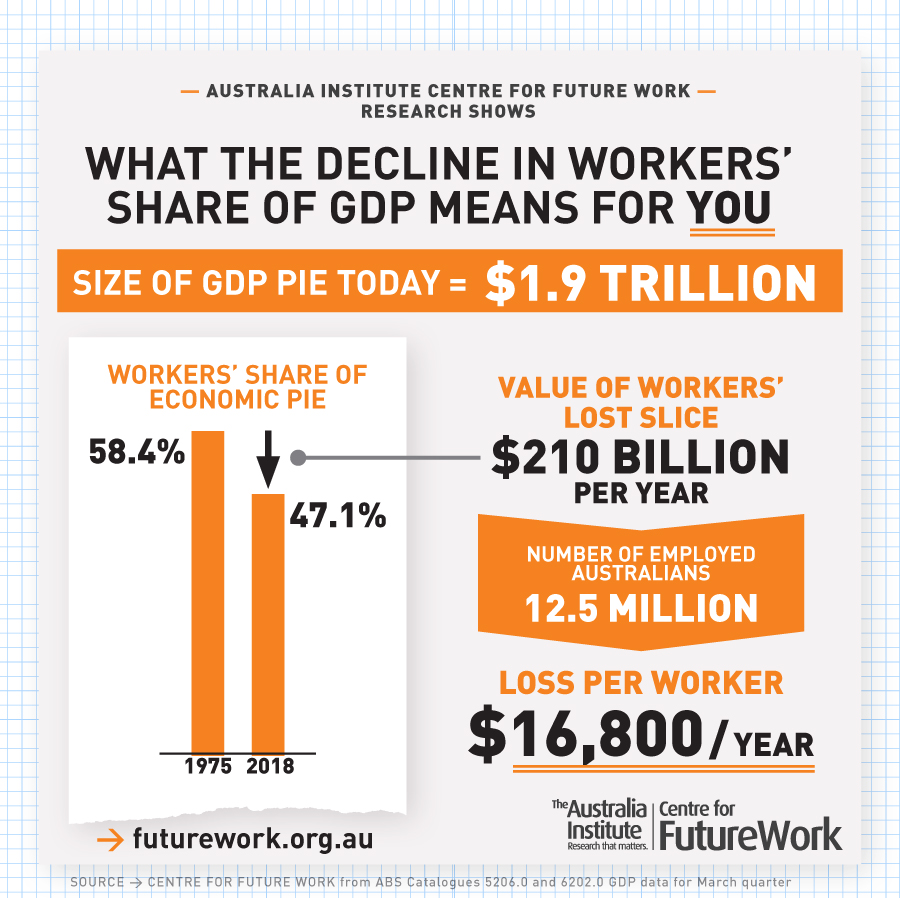
    This infographic summarises the bottom-line impact on average wage incomes for Australian workers.

    Labour Share Infographic

    In the March quarter of 2018, labour income (in wages, salaries, and superannuation contributions) accounted for 47.1% of total GDP. That is down over 11 percentage points from the peak labour share (over 58%) recorded in the same quarter of 1975. The loss of that share of GDP, given total output today, is equivalent to a redirection of some $210 billion in annual income – and the research symposium showed that almost all of that income was captured in the form of higher company profits (especially in the financial sector). If it were divided equally amongst all employed Australians, that lost income share translates into foregone income of close to $17,000 per worker.

    Many thanks to Anna Chang for her creative work on the infographic!

    The research symposium highlighted several factors that have caused the long-run shift in income distribution from workers to the business sector, and resulting growth in personal income inequality in Australia. Key factors included the erosion of union representation and collective bargaining, inadequate minimum wages, and the growing power of the financial sector.  For more details, see the articles by Jim Stanford, David Peetz, Margaret Mackenzie, Shaun Wilson, and Frances Flanagan.


    You might also like

    Denying Wages Crisis Won’t Make It Go Away

    by Jim Stanford

    As the great novelist Isaac Asimov wrote, “The easiest way to solve a problem is to deny it exists.” Business leaders and sympathetic commentators have adopted that advice with gusto, during current public debates over the unprecedented weakness of Australian wages.

  • Four Views on Basic Income, Job Guarantees, and the Future of Work

    Four Views on Basic Income, Job Guarantees, and the Future of Work

    The unprecedented insecurity of work in Australia’s economy – with the labour market buffeted by technology, globalisation, and new digital business models – has sparked big thinking about policies for addressing this insecurity and enhancing the incomes and well-being of working people. Two ideas which have generated much discussion and debate are proposals for a basic income (through which all adults would receive an unconditional minimum level of income whether they were employed or not) and a job guarantee (whereby government would ensure that every willing worker could be employed in some job, such as public works or public services, thus eliminating involuntary unemployment).

    Progressives have campaigned for generations for stronger income security programs and for a commitment to full employment by government. So these ideas have a long pedigree. However, there is great discussion over both the implementation and cost of these proposals, and their broader (and perhaps unintended) economic and political consequences.

    To shed some additional, constructive perspective on these proposals, we are pleased to present four short commentaries on basic income, job guarantees, and the future of work by four leading Australian experts on the economics and politics of work.

    The four commentaries are posted below in alphabetical order of their authors:

    • Dr. Frances Flanagan, Research Director, United Voice: The Policy and Politics of Basic Income: A Few Concerns
    • Troy Henderson, Economist, Centre for Future Work: Situating Basic Income and a Job Guarantee in a Hierarchy of Pragmatic-Utopian Reform
    • Dr. Ben Spies-Butcher, Dept. of Sociology, Macquarie University: Basic Income as a Progressive Priority
    • Dr. Jim Stanford, Economist and Director, Centre for Future Work: Work, Technology, and Basic Income: Issues to Consider

    Three of the commentaries (by Flanagan, Henderson, and Spies-Butcher) were initially presented to the recent “Reboot the Future” conference in Sydney, hosted by Greens NSW Political Education Trust. The authors expanded and edited their remarks for the purposes of this symposium. We thank the organisers for their cooperation. The fourth commentary (by Stanford) arose from recent discussions within the Centre for Future Work’s voluntary Advisory Committee.  Together, we think these nuanced commentaries add valuable perspective to these important but complex policy debates.

    Our publication of these commentaries coincides with this week’s annual General Assembly of the Basic Income Earth Network (BIEN), being held this year at the University of Tampere in Finland.  In a personal capacity, Centre for Future Work economist Troy Henderson is presenting at the Assembly on his Ph.D. research regarding the fiscal and labour market impacts of basic income.

    We will continue to consider the advantages and disadvantages of both these important policy proposals in future research and commentary. We thank the authors for their contributions to this discussion, and welcome further feedback!


    Frances Flanagan


    Troy Henderson


    Ben Spies-Butcher


    Jim Stanford

    Share

  • Exploring the Decline in the Labour Share of GDP

    Exploring the Decline in the Labour Share of GDP

    The share of total economic output in Australia that is paid to workers (in the form of wages, salaries, and superannuation contributions) has been declining for decades. Workers produce more real output with each hour of labour (thanks to ongoing efficiency improvements and productivity growth), but growth in real wages has been much slower – and recently, real wages haven’t been growing at all. The result is that labour’s slice of the economic pie has been getting smaller. In fact, a recent Centre for Future Work report showed that in early 2017 the labour share of GDP hit its lowest level since the Australian Bureau of Statistics began collecting quarterly GDP data.

    To explore the causes and consequences of this decline in workers’ share of national income, the Centre for Future Work convened a special panel of experts at the Society for Heterodox Economists conference at UNSW in Sydney last December. The papers presented at that panel have been peer-reviewed and just published in the Journal of Australian Political Economy. We are very pleased to co-publish the 4 papers here.

    • In addition to further documenting the long erosion of workers’ share of Australian GDP, the symposium sheds additional light on the trend, including the following aspects:
    • The shifting distribution of income from labour to capital contributes to widening inequality in personal incomes (since financial wealth, and income from that wealth, is so tightly concentrated among the richest Australians).
    • The decline in the labour share in Australia has been among the worst third of all OECD economies; and some countries have experienced stable or even rising labour shares, proving this trend is neither universal nor inevitable.
    • The growing power of finance, and the financialisation of business practices even by non-financial firms, have been key factors in the relative fall of labour compensation.
    • New business models involving the fragmentation of work and the outsourcing of direct employment responsibilities by lead companies (what participating author David Peetz terms “not-there capitalism”) have also contributed to the trend.
    • Australia’s minimum wage once established a strong foundation for a healthy labour share of national income, but its influence has eroded over the last 30 years as minimum wages have failed to keep up with overall wage trends and productivity growth.
    • Despite the erosion of union density and collective bargaining, Australian unions still possess an impressive capacity to mobilise working people to demand a better share of the economic pie (including through the political process).

    The long decline in the labour share is a powerful, telling indicator of the regressive shifts in the power balances of Australian society over the last generation.  These articles help us understand what has happened – and how to achieve a better distribution of income between factors of production in the future.

    Links to the 4 articles, and a rich introduction to the symposium (by Dr. Frances Flanagan of United Voice and Prof. Frank Stilwell of the University of Sydney) are provided below. Please visit the Journal of Australian Political Economy to learn more about the symposium, and to subscribe.

    • Introduction: Frances Flanagan and Frank Stilwell.
    • The Declining Labour Share in Australia: Definition, Measurement, and International Comparisons: Jim Stanford (Director, Centre for Future Work)
    • The Labour Share, Power and Financialisation: David Peetz (Professor of Employment Relations, Griffith University)
    • The Erosion of Minimum Wage Policy in Australia and Labour’s Shrinking Share of Total Income: Margaret McKenzie (Economist, Australian Council of Trade Unions)
    • The Declining Labour Share and the Return of Democratic Class Conflict in Australia: Shaun Wilson (Associate Professor Sociology, Macquarie University)


    Frances Flanagan & Frank Stilwell


    Jim Stanford


    David Peetz


    Margaret McKenzie


    Shaun Wilson

    Share

  • Possibly Surprising Insights on the Future of Work

    Possibly Surprising Insights on the Future of Work

    by Jim Stanford

    Share

    Trade unionists are gathering this week at the ACTU’s triennial Congress in Brisbane.  Jim Stanford, Director of the Centre for Future Work, participated in a panel on the Future of Work (an apt title!) at the Congress.

    His presentation was “5 Possibly Surprising Insights on the Future of Work”.

    More detail on the issues raised in his presentation is provided in the Centre’s recent submission to the Senate Inquiry on the Future of Work and the Future of Workers.


    Related documents


    Presentation Slides


    Factsheet

    Related research

    You might also like

    Centre For Future Work to evolve into standalone entity

    The Centre for Future Work was established by the Australia Institute in 2016 to conduct and publish progressive economic research on work, employment, and labour markets. Supported by the Australian Union movement, the centre produced cutting edge research and led the national conversation on economic issues facing working people: including the future of jobs, wages

  • Centre for Future Work at #ACTUCongress18

    Centre for Future Work at #ACTUCongress18

    by Jim Stanford

    Share

    Trade unionists from across Australia are gathering in Brisbane this week for the 2018 Congress of the Australian Council of Trade Unions. And the Centre for Future Work will be there!

    Come and check out our information booth in the exhibitors’ area: meet our staff, learn more about our work, and sign up for updates.

    Our Director Jim Stanford will be presenting as part of a session on The Future of Work (good title!), Tuesday July 17 at 2:15 pm in conference room P1.

    And we will be distributing copies of a brochure with links to some of our most recent research (attached below).

    We are glad that our research can support the campaign to #ChangeTheRules!


    Related documents


    Brochure

    Related research

    You might also like

    Commonwealth Budget 2025-2026: Our analysis

    by Fiona Macdonald

    The Centre for Future Work’s research team has analysed the Commonwealth Government’s budget, focusing on key areas for workers, working lives, and labour markets. As expected with a Federal election looming, the budget is not a horror one of austerity. However, the 2025-2026 budget is characterised by the absence of any significant initiatives. There is

  • Penalty Rates and Employment: One Year Later

    Penalty Rates and Employment: One Year Later

    by Jim Stanford and Tanya Carney

    On 1 July 2018, workers in several retail and hospitality industries will experience a second reduction in the penalty rates they receive for working on Sundays and public holidays.  The reductions were ordered by the Fair Work Commission, and follow an initial reduction imposed on 1 July 2017.

    Employer representatives argued that by reducing labour costs for work on Sundays and holidays, lower penalty rates would spur a big expansion in employment, via both new hiring and longer hours for existing workers.  One lobbyist predicted 40,000 new jobs.  Another said improved employment was “a certainty.”

    But a new report from the Centre for Future Work has examined employment and working hours in the retail and hospitality industries in the year since the first penalty rate reduction.  Far from spurring a jobs boom in the two sectors, they have actually significantly underperformed the rest of the economy on all of the indicators considered.

    The report reviews detailed data on employment, full-time employment, average hours of work, underemployment, and the incidence of short-hours work (under 20 hours per week).  By all these criteria, the retail and hospitality sectors performed among the worst of any other industries in the year since penalty rates were first cut.  Most industries where penalty rates did not change, created more work than the two sectors where penalty rates were cut.

    The retail sector in particular has performed very badly relative to the rest of the economy.  Total employment was unchanged in the year ending in May 2018 (according to most recent ABS data).  Full-time employment declined by 50,000 positions.  Average weekly hours of work declined by more than a full hour, and the underemployment ratio (share of workers who want more hours) grew almost 2 percentage points.

    The report does not suggest that lower penalty rates caused this poor performance (although it probably incrementally worsened underlying macroeconomic weakness, in particular stagnation in consumer incomes, that is the main cause of poor employment performance).  But the data certainly disprove inflated claims by employers and government that by cutting labour costs, the penalty rates decision would unleash a jobs boom in retail and hospitality.

    If we really want to strengthen employment conditions (in these and other sectors), we must emphasize stronger wages and incomes, stronger public and private investment, and strong purchasing power throughout the economy.  Cutting penalty rates (and other policy measures that have suppressed wage growth in recent years) won’t solve those problems — it will make them worse.


    Full report

    Share

  • Advanced Skills for Advanced Manufacturing

    Advanced Skills for Advanced Manufacturing

    by Jim Stanford and Tanya Carney

    Australia’s manufacturing industry is at a crossroads.  After years of decline, the sector has finally found a more stable economic footing, and many indicators point to an expansion in domestic  manufacturing in the coming years.  Manufacturing added almost 50,000 new jobs in the last year – making it one of the most important sources of new work in the whole economy.

    However, one key factor that could hold back that continuing recovery is the inability of Australia’s present vocational education and training system, damaged by years of underfunding and failed policy experimentation, to meet the needs of manufacturing for highly-skilled workers.  The skills challenge facing manufacturing is all the more acute because of the transformation of the sector toward more specialised and disaggregated advanced manufacturing  processes.  This naturally implies greater demand for highly-trained workers, in all its occupations: production workers, licensed trades, technology specialists, and managers.

    To sustain the emerging turnaround in manufacturing, the sector has an urgent need for a concerted and cooperative effort to strengthen vocational education and training. This report contributes to that process: by cataloguing the emerging skills challenges facing manufacturing, reviewing the failures of the existing approach to vocational education in this sector (and across Australia’s economy as a whole), and proposing twelve key principles for reform.

    This report, by Dr. Tanya Carney and Dr. Jim Stanford, was prepared by the Centre for Future Work for the Second Annual National Manufacturing Summit.  The Summit, held at Parliament House on 26 June 2018, will gather leading representatives from all major stakeholders in Australia’s manufacturing sector: business, unions, universities, the financial sector, suppliers and government. They will consider the industry’s prospects and identify promising, pragmatic policy measures to support a sustained industrial turnaround.  It is a highly appropriate forum at which to begin a discussion about multi-partite efforts to rebuild vocational education and address the looming skills challenges facing manufacturing.


    Full report

    Share

  • The Dimensions of Insecure Work in Australia

    The Dimensions of Insecure Work in Australia

    by Jim Stanford

    Share

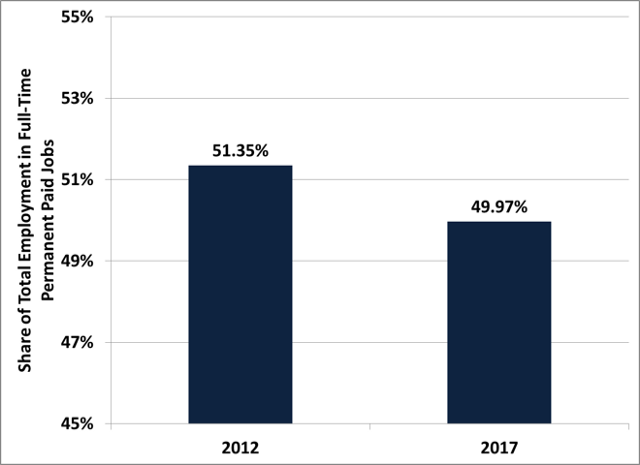
    Less than half of employed Australians now hold a “standard” job: that is, a permanent full-time paid job with leave entitlements. That’s the startling finding of a new report on the growing insecurity of work published by the Centre for Future Work.

    Share of Workers in Full-Time Paid Employment with Leave Entitlements. Source: Centre for Future Work calculations from ABS Catalogues 6291.0.55.003, EQ04 (2017), and 6333.0 Tables 2.3 and 9.1 (2012).

    The report, The Dimensions of Insecure Work: A Factbook, reviews eleven statistical indicators of the growth in employment insecurity over the last five years: including part-time work, short hours, underemployment, casual jobs, marginal self-employment, and jobs paid minimum wages under modern awards.

    All these indicators of job stability have declined since 2012, thanks to a combination of weak labour market conditions, aggressive profit strategies by employers, and passivity by labour regulators. Together, these trends have produced a situation where over 50 per cent of Australian workers now experience one or more of these dimensions of insecurity in their jobs - and less than half have access to “standard,” more secure employment.

    “Australians are rightly worried about the growing insecurity of work, especially for young people,” said Dr. Jim Stanford, one of the co-authors of the report. “Many young people are giving up hope of finding a permanent full-time job, and if these trends continue, many of them never will.”

    The report also documents the low and falling earnings received by workers in insecure jobs. While real wages for those in permanent full-time positions (the best-paid category) have grown, wages for casual workers have declined. And part-time workers in marginal self-employed positions (including so-called “gig” workers) have fared the worst: with real wages falling 26 percent in the last five years.

    “Given current labour market conditions and lax labour standards, employers are able to hire workers on a ‘just-in-time’ basis,” Dr. Stanford said. “They employ workers only when and where they are most needed, and then toss them aside. This precariousness imposes enormous risks and costs on workers, their families, and the whole economy.”

    Dr. Stanford called on policy-makers to address growing precarity with stronger rules to protect workers in insecure jobs (such as provisions for more stable schedules, and options to transition to permanent from casual work). He also stressed the need for economic policies that target the creation of permanent full-time jobs.


    Related research

    You might also like

    Centre For Future Work to evolve into standalone entity

    The Centre for Future Work was established by the Australia Institute in 2016 to conduct and publish progressive economic research on work, employment, and labour markets. Supported by the Australian Union movement, the centre produced cutting edge research and led the national conversation on economic issues facing working people: including the future of jobs, wages