Author: annamations

  • Interest Rates and the Federal Election

    Originally published in The Guardian on February 17, 2022

    For the first time in a decade the coming election will be at a time of increasing inflation and talk of rising interest rate. And while it is clear interest rates are always a political hot potato, Greg Jericho writes in his latest Guardian Australia column that we should not lose sight of the need for government support.

    Inflation is occurring off the back of the largest government intervention and the lowest interest rates in post-WWII history. But while the economy is performing better than might have been expected when the pandemic first occurred it would be a mistake now to quickly reduce economic support from the public sector.

    After the global financial crisis, worries about debt and deficit took precedence over the strength of the economy. At a time when government borrowing rates still remain historically low, the need to improve productivity through infrastructure and support in areas such as education and health, as well as equality improvements through high a higher Jobseeker rate, should take precedence in the upcoming federal budget.


    You might also like

    Dutton’s nuclear push will cost renewable jobs

    by Charlie Joyce

    Dutton’s nuclear push will cost renewable jobs As Australia’s federal election campaign has finally begun, opposition leader Peter Dutton’s proposal to spend hundreds of billions in public money to build seven nuclear power plants across the country has been carefully scrutinized. The technological unfeasibility, staggering cost, and scant detail of the Coalition’s nuclear proposal have

  • Digging Deeper Into Australia’s Unemployment Rate

    Originally published in The Guardian on February 10, 2022

    Australia’s unemployment rate is poised to hit its lowest level in a half-century, and this has been heralded by the current government as an economic triumph. But the unemployment rate depends on many factors (including labour supply, hours of work, and others), and does not by itself assure that the economy is maximising its potential.

    In his weekly column for The Guardian Australia, Centre for Future Work Policy Director Greg Jericho unpacks the numbers behind the current unemployment rate, and compares it to the situation in 1974 when unemployment was last below 4%.

    The column considers several factors contributing to the current unemployment rate, including:

    • The flattening of labour supply due to border closures during the pandemic.
    • Lower female labour force participation (especially in full-time work).
    • The general growth in part-time work, including for men.

    Please see Greg’s full column, “Australia’s 4% unemployment in isolation hides what’s really going on in the labour market,” in The Guardian Australia.


    You might also like

    Centre For Future Work to evolve into standalone entity

    The Centre for Future Work was established by the Australia Institute in 2016 to conduct and publish progressive economic research on work, employment, and labour markets. Supported by the Australian Union movement, the centre produced cutting edge research and led the national conversation on economic issues facing working people: including the future of jobs, wages

  • Power, Not Just Supply and Demand, Vital to Future Wage Growth

    Originally published in The Conversation on February 9, 2022

    Australia’s unemployment rate declined to 4.2% in December, and it could fall further (below 4%) in the coming year, barring further waves of COVID or other global shocks. This has some forecasters predicting a quick acceleration in wage growth — which has been stuck for almost a decade now at the slowest pace in Australia’s postwar history.

    Will a low unemployment rate be sufficient to solve the crisis in Australian wages? In this article published in The Conversation, Centre for Future Work Director Jim Stanford argues that the historic restructuring of Australia’s labour market institutions over the last half-century (since the last time unemployment was below 4%) will continue to undermine wages, despite apparently tight labour markets.

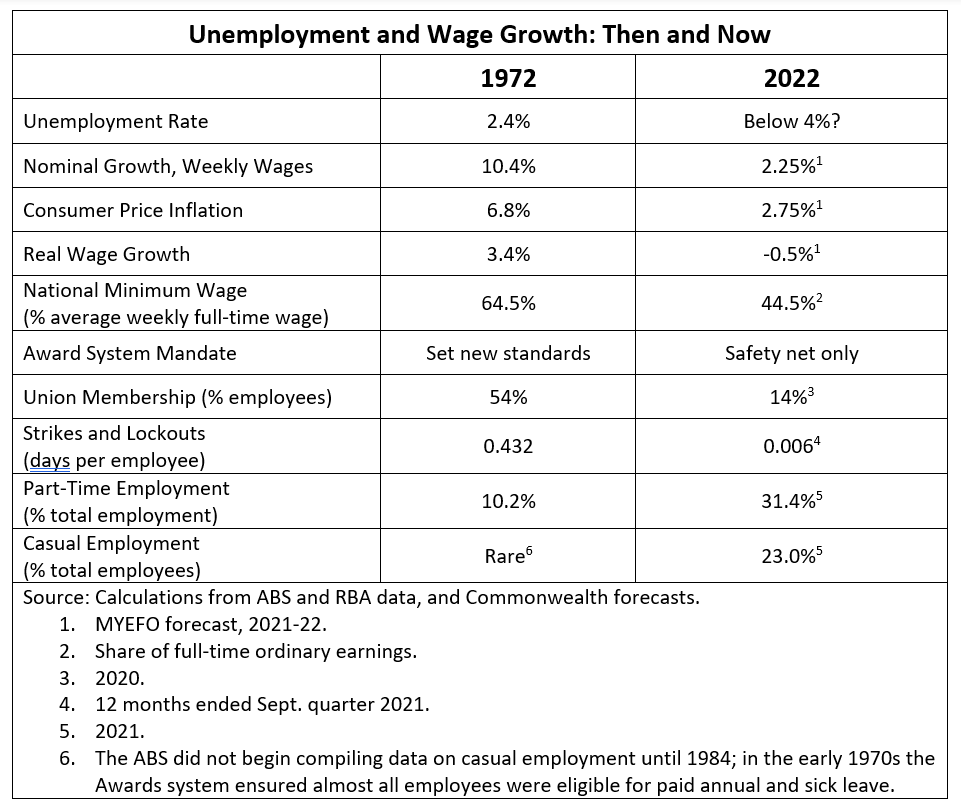
    This table compares regulatory and institutional parameters today, compared to fifty years ago. Across multiple dimensions (including the minimum wage, the Awards system, unions and collective bargaining, and job security), workers have lost the bargaining power they need to win higher wages. Hence labour costs remain suppressed, and business profits hit records, even as unemployment declines.

    Labour Institutions Then and NowPlease see Jim’s full article, “Why there’s no magic jobless rate to increase Australians’ wages,” at The Conversation.


    You might also like

    Dutton’s nuclear push will cost renewable jobs

    by Charlie Joyce

    Dutton’s nuclear push will cost renewable jobs As Australia’s federal election campaign has finally begun, opposition leader Peter Dutton’s proposal to spend hundreds of billions in public money to build seven nuclear power plants across the country has been carefully scrutinized. The technological unfeasibility, staggering cost, and scant detail of the Coalition’s nuclear proposal have

  • Rebuilding Vehicle Manufacturing in Australia

    Rebuilding Vehicle Manufacturing in Australia

    Industrial Opportunities in an Electrified Future
    by Mark Dean

    Global automotive manufacturing is rapidly transitioning to the production of Electric Vehicles (EVs) in line with technological advancements and the global community’s commitment to addressing climate change. This transition presents an enormous opportunity for Australia to rebuild its vehicle manufacturing industry, taking advantage of our competitive strengths in renewable energy, extractive industries, manufacturing capabilities, and skilled workers.

    Australia possesses many of the crucial elements for an EV manufacturing industry: rich mineral reserves, an advanced industrial base, a highly skilled workforce, and consumer interest. But what it lacks is an overarching, coordinating and strategic national industry policy. Global experience shows that this is central to EV-oriented industrial transformation. Australia can play an important role in global EV manufacturing industries but developing a strategy to realise this will require active government policy responses to both the challenges and opportunities at hand.

    Australia’s natural resource endowments and industrial capabilities make EV industry development a viable economic and social strategy. Our moral obligations to create a sustainable future make it essential public policy. This report illustrates how Australia can rebuild a vehicle manufacturing industry, on a sustainable ecological foundation, and meet our international environmental obligations. The report covers several important related dimensions of the issue:

    • How an EV manufacturing strategy can add value to Australia’s existing exports of primary resources – connecting them to innovative, sustainable manufacturing industries;
    • Developing supply and value chain linkages to the global EV industry by increasing the capability for innovation and advanced manufacturing amongst small and medium-sized enterprises;
    • The central role of Australia’s education systems in delivering sustainable industry-focused training and skills development, to provide workers with career pathways shaped by lifelong access to education and learning;
    • How active government intervention can coordinate economic sectors in an innovative and strategically oriented industry policy driving sustainable economic and technological transformation; and
    • Understanding the importance of automotive manufacturing to our industrial future, its role in redesigning transport systems, investing in new technology and gearing production systems to meet social and environmental requirements.

    To make the case for a national EV manufacturing policy, this paper reviews existing literature and presents relevant data to show that an EV industry in Australia is not just desirable – but it can also lead the sustainable transformation of Australia’s economy.

    The paper is arranged as follows. The next section provides an overview of the Australian national EV policy landscape and the international context, to identify trends and opportunities in EV manufacturing.

    The bulk of the paper is then dedicated to reviewing four key ‘Building Blocks’ of an industry policy: the resources sector, skilled labour, supply chain capabilities and capital assets, and the capacity of government to develop a policy response that assembles these key elements as the foundation for rebuilding Australian manufacturing with EVs at the centre.

    In mapping this foundation of an EV manufacturing policy, the subsequent section cautions that an EV industry is not a panacea for addressing the broader climate crisis and creating a sustainable economy. It argues, however, that a sustainable EV industry should be considered as a major driver of industrial transformation alongside other positive cultural and environmental changes within Australian society.

    The conclusion summarises the paper’s overarching theme that Australia can build a strong EV manufacturing industry with the right policy settings and government actions. It makes several specific recommendations to get the ball rolling on developing these settings – including recommendations touching on industry planning, energy requirements, consumer demand, resource use, supply chain developments, skills and training, and government support.


    Full report

    Share

  • Of 3’s, and Other Important Labour Market Numbers

    Of 3’s, and Other Important Labour Market Numbers

    by Jim Stanford

    Will an unemployment rate with a 3 in front it, ensure that we also get wage growth with a 3 in front of it? Don’t count on it.

    Prime Minister Scott Morrison set tongues wagging this week with a confident pledge that Australia’s unemployment rate could have “a 3 in front of it” this year. It’s a theme that will loom large in his campaign for reelection later this year.

    In this commentary, Centre for Future Work Director Jim Stanford considers whether a low unemployment rate is an accurate indicator of the state of the labour market — and whether, even if achieved, it would reignite wage growth and solve other problems holding back Australia’s labour market.

    The unemployment rate was 4.2% in December, so Mr Morrison’s prediction may not be as brave as might seem: it would only take a .3-point drop to achieve that magical ‘3’. The official unemployment rate often bounces by more than that (in either direction) in any given month, purely due to measurement errors or shifts in recorded labour force participation. So his prediction will likely come true. But is it the economic triumph that he and his political allies will claim?

    A lower unemployment rate is obviously better than a higher unemployment rate. But the unemployment rate itself has lost much of its value as an indicator of the state of the labour market. There are large pools of unutilised and underutilised labour in our economy that are not captured by the official unemployment measure.

    Equally important, assumptions that a historically low unemployment rate will automatically correct many of the labour market problems that Australia has experienced in recent years are misplaced. Problems like wage stagnation, falling real wages, income inequality and poverty (even among employed people), and the economic exclusion of sectors of society (such as indigenous and immigrant communities, and people with disability) all require more concerted and targeted actions to fix.

    Please see Jim’s full commentary: Of 3’s, and Other Important Labour Market Numbers.


    You might also like

    Centre For Future Work to evolve into standalone entity

    The Centre for Future Work was established by the Australia Institute in 2016 to conduct and publish progressive economic research on work, employment, and labour markets. Supported by the Australian Union movement, the centre produced cutting edge research and led the national conversation on economic issues facing working people: including the future of jobs, wages

  • CPI Numbers Don’t Tell the Whole Story

    Originally published in The Guardian on February 3, 2022

    With the rise in inflation as Australia’s economy struggles with re-opening and supply chain problems, each release of the Consumer Price Index (CPI) generates headlines and political debate. But the CPI doesn’t necessarily provide a full reading of price pressures: depending on who you are, and what you buy. In this column published in the Guardian Australia, Greg Jericho (new policy director for the Centre for Future Work) dissects several measurement issues related to this most-watched economic statistic.

    Jericho shows that inflation measurements can very widely for different types of household. Those with limited incomes (including government benefit recipients), who spend more of their income on ‘non-discretionary’ items, face an especially large threat to their real living standards as inflation picks up.

    See Greg’s full column, “With inflation on the rise, Australia’s cost of living will dominate the election debate,” in the Guardian Australia.


    You might also like

  • Centre for Future Work Announces Two Senior Appointments

    Centre for Future Work Announces Two Senior Appointments

    by Jim Stanford

    Share

    The Centre for Future Work at the Australia Institute is pleased to announce the appointment of two senior staff to its team of labour policy researchers.

    Greg Jericho will join the Centre on 1 February as Policy Director: Labour Market and Fiscal. Greg is an economist and well-known columnist for The Guardian in Australia; he currently teaches at the University of Canberra. He will continue writing his Guardian column, while overseeing new research projects for the Centre on issues of employment, wages, insecure work, and related topics.

    Dr Fiona Macdonald will join the Centre on 1 March as Policy Director: Industrial and Social. Fiona is presently Vice-Chancellor’s Senior Research Fellow at the School of Management, RMIT University, and an internationally recognised expert on caring labour, gender and work, and industrial relations policy. She has published extensively on the Awards system, working conditions and compensation in human and caring services, and violence at workplaces. Fiona will oversee new research at the Centre on industrial relations reform, social policy, and caring labour.

    The two Policy Directors join the Centre’s existing research team, which includes: Economist and Director Jim Stanford; Senior Economist Alison Pennington; Economist Dan Nahum; and Mark Dean, Distinguished Research Fellow at the Carmichael Centre.

    “This is a critical moment in the history of work and industrial relations in Australia,” said Dr Stanford, the Centre’s Director. “The addition of Greg Jericho and Fiona Macdonald to our team will greatly enhance our capacity to investigate the threats facing work and workers, and to develop progressive policy responses that could achieve a better future of work.”

    “I am very excited to join the Centre for Future Work,” said Jericho. “At such a crucial moment, being able to push the policy debate in the interests of fairness for workers is of utmost importance. I look forward to working with the great team at the Centre and the Australia Institute to continue producing quality research that leads the political and policy debates.”

    “As a long-time admirer of the Centre, I am thrilled to be joining its research team,” said Dr. Macdonald. “I look forward to contributing to the Centre’s important work, including in the vital areas of the care economy and gender equality. Work is changing rapidly, and the Centre’s research empowers those working for a fairer, more equal labour market.”

    Greg Jericho will work out of the Australia Institute’s central office in Canberra. Fiona Macdonald will be based in Melbourne.

    Greg Jericho can be followed on Twitter at @GrogsGamut. Fiona Macdonald can be followed at @DrFionaMac.


    You might also like

    Centre For Future Work to evolve into standalone entity

    The Centre for Future Work was established by the Australia Institute in 2016 to conduct and publish progressive economic research on work, employment, and labour markets. Supported by the Australian Union movement, the centre produced cutting edge research and led the national conversation on economic issues facing working people: including the future of jobs, wages

    Carmichael Centre Announces Appointment of Prof. David Peetz as Laurie Carmichael Distinguished Research Fellow

    by Jim Stanford

    The Carmichael Centre at the Australia Institute’s Centre for Future Work is proud to announce the appointment of Prof. David Peetz, one of Australia’s most outstanding labour policy experts, as the new Laurie Carmichael Distinguished Research Fellow. Prof. Emeritus Peetz has recently retired from a long career at Griffith University, where he served as Professor

  • Snatching Defeat from the Jaws of Victory: Labour Market Implications of Australia’s Failed COVID Strategy

    Snatching Defeat from the Jaws of Victory: Labour Market Implications of Australia’s Failed COVID Strategy

    by Jim Stanford

    Share

    As COVID and recession gripped the world, through 2020 and most of 2021 Australia recorded one of the best outcomes: lower infection, fewer deaths, and a faster, stronger economic recovery. That seeming victory has been squandered, however by the appalling and infuriating events of recent weeks. Purportedly in the name of ‘protecting the economy’, key political leaders (led by the Commonwealth and NSW governments) threw the doors open to the virus at exactly the wrong time: just as the super-infectious Omicron variant was taking hold.

    The resulting surge in infections has been among the worst in the industrialised world (worse than the U.S. now, as shown in the following graph from Our World in Data). The implications of this massive outbreak for work, workers, production, and the economy have been as predictable as they are devastating. One-third or more of workers in the most-affected regions cannot attend work: because they contracted COVID, were exposed to it, or must care for others (like children barred from child care and soon, possibly, schools).

    Our Centre for Future Work team has been active in highlighting the risks of ‘letting it rip’, analysing the failures of isolation and income support programs, and reminding everyone that keeping workers healthy must be the first priority in keeping the economy healthy. Here is a selection of our recent interventions:

    New COVID Cases per Million (7-day rolling)

    • Our Director Jim Stanford reminded policy-makers in this commentary in The Conversation that human labour is the critical input to production at all stages of value-added and supply chains, and if policy-makers acknowledged the centrality of work to the economy they would not have made such destructive choices. The article was reposted by the ABC, the Sydney Morning Herald, and other platforms, and viewed over a half-million times.
    • Senior Economist Alison Pennington has exposed the flaws in government isolation and testing systems. For example, she highlighted the perverse incentives created by the NSW government’s punitive $1000 fine for failing to register a positive RAT test — never mind the governments’ failures to make tests available, and support workers (with necessary income benefits) to isolate. Her analysis was shared thousands of times, and featured in multiple news coverage (including News.com, The New Daily, and Yahoo Finance) of the flawed NSW policy.
    • Alison further detailed the flaws in changes to the Commonwealth government’s isolating support payments, in this commentary in The New Daily. By punitively excluding hundreds of thousands from isolation benefits, the policy will accelerate contagion and make supply chain problems even worse down the road.
    • Our experts have been featured in numerous other reports on the supply chain problems arising from the Omicron surge, including these reports on Channel 10, Today, The Age, ABC Online, and The Guardian.
    • Our Economist Dan Nahum linked the surge in Omicron contagion to the spread of insecure work arrangements in Australian workplaces. And the Centre’s previous work on how COVID has accentuated the dominance of casual and insecure work in Australia’s labour market shows that without urgent action to improve job quality, the labour market will be even more vulnerable to the inevitable future disruptions from this continuing crisis.

    Our team of experts will continue monitoring the dangerous labour market developments arising from Omicron, and flawed government responses to it. Please watch our site and follow our Twitter feed for regular updates.


    You might also like

    Centre For Future Work to evolve into standalone entity

    The Centre for Future Work was established by the Australia Institute in 2016 to conduct and publish progressive economic research on work, employment, and labour markets. Supported by the Australian Union movement, the centre produced cutting edge research and led the national conversation on economic issues facing working people: including the future of jobs, wages

  • New International Research Exposes Australia’s Missed Wage-boosting Opportunities

    New International Research Exposes Australia’s Missed Wage-boosting Opportunities

    New research on international collective bargaining systems, released today in a special issue of the peer-reviewed journal, Labour and Industry, finds that Australia’s industrial relations system is rapidly losing its ability to support wages in the face of numerous challenges (now including the Omicron outbreak).

    On the heels of new data showing further erosion of Australia’s collective bargaining system, researchers and practitioners from five countries have identified best practices from other countries that could strengthen collective bargaining and lift wages.

    Key findings of the research include:

    • The Ardern government in New Zealand has implemented a new sector-wide bargaining system (called ‘Fair Pay Agreements’) that could be a model for similar changes in Australia. It would enhance workers’ ability to win more stable jobs and higher wages in highly fragmented industries (like security, cleaning or child care).
    • New Zealand-style reforms could also improve the effectiveness of Australia’s pay equity legislation. Recent changes in New Zealand’s pay equity system prove that wider scope for bargaining can address persistent gendered pay discrimination. One recent enterprise agreement in Australia (covering public sector workers in Victoria) has already applied that model here.
    • Nordic and continental European countries have used coordinated sectoral bargaining systems to enhance vocational training and technology adoption. Australia could learn from that experience to better integrate skills programs with secure job pathways.
    • In Germany, a combination of sector-wide bargaining over wages and other core compensation, combined with workplace-level consultations (under that country’s ‘works council’ system), produces employment outcomes that are both flexible and fair.

    The final published versions of all articles in the Special Issue are available through Labour and Industry, or through your local library. Links to the following articles are available free access for 3 months (ends March 2022):

    Introduction, by Alison Pennington and Jim Stanford

    Sector-wide bargaining: problems and prospects in the Australian case, by Tom Roberts

    Rebuilding worker power in Australia through multi-employer bargaining, by Tim Kennedy, Ben Redford, Renee Burns and Anthony Forsyth

    Bargaining for pay equity: an NZ-inspired approach to gender equality in Australia, by Alison Pennington and Megan Wenlock

    International approaches to solving the ‘free rider’ problem in industrial relations, by Jim Stanford

    Collective bargaining’s contribution to employment skills and transitions: lessons from the Nordic countries, by Andrew Scott

    The Ghent system of social insurance: a model for Australia?, by Russell Lansbury

    Industry 4.0 in Germany and Australia: digital choices, human responses, by Andrew Dettmer

    Unions and the evolution of trade and industry policy under the Ardern government, by Bill Rosenberg

    Comment from authors:

    “Australia’s workplace relations system is failing to address rising insecure work, record-low wages growth, and a persistent gender pay gap. Collective bargaining system retrenchment compounds risks in Australia’s uncoordinated, fragmented skills system. We’re failing to facilitate the millions of jobs pathways and transitions our economy needs now, and in the future,” said Alison Pennington, Senior Economist with the Australia Institute’s Centre for Future Work.

    “The pandemic has deepened the structural drivers behind the gender pay gap in low-paid, insecure work. Australia has much to learn from the labour policy settings implemented in neighbouring New Zealand to meaningfully address the gender pay gap, including Fair Pay Agreements and pay equity bargaining.”

    “Australian workers need an effective system of collective bargaining that goes beyond the legal entity that directly employs them. This is a vital mechanism to ensure workers have greater control over the safety of their work, across sectors, industries, franchises, labour hire arrangements, supply chains – or however work is configured,” said Tim Kennedy, Secretary of the United Workers Union.

    “Australia is currently deprived of the skill formation benefits that arise from strong sectoral collective bargaining between social partners observed in Nordic nations. It’s exacerbating serious deficiencies in our skills training arrangements, evident in high rates of misalignment between jobs and skills. Australia can learn much from the Nordic countries’ superior economic and social policy outcomes that arise from well-integrated skills and collective bargaining systems,” said Andrew Scott, Professor of Politics and Policy at Deakin University and Convenor of The Australia Institute’s Nordic Policy Centre.

    Share

  • Putting a Cap on Community

    Putting a Cap on Community

    The Economic and Social Consequences of Victoria’s Local Government Rate Caps Policy
    by Dan Nahum

    The Victorian Government’s policy of capping of local government rates revenue in Victoria is a regressive move on economic, social and democratic grounds. By arbitrarily tying the growth in total rates revenue in each local government area to price indexes, the state government restricts the ability of local governments to respond to the COVID-19 crisis with expanded, secure employment and service offerings.

    Rates on property are the largest single source of revenue to local governments in Victoria. Of total Victorian local government revenue in 2019-20 ($11.7 billion), rates accounted for $5.6 billion or almost half. Since 2016-17, the Victorian state government has capped the amounts local governments can collect from their ratepayers.

    New research by the Centre for Future Work, commissioned by the Australian Services Union, finds that the imposition of rate caps has cost up to 7425 jobs in 2021-22, counting both direct local government employment and indirect private sector jobs. They have also reduced GDP by up to $890 million in 2021-22. The costs of suppressed local government revenues, and corresponding austerity in the delivery of local government services, will continue to grow with each passing year if the policy is maintained.

    The rate cap policy becomes more restrictive as the overall economy slows, since the rate cap is tied to inflation indexes which tend to slow when the economy is weak.

    The local government sector in Victoria employs about 50,000 people in a wide range of services and occupations, including road planning and maintenance, home and aged care, waste disposal, libraries, childcare, school crossing supervision, maternal and child health, the State Emergency Service, and environmental management.

    The rate caps act as a brake on recovery and growth by embedding a dynamic of self-fulfilling fiscal restraint and austerity. Additionally, there has been a shift to other forms of local government revenue-raising that are less progressive and socially equitable, such as fees and fines.

    Rates bills are calculated based on relative property valuations – so even if local governments are collecting less from rates overall than they would in the absence of the cap, growth in a particular ratepayer’s payments may well exceed the overall cap.

    The rate cap policy inhibits a normal trend of expanding and improving local government services in line with population growth, rising living standards, and economic expansion – as well as interfering with the democratically-expressed preferences of local government voters.


    Full report

    Share