Author: annamations

  • Educating for Care

    Educating for Care

    Meeting Skills Shortages in an Expanding ECEC Industry
    by Mark Dean

    This report from the Carmichael Centre argues that Early Childhood Education and Care (ECEC) services should be treated as a strategic industry of national importance – not just a ‘market’, and not just a ‘cost’ item on government budgets.

    Building a stronger, more accessible, and high-quality ECEC system is not just a top-ranking social priority for several reasons:

    • The ECEC sector supports hundreds of thousands of jobs.
    • It directly creates billions of dollars of value-added in the Australian economy.
    • It generates further demand for other sectors – both upstream, in its own supply chain, and downstream in consumer goods and services industries that depend on the buying power of ECEC workers.
    • It facilitates work and production throughout the rest of Australia’s economy, by allowing parents to work – although that goal would be much better achieved if Australia had a more comprehensive, universal, and public ECEC system.
    • ECEC enhances the long-term potential of Australia’s economy, and all of society, by providing young children with high-quality education opportunities – that are proven to expand their lifetime learning, employment, and income outcomes, and enrich their families and communities.

    Australia’s current market-based system for ECEC funding and service provision is incapable of meeting the needs of parents, families, and the broader economy. A drift to the market-based provision of ECEC services has undermined public provision in Australia and diminished the quality of service and the conditions under which it is delivered.

    From this crisis-ridden starting point, the staff recruitment and retention challenge in ECEC will become much worse, if in fact Australia were to make a long-term commitment to expand ECEC provision to adequately meet the needs of working parents (and the entire economy).

    Much public debate over the viability of expanded ECEC, putting Australia on a par with other leading industrial nations, has focused on the fiscal dimensions of that undertaking: how would we pay for it?

    If Australia is going to expand its ECEC system in line with the needs of working parents and employers, increasing funding to the Nordic-level average for ECEC must be considered, and ramping up high-quality vocational education for ECEC workers must be an immediate and highest-order priority to meet the workforce needs of expanded ECEC coverage.

    A long-term commitment to improved funding and service delivery, ideally aimed at matching Nordic-level coverage and quality benchmarks, would require a larger, better-trained, better-supported, and better-compensated workforce. A pro-active strategy for sustainable workforce development should be developed and implemented with input from all stakeholders, including ECEC providers, unions, VET institutions (particularly TAFEs), and government.

    The best possible education and care to Australian preschool-aged children should also be provided by the most highly trained and experienced workers – employed in delivering a public or not-for-profit service, and well-trained in public vocational education delivered through the TAFEs.

    In this sense, developing a universal public ECEC system is a natural analogue to developing a universal public VET system: building a world-class public ECEC system, staffed with top-notch graduates from public TAFEs, provides a dual source of economic and social benefit.

    Meeting the goals of high-quality ECEC services thus means recognising that the full and proper funding of Australia’s state- and territory-based TAFE systems must be an essential component of post-pandemic economic reconstruction.

    An active industry policy for ECEC will set the direction for the de-marketisation of ECEC services, with higher levels of government funding facilitating a vastly expanded system of ECEC in Australia.

    A vital prerequisite in this effort is establishing a stable, professional, well-supported ECEC workforce, by providing extensive education and training of ECEC workers, and their entry to secure, well-paid career pathways. This can only be achieved by fully funding the training and development of a regular pipeline of trained ECEC workers, led first and foremost by greater investment in publicly funded, TAFE-delivered education and skills, new mandates for workforce qualifications and staffing levels, and health and wellbeing quality frameworks that neutralise cost-competitive approaches to delivering ECEC services.


    Full report

    Share

  • Rate rises are going to cause a housing affordability crunch

    Originally published in The Guardian on May 5, 2022

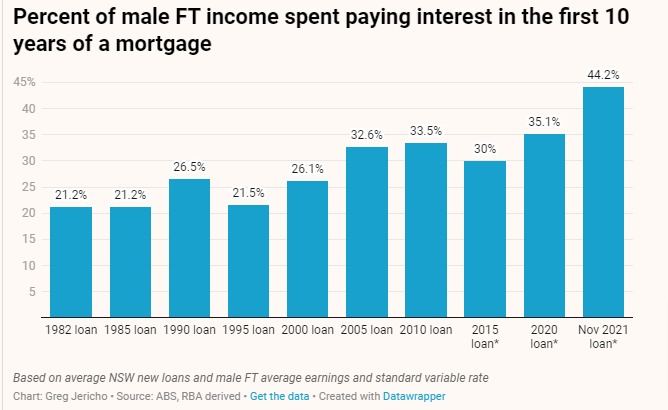
    For most of the past decade the talk about housing affordability has focussed on house prices. As fiscal policy director, Greg Jericho notes in his Guardian Australia column, falling interest rates since November 2010 have made paying off a mortgage less onerous than it otherwise would have given the soaring house prices.

    But that is about to change.

    The signal that interest rates are going to rise by possibly 2.5% points over the next 18 months means that for new mortgage holders the cost of repaying a mortgage is going to be harder than ever before – harder even than when interest rates hit 17% in 1990.

    It is a hit that will only exacerbate standard of living problems as wages will struggle to keep up with the rising cost of of holding a mortgage – especially given the belief that wage rises need to be contained below inflation rises continues in economic debate.


    You might also like

  • At the Crossroads

    At the Crossroads

    What is the post-COVID future of Australia’s Public universities?
    by Eliza Littleton

    If the federal government lifts annual higher education spending to 1% of GDP, it could repair the destruction inflicted by the COVID pandemic and make universities more accessible and affordable for all Australians, according to new research from the Centre for Future Work at the Australia Institute.

    The report analyses the current worrying state of Australia’s higher education sector based on current funding and policy trends, and provides an ambitious national vision for higher education that re-aligns the sector with its public service mission.

    At the Crossroads, authored by Eliza Littleton, identifies seven key policy initiatives including free higher education for domestic students, that if implemented, would put Australia’s public universities on a path toward full revitalisation.

    Key Findings:

    • Delivering free undergraduate education for domestic students, an expanded public research program, thousands of secure jobs, and a new national governance body for the sector would cost an estimated $6.9 billion per year in additional higher education funding. This funding would generate almost 27,000 additional jobs (FTE) in higher education through easing workload pressures, additional researching funding and staffing a new independent higher education agency.
    • Since 2013, Federal Government funding for higher education has declined in real terms by 2.6%, despite a 23% increase in student enrolments.
    • Federal Government funding as a percentage of university revenue has more than halved since the 1980s, declining from 80% in 1989 to only 33% in 2019. In Budget 2022-23, the government forecasts a cut to real university funding of 3.4% over the forward estimates.
    • Universities responded to the pandemic shock with dramatic job cuts. In the 12 months to May 2021, 40,000 jobs in public tertiary education were lost, with 88% of these losses estimated within public universities.
    • The Federal Government’s Job-Ready Graduates reforms result in a reduction in government spending on student learning of $1 billion per year, while student contributions increase $414 million per year.
    • In the face of COVID shocks, sustained international student fee intake combined with reduced teaching costs through online distance education and job cuts have primed universities for healthy surpluses this financial year. Despite that, universities are continuing with measures that further downsize and casualise their workforces,
    • Reduced government spending and university deregulation has led to teaching and learning crisis. Rampant casualisation, short-term contract use, excessive workloads, and wage theft characterise employment arrangements in Australia’s universities.

    The report recommends several measures to revitalise Australia’s public universities:

    • Free undergraduate education for domestic students
    • Adequate public funding for universities
    • Fully-funded research
    • Measures to provide secure employment
    • Improved higher education governance
    • Caps on vice-chancellor salaries; and
    • Transparency in data collection.


    Full report

    Share

  • The election campaign needs to tackle climate change

    Originally published in The Guardian on April 21, 2022

    In the week before the election campaign began the IPCC released its latest report that contained warnings that deep, rapid and sustained emissions reductions are needed to prevent temperatures from rising 1.5C or 2C above pre-industrial levels.

    And yet, as policy director Greg Jericho notes in his column in Guardian Australia, the issue has been virtually ignored in the election campaign thus far – with most focus being on the “costs” of reducing emissions rather than a focus on the need to do so, or that the cost of renewable energy has fallen so far that “maintaining emission-intensive systems may, in some regions and sectors, be more expensive than transitioning to low emission systems”.

    There need to be a focus on the jobs in a low-emissions economy rather than a belief that Australia can keep avoiding the reality of climate change.


    You might also like

    Dutton’s nuclear push will cost renewable jobs

    by Charlie Joyce

    Dutton’s nuclear push will cost renewable jobs As Australia’s federal election campaign has finally begun, opposition leader Peter Dutton’s proposal to spend hundreds of billions in public money to build seven nuclear power plants across the country has been carefully scrutinized. The technological unfeasibility, staggering cost, and scant detail of the Coalition’s nuclear proposal have

  • We (still) need to talk about insecure work

    Originally published in The New Daily on April 18, 2022

    Business groups and conservative media are happy to discuss insecure work as if it is nothing new – stable and part of a healthy economy that provides workers with independence. But this is not the case, with insecure forms of work – casual, gigs, temporary work and short-term contracts – taking up a growing share of jobs in Australia.

    Taking this perspective to task in a piece for The New Daily, Jim Stanford and Mark Dean discuss how a much broader range of forms of insecure work face many workers in Australia today, with the issue not getting any better. This is not even a trend created by unavoidable conditions created by the pandemic; it has rather been a deliberate outcome of the federal government’s labour market policies. Simply pretending it isn’t an issue won’t make it go away; nor will it provide us with sustainable solutions to the precarious situation that will keep facing more and more workers until the problem of insecure work is adequately addressed


    You might also like

    Centre For Future Work to evolve into standalone entity

    The Centre for Future Work was established by the Australia Institute in 2016 to conduct and publish progressive economic research on work, employment, and labour markets. Supported by the Australian Union movement, the centre produced cutting edge research and led the national conversation on economic issues facing working people: including the future of jobs, wages

  • The election campaign needs to be more than a quiz show

    Originally published in The Guardian on April 14, 2022

    The election campaign thus far has been dominated with gotcha questions that unfortunately have missed the vital need to examine the different policies on offer at a time when Australia’s economy is in a state of extreme flux.

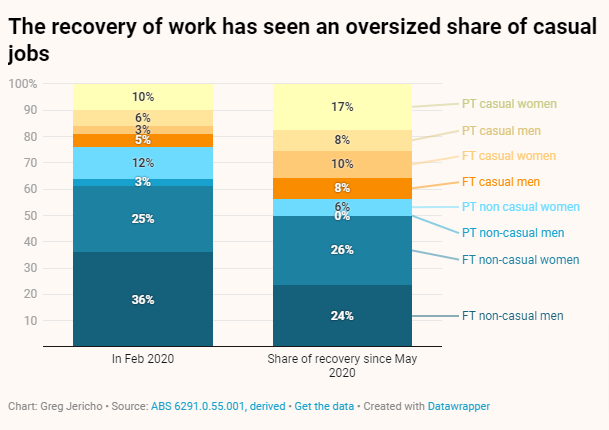
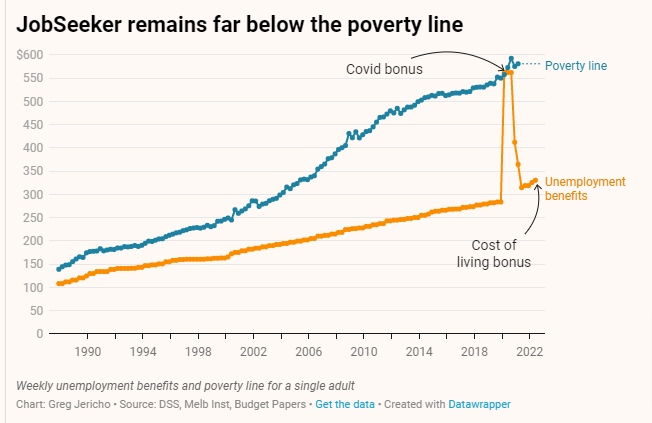
    Labour market and fiscal policy director, Greg Jericho writes in his Guardian Australia column that the recovery from the depths of the pandemic has overwhelmingly been on the backs of casual workers. It also has seen a large increase in the gap between people on JobSeeker and the number of unemployed. The rise of low paying, insecure work that has helped bolster the employment figures has also meant people who are working but still earning less than enough to keep out of poverty is remaining high.


    You might also like

    Dutton’s nuclear push will cost renewable jobs

    by Charlie Joyce

    Dutton’s nuclear push will cost renewable jobs As Australia’s federal election campaign has finally begun, opposition leader Peter Dutton’s proposal to spend hundreds of billions in public money to build seven nuclear power plants across the country has been carefully scrutinized. The technological unfeasibility, staggering cost, and scant detail of the Coalition’s nuclear proposal have

    Commonwealth Budget 2025-2026: Our analysis

    by Fiona Macdonald

    The Centre for Future Work’s research team has analysed the Commonwealth Government’s budget, focusing on key areas for workers, working lives, and labour markets. As expected with a Federal election looming, the budget is not a horror one of austerity. However, the 2025-2026 budget is characterised by the absence of any significant initiatives. There is

  • The Economic Benefits of High-Quality Universal Early Child Education

    The Economic Benefits of High-Quality Universal Early Child Education

    by Matt Grudnoff

    Expanded ECEC services would provide a badly-needed boost to Australia’s economic recovery from COVID-19.

    A universal ECEC system should be viewed as a fundamental goal for the future Australian economy. Achieving the superior quality and economic benefits of the Nordic systems cannot be done instantly, of course. But our ECEC policies should be reoriented and expanded, with a universal, publicly-delivered, high-quality, and affordable system akin to the Nordic benchmark as its end goal. That will require more substantial investments in ECEC funding, and its reallocation toward the not-for-profit and public facilities which deliver the best quality, and the largest economic benefits.


    Full report

    Share

  • House prices means interest rates do not need to rise much to inflict great costs

    Originally published in The Guardian on April 7, 2022

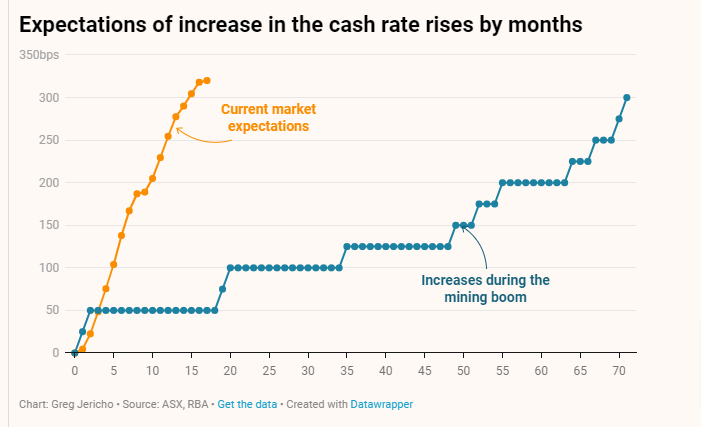
    The more than a decade long period of the Reserve Bank going without raising interest rates looks set to end. Rising inflation and the unwinding of the pandemic restrictions and border closures means that the emergency cash rate of 0.1% will soon go up. But at the moment the market expects before the end of next year that it will rise to above 3%.

    But while that may have been a neutral rate in the past, the Centre’s Fiscal and Labour Market Policy Director Greg Jericho, notes in his column in Guardian Australia, recent surges in house prices means such a rise would place an extreme burdon on mortgage payers – one not conducive to an economy still in recovery. 

    It took nearly 6 years during the mining boom for the RBA to raise the cash rate by 300 basis points; currently the market anticipates the same rise occurring in 17 months.

    That would massively limit economic growth for little purpose at a time when wage rises remains below inflation, and rather unlikely to occur given the Reserve Bank’s recent hesitancy to slow the economy until real wage again start rising.


    You might also like

    Dutton’s nuclear push will cost renewable jobs

    by Charlie Joyce

    Dutton’s nuclear push will cost renewable jobs As Australia’s federal election campaign has finally begun, opposition leader Peter Dutton’s proposal to spend hundreds of billions in public money to build seven nuclear power plants across the country has been carefully scrutinized. The technological unfeasibility, staggering cost, and scant detail of the Coalition’s nuclear proposal have

  • A slap-dash budget revealing a government with no idea why it is in power

    Originally published in The Guardian on March 31, 2022

    This year’s budget was transparently targeted towards the May election.

    But as Fiscal and Labour Market Policy Director, Greg Jericho notes in his Guardian Australia column, the slap-dash and short-term nature of the measures reveals this government has lost any real reason for governing.

    From the extra bonus of the low-middle income tax offset with no taper, which is now being used by businesses to argue against raising the minimum wage and the relative lack of concern about those in poverty while trying to exist on JobSeeker, this budget has all the hallmarks of an effort made up at the last minute and where poll numbers were more important than any economic figures.


    You might also like

    Commonwealth Budget 2025-2026: Our analysis

    by Fiona Macdonald

    The Centre for Future Work’s research team has analysed the Commonwealth Government’s budget, focusing on key areas for workers, working lives, and labour markets. As expected with a Federal election looming, the budget is not a horror one of austerity. However, the 2025-2026 budget is characterised by the absence of any significant initiatives. There is

    Dutton’s nuclear push will cost renewable jobs

    by Charlie Joyce

    Dutton’s nuclear push will cost renewable jobs As Australia’s federal election campaign has finally begun, opposition leader Peter Dutton’s proposal to spend hundreds of billions in public money to build seven nuclear power plants across the country has been carefully scrutinized. The technological unfeasibility, staggering cost, and scant detail of the Coalition’s nuclear proposal have

  • Alison Pennington: Budget billions wasted as real wages go backwards

    Originally published in The New Daily on March 30, 2022

    The federal government’s budget would have us believe that the cost of living is a sudden problem because of higher oil prices.

    But the real reason people are feeling the pinch is because their real wages are going backwards.

    The budget forecasts wage growth of 2.75 per cent in 2021-22, below inflation which is forecast to grow by 4.25 per cent. That’s a real wage cut of 1.5 per cent.

    The budget will increase the low-and-middle-income tax offset, but then scrap it at the end of this financial year. The fuel excise will be reduced for six months.

    Complex tax-bracket-shifting schemes are a good way to distract from powerful wage suppression policies. While we’re calculating “how much do I get”, these policies entrench insecure work, cap public sector pay, and stop collective bargaining. These measures hit workers every pay packet, not just at tax time.

    The amount workers get from the tax cuts is nothing compared to normal wage increases. For the 15 years to 2012, private-sector wages grew about 3.5 per cent per year. For someone on $70,000, that’s about $2500 more in one year.

    Distracting the income-strapped

    This budget is about trying to distract the income-strapped with temporary solutions that do nothing to help in the long-run. Alongside time-bound tax cuts are $250 one-off payments to income support recipients – thousands of people who permanently languish below the poverty line.

    The government is also hoping people believe in magical free-market fairies – that lower unemployment will finally unlock wages growth. As though holding a job automatically equips workers with bargaining power.

    The “record funding” fairies were out in full force, too. The Treasurer says “record funding” has been allocated in schools, hospitals, mental health, aged care, women’s safety and disability health. But if you reduce spending to rock-bottom, every marginal increase in spending with population growth can be called “record funding”.

    If it’s not enough funding to meet demand, then it can still be “record funding” for some. Shockingly, public school funding will be cut by $560 million over the next three years. Meanwhile, JobKeeper-subsidy-dripping private schools will get $2.6 billion more over the forward estimates. It’s not a budget without blows.

    Cuts to workers’ pay

    Worse, this budget signals more cuts to workers’ pay. The budget has earmarked reducing legislated minimum redundancy payments for part-time workers. This will disproportionately affect women.

    Women’s chronically low wages and poor job quality receive no attention. Hundreds of thousands of women in underfunded healthcare and social services need government to front up and fund their pay increases. This budget is proof the biggest barrier to Australian women’s progress isn’t glass ceilings, but their own government.

    This government will balls up any opportunity to address structural gender inequality. A new paid parental leave (PPL) scheme will combine the paltry two-week Dad and Partner Pay with the existing 18-week program for a combined 20 weeks. Packaged as empowering “family choice”, it will remove any incentive for fathers to take leave.

    PPL payment at minimum wage will continue to push women into primary caring roles. This is because men earn almost one-third more than women on average. That’s not women’s “choice”.

    Governments have wage-booting tools to deal with the higher cost of living. Across the ditch, New Zealand just increased the minimum wage by 6 per cent, recognising its frontline lowest-paid workers have offered the most in the pandemic, and been hit the hardest.

    Genuine cost-of-living help overlooked

    Along with boosting minimum wages, there are other options for helping workers deal with high inflation. The government could lower the cost of living by ending fee-for-service practices in all the areas they fund – child care, aged care, and disability care. Under the current government, out-of-pocket healthcare costs have increased almost three times more than CPI.

    And there’s not much hope for youth in this budget. Presented with a future of declining living standards, political dysfunction and ecological catastrophe, young people are given just $206 million in mental health funding. They can talk to someone on the phone while the world burns.

    The bottom rungs on the economic-opportunity ladder have been eliminated and youth can’t get up. Tens of thousands of educated capable youth languish in dead-end jobs. Sacrificed by a government that would rather turn unemployment into a misery industry than to create secure, career-building jobs.

    Billions of waste

    The government is wasting billions of dollars paying off their friends in business without conditions to invest in higher wages. Before this Budget, $291 billion in public spending was ploughed into a “business-led recovery” from COVID. On businesses responsibility to reinvest post-war record-high profits, there’s an eery silence.

    And in this budget, we have zero assurances new business subsidies will be invested in the real economy – people, capital, research – rather than more profit-padding.

    On budget eve, Morrison attempted to hat-tip a bygone conservative era. He said “families” will be key to winning the upcoming election. But he never invested in them, instead putting them in a pressure cooker of record-low wage growth and high living costs.

    The government was struck by enormous luck this budget. Extra revenue to play with and they’ve thrown it all away. Hundreds of billions in government spending and no era-defining economic reforms.

    Cos-of-living pressures wouldn’t be as acute if people had almost a decade of normal wages growth. But the truth is, the government has pursued wage suppression over the entire nine years it has been in power.


    You might also like

    Commonwealth Budget 2025-2026: Our analysis

    by Fiona Macdonald

    The Centre for Future Work’s research team has analysed the Commonwealth Government’s budget, focusing on key areas for workers, working lives, and labour markets. As expected with a Federal election looming, the budget is not a horror one of austerity. However, the 2025-2026 budget is characterised by the absence of any significant initiatives. There is