Author: admin

  • Vital Signs

    Vital Signs

    Indicators of Gender Inequality in Australia

    The Centre for Future Work has partnered with HESTA, the industry super fund for workers in health care and community services, to prepare a comprehensive report on the economic and social status of women in Australia today. The report shows that while progress has been made in some key areas, women continue to confront systematic barriers to their full participation in paid work, fair pay, retirement security, safety, and recognition.

    The report, “Vital Signs,” was published by HESTA as part of the fund’s ongoing efforts to address the all-around economic and social well-being of its members – 80% of whom are women. As HESTA’s CEO, Debby Blakey, put it, the systematic pattern of economic and social inequality follows women right into retirement: “Women, particularly those working in health and community services, often work in part-time or casual roles and are often lower paid. This perpetuates the gender pay gap, ultimately leaving them with less money in super.”

    The Centre for Future Work assisted with the economic and statistical research input to “Vital Signs.” Please see the announcement by HESTA of the report’s release.


    Full report

    Share

  • University-to-Job Pathways Key to Boosting Graduate Employment Outcomes

    University-to-Job Pathways Key to Boosting Graduate Employment Outcomes

    Share

    New research shows active strategies to directly link university degrees to a job are needed, to better support university graduates as they negotiate a rapidly changing labour market.

    The report, by the Australia Institute’s Centre for Future Work, shows that employment outcomes for university graduates have deteriorated significantly since the Global Financial Crisis, with only 73% of recent university graduates finding full-time employment within 4 months of graduating – down from 85% in 2008.

    Key Findings:

    • At the individual level, a university degree is still very valuable: people who hold a university degree are more likely to be employed, more likely to be employed in a stable job, and earn higher average wages and salaries. Half of new jobs created in the coming 5 years will require a degree.
    • However, many recent graduates report being underemployed or in insecure jobs that do not utilise their specific skills—including graduates who studied technical skills or STEM subjects.
    • The report makes 9 recommendations to improve university-to-work transitions for future graduates, including establishing a national higher education planning capacity, and creating a timely and high-quality labour force information system.

    Alison Pennington, Senior Economist, Centre for Future Work:
    “Employment outcomes for university graduates have deteriorated significantly since the GFC,” says Alison Pennington, Senior Economist at the Centre for Future Work and co-author of the report.

    “Finishing tertiary education and finding a job in your field is a difficult and haphazard experience, which is leaving many graduates in jobs that do not fully, or even partially, use their hard-won and expensively acquired skills.

    “Vocational degrees, which are tied to specific occupations like health care, engineering or teaching, have the best employment placement rates. As seen in these professions, directly linking degrees to jobs through paid placements, occupational licensing and accreditation would greatly improve the situation of graduates.

    “A hands-on and direct approach that channels graduates directly into relevant career opportunities is needed. Australia could learn a lot from other countries, especially in Europe, where this is already being achieved through forecasting future skill requirements and planning higher education offerings accordingly.”

    Noel Edge, Executive Director of Graduate Careers Australia:
    “The overwhelming message from this report by the Centre for Future Work is the need for further research in graduate employment,” says Noel Edge, Executive Director of Graduate Careers Australia.

    “Research to explore the emerging work environment for tertiary education students in Australia, beyond basic government labour-market forecasting and graduate outcomes reporting, simply does not exist.”

    The report was commissioned by Graduate Careers Australia.


    Related research

  • Million jobs not what it used to be: new report

    Million jobs not what it used to be: new report

    Share

    Prime Minister Scott Morrison claims that the pace of job creation under the Coalition Government – 1.1 million net new jobs in 5 years – is an achievement, however, the actual amount of new work added in the economy has not even kept up with population growth.

    New analysis of labour market performance released today by The Australia Institute’s Centre for Future Work, shows Australia’s job creation performance over the past five years has been weak relative to population growth and compared to past periods of history.

    “A million jobs in five years sounds like an impressive figure, but there are now over 20 million Australians of working age, and our population is growing very rapidly. A million new jobs every five years, isn’t even enough to keep up,” says Dr. Jim Stanford, Director of the Australia Institute’s Centre for Future Work.

    “A closer look at the evidence shows that both the quantity and the quality of work being created in Australia’s labour market is inadequate to the needs of our growing population, and highlights the role part-time work has played in inflating the apparent total number of jobs created.

    “Part-time employment has accounted for almost half of all new work created since 2013. Without the this rapid expansion of part-time work, which converts a given amount of hours of work into more jobs, the growth in employment would have fallen well below one million.

    “Due to soaring part-time employment, the number of hours worked by each worker has fallen to the lowest on record. Part-time workers also experience lower hourly wages, higher casualisation, and are more dependent on the minimum conditions of modern awards.

    “Along with the declining quality of jobs, our research shows an unprecedented stagnation of wages since 2013. With nominal pay lagging behind inflation, the real purchasing power of Australian works has declined for the first time since the recession-wracked 1990s.

    “This deterioration occurred in a time when the economy was growing steadily.  Instead of constituting some kind of economic triumph, the last five years really represents a lost economic opportunity.”


    Related research

  • Future of Collective Bargaining on the Brink

    Future of Collective Bargaining on the Brink

    Share

    Collective bargaining in private sector workplaces could be almost extinct by 2030 under current rules, new research from the Centre for Future Work shows.

    Australia’s enterprise bargaining system is rapidly crumbling in private sector workplaces, according to dramatic findings from a report released today by the Centre.

    Key Findings

    • the number of current enterprise agreements in private Australian businesses has collapsed by 46% since the end of 2013
    • the number of private sector workers covered by enterprise agreements has plunged 34% in the same time
    • in 2017, just 12% of employed private sector workers were covered by an enterprise agreement – down from 19% in 2013
    • the report provides a forward simulation of enterprise agreement-making if current trends in renewals, new agreements, and terminations continue, indicating that the total number of private sector enterprise agreements would fall by half (to below 6000) by 2023, and the proportion of private sector workers covered by agreements would fall below 6%.
    • a number of simultaneous trends have put the future of private sector bargaining in jeopardy: the sharp drop-off of renewals of expired enterprise agreements, the virtual disappearance of newly negotiated agreements; and a surge in terminations of agreements.

    “The dramatic downturn in collective bargaining in Australian workplaces reflects a number of simultaneous trends, creating a ‘perfect storm’ that jeopardises the future of private sector bargaining,” said Alison Pennington, economist at the Centre for Future Work.

    “It is no exaggeration to conclude that collective bargaining in private businesses will go extinct in coming years if these devastating trends are not reversed.

    “Our simulation shows that without a change in direction, the situation will only get worse. Less than 1700 agreements would survive to 2030, when only 2% of private sector workers would be covered by a collective agreement.

    “The accelerated collapse of enterprise bargaining in the private sector has been a key cause of the unprecedented weakness in wage growth experienced in Australia since 2013.

    “When workers have no collective voice or collective bargaining power, they have no chance of successfully negotiating better wage increases from their employers.

    “The evidence is overwhelming that Australia’s current system of collective bargaining is completely inadequate for representing workers in our evolving economy, with an increasingly fragmented labour market.

    “A viable collective bargaining system is essential to shared prosperity, but it will require far-reaching changes to the current rules to keep collective bargaining alive.”


    Related research

  • Workers’ Share of Economic Pie Shrinks Again

    Workers’ Share of Economic Pie Shrinks Again

    Share

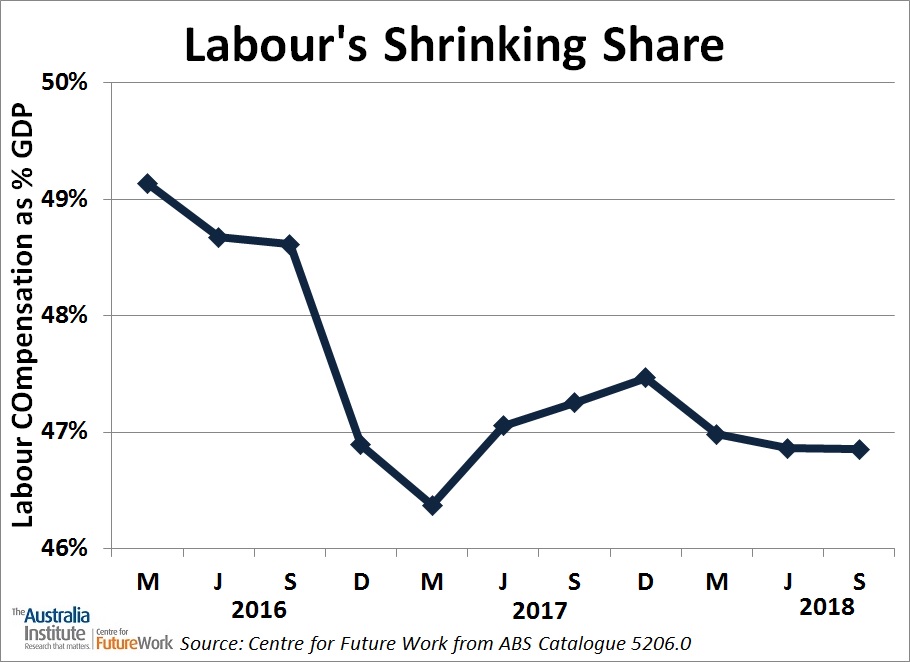
    For the third consecutive quarter, the share of Australian GDP paid out in wages, salaries and superannuation contributions to workers has shrunk.  Data for the September quarter of 2018, released by the Australian Bureau of Statistics on Wednesday, shows that labour compensation accounted for just 46.85% of total economic output – one of the lowest on record.

    That represents the third consecutive quarterly decline in relative labour compensation.

    Labour Share

    “A decline in the labour share of GDP indicates that workers’ wages and salaries are not keeping up with the growth of Australia’s economy,” explained Dr. Jim Stanford, Economist and Director of the Centre for Future Work. “And given that GDP growth itself was very anemic in the September quarter (expanding just 0.3%), that’s an especially weak result.”

    The labour share of GDP is now on track to set a new record low for 2018, below even last year’s average of 47.1% – which was the lowest annual average labour share recorded since the ABS began gathering modern GDP statistics in 1958.

    The weak growth of total wages reported in the GDP data was surprising, given the apparently strong increase in employment recorded over the past year. Labour compensation per employee increased by just 1.9% in the year ending in September, barely matching the increase in average consumer prices over that period. Wage growth in the private sector has been even slower.

    Despite a decline in the official unemployment rate over the past year, wages have been held back by a combination of high underemployment (workers who want more hours of work), the growing share of insecure and part-time jobs, and the erosion of traditional wage-setting institutions (including collective bargaining).

    With labour costs falling as a share of total output, profits have expanded. Corporate operating surpluses expanded by another 7.1% in the year to September, and reached their highest share of GDP (25.22%) since March, 2012.

    The Centre for Future Work reviewed the long-term decline of the labour share of Australian GDP in a recent research symposium, published in the Journal of Australian Political Economy.


    Related research

  • ‘Go Home On Time Day’ 2018: Australians Owed $106 Billion in Unpaid Overtime, Report Reveals

    ‘Go Home On Time Day’ 2018: Australians Owed $106 Billion in Unpaid Overtime, Report Reveals

    Share

    The 10th annual ‘Go Home On Time Day’ report by The Australia Institute’s Centre for Future Work estimates that Australian employees will work 3.2 billion hours of unpaid overtime for their employers this year, worth an estimated $106 billion in foregone wages.

    A national survey undertaken as part of the report has shown that the average Australian worker now puts in six hours of unpaid overtime per week, which equates to working an extra two months for free every year. That’s an increase from 5.1 hours on average in last year’s survey.

    “Australians are working more unpaid overtime than ever before, and they’re paying a high price for it,” said Troy Henderson, Economist at the Centre for Future Work.

    “Time theft takes many forms, including employees staying late, coming in early, working through their lunch or other breaks, taking work home on evenings and weekends or being contacted to perform work out of hours.

    “Most Australians wouldn’t dream of working for two months without pay. But it’s spread out over the whole year, and has become part of the implicit expectations of too many jobs. ‘Time theft’ has thus become endemic across the whole labour market.

    “Today we ask that all Australians go home on time and try to limit the unpaid overtime they work. And stopping time theft is ultimately the responsibility of employers and government, too, not just individual workers: employers must value and respect the leisure time of workers, and recognise that work cannot take over our entire lives.”

    The survey indicated that even part-time and casual workers – most of whom want more paid hours of work each week – are being asked to work unpaid overtime (averaging over 4 hours per week for part-timers and almost 3 hours per week for casuals). “Given the problem of underemployment and precarious work in today’s labour market, it is especially unfair that part-time and casual workers are being pressured to work for free,” Mr. Henderson added.

    This year’s Go Home on Time Day survey also included a special questionnaire on the use of digital surveillance and monitoring in Australian workplaces. 70% of respondents said their employers use at least one form of digital surveillance or monitoring, including cameras, GPS tracking, monitoring internet or social media activity or counting keystrokes, to monitor employees – and sometimes to discipline or even dismiss them.

    “Technology can have a strong positive effect in the workplace, but our research shows it is also being used in ways that increase pressure on employees and reduce the level of trust in workplaces,” Mr. Henderson said.

    “It’s clear from our research that millions of Australians are losing out to time theft. Both underemployed workers, and those who work too much, are giving up their precious time for free. All Australian workers have the right to go home on time.”


    Related research

  • Secret Weapon Overlooked in Fight Against Financial Misconduct

    Secret Weapon Overlooked in Fight Against Financial Misconduct

    Share

    A potent tool for cleaning up misconduct in the industry is being overlooked by the Royal Commission into financial services.

    The Centre for Future Work has proposed to the Commission that a system of sector-wide collective bargaining in the financial industry could establish clear and ethical benchmarks for compensation, avoiding the problem of ‘conflicted remuneration’, which is behind much of the misconduct the Royal Commission has exposed.

    The Centre for Future Work’s submission to the Royal Commission proposes a uniform compensation system, to apply across the whole industry, consistent with the principles of ethical banking:

    • Uniform compensation can be achieved via a sector-wide collective bargaining system, in which employer and union representatives negotiate standard compensation patterns to apply to all participants across the industry.
    • Compensation in each job to be tied to qualifications and experience; separate pay grids could be specified in various branches of finance (including major banks, insurance, superannuation, and financial advice).
    • Clear and enforceable limits on sales- or revenue-based incentives would be specified – eliminating what the Royal Commission has confirmed is a key motivation for misconduct.
    • Instead of depending solely on government regulators to stop misconduct, enforcement of compensation standards would become part of the regular administration of the collective agreement.

    “At present, flawed pay systems create perverse incentives for banks and brokers to push debt, insurance, and financial services to Australians,” says Dr. Jim Stanford, Director of the Centre for Future Work.

    “Financial professionals can reap tens or hundreds of thousands of dollars in commissions, bonuses and so-called ‘introducing’ fees; top executives pocket millions.

    “It is inevitable that these incentives lead sales staff and executives to sidestep or ignore basic rules and standards such as ‘know your client’ rules, fee transparency and responsible lending.

    “Consumers, many of them vulnerable, end up with expensive commitments they don’t need or – in many cases – even understand.

    “Under a sectoral agreement, hundreds of managers, union officials and delegates throughout the financial industry would be responsible for enforcing the ethical pay practices spelled out in the agreement.

    “Unfortunately, Australia’s current restrictive industrial relations laws generally prohibit collective bargaining on a multi-firm or sector-wide basis.

    “These restrictions are unusual. Most industrial countries permit, and even encourage, multi-firm, pattern, or industry-wide bargaining as an efficient way to determine consistent benchmarks for pay and conditions, and ensure that ongoing economic and productivity growth translates into rising living standards.”

    The Centre’s submission argues these restrictions on sector-wide bargaining should be reconsidered in light of the pervasive pattern of financial misconduct – and the key role of perverse compensation systems in motivating that misconduct.

    “Sectoral collective bargaining could help reform compensation and reduce financial misconduct on a uniform, industry-wide basis,” Stanford said.

    “The Royal Commission should explore standardised sector-wide collective agreements as a promising response to the problems it has documented, and the Commonwealth Government should eliminate its unusual restrictions on collective bargaining to allow this important reform.”

    Related research

  • Workers’ slice of Australian economic pie gets smaller

    Workers’ slice of Australian economic pie gets smaller

    Share

    As corporate profits continue to climb, new research from the Centre for Future Work shows the share of Australian GDP paid out to workers is hovering at a post-war low.

    The Australia Institute’s Centre for Future Work has today published a new research symposium documenting how workers’ slice of the national economic pie continues to get smaller.

    Key findings:

    • From peak levels of 58 per cent of GDP in the mid-1970s labour compensation — including wages, salaries, and superannuation contributions — declined to just 47 percent in 2017, their lowest level since 1960.
    • Real wages have consistently lagged behind the ongoing growth in labour productivity, meaning workers are not getting paid enough to buy back the goods and services they produce.
    • The loss of labour’s share of GDP translates into the redirection of over $200 billion in income per year from workers to other groups in society (mostly corporations).

    “In recent years, wages have barely kept up with consumer price inflation – and for many workers, they have fallen behind,” said Dr. Jim Stanford, Director of the Centre for Future Work.

    “The fact that the workers’ slice of the economic pie continues to get smaller speaks volumes about the lopsided power imbalance in today’s labour market.

    “The decline in Australia’s labour share from the 1970s peak to the present, ranks among the worst of all OECD countries, even worse than the United States.

    “Almost the entire decline in the labour share has been reflected in a corresponding increase in the share of GDP going to corporate profits – especially the financial sector.

    “In short, while the workers’ share has continued to get smaller, the share of corporate profits has continued to get larger.

    “By comparison, in some countries the labour share has been stable or rose during the same period, disproving the claim that this trend is somehow ‘universal’ or ‘inevitable’.

    “Without urgent measures to strengthen labour standards and protections, including stronger minimum wages and a restoration of meaningful collective bargaining, this decline will almost certainly continue.

    “The company tax cuts for big business now being proposed by the federal government are just the icing on top of an already-rich cake.”

    This research resulted from a special panel of experts convened by the Centre for Future Work, at the Society for Heterodox Economists conference at UNSW in Sydney last December. The papers from that panel have been peer-reviewed, and are published this week in the Journal of Australian Political Economy.

    Authors contributing to the symposium include Dr.David Peetz (Griffith University), Dr. Shaun Wilson (Macquarie University), Dr. Margaret Mackenzie (Economist, Australian Council of Trade Unions), and Dr. Jim Stanford (Economist and Director of the Centre for Future Work).


    Related research

  • Penalty rate cuts fail to ignite jobs boom

    Penalty rate cuts fail to ignite jobs boom

    Share

    Reduced Sunday and holiday penalty rates for retail and hospitality workers failed to ignite the boom in employment as promised by employer groups who supported the change.

    A new report from The Australia Institute’s Centre for Future Work examined employment and working hours in the retail and hospitality industries in the year since penalty rates were first cut.

    The report found, since the initial penalty rate reduction imposed by the Fair Work Commission on 1 July 2017:

    • The retail sector in particular performed very badly relative to the rest of the economy.
    • Total employment was unchanged in the year ending in May 2018, continuing a long-term trend of employment stagnation.
    • Full-time employment declined by 50,000 positions.
    • Average weekly hours of work declined by more than a full hour, and the underemployment ratio (share of workers who want more hours) grew almost 2 percentage points.
    • The hospitality sector (accommodation and food services) experienced similar results, including weak job-creation, a loss of full-time employment, shorter average hours of work, and higher underemployment.

    “Far from experiencing a jobs boom, the retail and hospitality sectors have significantly underperformed the rest of the economy in terms of both hiring and working hours,” says Dr. Jim Stanford, Director of the Centre for Future Work.

    “Most industries where penalty rates were unchanged did far better at job-creation than the two sectors where penalty rates were cut.

    “Employer representatives argued that reducing labour costs for work on Sundays and holidays would spur a big expansion in employment, one group even predicted 40,000 new jobs. Our report found that was simply not the case.

    “Based on a number of criteria, the retail and hospitality sectors performed among the worst of any Australian industries in the year since penalty rates were first cut.

    “While lower penalty rates are not the cause of the poor performance, our research certainly disproves inflated claims by employers and government that cutting labour costs would unleash a jobs boom.

    “If we really want more jobs, we should boost wages, improve job security, and strengthen purchasing power throughout the economy. Cutting penalty rates does the opposite.”


    Related research

  • Manufacturing Rebound Could Be Cut Short By Skills Shortage

    Manufacturing Rebound Could Be Cut Short By Skills Shortage

    Share

    After years of decline, Australia’s manufacturing industry is finally recovering – adding almost 50,000 jobs in the last year, one of the best job-creation records of any sector in the whole economy. But that recovery could be cut short by growing shortages of skilled workers, according to a new report on vocational training in manufacturing.

    The new report from the Centre for Future Work identifies key factors behind the rapid emergence of skills shortages in manufacturing, including:

    • The sector’s ageing workforce, creating a looming demographic transition for skilled worker
    • The highly specific nature of manufacturing skills (across sectors and occupations), creating difficulty for workers moving from between shrinking sectors to growing sectors
    • The need for new skills and ongoing training as companies adopt advanced manufacturing techniques and new digital technologies.

    “Manufacturing is again making a positive contribution to Australia’s economic progress after over a decade of decline. We don’t want to squander this potential,” said Dr. Jim Stanford, Director of the Centre for Future Work.

    “If Australia doesn’t get its act together on vocational training, this will be a wasted opportunity for manufacturing.

    “Recent experiments with market-based vocational training have been a waste, they have damaged confidence in the skills system among both potential students and employers.

    “Stable, well-funded, high-quality public institutions must be the anchors of any successful VET system.

    “Public institutions are the only ones with the resources, the connections, and the stability to provide manufacturers with a steady supply of world-class skilled workers.

    “No sector feels the pain of the failure of vocational training more than manufacturing, precisely because advanced skills are so essential for the success of advanced manufacturing techniques.

    “Manufacturing stakeholders need to work together to strengthen vocational education and training.”

    Key principles for rebuilding vocational education in manufacturing, discussed in the report, include:

    • A greater reliance on courses and apprenticeships through public-sector TAFE (rather than private providers)
    • Phased-in retirement programs to allow senior workers to pass on their skills to new apprentices
    • Inclusion of provisions guaranteeing access to further training in industry awards and enterprise agreements.

    The report was co-authored by Dr. Jim Stanford and Dr. Tanya Carney and prepared for the Second Annual National Manufacturing Summit at Parliament House on 26 June 2018.

    The National Manufacturing Summit engages leading representatives from all parts of Australian manufacturing: businesses, peak bodies, unions, universities, the financial sector, suppliers and government. The growing problem of skills shortages is a priority focus for this year’s Summit.


    Related research