Tag: Greg Jericho

  • With household incomes set to fall, we need to think about what matters in the economy

    Originally published in The Guardian on November 10, 2022

    The current tightening of monetary policy is undoubtedly having an impact. While it may take some time for the slowing of inflation to flow through to the official CPI figures – especially given the level of inflation that is being imported – the economy is set to slow drastically.

    As Labor Market and Fiscal Policy Director Greg Jericho notes in his Guardian Australia column the Reserve Bank in last week’s Statement on Monetary Policy, has forecast GDP growth to slow to levels normally associated with recessions – even if the RBA is not actually forecasting a recession.

    However, in one area the RBA is not hedging at all – that of real household disposable income. This measure, which essentially examines the living standards of the average household, is forecast to decline at a pace as bad as any experienced in the past 60 years.

    While a fall in household incomes was always expected given the abnormal level of stimulus that occurred during the pandemic, the fall is predicted to be much greater than just going back to where we were. The Reserve Bank predict incomes will fall well below the pre-pandemic trend level.

    That such a drastic fall has received little coverage highlights that the orthodox commentary and debate around the economy largely focuses on aspects that minimise workers and households in place of corporations and the “broader” economy of GDP.

    The cost of taming inflation is too often discussed in terms of whether it will send the economy into a recession, without examining if that measure misses the real-life experience of most people.

    If the RBA forecast comes true, inflation will have been brought back to the RBA target, GDP will have kept growing, but household living standards will have plunged.


    You might also like

  • Would further interest rate rises do more harm than good?

    Originally published in The Guardian on November 3, 2022

    In the past 7 months, the Reserve Bank has increased the cash rate by 275 basis points. That is as fast as any time since the RBA became independent. Given the pace of inflation growth, the rises are not wholly without cause, but as policy director, Greg Jericho notes in his Guardian Australia column the main drivers of inflation are now easing, and wages are yet to take off. In that case, should the RBA continue to raise rates given it will only slow the economy further?

    Over the past year, the main driver of inflation has been house prices accounting for a quarter of the 7.3% rise in the CPI. And yet we know that house price growth is now either slowing dramatically or even falling in some areas. The RBA has also noted that commodity prices are falling and supply-side issues are being dealt with and that these aspects, which are not influenced by interest rates, will reduce inflation next year.

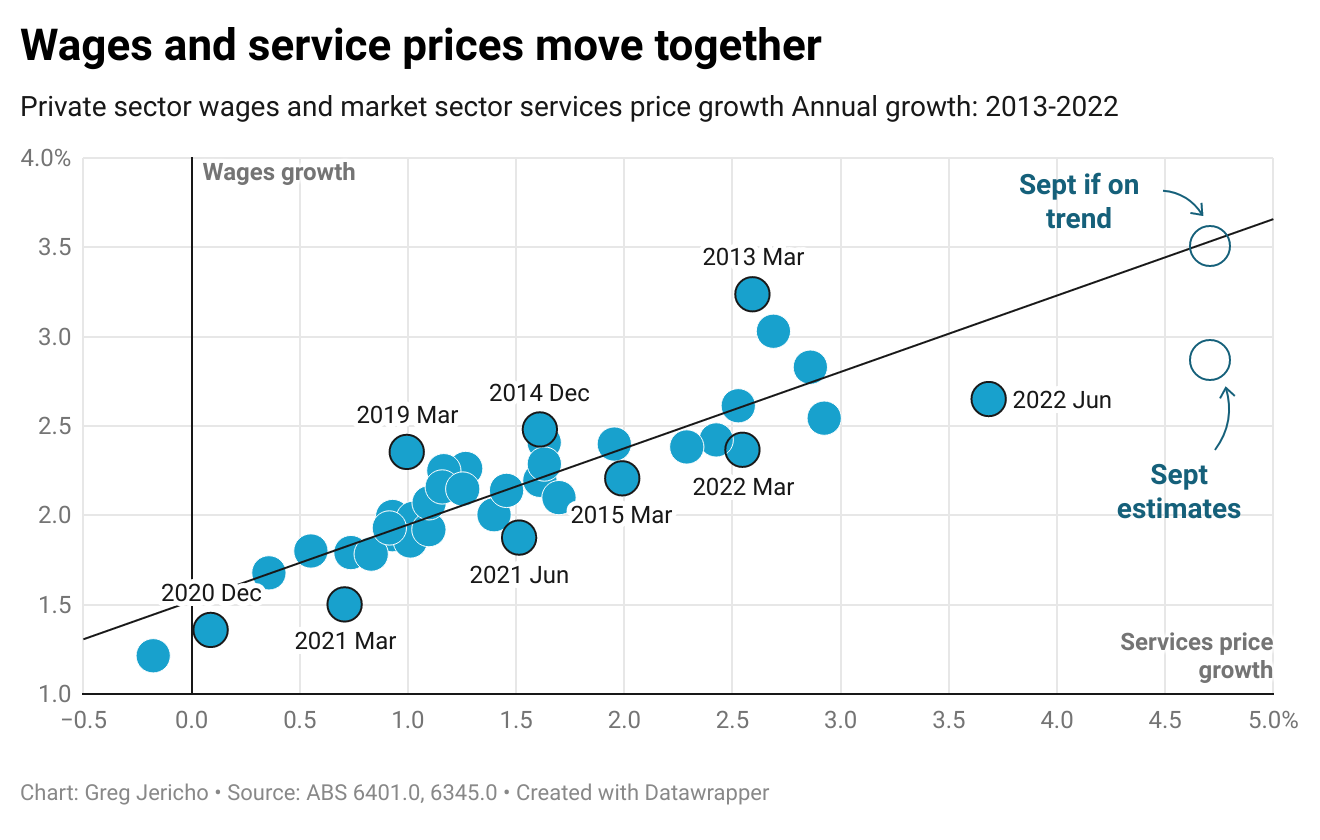
    At the same time, the Reserve Bank continues to sound warnings of a wage-price spiral despite any evidence of such a thing occurring. Indeed the latest CPI figures show that overwhelmingly inflation is driven by the price rises of goods rather than services. This is important because service prices and wages are strongly linked.

    More rate rises will certainly continue to reduce demand in the economy as the cost of servicing a mortgage rises. But to what end? The main factors driving inflation are easing, wages have not risen above 3% yet, let alone to a rate anywhere near inflation.

    Even if wages were to rise in line with the historical link with service prices, in September they would have risen 3.5% – a level very much consistent with inflation growth of between 2% and 3%. And yet we know that wages are unlikely to rise that fast. The most recent estimates have it closer to 2.8%.

    The great risk now is that further rate rises will only hurt the economy for little gain and see wages growth stunted before they even get to a level that would see real wages rising.


    You might also like

    Centre For Future Work to evolve into standalone entity

    The Centre for Future Work was established by the Australia Institute in 2016 to conduct and publish progressive economic research on work, employment, and labour markets. Supported by the Australian Union movement, the centre produced cutting edge research and led the national conversation on economic issues facing working people: including the future of jobs, wages

  • Inflation is soaring and real wages are plummeting

    Originally published in The Guardian on October 27, 2022

    On Wednesday the latest inflation figures showed that in the 12 months to September prices across Australia grew by 7.3% – the fastest rate since 1990.

    The biggest concerns about the figures are that inflation is rising fastest for items that are non-discretionary, which means people are unable to avoid paying them – things like food, energy bills, transport costs, and health costs. As Labour market and fiscal policy Director, Greg Jericho, notes in his Guardian Australia column low-middle income earners have to spend a greater share of their income on these items than the average, which means they are hurt hardest.

    The inflation figures also show that while house prices are still rising strongly, the rising interest rates are now starting to truly have an impact on rents. Rental prices across every capital city rose by more than 1% in the September quarter – the first time that has happened since 2007.

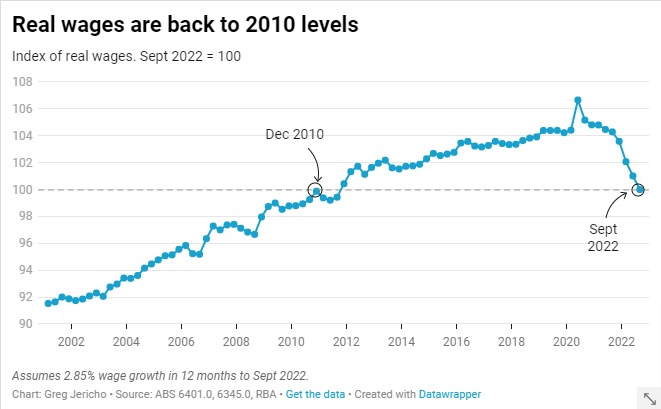
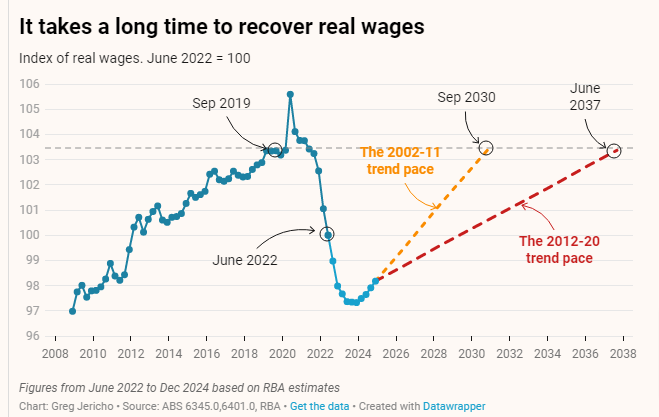
    But the real damage of inflation is seen in relation to wage growth. The Reserve Bank estimates that wages in the 12 months to September will have grown just 2.85%. This means people’s ability to buy things with their wages has fallen over 4% in the past year. This is a massive drop in real wages and unfortunately, it is expected to continue at least until the middle to end of next year.

    Right now real wages are back where they were 12 years ago. It is a damning indictment of the Industrial Relations system that has been designed to keep wages down. The Government today has introduced the Fair Work Legislation Amendment (Secure Jobs, Better Pay) Bill 2022 which seeks to provide workers with greater power to bargain for better wages. Given the latest figures, it is clear how urgently the changes are needed.


    You might also like

  • The October 2022-23 Commonwealth Budget: A Good Start… But Rocky Times Ahead

    The October 2022-23 Commonwealth Budget: A Good Start… But Rocky Times Ahead

    The new Albanese Labor government has tabled a revised budget for the 2022-23 fiscal year, revising revenue and spending forecasts originally contained in the March budget (from the previous Morrison government), and providing new funding to support several new programs and policies.

    In this review of the budget, our team of Centre for Future Work researchers evaluates the budget’s assumptions and policy measures, from the perspective of workers and labour markets. The budget marks a clear change of emphasis from budgets over the previous decade: including explicit recognition of the need to strengthen wage growth, new funding for vital care sectors, and important investments in diversifying Australia’s industrial base.

    However, the budget also acknowledges the downside risk of a slowing world economy, which could engulf Australia in another recession — just three years after entering the COVID pandemic. Stronger fiscal measures and income supports will be required if the economy does enter a downturn. And deep problems such as falling real wages, entrenched poverty, and gender inequality will require stronger measures than are included in this first budget. Meanwhile, crucial fiscal decisions (including the regressive Stage 3 tax cuts for high-income Australians) have been deferred for a later date.

    In sum, the budget marks a good start on addressing many of Australia’s key economic, social, and environmental challenges. But much more will be needed – and the risking of looming recession will complicate this progress considerably.


    Full report

    Share

  • Inflation: A Primer

    Inflation: A Primer

    by Greg Jericho

    Over the past year, inflation has accelerated both in Australia and in most advanced economies, to rates much faster than have been observed for many years. Not unsurprisingly, this has caused much concern among people whose cost of living has risen abruptly. It has also created great challenges for policy makers: the risks of tackling higher inflation are high, given that the conventional response is to reduce aggregate demand, economic activity, and employment in order to “cool off” spending and thus reduce price pressures. This can mean that the “cure” can be worse than the “disease” – especially if, as occurred in the 1980s and 1990s, a recession follows efforts to constrain inflation.

    The Inflation Primer report investigates the history of Australian inflation and policy choices and provides a counter to the view that low inflation and the current inflation target is an unalloyed good. The period of inflation targeting has coincided with a strong shift of national income away from workers to company profits. It has also seen a tendency of the Reserve Bank to act decisively when inflation grows above the target and be much less active when, as we saw in the years prior to the pandemic, inflation slowed below the target range. The report also reveals that workers’ wages did not cause the current level of inflation  and yet workers are being urged to accept historic falls in real wages in order bring inflation back within the Reserve Bank target.

    Our review of the causes of current inflation points to some clear policy conclusions, that should be kept in mind by the government, the Reserve Bank, and other stakeholders as Australia continues to adjust to these new inflationary challenges:

    1. Inflation targeting in Australia since 1993 has not been “neutral”. Inflation missed the target from below, far more often than from above. Moreover, that period of inflation targeting (especially the sustained periods when inflation fell below the target) was associated with a massive transfer of income and economic power from workers to businesses. As the Commonwealth government undertakes its review of the RBA’s mandate and operations, these broad political-economic dimensions of monetary policy must be considered carefully. Monetary policy has not been a technocratic exercise, intended to maximise public welfare in a general sense. It clearly reflects and continues to reflect, value judgments and priorities placed on how the costs and benefits of inflation management are distributed across society.
    2. There is no evidence at all that a tight labour market, rising wages, or labour costs more generally have anything to do with the surge in inflation since the COVID pandemic. To the contrary, the evidence is clear that wages have had a dampening impact on inflation in this period. Recent inflation is clearly associated with a further expansion of business profits in Australia, to their highest share ever. Attacking inflation by aiming deliberately to increase unemployment and restrain wage growth even further, is a “blame-the-victim” policy that will only make workers pay even more for a problem they clearly did not create.
    3. The current surge of inflation reflects a “perfect storm” of unique factors (mostly global in nature) sparked by the COVID pandemic: which has been, after all, the most dramatic and painful event in the world economy since WWII. It should hardly be surprising that after-shocks from those events will be felt for some time, and the surge in global inflation is clearly one of them. Responding to this unique and unprecedented challenge by simply reciting a monetary playbook formulated in a fundamentally different era (the inflation of the 1970s) is not just inappropriate. It will, if pursued, lead to a painful and unnecessary global recession that will almost certainly engulf Australia, too.

    For all these reasons, the Reserve Bank and the Commonwealth government need to take a more careful, balanced look at the nature, causes, and consequences of the upsurge in inflation since the pandemic, before leaping to conclusions that are unjustified – and imposing policy responses that do more harm than good.


    Full report

    Share

  • Families change but the same problems remain

    Originally published in The Guardian on October 20, 2022

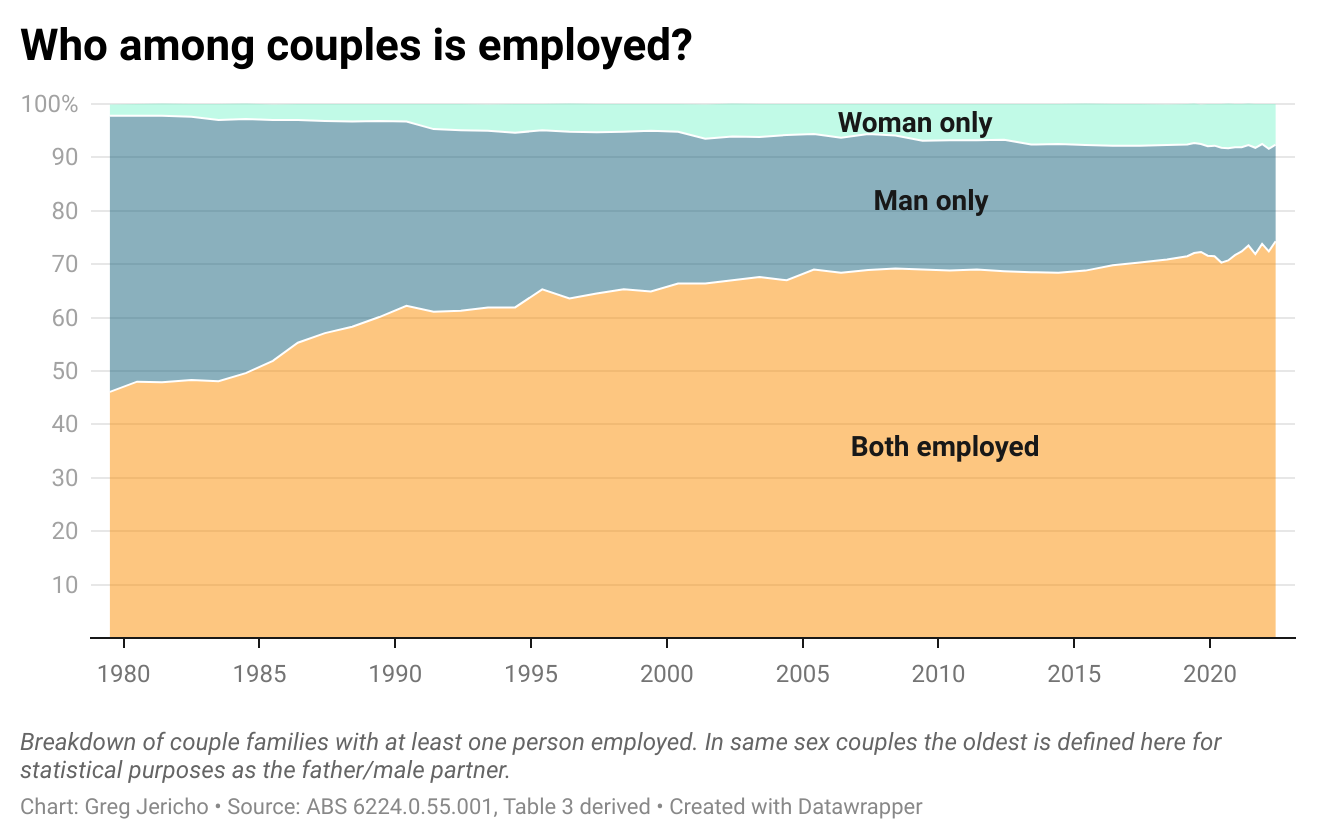
    The latest data from the Bureau of Statistics on families shows that more than ever before couples with dependants are both working.

    Labour market policy director, Greg Jericho, notes in his Guardian Australia column that over the past 40 years the make-up of families has shifted dramatically from ones with just one parent working to now more than 70% having both partners in employment.

    While this has mostly come from the great gains made by women since the 1970s that have seen changes to discrimination laws, child care and also societal norms to allow women to participate in paid work even once they have had children, it also highlights the rising cost of living pressures faced by most families.

    The times when a family on one income could be expected to buy a house are long gone. But the decade of weak wage growth and recent falls in real wages make living on one wage even more difficult.

    But the data reveals that men are still more likely to be the sole breadwinner and it confirms the labour force data that shows women remain much less likely than men to work full-time. This is a major reason why women in over 90% of occupations earn on average less than do men. It means that women remain at a heightened risk of income loss in the event of relationship breakdowns that can severely affect their standard of living, especially in retirement.

    The data also reveals that women remain very much the most likely parent in sole-parent families. Given the laws that now see such parents move from the parenting allowance to the lower-paying Jobseeker once their youngest child turns 8, this highlights the precarious nature over 800,000 women face as they attempt to survive as the sole parent.


    You might also like

    Centre For Future Work to evolve into standalone entity

    The Centre for Future Work was established by the Australia Institute in 2016 to conduct and publish progressive economic research on work, employment, and labour markets. Supported by the Australian Union movement, the centre produced cutting edge research and led the national conversation on economic issues facing working people: including the future of jobs, wages

  • With a global recession looming the cure of inflation looks to be worse than the disease

    Originally published in The Guardian on October 13, 2022

    This week the IMF released its latest World Economic Outlook. And the outlook is dire. Economic growth around the world was downgraded with recession-like conditions being predicted for many advanced economies including the USA, UK and much of the EU.

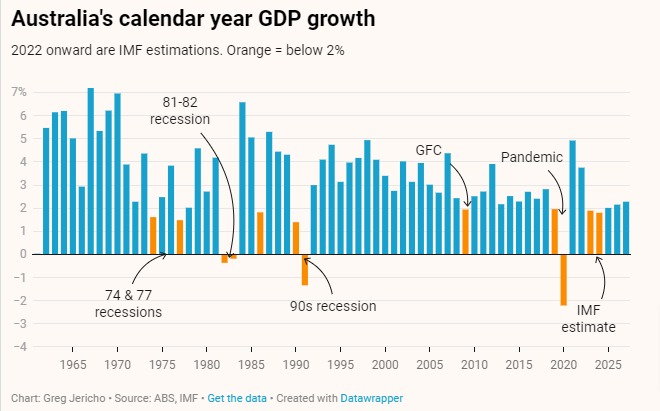
    As policy director, Greg Jericho, notes in his Guardian Australia column, the outlook is not much better for Australia. The IMF is now predicting that in 2023 and 2024 Australia’s GDP will grow less than 2%. Such meagre growth in the past has been consistent with periods of recession.

    The report should serve as a stark warning to central banks around the world that their efforts to limit inflation by sharply raising interest rates is becoming more and more likely to end with a recession and the resultant massive loss of jobs that will follow. Experience from the 1980s and 1990s where similar recessions followed extreme tightening of monetary policy suggests it can take a long time to reverse the damage.

    While the Reserve Bank is somewhat constrained because it needs to be mindful of the rate rises in the USA that weaken the value of the Australian dollar, the IMF report should cause them to weigh much more the costs of sharply slowing growth through interest rate rises.

    We know that current efforts to limit inflation growth are mostly involving workers taking a real wage hit. Having to endure rising unemployment and a recession after 2 years of already extreme falls in living standards would be disastrous, especially while profits continue to rise.


    You might also like

    Dutton’s nuclear push will cost renewable jobs

    by Charlie Joyce

    Dutton’s nuclear push will cost renewable jobs As Australia’s federal election campaign has finally begun, opposition leader Peter Dutton’s proposal to spend hundreds of billions in public money to build seven nuclear power plants across the country has been carefully scrutinized. The technological unfeasibility, staggering cost, and scant detail of the Coalition’s nuclear proposal have

  • The UK shows how bad the Stage 3 tax cuts will be

    Originally published in The Guardian on September 29, 2022

    This week the UK government introduced massive high-income tax cuts – cuts that are not even as bad as the Stage 3 tax cuts here in Australia. And the reaction by the market was brutal. Investors saw the tax cuts for what they were – a redistribution of national income from the poorest to the wealthiest, that provided no economic growth. As a result the value of the UK Pound plunged.

    Fiscal Policy Director, Greg Jericho, notes in his Guardian Australia column that there are big lessons for Australia.

    The Stage 3 tax cuts are a case of terrible economics masquerading as a growth strategy. Trickledown economics does not work, never has, and this week we have discovered that even the markets agree.

    Rather than destroy your tax base, governments need to care about sustaining a broad revenue base that works to reduce inequality and fund services and investments that drives productivity and helps those who most need it.

    Trickledown economics has never worked and was always just fraudulent spin designed to hide its real aim of giving rich and powerful people tax cuts at the expense of others.

    This week has shown that no one even believes the lie anymore.


    You might also like

    Centre For Future Work to evolve into standalone entity

    The Centre for Future Work was established by the Australia Institute in 2016 to conduct and publish progressive economic research on work, employment, and labour markets. Supported by the Australian Union movement, the centre produced cutting edge research and led the national conversation on economic issues facing working people: including the future of jobs, wages

  • They didn’t cause the inflation, but workers are expected to cure it

    Originally published in The Guardian on September 22, 2022

    Last week before the House Economics Committee, the Governor of the Reserve Bank made it clear that the current rise in inflation has nothing to do with wages growth. And yet he also made it clear he expects workers to bear the brunt of the cost that comes from slowing inflation.

    In his Guardian column, Policy Director Greg Jericho notes that given real wages have already fallen for 2 straight years any further falls will take workers’ purchasing power backwards to where it was more than a decade ago. This however is viewed as being “worse than the alternative” of inflation growth above 3%.

    He notes that over the past 2 years the profit margins of many industries, and most especially the mining industry, have risen and have themselves fuelled inflation. But company profits are never expected to suffer, wages however are always viewed as either the culprit of inflation or the means to reduce it. The vast increase in mining profits, largely due to the Russian invasion of Ukraine, also highlights the urgent need for a windfall profits tax.

    Using the RBA’s own estimates Jericho calcuates that by the end of next year real wages will be back at 2008 levels and even with the most optimistic outlook they will not return to 2019 levels until 2030.

    The Reserve Bank’s strategy of sharply increasing interest rates risk slowing the economy into a recession even though real wages are already falling faster and for longer than they have in modern times.


    You might also like

  • The latest data shows just how bad housing affordability is

    Originally published in The Guardian on September 15, 2022

    Since the Reserve Bank began raising interest rates in May, the housing market has very much come off the boil.

    But while the latest data from the ABS shows prices fell on average 2% across the nation in the June quarter, policy director Greg Jericho notes in his Guardian column that price remains well above what they were prior the pandemic.

    During the GFC the majority of the stimulus measures directed towards construction were on public works – most notably the Building the Education Revolution. During the pandemic, however, the Morrison government targeted the housing market with its HomeBuilder program in conjunction with the Reserve Bank’s cutting interest rates. These served to set fire to the market as prices soared and affordability plummeted.

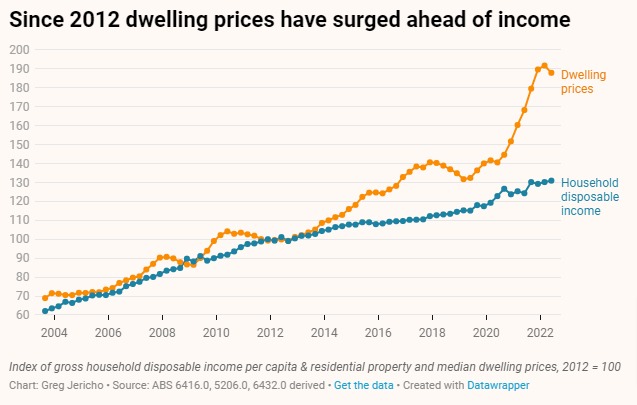
    In June 2020, the average dwelling price in Australia was $689,400. That was around 13.4 times the average annual household disposable income of $51,487. Now the average household disposable income is up to $56,129, while the average dwelling price is now some 16.4 times that at $921,500.

    Even worse, ten years ago the average dwelling price was just 11.4 times.

    Housing policy has for too long been driven by keeping prices rising, and combined with flat income growth, it has seen a generation of Australians left out of the housing market.


    You might also like

    Centre For Future Work to evolve into standalone entity

    The Centre for Future Work was established by the Australia Institute in 2016 to conduct and publish progressive economic research on work, employment, and labour markets. Supported by the Australian Union movement, the centre produced cutting edge research and led the national conversation on economic issues facing working people: including the future of jobs, wages