Tag: Greg Jericho

  • The Continuing Irrelevance of Minimum Wages to Future Inflation

    The Continuing Irrelevance of Minimum Wages to Future Inflation

    Minimum and award wages should grow by 5 to 9 per cent this year
    by Greg Jericho

    Updated analysis by the by the Centre for Future Work at the Australia Institute reveals that a fair and appropriate increase to the minimum wage, and accompanying increases to award rates, would not have a significant effect on inflation. The analysis examines the correlation between minimum wage increases and inflation going back to 1990, and finds no consistent link between minimum wage increases and inflation. It also reveals that such an increase to award wages could be met with only a small reduction in profit margins.

    The report, authored by Greg Jericho, based on previous work by both he and Jim Stanford finds that an increase to the National Minimum Wage and award wages of between 5.8% and 9.2% in the Fair Work Commission’s Annual Wage Review, due in June, is required to restore the real buying power of low-paid workers to pre-pandemic trends. The report also finds that this would not significantly affect headline inflation.

    Key findings of the report include:

    • Last year’s decision, which lifted the minimum wage and award wages by 3.75 per cent, offset the inflation of the previous year but still left those on Modern Awards with real earnings below what they were in 2020.
    • By June this year, the real value of Modern Award wages will be almost 4 per cent below what they were in September 2020
    • Despite increases in the minimum wage over the past 2 years above inflation, inflation fell by a combined 4.5 percentage points.
    • There has been no significant correlation between rises in the minimum wage and inflation since 1990.
    • Raising wages by 5.8 to 9.2 per cent this year would offset both recent inflation and restore real wages for award-covered workers to the pre-pandemic trend.
    • Even if fully passed on by employers, higher award wages would have no significant impact on economy-wide prices.
    • A 9.2 per cent increase in award wages could be fully offset, with no impact on prices at all, by a 1.8 per cent reduction in corporate profits – still leaving profits far above historical levels

    “Australia’s lowest paid workers have been hardest hit by inflation over the past 3 years. The price rises of necessities always hurt those on low incomes harder than those on average and high incomes. This analysis shows there is no credible economic reason to deny them a decent pay raise above inflation.” Jericho said.

    “It’s vital the Fair Work Commission ensure that the minimum wage not only keeps up with inflation but also returns the value to the real trend of before the pandemic.”


    The Continuing Irrelevance of Minimum Wages to Future Inflation


    Factsheet
    The continuing irrelevance of minimum wages to future inflation

    Share

  • Budget briefing paper 2025-2026

    The Centre for Future Work’s research team has analysed the Commonwealth Government’s budget.

    As expected with a Federal election looming, the budget is not a horror one of austerity. However, the 2025-2026 budget is characterised by the absence of any significant initiatives.  There is very little in this budget that is new other than the surprise tax cuts, which are welcome given they benefit mostly those on low-incomes. There are continuing investments in some key areas supporting wages growth, where it is sorely needed, and rebuilding important areas of public good. However, there remains much that needs to be done in the next parliament.

    This briefing paper reviews some of the main features of the budget, focusing on those aspects targeting and impacting on workers, working lives and labour markets.

    The establishment of a $1 billion Green Iron Investment Fund to provide capital grants to green iron projects is a significant investment. With $500 million of this fund going to the troubled Whyalla steelworks this investment should ensure ongoing integrity in the management of this vital industrial asset. We believe the government should take a significant ongoing stake in the ownership of the Whyalla steelworks. The $2 billion Green Aluminium Production Credit, to incentivise Australian aluminium smelters to switch to renewable electricity before 2036, is a necessary and welcome policy to assist the transition to a low emissions economy. Unfortunately, the credit is not available until 2028-2029.

    New and ongoing support for students in TAFE and in higher education are important cost-of-living measures while also making education and training more inclusive and accessible. There is some new funding for previously announced initiatives that support workers and wages growth and some funding for new wage increases in the female-dominated, and low-paid, aged care and early childhood education and care sectors; demonstrating the government’s commitment to addressing long-standing undervaluation of feminised care occupations. Continuing government support will be needed as the current Fair Work Commission review of awards to address undervaluation progresses.

    Other reforms in ECEC, along with previously announced changes to paid parental leave and carer payments, provide welcome, but belated, support for working parents and carers. It is disappointing to see that the opportunity has been missed to raise Job Seeker and Youth Allowances from their grossly inadequate levels.


    Full report

    Share

  • Chalmers is right, the RBA has smashed the economy

    Chalmers is right, the RBA has smashed the economy

    by Greg Jericho

    In recent weeks the Treasurer Jim Chalmers has been criticised by the opposition and some conservative economists for pointing out that the 13 interest rate increases have slowed Australia’s economy. But the data shows he is right.

    Last year the government announced it was considering removing its statutory power to overrule the Reserve Bank. Thankfully it has now reconsidered that move, and the actions of the RBA over the past year serve to remind everyone that it is far from infallible.

    In its May Statement on Monetary Policy the RBA looked ahead one month and estimated that in June the annual growth of household consumption would be 1.1%. When the national accounts were released last week, the actual growth was revealed to be just 0.5%.

    Now obviously economic forecasting is a bit of a mugs game, but household consumption makes up half of Australia’s economy and accounted for around 45% of all the growth in the economy over the past decade so it is pretty important. It is also the area of the economy most directly affected by interest rate rises. This error of forecasting suggests that the Reserve Bank has rather poorly misread just how greatly households had been impacted by the 13 rate rises that had taken the cash rate from 0.1% in April 2022 to 4.35% in November 2023.

    This error is crucial because the main reason the RBA raises rates is to reduce the ability of households to spend. Because you can’t tell your bank that you don’t really feel like paying your mortgage this month, interest rate rises force households to divert money that would have been spent on goods and services to paying your mortgage.

    The problem is when you are trying to slow down half of the economy so directly, if you overdo it the entire economy begins to fall. This is what happened in the early 1980s and 1990s when interest rates were raised sharply in order to slow inflation.

    And the private sector has already slowed so greatly that the only reason GDP rose in the past year was because of increased government spending.
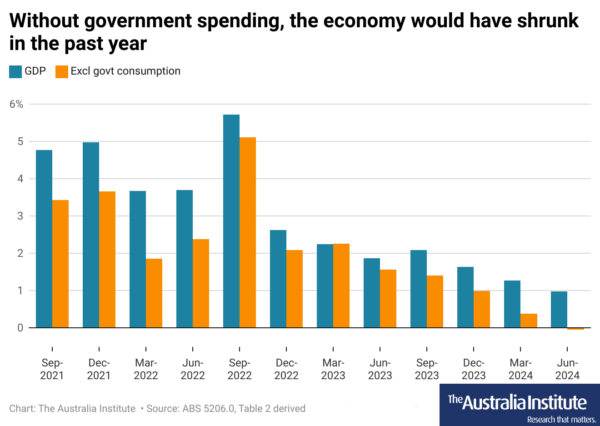
    That is not a sign of a strong economy, nor a sign of one, according to the assistant governor of the RBA, Dr Sarah Hunter, that “is running a little bit hotter than we thought previously”.

    Economies that are running a bit hot are ones in which households are spending a lot more than they were the year before because unemployment is falling and wages are rising well ahead of inflation. Instead we currently have a situation where unemployment has risen from 3.5% in June last year to the current level of 4.2%, household spending grew just 0.5% – well below the long-term average of 3% – and real wages in the past year rose just 0.1%.

    When asked about this discrepancy between reality and the RBA’s belief, the Governor of the Reserve Bank, Michele Bullock told reporters last week that

    …it’s the difference between growth rates and levels.

    She noted that “it’s true that the growth rate of GDP has slowed” but that “part of monetary policy’s job has been to try and slow the growth of the economy because the level of demand for goods and services in the economy is higher than the ability of the economy to supply those goods and services. So there’s still a gap there. So even though it’s slowing, we still have this gap.”

    In effect Bullock was telling people to stop worrying about the fact that household consumption was barely growing or that GDP only grew because of government spending or that GDP per capita has fallen for a record 6 consecutive quarters because the amount of consumption and GDP was too high.

    This could make sense – think of it like a car travelling on a 60km/h road. If it was travelling at 80km/h and slowed to 70km/h even though it was slowing it would still be going too fast.

    In essence this is what Bullock is arguing is happening to demand in the economy – it is slowing but overall there’s still too much of it.

    The only problem is that this is completely wrong.

    Consider the suggestion that the demand for goods and services is higher than the ability of the economy to supply those goods and services. One simple way to look at this is to see if the amount of goods and services bought per person is currently at a level consistent with the growth observed in the decade before the pandemic.

    This is actually not a major test – household consumption, along with most of the economy was rather weak in the 7 or 8 years before 2020. The RBA at the time actually was hoping Australians would spend more than they did, so you would expect in an economy with too much demand that the amount of things we are buying is well above the levels of that particularly weak period.

    But it is not.

    As we can see from the below graph, while household spending did quickly recover after the lockdowns in 2020 and 2021, by the time the RBA began raising interest rates our level of demand for goods and services was only back to the level consistent with the pre-pandemic growth.
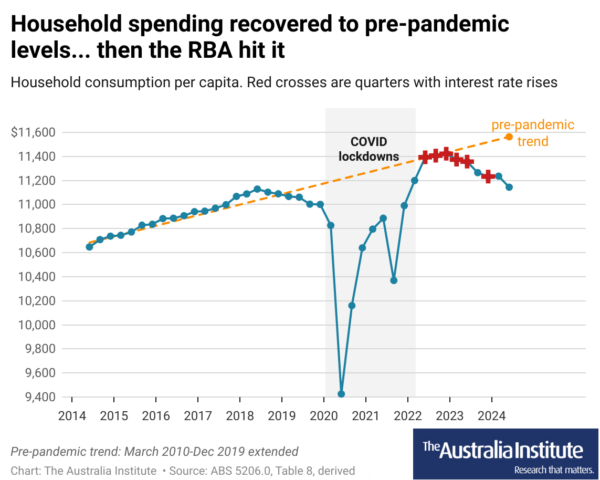
    Now yes you can argue the RBA was right to increase rates at that time – to ensure our spending didn’t keep zooming up in recovery. But by the time of the 10th rate increase in March 2023, household spending per person was already falling and 0.7% below the pre-pandemic trend. When the RBA raised rates for there 12th time in June 2023, the level of demand for goods and services was 1% below the pre-pandemic trend.

    At this point you might think the RBA had done enough. But after pausing for 4 months, the bank inexplicably raised rates for a 13th time in November 2023. At this stage household level of spending was 2.5% below the pre-pandemic trend.

    And because interest rate rises take months to worth through the economy we now find ourselves at a point where the level of household consumption per person is 3.8% lower than would have been expected had households merely kept increasing our consumption in line with the decade before the pandemic.

    In effect Australians are currently consuming almost the same amount of goods and services as they did in June 2018 and yet the head of the RBA would have us believe that is a case of excess demand.

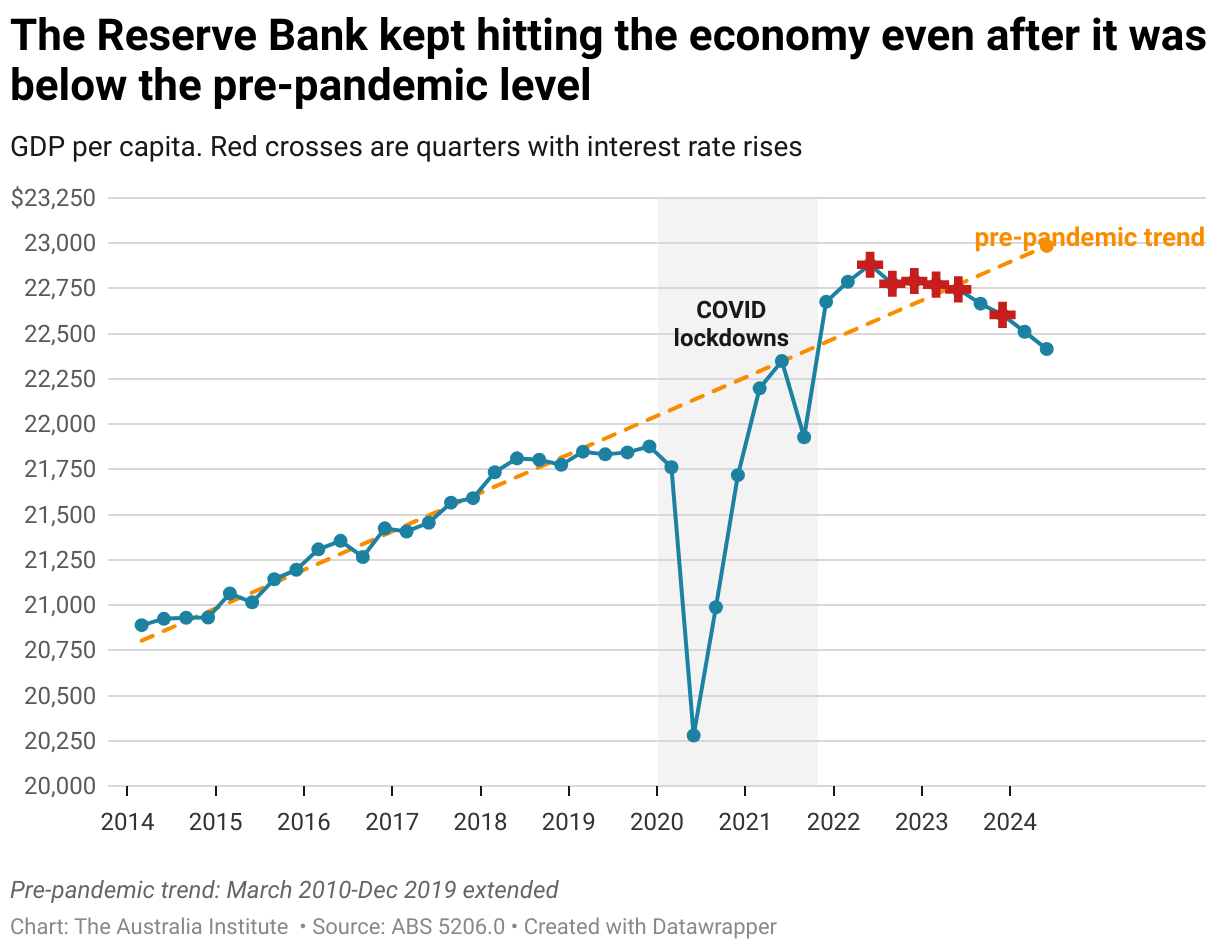
    If we look at the overall economy, the picture is much the same (see the graph at the top of the page). Australia’s level of GDP per capita did recover quickly after the lockdowns and by June 2022 was 1.4% above the pre-pandemic trend level. But the interest rates rises had an immediate impact – reducing GDP per capita in 7 of the next 8 quarters. By June 2023 the level of activity in the economy was already below pre-pandemic expectations, and when the RBA hit Australians with the 13th rate rise in November 2023, the level of GDP per capita was 1.2% below the long-term trend.

    It is now 2.5% below – back at the level it was in June 2021.

    The RBA has got it wrong. They were initially worried that inflation was driven by concerns of strong wage growth rather than supply side issues and corporate profits. They then tried to argue household spending was still growing too strongly. The GDP figures showed that to be woefully mistaken. They then tried to argue that while growth in the economy was slow, there was still too much demand. But again the figures show this to be mistaken.

    The Treasurer Jim Chalmers stated nothing but the facts when he said earlier this month that rate rises were “smashing the economy”. The data supports his assertion, and it is time the RBA admits that their actions have not only slowed the economy but slowed it at a pace that is now harming Australians for no benefit other than the RBA saving face from its previous over-reactions.


    Related research

    You might also like

  • No need for panic over ‘sticky’ inflation: Jericho

    No need for panic over ‘sticky’ inflation: Jericho

    by Greg Jericho

    Share

    Inflation has stopped falling, but there’s no need for a further rate hike, says Greg Jericho.

    Inflation is stubbornly staying above the Reserve Bank’s target, but it’s not because Australian consumers are flush with cash, according to Australia Institute Chief Economist, Greg Jericho.

    In fact, retail spending figures suggest that people are struggling and further suppressing consumer demand by increasing interest rates could have a detrimental effect on the economy, Jericho said on the latest episode of Dollars & Sense.

    “Pretty much since December, inflation has been stuck at that 3.5, 3.6 per cent area.

    “Whereas, before that, it had been coming down fairly steadily.

    “And so, some economists are getting rather panicky about the fact that inflation is ‘sticky’.”

    But that’s not the full picture, Jericho said.

    “What I care about as an economist is: are consumers out there spending like mad? And, as a result shop owners are going ‘wow, I’ve got lines around the block – I can raise prices’.

    “But what we see in the retail spending figures is that we are not buying much at all.

    “That is a real sign that we are not flush with cash, we are not doing well – households are really struggling.”

    While some are calling for the Reserve Bank to take further action, further suppressing consumer demand to get inflation below three per cent isn’t a silver bullet, Jericho said.

    “The Reserve Bank has a target – and it’s an arbitrary target – of trying to keep inflation between two and three per cent.

    “Other countries have different inflation targets.

    “There’s no natural law of economics that says once inflation goes below three per cent things are hunky dory.”

    Dollars & Sense is available on Apple Podcasts, Spotify or wherever you get your podcasts.


    You might also like

    Centre For Future Work to evolve into standalone entity

    The Centre for Future Work was established by the Australia Institute in 2016 to conduct and publish progressive economic research on work, employment, and labour markets. Supported by the Australian Union movement, the centre produced cutting edge research and led the national conversation on economic issues facing working people: including the future of jobs, wages

  • Budget 2024-25: Resists Austerity, Reduces Inflation, Targets Wage Gains

    Budget 2024-25: Resists Austerity, Reduces Inflation, Targets Wage Gains

    Important support to help with cost-of-living challenges, but more needed

    Commonwealth Treasurer Jim Chalmers delivered his 2024-25 budget to Parliament. While it booked a surplus for 2023-24 (the second consecutive surplus), it increased total spending for future years, and forecasts continued small deficits. In the wake of the economic slowdown resulting from RBA interest rate hikes, this new spending is needed and appropriate.

    Targeted cost of living measures will directly reduce inflation in some areas (like energy and rents), while helping working Australians deal with higher prices in others (including reworked State 3 tax cuts, and support for higher wages for ECEC and aged care workers). Unlike previous years, the budget is projecting real wage gains in coming years that are actually likely to materialise — however, the damage from recent real wage cuts will take several years to repair, and further support for strong wage growth will be required, from both fiscal policy and industrial laws. The budget also spelled out initial steps in the government’s Future Made in Australia strategy to build renewable energy and related manufacturing industries; these steps are welcome but need to be expanded, and accompanied by strong and consistent measures to accelerate the phase-out of fossil fuels.

    Our team of researchers at the Centre for Future Work has parsed the budget, focusing on its impacts on work, wages, and labour markets. Please read our full briefing report.


    Full report

    Share

  • Calls for massive rate hikes and recession are cavalier: Jericho

    Calls for massive rate hikes and recession are cavalier: Jericho

    by Greg Jericho

    Share

    Inflation will remain higher for longer, but a recession is not the solution, says Greg Jericho.

    The Reserve Bank have revised their inflation projections, suggesting that interest rates are going to remain high for longer than many expected.

    This has sent plenty of people into a spin, with media speculating about interest rate armageddon and some economists calling for a recession.

    But with inflation still heading in the right direction, cooler heads must prevail as policymakers navigate the tricky economic climate, Australia Institute Chief Economist Greg Jericho said on the latest episode of Dollars & Sense.

    “[Inflation] is not dropping as fast as people thought because the previous thinking was probably a bit hopeful.

    “Importantly, the long-term trend – where the Reserve Bank thinks inflation is going to go – really wasn’t changed. They still believe it’s going be below three per cent by the end of next year.

    “That was what they were thinking in February – perhaps it’s just not going to be as sharp a drop.”

    But that’s not necessarily a bad thing, Jericho argued – saying inflation’s fall had been roughly mirroring the pattern leading into the 1990s recession.

    “That’s generally not a good thing to try and copy.

    “Inflation, when it comes down, often can have a tendency to come down really fast – and the problem is it doesn’t actually steady and flatten out at the point you want it to.

    “It just keeps going because the economy kind of tanks.”

    Despite the risks, some economists have called for significant interest rate increases – even a small recession.

    “The reality is that you very rarely get what you desire when you call for a ‘little’ recession.

    “Calling for a ‘short recession’ is like calling for a ‘small war’. They don’t stay small, they don’t stay short.

    “How can you be so cavalier with people’s livelihoods?”

    Dollars & Sense is available on Apple Podcasts, Spotify or wherever you get your podcasts.


    You might also like

    Centre For Future Work to evolve into standalone entity

    The Centre for Future Work was established by the Australia Institute in 2016 to conduct and publish progressive economic research on work, employment, and labour markets. Supported by the Australian Union movement, the centre produced cutting edge research and led the national conversation on economic issues facing working people: including the future of jobs, wages

  • Increasing JobSeeker is possible, it’s just a question of priorities

    Increasing JobSeeker is possible, it’s just a question of priorities

    by Greg Jericho

    Share

    The government has the power to make significant and long-awaited improvements to the JobSeeker scheme in this federal budget, but it has to make it a priority, says Greg Jericho.

    The federal government’s hand-picked Economic Inclusion Advisory Committee has called for a significant increase to the JobSeeker unemployment payment, describing the current rate as “seriously inadequate”.

    While the aged pension has increased over time, JobSeeker has stagnated for decades, dragging people without a job well below the poverty line, Australia Institute Chief Economist Greg Jericho said on the latest episode of Dollars & Sense.

    Currently worth less than 70 per cent of the aged pension, JobSeeker payments should be increased to 90 per cent, according to the Committee.

    The significant disparity between the two payments is the result of a policy decision by the Howard government, Jericho explained.

    “What John Howard did was change how [JobSeeker and the aged pension] were indexed,” Jericho said.

    “He linked the aged pension – but not unemployment benefits – to average, full-time, male earnings.

    “In a sense, what [Howard] was saying was, ‘those people on that government benefit, they’re worthy – these people on unemployment benefits, not worthy.

    “We’ve always had people talking about ‘dole bludgers’…[but Howard] made that view government policy.”

    In considering the Committee’s recommendations, the federal government faces a question around where its priorities lie, Jericho said.

    “It’s going to cost around $4.6 billion a year, but this is where it comes back to choices.

    “Josh Frydenberg was quoted as saying, back when they were talking about AUKUS, that everything is affordable if it’s a priority. Julia Gillard made a speech in 2014 where she said budgets are made of choices.

    “If something is a priority, they find the money.”

    Dollars & Sense is available on Apple Podcasts, Google Podcasts, Spotify or wherever you get your podcasts.


    You might also like

    Centre For Future Work to evolve into standalone entity

    The Centre for Future Work was established by the Australia Institute in 2016 to conduct and publish progressive economic research on work, employment, and labour markets. Supported by the Australian Union movement, the centre produced cutting edge research and led the national conversation on economic issues facing working people: including the future of jobs, wages

  • Who’s hurting most from rising interest rates? It’s probably you.

    Who’s hurting most from rising interest rates? It’s probably you.

    by Greg Jericho

    Share

    Soaring house prices, high household debt and the pervasiveness of variable rate home loans mean that Australians bear the brunt of interest rate rises, says Greg Jericho.

    A new report by International Monetary Fund (IMF) shows rising interest rates bite harder in some countries than others – and it’s grim reading for Australian mortgage holders.

    Globally, repayments have become increasingly difficult to meet on the back of rapid rate increases.

    But the new IMF World Economic Outlook report shows that rate rises hurt Australians the most.

    “It mightn’t come us a surprise too many Australians, but we are right at the top – we’re number one,” Australia Institute Chief Economist Greg Jericho said on the latest episode of Dollars & Sense.

    “What it’s saying is that, if interest rates went up – let’s say by one per cent in every advanced economy in the world – Australians would feel that the most.”

    The prevalence of variable home loans in Australia is one of the reasons rate increases are hitting harder, according to the IMF.

    “In Australia, around 85 per cent of people with a mortgage have a variable rate of some kind. That’s actually really unusual,” Jericho said.

    “In the United States, 95 per cent of people with a home loan have a fixed rate mortgage. In the United Kingdom, it’s 85 per cent.

    “If you’ve got a 30-year fixed rate mortgage, you really don’t care what the Reserve Bank does.”

    Other drivers identified by the IMF include high levels of household debt and looser lending guidelines, but Jericho said that soaring house prices also play a big role.

    Since 2005, median house prices have gone up by 86 per cent globally, but Jericho’s analysis shows that prices have gone up 162 per cent in Australia over the same period.

    “So, just a little bit different.

    “I think you can make a pretty good case…that we have some damned expensive houses.

    “Things have really taken a turn for the worse over the past five, 10, 15 years – nearly 20 years really.”

    As for what the Reserve Bank of Australia might do from here, the market is predicting cuts over the next 12 months, but that might be optimistic, according to Jericho.

    “If Australians are hurt more by interest rate rises than elsewhere, it means they also get the benefit of rate cuts more than elsewhere.

    “So the Reserve Bank might be inclined to go, ‘yeah, let’s just wait and see’.”

    Dollars & Sense is available on Apple Podcasts, Google Podcasts, Spotify or wherever you get your podcasts.


    You might also like

  • Australia’s “stupid” surplus obsession must end

    Australia’s “stupid” surplus obsession must end

    by Greg Jericho

    Share

    A budget surplus doesn’t mean a government is good at running the economy – we should focus on the choices they make instead, says Greg Jericho.

    Australian governments like to brag about their big budget surpluses — one even slapped it on a mug — but they aren’t all they’re cracked up to be, according to Chief Economist at the Australia Institute, Greg Jericho.

    “I think the discussion about budget surpluses and deficits is quite stupid, to be blunt,” he said on the latest episode of Dollars & Sense.

    The accuracy of budget projections is highly dependent on commodity prices, international economic conditions and other factors outside a government’s control, making them notoriously difficult to get right.

    “It’s a fairly complicated thing, the Australian economy. There are lots of moving parts and they never get it right,” Jericho said.

    “Last year, in the May budget, there were essentially two months to go in the 2022-23 financial year, so you’d think they can’t get the figure that wrong. Treasury estimated that the budget was going to be in surplus by $4 billion.

    “When we got complete figures in September…they found out, no — it wasn’t $4 billion, it was $22 billion!

    “If they can be that wrong with two months to go, think how wrong they can be 12 months ahead, four years ahead.”

    Jericho said it’s “absurd” to suggest a surplus or deficit alone reveals if a government is managing the economy effectively.

    “It started with Paul Keating and then Peter Costello really set fire to it because he was Treasurer during a massive mining boom, where there were masses of tax revenue coming in, making it very easy to be in a surplus.

    “He wanted to be able to sell that as being really good and he was this great economic manager.”

    But like household debt, a national deficit can be good if used to invest in the future, Jericho argued.

    “What if that deficit was used to build a hospital?

    “Our children, and our children’s children, are going to be using that hospital — would you prefer they didn’t build it?

    It’s not just about expenditure, he said, because budgets also reflect a government’s priorities in how it raises revenue.

    “Let’s say we raised $5 billion more from the Petroleum Resources Rent Tax — that means we could reduce the tax on individuals by $5 billion with no change in the budget balance.

    “Or we could spend that money on health or education.

    “Budgets are very much about choices.”

    Dollars & Sense is available on Spotify, Apple Podcasts, Google Podcasts or wherever you get your podcasts.


    You might also like

    Commonwealth Budget 2025-2026: Our analysis

    by Fiona Macdonald

    The Centre for Future Work’s research team has analysed the Commonwealth Government’s budget, focusing on key areas for workers, working lives, and labour markets. As expected with a Federal election looming, the budget is not a horror one of austerity. However, the 2025-2026 budget is characterised by the absence of any significant initiatives. There is

    Centre For Future Work to evolve into standalone entity

    The Centre for Future Work was established by the Australia Institute in 2016 to conduct and publish progressive economic research on work, employment, and labour markets. Supported by the Australian Union movement, the centre produced cutting edge research and led the national conversation on economic issues facing working people: including the future of jobs, wages

  • “It’s a scare campaign”: award wage rise won’t trigger inflation spiral

    “It’s a scare campaign”: award wage rise won’t trigger inflation spiral

    by Greg Jericho

    Share

    With unions calling for a five per cent increase to award wages, business groups are crying wolf over the proposal’s impact on inflation and unemployment, says Greg Jericho.

    The call from the Australian Council of Trade Unions (ACTU) comes after the Fair Work Commission announced a 23 per cent pay increase for aged care workers, a decision Jericho – Chief Economist at the Australia Institute and Centre for Future Work –  said will bring the award up to around $63,000 per year.

    “It’s incredibly vital work, it’s a growing sector and there are massive shortages,” he said on the latest episode of the Dollars & Sense podcast.

    “One of the reasons there are these shortages is that [workers] are paid bugger all.”

    “And while I still think they are chronically underpaid, especially for how important the role is…at least there is some good news.”

    Business groups and commentators have argued that the ACTU’s proposal will send inflation and unemployment soaring, but Jericho said those claims don’t stack up.

    “Last year, when we had the award go up by 5.75 per cent and the minimum wage go up by 8.6 per cent – again we’re told this is the end of times.

    “The most recent unemployment figures, as we saw last week? They fell!”

    Far from being a sign of runaway wage growth, Jericho’s analysis shows that a five per cent increase would only get real wages back to where they were in 2020.

    The two per cent increase proposed by the Australian Chamber of Commerce and Industry (ACCI) would not only leave workers on an award well short of that mark, but also falling further behind inflation, which was 3.4 per cent in the 12 months to February.

    “Wages should go up more than inflation. Wages should go up more than prices,” said Jericho.

    “If you can’t buy more with your wage than you did a year ago then your living standards haven’t gone up.”

    While increasing wages can theoretically lead to greater demand and rising inflation, the reality is that, for decades, wage increases in Australia haven’t been anywhere near enough to set off inflation, he said.

    Australia Institute research found that, between 2019 and 2022, corporate profits contributed far more than wage rises to the rapid rise in inflation.

    “I can recall then-Senator Eric Abetz…during the Rudd-Gillard years saying we were about to have a wages breakout and then we went on a decade-long run of ever lower wages.

    “It’s a scare campaign.”

    Dollars & Sense is available on Apple Podcasts, Google Podcasts, Spotify or wherever you get your podcasts.


    You might also like