Blog

  • Excessive Hours and Unpaid Overtime: An update

    Excessive Hours and Unpaid Overtime: An update

    by Tom Swann and Jim Stanford

    The focus of this year’s Go Home on Time Day is the threat to the “Great Aussie Holiday.”  Thanks to the rise of precarious work in all its forms, a growing share of Australian workers (about one-third, according to our research) have no access to something we once took for granted: a paid annual holiday.  Moreover, about half of those who ARE entitled to paid annual leave, don’t use all of their weeks – in many cases because of work-related pressures.  And recent decisions by the Fair Work Commission allowing for the “cash out” of annual leave, mean that this great cultural institution – the Aussie holiday – is very much in jeopardy.

    We have updated our regular calculations of the value of workers’ time that is effectively “stolen” each year by employers through massive amounts of unpaid overtime regularly worked in all industries and occupations. 


    Full report

    Share

  • Hard to Get Away: Is the paid holiday under threat in Australia?

    Hard to Get Away: Is the paid holiday under threat in Australia?

    by Troy Henderson

    The focus of this year’s Go Home on Time Day is the threat to the “Great Aussie Holiday.”  Thanks to the rise of precarious work in all its forms, a growing share of Australian workers (about one-third, according to our research) have no access to something we once took for granted: a paid annual holiday.  Moreover, about half of those who ARE entitled to paid annual leave, don’t use all of their weeks – in many cases because of work-related pressures.  And recent decisions by the Fair Work Commission allowing for the “cash out” of annual leave, mean that this great cultural institution – the Aussie holiday – is very much in jeopardy.

    Check out our  special in-depth report, prepared by Troy Henderson of the University of Sydney, documenting these multiple threats to the Aussie holiday, and cataloguing the many economic, social, and health consequences that occur when we don’t get a break from work.


    Full report

    Share

  • What’s Wrong With Privatization?

    What’s Wrong With Privatization?

    by Jim Stanford

    Share

    You know that the tides of public opinion are starting to turn, when even the head of the Australian Competition and Consumer Commission, Mr. Rod Sims, will come out in public and criticize the usual claims that privatization is good for efficiency and national well-being.

    Our Director Jim Stanford recently spoke with Unions NSW about this surprising development, and the general flaws in the argument for privatization.


    You might also like

    Centre For Future Work to evolve into standalone entity

    The Centre for Future Work was established by the Australia Institute in 2016 to conduct and publish progressive economic research on work, employment, and labour markets. Supported by the Australian Union movement, the centre produced cutting edge research and led the national conversation on economic issues facing working people: including the future of jobs, wages

  • Denying The Downside Of Globalization Won’t Stop Populism

    Originally published in The Huffington Post on October 11, 2016

    The rise of anti-globalization sentiment, including in Australia, poses a big challenge to mainstream politicians who’ve been trumpeting the virtues of free trade for decades.

    Treasurer Scott Morrison recently started pushing back, delivering a staunch defense of globalization to an audience in Sydney. Like other world leaders responding to the wave of populism, Mr. Morrison doubled down with strong claims about the universal, lasting benefits of free trade. Australians may be anxious about their economic future, he conceded. But don’t blame globalization.

    Globalization “increases our living standards and always has,” Mr. Morrison bluntly proclaimed. Free trade, immigration and inward foreign investment are “the very sources of … prosperity.” Resisting globalization, he suggested, is like thinking “we can pull the doona over our head and insulate ourselves.”

    Denying any potential downside to globalization, and deriding critics as hiding from reality, will not defuse the wave of anger that put four One Nation senators into Parliament. Contrary to Mr. Morrison’s claims, there is ample evidence that Australia’s trade performance has deteriorated badly in recent years, despite –- or perhaps because of -– the acceleration of free trade.

    Globalization, as currently practiced, is imposing real, lasting damage in many parts of Australia, and producing a fertile political environment for nationalism and xenophobia. The political and policy responses to that danger must go beyond denial.

    Mr. Morrison stressed the effectiveness of his government’s trade agenda, especially what he called new “export trade deals” with China, Korea, and Japan. (This curious terminology deliberately neglects that free trade agreements are also intended to facilitate imports!) “The results are there to see,” he said.

    Or are they? As a share of GDP, Australia’s exports have declined significantly since the turn of the century, even as government inked several free trade pacts. Services exports also contracted relative to GDP. And ironically, Australia did worse with its free trade partners, than with the world as a whole.

    For example, we now have one year of experience under free trade with Japan and Korea. Perversely, Australian exports to both countries declined in the first year: by 9 percent for Korea, and 16 percent to Japan. Yet Australia’s imports from Japan and Korea surged by 14 percent and 24 percent, respectively.

    Therefore, Australia enjoyed more exports, and a better trade balance, without free trade than with it. In the first months of free trade with China, Australia’s exports are also declining. Similarly, under Australia’s trade pacts with the U.S., Thailand, Singapore and Chile, imports grew much faster than exports — and in some cases exports didn’t grow at all.

    There’s little reason to believe that new deals being pursued by Canberra (with India, Indonesia and the Trans Pacific Partnership) would have any better results.

    The cumulation of many bilateral trade deficits is an overall global payments imbalance that is driving Australia deeply into international debt. Australia’s current account deficit reached $77.5 billion last year: the biggest ever (in nominal terms). Relative to GDP, that’s the second-largest of any OECD country — behind only the U.K. (another hotbed of populism). It’s even worse than precarious emerging economies (like Brazil, South Africa or Turkey).

    Mr. Morrison actually celebrated this large international deficit last week, suggesting it allows Australia to invest more and grow faster. But he has it perfectly backwards. Business investment is contracting rapidly in Australia, not growing. And with Australia buying so much more from the rest of the world than it sells, we end up with less production, fewer jobs and less income. The gap can be offset with growing international debt, but only for a while.

    This miserable trade performance is clearly contributing to Australia’s weak labour market: declining total hours of employment, disappearing full-time jobs and unprecedented wage stagnation. So disaffected Australians aren’t making it up when they conclude their prospects have diminished, and no amount of boosterism can change that reality.

    Moreover, they have sound reasons to blame globalization as one important factor (certainly not the only one) for their predicament.

    If Mr. Morrison and other free-traders want to truly counter the divisive and dangerous ideas of nationalism and xenophobia, they should start by acknowledging that globalization does indeed have a downside, not just an upside. Then they must move to implement policies -– like balanced trade, job creation, stronger income security, and better vocational education — to assist those Australians who have been harmed by it.


    You might also like

    The Difference Between Trade and ‘Free Trade’

    by Jim Stanford in The Guardian

    U.S. President Donald Trump’s recent trade policies (including tariffs on steel and aluminium that could affect Australian exports) have raised fears of a worldwide slide into protectionism and trade conflict.  Trump’s approach has been widely and legitimately criticised.  But his argument that many U.S. workers have been hurt by the operation of current free trade

  • Auto Shutdown Will Deliver Another Economic Blow

    Auto Shutdown Will Deliver Another Economic Blow

    by Jim Stanford

    We’ve known for over two years that this day was coming.  But that won’t ease its economic and social pain.  The shutdown of Australia’s mass motor vehicle assembly industry is now upon us.  Ford’s assembly plant in Broadmeadows, Victoria, was the first to go dark: the final Aussie-made Ford has already rolled off the assembly line.  Remaining workers are preparing the factory’s final shutdown.  Holden’s assembly plant in Elizabeth, SA, and Toyota’s Altona factory (also in Victoria), are scheduled to close next year; both have already begun phasing down production.  Engine plants operated by Ford and Holden will also close.

    This briefing note reviews the direct and indirect economic consequences of the closures, which will extend far beyond the plants being shuttered.  After all, motor vehicle manufacturing purchases $8 billion in inputs from 100 different economic sectors in Australia — and most of those are services.  Ultimate job losses will be many times larger than the direct jobs eliminated at Ford, Holden, and Toyota.

    The briefing note also addresses the damaging effect of Australia’s lopsided trade agreements have played in hastening the industry’s end.  In particular, the implementation of 5 free trade deals with major auto-producing nations (the U.S., Thailand, South Korea, Japan, and China) over the past decade provided global automakers with a free ticket for selling their products in Australia, without necessarily producing anything here.  The FTAs have had no positive impact on Australian vehicle exports, and resulted in a forty-to-one imbalance in automotive trade flows.

    In addition to taking action to ameliorate the economic and social hardship that will be experienced in automotive regions over the coming months, government must also learn the lessons of this failed strategy — before other industries here experience a similar fate.


    Full report

    Share

  • Penny Wise and Pound Foolish

    The state government of New South Wales recently awarded a contract for the purchase of 512 new intercity passenger rail cars to a consortium that will manufacture the equipment in South Korea.  The contract is worth $2.3 billion, including an unspecified sum to cover maintenance of the double-decker cars over an initial 15-year period.  The government chose to import the cars from Korea instead of purchasing made-in-Australia products, claiming this was the “cheapest” option.  However, major government purchases have important indirect effects on many economic, social, and fiscal variables: including GDP, employment, incomes, exports, and even government revenues.  A comprehensive cost-benefit analysis must take those broader impacts into consideration; governments should make decisions that maximize the overall social net benefit of procurement, not simply minimize the up-front purchase cost to government.

    This paper reviews the economic importance of the railway equipment manufacturing sector in Australia, and describes its broad economic benefits: supporting 5000 direct jobs, and many more than that in supply industries and downstream consumer industries.  And it provides an illustrative simulation to show that offshoring this new contract could deprive the government sector of a cumulative total of $455 million in forgone revenue — as a result of lower GDP, employment, and incomes.  That is considerably more than any supposed “cost penalty” to government incurred as a result of manufacturing the equipment in Australia.  Worse yet, the NSW decision undermines attempts to coordinate and schedule upcoming railway rolling stock purchases from various governments across Australia, in order to maximize the economic benefits from future transit investments.


    Full report

    Share

  • The Flawed Economics of Cutting Penalty Rates

    The Flawed Economics of Cutting Penalty Rates

    by Jim Stanford

    It was a “sleeper” issue in the recent election, and led to the defeat of some high-profile Liberal candidates.  But now the debate over penalty rates for work on weekends and public holidays shifts to the Fair Work Commission.  The economic arguments in favour of cutting penalties (as advocated by lobbyists for the retail and hospitality sectors) are deeply flawed.

    Penalty rates for working on weekends were an important “sleeper” issue in the recent federal election.  On the surface, both Labor and the Coalition agreed the future of penalty rates would be determined by the Fair Work Commission.  But that superficial consensus couldn’t hide deep differences in what the respective parties were actually hoping for.  Labor explicitly urged the FWC to maintain existing penalties: double-time on Sundays, and time-and-a-half for Saturdays.  Many Coalition candidates, on the other hand, endorsed a reduction in penalties – consistent with the views of business lobbyists who want lower operating costs on weekends.

    At the grass-roots level, meanwhile, the issue resonated strongly with significant numbers of voters.  Union activists launched an 18-month “Save Our Weekend” campaign, knocking on tens of thousands of doors in marginal seats before the election was even called.  Opinion polls showed strong support for retaining (or even increasing) weekend penalty rates; respondents opposed cutting penalties by two-to-one margins, or more.  The swing against the Coalition in ridings targeted by the penalty rates campaign was nearly twice as large (6 percentage points) as the national swing.

    Penalty rates will remain a charged issue in the political arena.  But for now, the main attention shifts to the FWC, whose decision is expected in coming weeks.  The Commission should reject the entreaties of retail and restaurant employers for lower penalties, because the economic case for cutting penalties looks shakier all the time.

    Employers in all sectors routinely claim that cutting wages will strengthen job-creation.  But this purported trade-off between compensation and employment is refuted by macroeconomic evidence.  Indeed, historical data suggest higher wages are more often associated with stronger employment outcomes, not weaker: in part because household consumption spending (which depends directly on wages) is crucial for overall spending power and hence economic vitality.  The retail and hospitality industries have been the most aggressive advocates of weaker penalty rates.  Yet ironically, it is in these sectors that the argument for wage-cutting is weakest of all.

    After all, employment in stores and restaurants depends directly on the level of consumer spending.  And this demand constraint is more binding in domestic service sectors than any other part of the economy.  In export-oriented industries, employers can at least pretend that lower labour costs will boost sales (by undercutting foreign competition and hence winning new business).  Even here the argument is not convincing, since in practice global competitiveness depends more on productivity, quality, and innovation than on low wages.  But in non-traded domestic sectors, where Australians produce services for other Australians, the logic falls apart completely.

    Remember, Australian consumers already spend far more than they earn.  That’s why average consumer debt is growing rapidly: now equal to 125 percent of national GDP.  How could making it less costly for shops and cafes to open on weekends, somehow unleash new reservoirs of spending power, and stimulate tens of thousands of new jobs?  In macroeconomic terms it’s simply not possible.

    Keeping businesses open for longer hours on weekends, doesn’t mean consumers have more money in their wallets.  Instead, the same amount of retail and hospitality spending must now be spread across longer opening hours.  If anything, that hurts productivity and profitability, and will eventually lead to the closure of some retail and hospitality firms that were already operating on the financial edge.

    It’s the same reason why opening a new shopping mall cannot, on its own, increase total employment levels.  Unless there are other factors driving an expansion in broader incomes and spending, opening one store must inevitably lead to a closure somewhere else.

    It’s especially laughable to hope that cheaper weekend labour could somehow attract new business to Australia’s stores and cafes.  Are penalty rate opponents expecting a surge in tourists from China, perhaps – who were just waiting for cheaper Sunday shopping before booking their trips?

    In short, the very industries pushing hardest for reduced penalties – retail and hospitality – are the ones most dependent on the spending power of domestic consumers.  Hence they would directly experience the most economic blowback from their own wage cuts.

    Indeed, there is abundant evidence that unprecedented stagnation in wages is already undermining growth and job creation.  Nominal wages are inching along at their slowest pace in recorded history (barely 1 percent per year).  Real wages, adjusted for inflation, have been falling since 2013.  Economists of all persuasions have highlighted the resulting weakness in household incomes as a key factor behind sluggish growth, rising personal debt, and unemployment and underemployment.

    Ultimately, rolling back penalties would simply constitute a major effective wage cut for workers who are already among the worst-paid in society.  It will exacerbate the broader wage stagnation that is holding back Australian growth.  And it will whet the appetites of other employers for more wage suppression – now on grounds of “keeping up” with the advantages granted to retail and hospitality.

    Australia needs higher wages, not lower.  Let’s hope the Fair Work Commission sees this big picture.


    You might also like

    Centre For Future Work to evolve into standalone entity

    The Centre for Future Work was established by the Australia Institute in 2016 to conduct and publish progressive economic research on work, employment, and labour markets. Supported by the Australian Union movement, the centre produced cutting edge research and led the national conversation on economic issues facing working people: including the future of jobs, wages

  • Looking for “Jobs and Growth”: Six Infographics

    Looking for “Jobs and Growth”: Six Infographics

    Share

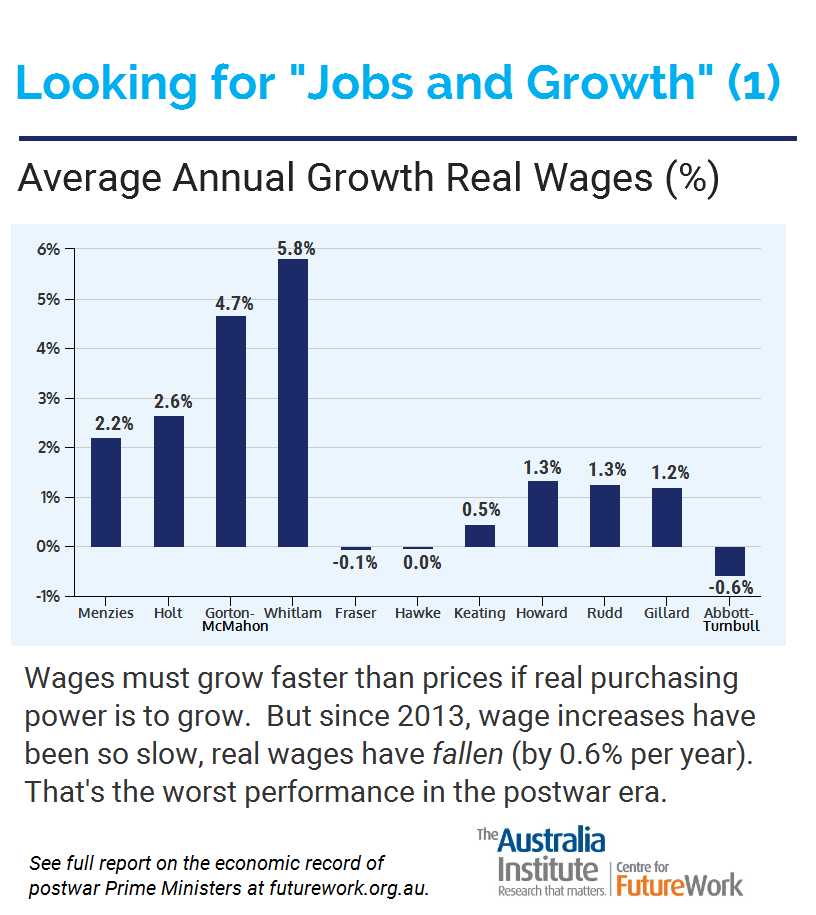
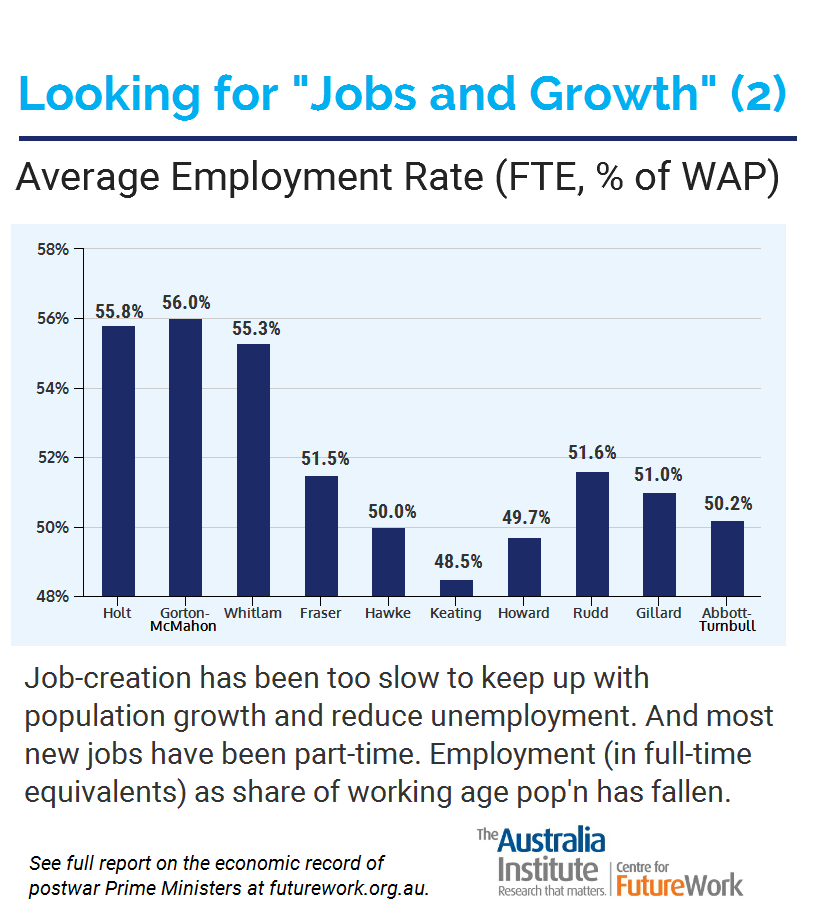
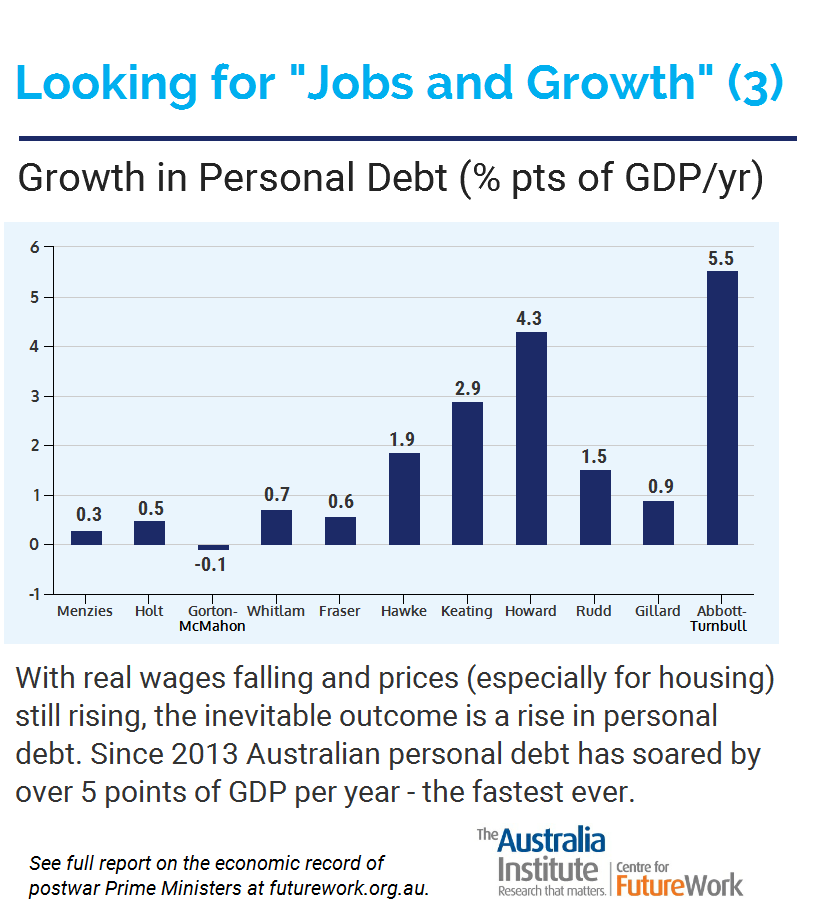
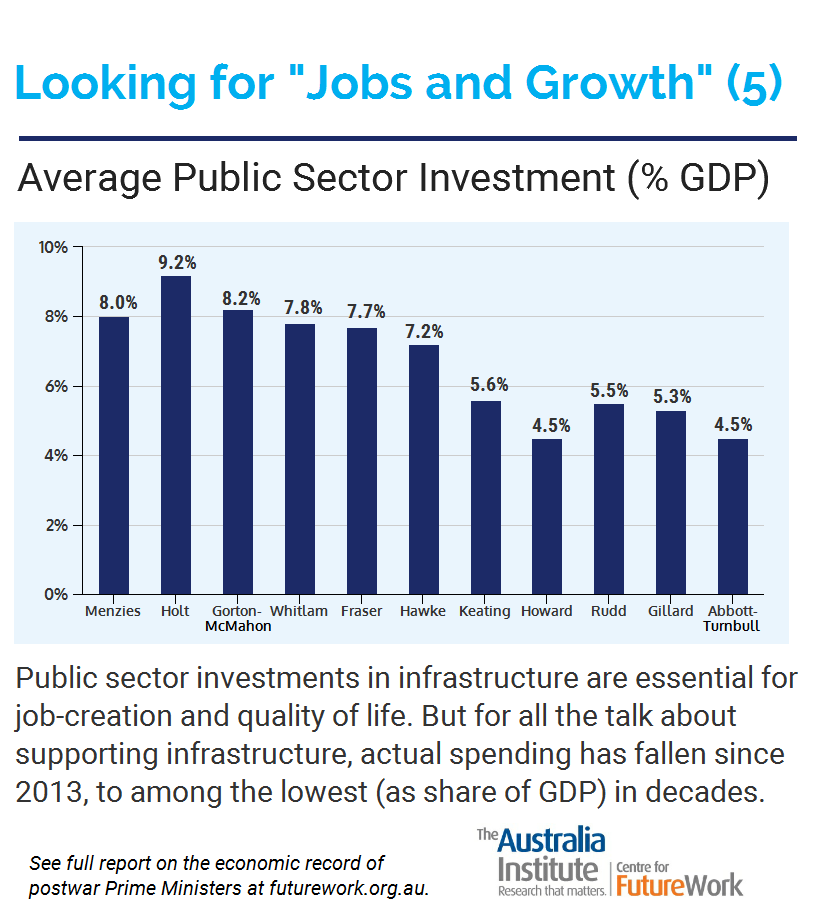
    We have prepared six shareable infographics based on material in our research paper, “Jobs and Growth… and a Few Hard Numbers,” which compared Australia’s economic performance under the respective postwar Prime Ministers.

    The infographics summarize several of the specific economic variables considered in the full report, dating back to 1950 (and Prime Minister Menzies) in most cases.

    Average Annual Growth, Real Wages
    Average Employment Rate
    Growth in Personal Debt
    Average Annual Growth, Business Investment
    Public Sector Investment
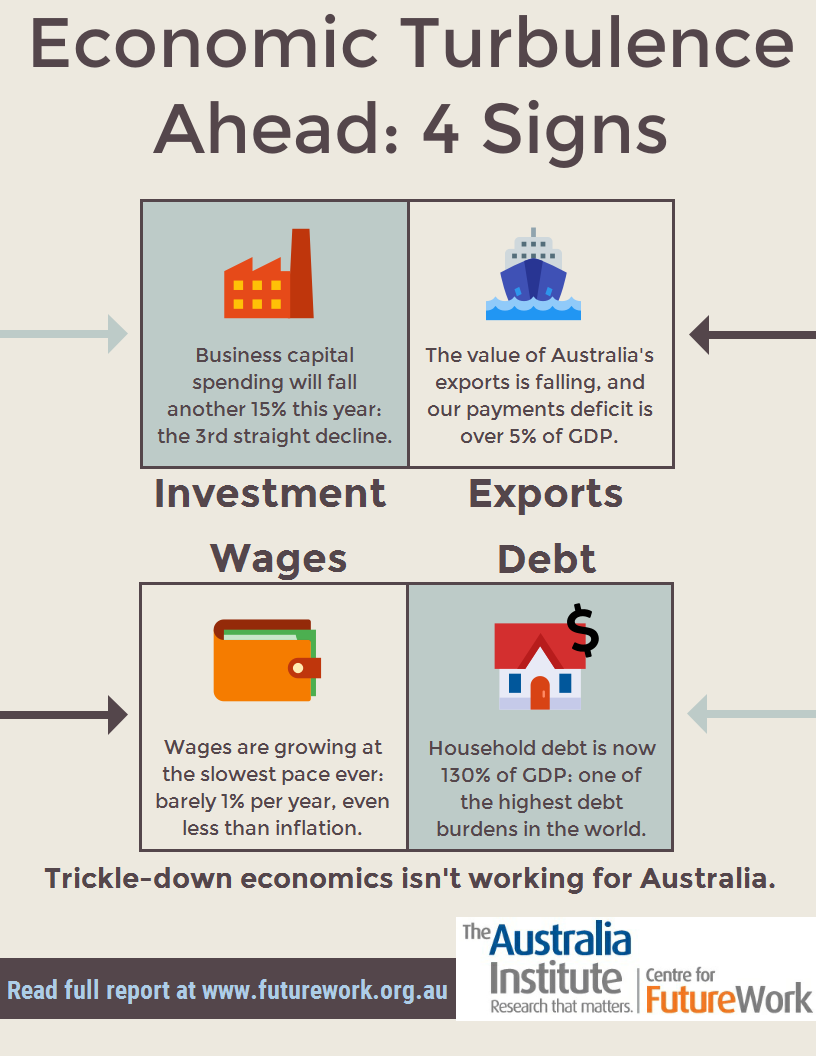
    4 Signs of Turbulence Ahead

    Related research

    You might also like

    Dutton’s nuclear push will cost renewable jobs

    by Charlie Joyce

    Dutton’s nuclear push will cost renewable jobs As Australia’s federal election campaign has finally begun, opposition leader Peter Dutton’s proposal to spend hundreds of billions in public money to build seven nuclear power plants across the country has been carefully scrutinized. The technological unfeasibility, staggering cost, and scant detail of the Coalition’s nuclear proposal have

    Centre For Future Work to evolve into standalone entity

    The Centre for Future Work was established by the Australia Institute in 2016 to conduct and publish progressive economic research on work, employment, and labour markets. Supported by the Australian Union movement, the centre produced cutting edge research and led the national conversation on economic issues facing working people: including the future of jobs, wages

  • Economic Management by PM

    Economic Management by PM

    by Jim Stanford

    New report from the Centre for Future Work ranks Prime Ministerships by 10 key economic performance indicators.

    In this report Jim Stanford digs beneath vague claims about economic competence and friendliness to business, and considers more concrete indicators of economic progress. The paper asks: is there any correlation between the policy outlook of those respective governments, and in particular its “business credentials,” and Australia’s real economic progress?

    This paper identifies a dozen standard indicators of economic performance: covering work, production, incomes, and debt. Consistent historical data is gathered for the twelve indicators, going back to the 1950s. Then the actual historical record is compared between the various postwar Prime Ministers (any who served in office for at least a full year). This analysis should assist voters to consider more concretely what the economy actually means to them, and evaluate the economic promises of competing parties accordingly.


    Full report

    Share

  • Jobs and Growth… and a Few Hard Numbers

    Jobs and Growth… and a Few Hard Numbers

    by Jim Stanford

    Share

    Voters typically rank economic issues among their top concerns. And campaigning politicians regularly make bold (but vague) pronouncements regarding their competence and credibility as “economic managers.”  In popular discourse, economic “competence” is commonly equated with being “business-friendly.”

    However, the economy consists of more than just private businesses – and certainly more than the large businesses which attract the main attention from politicians and reporters.  Other stakeholders are at least as crucial for powering real economic progress: including workers, households, governments at all levels, small businesses, public and non-profit institutions, NGOs and the voluntary sector, and more.  So being “business-friendly” is no guarantee that the real economy (measured by employment, output, and incomes) will automatically improve.  Having a more complete understanding of all of the different ingredients required for economic progress is necessary, in order to properly analyze the likely impact of specific measures.

    To demonstrate the lack of correlation between a government’s stated economic orientation, and the actual performance of the real economy, this briefing paper compiles historical data on twelve standard indicators of economic performance: including employment, unemployment, real output, investment (of various forms), foreign trade, incomes, and debt burdens.  Consistent annual data is gathered going back to the 1950s, allowing for a statistical comparison of Australia’s economic record under the various post-war Prime Ministers.  We compare Australia’s economic performance under each Prime Minister, on the basis of these twelve selected indicators.

    There is no obvious correlation between these respective swings in Australia’s economic history, and the policy orientation of the government that oversaw them. And the statistical review indicates that the present government, regardless of its business-friendly credentials, has in fact presided over one of the weakest economic periods in Australia’s entire postwar history.


    Related research

    You might also like

    Dutton’s nuclear push will cost renewable jobs

    by Charlie Joyce

    Dutton’s nuclear push will cost renewable jobs As Australia’s federal election campaign has finally begun, opposition leader Peter Dutton’s proposal to spend hundreds of billions in public money to build seven nuclear power plants across the country has been carefully scrutinized. The technological unfeasibility, staggering cost, and scant detail of the Coalition’s nuclear proposal have