Blog

  • Women’s Wages and the Penalty Rate Cut

    Women’s Wages and the Penalty Rate Cut

    by Jim Stanford

    Today is International Women’s Day, a time to reflect on the continued inequality faced by women — including in the world of work.  Traditional measures of the “gender pay gap” indicate that women earn around 17 percent less than men, in ordinary pay in equivalent full-time positions.  But the situation is worse than that, because of women’s disproportionate concentration in part-time work.  Including part-time workers, women now earn exactly one-third less than men.

    The Fair Work Commission’s announcement of coming reductions in penalty rates for Sunday and holiday work (of up to 50 percentage points of base wage) in the retail and hospitality sectors will clearly (if implemented) exacerbate the gender inequality in earnings.

    After all, the retail and hospitality sectors are among the biggest employers of part-time workers, very often in casual and irregular positions.  Women make up most of the workforce in both sectors, and they occupy an even larger share of part-time positions: 70 percent of women in food and beverage services, and 60 percent of women in retail, are in part-time jobs.  Most of the workers whose Sunday wages will be cut are women — and they were already among the lowest-earning workers in the entire labour force.

    If this decision was a “gift” to workers from the FWC (as some politicians have described it), wrapped up and delivered just in time for International Women’s Day, women should definitely send it back.


    Full report

    Share

  • Employers’ pyrrhic penalty rates win reflects self-defeating economics

    Originally published in The Sydney Morning Herald on February 24, 2017

    The Fair Work Commission unveiled its long-awaited decision on penalty rates for Sunday and holiday work this week. Penalty rates for most retail and hospitality workers will be cut, by up to 50 percentage points of the base wage. Hardest hit will be retail employees: their wages on Sundays will fall by $10 an hour or more. For regular weekend workers, that could mean $6000 in lost annual income.

    The equity implications of the commission’s decision are odious. Store clerks and baristas are already among the least-paid, least-secure members of Australia’s workforce. The retail and hospitality workforce is disproportionately female, young and immigrant. Most work part time, and casual and labour-hire positions are common. In short, the burden of this decision will be borne by those who can least afford it.

    Penalty rate cut: how did it happen?

    Workplace reporter Nick Toscano contextualises the Fair Work Commission’s announcement on Thursday that Sunday penalty rates paid in retail, fast food, hospitality and pharmacy industries will be reduced from the existing levels.

    Remember, too, that it’s in retail and hospitality that recent scandals regarding underpayment of wages and other violations of labour law have been rife. Weakening labour standards that are already poorly enforced thus constitutes a double jeopardy for service workers.

    It’s notable that the commission only targeted low-paid service workers with this review of penalty rates. There are many other people who need to work Sundays and holidays, including emergency personnel, essential service workers, healthcare workers and others. The commission stressed it wasn’t calling for those workers to lose their penalties, too (although employers everywhere are no doubt preparing to push to extend this precedent to other industries). If it’s all about changing “cultural norms” regarding weekend work, then why have these low-paid service jobs been singled out?

    All of this says much about the political and economic context for the Fair Work Commission’s deliberations. There was no emergency in Australia’s retail and hospitality sector; no crisis that needed immediate attention. It’s not that stores and restaurants couldn’t do business on Sundays under the existing rules; any casual observer can attest to the brisk trade that now takes place right through the weekend. It’s just that those businesses would be considerably more profitable if wages were lower.

    So penalty rates became the target of a sustained pressure campaign by business, backed by conservative political leaders. The commission heard those complaints and acceded to them. Whatever the precise wording of the commission’s legislative mandate, it was never envisioned as a mechanism for rolling back employment standards; it was supposed to protect them. This decision will therefore spark a political debate not only over the merits of this specific decision, but over the commission’s overall mandate and function.

    The politics of that debate will be complicated. Coalition leaders are hiding behind the commission’s supposed neutrality – although they are clearly pleased with the decision (and many explicitly lobbied for it). Labor’s response, meanwhile, is coloured by the fact that it created this commission; Bill Shorten now promises to adjust its mandate. None of this will stop the anger among working-class families who’ll lose income because of this decision. The threat to penalty rates was a potent doorstep issue for union campaigners across Australia before the last election, which the Coalition almost lost. It will be an even hotter button in the next one.

    The economics of the rollback are even more muddled than the politics. Retail lobbyists claim the decision will unleash a surge of new job creation, but those promises are hollow. After all, the market for retail and hospitality services depends primarily on the strength of domestic consumer spending power – more so than any other part of the economy. Australians have a certain amount of disposable income. Will they shop more, and eat out more, just because stores and restaurants stay open longer? Of course not.

    To the contrary, slashing retail and hospitality wages can only undermine demand for the very services that these businesses are selling. It’s incredibly ironic that, even as the commission’s Judge Iain Ross read his judgment on live television, the Australian Bureau of Statistics was releasing yet another dismal report on national wage trends. Average weekly earnings in the period to last November grew at an annualised rate of just 0.4 per cent: slower than any other point in the history of the data, and well behind the rate of inflation. This reflects both the stagnation of hourly wages, and the continuing shift to part-time and casual work (for which retail and hospitality employers are among the worst culprits).

    So this won’t increase the amount of money Australians have to spend in shops and restaurants. Instead, there will be an incremental decline. If stores actually do stay open longer hours, the same spending must now be spread across longer operating hours, driving down productivity. Retail lobbyists should be careful what they ask for.

    Meanwhile, employment in these industries will continue to reflect bigger, structural forces. For example, the whole Australian retail sector has created precisely zero net jobs over the last three years, largely because of the structural shift to big-box retailing (which employs fewer workers per unit of sales). That’s not going to change just because big-box stores can now pay their staff $10 an hour less.

    In short, Australia’s economy isn’t held back because wages are too high. It’s held back because wages are too low. And the stagnation of wages is no accident: it’s the cumulative result of years of deliberate efforts to weaken the power of wage-setting institutions (including unions, minimum wages and awards). The Fair Work Commission chopped away a little more of that edifice this week.

    The greatest irony is that it’s retail and hospitality businesses – which led the push to cut weekend wages – that confront the weakness of household spending power most directly. Each employer may individually celebrate the prospect of paying lower wages. Yet for their industry as a whole, this decision is collectively irrational and ultimately self-defeating.

    Jim Stanford is economist and director of the Centre for Future Work at The Australia Institute.


    You might also like

  • Cutting penalty rates will reinforce wage stagnation

    Cutting penalty rates will reinforce wage stagnation

    Share

    The Fair Work Commission’s decision to reduce penalty rates for Sundays and holidays in retail and hospitality jobs will reinforce wage stagnation and further widen income inequality, which is bad news for the economy as a whole, according to Dr. Jim Stanford, Director of the Centre for Future Work at the Australia Institute.

    “It’s painfully ironic that the Fair Work Commission’s decision was released just a day after the ABS confirmed the pace of Australian wages had already slowed to the worst in the history of their data,” Dr. Stanford said.

    “With household incomes going nowhere, and the economy slowing accordingly, now is the time to support the wages of low-income workers, not suppress them further.”

    “The economic argument that business will open longer, creating jobs has no basis. It will simply spread limited demand, and therefore jobs, over a longer period without increased employment.”

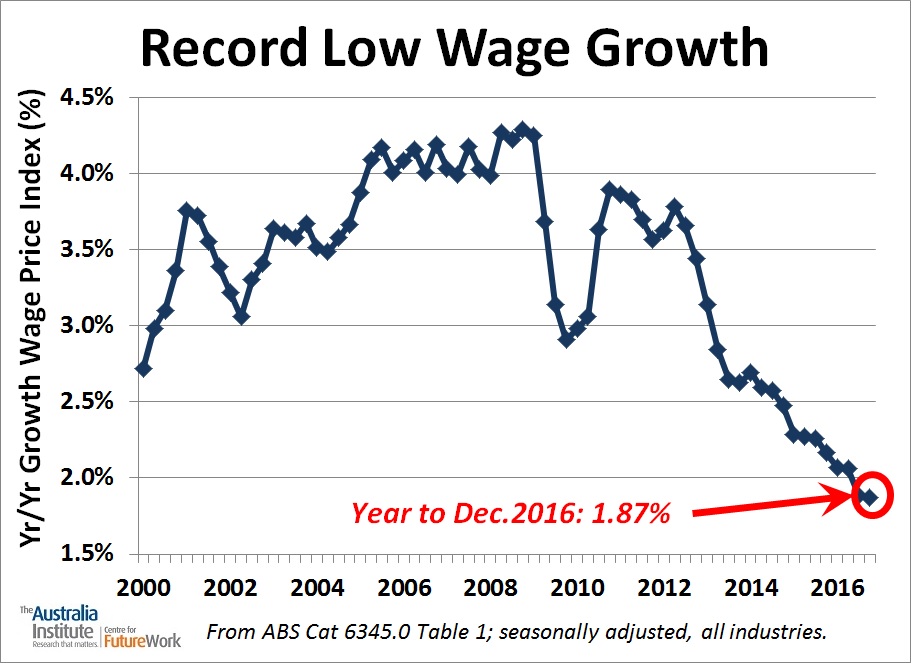
    ABS data released on Wednesday showed annual wage increases in the year to December 2016 fell to just 1.87 percent. Wages in retail and hospitality already lag far behind economy-wide averages, and part-time and casual jobs are the norm.

    Record low wage growth

    “Worse yet, workers in these sectors also face widespread wage fraud and violation of minimum wage laws, as documented at employers like 7-11 stores and Domino’s Pizza.”

    “By cutting Sunday and holiday penalty rates to as low as 125 percent, the Commission’s decision will significantly damage incomes for workers who already face precarious schedules and incomes.”

    Dr. Stanford was especially critical of claims that lower weekend wages will spur new job-creation in retail and hospitality.

    “It is elementary economics that employment in service sectors like retail and restaurants is constrained by the level of consumer demand, not by the level of wages.”

    “Lower wages will not lead to lower prices, they cannot boost consumer spending, and they will not create new jobs.  In fact, by further suppressing labour incomes, this decision will undermine economic growth and job-creation even further.”

    “The idea that more businesses will open up on a Sunday and this will lead to more employment is also flawed logic. Since total demand will remain unchanged, a business will simply sell the same amount over 7 days instead of 6 days,” Stanford said.

    Read our previous polling of public attitudes to cutting penalty rates.


  • Principles for Meaningful Transition Support for Workers in Carbon-Intensive Industries

    Principles for Meaningful Transition Support for Workers in Carbon-Intensive Industries

    by Jim Stanford

    As Australia and other countries shift their economies toward lower-carbon forms of energy and production, problems of displacement and transition for workers in carbon-intensive industries must be addressed as a top priority.  The coal-fired electricity generation industry is on the front lines of this challenge.

    Centre for Future Work Director Jim Stanford was recently invited to give testimony to a Senate of Australia reference committee studying the future transition of the coal-fired electricity sector.

    Offering meaningful and concrete job and income protection for workers in affected industries (like coal-fired power) is not only fair: after all, those workers should not bear disproportionate costs from policies that benefit broader society and the environment.  It is also politically important, because it refutes oft-made claims that environmental protection is incompatible with job security and economic prosperity.  Environmental advocates often speak of the need for a “just transition” for affected workers, although that idea is often described in broad, vague terms.  Developing specific, concrete programs to facilitate fair and effective employment transitions in carbon-intensive industries will be an important priority for the overall strategy to phase-out this highly-polluting energy form.

    Dr. Stanford reviewed for the Senate committee the experience of employment transitions in other jurisdictions, and identified key principles for minimising the cost of those transitions for the affected workforce.


    Full report

    Share

  • Economic Aspects of Paid Domestic Violence Leave Provisions

    Economic Aspects of Paid Domestic Violence Leave Provisions

    by Jim Stanford

    Economic insecurity is one of the greatest factors inhibiting victims of domestic violence from escaping violent situations at home.  To address that problem unions and employers have developed paid domestic violence leave provisions which allow victims to attend legal proceedings, medical appointments, or other events or activities related to the violence they have experienced, without risk of lost income or employment.  Proposals have now been made to extend that provision to more Australian workers, by including a paid domestic violence leave provision in the Modern Awards (presently being reviewed by the Fair Work Commission), and/or by including it as a universal entitlement under the National Employment Standards.

    This report considers the likely impact of such an extension on the payroll costs of employers, and finds it to be so small it would be difficult to measure: we estimate that incremental payments to workers taking the leave would amount to one-fiftieth of one percent (0.02%) of current payrolls.

    These findings refute recent statements by Commonwealth Finance Minister Mathias Cormann, who recently described domestic violence leave as “another cost on our economy that will have an impact on our international competitiveness.”  His government has opposed extending the provision — at least not until the Fair Work Commission has completed its review.

    The idea that a 0.02 percent increment to payrolls (less than one hundredeth of a percent of last year’s increase in average weekly wages) would even be noticed internationally, let alone undermine our “competitiveness,” is not credible.  Worse yet, this argument misunderstands the nature of competitiveness in a modern, innovation-driven economy.  Cementing a reputation as a safe, high-quality, inclusive place to live is beneficial to national competitiveness, and paid leave for victims of domestic violence would be an important symbol of Australia’s commitment in that regard.


    Full report

    Share

  • The Economic, Fiscal, and Social Importance of Aluminium Manufacturing in Portland, Victoria

    The Economic, Fiscal, and Social Importance of Aluminium Manufacturing in Portland, Victoria

    by Jim Stanford

    The unit price of aluminium is more than 50 times greater than the unit price of bauxite.  Yet Australia is growing its presence at the lower-value end of this industry – while perversely shrinking its presence in an industry whose output sells for 50 times as much.  In recent years, Australia’s downstream capabilities in aluminium manufacturing (including alumina refining, smelting, and secondary fabrication and manufacturing) have been substantially deindustrialised, even as exports of raw or barely-processed resources grow. Australia is shipping billions of dollars in value-added, and many thousands of jobs, to other countries.  This would get worse, if further manufacturing facilities — such as the smelter in Portland — are permanently closed.

    This report, prepared by the Centre for Future Work for the Australian Workers’ Union, describes the perverse evolution of Australia’s role in global aluminium production in recent years, including the growth of raw extraction, the decline of value-added activity, and the resulting shrinkage in net income and employment in the industry.  It also estimates the impact of the potential closure of another threatened smelter, in Portland, Victoria, on overall employment, output, exports, incomes, and government tax revenues.  The loss of another major manufacturing facility would be a significant blow, at a time when the failure of the previous extraction-dominated model of economic development has become abundantly clear.


    Full report

    Share

  • ABCC will do nothing for housing prices: Report

    ABCC will do nothing for housing prices: Report

    Share

    As the Senate continues to debate the proposed Australian Building and Construction Commission, new research from the Centre for Future Work challenges the government’s claim that construction labour costs have pushed up Australian housing prices.

    Prime Minister Turnbull blamed construction workers and their union for the high cost of housing, when he re-introduced the ABCC bill in Parliament last month, claiming the bill would help “young Australian couples that can’t afford to buy a house because their costs are being pushed up by union thuggery.”

    But new research from the Centre for Future Work shows there is no statistical correlation between construction unionization or construction wages, and the soaring cost of housing.

    “The government’s claim that construction labour costs explain the rising price of housing has no basis in evidence,” Director of the Centre for Future Work, Jim Stanford said.

    “The suggestion that restricting union activity in construction can somehow deflate the great Australian property bubble reveals a critical misunderstanding of the Australian housing market.”

    The study provides detailed statistics regarding housing prices, union membership, wage growth, total construction costs, and replacement building costs.  The report finds that:

    • Construction wages have grown more slowly than the Australian average over the last five years.
    • Real wage gains in construction have been slower than real productivity growth, and hence real unit labour costs in construction have declined.
    • Construction labour accounts for only 17-22 percent of the total costs of new building.
    • Construction costs, in turn, account for less than half the market value of residential property.
    • Construction labour costs correspond to less than 10 percent of housing prices (and even less than that in Australia’s biggest cities).
    • Construction labour accounts for about the same proportion of a house purchase as real estate commissions and stamp duty.

    “Homes in Australia are fast becoming unaffordable, even for the workers who build them. On average, a construction worker now needs 9.2 years of pre-tax earnings to purchase a median home – up 25 percent from just four years ago.

    “If the government is genuine in its desire to make housing more affordable in Australia, it should turn its attention to the real causes of the problem. Better policy responses would include measures to cool off property speculation, more carefully regulate the banking sector, and reform property-related taxes,” Dr Stanford said.


    Related research

  • Beyond Belief: Construction Labour and the Cost of Housing in Australia

    Beyond Belief: Construction Labour and the Cost of Housing in Australia

    by Jim Stanford

    Remember when Prime Minister Turnbull and Immigration Minister Dutton blamed unionized construction workers for the high cost of housing in Australia? The idea that workers (not property speculators or bankers) are to blame for the property bubble is pretty far-fetched — in fact, it sparked a viral storm on social media, using the #blameunions hashtag.

    We’ve looked in detail at the empirical data regarding the relationship (or lack thereof) between unions, construction wages, and housing prices.  The results are surprising…

    A new research paper from the Centre for Future Work has found that:

    • Average earnings in the construction industry have grown more slowly than the Australian average over the last five years.
    • Real wage increases in construction have been slower than real productivity growth, with the effect that real unit labour costs in construction have declined.
    • Construction labour accounts for only 17-22 percent of the total costs of new building.
    • Construction costs, in turn, account for less than half the market value of residential property.
    • Construction labour costs correspond to less than 10 percent of housing prices (and even less than that in Australia’s biggest cities).
    • Construction workers receive far less income from the housing sector than land-owners, property investors, and banks.
    • Construction labour accounts for about the same proportion of a house purchase as real estate commissions and stamp duty.
    • Homes in Australia are becoming unaffordable even for the workers who build them: on average, a construction worker would need to spend 9.2 years of their pre-tax earnings to purchase a median home (25 percent more than just four years ago).

    The paper recommends that if government genuinely wants to make housing more affordable, it should turn its attention to the real causes of soaring housing prices: by cooling off property speculation, more carefully regulating the banking sector, and reforming property-related taxes.


    Full report

    Share

  • New figures show Australians taking less annual leave

    New figures show Australians taking less annual leave

    Share

    23 November 2016 is National Go Home On Time Day, an initiative which encourages employers and employees to raise awareness of the importance of a healthy work-life balance.

    “This year, Go Home On Time Day will focus on the need for Australian workers to be entitled to, and to feel safe in taking their holiday leave,” Director of The Australia Institute’s Centre for Future Work, Jim Stanford said.

    The Centre for Future Work, which is coordinating this year’s event, published a report which revealed growing number of Australian workers do not qualify for, or are not taking their entitled paid holiday leave.

    A study of 891 workers showed:

    • Almost one-third (32%) don’t have access to paid holiday leave.
    • Over half of those with annual leave didn’t take their whole entitlement.
    • That result would equate, across the whole labour market, to 48 million unused holiday days, worth $11.1 billion – annually.

    “About half of those who responded cited work-related pressures as inhibiting their leave: including being too busy, having too much to do, being reluctant to ask, or worried it would affect their job security or promotion chances.

    “We don’t want to see a nation of empty beaches, unblackened sausages and grandparents waiting too long between visits.

    “We do want to see refreshed workers who have had the chance to spend some quality time with their families,” Stanford said.

    The Unpaid Overtime Calculator app has been used by thousands of Australians, collecting data on excessive hours of work, this year including the provision and use of holiday leave.

    In addition to the growing inaccessibility of paid holidays, the survey data also revealed that the average full-time worker in Australia loses 5.1 hours per week to unpaid overtime – or 264 hours per year. Workers donate $116 billion dollars’ worth of hours to their bosses, every year.


    Related research

  • Go Home on Time: Wednesday 23 November

    Go Home on Time: Wednesday 23 November

    Share

    The Centre for Future Work is proud to host this year’s Go Home on Time Day. It’s the eighth annual edition of this event, which draws light-hearted attention to a serious issue: the economic, social, and health consequences of excess working hours.

    This year’s Go Home on Time Day is Wednesday, November 23.  Visit our special Go Home on Time Day website for more information, to download posters and other materials, and use our online calculator to estimate the value of YOUR unpaid overtime.

    The focus of this year’s Go Home on Time Day is the threat to the “Great Aussie Holiday.”  Thanks to the rise of precarious work in all its forms, a growing share of Australian workers (about one-third, according to our research) have no access to something we once took for granted: a paid annual holiday.  Moreover, about half of those who ARE entitled to paid annual leave, don’t use all of their weeks – in many cases because of work-related pressures.  And recent decisions by the Fair Work Commission allowing for the “cash out” of annual leave, mean that this great cultural institution – the Aussie holiday – is very much in jeopardy.

    Check out our  special in-depth report, Hard to Get Away: Is the paid holiday under threat in Australia?, prepared by Troy Henderson of the University of Sydney, documenting these multiple threats to the Aussie holiday, and cataloguing the many economic, social, and health consequences that occur when we don’t get a break from work.

    We have also updated our regular calculations of the value of workers’ time that is effectively “stolen” each year by employers through massive amounts of unpaid overtime regularly worked in all industries and occupations: Excessive Hours and Unpaid Overtime: An Update.


    Related documents


    Participating workplace poster


    Missed hours poster


    Negative impacts poster


    Leave pass

    Related research

    You might also like