Blog

  • Doing it Tough

    Doing it Tough

    How Australians are experiencing the cost of living crisis
    by Lisa Heap

    This report documents the results of a recent survey of Australian adults regarding their experience of the cost of living crisis. Australian workers are doing it tough. Costs are increasing faster than wages and incomes. Those with less are doing it the toughest.

    The current cost of living crisis in Australia has two components – the incomes that people receive, and the prices they pay for goods and services. This is what Alan Fels has recently referred to as the “two faces” of the crisis .  Action to protect the living standards of Australians must address both faces of the crisis.

    As part of a broader research initiative investigating the human costs of the crisis and the impact of austerity on Australian workers, the Australia Institute’s Centre for Future Work surveyed a nationally representative sample of 1014 adults living in Australia about their household income and the costs of living.  The results show that:

    • Almost three-quarters (72%) of respondents felt their wages had grown slower than prices over the previous year.
    • Over half of respondents (53%) said their household’s financial situation was worse that it was two years ago.
    • The cost of living crisis has had differential impacts. Because it has affected lower-income Australians most severely, the cost of living crisis has exacerbated inequality.
    • Respondents identified higher grocery prices as the most visible source of the increased cost of living. Six out of 10 (60%) of respondents identified groceries as the purchase where they have most noticed higher prices followed by utilities (21%) and transport (7%).
    • There was strong support for measures across a broad range of policy areas to address the costs of living. 64% of respondents said it was very important to lower utility costs to reduce cost of living pressures. 64% said it was very important to increase supermarket competition, 60% to lower medical costs, and 58% to increase the pace of wages growth.

    The respondents to this survey supported a suite of policy initiatives designed to both reduce the cost of living, and to increase wages and income supports. In their view, addressing the cost of living crisis requires a multi-dimensional approach, rather than a singular reliance on high interest rates to slow inflation.

    The report is published by the Centre for Future Work in conjunction with a one-day symposium it is hosting in Melbourne on 17 October on the crisis in living standards in Australia, and how to address it through greater investments in wages, public services, and affordable housing and energy.


    Full report

    Share

  • An Industrial Strategy for Domestic Manufacturing of Onshore and Offshore Wind Energy Towers and Equipment

    An Industrial Strategy for Domestic Manufacturing of Onshore and Offshore Wind Energy Towers and Equipment

    by Phillip Toner

    Australia could create more than 4300 quality direct jobs by making its own wind towers instead of importing them, according to new research by the Centre for Future Work. At present, all wind towers installed in Australia are imported from overseas with most coming from China.

    The report, by Professor Phil Toner (Honorary Senior Research Fellow in the Department of Political Economy at the University of Sydney) found a domestic wind energy sector would generate:

    ●      4,350 ongoing jobs in wind tower manufacturing, and thousands more in input industries, especially steel

    ●      Output of over 800 towers per year, with cumulative value of up to $15 billion over the next 17 years

    ●      Incremental demand for up to 700,000 tonnes of Australian-made steel per year, creating a foundation for the recapitalization of Australian steel plants with carbon-free technologies

    ●      Avoiding 2.6 million tonnes of CO2 emissions thanks to reduced sea shipping of imported wind towers

    Wind energy manufacturing represents a prime opportunity to apply the new policy tools of the federal government’s Future Made in Australia manufacturing strategy.

    The report makes several recommendations, including:

    • The federal government in co-operation with state governments and industry should commission an engineering and financial study into the optimal location, plant size, plant playout, advanced production equipment and minimum scale of output required to establish competitive tower manufacturing on the east coast of Australia (where onshore and offshore wind farm activity will be intense for decades).
    • State and federal government local content plans for renewable energy generation should prescribe specific proportions of domestic content in private and public procurement of wind energy equipment – harmonised across states to improve efficiency in domestic wind tower manufacturing.
    • A public-private planning authority should be established to strengthen linkages between investments in renewable energy supply and parallel investments in green steel production, using steady demand for wind tower manufacturing (and resulting supply of non-carbon electricity) to validate investments in decarbonised steel production.
    • The Scope 3 emissions embodied in imported towers (both in offshore manufacturing and then shipping of those towers to Australia) should be fully reflected in decisions regarding sourcing.


    Full report

    Share

  • Leaving Money on the Table: Foregone Economic Gains from Continued SRS Underfunding

    Leaving Money on the Table: Foregone Economic Gains from Continued SRS Underfunding

    By locking in public school underfunding, Australia misses out on important economic, labour market, and fiscal benefits.
    by Jim Stanford

    The Commonwealth government’s current offer to fund public schools to just 22.5% of the agreed Schooling Resource Standard would leave much of the current school funding shortfall unrepaired. This would squander many of the economic benefits that would otherwise result from full public school funding. Based on disaggregation of previous estimates of the economic benefits generated by stronger school funding and hence scholastic outcomes, we estimate the failure to fulfil the 25% Commonwealth contribution required for full SRS funding would ultimately forego GDP gains of $3.5 to $5 billion per year, and impose net fiscal costs on government (all levels) of $0.6 to $1.5 billion per year.

    International and Australian research has confirmed the substantial economic and fiscal benefits of well-funded and accessible public schools. Extrapolating international evidence, previous research from the Centre for Future Work estimated cumulating Australian GDP gains reaching $18-$25 billion per year after two decades, as a result of fully meeting SRS funding standards for public schools. Those gains are experienced via increased employment and value-added in the school sector; improved productivity and wage outcomes for school graduates; and reduced income support and social expenditures as a result of better overall education. Higher GDP would in turn generate revenue gains for government that exceed the expense of meeting SRS funding benchmarks in the first place.

    The failure to fully fund public schools is clearly a case of false economy. The relatively small amounts of money ‘saved’ in the near term, are more than offset by long-run underperformance according to numerous indicators: school attainment and completion, productivity, GDP, and fiscal balances. The Commonwealth government is leaving money on the table, with its failure to fully meet SRS funding requirements.


    Full report

    Share

  • Chalmers is right, the RBA has smashed the economy

    Chalmers is right, the RBA has smashed the economy

    by Greg Jericho

    In recent weeks the Treasurer Jim Chalmers has been criticised by the opposition and some conservative economists for pointing out that the 13 interest rate increases have slowed Australia’s economy. But the data shows he is right.

    Last year the government announced it was considering removing its statutory power to overrule the Reserve Bank. Thankfully it has now reconsidered that move, and the actions of the RBA over the past year serve to remind everyone that it is far from infallible.

    In its May Statement on Monetary Policy the RBA looked ahead one month and estimated that in June the annual growth of household consumption would be 1.1%. When the national accounts were released last week, the actual growth was revealed to be just 0.5%.

    Now obviously economic forecasting is a bit of a mugs game, but household consumption makes up half of Australia’s economy and accounted for around 45% of all the growth in the economy over the past decade so it is pretty important. It is also the area of the economy most directly affected by interest rate rises. This error of forecasting suggests that the Reserve Bank has rather poorly misread just how greatly households had been impacted by the 13 rate rises that had taken the cash rate from 0.1% in April 2022 to 4.35% in November 2023.

    This error is crucial because the main reason the RBA raises rates is to reduce the ability of households to spend. Because you can’t tell your bank that you don’t really feel like paying your mortgage this month, interest rate rises force households to divert money that would have been spent on goods and services to paying your mortgage.

    The problem is when you are trying to slow down half of the economy so directly, if you overdo it the entire economy begins to fall. This is what happened in the early 1980s and 1990s when interest rates were raised sharply in order to slow inflation.

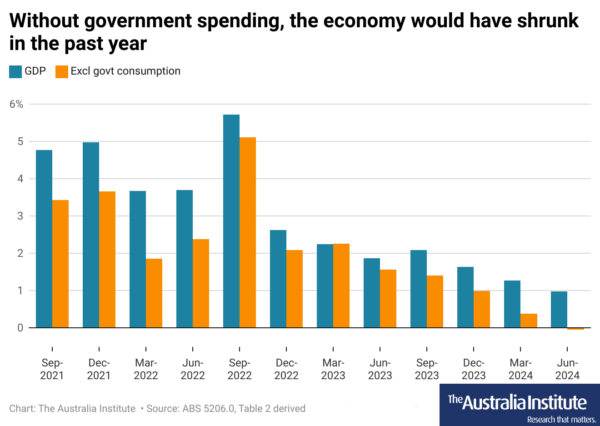
    And the private sector has already slowed so greatly that the only reason GDP rose in the past year was because of increased government spending.

    That is not a sign of a strong economy, nor a sign of one, according to the assistant governor of the RBA, Dr Sarah Hunter, that “is running a little bit hotter than we thought previously”.

    Economies that are running a bit hot are ones in which households are spending a lot more than they were the year before because unemployment is falling and wages are rising well ahead of inflation. Instead we currently have a situation where unemployment has risen from 3.5% in June last year to the current level of 4.2%, household spending grew just 0.5% – well below the long-term average of 3% – and real wages in the past year rose just 0.1%.

    When asked about this discrepancy between reality and the RBA’s belief, the Governor of the Reserve Bank, Michele Bullock told reporters last week that

    …it’s the difference between growth rates and levels.

    She noted that “it’s true that the growth rate of GDP has slowed” but that “part of monetary policy’s job has been to try and slow the growth of the economy because the level of demand for goods and services in the economy is higher than the ability of the economy to supply those goods and services. So there’s still a gap there. So even though it’s slowing, we still have this gap.”

    In effect Bullock was telling people to stop worrying about the fact that household consumption was barely growing or that GDP only grew because of government spending or that GDP per capita has fallen for a record 6 consecutive quarters because the amount of consumption and GDP was too high.

    This could make sense – think of it like a car travelling on a 60km/h road. If it was travelling at 80km/h and slowed to 70km/h even though it was slowing it would still be going too fast.

    In essence this is what Bullock is arguing is happening to demand in the economy – it is slowing but overall there’s still too much of it.

    The only problem is that this is completely wrong.

    Consider the suggestion that the demand for goods and services is higher than the ability of the economy to supply those goods and services. One simple way to look at this is to see if the amount of goods and services bought per person is currently at a level consistent with the growth observed in the decade before the pandemic.

    This is actually not a major test – household consumption, along with most of the economy was rather weak in the 7 or 8 years before 2020. The RBA at the time actually was hoping Australians would spend more than they did, so you would expect in an economy with too much demand that the amount of things we are buying is well above the levels of that particularly weak period.

    But it is not.

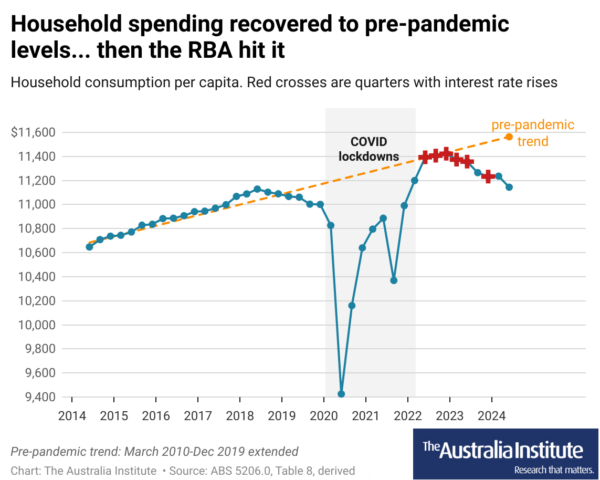
    As we can see from the below graph, while household spending did quickly recover after the lockdowns in 2020 and 2021, by the time the RBA began raising interest rates our level of demand for goods and services was only back to the level consistent with the pre-pandemic growth.

    Now yes you can argue the RBA was right to increase rates at that time – to ensure our spending didn’t keep zooming up in recovery. But by the time of the 10th rate increase in March 2023, household spending per person was already falling and 0.7% below the pre-pandemic trend. When the RBA raised rates for there 12th time in June 2023, the level of demand for goods and services was 1% below the pre-pandemic trend.

    At this point you might think the RBA had done enough. But after pausing for 4 months, the bank inexplicably raised rates for a 13th time in November 2023. At this stage household level of spending was 2.5% below the pre-pandemic trend.

    And because interest rate rises take months to worth through the economy we now find ourselves at a point where the level of household consumption per person is 3.8% lower than would have been expected had households merely kept increasing our consumption in line with the decade before the pandemic.

    In effect Australians are currently consuming almost the same amount of goods and services as they did in June 2018 and yet the head of the RBA would have us believe that is a case of excess demand.

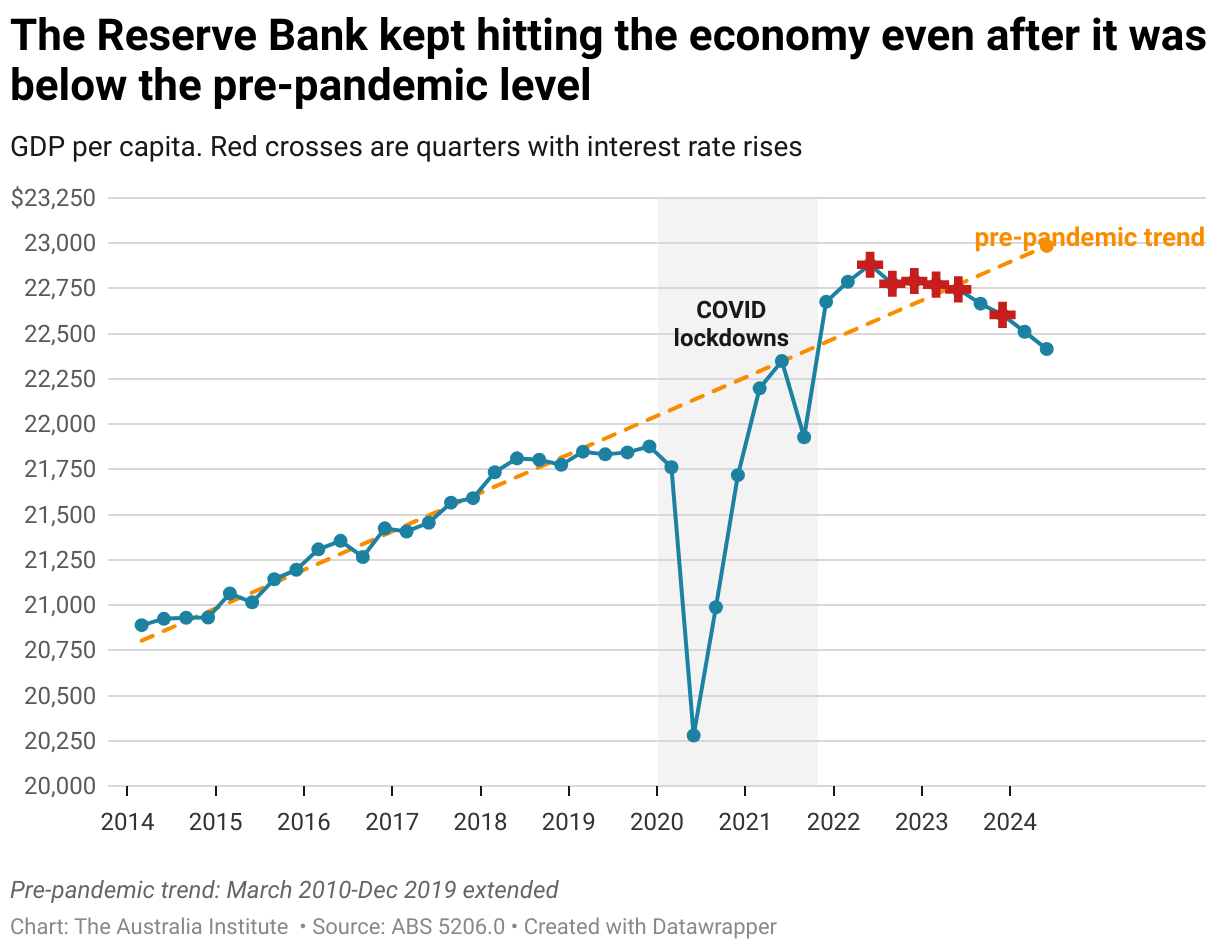
    If we look at the overall economy, the picture is much the same (see the graph at the top of the page). Australia’s level of GDP per capita did recover quickly after the lockdowns and by June 2022 was 1.4% above the pre-pandemic trend level. But the interest rates rises had an immediate impact – reducing GDP per capita in 7 of the next 8 quarters. By June 2023 the level of activity in the economy was already below pre-pandemic expectations, and when the RBA hit Australians with the 13th rate rise in November 2023, the level of GDP per capita was 1.2% below the long-term trend.

    It is now 2.5% below – back at the level it was in June 2021.

    The RBA has got it wrong. They were initially worried that inflation was driven by concerns of strong wage growth rather than supply side issues and corporate profits. They then tried to argue household spending was still growing too strongly. The GDP figures showed that to be woefully mistaken. They then tried to argue that while growth in the economy was slow, there was still too much demand. But again the figures show this to be mistaken.

    The Treasurer Jim Chalmers stated nothing but the facts when he said earlier this month that rate rises were “smashing the economy”. The data supports his assertion, and it is time the RBA admits that their actions have not only slowed the economy but slowed it at a pace that is now harming Australians for no benefit other than the RBA saving face from its previous over-reactions.


    Related research

    You might also like

  • The 9 to 5 is back! Time to put the phone on silent

    Originally published in The Sydney Morning Herald and The Age on August 26, 2024

    If you’ve ever flicked off an email before bed, texted your boss out of hours, or received an ‘urgent’ work call after clocking off, you’ll be glad to hear some respite is just around the corner.
    A new right to disconnect from work, for employees in businesses with 15 or more staff, comes into force across Australia from Monday 26th August. This is a welcome response to the growing problem of ‘availability creep’, where work demands spill over into workers’ leisure time.
    The new right means most employees can now refuse to monitor and respond to unreasonable contact from their employers about work matters outside of paid work hours.
    Many of us are now online and digitally connected to our workplaces 24/7. This constant connectedness can make it hard to escape work calls, texts, and emails when not actually at work.
    As we are now so easily contacted anywhere and anytime, our leisure and family time has become very susceptible to interruptions from work, leading to unpaid overtime, an inability to ‘switch off’, and blurred boundaries between work and non-work time. Gone are the days of 8 hours work, 8 hours rest, and 8 hours play.
    The consequences are stark. Research has shown these work practices lead to increased stress, health problems and a poor work-life balance.
    The right to disconnect from work is one solution to the problems of availability creep and unpaid overtime. The Senate Select Committee on Work and Care proposed this reform to Australia’s workplace laws in early 2023 and the initiative was included in the Government’s Closing Loopholes package of workplace reforms passed by the federal parliament later that year. A similar right is in place in a number of other countries including France, Canada and the Philippines.
    Australia’s new right to disconnect does not mean there is a blanket ban on contacting employees outside their scheduled work hours. Rather, it means that an employee cannot be penalised for refusing unreasonable contact.
    There are many circumstances in which a manager’s attempts to contact an employee out of their work hours might be reasonable. For example, this could be where an employee is on-call and receiving an on-call allowance. Some jobs regularly require a certain amount of out of hours contact and employees’ remuneration may reflect this. However, for many workers, contact out of working hours arises from pressures that lead to overwork and unpaid overtime.
    And unpaid overtime is a significant problem in Australia.
    In 2023 employees responding to a Centre for Future Work survey reported working an average of 5.4 hours of unpaid overtime a week, with full-time employees reporting working an average of 6.2 hours a week of unpaid overtime. A conservative back-of-the-envelope calculation shows that’s an extra seven weeks’ work every year.
    Workers should not have to monitor or respond to emails, text messages and phone calls after hours about concerns that could be raised and dealt with in their scheduled work time. Poor organisation, understaffing and reliance on overwork are not good reasons for requiring employees to be available out of hours. It is these practices that the right to disconnect is intended to challenge.
    Fears that workplace flexibility will be undermined as workers exercise their rights to disconnect are largely misplaced. In organisations where flexibility is based on employees’ constant availability there may be some disruption. But this is exactly the practices that the right to disconnect should disrupt.
    Flexibility can exist alongside respect for employees’ rights to switch off from work. Good flexible work practices and arrangements are those that benefit both employers and employees, and are designed through negotiation and consultation. The dissolution of boundaries between work and leisure time is not the answer.
    Will individual employees be lining up to ask the Fair Work Commission to order their employers to stop contacting them? Probably not. The real potential in the right to disconnect is its ability to catalyse an evolution in workplace expectations that shifts norms away from a reliance on overwork and constant availability.
    Time to put that phone on silent.


    You might also like

  • Former ACCC Chair Professor Allan Fels to Deliver Third Annual Laurie Carmichael Lecture

    Former ACCC Chair Professor Allan Fels to Deliver Third Annual Laurie Carmichael Lecture

    Share

    The Carmichael Centre is proud to announce that the third annual Laurie Carmichael Lecture will be delivered on 5 September 2024 by Professor Allan Fels AO, former Chair of the Australian Competition and Consumer Commission (ACCC) and Chair of the recent Inquiry into Price Gouging and Unfair Business Practices.

    He will be joined in conversation by Sally McManus, Secretary of the Australian Council of Trade Unions (ACTU) to discuss the topic “Power, Profits and Price Gouging.”

    WHO:

    Professor Allan Fels AO – former Chair of the ACCC

    Sally MacManus – Secretary of the ACTU

    WHEN: Thursday, 5 September 2024

    Doors open – 5.30pm

    Event – 6.00pm to 7.15

    WHERE: RMIT Building 80, Level 2, Lecture Theatre 7, 445 Swanston Street Melbourne, VIC 3000

    The Laurie Carmichael Lecture is an annual keynote lecture co-sponsored by the Carmichael Centre (an initiative of the Australia Institute’s Centre for Future Work) and RMIT University’s Business and Human Rights Centre (BHRIGHT).

    The lecture is named in honour of Laurie Carmichael, the legendary manufacturing trade union leader who passed away in 2018 at the age of 93. Previous Carmichael Lectures have included Nobel Prize economist Joseph E. Stiglitz and former ITUC General Secretary Sharan Burrow.

    “Prof. Fels is a distinguished economist, lawyer, and academic who has made an outstanding contribution to public policy in Australia,” said Jim Stanford, Director of the Centre for Future Work (home of the Carmichael Centre).

    “For years he has championed the cause of fair, competitive pricing—a concern which became more urgent in the wake of accelerating inflation (and profit mark-ups) after the COVID pandemic.

    “Professor Allan Fels has long recognised the dangers of corporate concentration and unfair pricing to the efficiency and equity of Australia’s economy.

    “His Carmichael Lecture is a timely opportunity to highlight his recommendations for preventing price-gouging and protecting workers’ living standards.”

    Attendance at the lecture is free, but advance registration is essential at:

    Home


  • Closing Loopholes Protections, Including Right to Disconnect, Come Into Effect 26 August

    Closing Loopholes Protections, Including Right to Disconnect, Come Into Effect 26 August

    by Melissa Donnelly

    New labour rights coming into effect on 26 August, including the ‘Right to Disconnect’.

    On Monday, 26 August, several legal and regulatory changes included in the Closing Loopholes Act (passed earlier this year by Parliament) will come into effect. These changes will better protect casual employees, with a new legal definition of what constitutes casual employment (rather than leaving it solely to employers), and better pathways for casual workers to obtain permanent employment. New protections for ‘employee-like’ workers in the road transport and platform economy (including food delivery riders and ride-share drivers) will also come into effect.

    One of the most exciting changes coming on 26 August is enactment of the new ‘Right to Disconnect’ for workers at large firms. (For smaller workplaces, these changes come into effect next year.) This marks an important step forward in workers’ ability to turn off their devices outside of normal work hours, and get full value from their leisure time.

    The importance of these protections, and some detail on how workers can make the most of them, are provided in this commentary article by Melissa Donnelly, National Secretary of the Community and Public Service Union. The commentary originally appeared in the Canberra Times. Ms Donnelly refers to research from the Centre for Future Work’s annual Go Home On Time Day survey; see our full 2023 report on unpaid overtime for full details on those findings.

    Right to Disconnect Means Countless Aussies are About to Reclaim Knock-Off Time

    By Melissa Donnelly

    Everything that is treasured by Australians gets a nickname and finishing work at the end of the day is no different.

    But I’d argue that knock-off time is more than treasured. It’s sacred.

    Workers will soon have the right to disconnect and not answer calls or emails outside of paid hours as parliament passes Labor’s bill endorsing the reform.

    For some, knock-off time leads to a frantic trip to pick up the kids from school and then piling over to the neighbours’ place to watch the footy.

    For others, it means a visit to the local gym, a game of social soccer, or dinner and drinks with friends.

    But as time has passed and technology has improved, we’ve become increasingly available.

    The iconic Nokia 3310 was released in 2000, but it wasn’t pinging at us every time we got an email or meeting invite.

    It was only used for texts, calls and, of course, snake.

    Fast forward to 2024 and things are little bit different.

    For many, our now very smart phones are ringing or sending us email notifications and texts more often than they aren’t.

    Things that could wait until you got to the office are being done while you eat breakfast, and that call that definitely could have been an email is being answered late into the night because you’re committed to your job and don’t want to ignore your boss.

    But it’s not sustainable.

    We’ve slowly but surely lost our sacred knock-off time, and in its place is “I’m heading off, but available on my mobile”, or “I’ll jump back online when I’m home to finish that thing off”.

    I don’t know that knock-off time really exists anymore, but I do know that we’re all the worse for it.

    The union movement has always fought to protect workers while they are at work.

    Basically, you now have the right to knock off at the end of day. Properly.

    But just as important, has been the long and consistent fight the union movement has had with businesses and governments to protect the right of workers to not be at work.

    Weekends, lunch breaks, annual leave, sick leave and parental have all been fought for and secured by the union movement.

    So, what do you do when your time away from work is increasingly compromised by the explosion of technology?

    You campaign for and secure the right for workers to disconnect.

    And that’s exactly what we’ve done.

    What does this mean in practice?

    It means that you’ve got a whole bunch of extra rights when it comes to being contacted after-hours or being asked to monitor emails or anything work related, outside of work hours.

    If an employer is contacting you outside of your working hours, there must be a good reason for it.

    The Fair Work Act provides a good outline to help determine if contact is reasonable or not. These include:

    The reason for the contact – is it an emergency or highly time sensitive?

    The method of contact and the level of disruption it causes (for example, an email is less disruptive than an SMS or phone call).

    Whether the employee is paid to be available or is paid for additional hours worked.

    The nature of the role and the level of responsibility held by the employee.

    The employee’s personal circumstances (including family or caring responsibilities).

    This law supports you to switch off and will make your boss think twice about contacting you.

    Basically, you now have the right to knock off at the end of day. Properly.

    You aren’t paid to be available 24/7 – so you shouldn’t be.

    You should be able to watch your child at footy training – uninterrupted.

    You should be able to go to a pottery class – uninterrupted.

    You should be able to go fishing, visit a loved one, make book week costumes (parents, head to toe in glitter and makeshift costumes will know it’s *this week*), play soccer, have a beer, go to a dance recital, plod around in your garden, read a book, bake a cake – uninterrupted.

    You might be asking yourself right now, how big of a problem is this?

    The Centre for Future Work at The Australia Institute publishes an annual report that shines a light on the amount of unpaid overtime that Australian workers are doing.

    The 2023 report found that on average, employees perform 5.4 hours of unpaid work per week, with full-time employees working about 6.2 unpaid hours per week. This equates to more than 280 additional hours per year, or about 7 weeks per year, per worker.

    Workers shouldn’t be working an extra 7 weeks for free every year.

    You’re meant to knock off on time, and you’re meant to be able to switch off at the end of the day because it is good for you. It is good for your mental health, it is good for your physical health, it is good for your relationships.

    Just because we can be available all the time, doesn’t mean we should be.

    My final comments are ones you’d expect from a union leader. I want to highlight that the rights you have as a worker aren’t really your rights unless they are enforced. And that goes for all rights – your right to flexible work, your right to a safe workplace and now, your right to disconnect.

    If you’re not sure how to access these rights and you’re a member of the CPSU, reach out to our Member Service Centre. If you’re an APS employee but not yet a member, it’s time to join.

    The right to knock off at the end of the day is back, and I encourage you to use it.

    Melissa Donnelly is the national secretary of the Community and Public Sector Union.


    You might also like

  • No Blood – No Job

    No Blood – No Job

    Australia’s privacy laws and workers’ rights
    by Lisa Heap

    Organisations in Australia are using blood analysis as a means of screening future employees for ‘health risks’ that they allege may impact on their performance of work.

    Collecting sensitive information from blood analysis is restricted under Australia’s privacy laws. This is because the mishandling of this information can have a substantial detrimental impact on those who have provided the information. Requiring workers to submit to blood analysis is just one example of how organisations are now routinely collecting sensitive information from workers, sometimes without adhering to the requirements of privacy laws. Other examples include using fingerprint and facial recognition software and sensors that collect physiological and psychological data about workers.

    The protection from arbitrary interference with a person’s privacy is a fundamental human right. Interfering with this right, by collecting sensitive personal information, should occur in limited circumstances and only where necessary. However, this report shows that some organisations in Australia, are not treating the collection of sensitive information from workers as an exception. They are collecting sensitive information as a routine step in their employment processes.

    The findings of this report raise concerns about power, privacy, fairness, and the potential for discrimination in the practices being adopted by some organisations. These findings also show that Australia’s current privacy and workplace relations laws do not adequately address these concerns. Amendments to Australian privacy laws are currently being considered by the Australian Government with reforms likely to be put before the Australian Parliament before the end of 2024.

    This report examines the need for new provisions within either or both privacy or workplace relations laws that set out the rights of workers to protect their sensitive information. It argues that regulation should be geared towards, not only protecting workers’ rights to privacy, but to providing a disincentive to organisations hoarding and misuse of the personal and sensitive information of workers.

    The worker-centric approach called for in this report includes:

    • the development of one system of regulation to protect the privacy concerns of all workers regardless of employment status or work context
    • defining the collection of workers’ personal and sensitive information as high risk requiring both specific and detailed justification for the collection of this information and the genuine informed and affirmative consent of workers
    • the establishment of a tripartite mechanism to assist the regulator to develop and manage processes for dealing with the privacy and related human rights concerns of workers
    • the use of codes and frameworks, developed via a tripartite mechanism, to set out when and how workers’ information can be collected and used
    • the development of an easy to access, and timely, worker centered mechanism to address concerns about the collection and use of workers’ information.


    Full report

    Share

  • Off-Peak Hot Water: One Simple Change to Support Renewable Rollout

    Off-Peak Hot Water: One Simple Change to Support Renewable Rollout

    Share

    Australia’s off-peak hot water systems should be reconfigured to consume electricity in the middle of the day, rather than at night, according to new research from the Australia Institute and Buildings Alive.

    This one simple change could redirect much of the clean, cheap renewable energy that is currently being wasted, or “curtailed”, by the National Energy Market during the day.

    Key Findings:

    • Annual forced curtailment for 2023-24 was around 4,000 gigawatt-hours (GWh).
    • This represents around 9.3% of Australia’s total generation from wind and utility solar.
    • Historically, Off-peak hot water systems have been set to operate at night, but they could be reconfigured to consume electricity during the middle of the day, when there is an abundant supply of renewable electricity.
    • Switching off-peak hot water to the middle of the day could provide around 4,000 GWh of flexible demand, almost the exact current level of renewable curtailment.
    • This could save up to $6 billion in household electricity and energy costs by 2040.

    “The fact that we in Australia choose to waste cheap and clean renewable energy on a regular basis is absurd,” said Dr Richard Denniss, Executive Director at the Australia Institute.

    “While the persistent claims of a looming energy crisis and gas shortage ring out across the country, we are turning our back on nearly 10% of the current renewable capacity in our grid.

    “The time for inflexible, expensive and polluting electricity from fossil fuels has come and gone. It is now up to the Federal Government to make the necessary changes that will allow Australians to properly access clean, cheap renewable energy.

    “If off-peak hours were moved away from the time of day dominated by coal-fired electricity and towards the time of day when the sun is shining brightest, households would save money and we would reduce emissions.”

    “This is the low hanging fruit of the energy transition,” said Dr Craig Roussac, Chief Executive Officer at Buildings Alive.

    “There are significant gains to be made from this one relatively simple and cost-effective intervention in our energy market.

    “While the problems faced by the electricity system of the 2020s are different to those faced in the 1950s, off-peak hot water systems could again play an important role in reducing costs for consumers and increasing efficiency.

    “There are so many untapped and cost-effective technologies that can shift electrical loads to support the clean energy transition and domestic hot water is one of the most obvious.

    “State and Federal Governments across Australia should harness this opportunity now, so that future pressures on the grid can be eased and Australians can get access to abundant, clean, and cheaper energy in their homes.”


  • Would you like a recession with that? New Zealand shows the danger of high interest rates

    Would you like a recession with that? New Zealand shows the danger of high interest rates

    by Matt Grudnoff

    New Zealand’s central bank raised interest rates more than Australia and went into a recession – twice.

    Recently there have been calls for the Reserve Bank to increase interest rates because inflation has remained “sticky” at 3.5%-4%. These calls are coming even though this may push Australia into recession. This horrifying scenario is being shrugged off by some as the price we have to pay to get inflation down – but the experience of New Zealand shows higher interest rates do not always bring down inflation, but they can very much lead to recessions.

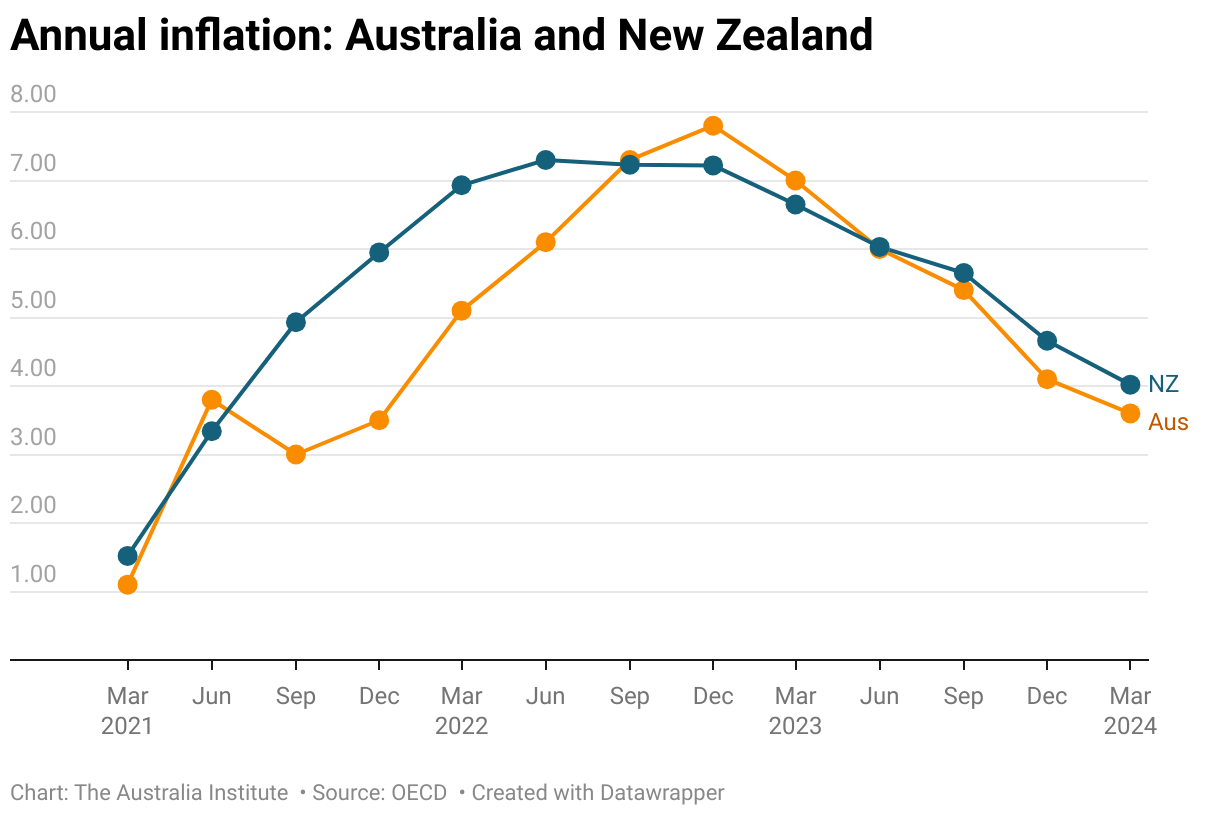
    The June quarter CPI is due out this week, and many economists predict that it will increase slightly from the current 3.6%. This comes after consistent falls in the rate of inflation since the end of 2022. In fact, the inflation rate has fallen from 7.8% in December 2022 to 3.6% in March 2024.

    But a more than halving in the inflation rate is not enough for the armchair inflation hawks who are determined to see the inflation rate back into the Reserve Bank’s target band as soon as possible and regardless of the cost.

    The idea that the costs of slightly elevated inflation are in any way comparable to the costs of a recession is just ridiculous. Recessions cause widespread suffering, unemployment, and economic scaring that can last for a decade or more.

    Now that wages are growing faster than inflation, the costs of inflation are minimal, particularly when it is less than a percentage point above the target band.

    Even worse, higher interest rates are unlikely to bring inflation down any faster.

    Normally inflation is caused when the economy is booming, incomes and spending is rapidly rising, and businesses can’t keep up with all the additional demand. In this situation, higher interest rates act by reducing spending and slowing the booming economy.

    The inflation Australia and the rest of the world are facing is not that kind of inflation. It is a much more uncommon kind of inflation that is caused by supply shocks. Supply shocks increase the costs that businesses face which leads to increased prices. Importantly higher costs can’t be fixed by increasing interest rates, making them a far less effective policy response.

    As former governor Philip Lowe pointed out, there is very little that monetary policy can do to offset supply shocks, and you should “let the supply shock wash through the system.”

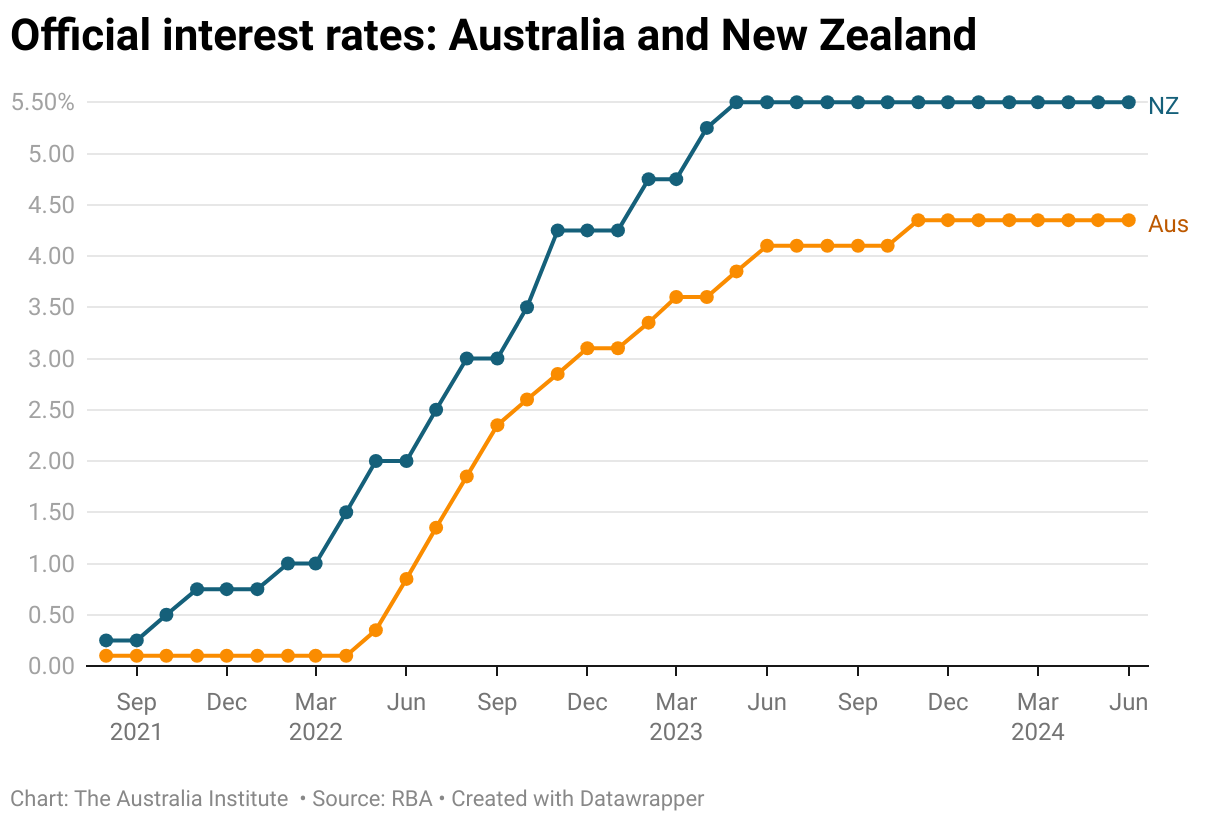
    New Zealand is a case in point. It has increased its official interest rate faster and higher than Australia. While Australia’s cash rate is at 4.35%, New Zealand’s rate is at 5.5%.

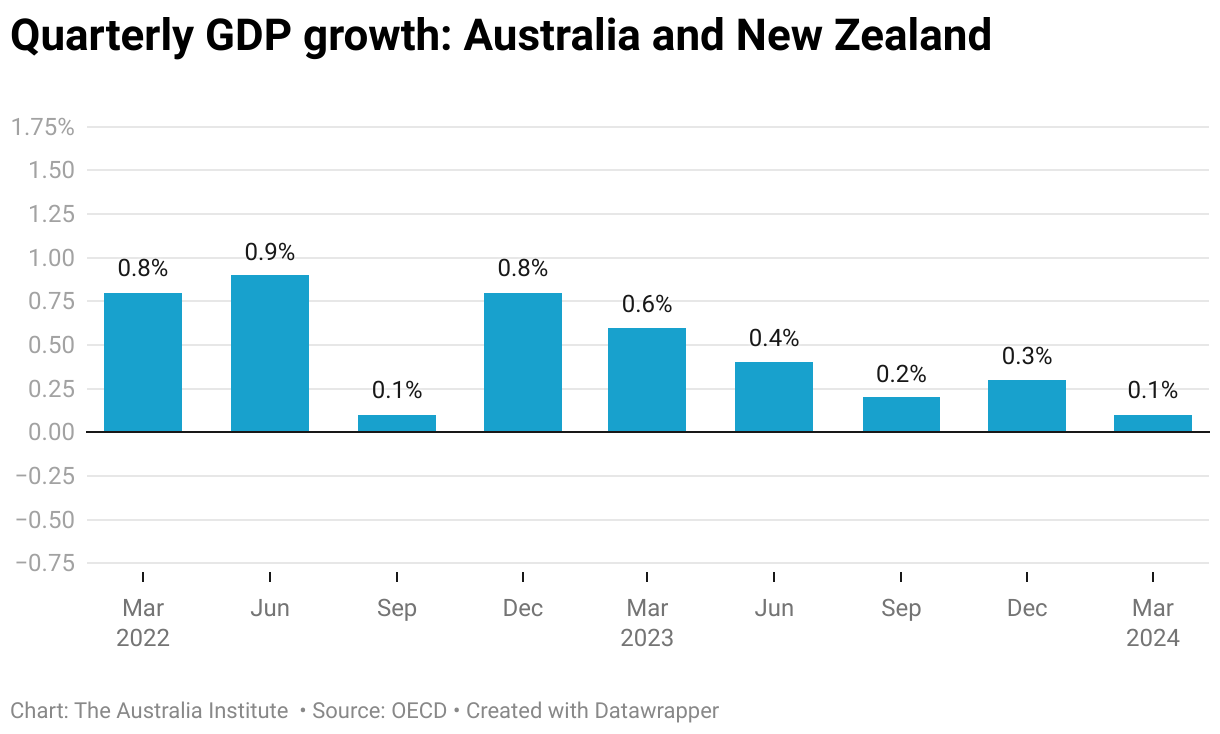
    The New Zealand economy has been dipping in and out of technical recession for 18 months. A technical recession is two consecutive quarter of negative economic growth – and New Zealand has experience that twice.

    By comparison Australia’s, economic growth has slowed but it has continued to remain positive.

    The problem for New Zealand is that the higher interest rates and slower economic growth have not led to a faster drop in inflation. If we compare the inflation in New Zealand and Australia, we can see that while inflation in New Zealand took off earlier than in Australia, both countries are seeing inflation come down at about the same pace.

    This should be a warning to the Reserve Bank that higher interest rates might work to crash the economy, pushing up unemployment, and heaping more misery on Australian households, but they will do little to bring down prices.

    Inflation is already on its way down as the supply shocks that set off this bout of inflation resolve themselves. When the June quarter inflation rate comes out, it might show the path back to the target band is not completely smooth. It may even increase slightly. But this is a time when the Reserve Bank needs to show courage and ignore the armchair critics and keep interest rates on hold.

    Inflation is coming down and a recession would be the worst possible outcome.


    Related research

    You might also like