Blog

  • Solving the crisis: Raising the living standards of Australian workers

    Productivity might be the word on everyone’s lips in the lead up to the Albanese Government’s Economic Reform Roundtable  however weak productivity isn’t the cause of many of the problems experience by workers in Australia today nor is increasing productivity the solution. Rapid inflation after the pandemic, combined with rising interest rates and slow wage growth, left many Australian households struggling to afford necessities. The Reserve Bank’s (RBA) blunt strategy of raising interest rates to slow the economy post the pandemic both misdiagnosed the drivers of inflation and harmed Australian workers who struggled to manage increased mortgage repayments and other debts. The root causes of Australia’s post pandemic crisis—rising corporate profits, unjustifiable price hikes, and deep wage stagnation were ignored by the RBA.

    Despite a reduction in inflation and interest rates, too many Australians are still experiencing lower living standards after the turbulent events of the past five years. Official inflation figures may capture broad economic trends however, they do not adequately describe the real pressures experienced by working people—particularly when it comes to the impact of the increasing costs of essentials like food, housing, and energy. Australian workers can ill afford another round of RBA driven unemployment, austerity, and uncertainty.

    What will it take to repair the damage to Australian workers’ living standards?

    In a new publication, Solving the Crisis: Raising the Living standards of Australian workers, some of Australia’s leading progressive economists and social policy analysts explain what is going on and how to fix it. The origins of the current crisis in living standards are documented. A progressive policy agenda for a second term Albanese Government is advanced.

    The multidimensional policy agenda in Solving the Crisis calls for

    • increases in real wages
    • achieving full employment
    • better quality jobs and greater assistance and respect for those seeking employment
    • strengthening public services (including health care, childcare, aged care and education)
    • making fair and affordable housing available
    • developing a well-planned and supported transition to renewable energy sources.

    The key to the success of this agenda is centering the experience of workers’ and their families.

    Australia should adopt a progressive multidimensional economic agenda that lifts living standards, reduces inequality, and strengthens democracy, rather than a narrow concentration on productivity. Uniting people behind this progressive economic agenda helps counter the trend towards increasing inequality, division and conflict, that has been present in other countries.

    How to solve the living standards crisis

    Four policy papers are the core of  Solving the Crisis. These papers examine the main drivers of inequality and deteriorating living standards in Australia

    • Greg Jericho examines how inflation is misunderstood when disconnected from wage growth. He proposes a shift in Reserve Bank policy and a renewed focus on promoting real wage increases.
    • Peter Davidson  argues that growing inequality is not inevitable. Through strengthening the four key policy pillars – income support, minimum wages, full employment, and employment services – minimum incomes can be raised and inequality reduced.
    • Thomas Greenwell highlights how decades of declining collective bargaining and high underemployment have undermined living standards. He calls for renewed support for unions, stronger collective bargaining systems, and a focus on full employment in macroeconomic policy.
    • Charlie Joyce revisits the concept of the social wage—and argues that rebuilding and expanding the social wage can raise living standards, promote inclusion, and restore trust in democratic institutions.

    Together these papers provide practical policy solutions forming a platform for economic reform.

    Solving the Crisis helps working people to help cut through economic misinformation and political spin, offering a clear lens on the structural factors that have driven inequality and declining living standards.

    Progress is happening

    In its first term the Albanese Government has made cautious progress on living standards. This progress includes labour market reforms that have contributed to stronger wage growth. These reforms include supporting increases in the minimum wage, facilitating collective bargaining in hard-to-organise industries, funding support for wage increase in early childhood education and aged care. Cost-of-living measures, like energy rebates and expanded renter assistance, also provide important support to hard-hit households. Meanwhile, the easing of interest rates by the RBA—better late than never, may support future growth and job-creation.

    However, while prices are growing more slowly, the levels of many prices remain too high—especially for necessities like food, housing, and energy. Wages growth may have commenced however at the current pace, it will take several years to repair real wages, and restore the same purchasing power for workers they enjoyed before the pandemic. The quality of public services (another critical determinant of living standards) has been damaged by underfunding and overreliance on privatised provision, the costs of which we are currently seeing in early childhood education and care. Minimum income payments such as Jobseeker remain woefully inadequate. The system designed to support and assist people from unemployment into decent jobs is broken beyond repair. Meanwhile, global economic and geopolitical uncertainty threatens to derail this modest recovery before it really gets going.

    More work to be done

    At the 2025 federal election the Australian people rejected political parties proposing cuts to public services, short-term fixes (like petrol tax cuts), and the politics of division. In its second term the Albanese Government has a unique opportunity to implement progressive policy changes such as those contained in Solving the Crisis.

    More details about Solving the Crisis and additional resources are available at https://www.carmichaelcentre.org.au/living_standards.


    Solving the Crisis: Raising the living standards of Australian workers

    Share

  • A smooth move or a tough transition? Protecting workers who’ll lose their jobs when the Eraring Power Station closes

    A smooth move or a tough transition? Protecting workers who’ll lose their jobs when the Eraring Power Station closes

    Share

    The Centre for Future Work at The Australia Institute has urged the federal government to take charge of transitioning hundreds of workers into secure employment when the Eraring Power Station shuts down.

    The power station is scheduled to close by August 2027. More than 1000 workers will be directly impacted by the closure.

    This is an important test in Australia’s transition from fossil fuel power to renewables.

    The Centre for Future Work has written a submission to the Net Zero Economy Agency (NZEA) urging it to apply its Energy Industry Jobs Plan to the Eraring closure, to avoid inflicting undue pain on workers currently employed at the power station.

    In the submission, it argues that this important process should not be left solely to the power station owner, Origin Energy, but managed under the Energy Industry Jobs Plan, which was set up for this precise purpose.

    “We hear a lot about how the transition to a clean energy future involves helping workers in the coal and gas industry secure jobs when theirs disappear,” said Charlie Joyce, Researcher, Centre for Future Work at The Australia Institute.

    “To help this process, the government set up the Net Zero Economy Authority, which established an Energy Industry Jobs Plan, designed specifically to support workers who’ll lose their jobs when coal and gas power stations close down.

    “Well, now the nation’s biggest coal-fired power station is closing down. It’s time for this plan to deliver.

    “Origin has made some noise about helping workers with retraining and career counselling, but that’s not enough. This impacts far more than those employed directly by Origin Energy. It requires coordination with industry, unions, and the broader community.

    “The nation will be watching how the Eraring closure unfolds. This is an important test for transitioning workers into good, secure jobs.

    “It would be senseless for the Net Zero Economy Authority not to use its Energy Industry Jobs Plan in this situation.  This is what it was set up to do.”


  • Australia does not have a “productivity crisis” – new research

    Australia does not have a “productivity crisis” – new research

    by Jim Stanford

    Share

    New research by The Australia Institute reveals there is little evidence of a “productivity crisis” in Australia, despite claims to the contrary from business leaders and politicians. 

    Like the rest of the world, productivity has been sluggish since the COVID pandemic, but that is largely due to businesses failing to adequately invest in machinery, equipment, technology and skills, at a time when many are recording record profits.

    The research also reveals that disappointing productivity is not the cause of the problems facing Australian households, like falling real wages, high prices, high interest rates and the unaffordability of housing.

    Key findings:

    • If real wages had grown at the same rate of productivity since 2000, average wages would be 18% – or $350 per week – higher.
    • Australian businesses now invest less than half as much in research and development as those in other OECD countries.
    • Higher productivity does not automatically “trickle down” to workers in terms of improved wages or living standards.
    • Productivity benefits are trending toward high-paid executives, shareholders and profits, rather than workers.
    • Business claims that productivity can be improved by wage cuts, tax cuts, deregulation or reduced unionisation are false.
    • The idea that workers should “tighten their belts and make do with less” to improve productivity is a lie.

    “Productivity has become an excuse for big, profitable businesses to do whatever they like,” said Greg Jericho, Chief Economist at The Australia Institute‘s Centre for Future Work.

    “Peter Dutton said he’d tear up the new right-to-disconnect laws, saying they hampered productivity, as if allowing employers to call staff any time of the day or night would somehow make them more efficient. This research dispels that kind of nonsense.

    “Australia’s so-called ‘productivity crisis’ is massively exaggerated. Low productivity is not to blame for the problems facing households today, like soaring interest rates, prices or low wage growth.

    “This research also shows that sluggish productivity is caused by companies investing far less in things like machinery, equipment and research.

    “The benefits of productivity should not go straight to profits, shareholders or fat cat CEOs. They should be shared with workers in the form of wages which grow at a similar rate.

    “That way productivity would deliver its true purpose: to provide economic prosperity and a higher quality of life for everyone.”


    Related research

  • Productivity in the Real World

    Productivity in the Real World

    What it is, what it isn’t, and how to make it work better for workers
    by Jim Stanford

    Claims that Australia faces a productivity crisis are overblown. Weak productivity didn’t cause the current problems facing Australian workers (falling real wages, high interest rates, unaffordability of essentials like housing and energy). Nor will higher productivity fix these problems.

    Faith that higher productivity will automatically trickle down, to be shared by all workers, is unfounded. Pro-active measures to lift wages and living standards are needed if stronger productivity growth is to support stronger living standards.

    This report presents empirical evidence showing that productivity growth in recent decades has not been equally reflected in higher real wages and better living standards.

    • Productivity grew four times faster since 2000 than average wages adjusted for consumer prices; it grew almost twice as fast as average wages adjusted for producer prices.
    • If workers had received wage increases since 2000 that matched productivity growth, wages would be as much as 18% higher than they are at present – worth $350 per week, or $18,000 per year.
    • Over time, the failure of wages to keep up with productivity has created a “productivity debt” effectively owed to workers, worth hundreds of thousands of dollars per worker.

    The fruits of productivity growth have been disproportionately captured in the form of business profits, dividend payouts, and executive compensation. It is only through deliberate measures to ensure productivity growth is reflected in improved compensation and conditions for workers that Australian workers can have any confidence their contributions to improved productivity will pay off in better lives. Repairing the link between productivity and mass prosperity, by strengthening the institutions of distribution and pushing wealth downward (rather than hoping it will trickle down automatically), is as important to Australia’s future productivity as any labour-saving technological breakthrough.

    The report concludes with a broad agenda of high-level policy themes that should be pursued to challenge and support Australian workplaces to become more productive – and to ensure the resulting gains are broadly shared.


    Productivity in the Real World


    Factsheet
    Australia does not have a “productivity crisis” – new research

    Share

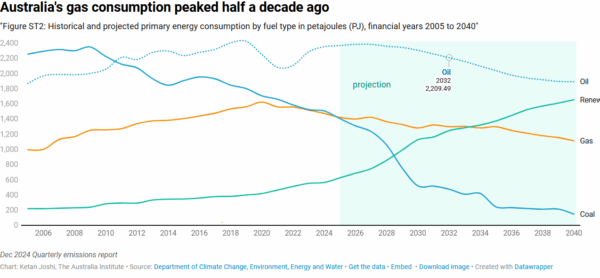
  • Australia’s Gas Use On The Slide

    Australia’s Gas Use On The Slide

    by Ketan Joshi

    Share

    The Federal Government has released a new report that includes projections of how much gas Australia is set to use over the coming decades. There is no ambiguity in its message: Australia reached peak gas years ago, and it’s all downhill from here:

    “Gas consumption is projected to decline to 2040 as electrification increases across the economy and renewables and storage take an increasing share of electricity generation”, wrote the Department of Climate Change, Energy, Environment and Water (DCCEEW).

    This doesn’t sit well with the Prime Minister’s recent claims that more gas is needed for “firming” renewable energy. Figures from the Australian Energy Market Operator (AEMO)’s 2024 Integrated System Plan (ISP) show just how little gas is likely to be required in Australia’s electricity system.

    In AEMO’s ‘step change’ scenario, there isn’t a single year where gas generates more than its historical peak in the National Electricity Market. In this scenario, more gas was burned in the past 16 years than is burned over the next 25 years.

    In short: while gas might serve occasional use during low wind and sun periods, Australia simply will not end up using large amounts of it.

    It is weird, then, that Australia has a massive pipeline of planned fossil gas extraction projects. Many of them are justified on the grounds that they’re required to help Australia decarbonise its power grids, with more than 1,000 new petajoules coming online by 2027, according to the latest government projects report.

    The chart below compares the above projections of Australia’s domestic gas use to projections of the volume of gas exports, prepared by the separate Department of Resources and Energy (DISER). It makes it pretty clear where all the new gas is going – exports.

    Only looking at new gas production capacity, and only looking at the proportion that has a clear operation date, that is still around 11 times the amount of gas projected to be used in the power sector. In fact, the use of LNG for FY23 was greater just for processing LNG than the entire power sector in Australia:

    This analysis by climate expert Tim Baxter lays it out in even more detail.

    “Again, more than 3,000 petajoules of gas were exported from Western Australia in 2022–23. If the entire transition to clean energy were to stand dead still as if renewables weren’t already going gang-busters — in Western Australia renewable energy generation has increased by an average of 20% each year for the past five years — we would need just 2.5% of that gas to keep the lights on for the state”.

    It is pretty simple: Australia does not need to be expanding its fossil gas production, least of all to run fossil gas power stations. It’s a hollow fossil fuel industry talking point, and the Federal Government should know better than to repeat it.


    You might also like

    Centre For Future Work to evolve into standalone entity

    The Centre for Future Work was established by the Australia Institute in 2016 to conduct and publish progressive economic research on work, employment, and labour markets. Supported by the Australian Union movement, the centre produced cutting edge research and led the national conversation on economic issues facing working people: including the future of jobs, wages

  • Dutton’s nuclear push will cost renewable jobs

    Dutton’s nuclear push will cost renewable jobs

    by Charlie Joyce

    Dutton’s nuclear push will cost renewable jobs

    As Australia’s federal election campaign has finally begun, opposition leader Peter Dutton’s proposal to spend hundreds of billions in public money to build seven nuclear power plants across the country has been carefully scrutinized.

    The technological unfeasibility, staggering cost, and scant detail of the Coalition’s nuclear proposal have brought criticism from federal and state governments, the CSIRO, the Climate Council, the Electrical Trade Union (ETU), the Climate Change Authority, the Australia Institute, and independent energy experts.

    The CSIRO, among others, has refuted the Coalition’s claim that nuclear will be cheaper than renewables; instead, they have shown the energy produced by Australian reactors would cost approximately eight times more than the same amount of energy produced by renewables. If this cost is passed on to consumers, the average household would pay $590 per year more on their power bill. Unsurprisingly, Australia Institute polling has found that fewer than one in twenty Australians (4%) are prepared to pay this nuclear premium.

    The cost alone should be enough to bury this nuclear proposal. But it is also important to recognise how the Coalition’s plan will impact – and fail – workers.

    False promises

    The Coalition has proposed that large nuclear reactors would be built on the sites of five operational or recently decommissioned coal fired power stations: Liddell and Mount Piper in New South Wales, Tarong and Callide in Queensland, and Loy Yang in Victoria. In doing so, the Coalition has promised that nuclear energy would be a source of stable and plentiful work for the communities where coal-fired power plants are phasing down.

    This is a false promise. Six coal fired power stations have already closed in the past decade, with 90% of Australia’s remaining coal-fired power stations set to close in the next decade. These communities are already undergoing structural adjustment, and they need new sources of employment now. But this is not what the Coalition’s plan delivers. The Coalition outlines that the first two nuclear reactors would not come online until the mid-2030s – more than a decade from now – while the remainder would be completed by 2050.

    And energy and technology experts agree that even this timeline is impossible. On average, a nuclear reactor takes 9.4 years just to build in countries with established and capable nuclear industries. Former Australian Chief Scientist Alan Finkel has estimated that it would take until the mid-2040s at the earliest for Australia to build an operational nuclear reactor. Moreover, analysis from the Institute for Energy, Economic & Financial Analysis (IEEFA) has found that, in economies comparable to Australia’s, every single nuclear reactor project experienced multi-year delays and cost blowouts of up to three and a half times over budget. It is hard to see how Australia, which lacks the experienced workforce, training and research base, or regulatory framework, would buck this trend.

    Lost jobs

    While the Coalition’s nuclear plan would not bring jobs to the communities that need them, it might have the real effect of depressing investment in renewables.

    Renewable energy already generates approximately 40% of Australia’s energy and is by far the cheapest form of electricity. Renewable energy industries already account for the employment of tens of thousands of workers, and Jobs and Skills Australia estimates that approximately 240,000 new workers will be required in industries associated with clean energy by 2030.

    But this requires ongoing and expanding investment in renewables, which the Coalition’s nuclear policy is likely to derail. The Clean Energy Council has estimated that by capping renewable energy to 54% of total use (as the Coalition’s modelling has assumed), 29GW of renewable energy generation projects would not be built – squandering an expected 37,700 full-time-equivalent construction jobs and 5,000 ongoing jobs in operations and maintenance. By limiting renewables investment, prolonging fossil fuel usage, and diverting investment towards nuclear energy, the full employment opportunities of the renewable energy transition are lost.

    Scarce and dangerous work

    If the Coalition’s nuclear plan does come to fruition it will hardly create any ongoing jobs for the communities that have undergone structural readjustment. According to analysis from the Nuclear Energy Agency, while the peak period of construction of the average 1GW nuclear power plant can demand up to 3,500 workers, ongoing operations and maintenance will only require about 400 workers – with only a quarter of these being onsite blue-collar jobs that might provide work for the people who will have lost jobs with the closure of coal-fired power stations. Most jobs will be in administration, regulatory compliance, energy, marketing, sales, science and emergency personnel – and many of them are likely to be located away from the nuclear facility itself.

    Disturbingly, any jobs on-site may put the health of workers at risk. Recent analysis of multiple studies of the health impacts of nuclear power plant employment across multiple countries found that workers have a significantly higher risk of mesothelioma and circulatory disease due to exposure to radiation. Nearby residents also exhibit a significantly higher risks of cancer, with children under the age of five at particular risk. And this does not even factor in the risk of sudden plant failure and reactor meltdown on workers and communities – a risk sharpened by the Coalition’s plan for these reactors to be built on geological fault lines with heightened earthquake risk.

    Australian workers have much to gain from the renewable energy transition, including cheaper power, new clean technology industries, and hundreds of thousands of new jobs. The Coalition’s nuclear plan only brings false promises, lost jobs, and – if the plan comes to fruition – few jobs and potentially dangerous work.


    You might also like

  • The curious incident of low wages growth

    The curious incident of low wages growth

    Wages and Policy in the 21st Century Report No. 1
    by David Peetz

    A new Carmichael Centre report by David Peetz considers why wages growth has been so low, despite a tight labour market and a brief surge in inflation.

    Asking why has there been no wages explosion, Peetz finds the answer lies in loss of power.

    The report documents how workers have lost power in the past two decades, with almost every change in the economy taking away workers’ bargaining power.

    From 2014 to 2022 most government policies took away workers’ bargaining power. The most recent industrial relations reforms in 2022-2024 shifted the pendulum back some way towards workers. These laws increased workers power and have also boosted wages growth.

    The analysis shows that all workers have had their wages damaged by lack of power. And all workers have been able to recover some ground since the recent industrial relations laws have come into effect.

    • Australian workers can no longer obtain the wage increases that they previously could from wage negotiations. Workers do not contribute to inflation.
    • Changes in power have combined to normalise low wages growth, for both union and non-union workers, even in tight labour markets. Of 16 developments in the labour market and economy over the past 50 years, 14 signalled deterioration in worker power, one an improvement in power for female workers only, and one an improvement only from 2010 until 2023 (lower unemployment).
    • The one countervailing force in recent times has been public policy which, since 2022, has led to some increases in workers’ power. Analysis of 34 policy events showed that the majority of those before 2022 further reduced workers’ bargaining power, while almost all of those since then have increased workers’ power.
    • In March 2014 wages were 53.0% of national income, but by December 2022 they had fallen to just 50.3%, before recovering to 53.5% by September 2024.
    • Wages grew at a little over 2% per year through most of the period from 2013-14.  After September 2022, they grew more quickly, to over 4% per annum throughout 2023-24.
    • The wage gains associated with increased worker power are not just restricted to unionists, but they are likely greater for unionists than non-unionists.


    Full report

    Share

  • Working from Home, Not a Problem

    More than one in three workers in Australia usually work from home at least some of the week. Working from home has become an established working arrangement for many employees in jobs where it is possible to work remotely. Yet, there is strong opposition from some employers to working from home and regular reports of pressure from organisations to wind back this work arrangement.

    During the lead up to the 2025 federal election we have heard a lot about working from home arrangements as the Coalition adopted a policy for all Commonwealth public servants to work from the office five days a week. The policy has been abandoned but it is not clear that the Coalition have changed their views on this flexible work option, having said it created inefficiencies, has harmed productivity and is much more common in the public than in the private sector. But is there any evidence supporting these views?

    In this briefing paper we review the evidence on working from home, addressing the questions: Who works from home and why? Who benefits from working from home arrangements? Why do some employers (and politicians) want workers back in the office? What is the future for work from home arrangements?

    We find working from home is a flexible work option that has benefits for workers and for organisations, and it contributes to more inclusive and gender-equal workforce participation and a more productive economy. Working from home arrangements may require some workplace adaptation including requiring managers to work differently. However these challenges should not get in the way of the many benefits that working from home and other flexible work arrangements offer.


    Full report

    Share

  • The continuing irrelevance of minimum wages to future inflation

    The continuing irrelevance of minimum wages to future inflation

    Share

    Minimum and award wages should grow by 5 to 9 per cent this year

    Updated analysis by the Centre for Future Work at The Australia Institute reveals that a fair and appropriate increase to the minimum wage, and accompanying increases to award rates, would not have a significant effect on inflation.

    The analysis examines the correlation between minimum wage increases and inflation going back to 1990, and finds no consistent link between minimum wage increases and inflation.

    It also reveals that such an increase to award wages could be met with only a small reduction in profit margins.

    The report, authored by Greg Jericho, based on previous work by both he and Jim Stanford, finds that an increase to the National Minimum Wage and award wages of between 5.8% and 9.2% in the Fair Work Commissions’ Annual Wage Review, due in June, is required to restore the real buying power of low-paid workers to pre-pandemic trends.

    The report also finds that this would not significantly affect headline inflation.

    Key findings of the report include:

    • Last year’s decision, which lifted the minimum wage and award wages by 3.75 per cent, offset the inflation of the previous year but still left those on Modern Awards with real earnings below what they were in 2020.
    • By June this year, the real value of Modern Award wages will be almost 4 per cent below what they were in September 2020.
    • Despite increases in the minimum wage over the past 2 years above inflation, inflation fell by a combined 4.5 percentage points.
    • There has been no significant correlation between rises in the minimum wage and inflation since 1990.
    • Raising wages by 5.8 to 9.2 percent this year would offset recent inflation and restore real wages for award-covered workers to the pre-pandemic trend.
    • Even if fully passed on by employers, higher award wages would have no significant impact on economy-wide prices.
    • A 9.2 per cent increase in award wages could be fully offset, with no impact on prices at all, by a 1.8 per cent reduction in corporate profits – still leaving profits far above historical levels.

    “Australia’s lowest paid workers have been hardest hit by inflation over the past 3 years,” said Greg Jericho, Chief Economist at The Australia Institute’s Center for Future Work.

    “The price rises of necessities always hurt those on low incomes harder than those on average and high incomes.

    “This analysis shows there is no credible economic reason to deny them a decent pay raise above inflation.

    “It’s vital the Fair Work Commission ensure that the minimum wage not only keeps up with inflation but also returns the value to the real trend of before the pandemic.”


    Related research

  • The Continuing Irrelevance of Minimum Wages to Future Inflation

    The Continuing Irrelevance of Minimum Wages to Future Inflation

    Minimum and award wages should grow by 5 to 9 per cent this year
    by Greg Jericho

    Updated analysis by the by the Centre for Future Work at the Australia Institute reveals that a fair and appropriate increase to the minimum wage, and accompanying increases to award rates, would not have a significant effect on inflation. The analysis examines the correlation between minimum wage increases and inflation going back to 1990, and finds no consistent link between minimum wage increases and inflation. It also reveals that such an increase to award wages could be met with only a small reduction in profit margins.

    The report, authored by Greg Jericho, based on previous work by both he and Jim Stanford finds that an increase to the National Minimum Wage and award wages of between 5.8% and 9.2% in the Fair Work Commission’s Annual Wage Review, due in June, is required to restore the real buying power of low-paid workers to pre-pandemic trends. The report also finds that this would not significantly affect headline inflation.

    Key findings of the report include:

    • Last year’s decision, which lifted the minimum wage and award wages by 3.75 per cent, offset the inflation of the previous year but still left those on Modern Awards with real earnings below what they were in 2020.
    • By June this year, the real value of Modern Award wages will be almost 4 per cent below what they were in September 2020
    • Despite increases in the minimum wage over the past 2 years above inflation, inflation fell by a combined 4.5 percentage points.
    • There has been no significant correlation between rises in the minimum wage and inflation since 1990.
    • Raising wages by 5.8 to 9.2 per cent this year would offset both recent inflation and restore real wages for award-covered workers to the pre-pandemic trend.
    • Even if fully passed on by employers, higher award wages would have no significant impact on economy-wide prices.
    • A 9.2 per cent increase in award wages could be fully offset, with no impact on prices at all, by a 1.8 per cent reduction in corporate profits – still leaving profits far above historical levels

    “Australia’s lowest paid workers have been hardest hit by inflation over the past 3 years. The price rises of necessities always hurt those on low incomes harder than those on average and high incomes. This analysis shows there is no credible economic reason to deny them a decent pay raise above inflation.” Jericho said.

    “It’s vital the Fair Work Commission ensure that the minimum wage not only keeps up with inflation but also returns the value to the real trend of before the pandemic.”


    The Continuing Irrelevance of Minimum Wages to Future Inflation


    Factsheet
    The continuing irrelevance of minimum wages to future inflation

    Share