Blog

  • The Reserve Bank needs to watch that it doesn’t push the economy off a cliff

    Originally published in The Guardian on December 1, 2022

    For most of this year, the warnings and news about inflation have been one of hope for the best but experience the worst. Predictions of future inflation growth have continually been revised upwards and with it has been the suggestion that interest rates need to keep rising.

    But as Labour Market and Fiscal Policy Director, Greg Jericho, notes in his Guardian Australia column, the latest monthly inflation figures out yesterday suggest that maybe the peak could be lower than anticipated.

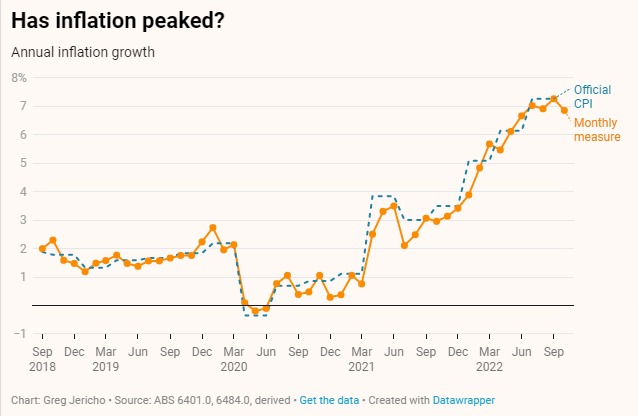
    While the monthly figures can be a little erratic, they do closely align with the quarterly “official” CPI figures and in October the ABS estimates that annual inflation growth fell from 7.3% to 6.9%. Better still this makes 4 months in a row where inflation has remained around 7%, rather than increasing quickly as it has since the middle of last year.

    Combined with the latest Retail Trade figures released this week which showed the dollar amount spent in the shops fell in October, and the volume of spending falling even faster, there are solid signs that the interest rate rises are having an impact.

    This means the Reserve Bank needs to be very cautious as much of the impact of the rate rises from September October and November has yet to flow through into the data. And because the rates of existing mortgages take longer to rise than do rates for new home loans this also means that even were the RBA to halt rate rises, for most mortgage holders rates will still be about to rise over the next few months.

    The IMF, OECD, Treasury and the RBA itself all forecast a sharp slowing of Australia’s economy next year and into 2024. The rationale has been that this is the cost of needing to reduce inflation, but the central bank needs to be very careful that it does not commit overkill. With the economy and consumer spending already slowing, and inflation showing some good signs that growth is no longer increasing at a rapid rate, the RBA should strongly consider not increasing the rate next week in its final board meeting of the year.

    You might also like

    Dutton’s nuclear push will cost renewable jobs

    by Charlie Joyce

    Dutton’s nuclear push will cost renewable jobs As Australia’s federal election campaign has finally begun, opposition leader Peter Dutton’s proposal to spend hundreds of billions in public money to build seven nuclear power plants across the country has been carefully scrutinized. The technological unfeasibility, staggering cost, and scant detail of the Coalition’s nuclear proposal have

  • Deal on IR Reforms Sets Stage for Faster Wage Growth

    Deal on IR Reforms Sets Stage for Faster Wage Growth

    Share

    Industrial Relations Reform Sets Stage for Significant Acceleration of Wage Growth.

    A legislative consensus reached over the weekend to approve reforms to industrial relations laws sets the stage for rebuilding collective bargaining and a significant acceleration of wage growth, according to research from the Australia Institute’s Centre for Future Work.

    “These reforms will lift wage growth and improve fairness in workplaces across Australia, big and small, in all sectors of the economy,” said Dr Jim Stanford, Economist and Director of the Centre for Future Work.

    “These measures will rebuild collective bargaining, enhance gender equity, ensure greater transparency, and equip workers with critical tools to pursue fair treatment,” Dr Stanford said.

    Research published by the Centre for Future Work suggests collective bargaining coverage will rebound under the new laws, which will allow for multi-employer collective bargaining in certain circumstances. Bargaining coverage in Australia has declined dramatically since 2013, with just 11% of private sector workers now covered by a current enterprise agreement. That fall in coverage has been the largest single cause of record-slow wage growth over the last decade.

    Based on the historical relationship between bargaining coverage and wage growth, rebuilding coverage toward pre-2013 levels will lift nominal wage growth by 1.6 percentage points per year. Additional wage growth of that magnitude would lift annual incomes for a typical worker by almost $1500 in just one year, and a cumulative total of almost $24,000 over five years.

    Another provision in the reform package is a new limit on the ability of employers to unilaterally terminate expired enterprise agreements during their renegotiation. Many employers have used this loophole to wipe out years of collective bargaining gains. A recent example was Qantas’s threat earlier this year to terminate its agreement for cabin crew. Centre for Future Work modeling shows that could have cost senior staff as much as $67,000 per year. This so-called ‘nuclear option’ in employers’ arsenal will be prohibited under the new laws.

    “With the post-pandemic acceleration of inflation, many years of wage stagnation have now tipped over into the fastest decline in real wages in Australian history,” said Dr Stanford.

    “This bill is a needed and timely response to an unprecedented crisis in workers’ living standards.

    “I congratulate the legislators, including Minister Tony Burke, Greens Leader Adam Bandt, and Senator David Pocock, for negotiating this package and working to approve it in Parliament,” Dr Stanford said.


    Related research

  • Rough times ahead for Australia’s economy as oil, gas and coal companies celebrate

    Originally published in The Guardian on November 24, 2022

    The latest economic outlook from the OECD highlights the precarious path for Australia over the next few years.

    As Labour market and Fiscal Policy Director, Greg Jericho, notes in in his Guardian Australia column, the OECD predicts in both 2023 and 2024 Australia’s economy will grow by less than 2%. In the past such weak growth has been associated with recessions. And while a recession is not predicted, unlike for the UK and Germany, the OECD also notes the risks that lie ahead.

    One major problem is that most nations around the world are lifting interest rates to attempt to slow their economies and thus reduce inflation. The OECD notes however that when nations act in concert the impact of higher interest rates on slowing the economy is greater, while the impact on slowing inflation is weaker.

    Given Australia has a higher proportion of mortgage holders with variable rates this increases the risk that higher interest rates will slow our economy more than in other nations, and still have less impact on inflation.

    But one sector of the economy are rejoicing at the current conditions that are causing the rising inflation – energy companies.

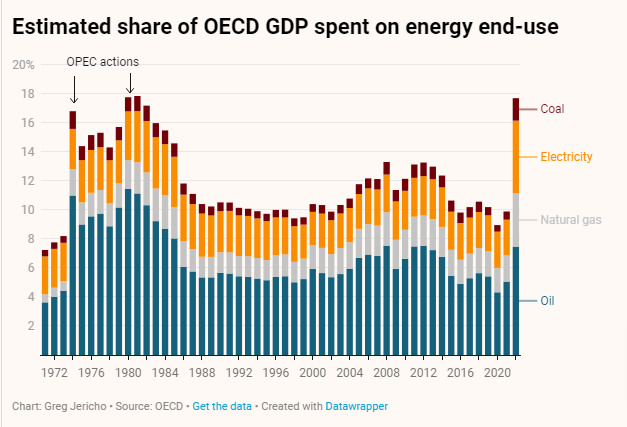
    The OECD notes that the share of GDP being spent on energy by OECD nations is higher now than it was during the OPEC crisis in 1974 and 1980. The evidence again is clear that a windfall profits tax should be levied on coal, oil and gas companies who a reaping massive profits while the cost of living rises sharply for households.


    You might also like

    Australia’s Gas Use On The Slide

    by Ketan Joshi

    The Federal Government has released a new report that includes projections of how much gas Australia is set to use over the coming decades. There is no ambiguity in its message: Australia reached peak gas years ago, and it’s all downhill from here:

    Dutton’s nuclear push will cost renewable jobs

    by Charlie Joyce

    Dutton’s nuclear push will cost renewable jobs As Australia’s federal election campaign has finally begun, opposition leader Peter Dutton’s proposal to spend hundreds of billions in public money to build seven nuclear power plants across the country has been carefully scrutinized. The technological unfeasibility, staggering cost, and scant detail of the Coalition’s nuclear proposal have

  • Theft By Any Other Name: Go Home On Time Day 2022

    Theft By Any Other Name: Go Home On Time Day 2022

    Unsatisfactory Working Hours and Unpaid Overtime
    by Eliza Littleton and Lily Raynes

    This year marks the fourteenth annual Go Home on Time Day (GHOTD), an initiative of the Centre for Future Work at the Australia Institute that shines a spotlight on the maldistribution of working hours and the scale of unpaid overtime worked by Australians.

    Last year’s report focused on working conditions during the pandemic. Since the re-opening of the global economy after pandemic era lockdowns, Australia’s economy and labour market face both new and old challenges. While the unemployment rate is at historic lows, inflation has accelerated, interest rates are rising, and real wages continue to decline. The tighter labour market conditions, combined with strong productivity growth should theoretically place workers in a position to shop around for well-paid secure work. Accordingly, we should be witnessing improvements in working conditions and wages at least keeping up with prices. But this is not what we observe, this myth that a tight labour market will automatically empower workers hides the many diverse realities of working lives in Australia.

    While the labour force participation rate is high, we continue to see growth in non-standard low security employment like labour hire, casual, rolling fixed term, and gig work. While the ‘strong’ labour market conditions may benefit some workers, they are not improving conditions for all, particularly persistently disadvantaged workers like young people, women, first nations workers, and people with disability. Meanwhile, financial dependency on employment remains high as disruptions to global and domestic supply chains cause price hikes for critical products and real wages continue to fall behind, undermining the purchasing power of Australians. This year’s GHOTD focuses on issues Australian workers are experiencing in this economic context.


    Full report

    Share

  • Australians Working 6 Weeks Unpaid Overtime, Costing Economy Over $92 Billion: Go Home on Time Day Report

    Australians Working 6 Weeks Unpaid Overtime, Costing Economy Over $92 Billion: Go Home on Time Day Report

    Share

    New research shows Australian workers are on average working 6 weeks unpaid overtime per year, costing over $92 billion dollars in unpaid wages across the economy. The average worker is losing over $8,000 per year or $315 per fortnight due to what researchers have branded “time theft”.

    23 November 2022 marks Go Home on Time Day, an initiative run by the Australia Institute’s Centre for Future Work, and now in its fourteenth year.

    Economists have recommended a ‘Right to Disconnect’ to tackle what they say is the systemic problem of unpaid overtime. The research reveals that employers are profiting from 2.5 billion hours of time theft worth over $92 billion in unpaid wages amid a cost-of-living crisis and declining real wages.

    Key Findings:

    • The average Australian worker performs 6 weeks unpaid overtime per year, worth over $8,000 per worker per year
    • The ‘Right to Disconnect’ is supported by six in seven (84%) workers, and has recently been recommended by the Senate Select Committee on Work & Care
    • Across the workforce, this equates to $92 billion in lost income per year, roughly the same as the Commonwealth’s annual expenditure on healthcare
    • Workers share of national income is at an all-time low of 44% in 2022, while the profit share of income is at an almost record high of 30%
    • Respondents reported 4.3 hours of unpaid work per week, equivalent to 15% of total working hours. This equates to 224.3 hours per year per worker, or six standard 38- hour work weeks.
    • Across the whole labour market, over half of all workers (56%) are unsatisfied with their working hours
    • Almost one in two (46%) workers in Australia reported that they wanted more paid hours
    • 84% workers support the Federal Government legislating a ‘Right to Disconnect’ that directs employers to avoid contacting workers outside of work hours, unless in an emergency, with only 8% who oppose

    Negative impacts from unpaid overtime:

    • The most commonly experienced negative consequences were physical tiredness (35%), followed by stress and anxiety (32%), and being mentally drained (31%), each affecting around a third of workers.
    • Over a quarter of workers reported that overtime interfered with their personal life and relationships (27%), and 17% responded that it led to disrupted or unfulfilling non-work time.
    • One in five workers identified that working outside scheduled hours negatively affected their relationship with work, with 22% who reported reduced motivation to work and 19% experienced poor job satisfaction.

    “Our research shows unpaid overtime is a systemic, multibillion-dollar problem which robs Australian workers of time and money,” said Eliza Littleton, research economist at the Australia Institute and report author.

    “This is time theft. Unpaid overtime harms our quality of life and reduces our time with family, friends, and those we care for.

    “This Go Home on Time Day, our research reveals that unpaid overtime is robbing Australian workers and the economy of over $92 billion per year. This time theft only further exacerbates our current cost of living crisis.

    “With workers share of national income at the lowest point ever, a focus on reducing unpaid overtime would improve quality of life and ease the cost of living pressure for millions.

    “The prevalence of overtime suggests that ‘availability creep’ has eroded the boundaries between work and life.

    “Workplace laws could be updated, including creating a ‘Right to Disconnect’ as recommended by the Senate Select Committee into Work & Care, and as exists for employees of Victoria Police, and Queensland Teachers”


    Related research

  • Call Me Maybe (Not)

    Call Me Maybe (Not)

    Working Overtime and A Right To Disconnect in Australia
    by Eliza Littleton and Lily Raynes

    Working beyond scheduled hours has long been a problem for Australian workers. The nature and scale of overtime has more recently been shaped by the rise in flexible working arrangements and the integration of information and communication technology at work. Checking emails on the weekend, taking multiple-time-zone calls out of hours, and teleconferencing from the dining table have all become familiar experiences amongst workers. This both enabled working from home conditions during the pandemic for a large portion of workers, and accelerated patterns of overtime through the blurring of lines between work and home life.

    The survey results presented in this report show that overtime is a prevalent and systemic issue in Australia, primarily driven by working conditions within the control of employers.

    • Seven in ten (71%) workers reported having performed work outside of scheduled working hours. While only 29% of workers indicated that they have not done overtime.
    • Of those who completed overtime, the largest share performed overtime often, as opposed to sometimes, rarely, or never.
      • Almost half (44%) reported often performing overtime to meet employer expectations, and another 31% performed overtime sometimes.
      • Overtime was fairly evenly spread across industries and occupations, suggesting it is not an isolated issue that can be resolved with a targeted solution.
    • The incidence and frequency of overtime are more common among men, young people, those with full-time jobs, and those in goods producing sectors or working as managers.
    • The most common reasons workers perform overtime were having too much work (36%), followed by staff shortages (28%), less interruptions working outside normal hours (26%), and managers’ or supervisors’ expectations (23%).
    • Over a third of workers (38%) reported that overtime was an expectation in their workplaces.

    Overtime doesn’t come without cost: it has significant consequences for workers, their families, and for society more broadly.

    • The most commonly experienced negative consequences of overtime work were physical tiredness (35%), followed by stress and anxiety (32%), and being mentally drained (31%), each affecting around a third of workers.
    • Over a quarter of workers reported that overtime interfered with their personal life and relationships (27%), and 17% responded that it led to disrupted or unfulfilling non-work time.
    • One in five workers identified that working outside scheduled hours negatively affected their relationship with work; 22% reported reduced motivation to work, and 19% experienced poor job satisfaction.

    Australia has enterprise agreements, modern awards, and national employment standards that are intended to set out limitations on working times. However, the prevalence of overtime suggests that Australia’s industrial relations systems are not properly protecting the boundaries between work and non-work time for many workers. In particular, existing laws have done little to prevent the creep of work into private time, aided by technology. This is why workers, employers, unions, and governments around the world have been looking at how to implement a ‘right to disconnect’.

    Our survey found considerable support amongst Australia workers for a right to disconnect.

    • Six in seven (84%) workers expressed support for the Federal Government to nationally legislate a right to disconnect that directs employers to avoid contacting workers outside of work hours, unless in an emergency.
      • Only 8% opposed the idea of a right to disconnect.

    A right to disconnect could take several forms, and be implemented via different avenues in Australia. Based on international examples and the attitudes of workers in Australia, this report finds that implementing the right within the national employment standards would be the most effective.

    • Four in five (80%) workers thought that a right to disconnect would be effective if legislated in national employment standards, making it the avenue viewed as effective by the most workers.

    This report provides strong evidence for the government to pursue a right to disconnect as a way of limiting the creep of work into non-work time.


    Full report

    Share

  • Public Services in the Hunter

    Public Services in the Hunter

    An Engine of Economic and Social Prosperity
    by Jim Stanford

    The provision of essential public services generates extraordinary and far-reaching economic and social benefits for the Hunter region. A new report prepared by the Centre for Future Work documents the scale of these benefits for workers, families and communities across the Hunter. The fact sheets provide a portrait of the different ways public services build a stronger economy, strong communities, and better lives.

    State-funded programs account for the lion’s share of public service jobs in the Hunter region: over 80% in total (in health care, education, state government, transport, first responders, social services, and more). That means a strong and stable commitment by state government to funding these services will be essential for the Hunter to continue reaping these economic and social benefits.

    Major findings of the report include:

    • Four sectors in which public provision is especially important (including health care, education, public administration and safety, and transportation) account for 35% of total Hunter region employment, and 85% of net job growth, in the last 5 years.
    • State-funded services alone account for almost 30,000 direct full-time equivalent (FTE) positions in the Hunter region, making this sector the largest single employer in the region. Those services add over $3 billion per year to regional GDP.
    • Combined wages and salaries for state public sector workers in the Hunter total $2.65 billion per year – constituting an enormous injection of household income and spending power into the regional economy.
    • State-funded service providers in the Hunter (including hospitals and schools) purchase some $1.3 billion worth of “upstream” inputs, materials, supplies, and services from private businesses in the public sector supply chain.
    • Consumer spending by state public service workers in the Hunter (and those in the supply chain) adds $1.75 billion to the sales of consumer goods and services businesses, most of them located right in this region.
    • For every 10 direct jobs in state-funded public services, there are another 5 indirect jobs in upstream supply chain and downstream consumer industries. In total, 45,000 regional jobs (public and private) depend on continued provision of high-quality state public services.
    • Public sector jobs are an especially important source of work and income for women. Women account for 64% of jobs in major Hunter public sector industries. The gender wage gap in public services is much smaller (12% for full-time ordinary earnings) than in the private sector.
    • Public services are especially important in regional areas, due to dispersed and older populations; greater distances between communities; and limited alternative employment opportunities. State service jobs (FTEs) make up 11.4% of all employment in the Hunter, 2 percentage points more than in Sydney.

    There is an unfortunate tendency in politics to view public services as merely a cost item on a government budget. But in fact they are a vital driver of economic growth and job-creation.

    State-funded public services also support tens of thousands of private sector jobs in the Hunter, both upstream in the supply chain and downstream through consumer goods and service sectors. It is vital to the prosperity of the whole region that these services are supported and well-funded.

    International evidence indicates that quality of life considerations (including community safety, housing, transportation, and culture and recreation) are increasingly vital in attracting new business investment to a region. This requires continued public fiscal support for top-quality public services.

    Please see the full set of fact sheets, Public Services in the Hunter: An Engine of Economics and Social Prosperity, prepared by Jim Stanford below. The fact sheets were commissioned by Hunter Workers.


    Full report

    Share

  • Wages growth improves but real wages fall at a record rate

    Originally published in The Guardian on November 17, 2022

    The latest wages price index figures show that for the first time since 2013 wages grew by more than 3% in the past year.

    This growth is very welcome. It highlights that far from wages driving inflation, wage growth is only now beginning to grow at a pace that would be expected given the low level of unemployment. But as Labour Market and Fiscal Policy Director, Greg Jericho notes in his Guardian Australia column, while the level of wage growth we are seeing remains well below what would have been expected in the past with a 3.5% unemployment rate.

    The strong growth came mostly from the private sector through a combination of new financial year individual contracts and the 5.2% minimum wage increase.

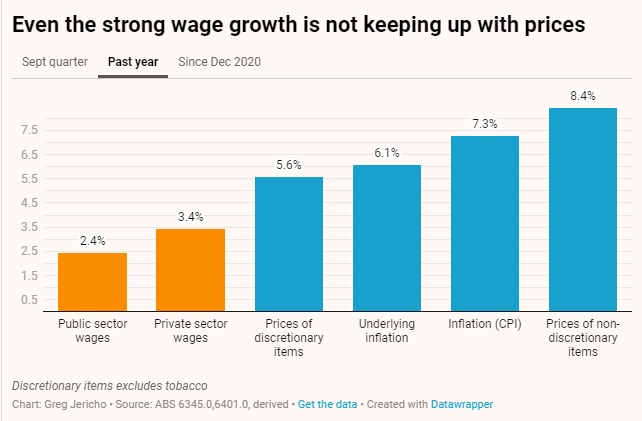
    But even this is not enough to prevent real wages from falling for the 9th straight quarter. For more than 2 years now prices have been rising faster the wages. It has seen real wages fall back to 2011 levels after a 4.6% fall since September 2020.

    The figures show that greater bargaining power is required for workers as they continue to lose out. The fastest wage growth for a decade should not see the biggest fall in real wages on record.

    We know that greater enterprise bargaining producers better wages growth. That business groups are so against the provision in the Fair Work Amendment Bill demonstrates how worried they are about the ability of workers to have increased ability to bargain.

    Profits have been growing faster than inflation, but wages are not.

    The latest wage growth figures are pleasing to see, but they also demonstrate the challenges ahead, and just how greatly workers’ living standards have been hit by price rises that they did nothing to cause.


    You might also like

  • Going Nuclear: The Costs of Mid-Bargaining Termination of Enterprise Agreements

    Going Nuclear: The Costs of Mid-Bargaining Termination of Enterprise Agreements

    by Lily Raynes and Jim Stanford

    New research from the Centre for Future Work quantifies the dramatic risks faced by workers whose employers unilaterally terminate enterprise agreements during the course of renegotiations. This aggressive employer strategy, which became common after a precedent-setting 2015 court decision, would be curtailed by new industrial relations legislation proposed by the Commonwealth government.

    The paper reviews one dramatic example of this termination threat – dubbed the ‘nuclear option’ by labour law experts (because it ‘blows up’ years of collective bargaining embodied in existing enterprise agreements). Earlier this year, Qantas threatened termination of the EA covering its international cabin crew unless they accepted significant contract concessions.

    The new report confirms that losses from termination, if it had gone ahead, would have been enormous for the affected workers:

    • Hourly wage cuts between 25% and 70%.
    • Annual income losses up to $67,000 for the most senior staff.
    • Loss of superannuation contributions and investment income, totalling as much as $130,000 and dramatically reducing retirement incomes.
    • Painful retrenchment of many working conditions issues (including rest periods and accommodation).
    • From the company’s perspective, termination of the EA for just this group of its staff would save $63 million per year, and up to $1 billion over 15 years.

    This threat, backed up by an application for termination lodged with the Fair Work Commission, was sufficient to convince cabin crew staff to accept a new EA containing a two-year wage freeze, real wage cuts, and other compensation and conditions reductions. Staff had earlier voted 97% to reject that agreement. This reversal confirms the termination threat is a very powerful bargaining lever for employers.

    The report recommends reforms to the Fair Work Act to limit employers’ ability to apply for unilateral termination during renegotiations. Current legislation in Parliament (the Secure Jobs, Better Pay Bill) would put new restrictions on employers’ ability to terminate EAs during renegotiation.


    Full report

    Share

  • Restoring Collective Bargaining Coverage Would Boost Wage Growth: Research Report

    Restoring Collective Bargaining Coverage Would Boost Wage Growth: Research Report

    Share

    Proposed reforms to Australia’s industrial relations laws are likely to support higher coverage for collective bargaining in the national labour market, and provide a boost to stagnant wage growth according to new research from the Centre for Future Work.

    The report reviews historical data on the erosion of collective bargaining in Australia, and its close correlation to the slowdown in wage growth visible after 2013. The authors find that the decline of collective bargaining coverage (which fell by almost half in the private sector since 2013) explains over 50% of the change in wage growth during that same time.

    “Restoring collective bargaining is vital to any strategy to get wages growing again in Australia,” said Dr. Jim Stanford, co-author of the report and Director of the Centre for Future Work.

    “International evidence indicates that requires the ability to undertake bargaining at a multi-employer level.”

    Key Points from Report:

    • Each one percentage point loss of bargaining coverage has been associated with a reduction in annual wage growth of 0.15 percentage points.
    • There is a clear and predictable relationship between countries which support broader multi-employer bargaining, and the level of bargaining coverage which they achieve.
    • The reforms contemplated in the Secure Jobs, Better Wages legislation would incrementally restore collective bargaining coverage in Australia: by relaxing current restrictions on multi-employer bargaining, and supporting bargaining through other measures (such as limitations on employer termination of enterprise agreements, stronger dispute settlement provisions, and streamlined processes for approving new agreements).
    • These reforms would elevate bargaining coverage in Australia toward a level typical of other countries where most bargaining still occurs at the enterprise level (as would be true under these reforms), but supplemented by some multi-employer bargaining and broader coordination. The OECD has identified a group of these countries, with an average bargaining coverage rate of 33%.
    • That would reverse most (but not all) of the loss in coverage experienced over the past decade.
    • Considering the observed correlation between bargaining coverage and wage growth, this would lead to an improvement in nominal wage growth of 1.6 percentage points per year.
    • Just one year of wage growth at this faster pace would boost annual earnings for a worker with average full-time wages by $1473. That increment would expand to $8300 by the fifth year of (compounded) faster wage growth. On a cumulative basis over the first five years alone, the average worker would receive additional income of almost $24,000.
    • The 1.6-percentage-point increment in annual wage growth would boost aggregate wage incomes by $15 billion in the first year, and $75 billion in the fifth year.

    Related research