Blog

  • Submission to the Senate Standing Committee on Education and Employment

    Submission to the Senate Standing Committee on Education and Employment

    by Eliza Littleton

    As tertiary education has become increasingly essential to employment outcomes, financial security, and meeting the demands of the future economy, the importance of affordable or free tertiary education increases. Instead, education is getting more expensive. Tuition fees have increased significantly since their introduction, and debts are growing and taking longer to repay. The context of high inflation and declining real wages HELP indexation and low repayment thresholds are putting an unnecessary financial burden on already disadvantaged Australians. The Government should consider abolishing indexation on educational loans and increasing the threshold for repayments.


    Full submission

    Share

  • The housing market has cooled, but housing unaffordability remains a long way off

    Originally published in The Guardian on March 16, 2023

    House prices are falling but housing unaffordability remains high

    The most recent data on the value of dwelling around Australia reveals the prices in most capital cities have fallen over the past year and are likely to keep doing so for some months. But the data also shows that housing affordability remains a long way from repairing the decades of damage.

    In his Guardian Australia column, policy director, Greg Jericho, notes that the impact of interest rate rises has definitely caused the housing market to come off the boil. In most capital cities median house prices are now below what they were a year ago. Coming as this does off data suggesting wages are not rising as fast as the Reserve Bank feared, and amid the ructions in the USA financial system after the Silicon Valley Bank collapse, the Reserve Bank certainly has enough reason to not raise rates again.

    But while the fall in house prices does help those trying to buy a home, the decrease in affordability is highlighted by the fact that while house prices are mostly below what they were a year ago, they are well above what they were 2 years ago in all capital cities. And those rises have been well above the growth in wages in that time.

    Jericho notes that in Sydney for example, wages and house prices from 2003-2013 largely rose in line but over the past decade house prices have surged above wages. Had prices instead continued to rise in line with wages the median house price in Sydney would now be $863,000 rather than $1,270,000.

    This disconnect is replicated around the country with house prices being some 60% above what they would have been had they risen along with wages. In Hobart the current median house price of $727,000 is some 133% above the price it would have been had they rinse in line with wages in Tasmania of $297,000.

    This disconnect highlights the need for tax reform of the housing market, an increase in supply including increased median density housing, and especially public housing.

    And above all we need wages to no longer be left behind.


    You might also like

    Centre For Future Work to evolve into standalone entity

    The Centre for Future Work was established by the Australia Institute in 2016 to conduct and publish progressive economic research on work, employment, and labour markets. Supported by the Australian Union movement, the centre produced cutting edge research and led the national conversation on economic issues facing working people: including the future of jobs, wages

  • The Fiscal, Economic, and Public Health Dangers of Water Privatisation

    The Fiscal, Economic, and Public Health Dangers of Water Privatisation

    by Jim Stanford

    Safe drinking water and sewage services are one of the most essential elements of public infrastructure in our society. Communities cannot survive and thrive without reliable water services. Providing those services is core business for any municipal or regional government.

    But beyond the obvious importance of good water systems to life, health, and well-being, the water system also constitutes a valuable economic asset in the overall portfolio of public enterprise (see box). Investments in high-quality water and sewage systems represent enormous sums of fixed capital. The financial and operational dimensions of water systems are significant to the fiscal and macroeconomic functioning of the whole state economy.

    In this context, suggestions that the Sydney Water system might be sold to private investors raise a wide range of significant concerns: regarding the efficiency and safety of their continued operation, access to healthy and affordable water services for state residents, and the economic implications for customers, workers, and state government itself. A new research report from the Centre for Future Work reviews some of those concerns, and considers the likely consequences of Sydney Water’s potential privatisation.

    Main findings of the report include:

    • Sydney Water represents an essential public asset, important for both economic as well as public health reasons
    • Sydney Water boasts total assets of almost $24 billion, public equity of $8 billion, annual revenues of $2.8 billion, and dividend and tax payments to the people of NSW that averaged $870 million per year since 2018
    • The state earns far more from dividend payments arising from its equity in Sydney Water, than it would pay in interest on an equivalent amount of public debt
    • Selling the utility would impose a significant fiscal cost on the state through lost dividend and tax revenues
    • Experience with privately-owned water systems in other countries suggests water charges would rise significantly under private ownership, largely because of higher interest costs, higher debt, and higher dividend payouts
    • Based on UK and US studies, Sydney Water customers could see their annual water bills grow under private ownership by 39% to 59% (or by an average of between $174 and $264 per customer per year).

    The report was commissioned by the NSW & ACT Branch of the Australian Services Union.


    Full report

    Share

  • Women Earn $1m less than men & $136,000 Less in Super over Working Life

    Women Earn $1m less than men & $136,000 Less in Super over Working Life

    Share

    New research released on International Women’s Day reveals Australian women earn $1.01m less over their working lives than men, based on median income data.

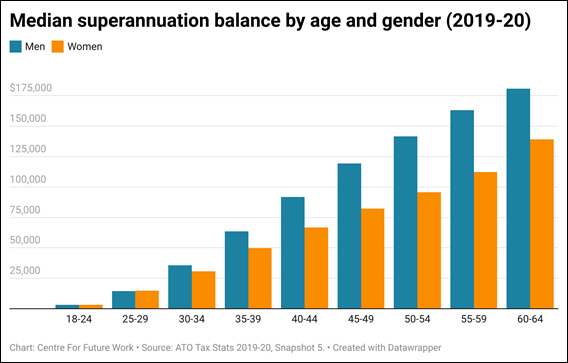
    Women earn $136,000 less in superannuation over their working lives than men, based on median income data. Women earning the median wage will accumulate approximately $393,676 in super, $151,000 below what is considered a ‘comfortable retirement’. The average super balance in Australia in 2023 is $150k.

    Experts say if the gender pay gap was eliminated women would be $3 billion per week better off.

    Despite the gender pay gap narrowing slowly, based on data from the past decade it will only be eradicated by the year 2053 when more than 60% of the current workforce will be retired.

    Key Points:

    • Australian women on a median income will earn $1.01m less over their working lives on average than their male counterparts.
    • Australian women on a median income will earn $136,000 less in superannuation over their working lives than their male counterparts.
      • Women earning the median wage will accumulate approximately $393,676 in super, $151,000 below what is considered a ‘comfortable retirement.
      • The average super balance in Australia in 2023 is $150k.
    • Experts say if the gender pay gap was eliminated women would be $3 billion per week better off.
    • The gender pay gap is narrowing so slowly that it will not fully close for another 30 years until 2053. At that stage 60% of people currently working will have retired.
    • The Gender wage gap in Australia (15.3%) is more than double what it is in New Zealand (6.7%)
    • The gender gap occurs across all occupations and industries:
      • Men have higher average salaries than women in 95% of all occupations, including those where women dominate the workforce. For example, women account for 99% of all midwives, and yet are paid on average 19% less.
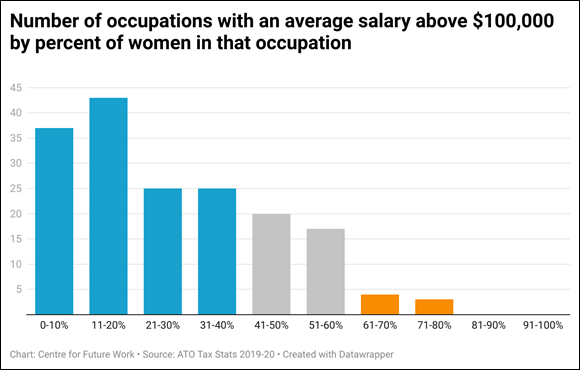
        • 80 occupations in which men make up 80% or more of the workforce have an average salary above $100,000.
        • By contrast zero occupations in which women make up 80% or more of the workforce have an average salary above $100,000.

    “For the average woman in Australia, the gender pay gap will be more than $1.01m over her working life, based on conservative estimates,” said Senior Economist Eliza Littleton from the Australia Institute’s Centre for Future Work.

    “There’s been a noisy political debate about super in Australia for the past week, but this data shows that based on median income data Australian women will earn $136,000 less than their male counter parts over their working life. When you consider that the average super balance in Australia right now is approximately $150,000, that’s a huge disparity.

    “Australian women continue to be paid less than men on average across all industries and occupations, costing us more than $3b across the economy each week.

    “We know that older women are one of the most vulnerable groups when it comes to poverty and homelessness in Australia.

    “Australian women shouldn’t have to wait until the year 2053 for substantive equality. We deserve equity today and our research makes several sensible policy recommendations for the Labor Government to action.”

    Policy recommendations:

    • Greater access to free or more affordable earlier childhood education & care: Australia Institute research shows if Australia had the same labour force participation rates as Nordic countries do, then the economy would be $60 billion, or 3.2% of GDP, larger (Grudnoff and Denniss, 2020).
    • More paid parental leave for both parents: Australia’s PPL scheme is well behind international standards. The OECD average PPL scheme is 60 weeks in total, with 24.6 weeks reserved for mothers, 10.4 weeks for fathers and 25.4 weeks that can be flexibly distributed (OECD, 2022). With a 20-week scheme, Australia unsurprisingly ranks low – 30th out of 38 countries for the duration of paid leave entitlements. Extending leave entitlements and encouraging a more even distribution of childcare would help reduce the career and financial penalty of having children both for all parents, but especially women. Additionally, making it mandatory for superannuation to be paid while a person is taking paid parental leave would help to reduce the gendered super gap.
    • Greater family-friendly work practices: Some workplaces and workers have managed to maintain flexible working arrangements, but this should be standardised, expanded and embedded in employment relations frameworks to make balancing work and care more achievable across the workforce. Breaking down rigid job design in male-dominated jobs could also help with reducing entrenched gendered segregation by industry and occupation.
    • Deliberate policy to lift the wages for industries dominated by women — most urgently in the care sector: Women dominated sectors, especially in the care industry are among the lowest paid work. The 2021 Royal Commission into Aged Care Quality and Safety recommended that gig work, independent contracting and other ‘indirect’ employment arrangements be restricted in the publicly-funded aged care sector. This needs to be agreed to.
    • Address insecure work: Further reforms should include rights to family-friendly working time arrangements and stable work as minimum standards for all employees in the National Employment Standards.
    • Full recommendations in attached report

    Related research

  • The Times They Aren’t A-Changin (enough)

    The Times They Aren’t A-Changin (enough)

    It is past time to value women’s work equally
    by Eliza Littleton and Greg Jericho

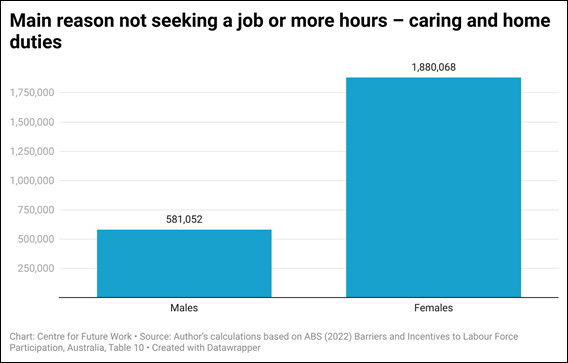
    This report examines the barriers to closing the gender gap by reviewing Australia’s position within the industrial countries of the OECD. The report also uses data from the ABS and the ATO to highlight gender disparities across all levels of income, ranges of occupation and ages, as well as disparities regarding who undertakes the greater share of unpaid work.

    One clear concern is gender segregation, where either men or women dominate an occupation or industry. Men have higher average salaries than women in 95% of all occupations, including those where women dominate the workforce. For example, women account for 99% of all midwives, and yet are paid on average 19% less.

    We identify 80 occupations in which men make up 80% or more of the workforce; these occupations have an average salary above $100,000. In contrast, no occupation where women make up that share of the workforce has such a high average salary. This highlights how segregation has reinforced massive differences in pay.

    The report recommends policies to promote greater access to childcare and parental leave for both parents, family-friendly work practices, and the lifting of wages for industries dominated by women – most urgently in the care sector.


    Full report

    Share

  • Australian Inflation Reflects a Historic Redistribution from Workers to Bosses

    Originally published in The Conversation on April 7, 2023

    The upsurge of inflation since the COVID-19 lockdowns has not had equal impacts on all Australians. Workers and low-income people have experienced the worst losses: both because their incomes, in most cases, have not kept up with prices, and because they are more dependent on essential goods and services (like shelter, food, and energy) than higher-income households.

    Meanwhile, business profits have expanded strongly through this inflationary episode. Companies haven’t just passed along higher input costs to their customers. Rather, they have taken advantage of the conjuncture of factors related to the pandemic (supply shortages and disruptions, consumer desperation and pent-up demand, and oligopolistic pricing power) to push up prices far higher than needed to cover their own costs.

    The result has been a process of ‘profit-price inflation’: higher profit margins are both a cause and consequence of rapid inflation. Centre for Future Work Director Jim Stanford discusses the distributional impacts of recent inflation in this new commentary for The ConversationUnderlying Australia’s inflation problem is a historic shift of income from workers to corporate profits


    You might also like

  • Profit-Price Spiral: Excess Profits Fuelling Inflation & Interest Rates, not Wages

    Profit-Price Spiral: Excess Profits Fuelling Inflation & Interest Rates, not Wages

    Share

    New empirical research reveals the main driver for inflation in Australia is excess corporate profits, not wages, and that inflation would have stayed within the RBA target band if corporates had not squeezed consumers through the pandemic via excess price hikes.

    The dramatic expansion of business profits has gone mostly ignored by the RBA and other macroeconomic policy-makers, who have focused instead on a supposed ‘wage-price’ spiral which does not exist. This suggests the focus of the RBA on wage restraint is misplaced and unfair, and that interest rates would be far lower today if companies had not gouged customers at the checkout.

    The report Profit-Price Spiral: The Truth Behind Australia’s Inflation (attached) comes in the same week supermarket giants Woolworths and Coles posted soaring profits, with banks, gas and petrol companies posting similarly soaring returns.

    Key Findings:

    • A Profit-Price spiral is the main driver of inflation in Australia, rather than a supposed “Wage-Price” spiral, which does not exist
    • As of the September quarter of 2022 (most recent data available), Australian businesses increased prices by a total of $160 billion per year over and above their higher expenses for labour, taxes, and other inputs, and over and above profits generated by growth in real economic output
    • Without the inclusion of those excess profits in final prices for Australian-made goods and services, inflation since the pandemic would have been much slower: an annual average of 2.7% per year, barely half of the 5.2% annual average actually recorded since end-2019.
    • That pace of inflation would have fallen within the RBA’s target inflation band (equal to its 2.5% target, plus-or-minus 0.5%)
    • Excess corporate profits account for 69% of additional inflation beyond the RBA’s target. Rising unit labour costs account for just 18% of that inflation
    • The RBAs 9 back-to-back interest rate rises would have been unlikely without excess profits and prices based on the RBA’s own policy framework
    • Real wages in Australia fell 4.5% in 2022, the largest fall on record

    “This empirical evidence shows excess corporate profits are the main culprit driving inflation, not workers’ wages,” said Dr. Jim Stanford from the Australia Institute’s Centre for Future Work.

    “For Australians doing it tough this data would be aggravating.

    “We’ve been told a story that workers need to restrict wage growth and accept a permanent reduction in living standards in order to fix inflation. This evidence shows that’s an economic fairytale.

    “ABS data shows that without excess price hikes through the pandemic, inflation would likely be within the RBA target band, and hence there would be no need for the nine extreme, back-to-back interest rate rises that are crushing households and mortgage holders, fuelling the cost-of-living crisis.

    “The pain experienced by workers through current inflation contrasts sharply with unprecedented increases in business profitability at the same time.

    “Through this episode of post-COVID inflation, real wages have declined rapidly, labour’s share of GDP has declined, and corporate profits have set records. That is completely opposite from the experience of the 1970s, when real wages rose, labour’s share of GDP increased, and corporate profit margins fell.

    “History confirms that fears of a 1970s-style ‘wage price spiral’ are simply not justified or grounded in reality. Instead, inflation in Australia since the pandemic clearly reflects a profit-price dynamic.”

    The new report ‘Profit-Price Spiral: The Truth Behind Australia’s Inflation’ is attached and comes from the Australia Institute’s Centre for Future Work, by Dr. Jim Stanford.

    Supermarkets, banks and petrol companies have recently posted huge profits:


    Related research

  • Profit-Price Spiral: The Truth Behind Australia’s Inflation

    Profit-Price Spiral: The Truth Behind Australia’s Inflation

    by Jim Stanford

    Workers in Australia have suffered considerable economic losses as a result of accelerating inflation since the onset of the COVID pandemic. Reaching a year-over-year rate of 7.8% by end-2022, inflation has rapidly eroded the real purchasing power of workers’ incomes; average wages are currently growing at less than half the pace of prices. Now, severe monetary tightening by the Reserve Bank of Australia (through higher interest rates) is imposing additional pain on millions of workers. Tens of billions of dollars of household disposable income are being diverted away from consumer spending, into extra interest payments made to banks and other lenders. Most ominously, signs of macroeconomic slowdown from higher interest rates portend job losses and even greater income losses in the month ahead.

    The pain experienced by workers through this inflationary episode contrasts sharply with an unprecedented upsurge in business profitability at the same time. Additional profits resulted from businesses increasing prices for the goods and services they sell, above and beyond incremental expenses for their own purchases of inputs and supplies. This dramatic expansion of business profits (taking gross corporate profits to almost 30% of national GDP, the highest in history) has been mostly unremarked on by the RBA and other macroeconomic policy-makers. They have focused instead on the supposed risk of a ‘wage-price’ spiral. However, new empirical evidence confirms the dominant role of business profits in driving higher prices in Australia – not wages. This suggests the focus of monetary policy on wage restraint is misplaced and unfair.

    Major findings:

    • As of the September quarter of 2022 (most recent data available), Australian businesses had increased prices by a total of $160 billion per year over and above their higher
      expenses for labour, taxes, and other inputs, and over and above new profits generated by growth in real economic output.
    • Without the inclusion of those excess profits in final prices for Australian-made goods and services, inflation since the pandemic would have been much slower than was experienced in practice: an annual average of 2.7% per year, barely half of the 5.2% annual average actually recorded since end-2019.
    • That pace of inflation would have fallen within the RBA’s target inflation band (equal to its 2.5% target plus-or-minus 0.5%). Even within the RBA’s own policy rule, therefore, current painful interest rate hikes would be unnecessary.
    • A second scenario considered below allows for modest nominal inflation in unit profit margins, consistent with the RBA’s 2.5% target – once again, above and beyond the costs of other inputs (including labour and taxes) and the growth of profits due to expanded real output. Even in this scenario, inflation would have averaged just 3.3% since the pandemic, only slightly above the target band, and current harsh interest rate changes would again have been unnecessary.
    • Analysis of the income flows associated with excess inflation since end-2019 confirm the dominance of corporate profits in the acceleration of inflation since the pandemic. Excess corporate profits account for 69% of additional inflation beyond the RBA’s target. Rising unit labour costs account for just 18% of that inflation.
    • The distributional dimensions of post-COVID inflation (falling real wages, falling labour share of GDP, and record corporate profits) are completely opposite from the experience of the 1970s (when real wages rose, the labour share of GDP increased, and corporate profit margins fell). This historical comparison confirms that fears of a 1970s-style ‘wage price spiral’ are not justified. Instead, inflation in Australia since the pandemic clearly reflects a profit-price dynamic.


    Full report

    Share

  • Superannuation needs an objective and needs to be reviewed

    Originally published in The Guardian on February 23, 2023

    Superannuation is too important for retirement to be allowed to be a tax dodge scheme for the wealthy. It is time to review the scheme and stop the abuses

    This week the government announced a review to legislate the objective of superannuation. Surprisingly, there is no official objective of superannuation and this has allowed it to be used for purposes that are decidedly not about ensuring a comfortable retirement.

    The review has sparked criticism from the opposition who are using it to suggest the government is coming after your money. But as policy director, Greg Jericho, writes in his Guardian Australia column, for the very rich, superannuation has become less about retirement and more about dodging tax.

    Because super contributions are taxed at 15% the biggest benefit goes to those who are on the highest marginal income tax rate. As a result, those with the highest incomes contribute much more of their own money to superannuation than do those on lower incomes. Those earning over $150,000 make up 7% of individuals, 27% of total income, but 32% of total personal superannuation contributions. Also because there is no limit on the size of superannuation balances that can access this tax concession it means those with the very largest superannuation balances continue to get the advantage of a tax concession that has long past any sense of assisting a comfortable retirement.

    These tax concessions are now extremely costly – costing the government almost as much as the aged pension – and moreover so slanted are the benefits to the wealthy that the richest 20 per cent cost the government more tax concessions than it would pay them the full aged pension.

    Clearly, the system is not working as it should. It is not about self-funding retirement but funding retirement by avoiding tax.

    The Treasurer has suggested putting a cap on the size of superannuation balances – somewhere around $3m. Such a size would only affect less than 1.5% of all individuals aged 55-69. But clearly needs to be done because those 1.5% hold 14% of all superannuation balances of people in that age.

    Superannuation is important and vital for the retirement of many Australians. But it should not be used just to avoid paying tax – the cost of that lost revenue is denying assistance to those who actually need help once they stop work.


    You might also like

    Centre For Future Work to evolve into standalone entity

    The Centre for Future Work was established by the Australia Institute in 2016 to conduct and publish progressive economic research on work, employment, and labour markets. Supported by the Australian Union movement, the centre produced cutting edge research and led the national conversation on economic issues facing working people: including the future of jobs, wages

  • Carmichael Centre Announces Appointment of Prof. David Peetz as Laurie Carmichael Distinguished Research Fellow

    Carmichael Centre Announces Appointment of Prof. David Peetz as Laurie Carmichael Distinguished Research Fellow

    by Jim Stanford

    Share

    The Carmichael Centre at the Australia Institute’s Centre for Future Work is proud to announce the appointment of Prof. David Peetz, one of Australia’s most outstanding labour policy experts, as the new Laurie Carmichael Distinguished Research Fellow.

    Prof. Emeritus Peetz has recently retired from a long career at Griffith University, where he served as Professor of Employment Relations at the Centre for Work, Organisation and Wellbeing.

    He is also a Fellow of the Academy of Social Sciences in Australia, and author of several important books on labour policy, including: Unions in a Contrary World (1998), Brave New Workplace (2006), and The Realities and Futures of Work (2019).

    Prof. Peetz has provided expert opinion in numerous labour policy forums at the state and Commonwealth level, including providing research and expert input to the Fair Work Commission, and heading an independent review of the Queensland workers compensation system.

    “David Peetz has been a powerful and influential voice for a more balanced and fair approach to labour policy and employment relations for many years,” said Jim Stanford, Director of the Centre for Future Work, host of the Carmichael Centre.

    “His appointment as Distinguished Research Fellow will greatly enhance the capacity and influence of the Carmichael Centre, at a pivotal moment in Australia’s economic and political history,” concluded Dr. Jim Stanford.

    Remarks from Professor David Peetz:

    “The choices we make about labour policy now will shape society for decades, maybe permanently. So it’s an outstanding opportunity to be able to contribute to the formation of those choices through the work of the Carmichael Centre,” Professor Peetz concluded.

    Prof. Peetz will serve a three-year term as Distinguished Research Fellow. The Carmichael Centre was established in 2021 to undertake research and education activities related to the legacy of Laurie Carmichael, the long-time Australian union leader who passed away in 2018.