Category: Opinion

  • A Comprehensive and Realistic Strategy for More and Better Jobs

    A Comprehensive and Realistic Strategy for More and Better Jobs

    by Jim Stanford

    Share

    The Australian Council of Trade Unions has released a major policy paper outlining an ambitious, multi-faceted program to address the chronic shortage of work, and the steady erosion of job quality, in Australia. The full paper, Jobs You Can Count On, is available on the ACTU’s website.  It contains specific proposals to stimulate much stronger job-creation, reduce unemployment and underemployment, improve job quality (including through repairs to Australia’s industrial relations system), and ensure that all communities (including traditionally marginalised populations like indigenous peoples, women, youth, and people with disability) have full access to the decent work opportunities that the plan would generate.

    Dr. Jim Stanford, Director of the Centre for Future Work, reviewed the ACTU’s paper in detail, and prepared an evaluation of its proposals and likely effects. Stanford endorsed the policy’s complementary set of expansionary macroeconomic measures, which would strengthen every major component of aggregate demand in the national economy: including government programs, capital investment, net exports, and consumer spending. He also emphasised the importance of the paper’s vision for a stronger labour market information and planning system, which will be essential to effectively match workers with jobs as the labour market tightens.

    Stanford estimated that the ACTU’s plan, if implemented consistently over a five-year period, would be capable of achieving the following outcomes:

    • Unemployment rate falling to 4 percent or lower.
    • Share of full-time work rebounding toward 75 percent of employment (since employers will be pressured by falling unemployment to create full-time jobs).
    • Underemployment rate falling to fall to 5 percent or lower.
    • Incidence of casual work declining below 20 percent.
    • Labour force participation rising by at least 2 percentage points, especially among young workers.
    • Nominal wage growth accelerating to traditional rates of 4 percent per year.

    Read the complete ACTU paper, Jobs You Can Count On.


    Related documents


    Report review

    You might also like

  • Wages Crisis Has Obvious Solutions

    Wages Crisis Has Obvious Solutions

    by Jim Stanford

    Mainstream economists and conservative political leaders profess “surprise” at the historically slow pace of wage growth in Australia’s labour market. They claim that wages will start growing faster soon, in response to the normal “laws of supply and demand.”  This view ignores the importance of institutional and regulatory factors in determining wages and income distribution.  In fact, given the systematic efforts in recent decades to weaken wage-setting institutions (including minimum wages, the awards system, and collective bargaining), it is no surprise at all that wages have slowed to a crawl.  And the solutions to the problem are equally obvious: rebuild the power of those institutions, to support workers in winning a better share of the economic pie they produce.

    This recent commentary, by Centre for Future Work Director Jim Stanford, appears in the March 2018 issue of Australian Options magazine, and is reprinted with permission.

    Wage Crisis Has Obvious Solutions

    By Jim Stanford

    When the head of the central bank declares wages are too low, and urges workers to demand more money, you know you have a problem.

    After all, central bankers are traditionally the “party poopers” of the economy: they are the ones who march in and take away the punch bowl, as soon as the party gets rolling.  Yet here was Governor Philip Lowe, Governor of the Reserve Bank of Australia, urging party-goers to turn up the volume.  It’s like he was pouring bottles of straight tequila into the punchbowl, instead of taking it away – desperately trying to turn a boring flop into a wild shindig.

    Mr. Lowe made his surprising call at a conference last year on Australia’s economic outlook at Australian National University.  He said weak wage growth was holding back national purchasing power and economic growth, and contributing to too-low inflation (which has languished below his bank’s official 2.5 percent target for several years running).

    But while his acknowledgement of the consequences of wage stagnation was refreshing, his diagnosis of the causes was incomplete and unconvincing.  In fact, Governor Lowe almost seemed to blame the victims of wage stagnation – namely, Australia’s workers – for the problem.  They were unduly worried about losing their jobs to robots or imports, he suggested; they should feel more “confident” in asking for higher wages.  He has clearly not experienced the reality of Australia’s dog-eat-dog labour market in recent years, or felt the desperation that drives workers, especially young workers, to accept any job on offer.

    (Incidentally, the RBA’s own enterprise agreement signed last year will raise base wages by just 2 percent per year over the next 3 years … below the bank’s own inflation target!)

    While mainstream economists and policy-makers belatedly recognise the economic and social damage resulting from weak wages (even Treasurer Scott Morrison frets about the negative effect of slow wage growth on his budget balance), they’ve been distinctly reticent to connect the dots about the causes of the problem – and its obvious solutions.  Lowe, Morrison, and their colleagues pretend wages will pick up automatically as the economy grows and the labour market tightens.  But with official unemployment only a tick above 5 percent (still the RBA /Treasury estimate of “full employment,” according to their discredited but still operational NAIRU model), yet wages still decelerating, this faith in a market solution is increasingly far-fetched.

    Measuring the Slowdown

    The stagnation of Australian wages is visible by many indicators.  The most common “headline” source is the ABS’s quarterly Wage Price Index, which reports an index of wages calculated from a representative sample of jobs (the methodology is similar to the Consumer Price Index).  The WPI therefore measures changes in average hourly compensation holding constant the bundle of jobs which make up the overall labour market.

    However, one important factor in weak wages has been the changing composition of work.  In particular, the growth of part-time, casual, and irregular jobs has undermined the overall level (and stability) of labour incomes.  These changes are not captured in the WPI.  Similarly, changes in average hours worked per week (due to growing part-time work) are also excluded from the WPI.  So the WPI data understates the true extent of the wage slowdown.

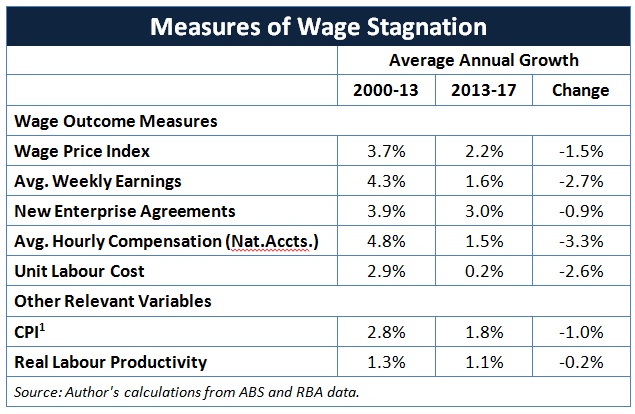
    Other ways of measuring the wage slowdown show an even bigger drop-off in wage growth.  These include average weekly earnings, the pay increases specified in enterprise agreements, and estimates of average labour compensation generated through GDP statistics.  Trends in all these indicators are summarised in the accompanying table.  Whatever measure is chosen, it is clear that there has been a dramatic slowdown in wage growth – especially visible since 2013.

    Annual wage growth fluctuated around 4 to 5 percent during the first decade of the century.  Wage growth fell sharply but temporarily during the GFC – but then quickly regained pre-crisis norms from 2011 through 2013.  After 2013, however, wage growth has decelerated dramatically: to 2 percent or even lower.  In fact, by the broadest measure of labour compensation (wages, salaries, and superannuation contributions paid per hour of work), there has been virtually no nominal wage growth in the past year.  Consumer prices, meanwhile, continue to grow at around 2 percent per year (and even faster, if escalating housing prices are taken into account).  Real earnings, therefore, are flat or falling.

    What is “Normal” Wage Growth?

    Any shortfall in wage growth below the pace of consumer price increases (corresponding to a decline in the real purchasing power of workers’ incomes) is a clear sign of labour market dysfunction.  But even flat real wages (ie. nominal wages that just keep pace with inflation) are problematic.  After all, wages are supposed to reflect ongoing growth in real labour productivity (or at least that’s what the economics textbooks tell us).  So wages should actually consistently grow faster than consumer price inflation, to fairly reflect the enhanced real output of each hour of labour.

    Therefore, a “normal” benchmark for wage growth might be the sum of long-run consumer price inflation (the RBA’s 2.5 percent target) plus average productivity growth (running around 1.5 percent per year over the past three decades).  That suggests a “normal” benchmark for annual nominal wage growth should be 4 percent per year.  Australian wage growth in the pre-GFC period generally fit that definition of “normal.”  But since 2013 wages shifted to a significantly lower trajectory.

    Joining the Dots

    Contrary to the assumptions of free-market economics, there is no guarantee that wages will automatically grow in line with labour productivity, as a result of automatic market mechanisms.  Power is always a key factor in income distribution.  And labour markets never “clear,” so that labour supply (the number of workers) equals labour demand (the number of jobs).  In fact, inflation-targeting policy deliberately aims to maintain a certain level of unemployment (5 percent is the target in Australia) to suppress wage demands and protect profits.

    The systematic and structural disempowerment of workers and their unions over the neoliberal era is therefore the most relevant factor in the deceleration of wage growth, and the erosion of labour’s share of total GDP.  Some obvious indicators of that dramatic shift in economic and political power include:

    • A steady erosion in the real “bite” of minimum wages, which have fallen from 60 percent of median wages in 1990 to around 45 percent today.
    • The collapse of trade union membership in the face of legal restrictions, harassment, and full-protection for “free riders.” Today just 9 percent of private sector workers, and less than 5 percent of young workers, are union members.
    • A corresponding collapse in collective industrial action.  Adjusted for the size of the workforce, the frequency of strikes and other industrial disputes has declined by 97 percent from the 1970s to the present decade.
    • The relegation of industry awards to a baseline “safety net,” instead of a system for supporting ongoing progress in wages and working conditions.
    • The generally pro-business shifts in economic policy, including tax cuts, deregulation, privatisation, and globalisation, which have also shifted economic power in favour of employers and hence indirectly suppressed wage growth.

    To begin to rebuild wage growth, restore labour’s share of GDP, and achieve greater equality in labour incomes will require a comprehensive, multidimensional effort to restore the power of all these wage-supporting institutions.  The ACTU is tackling this challenge with gusto, with its ambitious “Change the Rules” campaign.  The goal is to propose a consistent, holistic vision for repairing the institutions that support workers and their wages – and then building a strong grass roots campaign to push politicians of all stripes to adopt that vision.

    On the other hand, if we follow the advice of Scott Morrison and Philip Lowe, and simply wait for supply and demand forces to rescue wages from their current doldrums, we are going to be waiting a very long time.


    You might also like

    Centre For Future Work to evolve into standalone entity

    The Centre for Future Work was established by the Australia Institute in 2016 to conduct and publish progressive economic research on work, employment, and labour markets. Supported by the Australian Union movement, the centre produced cutting edge research and led the national conversation on economic issues facing working people: including the future of jobs, wages

  • The Difference Between Trade and ‘Free Trade’

    Originally published in The Guardian on March 19, 2018

    U.S. President Donald Trump’s recent trade policies (including tariffs on steel and aluminium that could affect Australian exports) have raised fears of a worldwide slide into protectionism and trade conflict.  Trump’s approach has been widely and legitimately criticised.  But his argument that many U.S. workers have been hurt by the operation of current free trade agreements is legitimate; conventional economic claims that free trade benefits everyone who participates in it, have been discredited by the reality of large trade imbalances, deindustrialization, and displacement.

    Can progressives respond to the real harm being done by current trade rules, without endorsing Trump-like actions – which will almost certainly hurt U.S. workers more than they will help?  Centre for Future Work Director Jim Stanford has proposed several key principles to guide a progressive vision of international trade: one that would capture the potential benefits of greater trade in goods and services, while managing the downsides (instead of denying that there are any downsides).

    Dr. Stanford’s commentary was recently published in the Australian Guardian.  The column generated follow-up coverage and commentary in Australia and internationally.  For example, here is an interview with Phillip Adams on ABC Radio National’s Late Night Live.

    Here is an edited version of Dr. Stanford’s commentary:

    Progressives Alternatives to So-Called Free Trade Deals

    U.S. President Donald Trump’s bellicose policies, including new tariffs on steel and aluminium, have raised fears of a worldwide slide into protectionism and trade conflict.  Trump’s unilateral and xenophobic approach to trade policy is reprehensible and dangerous from any perspective.  But many progressives feel conflicted about Trump’s actions.  After all, he is challenging business-friendly trade deals (including the TPP and NAFTA) which labour, social and environmental advocates opposed for years.  And while his policies will clearly make life worse for working and poor people in the U.S., he is nevertheless speaking to their actual experience: unlike free trade defenders, who continue to pretend that the tide of globalisation has lifted all boats.

    But many progressives feel conflicted about Trump’s actions.  After all, he is challenging business-friendly trade deals (including the TPP and NAFTA) which labour, social and environmental advocates opposed for years.  And while his policies will clearly make life worse for working and poor people in the U.S., he is nevertheless speaking to their actual experience: unlike free trade defenders, who continue to pretend that the tide of globalisation has lifted all boats.

    Given Trump’s domination of the debate, progressives need to work quickly to distinguish our critique of globalisation from his.  In particular, we must flesh out a vision of trade policy reforms that would genuinely help those harmed by globalisation, while rejecting the nationalism and racism that underlies Trump’s appeal.

    Established policy elites still ridicule Trump’s belief that trade deals have contributed to the misery and inequality afflicting working class communities in America (and, for that matter, Australia).  For them, globalisation must produce winners but no losers.  And they trot out theoretical economic models (premised on assumptions of full employment and costless adjustment) to buttress their case.  They concede the gains from trade may not have been evenly shared.  But they deny that globalisation has anything to do with the erosion of living standards experienced in so many once-prosperous working communities.

    This patronising denial is precisely what got Trump elected in the first place.  It’s not that depressed industrial towns in Pennsylvania, Ohio, and Wisconsin (the states that put Trump over the top) didn’t “share in the benefits” of free trade.  It’s that their economic viability was destroyed by it.

    Acknowledging that globalisation produces losers as well as winners, allows us to imagine policies to moderate the downsides of trade – and purposefully share the upsides.  The next step is to make a crucial distinction between trade and ‘free trade.’  The former is the pragmatic day-to-day flow of goods and services between countries.  The latter is the set of specific, lopsided rules embodied in the plethora of trade and investment agreements enacted over the last generation.

    These ‘free trade’ rules often have very little to do with actual trade: describing tariff elimination, for example, usually takes up just a tiny part of the text of each trade deal.  The rest is devoted to a raft of provisions securing and protecting the rights of private companies to do business anywhere they want, on predictable and favourable terms.

    Proof of the dissonance between trade and ‘free trade’ is provided by Australia’s lacklustre trade performance over the last two decades.  Exports of actual goods and services constitute a smaller share of total GDP today, than at the turn of the century.  Sure, the volume of resource exports has surged – not surprisingly, since that’s what our trading partners wanted.  But resource prices have been shaky, and meanwhile our other value-added exports flagged badly. If the goal of all the free trade agreements signed since then (a dozen) was to boost Australia’s exports, they failed miserably.  But of course, that wasn’t the goal: the deals were actually intended to cement a business-friendly policy environment, even in sectors that have nothing to do with international trade.

    Progressives can endorse mutually beneficial international trade, and even international flows of direct investment, without accepting the lopsided, business-dominated vision of ‘free trade’ agreements.  In fact, a progressive approach to managing globalisation would actually boost real trade more effectively: by supporting purchasing power on all sides, and avoiding the contractionary race-to-the-bottom unleashed by current free trade rules.

    Here are several key principles central to a more hopeful and inclusive vision of globalisation:

    Preserve the power to regulate:  Free trade deals assume government intervention in markets (regulating prices, service standards, investment, and more) is inherently illegitimate and wasteful; they establish “ratchet” rules to limit regulation and public ownership, and lock-in deregulation over time.  The failure of market competition in so many areas – in Australia’s case, including electricity, vocational education, and employment services – reaffirms that trade deals must not inhibit governments from regulating businesses, no matter where they are owned.

    Eliminate investment preferences:  ‘Free trade’ deals proffer all kinds of preferences and rights for businesses and investors that have no necessary connection at all to actual trade.  Chief among these are the unique quasi-judicial rights and powers granted to corporations (such as investor-state dispute settlement panels); these are an affront to democracy.  Progressive trade policy would abolish these preferences, and subject corporations and their owners to the same laws and processes the rest of us face.  Similarly, progressive trade deals would aim to relax monopoly patent rights (for drug companies and others), rather than strengthening them.

    Manage capital and currencies:  Foreign direct investments in real businesses that produce actual goods and services can certainly benefit host communities, but only so long as those operations are subject to normal public interest and regulatory oversight.  Retaining the capacity to regulate foreign investment is essential to capturing maximum benefits from foreign investment.  On the other hand, volatile, speculative flows of financial capital and foreign exchange have less upside, and more downside.  In particular, rules should prevent the common practice of suppressing exchange rates to gain artificial advantage in international competition.

    Social clauses that mean something:  Most ‘free trade’ deals, the TPP included, feature token language about protecting labour and environmental standards.  These provisions are window-dressing: responding to fears that global competition will spark a downward spiral in social standards.  Typically these clauses simply commit signatories to follow their own laws – with no requirement that those laws are decent to start with.  Progressive trade deals would have safeguards that are enforceable, including requiring participating jurisdictions to respect universal standards or lose preferential trade rights.  Where trade partners have different standards (such as, for example, levying varying degrees of carbon pricing), border adjustments must be permitted so that trade competition does not undermine environmental and social progress.

    Balanced adjustment:  Trade and investment flows never automatically settle at a balanced position – even if a “level playing field” in labour and environmental standards was actually achieved.  That’s because competition always has uneven effects, producing both winners and losers.  Countries that experience loss of employment and production through global competition (a possibility denied by free trade theory, but commonplace in practice) must be supported with measures to safeguard domestic employment, facilitate adjustment, and boost exports.  Chronic surplus countries (like China and Germany) must recycle excess earnings into expanding their own imports, thus bearing a fair share of adjustment – rather than forcing deficit countries to do all the heavy lifting.

    Active, inclusive domestic policies:  Opposition to trade liberalisation is relatively mild in the highly trade-exposed social-democratic countries of Europe: like the Nordic countries, Germany, and Netherlands.  Their extensive networks of social protections provide average workers with reasonable confidence they won’t be economically tossed aside for any reason: whether trade competition, or some other disruption.  That’s why a key component of progressive trade policy must be a general commitment to social protection, inclusion, and job-creation. A general context of security and equity better facilitates adjustments of any kind, in response to any source of change.  Indeed, collecting healthy taxes from successful industries, and reinvesting them in priorities like infrastructure, training, and communities, is precisely how to harvest the much-trumpeted gains from trade – and pro-actively share them throughout society.  That’s much more feasible than hoping those benefits will somehow trickle down of their own accord.

    Claims by policy elites that international trade is the engine of all progress are vastly overblown.  Our well-being mostly depends on what we do with our skills, energies and innovation right here at home.  But real international trade and investment, properly managed, can certainly make a contribution to prosperity.  And progressives can advance a vision of a more balanced, inclusive globalisation that has nothing in common with Donald Trump.


    You might also like

  • Scare Tactics for Corporate Tax Cuts Do Not Stand Fact Checks

    Scare Tactics for Corporate Tax Cuts Do Not Stand Fact Checks

    by Anis Chowdhury

    Share

    In the wake of the Trump Administration’s success in pushing a major company tax cut through the U.S. Congress, the Australian Treasurer has stepped up his calls for reduced company taxes here. He claims Australia will bypass the growth-inducing benefits of these tax cuts, but Dr. Anis Chowdhury, Associate of the Centre for Future Work, has compiled the economic evidence.  The U.S. experience shows no statistical evidence of any “trickle-down” growth dividend from company tax cuts.

    “Trump tax cuts: Scott Morrison warns business will abandon Australia while we are at the beach” was the Sydney Morning Herald headline, reporting on the Coalition Government’s scare tactics to press through its tax cuts gift for business.  The Treasurer used the opportunity of the Trump tax cuts to issue this “dire” warning. However, his claim does not withstand some basic empirical scrutiny.

    Fact 1: Australia is not a high tax country

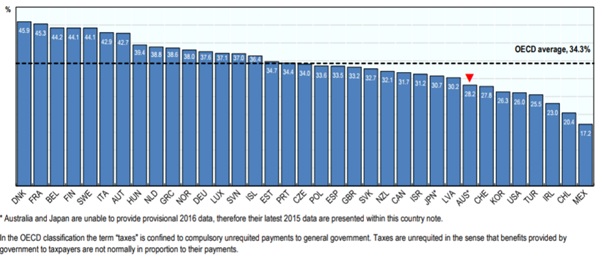
    Our overall tax take is one of the lowest among the 35 OECD countries. If Mr. Morrison was correct, then by now there should have been a tsunami of investment flowing here from 27 OECD countries with higher tax-GDP ratios than that of Australia’s 28.2% in 2016. Australia’s overall tax ratio is well below the OECD average of 34%, and also below neighbouring New Zealand’s tax take of 32.1% of GDP.

    Here are reported tax ratios for 27 OECD countries, 2016.

    OECD Tax Shares
    Source: Revenue Statistics 2017 – Australia; https://www.oecd.org/tax/revenue-statistics-australia.pdf

    Fact 2: Australia’s effective corporate tax is far below its statutory 30% rate

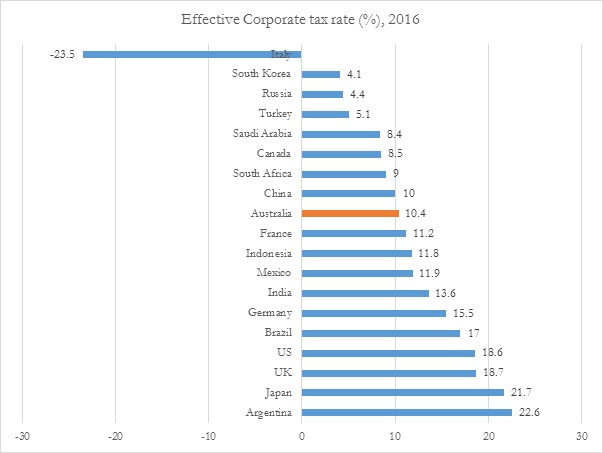
    Australian companies may seem to face a higher statutory corporate tax rate, but once they go through all their deductions and credits they don’t end up paying an unusually high amount compared to companies in other nations. The average effective rate (10.4%) is barely one-third the statutory rate. In fact, more than a third of large companies did not pay any corporate taxes in 2016 according to the recently released ATO data.

    Effective vs Statutory Tax Rates
    Source: National Public Radio, based on US Congressional Budget Office data; https://www.npr.org/2017/08/07/541797699/fact-check-does-the-u-s-have-the-highest-corporate-tax-rate-in-the-world

    Fact 3: Tax is low on companies’ lists of factors influencing investment location decision

    For example, the OECD noted, “it is not always clear that a tax reduction is required (or is able) to attract FDI. Where a higher corporate tax burden is matched by well-developed infrastructure, public services and other host country attributes attractive to business… tax competition from relatively low-tax countries not offering similar advantages may not seriously affect location choice. Indeed, a number of large OECD countries with relatively high effective tax rates are very successful in attracting FDI.”

    This is corroborated by the most recent World Bank survey of enterprises, which found that tax incentives are not high on the list of critical factors affecting inflows of foreign direct investment. The IMF’s recent research also reports that the net impact of corporate tax cuts to incentivise private investment is quite often negative on government revenues.  The pre-tax profitability of Australian businesses has also tended to exceed that in other countries, and this is surely more important in motivating investment flows.

    Fact 4: Rigorous studies of past US tax cuts did not find a positive link between tax cuts and economic or employment growth

    For example, the oft-cited examples of the Reagan or Bush tax cuts do not in fact demonstrate that tax cuts cause growth.  Admitted by President Reagan’s former chief economist, Martin Feldstein, the vast majority of growth during the Reagan era was due to expansionary monetary policy that slashed interest rates massively to help the economy bounce back from a severe recession in 1982.  Increased defence spending and an expanded labour force due to an influx of baby boomers also boosted the economy. In another study with Doug Elmendorf, the former Congressional Budget Office Director, Martin Feldstein found no evidence that the 1981 tax cuts increased employment.

    The 2001 and 2003 Bush tax cuts also failed to spur growth. Between 2001 and 2007 the economy grew at a lacklustre pace—real per-capita income rose by 1.5% annually, compared to 2.3% over the 1950-2001 period. Interestingly, the two sectors that grew most rapidly in this period were housing and finance, which were not affected by the 2001 and 2003 tax cuts.  Moreover, by 2006, prime-age males were working the same hours as in 2000 (before the tax cuts), and women were working less – both facts inconsistent with the view that lower tax rates raise labour supply.

    Fact 5: The most infamous case of tax cuts in the US State of Kansas was a colossal failure

    Governor Sam Brownback promised that a moderate tax cut for individuals and a big tax cut for businesses would be “like a shot of adrenaline into the heart of the Kansas economy.”  Unfortunately, however, despite his 2012 tax cuts, the Kansas economy remained moribund, while neighbouring states surged ahead. In the process, the Kansas state budget was left in tatters. No wonder that the Republican-led state legislature reversed most of Brownback’s tax cuts in the face of poor growth and pressing public spending needs.

    Therefore, if Mr. Morrison is serious about repairing the budget, or stimulating growth and employment, then he should be concentrating on raising more revenues (not less) and investing in the nation – instead of cutting basic services to fund his tax cuts for the rich. He should be looking at the facts, instead of resorting to scare tactics.


    You might also like

    Commonwealth Budget 2025-2026: Our analysis

    by Fiona Macdonald

    The Centre for Future Work’s research team has analysed the Commonwealth Government’s budget, focusing on key areas for workers, working lives, and labour markets. As expected with a Federal election looming, the budget is not a horror one of austerity. However, the 2025-2026 budget is characterised by the absence of any significant initiatives. There is

    Centre For Future Work to evolve into standalone entity

    The Centre for Future Work was established by the Australia Institute in 2016 to conduct and publish progressive economic research on work, employment, and labour markets. Supported by the Australian Union movement, the centre produced cutting edge research and led the national conversation on economic issues facing working people: including the future of jobs, wages

  • Job Opportunity – Research Economist

    Job Opportunity – Research Economist

    Share

    The Centre for Future Work invites applications for an economist to join our research team in labour market research and policy analysis, working from our offices in Sydney or Canberra.

    Deadline for applications is December 21 2017.

    It’s a chance to be part of our growing team, and to make a contribution to strong, progressive policy research on jobs, employment, fairness, and the future of work!

    Please download the full notice below for more details.


    Related documents


    Position description

    You might also like

    Dutton’s nuclear push will cost renewable jobs

    by Charlie Joyce

    Dutton’s nuclear push will cost renewable jobs As Australia’s federal election campaign has finally begun, opposition leader Peter Dutton’s proposal to spend hundreds of billions in public money to build seven nuclear power plants across the country has been carefully scrutinized. The technological unfeasibility, staggering cost, and scant detail of the Coalition’s nuclear proposal have

  • Job Growth No Guarantee of Wage Growth

    Originally published in The Sydney Morning Herald on November 17, 2017

    Measured by official employment statistics, Australia’s labour market has improved in recent months: full-time employment has grown, and the official unemployment rate has fallen. But dig a little deeper, and the continuing structural weakness of the job market is more apparent. In particular, labour incomes remain unusually stagnant. In this commentary, Centre for Future Work Associate Dr. Anis Chowdhry reflects on the factors explaining slow wage growth — and what’s required to get wages growing.

    Job Growth No Guarantee of Wage Growth

    by Dr. Anis Chowdhury

    ‘Remarkable’ jobs growth raises hopes for wages” was the headline for a recent Sydney Morning Herald opinion piece by Clancy Yeates. He bases this claim on “some brighter news on the labour market to balance the bad: there is something of a jobs boom under way”. Apparently “more jobs have been created in 2017 in net terms than any year since 2005, with 371,000 new net jobs so far this year”. Clancy Yeates also points to “the lowest number of unemployed people per unfilled position since 2012”.

    This optimism is also shared by the Treasury Secretary John Fraser. In his opening statement at the recent Senate budget estimates hearing on 25 October, he said, “We expect that a period of stronger growth and falling unemployment will lift wages in the next few years.” He further noted, “We do expect that as the cyclical constraints that have weighed on the economy recede wages growth will accelerate.”

    The RBA also holds a similar optimistic view. Philip Lowe, the RBA Governor, in his September statement observed, “Employment growth has been stronger over recent months and has increased in all states. The various forward-looking indicators point to solid growth in employment over the period ahead. … stronger conditions in the labour market should see some lift in wages growth over time.” He had the same positive view in his October statement.

    But can we really be so confident that job growth will eventually lead to wage growth? And even if it does, would it be strong enough to catch up and compensate for the losses incurred from such a long period of wage stagnation?

    Unfortunately, the answer to these questions is a resounding ‘NO’. This so-called remarkable jobs growth will not result in an eventual wage growth sufficient to close the wages gap. This has been confirmed by the latest data showing wages rose by less than expected last quarter; even a significant mandated jump in the minimum wage failed to lift the rate of growth of workers’ pay across the economy. The most broad measure of average earnings growth (derived from GDP statistics) has actually turned negative – the weakest since the mid-1960s.

    The reason for this contradiction is very simple – it is rooted in the different nature of new and old jobs. Jobs, whether part-time or full-time, are now more insecure. Just consider some recent news. The NAB has announced 6,000 job cuts by 2020 even when it announced $6.6 billion profit! Earlier Telstraconfirmed 1,400 job cuts.

    Job insecurity is not just a phenomena in the private sector. Governments – State and Commonwealth – have also joined the new trend. For example, the NSW department of Finance Services and Innovation has notified the union representing the cleaners that employment guarantees in place since 1994 “will not be extended in the new contracts from 2018”.

    The optimists seemed to have decided to ignore what Alan Greenspan, the former chairman of the US Federal Reserve, said in his Congressional hearing two decades ago (on 26 February, 1997). Explaining why “the rate of pay increase still was markedly less than historical relationships with labor market conditions would have predicted”, he said: “Atypical restraint on compensation increases … appears to be mainly the consequence of greater worker insecurity.”

    He clearly elevated job insecurity to major status in the Fed’s policy analysis. Workers have been too worried about keeping their jobs to push for higher wages. And this has been sufficient to hold down inflation without the added restraint of higher interest rates.

    But Greenspan also implied that workers’ fear of losing their jobs was not in itself a sufficient explanation for their failure to push for significant wage increases. The sense of job insecurity has to be rising over time; that is, continually getting worse. Because once the level of insecurity leveled off, and workers become accustomed to their new level of uncertainty, their confidence may revive and the upward pressure on wages would resume. That is particularly true when the unemployment rate is low, as it is today (at least officially).

    However, looking at the length of contracts, Jeff Borland, a leading Australian labour economist, finds no evidence of increased job insecurity in Australia. Others have reported similar findings, while others cite different data to indicate a growth in insecurity. A new ABS survey also showed that while there had been an increase in the number of people with more than one job since 2010-11, those doing multiple jobs as a proportion of the workforce had remained almost completely unchanged at 6%.

    Job insecurity is notoriously difficult to measure. It is not the length of contracts or whether a job is full-time or part-time, that matters. It is the constant threat of losing jobs or pay conditions despite tenure due to constant restructuring that the workers fear. It is the news like that from the ice cream manufacturer Street wanting to terminate its enterprise agreement, or announcements like the one from the NSW department of Finance Services and Innovation, which generate the sense of job insecurity.

    It is this sense of job insecurity and fear of not finding a decent job after losing one (as experienced, for example, when Holden and Toyota recently closed down) which Alan Greenspan had in mind when he calibrated Fed’s monetary policy levers. Thus, there has to be continuous restructuring in the guise of addressing falling or stagnant productivity to keep lid on wages, while the real intent is creating fears among the working class.

    When nearly half the Australian families (41%) feel job security is chief among their concerns, this supposedly remarkable jobs growth won’t generate pressure for wage growth as hoped by the optimists. “Insecure, stressed, and underemployed: The daily reality for millions of Australians”, is how David Taylor summarised the labour market in Australia. This is experienced even as profits are growing at their highest rate in two decades.

    Governments – State and Federal – should worry about rising job insecurity, instead of adding fuel to the fire with their own employment restructuring initiatives. The high level of job insecurity doesn’t just have an effect on wage growth and inflation. Recent research has found that it “cuts to the core of identity and social stability – and can push people towards extremism”. We all have a stake in creating more secure jobs, and fairly rewarding those who perform them.


    You might also like

    Dutton’s nuclear push will cost renewable jobs

    by Charlie Joyce

    Dutton’s nuclear push will cost renewable jobs As Australia’s federal election campaign has finally begun, opposition leader Peter Dutton’s proposal to spend hundreds of billions in public money to build seven nuclear power plants across the country has been carefully scrutinized. The technological unfeasibility, staggering cost, and scant detail of the Coalition’s nuclear proposal have

  • The Future of Work is What We Make It

    The Future of Work is What We Make It

    by Sarah Kaine and Jim Stanford

    Share

    Progressives everywhere are grappling with developing policy proposals to improve the quantity and quality of work in our economy, as part of their broader vision for building more successful and inclusive societies. To this end, the Fabians Society in NSW recently published an interesting booklet of policy proposals, to inject into debate within the Labor Party and other fora. One chapter written by Sarah Kaine (Associate Professor at UTS and a member of the Centre for Future Work’s Advisory Committee) and Jim Stanford (Economist and Director of the Centre) deals head-on with the challenges facing work, and what can be done to make it better; it is reprinted below.

    To receive a copy of the full Fabians Society booklet, please visit their website.

    The Future of Work is What We Make It

    There has been an outbreak of public concern recently about the impacts of technological change on employment. Some research suggests that 40 percent or more of all jobs are highly vulnerable to automation and computerisation in coming decades (Frey and Osborne, 2013). Some observers even suggest that work can no longer be the primary means for people to support themselves – leading to all sorts of radical policy responses ranging from taxing robots (Delaney, 2017) to the provision of universal basic income to all people, working or not (Arthur, 2016).

    Of course, this general fear of technological unemployment isn’t new. Since the industrial revolution, workers have quite understandably worried about what will happen to their jobs when machines can do their work faster, cheaper, or better. Previous periods of accelerating technological change were also associated with other waves of concern; even relatively recently, futurists were predicting that technology would make work largely obsolete (for example, Rifkin, 1995).

    Conventional market-oriented economists downplay these concerns: the magical workings of supply and demand forces should ensure that any labour displaced by technology is automatically redeployed in other, more appropriate endeavours, and people will be better off in the long run. The focus of policy should be to facilitate that transition through retraining and mobility assistance, allowing displaced workers to move more easily into better, alternative occupations.

    There are many reasons to question this optimistic theoretical perspective. But actual historical experience gives more cause to doubt ultra-pessimistic forecasts of technological unemployment. In practice, previous waves of technological change have not been associated with mass unemployment, for a range of reasons. The labour-displacing effects of new technology can be offset, in whole or in part, by other factors: including new work associated with the development, production, and operation of the new technology itself; new tasks that become conceivable only as a result of the new technology; historic reductions in average working hours (a trend which has unfortunately stalled under neoliberalism); and the capacity of active macroeconomic policy to boost aggregate labour demand when needed.

    So even from a critical economic perspective, there is little reason to conclude that “work will disappear”. This does not mean we should be complacent about the problems and risks posed to workers by accelerating technological change. But it does mean our response to those challenges should be grounded in a more balanced and complete assessment of what technology actually does to work – and where technology comes from in the first place.

    Remember, technology is not some exogenous, uncontrollable force. What we call “technology” is actually the composite of human knowledge about how to produce a broader range of goods and services, using better tools and techniques. Humans put their minds to solving certain problems (so-called “mission-based innovation”, as termed by Mazzucato, 2011), based on their particular concerns and interests. And therefore, technology is never neutral: the problems we turn our creative attention to, reflect the interests and influence of the constituencies which get to decide and fund innovation activity.

    For example, one nefarious use of modern technology in workplaces is the ubiquitous and largely uncontrolled application of surveillance and performance-tracking technology by employers, to more immediately and completely monitor the work effort of their employees. Increasingly intrusive systems now give bosses minute-by-minute data on the whereabouts, productivity, and even attitudes of their workers. This has wide-ranging impacts not only on privacy and the quality of work. It even affects compensation: when it is so easy and cheap to monitor employees (and sack them if their performance is unsatisfactory), employers have less reason to offer workers positive incentives (or “carrots”) for performance and retention – and are more likely to use a disciplinary “stick” instead. It is no accident that surveillance and monitoring technology has advanced in leaps and bounds: employers have a strong vested interest in using these techniques to intensify work and enhance profit margins. Yet at the same time, easily-solvable monitoring problems – like ensuring that franchise businesses actually pay their employees minimum wages, for example, or are making their legally mandated superannuation contributions – are not addressed with technological solutions. Why not?

    This non-neutrality of technology reflects the increasingly lopsided power imbalances in the modern labour market: those with power can influence the direction of technology in ways that reinforce their power. Another example is the one-sided application of digital platforms for assigning work and collecting payment used by “gig”-economy businesses like Uber and Deliveroo. Their technology has not (so far) actually changed the core nature of the work involved in these businesses: passengers are still driven about in a car, and take-away food is still delivered on a bicycle. What technology has facilitated, rather, are big changes in how work is hired, supervised, and compensated. By using digital applications (which they developed and own), platform businesses try to distance themselves from traditional employer functions and responsibilities (like paying minimum wages, or offering any stability or continuity of work). Technology thus allows businesses to shift risk to those performing the work, and minimise their labour costs. These changes in the social relations of work are by no means inevitable – as is being proven as workers around the world fight back against the most exploitive practices of these businesses. (Singapore’s approach was fairly effective in this regard: simply banning Uber from operating altogether). Resisting the mis-use of technology to cheapen and degrade work, is very different from a Luddite-like effort to try to stop technology itself.

    Some jobs will certainly disappear as technology replaces some tasks (and employers use it to enhance their ability to control and parcel out work most profitably). Some new jobs will be created: including good ones (like the creative, knowledge-intensive ones developing and managing new technologies), and some less good ones (like the menial digital work associated with many technologies). Many jobs, perhaps counterintuitively, will hardly be affected at all: including a range of caring services, cleaning, hospitality, and other functions which seem to inherently require hands-on human labour.

    To be sure, the quantity of work available is always a concern, all the more so given the stagnation (globally and in Australia) which continues to dominate the global economy since the GFC. Governments should put top priority on stimulating job-creation, wielding the whole array of policy tools (fiscal, monetary, industry, trade, skills, and more) at their disposal. Spurring stronger demand for labour will automatically ease adjustment to new technologies and their labour-displacing effects.

    But the quality of jobs is an equal concern, and it is in this realm that the impacts of new technology may be most severe. The quality of new jobs created as technology advances, and the quality of existing jobs that are largely untouched by technology, must be targeted for forceful, ambitious policy attention, to arrest and reverse the widespread degradation of work which is being permitted by weak labour market conditions, technology, and the enhanced and largely unchallenged power of employers.

    After all, a sustained structural shift in bargaining power in the labour market, in favour of employers, has been a central goal of neoliberal economic and social policy. There has been an expansion of non-standard employment in all its forms: irregular hours, casual work, labour hire positions, precarious forms of contracting and self-employment, and more. This precarity has been facilitated by a combination of persistently weak labour market conditions (compelling desperate workers to take any job no matter how insecure); technologies which make it easier for firms to orient staffing around precarious and on-call work; and regulatory inattention and complacency. On this last point, regulatory levers for protecting workers have not kept up with employers’ efforts to sidestep traditional minimum standards. Even the simplest of standards (like the minimum wage) are widely unenforced.

    In short, to address the impacts of technology – and, more importantly, the one-sided application of technology within workplaces – we must modernise and revitalise the concept of a social contract. We need a social contract for the digital age, that re-establishes mutual responsibilities and expectations, that commits to improving both the quantity and quality of work as a central goal of policy, and that actively supports the countervailing forces (like unions, employment standards, and cultural expectations of fairness) that are essential to achieving more security and fairness in the world of work.

    The values of NSW Labor provide a solid foundation from which to embark on such a revitalisation. The party’s vision emphasises that ‘prosperity starts with good jobs’ and commits that the ‘benefits of rising prosperity are shared fairly’; working towards such collective prosperity is a stated goal (NSW Labor, 2017). Key to this prosperity from a Labor viewpoint is support for more equal opportunities in the labour market and an effective system for regulating work. These values are constant and are not altered by technology or innovation: they apply whether citizens are engaged to work in full-time, “old economy” jobs or precarious “gigging” in the digital economy. A challenge is posed, though, by the rhetoric of innovation that leads the launch of a shiny new app to distract from the business models that underpin it – often based on underpaid, insecure, or invisible labour. What is needed then is clarity and purpose to create a system for regulating work that is modern, but fair.

    Australian governments at all levels have been creative regulators of the labour market since Federation: think of the tax provisions implemented in the early years following federation. The Commonwealth government was constrained by the Labour power [Section 51 (xxxv)] of the Constitution, meaning that it could not intervene directly to set wages and conditions of work. However, it could impose taxes. The Excise Tariff Act 1906 passed by the Deakin government included a provision for manufacturers of agricultural machinery to be exempt from the excise if the workers in that company were paid a ‘fair and reasonable’ wage (Hamilton, 2011). The Harvester judgement that ensued is embedded in industrial relations folklore and has become synonymous with the establishment of minimum wages in Australia. However, what is often overlooked is that the mechanism used to establish this landmark was not a mechanism of traditional labour law – it was, after all, triggered by tax law.

    Labor Governments have not been alone in this regulatory innovation to address labour policy concerns. The Howard Government was just as inventive and driven in its determination to use the Corporations power [Section 51 (xx)] of the Constitution to create a national regulatory framework that downgraded collective bargaining and instituted statutory individual contracts. A further legacy of that re-orientation was the whittling away of State industrial relations jurisdictions. This might lead to the conclusion that a State Labor government has little capacity to influence the wages and conditions of workers beyond the public sector. However, this conclusion is too narrow, and underestimates the extent to which creative, ambitious interventions at the state level could contribute to the restoration of a progressive social contract.

    Consider, for example, the current Victorian government’s attempts to eradicate the exploitation of workers in industries like horticulture, through the introduction of a legislated licensing scheme for labour hire companies. This is illustrative of the potential for action by a State government to curb the exploitation of vulnerable workers. But legislation is not the only choice; there is a vast array of options on the regulatory spectrum.

    Another means of regulating for better outcomes outside the confines of labour law is to support industry-specific multi-stakeholder collaboration. A developing example of this is the Cleaning Accountability Framework. CAF is an independent, multi-stakeholder initiative comprising representatives from across the cleaning supply chain – including institutional property investors, building owners, facility managers, cleaning companies, cleaners (through United Voice) and industry associations. CAF seeks to improve labour standards by encouraging transparency throughout the cleaning supply chain. CAF will recognise stakeholders who adopt better practice in the cleaning industry through a building certification scheme. In doing so, CAF will work to improve the employment conditions of cleaners, support sustainable business models and responsible contracting practices, help building owners and investors manage risk, and assist tenants in ensuring that they are benefiting from quality cleaning services. Multi-stakeholder initiatives have been criticised for lacking enforceability, but CAF overcomes this by using the structure of the supply chain, specifically the power of building owners and managers to drive compliance.

    None of these examples are centred in the “gig economy,” nor do they address sectors immediately threatened by automation. But they nevertheless provide an insight into “‘outside the box” efforts to improve the quality and fairness of jobs. Similar ambition and creativity could provide a better regulatory environment for the conduct of all types of work – not least in the digitally enabled economy. This could begin with a comprehensive mapping of State-based regulation to identify potential opportunities to leverage existing laws, regulations, procurement policies and industry codes.

    This would be an ambitious project, but given the extent of State influence in major areas of the economy (health, education, transport), it would provide a plethora of policy options.

    Alternatively, if changes to work (whether wrought by technology or ‘innovation’ in business models) are left unquestioned, and if we assign the determination of working conditions to algorithms, then the aspirations encapsulated in “Labor values” will remain unrealised and, a chance to re-imagine a social contract based on decent work will be squandered.

    References

    Arthur, Don 2016, “Basic Income: A Radical Idea Enters the Mainstream,” Parliament of Australia, Research Paper Series 2016-17, November 18.

    Delaney, Kevin J 2017, “The robot that takes your job should pay taxes, says Bill Gates,” Quartz, February 17.

    Frey, Carl Benedikt, and Michael A. Osborne 2013, The Future of Employment: How Susceptible are Jobs to Computerisation? (Oxford: Oxford Martin School).

    Hamilton, R. S. 2011, Waltzing Matilda and the Sunshine Harvester Factory: The early history of the Arbitration Court, the Australian minimum wage, working hours and paid leave (Melbourne: Fair Work Australia).

    Mazzucato, Mariana 2011, The Entrepreneurial State: Debunking Public vs. Private Sector Myths (London: Anthem).

    NSW Labor 2017, “Our Values,”.

    Rifkin, Jeremy 1995, The End of Work: The Decline of the Global Labor Force and the Dawn of the Post-Market Era (New York: Putnam & Sons).

    Sarah Kaine is an Associate Professor at the UTS Business School, and a member of the Advisory Committee of the Centre for Future Work. Jim Stanford is Economist and Director of the Centre for Future Work, part of the Australia Institute.


    You might also like

    Centre For Future Work to evolve into standalone entity

    The Centre for Future Work was established by the Australia Institute in 2016 to conduct and publish progressive economic research on work, employment, and labour markets. Supported by the Australian Union movement, the centre produced cutting edge research and led the national conversation on economic issues facing working people: including the future of jobs, wages

  • The Paradox of Rising Underemployment and Growing Hours

    The Paradox of Rising Underemployment and Growing Hours

    by Anis Chowdhury

    Share

    Paradoxically, underemployment and number of hours actually worked are both on the rise in Australia.

    Paradoxically, underemployment and number of hours actually worked are both on the rise in Australia.

    Since 1978 from when the ABS started publishing data on the number of hours worked per month, the hours increased continuously. For example, in July 1978 slightly less than a billion hours was worked; the figure was 1.7 billion in June 2017 – a rise of 781.9 million hours worked a month. Compared with June 2008, 151.3 million more hours were worked in June 2017. The recently released Labour Account Australia, Experimental Estimates, July 2017 (by ABS) shows that between 2010/11 and 2015/16, hours actually worked increased by 5.7% from 19.15 billion hours to 20.23 billion hours.

    The rising number of hours worked should be a good news, provided it meant more income. But for the most part during this period real wages either stagnated or fell. Recent ABS data show that quarterly real wage growth stuck below 0.6% for three years, translating into an annual wage growth of just 1.9%, the lowest figure since the late 1990s, and probably the slowest rate of pay rises since the last recession.

    Hence the majority of workers are forced to work more hours in their struggle to maintain a decent living. Labour Account Australia, Experimental Estimates (July 2017) records that a good number of people work more than one job. Interestingly, increasing by 64,100 (9.2%), the growth in secondary jobs outstripped the growth in main jobs which increased by 791,700 (6.8%) over the six years to June 2016.

    It is also not surprising that people are wanting to work more hours, raising the incidence of involuntary underemployment. The most recent ABS estimate, for May 2017, shows 1.129 million Australians working fewer hours than they would like. This translates into an underemployment rate of 9.3%. When added to the current headline unemployment rate of 5.6%, we have a whopping “underutilisation” rate of around 14.9%!

    Labour exploitation is also on the rise as the unpaid overtime work gets longer. The Australia Institute’s 2016 survey (Excessive Hours and Unpaid Overtime: An Update) found that full-time workers were on average performing more than 5.1 hours a week in unpaid overtime. Part-time and casual employees work an average of 3.74 hours unpaid overtime per week. For full-time workers, average unpaid overtime is worth over $10,000 per year – or 13% of actual earnings. For part-time workers, lost income from unpaid overtime exceeds $7500 per year, and represents an even larger share (nearly 25%) of actual earnings. The lost income due to unpaid overtime represents a significant loss to workers and their families.

    Australians are putting in some of the longest hours (more than 50 hours) in the developed world, coming in 9th in a survey of OECD countries. Full-time employees are on average putting in extra 4.28 hours and part-time staff are working an hour over their contracted hours every week. ABS data show that around 30% of employed men and 11% of employed women report usual working 45 hours or more each week.

    Thus, Australian workers are over-worked and underpaid. They are both time and income poor.

    These paradoxes are not statistical quirks. They are the results of heightened job insecurity; but it is deliberate! It is caused by changes in the labour market institutions governing wage and employment conditions, designed to increase the share of profit and strengthen corporate power.

    Alan Greenspan, the former Chairman of the US Federal Reserve, made this very clear in his testimony to the Congress two decades ago (26 February, 1997). He elevated job insecurity to major status in central bank policy when he said, “Certainly other factors have contributed to ‘the softness in compensation growth” despite a low unemployment rate, but ”I would be surprised if they were nearly as important as job insecurity”.

    Workers have been too worried about keeping their jobs to push for higher wages, and this has been sufficient to hold down inflation without the added restraint of higher interest rates. He also acknowledged, “Owing in part to this subdued behavior of unit [labour] costs, profits and rates of return on capital have risen to high levels”.

    Most interestingly, according to Greenspan, widely regarded as the “guru” of present day monetary policy-makers, workers’ fear of losing jobs is not in itself sufficient; the sense of job insecurity has to be rising or getting worse to prevent any push for significant wage increases. This is because, once it levels off, and workers become accustomed to their new level of uncertainty, their confidence may revive and the upward pressure on wages resume, especially when more people find jobs and the unemployment rate drops.

    Right now, millions of Australians are feeling some level of job insecurity because of increased casualisation of employment and insufficient availability of full-time regular jobs. The increase in casual and non-permanent work is putting pressure on people to work harder for longer, and to work more hours unpaid.

    There are many reasons, from automation to slower growth of the economy, for increased job insecurity. But one factor contributed the most – the deregulation of the labour market in the name of increased flexibility. This not only involved moves from centralised to enterprise bargaining and to individual contracts, but also restrictions on union activities – both intended to weaken worker’s bargaining power and strengthen business’s hiring and firing power.

    One can easily blame successive Liberal-National Coalition Governments, starting from John Howard for this. But the Hawke-Keating Labor Government started the process, arguing that it was necessary to respond to changing global economic conditions and to remain competitive. The Hawke-Keating Government argued that linking wage bargaining to the enterprise performance would provide flexibility and hence boost productivity.

    The succeeding Howard-Costello Government increased so-called flexibility by introducing “work choices” (individual contracts) arguing the same. In 2007, Peter Costello said that the greatest risk to Australia’s prosperity is a return to centralised wage fixing: “Nothing could be a bigger threat to the Australian economy at the moment than moving away from decentralised wage fixation and going back to the past.”

    But alas; there has been no sustained boost in productivity growth. Instead, successive labour market reforms have allowed inefficient enterprises to survive. Employers  felt no pressure to upgrade technology, improve management practices or train workers to boost productivity, as both Labor and Coalition Governments, held hostage by the business group threatening to leave Australia for cheaper destinations, vied with each other to make Australia more hospitable – more “competitive” – for businesses by making labour cheaper and regulations looser.

    During 2016, Australia’s labour productivity growth was nil whereas it grew by 1.9% in OECD. Only 4 other OECD countries experienced lower productivity growth than Australia. Using the internationally comparable US Conference Board data, the Productivity Commission reported that Australia’s multi-factor productivity (MFP) growth in 2014 was negative (-0.9%) – and lower than China, India and Korea. MFP reflects the overall efficiency with which labour and capital inputs are used together in the production process. MFP growth in Australia continued to decline since the mid-1990s reaching a negative figure, i.e., declining during 2005-2010.

    The problem is well exemplified by Australia’s auto industry which survived only due to the life-line of government subsidies and some industry protection – recall the Rudd Labor Government’s $6.2 billion over the next 13 years and Abbott Government’s $900 million budget backdown. Despite all the flexibilities afforded by diluting the employment and pay conditions, one of just 13 countries in the world capable of building a car from the ground up, Australia’s 90-year history of assembling and building automobiles is coming to an end with the pulling off of the plug of government assistance.

    Therefore, the only way Australia can now compete internationally is by racing to the bottom; by lowering labour cost – cutting the penalty rates, lowering the minimum wage and diluting working conditions; in short, by underpaying the workers and forcing them to work longer hours. And this only can succeed by ensuring continued rise in job insecurity though underemployment, more spells of unemployment, more volatility in the hours the workers are expected to work and continued weakening of labour’s bargaining power.


    You might also like

    Centre For Future Work to evolve into standalone entity

    The Centre for Future Work was established by the Australia Institute in 2016 to conduct and publish progressive economic research on work, employment, and labour markets. Supported by the Australian Union movement, the centre produced cutting edge research and led the national conversation on economic issues facing working people: including the future of jobs, wages

  • Budget Wrap-Up

    Budget Wrap-Up

    Share

    Commonwealth Treasurer Scott Morrison tabled his 2017-18 budget in Parliament House on May 9, and the Centre for Future Work’s Director Jim Stanford was there in the lock-up to analyse its likely impacts. Here are some of our main impressions and comments:

    Wage Growth and Deficit Reduction

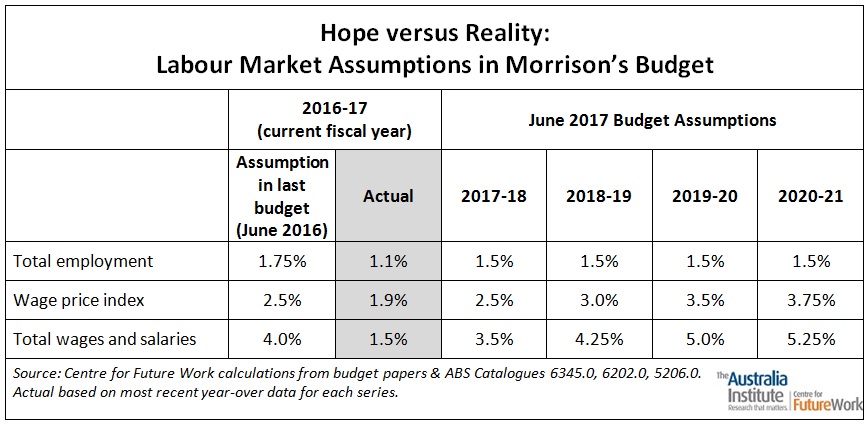
    Several commentators have highlighted the budget’s highly optimistic assumptions regarding future job-creation and wage growth incorporated into the budget forecast. The government is anticipating an immediate and sustained acceleration of all of the factors that contribute to the wage base for tax revenue: faster job-creation, significantly faster growth in hourly pay, and dramatically faster growth in total wages and salaries.

    Back in the real world, the labour market has been underperforming on ALL THREE of those components: slow job-growth, record slow growth in hourly wages, and falling weekly hours of work (due to the dramatic expansion of part-time and irregular work). For all of these reasons, total wages and salaries paid out in the economy (which forms the major basis for personal tax collections, both income and GST) actually declined in the latest quarter of GDP (Dec 2016).

    This table summarises the main wage assumptions in Mr. Morrison’s budget, contrasting them to the latest actual figures on each of the three criteria. The last budget (2016-17) missed the mark badly on all three criteria — but the likely undershooting error will be huge by the end of this budget’s forward estimates, unless there is a dramatic and sustained acceleration of employment and wages growth.

    Director Jim Stanford pointed out in this Huffington Post column that the current weakness in Australian wages is not an accident, nor is it likely to reverse automatically. Chronically weak aggregate labour market conditions, combined with structural attacks on the institutions that support wages (including unions, minimum wages, penalty rates, and others), have caused the unprecedented stagnation of wage incomes in Australia. The macroeconomic consequences of this state of affairs have been widely acknowledged — even by the government itself. (Mr. Morrison himself spoke recently of his concern with the impact of wage stagnation on his own budget targets.)

    As Stanford put it in his Huffington Post commentary, the contradiction between the government’s wage-suppressing economic and regulatory policies, and its hope that wage growth will nevertheless power the way to a balanced budget, is both glaring and unsustainable:

    “[Morrison’s] rose-coloured labour market assumptions will be sabotaged by his own government’s continuing war on workers and wages. And that’s one important reason why his hopeful deficit targets will not be realised.”

    General Optimism Regarding Revenue

    The budget’s optimistic wage growth assumptions are just one factor behind an overall revenue forecast that is downright ebullient. The main force behind the projected return to a balanced budget is an enormous assumed increase in tax revenues — very ironic coming from a government that regularly derides the alleged “tax-and-spend” procilivities of its opponents. Over the four years of the forward projection, annual revenues are expected to expand $120 billion by 2020-21 (or 30 percent). As a share of GDP, revenues are expected to swell by 2.2 percentage points, reaching the highest share (25.4% of GDP) since the peak of the mining boom (in 2005-06).

    There is no clear explanation of where these huge new revenues come from – especially given the revenue-reducing effect of other budget measures, including company tax cuts, the elimination of the deficit repair levy for high-income earners, last year’s bracket adjustments, and others. There are some modest revenue measures in the budget: including the 0.5% Medicare levy increase (after 2019), the levy on bank liabilities, and a new levy on employers who hire migrant labour. But those policy decisions account for just 6.5% of all new revenues assumed to be received over the coming 4 years — and they will be more than offset by the revenue losses from the other measures (especially the company tax cuts).

    If revenues stay constant as a share of GDP (instead of magically growing), the budget will be $45 billion short in 2020-21 – and the forecast small surplus will evaporate into a large continuing deficit. Indeed, as our colleagues at the Australia Institute have pointed out, this budget marks the fourth consecutive four-year LNP timetable for balancing the budget. The government’s tough talk on the dangers of deficit-financing, and stated intention to quickly achieve balance, have proven hollow. Many of its proposed spending cutbacks have been successfully resisted by community campaigning. And its rosy revenue forecasts have been consistently unfounded. There is no reason to believe this year’s four-year deficit elimination timetable is any more realistic than the last three.

    Robbing Peter to Pay Paul

    On the spending side, the government is announcing some modest new spending initiatives, totaling $9 billion over 4 years.

    But at the same time, they are announcing spending cuts to a wide range of programs (including higher education, welfare, and civil servants) – totaling $10 billion over the same period.

    The net impact of new policy decisions on spending is therefore $1 billion in the negative. Despite the promise of “better times” in the future, the government’s discretionary actions will reduce aggregate funding for the programs that Australians depend on.

    A Target Everyone Can Love: The Big Banks

    The government’s new 6 basis point “levy” on bank liabilities (ie. on outstanding loans) is forecast to raise $6.2 billion over 4 years.

    Many analysts believe this tax will be passed on to borrowers (since it is defined as a proportion of lending), and the government has not provided a convincing refutation of this concern. The levy is equivalent to a slight increase in the cost of capital for new lending. (In fact, this new “levy” is smaller than recent increases in interest rates which the banks have already passed on to their borrowers.)

    The government’s claim that the ACCC, with increased funding, will ensure the banks do not pass on the costs of the levy is laughable — as is its claims that competition from smaller banks will keep the big banks in line. Unless there is outright collusion and price-setting between the banks (something that is rare and unnecessary anyway), there is nothing illegal about passing on higher costs to consumers. Indeed, the ability to do this is precisely what explains the banks’ consistent above-normal profits (earning return on equity of 15 percent or more each and every year).

    At any rate, once the banks start to benefit from the full 5% reduction in their own corporate taxes (by 2026-27), they will still be saving billions each year on a net basis.

    The eminent economist Prof. Geoffrey Harcourt, a good friend of our Centre, put it this way in a blog comment:

    “The discussions on the levy/tax on the big four banks in the 2017 budget are often hysterical and beside the point. Because banks play an essential role in the running of the economy, they need protection through a guarantee from the government. Because of their oligopolistic market structure, they are in a privileged position to make large profits, a portion of which reflects their necessary privileged position, rather than any merit of their own. Common sense suggests that it would be both efficient and equitable that the banks be allowed to receive, say, the average rate of profits ruling in the economy as a whole without being taxed differently than any other form of enterprise in Australia. If their overall rates of profit are greater than the average – which they certainly are – the differences between the two sets of rates should be subject to a higher rate of tax so that the community at large receives a return on the privileged position the banks have been necessarily granted. The proposed levy is roughly akin to this proposal, which is tackling an equitable puzzle. It should not, in principle, be related to what is happening to the budget overall and especially to the sizes of any deficits or surpluses. These should reflect the outcome of attempting to meet the real aims of good government starting with achieving and sustaining full employment and sustainable growth.”

    Infrastructure Spending: Show Us the Money

    The government is boasting of $75 billion in infrastructure funding and financing over the next ten years. It is impossible to know how much of this represents new funds, nor when the funds would be delivered. Keep in mind that at present the government already spends over $18 billion per year on capital (or $200 billion over the next decade): both on new projects, and offsetting the wear and tear of existing assets. So the $75 billion “plan” ($7.5 billion per year) may or may not represent a substantial ramp-up in new capital spending by Canberra.

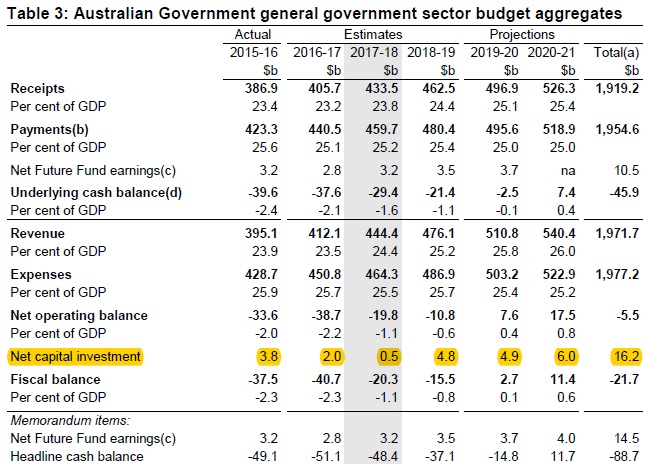
    In fact, the details of the budget do not seem to indicate any enormous expansion in capital spending. Net capital spending (after depreciation) is projected to decline in 2017-18: to just $0.5 billion, the smallest since 2002-03. (See Budget Table 3, reprinted below.) In essence, in the first year of the budget, the government will spend barely enough to offset depreciation of existing assets.

    Net investment grows in later years, but not dramatically. And as a share of GDP, net capital spending by the Commonwealth is projected to average just 0.2% of GDP over the forward projections. Over the last ten years, in contrast, it averaged 0.25% of GDP. In other words, under this budget, net Commonwealth capital spending will actually shrink relative to the economy.

    It is easy to come up with “big numbers” when talking about infrastructure programs (especially by summing totals over many years), and associated ribbon-cutting ceremonies will attract much attention. But there is no concrete evidence that this budget will accomplish the real and sustained increase in Commonwealth government capital spending that is needed. Commonwealth capital spending has declined in recent years compared to earlier decades, and there is no evidence that this budget will change that trend.

    Migrant Labour and Apprentices

    The government is imposing a new “head tax” on employers who hire foreign migrants: $1200 to $1800 per year per head for temporary migrants, and $3000 to $5000 for each permanent migrant (on a one-time basis). The revenues from this levy will be used to fund support for apprenticeships in conjunction with the states, to a total of $1.2 billion over the next 4 years.

    Funding skill programs through a tax on migrant labour is not an effective way to rebuild Australia’s battered vocational education system – nor is it an effective way to regulate employers’ over-reliance on temporary foreign migrants (rather than recruiting and training Australian workers). Indeed, the scale of revenues anticipated by the government suggests that incoming migrant labour will continue to constitute a major force in Australia’s labour market.

    Effectively regulating and reforming Australia’s migrant labour system – limiting its use to classifications where skilled workers are truly unavailable, and ensuring that migrant workers are entitled to the same protections as all other workers – would in fact undermine the head tax revenues that the government is now counting on.

    Check Out The Australia Institute’s Budget Analysis

    Our colleagues at the Australia Institute have also generated some useful and punchy commentary on the budget: see it all (including a hilarious podcast with economists Richard Denniss and Matt Grudnoff) on the Institute’s Budget Wrap page.


    You might also like

    Commonwealth Budget 2025-2026: Our analysis

    by Fiona Macdonald

    The Centre for Future Work’s research team has analysed the Commonwealth Government’s budget, focusing on key areas for workers, working lives, and labour markets. As expected with a Federal election looming, the budget is not a horror one of austerity. However, the 2025-2026 budget is characterised by the absence of any significant initiatives. There is

    Centre For Future Work to evolve into standalone entity

    The Centre for Future Work was established by the Australia Institute in 2016 to conduct and publish progressive economic research on work, employment, and labour markets. Supported by the Australian Union movement, the centre produced cutting edge research and led the national conversation on economic issues facing working people: including the future of jobs, wages

  • Economists Debunk Job-Creation Claims of Penalty Rate Cut

    Economists Debunk Job-Creation Claims of Penalty Rate Cut

    Share

    The Fair Work Commission has ruled that penalty rates for Sunday and public holiday work in the retail and hospitality sectors should be reduced, which would reduce hourly wages on those days by up to $10 per hour. Business lobbyists predict this will spark a hiring surge in stores and restaurants, as employers take advantage of lower wages to extend hours and ramp up operations. The economic logic of this claim is highly suspect, however – especially in light of the fundamental factors which truly limit employment in these sectors (namely, the sluggish growth of personal incomes). 78 Australian economists have signed a public letter debunking these job-creation claims, arguing that the FWC’s decision will lead to more inequality, not more employment.

    A 3-person drafting committee wrote the letter and circulated it among the economics community.  The committee included Stephen Koukoulas (Managing Director of Market Economics), John Quiggin (Dept. of Economics, University of Queensland), and our own Jim Stanford (Economist and Director of the Centre for Future Work). See the full letter, and list of signatories, below.


    Related documents


    Public letter

    You might also like

    Dutton’s nuclear push will cost renewable jobs

    by Charlie Joyce

    Dutton’s nuclear push will cost renewable jobs As Australia’s federal election campaign has finally begun, opposition leader Peter Dutton’s proposal to spend hundreds of billions in public money to build seven nuclear power plants across the country has been carefully scrutinized. The technological unfeasibility, staggering cost, and scant detail of the Coalition’s nuclear proposal have