Category: Environment

Research branch

  • Sustainable Industrial Jobs in the Hunter

    Sustainable Industrial Jobs in the Hunter

    Aluminium Manufacturing and Australia’s Energy Advantage
    by Jim Stanford and Alia Armistead

    New research from the Centre for Future Work shows that the rapid transformation of Australia’s aluminium facilities to sustainable sources of electricity would spark substantial economic benefits: for the aluminium industry, its supply chain, and for the burgeoning renewable energy sector (which would achieve greater critical mass from major new power supply contracts).

    The report, by Jim Stanford (the Centre’s Director) and Alia Armistead, looks in detail at the Tomago aluminium smelter in the Hunter region of NSW. It is Australia’s largest smelter, and is currently powered through electricity mostly sourced from coal-fired generation. The facility has pledged to move to renewable power sources by 2030 – and the new report confirms that this would underpin long-term industrial and economic benefits felt in all parts of the country.

    The report reviews the worrisome deindustrailisation of Australia’s foothold in the global aluminium industry. Australia’s exports of raw bauxite have grown rapidly, but value-added aluminium manufacturing (including smelting) has declined. This undermines employment, exports, and spin-off jobs.

    The study also reports results of macroeconomic simulations of the overall impacts of the Tomago facility on the national economy (including employment, incomes, GDP, and government revenue). These effects, because of the economic linkages between the smelter, its supply chain, and the consumer goods and services industries which depend on its continued existence, are very large.  Our results indicate the Tomago facility ultimately supports:

    • Over $1.2 billion in national GDP per year, with production benefits experienced in all states (70% in NSW).
    • Household disposable incomes of almost $500 million.
    • Direct and indirect employment of over 6000 jobs: in the smelter, in its various suppliers, and in downstream consumer industries.
    • Incremental government revenues worth $465 million per year: two-thirds of which is captured by the Commonwealth, and $120 million by the NSW state government.

    The study makes several recommendations for supporting Tomago’s transition to renewable energy, and enhancing Australia’s value-added aluminium presence. These include:

    • A clear and sustained commitment to rapid roll-out of renewable energy sources: Government should assist and accelerate Tomago’s transition to renewable power with clear, powerful measures to support expanded renewable energy developments, appropriate capacities (including batteries and pumped hydro) for backing up variable renewable power supplies, and fiscal measures that acknowledge the contribution Tomago could make (through the scale of its renewable energy purchases, as well as its potential role in demand-response measures that stabilise the regional electricity grid) to support NSW’s transition to renewable energy.
    • Full-cycle financial support and public equity: Our simulations confirm a large fiscal payback to state and Commonwealth governments arising from the operation of the Tomago smelter, its supply chain, and the downstream consumer industries which depend on its continued operation. This gives both levels of government a major fiscal stake in Tomago’s continuing operation. For that reason, in addition to supporting the roll-out of renewable energy, both governments should negotiate other forms of fiscal support for future capital improvements (including those tied to developments of renewable energy supply for the smelter).
    • Leveraging public infrastructure and procurement: Considerable demand for aluminium products will be forthcoming in future years as a result of the unprecedented investments being made by governments at all levels in new physical infrastructure: ranging from transportation to utilities to public buildings. The business case for continued aluminium manufacturing in Australia can be incrementally strengthened with pro-active efforts on the part of government to ensure that these investments (which are ultimately paid for by Australian taxpayers) embody maximum Australian-made content in all building materials and inputs, including aluminium.
    • A value-added trade policy: Australia’s laissez faire approach to international trade has concentrated Australia’s exports in the extraction and export of unprocessed or barely processed non-renewable resources; this has been coincident with a severe decline in domestic manufacturing and value-added activity, and a precarious dependence on imports to meet most domestic manufacturing needs. A rethinking of Australian trade policy could help reverse this damaging deindustrialisation. This must include active interventions to limit the inflow (often at prices below cost of production) of aluminium products from other countries which are not making reciprocal purchases of value-added merchandise from us. Trade policy should actively discourage exports of unprocessed bauxite, and instead require at least preliminary processing (and better yet, smelting) of Australian bauxite in Australian facilities.


    Full report

    Share

  • Record number of people working multiple jobs reveals the problems for workers

    Originally published in The Guardian on March 10, 2022

    The latest Labour Account figures from the Bureau of Statistics reveal that at the end of last year a record percent of people were working more than one job.

    The Centre for Future Work’s Greg Jericho has analysed the figures and found an abnormally large number of new jobs since the pandemic have been in secondary jobs.

    In the December quarter of 2021 a record 6.4% of employees were working multiple jobs

    This unfortunately is not a pandemic-led one-off but part of a now 6-7 year trend that finds workers who are facing fewer hours, more insecure work, and getting pay rises that barely keep up with the cost of living being forced to seek another job to pay the bills. 

    See Greg’s full commentary in The Guardian: “Rise in hours worked signals post-lockdown recovery, but more people have multiple jobs than ever


    You might also like

    Dutton’s nuclear push will cost renewable jobs

    by Charlie Joyce

    Dutton’s nuclear push will cost renewable jobs As Australia’s federal election campaign has finally begun, opposition leader Peter Dutton’s proposal to spend hundreds of billions in public money to build seven nuclear power plants across the country has been carefully scrutinized. The technological unfeasibility, staggering cost, and scant detail of the Coalition’s nuclear proposal have

  • Loss of Bargaining Power Explains Wage Stagnation

    Originally published in The Guardian on February 24, 2022

    The latest wages data from the Bureau of Statistics shows that in 2021 real wages plummeted, with inflation raising by 3.5%, while wages increased just 2.3%.

    Our Policy Director Greg Jericho writes in Guardian Australia that claims of a “wages breakout” remain purely a scare campaign from employer groups determined to keep wages low. He finds that once again real wages are failing to keep pace with productivity and that as a result no pressure on inflation is coming from wage claims, but instead workers are missing out. With levels of unemployment now associated with much lower wage growth than in the past, it is clear the power imbalance in wage negotiations has shifted drastically away from workers.


    You might also like

    Dutton’s nuclear push will cost renewable jobs

    by Charlie Joyce

    Dutton’s nuclear push will cost renewable jobs As Australia’s federal election campaign has finally begun, opposition leader Peter Dutton’s proposal to spend hundreds of billions in public money to build seven nuclear power plants across the country has been carefully scrutinized. The technological unfeasibility, staggering cost, and scant detail of the Coalition’s nuclear proposal have

  • Interest Rates and the Federal Election

    Originally published in The Guardian on February 17, 2022

    For the first time in a decade the coming election will be at a time of increasing inflation and talk of rising interest rate. And while it is clear interest rates are always a political hot potato, Greg Jericho writes in his latest Guardian Australia column that we should not lose sight of the need for government support.

    Inflation is occurring off the back of the largest government intervention and the lowest interest rates in post-WWII history. But while the economy is performing better than might have been expected when the pandemic first occurred it would be a mistake now to quickly reduce economic support from the public sector.

    After the global financial crisis, worries about debt and deficit took precedence over the strength of the economy. At a time when government borrowing rates still remain historically low, the need to improve productivity through infrastructure and support in areas such as education and health, as well as equality improvements through high a higher Jobseeker rate, should take precedence in the upcoming federal budget.


    You might also like

    Dutton’s nuclear push will cost renewable jobs

    by Charlie Joyce

    Dutton’s nuclear push will cost renewable jobs As Australia’s federal election campaign has finally begun, opposition leader Peter Dutton’s proposal to spend hundreds of billions in public money to build seven nuclear power plants across the country has been carefully scrutinized. The technological unfeasibility, staggering cost, and scant detail of the Coalition’s nuclear proposal have

  • Power, Not Just Supply and Demand, Vital to Future Wage Growth

    Originally published in The Conversation on February 9, 2022

    Australia’s unemployment rate declined to 4.2% in December, and it could fall further (below 4%) in the coming year, barring further waves of COVID or other global shocks. This has some forecasters predicting a quick acceleration in wage growth — which has been stuck for almost a decade now at the slowest pace in Australia’s postwar history.

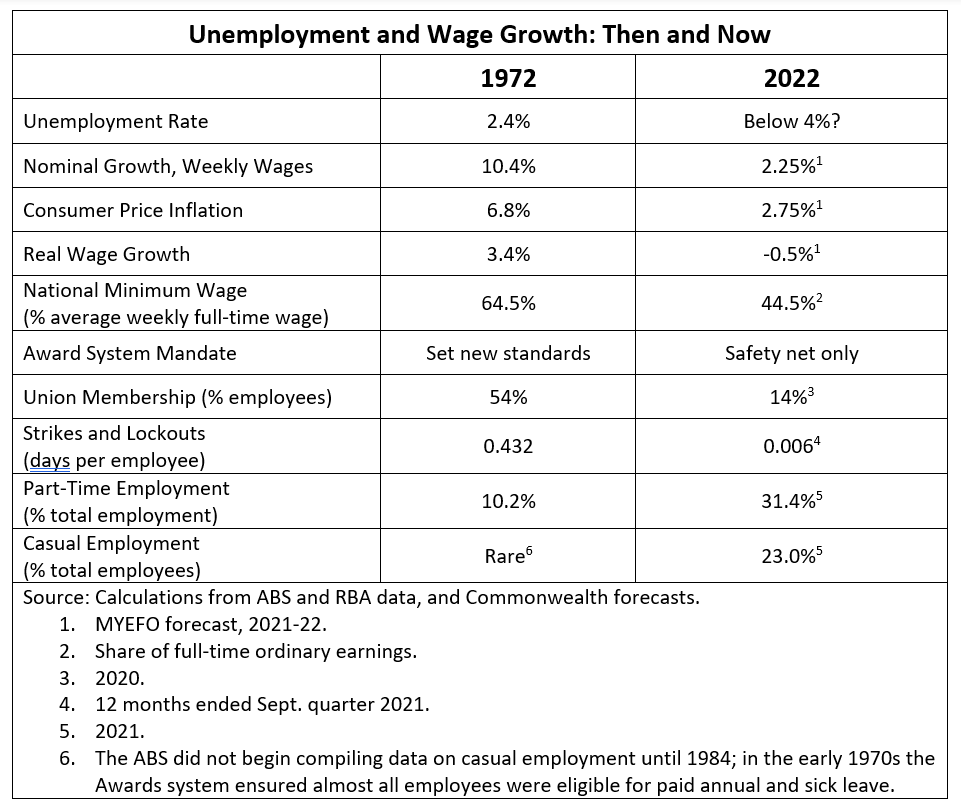
    Will a low unemployment rate be sufficient to solve the crisis in Australian wages? In this article published in The Conversation, Centre for Future Work Director Jim Stanford argues that the historic restructuring of Australia’s labour market institutions over the last half-century (since the last time unemployment was below 4%) will continue to undermine wages, despite apparently tight labour markets.

    This table compares regulatory and institutional parameters today, compared to fifty years ago. Across multiple dimensions (including the minimum wage, the Awards system, unions and collective bargaining, and job security), workers have lost the bargaining power they need to win higher wages. Hence labour costs remain suppressed, and business profits hit records, even as unemployment declines.

    Labour Institutions Then and NowPlease see Jim’s full article, “Why there’s no magic jobless rate to increase Australians’ wages,” at The Conversation.


    You might also like

    Dutton’s nuclear push will cost renewable jobs

    by Charlie Joyce

    Dutton’s nuclear push will cost renewable jobs As Australia’s federal election campaign has finally begun, opposition leader Peter Dutton’s proposal to spend hundreds of billions in public money to build seven nuclear power plants across the country has been carefully scrutinized. The technological unfeasibility, staggering cost, and scant detail of the Coalition’s nuclear proposal have

  • Australia ready to become sustainable EV-making powerhouse: new research

    Australia ready to become sustainable EV-making powerhouse: new research

    Share

    A unique combination of advantages has handed Australia a historic chance to become a sustainable global manufacturer of electric vehicles – provided the federal government acts swiftly and decisively, according to new research by the Australia Institute’s Carmichael Centre.

    The new report, Rebuilding Vehicle Manufacturing in Australia: Industrial Opportunities in an Electrified Future, has found Australia is uniquely blessed with advantages to attract and retain EV manufacturing and rebuild the nation’s car-making capacity. This potential, however, will not be met without major government action.

    “When it comes to creating an EV manufacturing sector, Australia enjoys advantages other nations would die for: rich reserves of lithium and rare earths, strong industrial infrastructure, a highly skilled workforce, powerful training capacity, abundant renewable energy options, and untapped consumer potential,” said Dr Mark Dean, the report’s lead author.

    “And contrary to popular belief, we wouldn’t be starting from scratch. Thanks to the resilience of our remaining automotive manufacturing supply chain, a surprising amount of auto manufacturing work – including components, specialty vehicles, and engineering – still exists here.”

    But Dr Dean said his research found Australia’s advantages would count for little without significant government support. The report makes a number of recommendations including:

    • Establishing an EV Manufacturing Industry Commission
    • Using tax incentives to encourage firms involved in the extraction of key minerals – primarily lithium and rare earths – with local manufacturing capabilities, especially emerging Australian EV battery industries
    • Introducing a long-term strategy for vocational training, ensuring the establishment of skills to service major EV manufacturers looking to set up operations Australia
    • Offering major global manufacturers incentives (tax incentives, access to infrastructure, potential public capital participation, etc) to global manufacturers to set up – especially in Australian regions undergoing transition from carbon-intensive industries
    • Introducing local procurement laws for the rapid electrification of government vehicle fleets

    “No nation builds a major industry without its government taking a proactive role. Our new research shows there’s no excuse for inaction, because there are a huge range of powerful levers our government could be pulling,” Dr Dean said.

    “If we capture the moment we’ll capture abundant benefits: creating tens of thousands of regional manufacturing jobs, reducing our dependence on raw resource extraction, reinforcing our accelerating transition toward non-polluting energy sources, and spurring innovation, research, and engineering activity in Australia. We just need our government to act.”


    Related research

  • Rebuilding Vehicle Manufacturing in Australia

    Rebuilding Vehicle Manufacturing in Australia

    Industrial Opportunities in an Electrified Future
    by Mark Dean

    Global automotive manufacturing is rapidly transitioning to the production of Electric Vehicles (EVs) in line with technological advancements and the global community’s commitment to addressing climate change. This transition presents an enormous opportunity for Australia to rebuild its vehicle manufacturing industry, taking advantage of our competitive strengths in renewable energy, extractive industries, manufacturing capabilities, and skilled workers.

    Australia possesses many of the crucial elements for an EV manufacturing industry: rich mineral reserves, an advanced industrial base, a highly skilled workforce, and consumer interest. But what it lacks is an overarching, coordinating and strategic national industry policy. Global experience shows that this is central to EV-oriented industrial transformation. Australia can play an important role in global EV manufacturing industries but developing a strategy to realise this will require active government policy responses to both the challenges and opportunities at hand.

    Australia’s natural resource endowments and industrial capabilities make EV industry development a viable economic and social strategy. Our moral obligations to create a sustainable future make it essential public policy. This report illustrates how Australia can rebuild a vehicle manufacturing industry, on a sustainable ecological foundation, and meet our international environmental obligations. The report covers several important related dimensions of the issue:

    • How an EV manufacturing strategy can add value to Australia’s existing exports of primary resources – connecting them to innovative, sustainable manufacturing industries;
    • Developing supply and value chain linkages to the global EV industry by increasing the capability for innovation and advanced manufacturing amongst small and medium-sized enterprises;
    • The central role of Australia’s education systems in delivering sustainable industry-focused training and skills development, to provide workers with career pathways shaped by lifelong access to education and learning;
    • How active government intervention can coordinate economic sectors in an innovative and strategically oriented industry policy driving sustainable economic and technological transformation; and
    • Understanding the importance of automotive manufacturing to our industrial future, its role in redesigning transport systems, investing in new technology and gearing production systems to meet social and environmental requirements.

    To make the case for a national EV manufacturing policy, this paper reviews existing literature and presents relevant data to show that an EV industry in Australia is not just desirable – but it can also lead the sustainable transformation of Australia’s economy.

    The paper is arranged as follows. The next section provides an overview of the Australian national EV policy landscape and the international context, to identify trends and opportunities in EV manufacturing.

    The bulk of the paper is then dedicated to reviewing four key ‘Building Blocks’ of an industry policy: the resources sector, skilled labour, supply chain capabilities and capital assets, and the capacity of government to develop a policy response that assembles these key elements as the foundation for rebuilding Australian manufacturing with EVs at the centre.

    In mapping this foundation of an EV manufacturing policy, the subsequent section cautions that an EV industry is not a panacea for addressing the broader climate crisis and creating a sustainable economy. It argues, however, that a sustainable EV industry should be considered as a major driver of industrial transformation alongside other positive cultural and environmental changes within Australian society.

    The conclusion summarises the paper’s overarching theme that Australia can build a strong EV manufacturing industry with the right policy settings and government actions. It makes several specific recommendations to get the ball rolling on developing these settings – including recommendations touching on industry planning, energy requirements, consumer demand, resource use, supply chain developments, skills and training, and government support.


    Full report

    Share

  • If You Thought Employers Were Exploiting Workers With Too Many Insecure Jobs Before The Pandemic, Wait Till You See The Figures Now

    If You Thought Employers Were Exploiting Workers With Too Many Insecure Jobs Before The Pandemic, Wait Till You See The Figures Now

    by Dan Nahum

    Australia paid a big price for the over reliance on insecure jobs prior to the pandemic. But as our economy recovers, insecure jobs account for about two out of every three new positions. In this commentary, originally published on New Matilda, Economist Dan Nahum explains why that’s a very bad thing – especially in front-line, human services roles. In the context of COVID-19, the effects of insecure work in these sectors, in particular, reverberate across the whole community with dangerous and tragic consequences.

    COVID-19 has been reintroduced into multiple aged care homes in Victoria, in part via staff who worked in multiple locations. We have been here before, but this time, the Commonwealth government should have prevented this channel of contagion.

    The poorly-managed vaccine rollout, including inexplicable delays in vaccinating aged care residents and staff, has played a key role in the current outbreak. But there is another policy factor at play as well: multi-site, insecure, and precarious work in Australia’s aged care sector.

    There has been a dramatic expansion of insecure work in this sector: including more than doubling the share of part-time jobs in the last generation, a huge shift toward lower-qualified, frequently precarious personal care positions (rather than qualified and registered health workers), and the widespread use of labour hire and agencies to provide short-term labour (rather than creating permanent, stable jobs).

    The recent report of the Royal Commission into Aged Care Quality and Safety identified these precarious staffing practices as a major risk to the quality and safety of care. The Commissioners criticised the over-use of temporary or agency work, and emphasised the inextricable linkage between ‘the quality of care and the quality of jobs.’ They recommended that permanent, more stable jobs are most compatible with ‘developing a skilled, career-based, stable and engaged workforce providing high quality aged care’.

    It’s not just in aged care facilities that insecure work has accelerated the spread, and magnified the consequences, of COVID-19. In fact, insecure work has generally weakened Australia’s resistance to the virus, and undermined both our health and economic responses. In aged care and beyond, precarious work enhances risks that the virus is transmitted.

    Precarious jobs do not provide the training and stability to ensure that rigorous infection control measures are implemented and followed. Workers in those jobs have low and unstable incomes, and generally lack paid sick leave: the resulting economic desperation compels many of them to work, when they should be isolating. Another tragic example of the overlap between insecure work and COVID-19 contagion was the tragic failures in hotel quarantine – where a perfect storm of poor training, low wages, and insecure work clearly contributed to the virus’s escape into the community.

    Precarious work is more than just casual work – it includes part-time (especially with unpredictable hours), casual, labour hire, sham contracting, and gig work. Around half of all Australian jobs embody one or more of those dimensions of insecurity.

    Sick pay is unavailable in most of these roles: casual and self-employed workers have none, while even permanent part-timers accumulate only partial credits. When the pandemic hit, 37% of all employed Australians (including self-employed) had no paid sick leave entitlement. Unwell workers thus faced the economic compulsion to work when they should have stayed home.

    Workers in insecure jobs experienced the lion’s share of initial job loss in the early days of the pandemic, cruelly concentrating the costs of the downturn on those who could least afford it. Casual workers lost employment eight times faster than those in permanent jobs. Part-time workers lost work three times faster than full-time workers, and insecure self-employed workers (those without incorporation or without any employees) lost work four times faster than those in more stable small businesses.

    Now, however, the rebound of employment since the initial lockdowns is being dominated by a surge in insecure jobs. Casual jobs account for almost 60% of all waged jobs created since the trough of the recession. Part-time work accounts for almost two-thirds of all new jobs. And very insecure positions (including own-account contractors and ‘gigs’) account for most of the rebound in self-employment.

    So without measures to improve job stability, the post-COVID labour market will clearly be dominated by insecure work – setting us up for future economic, social, and public health risks in the future.

    Multiple job-holding provides further evidence that the labour market, for many people, provides only fractured, incomplete, precarious opportunity. In the December quarter of 2020, there were over a million ‘secondary jobs’ in Australia (where a person is working that job in addition to another role) – the highest in history. Secondary jobs surged by 27% from June through December 2020 (alongside other types of insecure work).

    These jobs now account for 7.2% of all employment in Australia – also the highest in history. As we have tragically been reminded, multiple job holding poses enormous risks: not just on workers forced to juggle multiple positions to make ends meet, but for quality of care and public health.

    Finally, the broader social and familial stresses unleashed by the pandemic have also been exacerbated by insecure work. This problem has a particularly gendered slant: women do most of the unpaid work in our society, and carrying this burden of unpaid work is made even more difficult when paid work is precarious and unreliable. Family demands do not suddenly disappear when there is an opportunity to pick up a casual shift. And for the worker, the consequences of turning down that shift can be damaging and long-term – likely leading to fewer hours subsequently offered by that employer.

    Avoidable outbreaks of COVID-19 provide further proof that Australia needs to roll back precarious work, and ensure all workers have basic security, stability and entitlements.

    Australia has among the highest reliance on insecure work arrangements of any industrial country. That precarity is not natural or inevitable, it is the result of deliberate policy choices. And in the wake of COVID-19, Australia should be making different ones.


    You might also like

    Dutton’s nuclear push will cost renewable jobs

    by Charlie Joyce

    Dutton’s nuclear push will cost renewable jobs As Australia’s federal election campaign has finally begun, opposition leader Peter Dutton’s proposal to spend hundreds of billions in public money to build seven nuclear power plants across the country has been carefully scrutinized. The technological unfeasibility, staggering cost, and scant detail of the Coalition’s nuclear proposal have

  • Why is Job Quality Worsening?

    Why is Job Quality Worsening?

    by Alison Pennington

    Over time, insecure work has become more prevalent in the Australian economy. Key drivers of worsening job quality include: decades of economic policies which constructed unemployment “buffers”; insufficient paid work available for all who need it; reductions in the level of unemployment benefits to below-poverty levels, collapse in collective bargaining coverage, and failure to regulate insecure work.

    In this update on job insecurity in Australia, Alison Pennington reviews the ongoing erosion of full-time, traditional “good” jobs, growth in COVID-era “gig” work, and outlines how business trends and labour market policies have facilitated both lower worker bargaining power and a dramatic rise in insecure work.

    For more on reducing the incidence and consequences of insecure work, see our recent submission to the Select Committee on Job Insecurity, by Dan Nahum.


    You might also like

    Dutton’s nuclear push will cost renewable jobs

    by Charlie Joyce

    Dutton’s nuclear push will cost renewable jobs As Australia’s federal election campaign has finally begun, opposition leader Peter Dutton’s proposal to spend hundreds of billions in public money to build seven nuclear power plants across the country has been carefully scrutinized. The technological unfeasibility, staggering cost, and scant detail of the Coalition’s nuclear proposal have

  • Video: Myth & Reality About Technology, Skills & Jobs

    Video: Myth & Reality About Technology, Skills & Jobs

    by Jim Stanford

    Share

    We are constantly told that the world of work is being turned upside down by ‘technology’: some faceless, anonymous, uncontrollable force that is somehow beyond human control. There’s no point resisting this exogenous, omnipresent force. The best thing to do is get with the program… and learn how to program! Acquiring the right skills (usually assumed to be STEM or computer skills) is the best way to protect yourself in this brave new high-tech future.

    But what if technology isn’t all it’s cracked up to be? And what if you invest in learning the current hot coding language, only to see it replaced by something totally different as soon as you graduate?

    In this 30-minute video, Centre for Future Work Economist and Director Dr. Jim Stanford takes on several myths related to technology and jobs.

    He argues that technology is neither exogenous nor neutral: innovation reflects the priorities (and the power) of those who have the resources to pay for it. By some indicators, jobs are becoming less technology-intensive — and this is undermining job security and living standards. Finally, we need a more holistic and democratic approach to skills and training: one that respects the all-round interests of workers as human beings (not just ‘producers’), and accepts that skills alone are no guarantee of decent, fair jobs in the future.

    The video is an excellent, free resource for adult education workshops, career development courses, and union meetings.


    You might also like

    Dutton’s nuclear push will cost renewable jobs

    by Charlie Joyce

    Dutton’s nuclear push will cost renewable jobs As Australia’s federal election campaign has finally begun, opposition leader Peter Dutton’s proposal to spend hundreds of billions in public money to build seven nuclear power plants across the country has been carefully scrutinized. The technological unfeasibility, staggering cost, and scant detail of the Coalition’s nuclear proposal have