Category: Environment

Research branch

  • Economists Debunk Job-Creation Claims of Penalty Rate Cut

    Economists Debunk Job-Creation Claims of Penalty Rate Cut

    Share

    The Fair Work Commission has ruled that penalty rates for Sunday and public holiday work in the retail and hospitality sectors should be reduced, which would reduce hourly wages on those days by up to $10 per hour. Business lobbyists predict this will spark a hiring surge in stores and restaurants, as employers take advantage of lower wages to extend hours and ramp up operations. The economic logic of this claim is highly suspect, however – especially in light of the fundamental factors which truly limit employment in these sectors (namely, the sluggish growth of personal incomes). 78 Australian economists have signed a public letter debunking these job-creation claims, arguing that the FWC’s decision will lead to more inequality, not more employment.

    A 3-person drafting committee wrote the letter and circulated it among the economics community.  The committee included Stephen Koukoulas (Managing Director of Market Economics), John Quiggin (Dept. of Economics, University of Queensland), and our own Jim Stanford (Economist and Director of the Centre for Future Work). See the full letter, and list of signatories, below.


    Related documents


    Public letter

    You might also like

    Dutton’s nuclear push will cost renewable jobs

    by Charlie Joyce

    Dutton’s nuclear push will cost renewable jobs As Australia’s federal election campaign has finally begun, opposition leader Peter Dutton’s proposal to spend hundreds of billions in public money to build seven nuclear power plants across the country has been carefully scrutinized. The technological unfeasibility, staggering cost, and scant detail of the Coalition’s nuclear proposal have

  • Principles for Meaningful Transition Support for Workers in Carbon-Intensive Industries

    Principles for Meaningful Transition Support for Workers in Carbon-Intensive Industries

    by Jim Stanford

    As Australia and other countries shift their economies toward lower-carbon forms of energy and production, problems of displacement and transition for workers in carbon-intensive industries must be addressed as a top priority.  The coal-fired electricity generation industry is on the front lines of this challenge.

    Centre for Future Work Director Jim Stanford was recently invited to give testimony to a Senate of Australia reference committee studying the future transition of the coal-fired electricity sector.

    Offering meaningful and concrete job and income protection for workers in affected industries (like coal-fired power) is not only fair: after all, those workers should not bear disproportionate costs from policies that benefit broader society and the environment.  It is also politically important, because it refutes oft-made claims that environmental protection is incompatible with job security and economic prosperity.  Environmental advocates often speak of the need for a “just transition” for affected workers, although that idea is often described in broad, vague terms.  Developing specific, concrete programs to facilitate fair and effective employment transitions in carbon-intensive industries will be an important priority for the overall strategy to phase-out this highly-polluting energy form.

    Dr. Stanford reviewed for the Senate committee the experience of employment transitions in other jurisdictions, and identified key principles for minimising the cost of those transitions for the affected workforce.


    Full report

    Share

  • Looking for “Jobs and Growth”: Six Infographics

    Looking for “Jobs and Growth”: Six Infographics

    Share

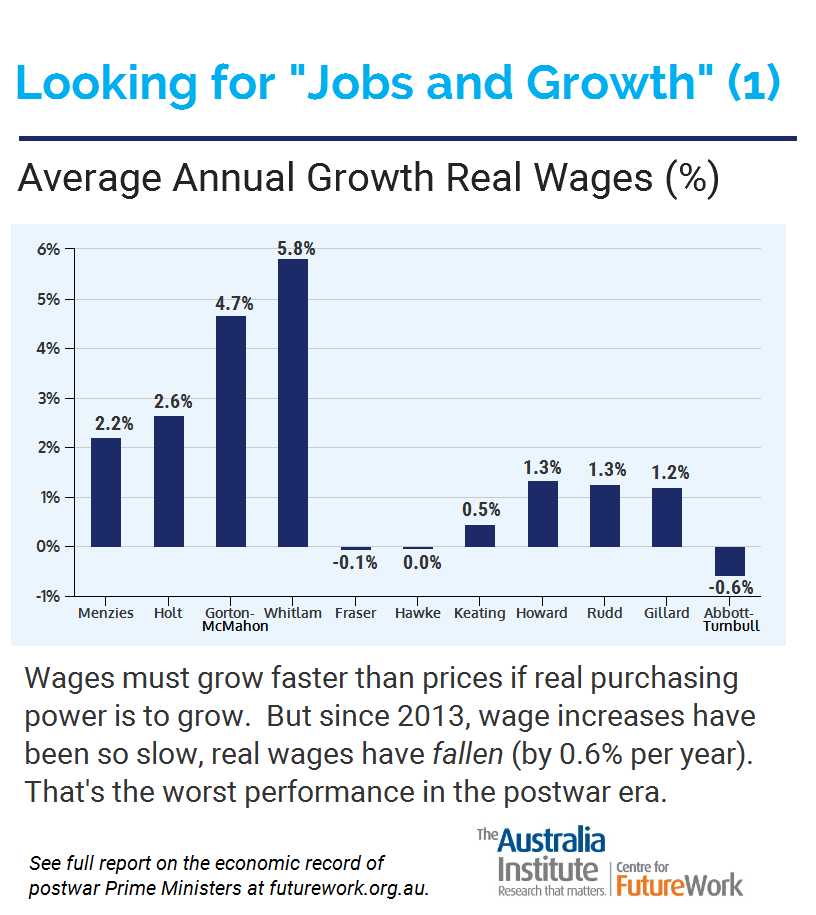
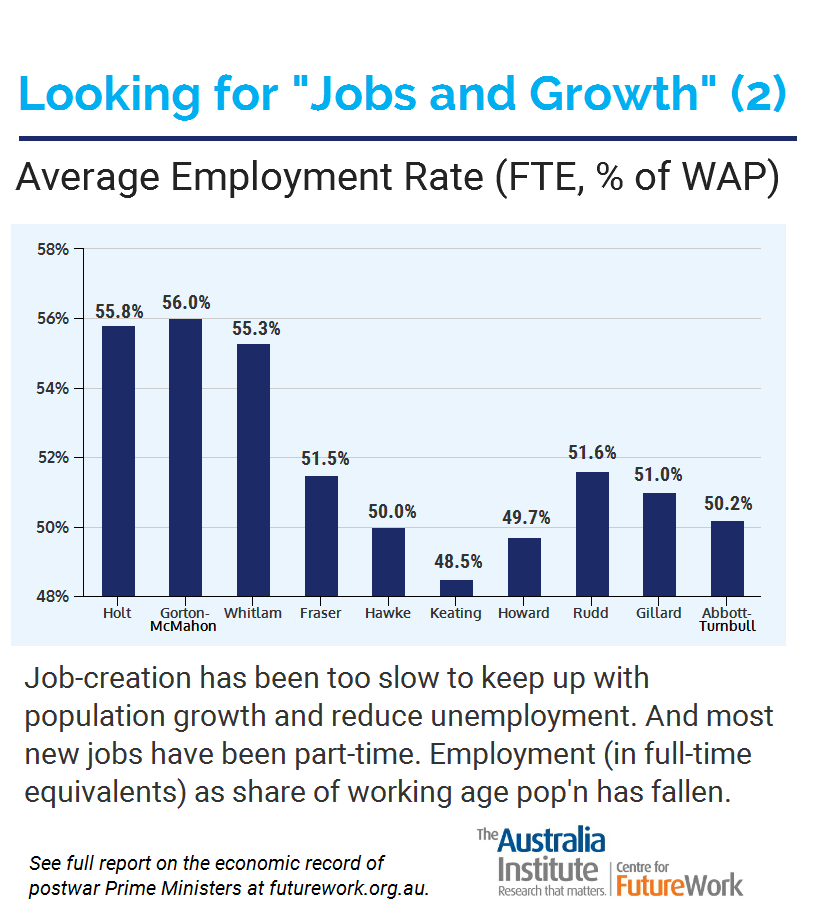
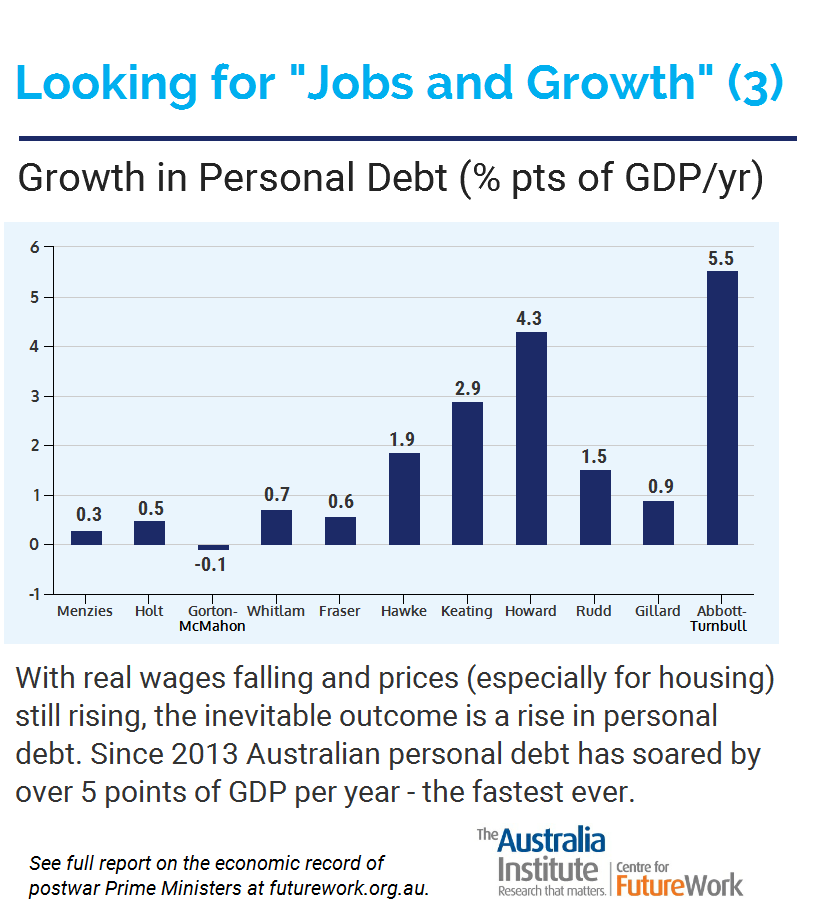
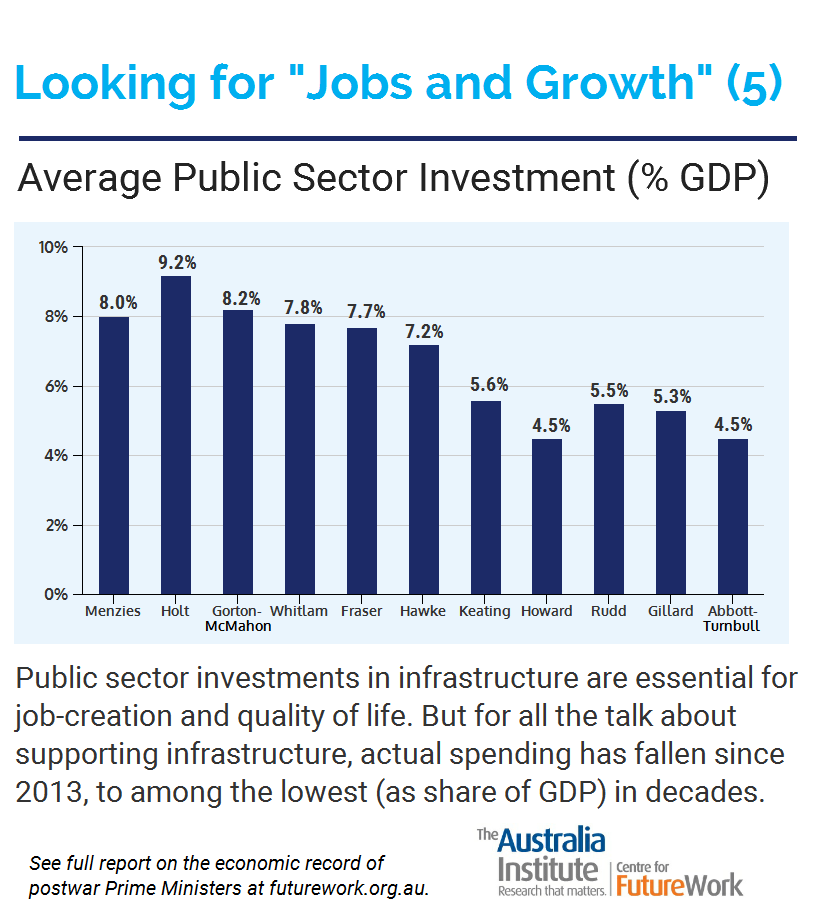
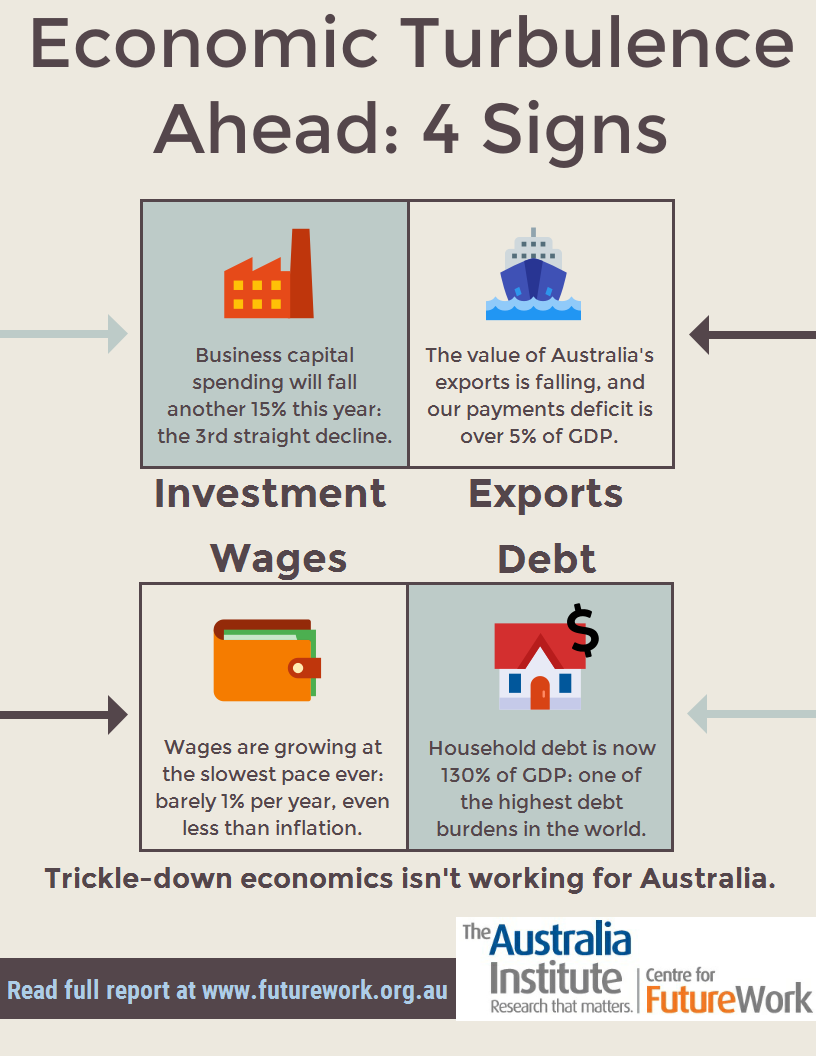
    We have prepared six shareable infographics based on material in our research paper, “Jobs and Growth… and a Few Hard Numbers,” which compared Australia’s economic performance under the respective postwar Prime Ministers.

    The infographics summarize several of the specific economic variables considered in the full report, dating back to 1950 (and Prime Minister Menzies) in most cases.

    Average Annual Growth, Real Wages
    Average Employment Rate
    Growth in Personal Debt
    Average Annual Growth, Business Investment
    Public Sector Investment
    4 Signs of Turbulence Ahead

    Related research

    You might also like

    Dutton’s nuclear push will cost renewable jobs

    by Charlie Joyce

    Dutton’s nuclear push will cost renewable jobs As Australia’s federal election campaign has finally begun, opposition leader Peter Dutton’s proposal to spend hundreds of billions in public money to build seven nuclear power plants across the country has been carefully scrutinized. The technological unfeasibility, staggering cost, and scant detail of the Coalition’s nuclear proposal have

    Centre For Future Work to evolve into standalone entity

    The Centre for Future Work was established by the Australia Institute in 2016 to conduct and publish progressive economic research on work, employment, and labour markets. Supported by the Australian Union movement, the centre produced cutting edge research and led the national conversation on economic issues facing working people: including the future of jobs, wages

  • Jobs and Growth… and a Few Hard Numbers

    Jobs and Growth… and a Few Hard Numbers

    by Jim Stanford

    Share

    Voters typically rank economic issues among their top concerns. And campaigning politicians regularly make bold (but vague) pronouncements regarding their competence and credibility as “economic managers.”  In popular discourse, economic “competence” is commonly equated with being “business-friendly.”

    However, the economy consists of more than just private businesses – and certainly more than the large businesses which attract the main attention from politicians and reporters.  Other stakeholders are at least as crucial for powering real economic progress: including workers, households, governments at all levels, small businesses, public and non-profit institutions, NGOs and the voluntary sector, and more.  So being “business-friendly” is no guarantee that the real economy (measured by employment, output, and incomes) will automatically improve.  Having a more complete understanding of all of the different ingredients required for economic progress is necessary, in order to properly analyze the likely impact of specific measures.

    To demonstrate the lack of correlation between a government’s stated economic orientation, and the actual performance of the real economy, this briefing paper compiles historical data on twelve standard indicators of economic performance: including employment, unemployment, real output, investment (of various forms), foreign trade, incomes, and debt burdens.  Consistent annual data is gathered going back to the 1950s, allowing for a statistical comparison of Australia’s economic record under the various post-war Prime Ministers.  We compare Australia’s economic performance under each Prime Minister, on the basis of these twelve selected indicators.

    There is no obvious correlation between these respective swings in Australia’s economic history, and the policy orientation of the government that oversaw them. And the statistical review indicates that the present government, regardless of its business-friendly credentials, has in fact presided over one of the weakest economic periods in Australia’s entire postwar history.


    Related research

    You might also like

    Dutton’s nuclear push will cost renewable jobs

    by Charlie Joyce

    Dutton’s nuclear push will cost renewable jobs As Australia’s federal election campaign has finally begun, opposition leader Peter Dutton’s proposal to spend hundreds of billions in public money to build seven nuclear power plants across the country has been carefully scrutinized. The technological unfeasibility, staggering cost, and scant detail of the Coalition’s nuclear proposal have