Category: Climate & Energy

Research branch

  • Industry-Wide Bargaining Good for Efficiency, as Well as Equity

    Industry-Wide Bargaining Good for Efficiency, as Well as Equity

    by Anis Chowdhury

    In this commentary, Centre for Future Work Associate Dr. Anis Chowdhury discusses the economic benefits of industry-wide collective bargaining. In addition to supporting wage growth, industry-wide wage agreements generate significant efficiency benefits, by pressuring lagging firms to improve their innovation and productivity performance. The experience of other countries (such as Germany and Singapore) suggests that this system promotes greater efficiency, as well as equity — although other wealth-sharing policies are also needed.

    Dr. Chowdhury’s full comment is posted below.

    INDUSTRY-WIDE BARGAINING CAN BOOST EFFICIENCY AS WELL AS WAGES

    by Dr. Anis Chowdhury

    In an effort to reverse long-term wage stagnation, the ACTU is calling for an end to current industrial rules which effectively prohibit sector- or industry-wide wage bargaining. Predictably, the business community is opposed. Australian Industry Group chief executive, Innes Willox, said, “The ACTU’s latest proposals would destroy jobs and the competitiveness of Australian businesses…If the ACTU got its way, unions would be able to make unreasonable claims and cripple whole industries and supply chains until employers capitulated.”

    No doubt, the issue will be a hot topic in the upcoming Federal Elections. The Labor Party conference is debating the ACTU’s call. And the Liberal-National Coalition will surely accuse Labor of capitulating to the vested interest of the union movement.

    Mr. Willox’s claim that the sector-wide wage bargaining would destroy jobs and Australia’s competitiveness has no basis. A powerful example is provided by Germany, Europe’s strongest economy. In Germany, wages, hours, and other aspects of working conditions are decided by unions, work councils (organisations complementing unions by representing workers at the firm level in negotiations), and employers’ associations. Collective wage bargaining takes place not at the company or enterprise level but at the industry and regional levels, between unions and employers’ associations. If a company recognises the trade union, all of its workers are effectively covered by the union contract.

    Yet, Germany’s competitiveness did not decline. On the contrary, Germany experiences both strong productivity growth and strong wage growth. Despite ongoing real wage improvements, unit labour costs are stable or even declining – further enhancing Germany’s competitiveness.

    How is this possible? The answer was given by more than half a century ago by two leading Australian academics – WEG Salter and Eric Russel. By de-linking productivity-based wage increases at the enterprise level and adhering to the industry-wide average productivity-based wage increases, an industry bargaining system raises relative unit labour costs of firms with below-industry-average productivity, thereby forcing them to improve their productivity or else exit the industry. At the same time, firms with above-industry-average productivity enjoy lower unit labour costs, hence higher profit rates for reinvestment. Singapore also used this approach to restructure its industry in the 1980s towards higher value-added activities, with great success.

    Trying to compete on the basis of low wages is a recipe for failure. As a matter of fact, low-wage countries typically demonstrate lower productivity; and research by a leading French economist, Edmond Malinvaud, showed that a reduction in the wage rates has a depressing effect on capital intensity. Salter’s research implies that the availability of a growing pool of low paid workers makes firms complacent with regard to innovation and technological or skill upgrading. Other researchers show that under-paid labour provides a way for inefficient producers and obsolete technologies to survive. Firms become caught in a low-level productivity trap from which they have little incentive to escape – a form of Gresham’s Law’ whereby bad labour standards drive out good. The discipline imposed on all firms as a result of negotiated industry-wide wage increases forces all of them to innovate and become more efficient.

    So, sector-wide wage bargaining is good for the economy: favouring efficient firms, stimulating investment, and lifting wages. Of course, industry-wide bargaining alone cannot solve all the problems of wage inequity or wage stagnation. It must be part of a broader suite of policy measures, to provide all-round support for greater equality and inclusive prosperity.

    In particular, we must address the system that produces sky-rocketing executive pays at the expense of workers. A lower marginal tax rate is one of the incentives for the executives to pay themselves heftily, while tax cuts are not found to boost growth or employment. Share options for CEOs, which encourage job cuts and discourage re-investment, also must be reined in. If anything that is making the Australian economy vulnerable, is growing economic disparity between self-serving executive compensation and stagnant wages for the rest of the population.

    Reforms also need to address the macroeconomic policy paradigm, where fiscal policy is focused on creating needless budget surpluses by cutting social services and public infrastructure investment. Meanwhile, monetary policy is focused on a pre-determined inflation target regardless of the economic cycle. All of this stifles economic growth prospects and increases job insecurity – both of which are detrimental for wage recovery.


    You might also like

  • The Future of Transportation Work: Special Series, WA Transport

    The Future of Transportation Work: Special Series, WA Transport

    by Jim Stanford and Matt Grudnoff

    A special 6-part series of short articles from WA Transport Magazine:

    Researchers have identified the transportation industry as one of the sectors likely to be most affected by the coming implementation of new technologies: such as self-driving vehicles, artificial intelligence, and automated logistics systems. How will transportation workers fare as these technologies are rolled out, and what measures can be taken – by employers, governments, unions, educational institutions, and other stakeholders – to ease the transitions?

    Earlier this year the Centre for Future Work completed a comprehensive review of factors influencing the future of work in transportation industries, commissioned by TWUSUPER (the main industry super fund serving the transportation sector). The report (co-authored by Jim Stanford and Matt Grudnoff) concluded that technology is not the only factor transforming work in transportation; in fact, if anything, accelerating changes in the nature of employment relationships (including the spread of independent contractor roles, “gigs”, and other forms of insecure work) are having a bigger immediate impact. Moreover, with appropriate planning, consultation, negotiation, and investments in training and adjustment, the employment impacts of new technology could clearly be managed without undue harm or displacement – but only if all stakeholders commit to an inclusive, collaborative process of planning and adjustment.

    In the wake of our report, the industry journal WA Transport has published a very readable compendium of short articles, each exploring a different aspect of our report.

    With the kind permission of WA Transport, we reprint those articles here. Together they are a useful resource for leaders and educators in the transportation industry.

    Part I: The Economic Importance of Transportation

    Part II: Transportation Work Today

    Part III: Twin Drivers of Change

    Part IV: Applications of New Technology in Transportation

    Part V: Work Organisation and Employment Relationships

    Part VI: Change Scenarios and Policy Implications

    We thank TWUSUPER for the opportunity to undertake this research, and WA Transport for publishing this series of articles.


    Part I: The Economic Importance of Transportation


    Part II: Transportation Work Today


    Part III: Twin Drivers of Change


    Part IV: Applications of New Technology in Transportation


    Part V: Work Organisation and Employment Relationships


    Part VI: Change Scenarios and Policy Implications

    Share

  • The future of transportation work: Technology, work organization, and the quality of jobs

    The future of transportation work: Technology, work organization, and the quality of jobs

    by Jim Stanford and Matt Grudnoff

    Workers in all parts of the economy are confronting twin threats from accelerating changes in technology and automation, and the ongoing shift toward more precarious and irregular forms of work — including “gigs” on digital platforms.  The transportation sector is widely acknowledged to be one of the most susceptible to both of these trends.  The Centre for Future Work has published a major new research report on these trends, and how sector stakeholders can best prepare for the coming changes.

    The report was commissioned by TWUSUPER (the main industry superannuation fund in Australia’s transportation sector).  It describes the current size and economic importance of the transportation industry, and provides a detailed profile of its existing workforce.  In then considers twin drivers of change buffeting the industry: changes in technology, and changes in work organisation and employment relationships.  The report stresses the importance of distinguishing between these factors, lest observers accept a misplaced sense of “technological determinism” regarding the evolution of work and jobs.  The report concludes that the erosion of job quality and stability associated with the growth of non-standard work poses a greater challenge to quality transportation jobs, than the much-hyped advent of driverless vehicles and other technological breakthroughs.

    The report concludes with several key recommendations for transportation stakeholders to assist in preparing for these changes, and managing them so as to maximise their benefits and minimise their costs.  These include:

    1. Facilitating Mobility: There will be significant new work associated with the advent of new transportation technologies. An obvious response is to assist existing workers to fill new positions by providing notice, support, and access to training and adjustment programs. Financial support from employers and governments will be necessary. Training and adjustment programs need to take account of the advanced age of many transportation workers, and tailor offerings to fit needs of older workers with less formal qualifications.
    2. Establishing Benchmarks for Skills and Qualifications: New technology-intensive jobs will require a wide-ranging suite of new skills – including design, programming, operation, data management, and more. Specific requirements and qualifications for those skills must be formalized and regulated. Sector stakeholders should work closely with existing bodies (such as Australian Industry Standards, TAFEs, and others) to specify and catalogue requirements for new jobs. Transferable certifications will assist workers and employers to identify and acquire needed skill sets, and develop a ready supply of qualified, flexible workers. Strengthening high-quality apprenticeships is also critical.
    3. Facilitating Decent Retirement: The advanced age of many transportation workers is an advantage in a time of transition. Downsizing or restructuring can be managed in part by facilitating exit by workers not interested or able to undertake retraining and adjustment. Bridging benefits and early retirement incentives, with government support, ease the transition, and avoid involuntary job losses that would otherwise occur.
    4. Negotiating Technological Change: Adaptation is more successful when all parties have a genuine say in how it is implemented and managed. Transportation stakeholders must commit to information sharing, consultation, and negotiation over technological change. Workers and their unions should be notified of plans for new technologies. Discussions should occur regarding timing, scope, and effects of new investments. Opportunities should be provided for early input from workers regarding how change will be managed; collective bargaining should include the terms of technology and its application.
    5. Building Consensus: Sector needs a multi-partite, sector-wide approach to analysing challenges and developing inclusive sector-wide responses. Undertake social dialogue among industry participants to maximise benefits of change, reduce costs – and share both costs and benefits fairly. Multi-partite forums (engaging business, workers and their unions, government, regulators, training institutions, financial institutions, and others) will help build relationships among stakeholders, identify future needs, and imagine and implement initiatives to facilitate necessary investments and adjustments.
    6. Protecting Standards and Benefits: Changes in work organisation and employment relationships are changing transportation jobs and challenging traditional standards of security, entitlements, and compensation. The use of non-standard employment forms (like contractors and labour hire) imposes unsustainable consequences on workers who are denied stable, decent opportunity. Traditional standards and entitlements should apply to all transportation workers, including in non-standard, independent, or “gig” situations. Regulatory benchmarks and corporate accountability should apply across the supply chain.


    Summary Report


    Full report

    Share

  • Job Opportunity – Research Economist

    Job Opportunity – Research Economist

    Share

    The Centre for Future Work invites applications for an economist to join our research team in labour market research and policy analysis, working from our offices in Sydney or Canberra.

    Deadline for applications is December 21 2017.

    It’s a chance to be part of our growing team, and to make a contribution to strong, progressive policy research on jobs, employment, fairness, and the future of work!

    Please download the full notice below for more details.


    Related documents


    Position description

    You might also like

    Dutton’s nuclear push will cost renewable jobs

    by Charlie Joyce

    Dutton’s nuclear push will cost renewable jobs As Australia’s federal election campaign has finally begun, opposition leader Peter Dutton’s proposal to spend hundreds of billions in public money to build seven nuclear power plants across the country has been carefully scrutinized. The technological unfeasibility, staggering cost, and scant detail of the Coalition’s nuclear proposal have

  • Job Growth No Guarantee of Wage Growth

    Originally published in The Sydney Morning Herald on November 17, 2017

    Measured by official employment statistics, Australia’s labour market has improved in recent months: full-time employment has grown, and the official unemployment rate has fallen. But dig a little deeper, and the continuing structural weakness of the job market is more apparent. In particular, labour incomes remain unusually stagnant. In this commentary, Centre for Future Work Associate Dr. Anis Chowdhry reflects on the factors explaining slow wage growth — and what’s required to get wages growing.

    Job Growth No Guarantee of Wage Growth

    by Dr. Anis Chowdhury

    ‘Remarkable’ jobs growth raises hopes for wages” was the headline for a recent Sydney Morning Herald opinion piece by Clancy Yeates. He bases this claim on “some brighter news on the labour market to balance the bad: there is something of a jobs boom under way”. Apparently “more jobs have been created in 2017 in net terms than any year since 2005, with 371,000 new net jobs so far this year”. Clancy Yeates also points to “the lowest number of unemployed people per unfilled position since 2012”.

    This optimism is also shared by the Treasury Secretary John Fraser. In his opening statement at the recent Senate budget estimates hearing on 25 October, he said, “We expect that a period of stronger growth and falling unemployment will lift wages in the next few years.” He further noted, “We do expect that as the cyclical constraints that have weighed on the economy recede wages growth will accelerate.”

    The RBA also holds a similar optimistic view. Philip Lowe, the RBA Governor, in his September statement observed, “Employment growth has been stronger over recent months and has increased in all states. The various forward-looking indicators point to solid growth in employment over the period ahead. … stronger conditions in the labour market should see some lift in wages growth over time.” He had the same positive view in his October statement.

    But can we really be so confident that job growth will eventually lead to wage growth? And even if it does, would it be strong enough to catch up and compensate for the losses incurred from such a long period of wage stagnation?

    Unfortunately, the answer to these questions is a resounding ‘NO’. This so-called remarkable jobs growth will not result in an eventual wage growth sufficient to close the wages gap. This has been confirmed by the latest data showing wages rose by less than expected last quarter; even a significant mandated jump in the minimum wage failed to lift the rate of growth of workers’ pay across the economy. The most broad measure of average earnings growth (derived from GDP statistics) has actually turned negative – the weakest since the mid-1960s.

    The reason for this contradiction is very simple – it is rooted in the different nature of new and old jobs. Jobs, whether part-time or full-time, are now more insecure. Just consider some recent news. The NAB has announced 6,000 job cuts by 2020 even when it announced $6.6 billion profit! Earlier Telstraconfirmed 1,400 job cuts.

    Job insecurity is not just a phenomena in the private sector. Governments – State and Commonwealth – have also joined the new trend. For example, the NSW department of Finance Services and Innovation has notified the union representing the cleaners that employment guarantees in place since 1994 “will not be extended in the new contracts from 2018”.

    The optimists seemed to have decided to ignore what Alan Greenspan, the former chairman of the US Federal Reserve, said in his Congressional hearing two decades ago (on 26 February, 1997). Explaining why “the rate of pay increase still was markedly less than historical relationships with labor market conditions would have predicted”, he said: “Atypical restraint on compensation increases … appears to be mainly the consequence of greater worker insecurity.”

    He clearly elevated job insecurity to major status in the Fed’s policy analysis. Workers have been too worried about keeping their jobs to push for higher wages. And this has been sufficient to hold down inflation without the added restraint of higher interest rates.

    But Greenspan also implied that workers’ fear of losing their jobs was not in itself a sufficient explanation for their failure to push for significant wage increases. The sense of job insecurity has to be rising over time; that is, continually getting worse. Because once the level of insecurity leveled off, and workers become accustomed to their new level of uncertainty, their confidence may revive and the upward pressure on wages would resume. That is particularly true when the unemployment rate is low, as it is today (at least officially).

    However, looking at the length of contracts, Jeff Borland, a leading Australian labour economist, finds no evidence of increased job insecurity in Australia. Others have reported similar findings, while others cite different data to indicate a growth in insecurity. A new ABS survey also showed that while there had been an increase in the number of people with more than one job since 2010-11, those doing multiple jobs as a proportion of the workforce had remained almost completely unchanged at 6%.

    Job insecurity is notoriously difficult to measure. It is not the length of contracts or whether a job is full-time or part-time, that matters. It is the constant threat of losing jobs or pay conditions despite tenure due to constant restructuring that the workers fear. It is the news like that from the ice cream manufacturer Street wanting to terminate its enterprise agreement, or announcements like the one from the NSW department of Finance Services and Innovation, which generate the sense of job insecurity.

    It is this sense of job insecurity and fear of not finding a decent job after losing one (as experienced, for example, when Holden and Toyota recently closed down) which Alan Greenspan had in mind when he calibrated Fed’s monetary policy levers. Thus, there has to be continuous restructuring in the guise of addressing falling or stagnant productivity to keep lid on wages, while the real intent is creating fears among the working class.

    When nearly half the Australian families (41%) feel job security is chief among their concerns, this supposedly remarkable jobs growth won’t generate pressure for wage growth as hoped by the optimists. “Insecure, stressed, and underemployed: The daily reality for millions of Australians”, is how David Taylor summarised the labour market in Australia. This is experienced even as profits are growing at their highest rate in two decades.

    Governments – State and Federal – should worry about rising job insecurity, instead of adding fuel to the fire with their own employment restructuring initiatives. The high level of job insecurity doesn’t just have an effect on wage growth and inflation. Recent research has found that it “cuts to the core of identity and social stability – and can push people towards extremism”. We all have a stake in creating more secure jobs, and fairly rewarding those who perform them.


    You might also like

    Dutton’s nuclear push will cost renewable jobs

    by Charlie Joyce

    Dutton’s nuclear push will cost renewable jobs As Australia’s federal election campaign has finally begun, opposition leader Peter Dutton’s proposal to spend hundreds of billions in public money to build seven nuclear power plants across the country has been carefully scrutinized. The technological unfeasibility, staggering cost, and scant detail of the Coalition’s nuclear proposal have

  • Economists Debunk Job-Creation Claims of Penalty Rate Cut

    Economists Debunk Job-Creation Claims of Penalty Rate Cut

    Share

    The Fair Work Commission has ruled that penalty rates for Sunday and public holiday work in the retail and hospitality sectors should be reduced, which would reduce hourly wages on those days by up to $10 per hour. Business lobbyists predict this will spark a hiring surge in stores and restaurants, as employers take advantage of lower wages to extend hours and ramp up operations. The economic logic of this claim is highly suspect, however – especially in light of the fundamental factors which truly limit employment in these sectors (namely, the sluggish growth of personal incomes). 78 Australian economists have signed a public letter debunking these job-creation claims, arguing that the FWC’s decision will lead to more inequality, not more employment.

    A 3-person drafting committee wrote the letter and circulated it among the economics community.  The committee included Stephen Koukoulas (Managing Director of Market Economics), John Quiggin (Dept. of Economics, University of Queensland), and our own Jim Stanford (Economist and Director of the Centre for Future Work). See the full letter, and list of signatories, below.


    Related documents


    Public letter

    You might also like

    Dutton’s nuclear push will cost renewable jobs

    by Charlie Joyce

    Dutton’s nuclear push will cost renewable jobs As Australia’s federal election campaign has finally begun, opposition leader Peter Dutton’s proposal to spend hundreds of billions in public money to build seven nuclear power plants across the country has been carefully scrutinized. The technological unfeasibility, staggering cost, and scant detail of the Coalition’s nuclear proposal have

  • Looking for “Jobs and Growth”: Six Infographics

    Looking for “Jobs and Growth”: Six Infographics

    Share

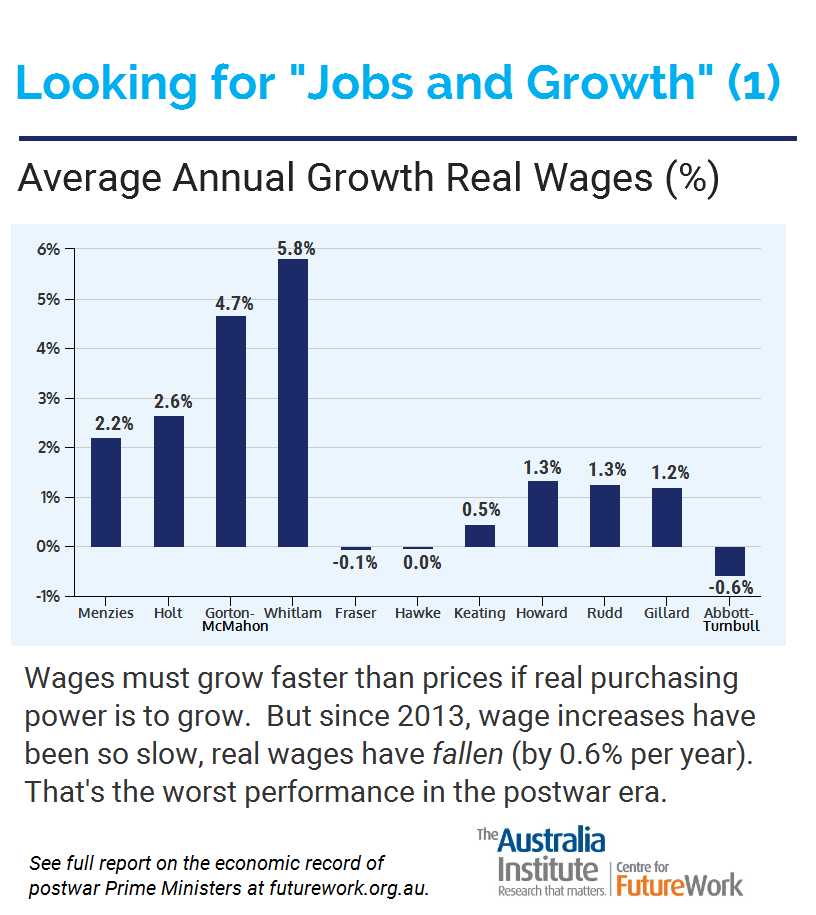
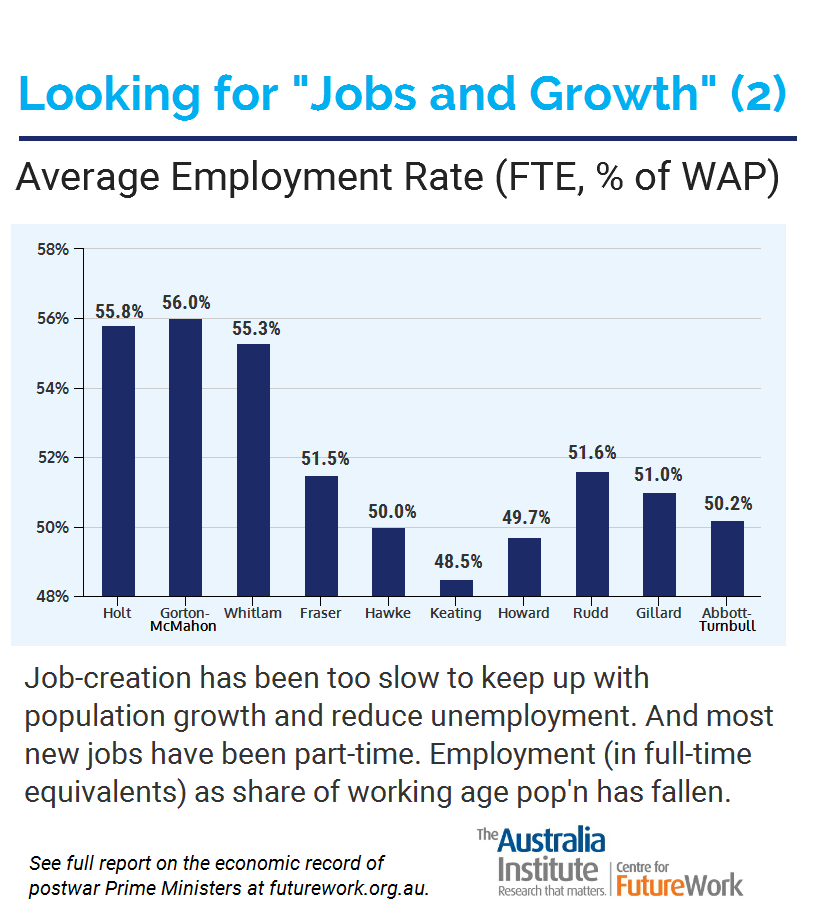
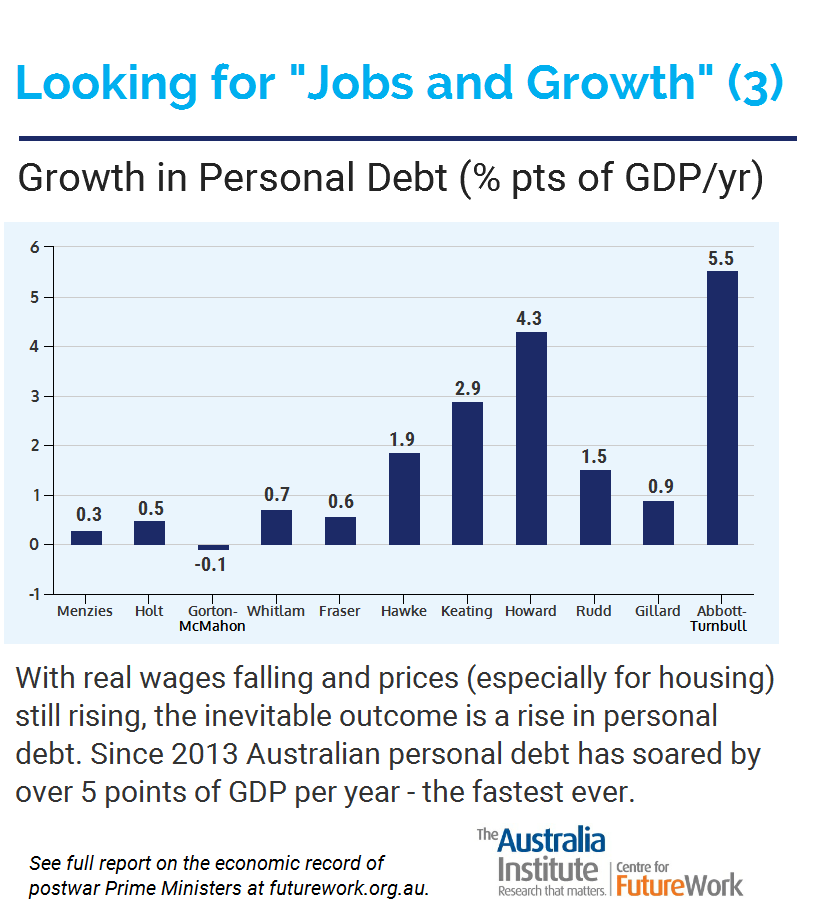
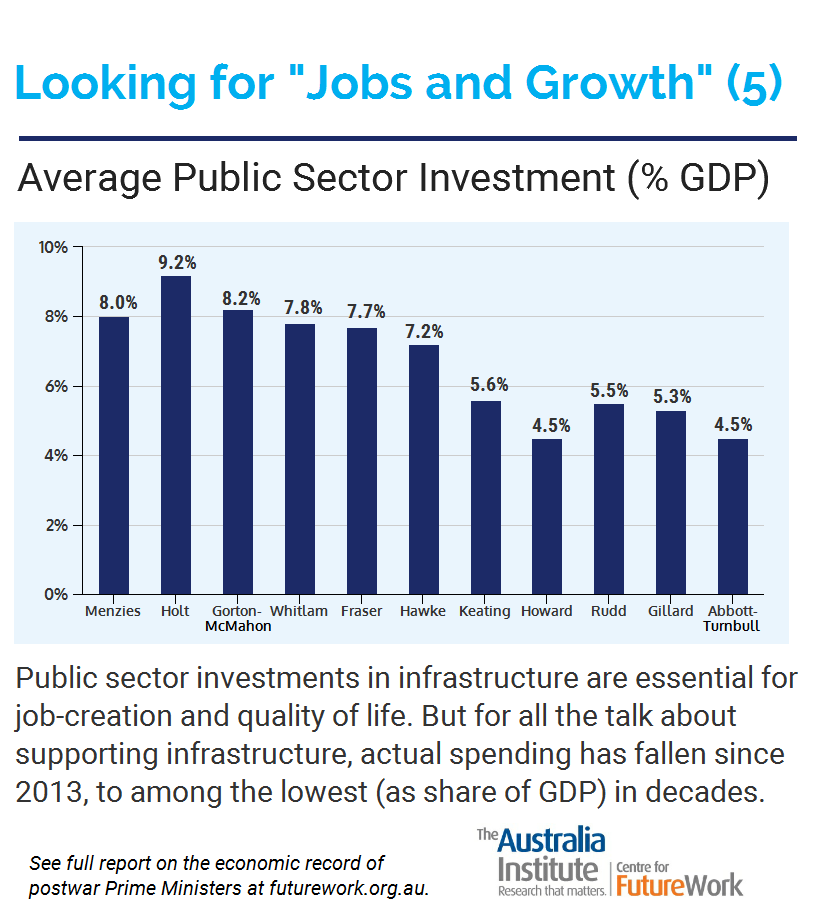
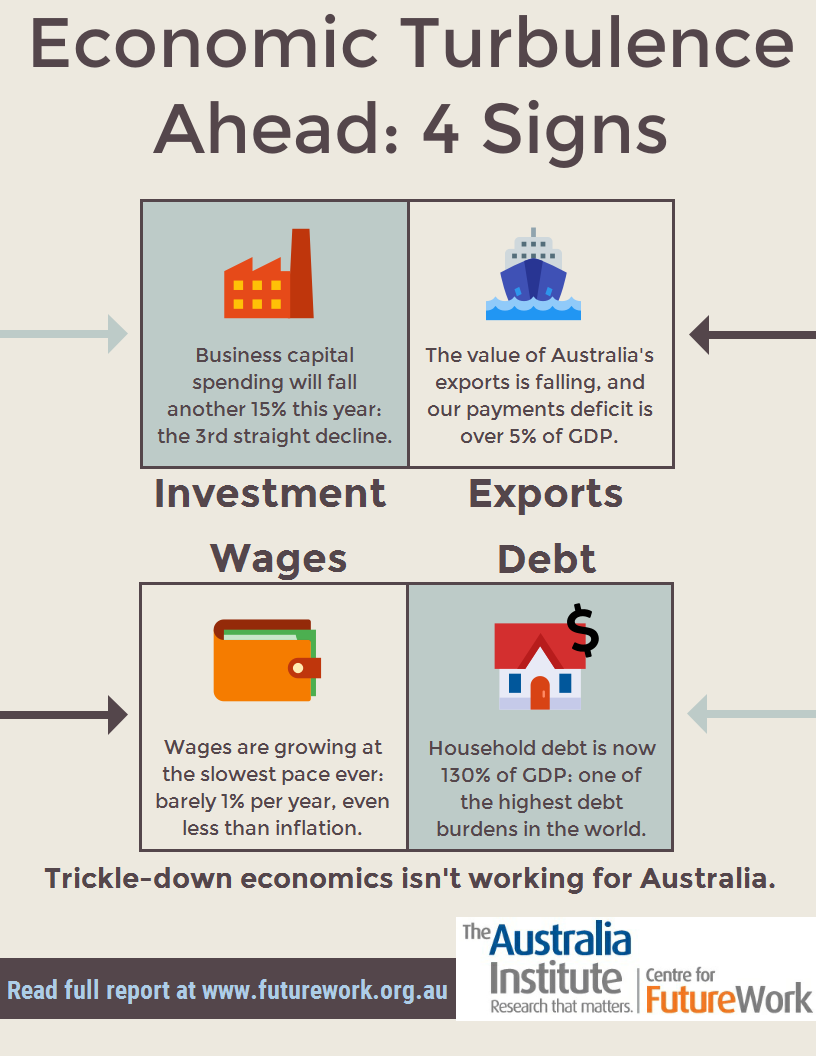
    We have prepared six shareable infographics based on material in our research paper, “Jobs and Growth… and a Few Hard Numbers,” which compared Australia’s economic performance under the respective postwar Prime Ministers.

    The infographics summarize several of the specific economic variables considered in the full report, dating back to 1950 (and Prime Minister Menzies) in most cases.

    Average Annual Growth, Real Wages
    Average Employment Rate
    Growth in Personal Debt
    Average Annual Growth, Business Investment
    Public Sector Investment
    4 Signs of Turbulence Ahead

    Related research

    You might also like

    Dutton’s nuclear push will cost renewable jobs

    by Charlie Joyce

    Dutton’s nuclear push will cost renewable jobs As Australia’s federal election campaign has finally begun, opposition leader Peter Dutton’s proposal to spend hundreds of billions in public money to build seven nuclear power plants across the country has been carefully scrutinized. The technological unfeasibility, staggering cost, and scant detail of the Coalition’s nuclear proposal have

    Centre For Future Work to evolve into standalone entity

    The Centre for Future Work was established by the Australia Institute in 2016 to conduct and publish progressive economic research on work, employment, and labour markets. Supported by the Australian Union movement, the centre produced cutting edge research and led the national conversation on economic issues facing working people: including the future of jobs, wages

  • Jobs and Growth… and a Few Hard Numbers

    Jobs and Growth… and a Few Hard Numbers

    by Jim Stanford

    Share

    Voters typically rank economic issues among their top concerns. And campaigning politicians regularly make bold (but vague) pronouncements regarding their competence and credibility as “economic managers.”  In popular discourse, economic “competence” is commonly equated with being “business-friendly.”

    However, the economy consists of more than just private businesses – and certainly more than the large businesses which attract the main attention from politicians and reporters.  Other stakeholders are at least as crucial for powering real economic progress: including workers, households, governments at all levels, small businesses, public and non-profit institutions, NGOs and the voluntary sector, and more.  So being “business-friendly” is no guarantee that the real economy (measured by employment, output, and incomes) will automatically improve.  Having a more complete understanding of all of the different ingredients required for economic progress is necessary, in order to properly analyze the likely impact of specific measures.

    To demonstrate the lack of correlation between a government’s stated economic orientation, and the actual performance of the real economy, this briefing paper compiles historical data on twelve standard indicators of economic performance: including employment, unemployment, real output, investment (of various forms), foreign trade, incomes, and debt burdens.  Consistent annual data is gathered going back to the 1950s, allowing for a statistical comparison of Australia’s economic record under the various post-war Prime Ministers.  We compare Australia’s economic performance under each Prime Minister, on the basis of these twelve selected indicators.

    There is no obvious correlation between these respective swings in Australia’s economic history, and the policy orientation of the government that oversaw them. And the statistical review indicates that the present government, regardless of its business-friendly credentials, has in fact presided over one of the weakest economic periods in Australia’s entire postwar history.


    Related research

    You might also like

    Dutton’s nuclear push will cost renewable jobs

    by Charlie Joyce

    Dutton’s nuclear push will cost renewable jobs As Australia’s federal election campaign has finally begun, opposition leader Peter Dutton’s proposal to spend hundreds of billions in public money to build seven nuclear power plants across the country has been carefully scrutinized. The technological unfeasibility, staggering cost, and scant detail of the Coalition’s nuclear proposal have